Learning Universal Sentence Representations
with Mean-Max Attention Autoencoder
Minghua Zhang, Yunfang Wu∗, Weikang Li and Wei Li
Key Laboratory of Computational Linguistics, Ministry of Education
School of Electronics Engineering and Computer Science, Peking University, Beijing, China
{zhangmh,wuyf,wavejkd,liweitj47}@pku.edu.cn
Abstract
In order to learn universal sentence repre-sentations, previous methods focus on com-plex recurrent neural networks or supervised learning. In this paper, we propose a mean-max attention autoencoder (mean-mean-max AAE) within the encoder-decoder framework. Our autoencoder rely entirely on the MultiHead self-attention mechanism to reconstruct the in-put sequence. In the encoding we propose a mean-max strategy that applies both mean and max pooling operations over the hidden vec-tors to capture diverse information of the in-put. To enable the information to steer the re-construction process dynamically, the decoder performs attention over the mean-max repre-sentation. By training our model on a large collection of unlabelled data, we obtain high-quality representations of sentences. Experi-mental results on a broad range of 10 trans-fer tasks demonstrate that our model outper-forms the state-of-the-art unsupervised single methods, including the classical skip-thoughts (Kiros et al., 2015) and the advanced skip-thoughts+LN model (Ba et al.,2016). Further-more, compared with the traditional recurren-t neural nerecurren-twork, our mean-max AAE grearecurren-tly reduce the training time.1
1 Introduction
To automatically get the distributed representa-tions of texts (words, phrases and sentences) is a fundamental task for natural language process-ing (NLP). There have been efficient learnprocess-ing al-gorithms to acquire the representations of word-s (Mikolov et al., 2013a), which have shown to provide useful features for various tasks. Inter-estingly, the acquired word representations reflect some observed aspects of human conceptual
orga-∗
Corresponding author.
1Our code is publicly available athttps://github.
com/Zminghua/SentEncoding.
nization (Hill et al.,2015). In recent years, learn-ing sentence representations has attracted much at-tention, which is to encode sentences into fixed-length vectors that could capture the semantic and syntactic properties of sentences and can then be transferred to a variety of other NLP tasks.
The most widely used method is to employ an encoder-decoder architecture with recurrent neu-ral networks (RNN) to predict the original input sentence or surrounding sentences given an in-put sentence (Kiros et al., 2015; Ba et al., 2016; Hill et al., 2016; Gan et al., 2017). However, the RNN becomes time consuming when the quence is long. The problem becomes more se-rious when learning general sentence representa-tions that needs training on a large amount of data. For example, it took two weeks to train the skip-thought (Kiros et al., 2015). Moreover, the tra-ditional RNN autoencoder generates words in se-quence conditioning on the previous ground-truth words, i.e., teacher forcing training (Williams and Zipser, 1989). This teacher forcing strategy has been proven important because it forces the output of the RNN to stay close to the ground-truth se-quence. However, at each time step, allowing the decoder solely to access the previous ground-truth words weakens the encoder’s ability to learn the global information of the input sequence.
Some other approaches (Conneau et al., 2017; Cer et al.,2018;Subramanian et al.,2018) attempt to use the labelled data to build a generic sentence encoder, such as the Stanford Natural Language Inference (SNLI) dataset (Bowman et al., 2015), but such large-scale high-quality labelled data ap-propriate for training sentence representations is generally not available in other languages.
attention autoencoder (mean-max AAE) to model sentence representations. Specifically, an encoder performs the MultiHead self-attention on an input sentence, and then the combined mean-max pool-ing operation is employed to produce the laten-t represenlaten-talaten-tion of laten-the senlaten-tence. The represenlaten-ta- representa-tion is then fed into a decoder to reconstruct the input sequence, which also depends entirely on the MultiHead self-attention. At each time step, the decoder performs attention operations over the mean-max encoding, which on the one hand, en-ables the decoder to utilize the global information of the input sequence rather than generating word-s word-solely conditioning on the previouword-s ground-truth words, and on the other hand, allows the decoder to attend to different representation subspaces dy-namically.
We train our autoencoder on a large collection of unlabelled data, and evaluate the sentence em-beddings across a diverse set of 10 transfer tasks. The experimental results show that our model out-performs the state-of-the-art unsupervised single models, and obtains comparable results with the combined models. Our mean-max representation-s yield conrepresentation-sirepresentation-stent performance gain over the indi-vidual mean and max representations. At the same time, our model can be efficiently parallelized and so achieves significant improvement in computa-tional efficiency.
In summary, our contributions are as follows:
• We apply the MultiHead self-attention mech-anism to train autoencoder for learning uni-versal sentence representations, which allows our model to do processing parallelization and thus greatly reduce the training time in large unlabelled data.
• we adopt a mean-max representation strate-gy in the encoding and then the decoder con-ducts attention over the latent representation-s, which can well capture the global informa-tion of the input from different views.
• After training only on naturally occurring un-ordered sentences, we obtain a simple and fast sentence encoder, which is an unsuper-vised single model and achieves state-of-the-art performance on various transfer tasks.
2 Related Work
With the flourishing of deep learning in NLP re-search, a variety of approaches have been
de-veloped for mapping word embeddings to fixed-length sentence representations. The methods generally fall into the following categories.
Unsupervised training with unordered sen-tences. This kind of methods depends only on naturally occurring individual sentences. Le and Mikolov (2014) propose the paragraph vec-tor model, which incorporates a global contex-t veccontex-tor incontex-to contex-the log-linear neural language mod-el (Mikolov et al.,2013b), but at test time, infer-ence needs to be performed to compute a new vec-tor. Arora et al. (2017) propose a simple but ef-fective Smooth Inverse Frequency (SIF) method, which represents sentence by a weighted average of word embeddings. Hill et al. (2016) intro-duce sequential denoising autoencoders (SDAE), which employ the denoising objective to predict the original source sentence given a corrupted ver-sion. They also implement bag-of-words model-s model-such amodel-s word2vec-SkipGram, word2vec-CBOW. Our model belongs to this group, which has no re-striction on the required training data and can be trained on sets of sentences in arbitrary order.
Unsupervised training with ordered sen-tences. This kind of method is trained to predic-t predic-the surrounding senpredic-tences of an inpupredic-t senpredic-tence, based on the naturally occurring coherent texts. Kiros et al.(2015) propose the skip-thoughts mod-el, which uses an encoder RNN to encode a sen-tence and two decoder RNN to predict the sur-rounding sentences. The skip-thought vectors per-form well on several tasks, but training this mod-el is very slow, requiring several days to produce meaningful results.Ba et al.(2016) further obtain better results by adding layer-norm regularization on the skip-thoughts model. Gan et al.(2017) ex-plore a hierarchical model to predict multiple fu-ture sentences, using a convolutional neural net-work (CNN) encoder and a long-short term mem-ory (LSTM) decoder.Logeswaran and Lee(2018) reformulate the problem of predicting the contex-t in which a sencontex-tence appears as a classificacontex-tion task. Given a sentence and its context, a classifi-er distinguishes context sentences from othclassifi-er con-trastive sentences based on their vector represen-tations.
translat-ed texts. Conneau et al. (2017) attempt to ex-ploit the SNLI dataset for building generic sen-tence encoders. Through examining 7 different model schemes, they show that a bi-directional L-STM network with the max pooling yields excel-lent performance. Cer et al. (2018) apply multi-task learning to train sentence encoders, including a skip-thought like task, a conversational input-response task and classification tasks from the SNLI dataset. They also explore combining the sentence and word level transfer models. Sub-ramanian et al. (2018) also present a multi-task learning framework for sentence representation-s, and train their model on several data resources with multiple training objectives on over100 mil-lion sentences.
3 Model Description
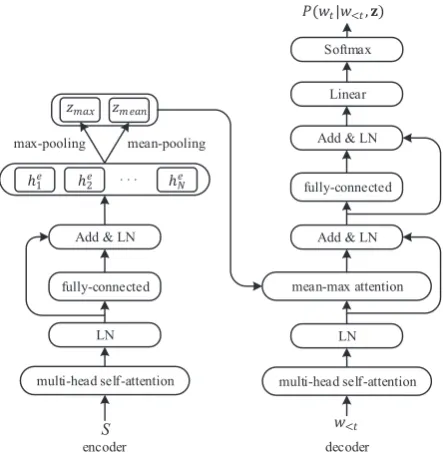
Our model follows the encoder-decoder architec-ture, as shown in Figure 1. The input sequence is compressed into a latent mean-max representa-tion via an encoder network, which is then used to reconstruct the input via a decoder network.
3.1 Notation
In our model, we treat the input sentence as one sequence of tokens. Let S denote the in-put, which is comprised of a sequence of token-s{w1, w2, . . . , wN}, whereN denotes the length
of the sequence. An additional “</S>” token is appended to each sequence. Each word wt
in S is embedded into a k-dimensional vector et =We[wt], whereWe ∈Rdw×V is a word
em-bedding matrix, wt indexes one element in a V
-dimensional set (vocabulary), and We[v]denotes
thev-th column of matrixWe.
In order for the model to take account of the se-quence order, we also add “positional encodings” (Vaswani et al.,2017) to the input embeddings:
pt[2i] =sin( t
100002i/dw) (1)
pt[2i+ 1] =cos( t
100002i/dw) (2)
where t is the position and i is the dimension. Each dimension of the positional encoding corre-sponds to a sinusoid. Therefore, the input of our model can be represented asxt=et+pt.
In the following description, we usehe
t andhdt
to denote the hidden vectors of the encoder and decoder respectively, the subscripts of which
indi-multi-head self-attention LN fully-connected
Add & LN
Softmax
݄ͳ݁澳
S
݄ʹ݁澳 ݄ܰ݁澳
encoder decoder ܲሺݓݐȁݓ൏ݐǡ ܢሻ澳
Linear
LN mean-max attention
Add & LN
ݓ൏ݐ澳 multi-head self-attention ݖ݉ܽݔ澳 ݖ݉݁ܽ݊澳
max-pooling mean-pooling
[image:3.595.309.531.62.291.2]fully-connected Add & LN
Figure 1: Illustration of the mean-max attention au-toencoder.
cate timestept, and the superscripts indicate oper-ations at the encoding or decoding stage.
3.2 MultiHead Self-Attention
In this subsection, we give a quick overview of MultiHead Self-Attention mechanism (Vaswani et al., 2017). The attention is to map a queryq and a set of key-value pairs(K, V) to an output. The output is computed as a weighted sum of the values, where the weight assigned to each value is computed based on the query and the correspond-ing key. The MultiHead mechanism applies mul-tiple attention operations in parallel. Givenq and
(K, V), we can obtain the attention vectoraby:
a=M ultiHead(q, K, V) (3)
=concat(head1, . . . , headl) (4)
headi=attention(q, K, V) (5)
=sof tmax(qK T √
dk
)V (6)
where
q, K, V =qWiq, KWiK, V WiV (7)
Wiq, WK
i and WiV are parameter matrices; q ∈
Rdk, K ∈ Rnk×dk andV ∈ Rnk×dv; dk anddv
are the dimensions ofKandV respectively;nkis
the number of key-value pairs.
positions. Due to the reduced dimension of each head and parallel operations, the total computa-tional cost is similar to that of a single-head at-tention.
3.3 Attention Encoder
The encoder has two sub-layers. The first is a Mul-tiHead self-attention mechanism, and the second is a position-wise fully connected feed-forward network which consists of two linear transforma-tions with a ReLU activation in between. Different fromVaswani et al.(2017), we remove the residual connections in the MultiHead self-attention layer and only employ a residual connection in the fully connected layer, allowing the model to expand the dimension of hidden vectors to incorporate more information.
Given the input x = (x1, . . . , xN), the hidden
vectorhet at time-steptis computed by:
aet =M ultiHead(xt,x,x) (8)
aet =LN(aet) (9)
het =max(0, aetW1e+be1)W2e+be2 (10)
het =LN(het +aet) (11)
whereW1e ∈Rdm×df andWe
2 ∈ Rdf×dm are pa-rameter matrices;be
1∈Rdf andbe2∈Rdmare bias vectors;dm anddf are the dimensions of hidden
vector and fully connected inner layer respective-ly;LN denotes layer normalization.
Our model can be efficiently parallelized over the whole input. We can obtain all hidden vec-tors(he1, . . . , heN)simultaneously for an input se-quence, thus greatly reducing the computational complexity compared with the sequential process-ing of LSTM.
3.4 Mean-Max Representation
Given the varying number of hidden vectors {het}t=[1,...,N], we need to transform these local hidden vectors into a global sentence representa-tion. We would like to apply the pooling strategy, which makes the extracted representation indepen-dent of the length of the input sequence and ob-tains a fixed-length vector. Conneau et al.(2017) examine BiLSTM with mean and max pooling for fixed-size sentence representation, and they con-clude that the max pooling operation performs bet-ter on transfer tasks.
In this work, we propose to apply mean and max pooling simultaneously. The max pooling takes
the maximum value over the sequence, which tries to capture the most salient property while filter-ing out less informative local values. On the oth-er hand, the mean pooling does not make sharp choices on which part of the sequence is more im-portant than others, and so it captures general in-formation while not focusing too much on specific features. Obviously, the two pooling strategies can complement each other. The mean-max represen-tation is obtained by:
zmax[i] = max t h
e
ti (12)
zmean= 1
N
X
t
het (13)
z= [zmax, zmean] (14)
Through combining two different pooling s-trategies, our model enjoys the following advan-tages. First, in the encoder, we can summarize the hidden vectors from different perspectives and so capture more diverse features of the input se-quence, which will bring robustness on differen-t differen-transfer differen-tasks. Second, in differen-the decoder (as de-scribed in the next subsection), we can perform attention over the mean-max representation rather than over the local hidden vectors step by step, which would potentially make the autoencoder ob-jective trivial.
3.5 Attention Decoder
As with the encoder, the decoder also applies the MultiHead self-attention to reconstruct the in-put sequence. As shown in Figure 1, the en-coder and deen-coder are connected through a mean-max attention layer, which performs attention over the mean-max representation generated by the en-coder.
To facilitate expansion of the hidden size, we employ residual connections in the mean-max at-tention layer and the fully connected layer, but not in the MultiHead self-attention layer. Given
y = (x1, . . . , xt−1) and z as the decoder input, the hidden vectorhdt at time steptis obtained by:
adt =M ultiHead(yt,y,y) (15)
adt =LN(adt) (16)
azt =M ultiHead(adt,z,z) (17)
azt =LN(azt +adt) (18)
hdt =max(0, aztW1d+bd1)W2d+bd2 (19)
whereW1d ∈Rdm×df andWd
2 ∈Rdf×dm are pa-rameter matrices; bd1 ∈ Rdf and bd
2 ∈ Rdm are bias vectors. zin Equation (17) is the mean-max representation generated by Equation (14).
Given the hidden vectors (hd1, . . . , hdN), the probability of generating a sequence S with length-N is defined as:
P(wt|w<t,z)∝exp(W3dhdt +bd3) (21)
J(θ) =X t
logP(wt|w<t,z) (22)
The model learns to reconstruct the input sequence by optimizing the objective in Equation (22).
4 Evaluating Sentence Representations
In the previous work, researchers evaluated the distributed representations of sentences by adding them as features in transfer tasks (Kiros et al., 2015;Gan et al.,2017;Conneau et al.,2017). We use the same benchmarks and follow the same pro-cedure to evaluate the capability of sentence em-beddings produced by our generic encoder.
4.1 Transfer Tasks
We conduct extensive experiments on 10 trans-fer tasks. We first study the classification task on 6 benchmarks: movie review sentiment (M-R, SST) (Pang and Lee, 2005; Socher et al., 2013), customer product reviews (CR) (Hu and Liu, 2004), subjectivity/objectivity classification (SUBJ) (Pang and Lee, 2004), opinion polarity (MPQA) (Wiebe et al., 2005) and question type classification (TREC) (Li and Roth,2002).
We also consider paraphrase detection on the Microsoft Research Paraphrase Corpus (MRPC) (Dolan et al.,2004), where the evaluation metrics are accuracy and F1 score.
We then evaluate on the SICK dataset (Marelli et al.,2014) for both textual entailment (SICK-E) and semantic relatedness (SICK-R). The evalua-tion metric is Pearson correlaevalua-tion for SICK-R. We also evaluate on the SemEval task of STS14 (A-girre et al.,2014), where the evaluation metrics are Pearson and Spearman correlations.
The processing on each task is as follows: 1) Employ the pre-trained attention autoencoder to encode all sentences into the latent mean-max rep-resentations. 2) Using the representations as fea-tures, apply the open SentEval with a logistic re-gression classifier (Conneau et al., 2017) to au-tomatically evaluate on all the tasks. For a fair
comparison of the plain sentence embeddings, we adopt all the default settings.
4.2 Experiment Setup
We train our model on the open Toronto Books Corpus (Zhu et al., 2015), which was also used to train the skip-thoughts (Kiros et al.,2015) and skip-thoughts+LN (Ba et al., 2016). The Toron-to Book Corpus consists of70 million sentences from over 7,000 books, which is not biased to-wards any particular domain or application.
The dimensions of hidden vectors and fully con-nected inner layer are set to2,048and4,096 re-spectively. Hence, our mean-max AAE represents sentences with4,096dimensional vectors. We set l= 8parallel attention heads according to the de-velopment data.
We use the Adam algorithm (Kingma and Ba, 2014) with learning rate2×10−4for optimization. Gradient clipping is adopted by scaling gradients when the norm of the parameter vector exceeds a threshold of 5. We perform dropout (Srivastava et al.,2014) and set the dropout rate to0.5. Mini-batches of size64are used. Our model learns un-til the reconstruction accuracy in the development data stops improving.
Our aim is to learn a generic sentence encoder that could encode a large number of words. There always are some words that haven’t been seen dur-ing traindur-ing, and so we use the publicly available GloVe vectors 2 to expand our encoder’s vocab-ulary. We set the word vectors in our models as the corresponding word vectors in GloVe, and do not update the word embeddings during training. Thus, any word vectors from GloVe can be nat-urally used to encode sentences. Our models are trained with a vocabulary of21,583top frequent words in the Toronto Book corpus. After vocab-ulary expansion, we can now successfully cover
2,196,017words.
All experiments are implemented in Tensorflow (Abadi et al., 2016), using a NVIDIA GeForce GTX 1080 GPU with 8GB memory.
4.3 Evaluation Results
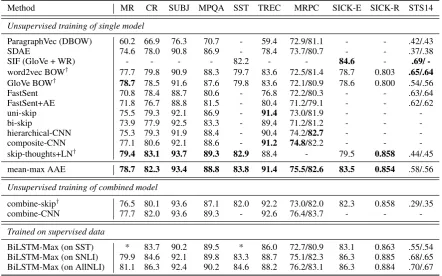
A summary of our experimental results on10tasks is given in Table1, in which the evaluation metric of the first 8 tasks is accuracy. To make a clear comparison of the overall performance, we com-pute the “macro” and “micro” average of accuracy
2https://nlp.stanford.edu/projects/
Method MR CR SUBJ MPQA SST TREC MRPC SICK-E SICK-R STS14
Unsupervised training of single model
ParagraphVec (DBOW) 60.2 66.9 76.3 70.7 - 59.4 72.9/81.1 - - .42/.43
SDAE 74.6 78.0 90.8 86.9 - 78.4 73.7/80.7 - - .37/.38
SIF (GloVe + WR) - - - - 82.2 - - 84.6 - .69/
-word2vec BOW† 77.7 79.8 90.9 88.3 79.7 83.6 72.5/81.4 78.7 0.803 .65/.64
GloVe BOW† 78.7 78.5 91.6 87.6 79.8 83.6 72.1/80.9 78.6 0.800 .54/.56
FastSent 70.8 78.4 88.7 80.6 - 76.8 72.2/80.3 - - .63/.64
FastSent+AE 71.8 76.7 88.8 81.5 - 80.4 71.2/79.1 - - .62/.62
uni-skip 75.5 79.3 92.1 86.9 - 91.4 73.0/81.9 - -
-bi-skip 73.9 77.9 92.5 83.3 - 89.4 71.2/81.2 - -
-hierarchical-CNN 75.3 79.3 91.9 88.4 - 90.4 74.2/82.7 - -
-composite-CNN 77.1 80.6 92.1 88.6 - 91.2 74.8/82.2 - -
-skip-thoughts+LN† 79.4 83.1 93.7 89.3 82.9 88.4 - 79.5 0.858 .44/.45
mean-max AAE 78.7 82.3 93.4 88.8 83.8 91.4 75.5/82.6 83.5 0.854 .58/.56
Unsupervised training of combined model
combine-skip† 76.5 80.1 93.6 87.1 82.0 92.2 73.0/82.0 82.3 0.858 .29/.35
combine-CNN 77.7 82.0 93.6 89.3 - 92.6 76.4/83.7 - -
-Trained on supervised data
BiLSTM-Max (on SST) * 83.7 90.2 89.5 * 86.0 72.7/80.9 83.1 0.863 .55/.54
BiLSTM-Max (on SNLI) 79.9 84.6 92.1 89.8 83.3 88.7 75.1/82.3 86.3 0.885 .68/.65 BiLSTM-Max (on AllNLI) 81.1 86.3 92.4 90.2 84.6 88.2 76.2/83.1 86.3 0.884 .70/.67
Table 1: Performance of sentence representation models on10transfer tasks. Top2results of unsupervised single models are shown in bold. The results with†are extracted fromConneau et al.(2017).
Method Macro/Micro
8 tasks 7 tasks 6 tasks
uni-skip - - 83.0/83.7
bi-skip - - 81.4/82.1
hierarchical-CNN - - 83.3/84.0
composite-CNN - - 84.1/84.8
skip-thoughts+LN - 85.2/85.9
-mean-max AAE 84.7/85.6 86.0/86.0 85.0/85.9
combine-skip 83.4/84.2 -
-combine-CNN - - 85.3/85.8
BiLSTM-Max(SST) - -
-BiLSTM-Max(SNLI) 85.0/86.2 -
-BiLSTM-Max(AllNLI) 85.7/86.9 -
-Table 2: The macro and micro average accuracy across different tasks. The bold is the highest score among all unsupervised models.
in Table2, where the micro average is weighted by the number of test samples in each task. In the previous work, different approaches conduct ex-periments on different benchmarks. Therefore we report the average scores on6tasks,7tasks and8
tasks, respectively.
We divide related models into three groups. The first group contains unsupervised single model-s, including the Paragraph Vector model (Le and Mikolov, 2014), the SDAE method (Hill et al., 2016), the SIF model (Arora et al.,2017), the
Fast-Sent (Hill et al., 2016), the skip-thoughts (uni-skip and bi-(uni-skip) (Kiros et al., 2015), the CNN encoder (hierarchical-CNN and composite-CNN) (Gan et al.,2017) and skip-thoughts+LN (Ba et al., 2016). Our mean-max attention autoencoder sits in this group. The second group consists of un-supervised combined models, including combine-skip (Kiros et al.,2015) and combine-CNN (Gan et al.,2017). In the third group, we list the results from the work ofConneau et al. (2017) only for reference, since it is trained on labelled data.
[image:6.595.78.521.63.339.2]model needs only individual sentences. Moreover, we train our model in less than5hours on a sin-gle GPU compared to the best skip-thoughts+LN network trained for a month.
Unsupervised combined models. The result-s of the individual modelresult-s (Kiroresult-s et al., 2015; Gan et al.,2017) are not promising. To get bet-ter performance, they train two separate models on the same corpus and then combine the laten-t represenlaten-talaten-tions laten-togelaten-ther. As shown in Table 2, our mean-max attention autoencoder outperform-s the claoutperform-soutperform-sical combine-outperform-skip model by1.3points in the average performance across 8 considered tasks. Specially, the pearson correlation of our model is2times over the combine-skip model on the STS14 task. Looking at the overall perfor-mance of6tasks, our model gets comparable re-sults with the combine-CNN, which combines the hierarchical and composite approaches to exploit the intra-sentence and inter-sentence information. Obviously, our model is simple and fast to imple-ment compared with the combined methods.
Supervised representation training. It is un-fair to directly compare our totally unsupervised model with the supervised representation learning method.Conneau et al.(2017) train the BiLSTM-Max (on ALLNLI) on the high-quality natural lan-guage inference data. Our model even perform-s better than the BiLSTM-Max (on ALLNLI) on the SUBJ and TREC tasks. More importantly, our model can be easily adapted to other low-resource languages.
4.4 Model Analysis
Our model contains three main modules: the mean-max attention layer, the combined pooling strategy and the encoder-decoder network. We make a further study on these components. The experimental results are shown in Table3.
In our model, the mean-max attention layer al-lows the decoder to pay attention to the encod-ing representation of the full sentence at each time step dynamically. To summarize the contribu-tion of the mean-max attencontribu-tion layer, we compare with traditional baselines, including the sequential denoising autoencoder (SDAE) with LSTM net-works (Hill et al.,2016) and the CNN-LSTM au-toencoder (Gan et al., 2017), both of which only use the encoding representation to set the initial s-tate of the decoder and follow the teacher forcing strategy.
We employ both the mean and max pooling op-erations over the local hidden vectors to obtain sentence embeddings. To validate the effective-ness of our mean-max representations, we train two additional models: (i) an attention autoen-coder only with max pooling (max AAE) and (ii) an attention autoencoder only with mean pooling (mean AAE). The dimension of hidden vectors is also set to2,048.
Our encoder-decoder network depends on the MultiHead self-attention mechanism to recon-struct the input sequence. To test the effect of the MultiHead self-attention mechanism, we replace it with RNN and implement a mean-max RNN au-toencoder (mean-max RAE) training on the same Toronto Books Corpus. A bidirectional LSTM computes a set of hidden vectors on an input sen-tence, and then the mean and max pooling oper-ations are employed to generate the latent mean-max representation. The representation is then fed to a LSTM decoder to reconstruct the input sequence through attention operation over the la-tent representation. The parameter configurations are consistent with our other models. Moreover, we also train two additional models with different pooling strategies: mean RAE and max RAE.
Analysis on the mean-max attention layer.
Our mean-max attention layer brings significan-t performance gain over significan-the previous ausignifican-toen- autoen-coders. Compared the mean RAE with LSTM-SDAE, both of which use the RNN-RNN encoder-decoder network to reconstruct the input sequence, our mean RAE consistently obtains better perfor-mance than LSTM-SDAE across all considered tasks. In particular, it yields a performance gain of10.4on the TREC dataset and29on the STS14 dataset. Compared with another CNN-LSTM au-toencoder, our mean RAE also gets better perfor-mance for all but one task. It demonstrates that the mean-max attention layer enables the decoder to attend to the global information of the input se-quence, thus go beyond the “teacher forcing train-ing”.
Analysis on the pooling strategy.Considering the overall performance, our mean-max represen-tations outperform the individual mean and max representations both in the attention and RNN net-works. In our attention autoencoder, the macro av-erage score of the mean-max AAE is more than
Method Macro MR CR SUBJ MPQA SST TREC MRPC SICK-E SICK-R STS14
mean AAE 84.1 78.6 81.6 93.3 88.6 83.5 90.2 74.8/82.3 82.2 0.851 .57/.55 max AAE 84.1 78.6 81.4 93.1 88.7 82.8 90.6 75.1/82.5 82.2 0.851 .57/.55 mean-max AAE 84.7 78.7 82.3 93.4 88.8 83.8 91.4 75.5/82.6 83.5 0.854 .58/.56
mean RAE 83.1 77.1 80.2 92.4 88.4 81.9 88.8 74.3/82.2 81.9 0.836 .66/.64 max RAE 83.0 77.2 80.1 92.0 88.4 81.0 88.6 74.3/82.0 82.0 0.851 .68/.66 mean-max RAE 83.6 77.4 80.1 92.2 88.5 82.3 90.6 74.6/82.0 83.2 0.853 .68/.65
LSTM SDAE - 74.6 78.0 90.8 86.9 - 78.4 73.7/80.7 - - .37/.38
CNN-LSTM AE - 75.5 79.0 92.0 88.0 - 89.8 73.6/82.1 - -
-Table 3: Performance of different pooling strategies and different encoder-decoder networks on 10 transfer tasks. Macro is the macro average over the first 8 tasks whose metric is accuracy.
yields a performance gain of 0.5 over the mean pooling and 0.6 over the max pooling. The re-sults indicate that our mean-max pooling captures more diverse information of the input sequence, which is robust and effective in dealing with vari-ous transfer tasks.
Comparison with RNN-based autoencoder.
As shown in Table3, our MultiHead self-attention network obtains obvious improvement over the RNN network in different sets of pooling strate-gies, and it yields a performance gain of1.1when applying the best combined mean-max pooling operation. The results demonstrate that the Mul-tiHead self-attention mechanism enables the sen-tence representations to capture more useful infor-mation about the input sequence.
Analysis on computational complexity. A self-attention layer connects all positions with a constant number of sequentially executed opera-tions, whereas a recurrent layer requiresO(n) se-quential operations. Therefore, our model greatly reduces the computational complexity. Excluding the number of parameters used in the word embed-dings, the skip-thought model (Kiros et al.,2015) contains 40 million parameters, while our mean-max AAE has approximately 39 million parame-ters. It took nearly50.4and25.4minutes to train the skip-thought model (Kiros et al.,2015) and the skip-thoughts+LN (Ba et al.,2016) per1000 mini-batches respectively. Both the skip-thought and skip-thought+LN are implemented in Theano. A recent implementation of the skip-thoughts model was released by Google3, which took nearly25.9
minutes to train1000mini-batches on a GTX 1080 GPU. In our experiment, it took 3.3 minutes to train the mean-max AAE model every1000 mini-batches.
3https://github.com/tensorflow/models/
tree/master/research/skip_thoughts
[image:8.595.88.511.64.181.2]mean max mean max
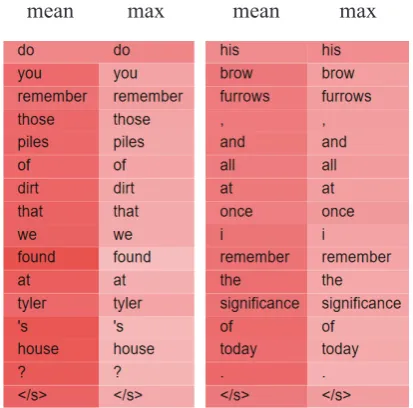
Figure 2: Two examples illustrate that our mean-max attention layer could attend to the two different repre-sentations dynamically.
4.5 Attention Visualization
[image:8.595.313.520.230.434.2]5 Conclusion
In this paper, we present a mean-max AAE to learn universal sentence representations from un-labelled data. Our model applies the MultiHead self-attention mechanism both in the encoder and decoder, and employs a mean-max pooling strat-egy to capture more diverse information of the input. To avoid the impact of “teacher forcing training”, our decoder performs attention over the encoding representations dynamically. To eval-uate the effectiveness of sentence representation-s, we conduct extensive experiments on10 trans-fer tasks. The experimental results show that our model obtains state-of-the-art performance among the unsupervised single models. Furthermore, it is fast to train a high-quality generic encoder due to the paralleling operation. In the future, we will adapt our mean-max AAE to other low-resource languages for learning universal sentence repre-sentations.
Acknowledgments
We would like to thank the anonymous reviewers for their valuable comments. This work is support-ed by the National Key Basic Research Program of China (2014CB340504) and National Natural Sci-ence Foundation of China (61773026, 61572245). The corresponding author of this paper is Yunfang Wu.
References
Mart´ın Abadi, Ashish Agarwal, Paul Barham, Eugene Brevdo, Zhifeng Chen, Craig Citro, Greg S Corra-do, Andy Davis, Jeffrey Dean, Matthieu Devin, et al. 2016. Tensorflow: Large-scale machine learning on heterogeneous distributed systems. arXiv preprint arXiv:1603.04467.
Eneko Agirre, Carmen Banea, Claire Cardie, Daniel Cer, Mona Diab, Aitor Gonzalez-Agirre, Weiwei Guo, Rada Mihalcea, German Rigau, and Janyce Wiebe. 2014. Semeval-2014 task 10: Multilingual semantic textual similarity. InInternational Work-shop on Semantic Evaluation, pages 81–91.
Sanjeev Arora, Yingyu Liang, and Tengyu Ma. 2017. A simple but tough-to-beat baseline for sentence em-beddings. InICLR.
Jimmy Lei Ba, Jamie Ryan Kiros, and Geoffrey E Hin-ton. 2016. Layer normalization. arXiv preprint arX-iv:1607.06450.
Samuel R Bowman, Gabor Angeli, Christopher Potts, and Christopher D Manning. 2015. A large
anno-tated corpus for learning natural language inference. arXiv preprint arXiv:1508.05326.
Daniel Cer, Yinfei Yang, Sheng-yi Kong, Nan Hua, Nicole Limtiaco, Rhomni St John, Noah Constan-t, Mario Guajardo-Cespedes, Steve Yuan, Chris Tar, et al. 2018. Universal sentence encoder. arXiv preprint arXiv:1803.11175.
Alexis Conneau, Douwe Kiela, Holger Schwenk, Loic Barrault, and Antoine Bordes. 2017. Supervised learning of universal sentence representations from natural language inference data. arXiv preprint arX-iv:1705.02364.
Bill Dolan, Chris Quirk, and Chris Brockett. 2004. Un-supervised construction of large paraphrase corpora: exploiting massively parallel news sources. In Inter-national Conference on Computational Linguistics, page 350.
Zhe Gan, Yunchen Pu, Ricardo Henao, Chunyuan Li, Xiaodong He, and Lawrence Carin. 2017. Learning generic sentence representations using convolution-al neurconvolution-al networks. InProceedings of the 2017 Con-ference on Empirical Methods in Natural Language Processing, pages 2380–2390.
Felix Hill, Kyunghyun Cho, and Anna Korhonen. 2016. Learning distributed representations of sentences from unlabelled data. In Proceedings of NAACL-HLT, pages 1367–1377.
Felix Hill, Roi Reichart, and Anna Korhonen. 2015. Simlex-999: Evaluating semantic models with (gen-uine) similarity estimation. Computational Linguis-tics, 41(4):665–695.
Minqing Hu and Bing Liu. 2004. Mining and summa-rizing customer reviews. In Tenth ACM SIGKDD International Conference on Knowledge Discovery and Data Mining, Seattle, Washington, Usa, August, pages 168–177.
Diederik Kingma and Jimmy Ba. 2014. Adam: A method for stochastic optimization. arXiv preprint arXiv:1412.6980.
Ryan Kiros, Yukun Zhu, Ruslan R Salakhutdinov, Richard Zemel, Raquel Urtasun, Antonio Torralba, and Sanja Fidler. 2015. Skip-thought vectors. In Advances in neural information processing systems, pages 3294–3302.
Quoc Le and Tomas Mikolov. 2014. Distributed repre-sentations of sentences and documents. In Proceed-ings of the 31st International Conference on Ma-chine Learning (ICML-14), pages 1188–1196.
Xin Li and Dan Roth. 2002. Learning question classi-fiers. Coling, 12(24):556–562.
Lajanugen Logeswaran and Honglak Lee. 2018. An efficient framework for learning sentence represen-tations.arXiv preprint arXiv:1803.02893.
Marco Marelli, Stefano Menini, Marco Baroni, Luisa Bentivogli, Raffaella Bernardi, and Roberto Zam-parelli. 2014. A sick cure for the evaluation of com-positional distributional semantic models. In Lan-guage Resources and Evaluation Conference, pages A–696.
Tomas Mikolov, Kai Chen, Greg Corrado, and Jef-frey Dean. 2013a. Efficient estimation of word rep-resentations in vector space. arXiv preprint arX-iv:1301.3781.
Tomas Mikolov, Ilya Sutskever, Kai Chen, Greg S Cor-rado, and Jeff Dean. 2013b. Distributed representa-tions of words and phrases and their compositional-ity. InAdvances in neural information processing systems, pages 3111–3119.
Bo Pang and Lillian Lee. 2004. A sentimental educa-tion: sentiment analysis using subjectivity summa-rization based on minimum cuts. InMeeting on As-sociation for Computational Linguistics, page 271.
Bo Pang and Lillian Lee. 2005. Seeing stars: Exploit-ing class relationships for sentiment categorization with respect to rating scales. In Proceedings of A-CL, pages 115–124.
Richard Socher, Alex Perelygin, Jean Wu, Jason Chuang, Christopher D Manning, Andrew Ng, and Christopher Potts. 2013. Recursive deep models for semantic compositionality over a sentiment tree-bank. In Proceedings of the 2013 conference on empirical methods in natural language processing, pages 1631–1642.
Nitish Srivastava, Geoffrey E Hinton, Alex Krizhevsky, Ilya Sutskever, and Ruslan Salakhutdinov. 2014. Dropout: a simple way to prevent neural networks from overfitting. Journal of machine learning re-search, 15(1):1929–1958.
Sandeep Subramanian, Adam Trischler, Yoshua Ben-gio, and Christopher J Pal. 2018. Learning gener-al purpose distributed sentence representations via large scale multi-task learning. arXiv preprint arX-iv:1804.00079.
Ashish Vaswani, Noam Shazeer, Niki Parmar, Jakob Uszkoreit, Llion Jones, Aidan N Gomez, Lukasz Kaiser, and Illia Polosukhin. 2017. Attention is all you need. arXiv preprint arXiv:1706.03762.
Janyce Wiebe, Theresa Wilson, and Claire Cardie. 2005. Annotating expressions of opinions and emo-tions in language. Language Resources and Evalu-ation, 39(2-3):165–210.
Ronald J Williams and David Zipser. 1989. A learn-ing algorithm for continually runnlearn-ing fully recurren-t neural nerecurren-tworks. Neural computation, 1(2):270– 280.