157
Developing Production-Level Conversational Interfaces with Shallow
Semantic Parsing
Arushi Raghuvanshi
Cisco Systems
Lucien Carroll
Cisco Systems
Karthik Raghunathan
Cisco Systems
Abstract
We demonstrate an end-to-end approach for building conversational interfaces from proto-type to production that has proven to work well for a number of applications across di-verse verticals. Our architecture improves on the standard domain-intent-entity classi-fication hierarchy and dialogue management architecture by leveraging shallow semantic parsing. We observe that NLU systems for in-dustry applications often require more struc-tured representations of entity relations than provided by the standard hierarchy, yet with-out requiring full semantic parses which are often inaccurate on real-world conversational data. We distinguish two kinds of semantic properties that can be provided through shal-low semantic parsing: entity groups and entity roles. We also provide live demos of conver-sational apps built for two different use cases: food ordering and meeting control.
1 Introduction
Conversational interfaces are a prominent fea-ture of many consumer technology products to-day. Popular voice assistants, such as Alexa, Siri, Google Assistant, and Cortana, have been built us-ing a methodical approach of domain-intent-entity classification and dialogue management that is be-coming an industry standard (Dialogflow, 2018;
Wit.ai,2018;Amazon,2018;Microsoft,2018). In this demo, we share best practices on de-veloping production conversational interfaces. We provide attendees with an interactive demo which illustrates the live classification of each model in the end-to-end pipeline for different queries and use cases. The demo systems focus on two use cases in English—food ordering and meeting control—though the architecture is broadly appli-cable to other languages and use cases.
Furthermore, we introduce two components of the pipeline that are improvements over the
indus-try standard—entity grouping and entity roles— which are forms of shallow semantic parsing. We demonstrate the value of these shallow seman-tic parses, going beyond named entity recognition without exhaustive semantic or syntactic parsing, or even full relation extraction. We first give an overview of the system architecture, then describe the shallow semantic parsing problems in more de-tail and compare our approach to related systems.
2 Architecture
The NLP pipeline is broken down into a series of components as illustrated in Figure1: Intent Clas-sifier, Entity Recognizer, Entity Resolver, Seman-tic Parser, Dialogue Manager, Question Answerer and Application Manager. For each component, the model type, features, and hyperparameters are tuned for the use case.
This architecture allows us to bootstrap appli-cations with few queries per intent—tens or hun-dreds of queries for narrow vocabulary intents and thousands of queries for open vocabulary intents—and smoothly transition as data sets in-crease. Getting a deployable version of a conver-sational assistant on small data set sizes is key, since generating conversational data is expensive, and early in development, product decisions can often change, requiring relabeling the data. Once a model is in production, dataset sizes can grow by labeling queries from user logs. This architecture scales well and continues to give robust perfor-mance as query sizes increase by orders of mag-nitude. As the dataset sizes grow, the most op-timal model type, features, and hyperparameters will change.
2.1 Intent Classification
Figure 1: Natural language processing pipeline
text features like n-grams and gazetteer matches to determine which domain the vocabulary of the query is most likely in. In addition to these fea-tures that capture language and sentence structure, this component has access to the user context and the history of previous queries in the conversation. Different models such as logistic regression (LR), support vector machine (SVM), decision tree, or random forest can be selected for different use cases based on the data set size and distribution.
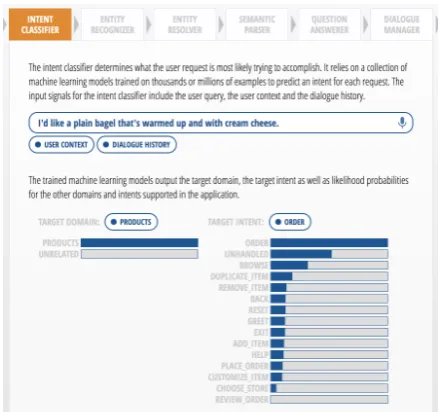
Intent Classifiers predict which of the do-main’s intents is expressed in the request. It is a text classification model like the domain classifier, but trained on data to distinguish among the types of intended dialogue acts within a domain.
Figure2illustrates the domain and intent classi-fications for the input query “I’d like a plain bagel that’s warmed up and with cream cheese” for a food ordering app. In the demo, users can try tweaking the language of the query and see how it affects the model prediction. For example, when keeping the phrase “I’d like a”, but changing the rest of the query to an unrelated item (e.g. “I’d like a link to a funny video”), the domain classification changes toUNRELATED. When tweaking the lan-guage from “I’d like a bagel” to a more explicit “I want to order a bagel” increases the confidence of theORDERintent classification.
2.2 Entity Recognition
Entity Recognizers identify and label entities— the words and phrases that must be represented and interpreted to fulfill requests. It is a se-quence tagging model such as a Maximum En-tropy Markov Model (MEMM), Long Short-Term Memory recurrent neural network (LSTM), or a Conditional Random Field (CRF). The features depend on the model type used but can include word embeddings or gazetteer matches. The opti-mal model is dependent on dataset size. A MEMM model with gazetteer and n-gram features may be most robust when trained on a few hundred queries, but the LSTM model with character and
[image:2.595.75.291.64.136.2]Figure 2: Domain and intent classifier demo view
Figure 3: Entity recognizer demo view
word embeddings can have better accuracy when trained on a few hundred thousand queries.
In Figure 3 we illustrate the extracted entities from an example query and the confidence of those predictions.
2.3 Entity Resolution
AnEntity Resolvermaps each identified entity to a canonical value. For example, in the food or-dering use case, the text “plain bagel” needs to be mapped to a canonical id that can be use to make an API call to place the order.
[image:2.595.308.526.297.449.2]Figure 4: Entity resolver demo view
that are semantically similar but syntactically dif-ferent. For example, “pasta with tomato sauce” can be resolved to “spaghetti marinara”. In Fig-ure4, the entity text “warmed up” is resolved to the “Warmed” (SKU: 204198) as an example.
2.4 Semantic Parser
The interpretation of some queries requires a more structured representation than domains, intents and entities provide. We decompose entity rela-tion extracrela-tion into two degenerate cases: assign-ment of entity relation type orroleand association of dependent ‘child’ entities to a head ‘parent’ en-tity in an enen-tity group. Though some use cases require both kinds of information, many use cases only require one of these, and it is productive to treat them as separable problems.
Entity Role Classifiers add another level of labeling when knowing an entity’s type is not enough to interpret the entity correctly. E.g., a role label can be used to classify a numerical entity as aSIZEversus a QUANTITY. In the case “I’ll have the 12 oz soda”, the role of the entity “12” should beSIZE, but in the case “I’ll have 3 sodas”, the role of the entity “3” should be aQUANTITY.
[image:3.595.73.290.62.205.2]The addition of the role classification is novel to our architecture. It is an intermediate between us-ing only NER and dous-ing a full semantic or syntac-tic parse. The benefit of doing role classification is that you can get important semantic and syntactic information in a targeted way for entities that are predefined to take multiple roles, rather than hav-ing to generate a full parse for each query. Without this learned role classification, systems often have to rely on heuristics in the dialogue manager to determine the roles of the entities. Unlike our ap-proach, the alternative of using ruled-based heuris-tics does not scale to unseen language patterns.
Figure 5: Semantic parser demo view
Our role classifier can be a logistic regression, SVM, decision tree, or random forest model. The best model is selected based on the data distribu-tion and use case. Features include n-grams, bag of words, and other entities present in the query.
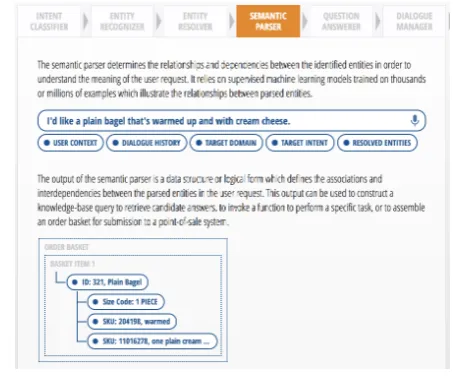
AEntity Group Parserfinds relationships be-tween the extracted entities and groups them into a meaningful hierarchy as illustrated in Figure5.
The language parser for entity grouping is an-other novel component of our architecture. A small number of configuration parameters gener-ates a weighted context-free grammar (WCFG) over entities and the words not in entities. The de-veloper can specify whether to allow parent-child attachment to the left or right, what the minimum or maximum number of dependent entities should be, and the preferred direction of attachment. The developer can also specify certain ‘linking’ words, whose occurrence between two entities increases the chance of the entities being in the specified head-dependent relationship. More details on the semantic parser are given in section 3.
2.5 Question Answerer
AQuestion Answererqueries a Knowledge Base, which encompasses all of the important world knowledge for a given application use case, to find answers to user queries. The example in Figure6
demonstrates the ranked list of relevant results for the request “what pastries are available?”.
2.6 Dialogue Manager
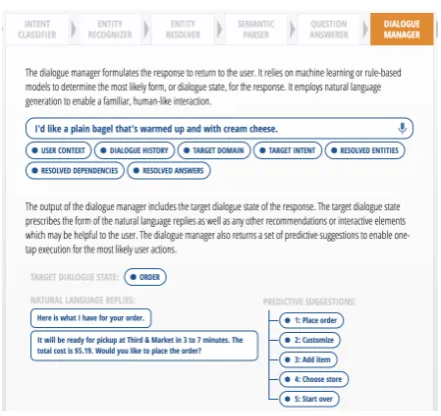
lan-Figure 6: Question answerer demo view
Figure 7: Dialogue manager demo view
guage of the response itself is often templated, but the appropriate template is selected based on the context of the target domain, intent, entities, and results from the question answerer. In the exam-ple in Figure 7, the user’s query was classified as the order intent with the correct entity and op-tions filled in, so the dialogue manager prompts the user to confirm their order and informs them of the pickup time.
2.7 Application Manager
AnApplication Manager orchestrates the query workflow. It receives requests from the client in-cluding both text queries and context information, processes the requests by passing them through each of the other components, and then returns the final response to the client endpoint.
3 Shallow Semantic Parsing
In conventional semantic parsing, a single tree of dependency relations is constructed to cover ap-proximately a whole sentence, enabling a transla-tion from natural language to logical form for each sentence. In the example below, the dependencies
OWNER, POSSESSION andQUANTITYcan be as-signed within a sentence in which aNUMBER en-tity andDRINKentity are already recognized.
I’ll have six sodas
NUMBER DRINK
QUANTITY POSSESSION
OWNER
For many information retrieval tasks, including this task-oriented dialogue system, it is sufficient to just extract the relations among entities, in this caseQUANTITY.
I’ll have six sodas
NUMBER DRINK
QUANTITY
TheQUANTITYrelation enables the system to dis-tinguish the sentence above from the sentence be-low, for example, where the sameNUMBERentity
has aSIZErelation.
I’ll have the six ounce soda
NUMBER DRINK
SIZE
But beyond that, it is often sufficient for the trained model to recognize the relation type, without spec-ifying the parent. When this is the case, we can treat the relation type as a role label on the entity.
I’ll have the six ounce soda
NUMBER DRINK
SIZE
I’ll have six sodas
NUMBER DRINK
QUANTITY
This unifies the classification problem with cases where the same disambiguation is required even though there is no explicit head, as in the query below.
I’ll have six
[image:4.595.71.292.283.491.2]In contrast, entity grouping associates child enti-ties to a parent entity without specifying a rela-tion type, such as theOPTIONentities to the corre-spondingDISHentities below.
a bagel with butter and warm muffin
DISH OPTION OPTION DISH
Entity grouping is sufficient in cases where there is only one relation type relevant to a particular in-tent, or in cases where the relation type is fully de-termined by the associated entity types. But even when both relation type and parent-child links are required, as below, we benefit from decomposing the problem.
a bagel and two of the muffins
DISH NUMBER DISH
QUANTITY
In the initial stages of development, when train-ing data is limited, this allows the system to use a probabilistic model for role labeling which gener-alizes across cases with and without explicit heads, while using a simple deterministic parser for entity grouping. Once training data is sufficient, these can be smoothly transitioned to a fully probabilis-tic dependency parser, performing joint learning of entity roles and entity groups.
4 Evaluation of the Semantic Parser
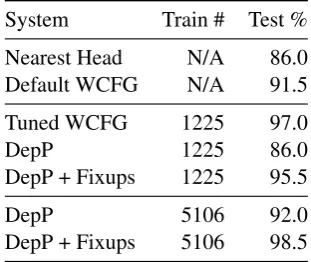
To illustrate the trade-off in model approaches within this architecture as development matures, we provide an evaluation of different entity group-ing systems in Table1. The test data in this eval-uation is 200 food ordering queries with more than oneDISHentity, and we focus on query-level accuracy—the percentage of queries with correct labels. The baseline system Nearest Head simply assigns any dependent entity to the nearest avail-able head entity. The Default WCFG system uses NLTK (Bird et al.,2009) to construct a CFG over entities and assigns domain-general costs to se-lect a parse, while the Tuned WCFG uses prefer-ences specified by the developer for this use case (e.g. particular entities tend to associate left vs. right) to adapt the cost calculation to the use case. Tuning the WCFG on 1225 queries with multi-ple dish entities provides an acceptable 97% accu-racy. The DepP system trains the transition-based
System Train # Test %
Nearest Head N/A 86.0 Default WCFG N/A 91.5
Tuned WCFG 1225 97.0
DepP 1225 86.0
DepP + Fixups 1225 95.5
DepP 5106 92.0
[image:5.595.338.494.63.194.2]DepP + Fixups 5106 98.5
Table 1: Evaluation of approaches to entity grouping for a food ordering use case.
dependency parser from Spacy v. 1.9 (Honnibal and Johnson, 2015) on the entity grouping prob-lem. With only 1225 training queries, the parser is not able to learn the structure of the problem well, sometimes leaving dependent entity types unas-sociated or producing impossible tag sequences. Fixup rules that force dependent entities to asso-ciate to a head entity improve the accuracy, and adding nearly 4000 training queries that only have oneDISH name allows the parser to learn the ba-sic structure better. The combination of these al-lows the DepP system to reach 98.5% accuracy. With smaller training data set sizes the DepP sys-tem is not viable, but once training data increases, we can expect more robust performance from the more powerful model.
5 Related Work
only perform well with abundant training data, so while product decisions are in flux, working with simpler models facilitates the quick development of a production app on smaller data sets.
Some researchers have attempted full seman-tic parsing for task-oriented systems similar to ours.Berant et al.(2013) induce a semantic parser from question–answer pairs, and then these parses can be used to find answers for unseen questions.
Chen et al. (2014) combine a semantic parser with word embeddings to induce mappings from the semantic parser’s relations to the slots of a task-oriented dialogue system. In customer-facing products, systems trained by unsupervised learn-ing have too high risk of misbehavior. Moreover, in our applied domains, either the relation head or the relation type is often predetermined or irrele-vant, so that information can remain undefined or implicit, leaving a simpler problem.
6 Conclusion
We have described a dialogue system interface for an architecture which extends the traditional NLU pipeline with entity role labeling and entity grouping, forms of shallow semantic parsing. The described methodology has allowed us to consis-tently build production-level conversational assis-tants. In this demo, we hope to share these insights in an interactive way.
7 Acknowledgements
The software presented in this paper has greatly benefited from the comments and code contribu-tions of Tim Tuttle, J.J. Jackson, Vijay Ramakr-ishnan, Marvin Huang, Jui-Pin Wang, Minh Tue Vo Thanh, Amrut Nagasunder, and Varsha Embar.
References
Amazon. 2018. Create the interaction model for your skill. https://developer.amazon.com/docs/custom- skills/create-the-interaction-model-for-your-skill.html.
Jonathan Berant, Andrew Chou, Roy Frostig, and Percy Liang. 2013. Semantic parsing on freebase from question-answer pairs. In Proceedings of the 2013 Conference on Empirical Methods in Natural Lan-guage Processing, pages 1533–1544. Association for Computational Linguistics.
Steven Bird, Edward Loper, and Ewan Klein. 2009. Natural Language Processing with Python. O’Reilly Media Inc.
Razvan C. Bunescu and Raymond J. Mooney. 2005. A shortest path dependency kernel for relation ex-traction. In Proceedings of the conference on Hu-man Language Technology and Empirical Methods in Natural Language Processing - HLT ’05, pages 724–731, Morristown, NJ, USA. Association for Computational Linguistics.
Yun-Nung Chen, William Yang Wang, and Alexan-der I. Rudnicky. 2014. Leveraging frame seman-tics and distributional semanseman-tics for unsupervised semantic slot induction in spoken dialogue systems. In 2014 IEEE Spoken Language Technology Work-shop (SLT), pages 584–589. IEEE.
Aron Culotta and Jeffrey Sorensen. 2004. Dependency tree kernels for relation extraction. In Proceed-ings of the 42nd Annual Meeting on Association for Computational Linguistics - ACL ’04, pages 423– es, Morristown, NJ, USA. Association for Compu-tational Linguistics.
Dialogflow. 2018. Create and query your first agent. https://dialogflow.com/docs/getting-started/first-agent.
George Doddington, Alexis Mitchell, Mark Przybocki, Lance Ramshaw, Stephanie Strassel, and Ralph Weischedel. 2004. The Automatic Content Extrac-tion (ACE) Program Tasks, Data, and EvaluaExtrac-tion. Proceedings of LREC 2004, pages 837–840.
Matthew Honnibal and Mark Johnson. 2015. An Im-proved Non-monotonic Transition System for De-pendency Parsing. Proceedings of the 2015 Con-ference on Empirical Methods in Natural Language Processing, pages 1373–1378.
Llu´ıs M`arquez, Xavier Carreras, Kenneth C. Litkowski, and Suzanne Stevenson. 2008. Semantic Role Labeling: An Introduction to the Special Issue. Computational Linguistics, 34(2):145–159.
Microsoft. 2018. Building conversations. https://docs.
microsoft.com/en-us/cortana/skills/mva32-building-conversations.
Makoto Miwa and Mohit Bansal. 2016. End-to-End Relation Extraction using LSTMs on Sequences and Tree Structures. Proceedings of the 54th Annual Meeting of the Association for Computational Lin-guistics, pages 1105—-1116.
Martha Palmer, Daniel Gildea, and Nianwen Xue. 2010. Semantic Role Labeling. Synthesis Lectures on Human Language Technologies, 3(1):1–103.
Michael Roth and Mirella Lapata. 2016. Neural Se-mantic Role Labeling with Dependency Path Em-beddings. Proceedings of the 54th Annual Meet-ing of the Association for Computational LMeet-inguis- Linguis-tics, pages 1192–1202.