101
Automatically Detecting the Position and Type of Psychiatric Evaluation
Report Sections
Deya M. Banisakher, Naphtali Rishe, Mark A. Finlayson School of Computing and Information Sciences
Florida International University Miami, FL 33199
{dbani001,rishe,markaf}@fiu.edu
Abstract
Psychiatric evaluation reports represent a rich and still mostly-untapped source of informa-tion for developing systems for automatic di-agnosis and treatment of mental health prob-lems. These reports contain free-text struc-tured within sections using a convention of headings. We present a model for automati-cally detecting the position and type of differ-ent psychiatric evaluation report sections. We developed this model using a corpus of 150 sample reports that we gathered from the Web, and used sentences as a processing unit while section headings were used as labels of section type. From these labels we generated a unified hierarchy of labels of section types, and then learnedn-gram models of the language found in each section. To model conventions for sec-tion order, we integrated thesen-gram mod-els with a Hierarchical Hidden Markov Model (HHMM) representing the probabilities of ob-served section orders found in the corpus, and then used this HHMMn-gram model in a de-coding framework to infer the most likely sec-tion boundaries and secsec-tion types for docu-ments with their section labels removed. We evaluated our model over two tasks, namely, identifying section boundaries and identifying section types and orders. Our model signif-icantly outperformed baselines for each task with an F1 of 0.88 for identifying section types, and a 0.26 WindowDiff (Wd) and 0.20
and (Pk) scores, respectively, for identifying
section boundaries.
1 Introduction
With the exponential growth of free text in elec-tronic health records (EHRs)—which includes mental health documents—it is ever more impor-tant to develop natural language processing (NLP) models that automatically understand and parse such text. When incorporated in other systems, these models may aid (1) clinical decision
sup-port, (2) the extraction of key population informa-tion and trends, and (3) precision medicine efforts where personalized information and trends are ex-tracted and used in the treatment process (Demner-Fushman et al., 2009; Hripcsak et al., 2003).
The majority of clinical NLP work has focused on semantic parsing of clinical notes found in EHRs. There are several challenges in automatic understanding of unstructured text in EHRs, en-compassing many levels of linguistic processing: identifying document layouts, their discourse or-ganization, mapping lexical information to seman-tic concepts found in biomedical ontologies, as well as understanding inter-concept co-reference and temporal relations (Li et al., 2010). These challenges are also present for mental health NLP applications.
We present an approach to automatically model the discourse structure of psychiatric reports as well as segment these reports into various sec-tions. Our model learns the section types, po-sitions, and sequence and can automatically seg-ment unlabeled text in a psychiatric report into the corresponding sections. We hypothesize that knowledge of the ordering of the sections can im-prove the performance of a section classifier and a text segmenter. To test this hypothesis, we train a Hierarchical Hidden Markov Model (HHMM) that categorizes sections in psychiatric reports into one of 25 pre-defined section labels.
section identification and text segmentation (§6). Finally, we conclude and specify our contributions (§7).
2 Psychiatric Evaluation Reports
A mental health assessment is the process through which a psychiatrist or a psychologist obtains and organizes necessary information about men-tal health patients. This process usually involves a series of psychological and medical tests (clin-ical and non-clin(clin-ical), examinations, and inter-views (Reeves and Rosner, 2016). These proce-dures serve the purpose of making a diagnosis that then guides a treatment or a treatment plan (Asso-ciation, 2018).
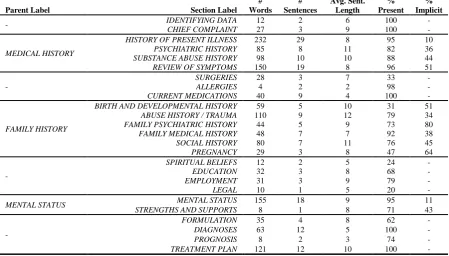
The output of a mental health assessment is a mental health report. Psychiatric reports are sim-pler subtype of this document type, and mainly consist of long-form unstructured text. They are the end product of psychiatric assessments in which psychiatrists summarize the information they gathered, as well as integrate the patient his-tory, their evaluation, patient diagnosis, and sug-gested treatments or future steps (Groth-Marnat, 2009; Goldfinger and Pomerantz, 2013). There are several types of psychiatric reports that vary depending on the type and purpose of assessment: Psychiatric evaluation reports, crisis evaluation re-ports, daily SOAP reports (Subjective, Objective, Assessment, Plan), mental status exam reports, and mini mental status exam reports, to name a few (Association, 2006). Our study focuses on psychiatric evaluation reports. Although there is no one strict format, there are general guide-lines that psychiatrists follow when writing psy-chiatric evaluation reports. Drawing from the gen-eral psychiatric evaluation domains, these reports start with the patient’s identifying information, followed by the patient’s chief complaints, pre-senting illness and its history, personal and fam-ily’s medical history, mental status examination, and ending with the psychiatric medical diagnosis and treatment plan. This information is typically structured into an ordered list of headed sections (Association, 2006). Table 1 contains a detailed list of the main sections of a psychiatric evalua-tion report in general order of appearance. Not all listed sections appear in all psychiatric evaluation reports, and they also do not necessarily appear in the same order, although there is usually a general pattern to the order.
Family History: Her mother was depressed and was treated. Her mother is currently age 55 . . . There is no family history of bipolar disorder, anxiety . . . Medical history in the family is significant for her son, age 4, who is having seizures . . . and several paternal great aunts had breast cancer.
Figure 1: Excerpt from a psychiatric report showing an example of implicitly including two different sec-tions within another (namely,FAMILY PSYCHIATRIC HISTORY in the first underlined portion, andFAMILY MEDICAL HISTORYin the second underlined portion withinFAMILY HISTORY).
3 Task Definition
Our goal was to build models that learn the sec-tion structure of an evaluasec-tion psychiatric report. As discussed earlier, a psychiatric evaluation re-port consists of several sections, often ordered in a usual way. Therefore the task we tackle here is to segment and classify blocks of unstructured text (at the sentence level) drawn from psychi-atric evaluation reports into their appropriate sec-tion types. We assume that the reports follow the general guidelines of psychiatric evaluation report writing discussed in (§2).
There are four main challenges in section classi-fication of clinical notes and mental health reports. First, labels that psychiatrists use to designate sec-tions are ambiguous and various (Li et al., 2010), for example, a section titled IDENTIFICATION OF PATIENT by one psychiatrist might be named
REFERRAL DATAorIDENTIFYING INFORMA-TIONby another. Second, psychiatrists often omit some sections entirely or include them implicitly within other sections or under other labels, for ex-ample, the sectionCHILDHOOD EVENTScan be included in a larger section such asFAMILY HIS-TORY while STRENGTHS AND SUPPORTScan be listed withinMental Status. Figure 1 shows an example. Third, the sections’ order can be differ-ent between differdiffer-ent psychiatric reports. Fourth, some section labels are omitted or skipped, es-pecially if the information that would be placed in that section is not relevant to the patient being evaluated.
doctor-patient counseling conversations (both, written and spoken). Psychiatric reports are highly struc-tured , with specific types of information (e.g., prescribed medications) found in particular sec-tions (e.g., Treatment Plan), and with various gen-eral conventions for what information should ap-pear in which sections, and in what order. How-ever, the segmentation task is not trivial as it faces the same aforementioned challenges. Addition-ally, one must find highly distinctive features to distinguish individual sentences (and thus, bound-aries) in various sections as some of these sec-tions can contain similar linguistic and structural features and may even contain similar topic key-words (e.g. language in FAMILY PSYCHIATRIC HISTORYandSOCIAL HISTORY.
We identify the subtasks of this problem as (1) learning and building a model for the sections’ order and presence in a report, (2) learning and building models that describe the distinctive fea-tures of the various section types, and (3) apply-ing a combination of these two model to simulta-neously identifying section boundaries and label section types.
4 Approach
Given the sequential nature of the reports’ sec-tions, we treat this ordering task as a sequence labeling task. That is, given a psychiatric re-port with n sections S = (S1, . . . , Sn),
de-termine the optimal sequence of section labels O∗ = (O1∗, . . . , O∗n) among all possible section sequences. Hidden Markov Models (HMMs) have been used successfully for sequence labeling in a wide variety of applications, including specifi-cally natural language processing and medical in-formatics. In our problem formulation and ap-proach, we follow and combine work presented by Sherman and Liu (2008) and Li et al. (2010). Both of these approaches used HMM-based mod-els coupled with section or topic-specific n-gram models to segment text. Sherman and Liu (2008) focused on segmenting sentences within meeting minutes into a set of predefined topics, while Li et al. (2010) focused on identifying sections within a clinical note documents. We take a supervised learning approach where we learn the HMM pa-rameters using a labeled corpus. Our implementa-tion was generally guided by the work described in Barzilay and Lee (2004) and (Rabiner, 1989).
To overcome the challenges outlined in (§3), we
first created a unified hierarchy of standardize sec-tion labels types, based on observasec-tions in a 150 report corpus that we assembled. Second, while Li et al. (2010) focused on the section level when building theirn-gram language models, we focus on the sentence level, similar to Sherman and Liu (2008). Additionally, to model the inclusion of some sections within others as discussed in (§3) we built a two-level Hierarchical HMM (HHMM) (Bui et al., 2004) in which some states contain HMM models for their implicit subsections. This is in contrast to the approach presented by Li et al. (2010), who used a flat HMM, disregarding any hierarchy within the clinical notes’ sections. The HHMM model was first proposed by Fine et al. (1998) as a strict tree structure where each state in the HHMM is an HHMM itself. This approach was extended and tailored by researchers for var-ious tasks such as the approach proposed by Bui et al. (2004) who relaxed the original model to fit general HMM structures and implementations.
In summary, to tackle the first subtask from (§3) we built a two-level HHMM that models the positions and order of the reports’ sections. To tackle the second subtask, we built language mod-els (namely,n-gram models) per section type that describe distinctive lexical information for each of those sections. We then couple the HHMM with then-gram models where the HHMM and HMM states represent the known section labels, while the states’ observations are then-grams contained within each of the individual sections. Finally, to tackle the the third subtask, that is identifying section boundaries, we follow a decoding scheme using the Viterbi algorithm (discussed briefly in §4.4).
In the remainder of this section we describe the corpus we collected and annotated. Next, we present the two components of the HHMM model, that is, the states (modeling the section order) and the observations (modeling the section language). Finally we briefly discuss the process by which we use the model to identify section boundaries.
4.1 Corpus
Med-Parent Label Section Label # Words
# Sentences
Avg. Sent. Length
% Present
% Implicit
- IDENTIFYING DATA 12 2 6 100 -
CHIEF COMPLAINT 27 3 9 100 -
MEDICAL HISTORY
HISTORY OF PRESENT ILLNESS 232 29 8 95 10
PSYCHIATRIC HISTORY 85 8 11 82 36
SUBSTANCE ABUSE HISTORY 98 10 10 88 44
REVIEW OF SYMPTOMS 150 19 8 96 51
-
SURGERIES 28 3 7 33 -
ALLERGIES 4 2 2 98 -
CURRENT MEDICATIONS 40 9 4 100 -
FAMILY HISTORY
BIRTH AND DEVELOPMENTAL HISTORY 59 5 10 31 51
ABUSE HISTORY / TRAUMA 110 9 12 79 34
FAMILY PSYCHIATRIC HISTORY 44 5 9 73 80
FAMILY MEDICAL HISTORY 48 7 7 92 38
SOCIAL HISTORY 80 7 11 76 45
PREGNANCY 29 3 8 47 64
-
SPIRITUAL BELIEFS 12 2 5 24 -
EDUCATION 32 3 8 68 -
EMPLOYMENT 31 3 9 79 -
LEGAL 10 1 5 20 -
MENTAL STATUS MENTAL STATUS 155 18 9 95 11
STRENGTHS AND SUPPORTS 8 1 8 71 43
-
FORMULATION 35 4 8 62 -
DIAGNOSES 63 12 5 100 -
PROGNOSIS 8 2 3 74 -
[image:4.595.74.524.72.328.2]TREATMENT PLAN 121 12 10 100 -
Table 1: List of possible sections in a psychiatric report used in the corpus.
ical Transcriptionists1 and GoogleMT2) and other sources3. The reports we selected were complete and adhere to the general guidelines for psychi-atric report writing discussed in the previous sec-tions. Some of the reports were anonymized sam-ples of real reports, while others were mock re-ports written for educational purposes.
We prepared the corpus in two stages. First, we standardized the labels’ names, selecting a single uniform name for each section type and mapping corresponding section labels found in the corpus to those names. For example, some reports con-tained the sectionSCHOOLwhile others listed it asEDUCATION. Here we selectedEDUCATION
as the uniform section label across all reports. Second, we created a hierarchy for the tion names which reflected implicit embedded sec-tions types that we found in the corpus. There were only three section types that included
im-1
https://cse.google.com/cse/publicurl? cx=010964806533120826279:kyuedntb2fy
2https://www.googlemt.com/#gsc.tab=0 3http://www.medicaltranscriptionsamples.
com/
http://mtsamples.com/
https://medword.com/psychiatry5.html
http://www.medicaltranscriptionsamplereports. com/
http://onwe.bioinnovate.co/ psychological-assessment-example/
plicit subsections in our data, namely, MEDI-CAL HISTORY, FAMILY HISTORY, and MEN-TAL STATUS. For example, some reports con-taining the section MENTAL STATUS might in turn include information in that section about both
MENTAL STATUS EXAMandSTRENGTHS AND SUPPORTS. In this case we identified these im-plicit subsection boundaries (that is, the bound-aries were not identified with a section header) and labeled those subsections with both the parent and child label. Table 1 lists the the parent sections that sometimes included other sections implicitly (first column), the unified list of section types found in the collected reports (second column), word and sentence level statistics (columns 3-5), and per-centage of reports containing those sections in the corpus (last two columns). For both of these stages we used all 150 reports.
4.2 Modeling the Section Orders
As discussed before, we built an HHMM where each state corresponds to a distinct section la-bel. We introduce the termsstateandparent state
when discussing the HHMM. A state is simply an HMM state corresponding to a distinct section. A parent stateis an HHMM state corresponding to a collection of ordered sections. To account for sections listed implicitly, we created a two-level HHMM whereparent statescontainedstates
representing the ordered subsections found in the
parent state section. Thus our model contained 25statesand threeparent statescorresponding to information in Table 1. The first HHMM layer contained bothstatesandparent states, while the second layer contained a total of 12 states corre-sponding to the potential implicit subsections for the threeparent states. In our HHMM, each par-ent stateis simply an HMM itself. Thus our dis-cussion of HMM parameter calculation applies to bothstatesandparent states.
Our model learned transition probabilities from the labeled corpus. The state transition prob-abilities capture constraints on section order-ings. We estimated the probabilities between each statesusing Equation 1. Additionally, to account for sparsity (that is, unseen section orders) we smoothed the probabilities by the total number of section labelstSfollowing Laplace smoothing.
P(sj|si) =
count(si, sj) + 1 count(si) +tS
(1)
The second level HMM models contained within theparent statesfollow the same scheme in probability estimation, but differ in the smoothing parameter (tS). Here, the total number of section
labelstSdepends on the number of subsections in
each of theparent states. For example, theparent state MEDICAL HISTORYcontains a total of four subsections orstates, and thus its HMM model is smoothed by tS = 4. Finally, all of the model’s
states were linked with empty transitions in ad-dition to self-looping ones to account for missing sections as well as a section continuation, respec-tively (i.e. indicating a section shift or a continua-tion).
4.3 Modeling Section Language
To tackle the second subtask identified in (§3), we builtn-gram language models (Jain et al., 2015) that captured distinctive lexical information
con-tained within the individual sections. This, in turn, helped classify unknown blocks of text (that is, text unseen previously by the trained mod-els) within a report into their respective sections. We opted to use bigrams as our training corpus because higher n-gram models were extremely sparse, and had poor performance. This is con-sistent with significant research showing that in most applications bigrams work well and better than others (Reynar, 1998).
We built independent bigram models for each section type in the reports, using only text from that section type. Additionally, for each of the three section types represented by theparent states
(discussed above) we built bigram models using text found in all of the contained subsections. A common problem that arises withn-gram models is sparsity of phrases or words. This is especially the case when training on a small corpus. Given our relatively small corpus, our models were quite sparse at first, however, we used Laplace Smooth-ing as a solution.
Similar to transition probabilities, our HHMM learned observation probabilities from the labeled corpus. We trained a bigram model for each state sof the HHMM. Equation 2 shows the computa-tion for the likelihood of a sentence sequencew0k (i.e., a long sequence of words) to be generated by a states. Equation 3 shows the computation for estimating the specific state bigram probabil-ity along with Laplace smoothing counts for the corresponding sectionS(VS represents the
vocab-ulary size for that section state).
P(wk0|s) =
k−1 Y
0
Ps(wi+1|wi) (2)
Ps(wi+1|wi) =
countS(wii+1) + 1 countS(wi) +|VS|
(3)
We used a rule-based approach to detect uni-formly structured sections containing only stan-dard medical terms such as medications and addi-tional key terms. The sections mapped with hard-coded rules are the CURRENT MEDICATIONS
in existence do since the new standard is relatively new.
Figure 2: Example ofDSM-IVmultiaxal diagnosis as-sessment.
For the MEDICATIONS section we used pub-licly available datasets containing lists of medica-tions (eMedicineHealth, 2018), and the U.S. Na-tional Library of Medicine’s RxNorm dataset (Liu et al., 2005). String-matching was additionally used to locate theDIAGNOSISsections as our al-gorithm would search for the key headers “Axis I, II, III, IV, V”.
Therefore we generated 26 bigram models, one for each section type (except for the two rule-based types) plus three parent section types.
4.4 Decoding
We integrated the bigram models with the HHMM and then used this bigram-HHMM model in a de-coding framework to infer the most likely sec-tion boundaries and secsec-tion types for documents with their section labels removed. We used the Viterbi algorithm and applied the following equa-tion to obtain the most likely labeling of secequa-tions O∗, where n is the section index, and kn is the
word index for sectionn:
O∗ = arg max
s
P(s)P(wkn
0 |s)
= arg max
s1s2...sn
P(s1)P(w0kn|s1)×
n
Y
i=0
P(si|si−1)P(wk1n|si)
5 Results and Discussion
As discussed above, we randomly split the corpus into training and testing sets in a cross-validation setup, using ten folds, resulting in 120 reports for training and 30 for testing in each fold. Our mod-els were trained to learn a total of 25 distinct sec-tions. Here we present our evaluation methods and results, describing our baseline approaches, as well as the performance of both the baselines and our method averaged across the test sets.
5.1 Evaluation Methods
There are two problems that our system solves: 1) the section labeling problem —applying the cor-rect section type to each section—and 2) the sec-tion segmentasec-tion problem—identifying the cor-rect section boundaries. We evaluate our system’s performance on these two problems separately.
For the section ordering, we evaluated the per-formance of the model on each section using the F1 measure averaged across all folds. As for the boundary detection problem, we use the Win-dowDiff (Wd) (Pevzner and Hearst, 2002) andPk
(Beeferman et al., 1999) metrics. These metrics compare the number of segmentation boundaries between a system’s output and a gold standard by observing a scrolling window of text in the docu-ment, and run from 0 to 1, with scores closer to 0 being better. Wdincreases (gets worse) when the
boundaries are different. Similarly Pk increases
when a section type transition (i.e., a section type for this study) is different. TheWd score
repre-sents the probability that the number of boundaries found by the system is different from that in the gold standard, while the Pk score represents the
probability that any two sentences are incorrectly listed as being in the same section.
5.2 Baseline Methods
We compared our system’s performance in find-ing the correct labels of sections in a report to two baseline methods. The first method was in-troduced as a baseline by Li et al. (2010). This method uses bigrams to independently classify each section, disregarding any section order in-formation. For the second baseline, we followed the primary approach proposed by Li et al. (2010) which is a flat HMM model built similarly to our model as described previously (§4), but op-erates on a section level rather than a sentence level. Li’s method ignores hierarchical informa-tion where some report secinforma-tions are implicitly in-cluded within other sections. Our implementation of this model included 25 states corresponding to each section within the reports. Both of these methods assume that the section boundaries are given, and as such they only generate a sequence labeling for section types.
LC-Section Independent Bigram Flat HMM HHMM
P R F1 P R F1 P R F1
IDENTIFYING DATA 0.83 0.81 0.82 0.96 0.94 0.95 0.98 0.95 0.97
CHIEF COMPLAINT 0.68 0.65 0.67 0.88 0.74 0.80 0.94 0.89 0.91
MEDICAL HISTORY 0.66 0.66 0.65 0.93 0.88 0.90 0.93 0.88 0.90
HISTORY OF PRESENT ILLNESS 0.69 0.67 0.68 0.91 0.86 0.88 0.94 0.86 0.90
PSYCHIATRIC HISTORY 0.65 0.60 0.62 0.74 0.85 0.79 0.93 0.86 0.89
SUBSTANCE ABUSE HISTORY 0.69 0.69 0.69 0.88 0.80 0.84 0.95 0.83 0.89
REVIEW OF SYMPTOMS 0.8 0.67 0.73 0.79 0.86 0.82 0.94 0.87 0.90
SURGERIES 0.4 0.31 0.35 0.79 0.51 0.62 0.85 0.64 0.73
ALLERGIES 0.6 0.80 0.69 0.90 0.86 0.88 0.88 0.91 0.89
CURRENT MEDICATIONS 0.87 0.74 0.80 0.90 0.84 0.87 0.91 0.93 0.92
FAMILY HISTORY 0.60 0.56 0.58 0.92 0.86 0.89 0.92 0.86 0.89
BIRTH AND DEVELOPMENTAL HISTORY 0.68 0.50 0.57 0.71 0.68 0.69 0.89 0.80 0.84
ABUSE HISTORY / TRAUMA 0.42 0.33 0.37 0.87 0.77 0.82 0.96 0.81 0.88
FAMILY PSYCHIATRIC HISTORY 0.57 0.59 0.58 0.92 0.87 0.89 0.92 0.90 0.91
FAMILY MEDICAL HISTORY 0.65 0.60 0.62 0.92 0.89 0.90 0.94 0.89 0.91
SOCIAL HISTORY 0.67 0.69 0.68 0.66 0.89 0.76 0.93 0.81 0.87
PREGNANCY 0.6 0.67 0.63 0.89 0.51 0.65 0.92 0.80 0.86
SPIRITUAL BELIEFS 0.73 0.46 0.56 0.90 0.9 0.90 0.93 0.88 0.90
EDUCATION 0.66 0.61 0.63 0.71 0.77 0.74 0.92 0.84 0.88
EMPLOYMENT 0.65 0.62 0.63 0.91 0.88 0.89 0.92 0.86 0.89
LEGAL 0.16 0.62 0.26 0.67 0.61 0.64 0.72 0.68 0.70
MENTAL STATUS 0.56 0.72 0.62 0.85 0.94 0.89 0.85 0.94 0.89
MENTAL STATUS EXAM 0.64 0.63 0.64 0.83 0.96 0.89 0.85 0.96 0.90
STRENGTHS AND SUPPORTS 0.42 0.82 0.56 0.80 0.92 0.86 0.82 0.92 0.87
FORMULATION 0.56 0.71 0.63 0.86 0.78 0.82 0.92 0.82 0.87
DIAGNOSES 0.88 0.76 0.81 0.96 0.95 0.96 0.98 0.98 0.98
PROGNOSIS 0.66 0.62 0.64 0.84 0.82 0.83 0.90 0.86 0.88
TREATMENT PLAN 0.74 0.83 0.78 0.95 0.93 0.94 0.97 0.93 0.95
Macro-Average 0.62 0.64 0.62 0.85 0.82 0.83 0.91 0.86 0.88
[image:7.595.75.525.64.401.2]Micro-Average 0.62 0.62 0.62 0.86 0.83 0.84 0.93 0.91 0.92
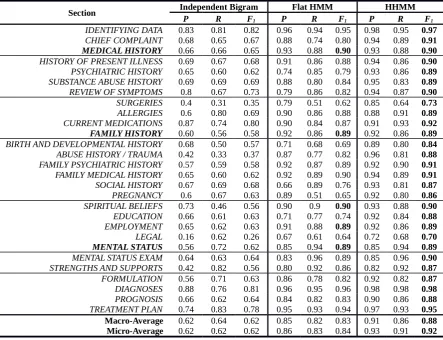
Table 2: Section type identification results (precision, recall andF1scores) per section as well as micro and macro averages. Parent sections are in bold.
Seg assumes that a topic change in written text oc-curs when chains of frequent repetitions of words begin and end. It rewards shorter chains over longer ones and further rewards chains with more repeated terms. Finally, the lexical cohesion be-tween two chains is evaluated using a cosine simi-larity. The second method is TopicTiling—an aug-mentation of the well-known TextTiling algorithm (Hearst, 1994). TopicTiling (Riedl and Biemann, 2012) is LDA-based and represents segments as dense vectors of terms contained in dominant top-ics (as opposed to sparse term vectors).
5.3 Results
For the section labeling problem, our model equaled or outperformed both baselines in all the sections. Table 2 shows the precision, re-call, andF1 scores for the two baselines and our model. TheDIAGNOSISsection saw the best per-formance due to a rule-based approach. Simi-larly, CURRENT MEDICATIONS achieved high scores due to the use of dictionaries. All three
models performed the worst in identifying the LE-GAL section. We suspect that this is due to the low prevalence of this section and its content in the dataset. Similarly, sections with lower preva-lence saw lower performance than others. Both baselines performed well in identifying the IDEN-TIFYING DATAandDIAGNOSISsections due to their highly distinctive language. Our model per-formed better for all implicit subsections, and sig-nificantly better for two (i.e., PREGNANCY and
BIRTH AND DEVELOPMENTAL HISTORY. Fi-nally, our model performed exactly the same as the Flat HMM baseline for the three parent types, as our model reduces to the Flat HMM in these cases and because the flat HMM model assumes a fixed general ordering of the sections.
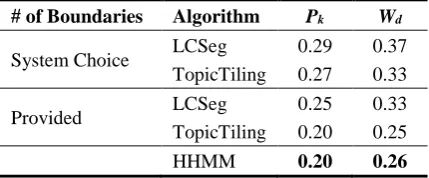
[image:7.595.79.523.65.405.2]performing at 85% and 62% respectively. Sim-ilar to Li et al. (2010), both our HHMM and the Flat-HMM baseline seemed to neither overfit nor underfit, which is indicated by higher micro-averaged compared to the macro-micro-averaged scores. As for the boundary detection problem, and similar to the evaluation in Sherman and Liu (2008), we performed two experiments for the baselines since both baselines require a parame-ter representing the number of boundaries (num-ber of topics minus one). In the first experiment we allowed the parameter to be chosen by LCSeg and TopicTiling, respectively, while in the second experiment, we provide the algorithms with the correct number of boundaries (i.e., number of sec-tions minus one). Our model however, needs no prior information regarding the number of sections present in a given report. Table 3 shows the Wd
andPk scores for all three approaches. Our
sys-tem again outperformed both baselines indicated by lower Wd and Pk error rates overall. Both
baselines performed better when the number of boundaries is known—an expected result. In fact, TopicTiling outperformed our approach by a small margin when provided with the correct parameter value. We note, however, that when running open loop on new text, the number of sections will be unknown, so this result does not reflect how we envision the approach being used.
# of Boundaries Algorithm Pk Wd
System Choice LCSeg 0.29 0.37
TopicTiling 0.27 0.33
Provided LCSeg 0.25 0.33
TopicTiling 0.20 0.25
[image:8.595.74.289.471.560.2]HHMM 0.20 0.26
Table 3: Section boundary identification results.
6 Related Work
As discussed above, our work simultaneously solves two problems within a psychiatric evalua-tion report: identifying secevalua-tion types and identify-ing section boundaries. The first problem has been referred to as argumentative zoning (Teufel et al., 1999; Li et al., 2010; Denny et al., 2009), while the second is a type of text segmentation problem (Hearst, 1994; Riedl and Biemann, 2012). Argu-mentative zoning refers to classifying text sections into mutually exclusive categories. Work on this
task is mostly centered around identifying scien-tific article sections (e.g., abstract, introduction, methodology, etc.) (Teufel, 1999).
Our work is a combination and extension of Li et al. (2010)’s work on identifying section types within clinical notes and Sherman and Liu (2008)’s work on text segmentation of meeting minutes. Both approaches integratedn-gram lan-guage models into HMMs. The former mod-eled HMM emissions at the section level using bigrams, while the later modeled the emissions at the sentence level and used unigrams and tri-grams. Other approaches followed similar strate-gies in segmenting story text and in creating gener-ative models for detecting story boundaries (Mul-bregt et al., 1998; Yamron et al., 1998). More re-cently, Yu et al. (2016) used a hybrid deep neural network combined with a Hidden Markov Model (DNN-HMM) to segment speech transcripts from broadcast news to a sequence of stories.
More broadly, there has been some work on ap-plying NLP in the mental health domain. How-ever, due to lack of readily available clinical data (e.g. clinical reports), researchers have fo-cused on non-clinical sources (e.g., social me-dia) (Chapman et al., 2011). Several algorithms were developed to detect specific emotions from suicide notes and online journals (Pestian et al., 2012; Strapparava and Mihalcea, 2008), while twitter data was used to detect distress and sui-cide ideation (Homan et al., 2014; O’Dea et al., 2015). Additionally, twitter data was used to mea-sure mood valence and detect depression (Sadilek et al., 2013; De Choudhury et al., 2013; Cop-persmith et al., 2015). Facebook data was used to measure emotion contagion and to predict post-partum depression (Coviello et al., 2014; De Choudhury et al., 2014). Instead of social me-dia and publicly available, non-clinical data Al-thoff et al. (2016) used counseling conversations gathered using a messaging service and developed discourse analysis methods to measure the corre-lation of outcomes with various linguistic aspects.
7 Contributions
documents and created a unified hierarchy of sec-tion labels. We built an n-gram-based HHMM model that successful detects the order of sec-tions as well as their boundaries within a given re-port. We evaluated our model’s performance over two separate tasks, namely the section ordering task and the section boundary identification. Our model outperformed baselines for both of those tasks. Finally, our approach further confirms that learning the section ordering of a psychiatric re-port yields better performance for boundary iden-tification and text segmentation.
Acknowledgments
We thank our colleagues at the Cognition, Narra-tive, and Culture Laboratory (Cognac Lab), espe-cially Mohammed Aldawsari and Victor Yarlot for their contributions to the overall idea, approach, and evaluation.
References
Tim Althoff, Kevin Clark, and Jure Leskovec. 2016. Large-scale analysis of counseling conversations: An application of natural language processing to mental health. Transactions of the Association for Computational Linguistics, 4:463–476.
American Psychiatric Association. 2006. American Psychiatric Association Practice Guidelines for the Treatment of Psychiatric Disorders: Compendium 2006. American Psychiatric Association Publish-ing, Washington, DC.
American Psychiatric Association. 2018. What is psychiatry? Available from: https://www. psychiatry.org/patients-families/
what-is-psychiatry. (Accessed on Jul 1,
2018).
Regina Barzilay and Lillian Lee. 2004. Catching the drift: Probabilistic content models, with applica-tions to generation and summarization. In Proceed-ings of the 2004 North American Chapter of the Association for Computational Linguistics: Human Language Technologies Conference (HLT-NAACL), pages 113–120.
Doug Beeferman, Adam Berger, and John Lafferty. 1999. Statistical models for text segmentation. Ma-chine Learning, 34(1):177–210.
Hung H. Bui, Dinh Q. Phung, and Svetha Venkatesh. 2004. Hierarchical hidden markov models with general state hierarchy. In Proceedings of the 19th National Conference on Artifical Intelligence, AAAI’04, pages 324–329, San Jose, California.
Wendy W Chapman, Prakash M Nadkarni, Lynette Hirschman, Leonard W D’Avolio, Guergana K Savova, and Ozlem Uzuner. 2011. Overcoming bar-riers to NLP for clinical text: The role of shared tasks and the need for additional creative solutions. Journal of the American Medical Informatics Asso-ciation, 18(5):540–543.
Glen Coppersmith, Mark Dredze, Craig Harman, Kristy Hollingshead, and Margaret Mitchell. 2015. CLPsych 2015 shared task: Depression and PTSD on twitter. In Proceedings of the 2nd Workshop on Computational Linguistics and Clinical Psychol-ogy: From Linguistic Signal to Clinical Reality (CLPsych), pages 31–39.
Lorenzo Coviello, Yunkyu Sohn, Adam D. I. Kramer, Cameron Marlow, Massimo Franceschetti, Nicholas A. Christakis, and James H. Fowler. 2014. Detecting emotional contagion in massive social networks. PLOS ONE, 9(3):1–6.
Munmun De Choudhury, Scott Counts, Eric J. Horvitz, and Aaron Hoff. 2014. Characterizing and pre-dicting postpartum depression from shared facebook data. InProceedings of the 17th ACM Conference on Computer Supported Cooperative Work & Social Computing, CSCW ’14, pages 626–638, Baltimore, MD.
Munmun De Choudhury, Michael Gamon, Scott Counts, and Eric Horvitz. 2013. Predicting depres-sion via social media. InProceedings of the 7th In-ternational AAAI Conference on Weblogs and Social Media (ICWSM), volume 13, pages 1–10, Boston, MA.
Dina Demner-Fushman, Wendy W Chapman, and Clement J McDonald. 2009. What can natural lan-guage processing do for clinical decision support? Journal of Biomedical Informatics, 42(5):760–772.
Joshua C. Denny, Anderson Spickard, III, Kevin B. Johnson, Neeraja B. Peterson, Josh F. Peterson, and Randolph A. Miller. 2009. Evaluation of a method to identify and categorize section headers in clinical documents. Journal of the American Medical Infor-matics Association, 16(6):806–815.
eMedicineHealth. 2018. Medications and drugs listing. https://www.emedicinehealth.com/ medications-drugs/article_em.htm. (Accessed on Feb 18, 2018).
Shai Fine, Yoram Singer, and Naftali Tishby. 1998. The hierarchical hidden markov model: Analysis and applications. Machine Learning, 32(1):41–62.
Karen Goldfinger and Andrew M Pomerantz. 2013. Psychological Assessment and Report Writing. Sage, Thousand Oaks, CA.
Gary Groth-Marnat. 2009.Handbook of Psychological Assessment. John Wiley & Sons, Hoboken, NJ.
Marti A. Hearst. 1994. Multi-paragraph segmentation of expository text. InProceedings of the 32nd An-nual Meeting on Association for Computational Lin-guistics, ACL ’94, pages 9–16, Las Cruces, NM.
Christopher Homan, Ravdeep Johar, Tong Liu, Megan Lytle, Vincent Silenzio, and Cecilia Ovesdotter Alm. 2014. Toward macro-insights for suicide preven-tion: Analyzing fine-grained distress at scale. In Proceedings of the Workshop on Computational Lin-guistics and Clinical Psychology: From Linguistic Signal to Clinical Reality, pages 107–117.
George Hripcsak, Suzanne Bakken, Peter D Stetson, and Vimla L Patel. 2003. Mining complex clini-cal data for patient safety research: A framework for event discovery. Journal of Biomedical Informatics, 36(1-2):120–130.
Kush Jain, Priya Khatri, and Garima Indolia. 2015. Chunked n-grams for sentence validation. Procedia Computer Science, 57:209–213.
Ying Li, Sharon Lipsky Gorman, and No´emie Elhadad. 2010. Section classification in clinical notes using supervised hidden markov model. InProceedings of the 1st ACM International Health Informatics Sym-posium IHI, pages 744–750, Arlington, VA.
S. Liu, Wei Ma, R. Moore, V. Ganesan, and S. Nel-son. 2005. Rxnorm: Prescription for electronic drug information exchange. IT Professional, 7(5):17–23.
Paul van Mulbregt, Ira Carp, Lawrence Gillick, Steve Lowe, and Jon Yamron. 1998. Text segmentation and topic tracking on broadcast news via a hidden markov model approach. InFifth International Con-ference on Spoken Language Processing.
Bridianne O’Dea, Stephen Wan, Philip J. Batterham, Alison L. Calear, Cecile Paris, and Helen Chris-tensen. 2015. Detecting suicidality on twitter. In-ternet Interventions, 2:183–188.
John P. Pestian, Pawel Matykiewicz, Michelle Linn-Gust, Brett South, Ozlem Uzuner, Jan Wiebe, K. Bretonnel Cohen, John Hurdle, and Christopher Brew. 2012. Sentiment analysis of suicide notes: A shared task. Biomedical Informatics Insights, 5s1:BII.S9042.
Lev Pevzner and Marti A Hearst. 2002. A critique and improvement of an evaluation metric for text seg-mentation. Computational Linguistics, 28(1):19– 36.
L. R. Rabiner. 1989. A tutorial on hidden markov mod-els and selected applications in speech recognition. Proceedings of the IEEE, 77(2):257–286.
R Reeves and R Rosner. 2016.Forensic Psychiatry and Forensic Psychology: Forensic Psychiatric Assess-ment. Elsevier.
Jeffrey C Reynar. 1998. Topic Segmentation: Algo-rithms and Applications. Ph.D. thesis, University of Pennsylvania, Philadelphia, PA.
Martin Riedl and Chris Biemann. 2012. Topictiling: A text segmentation algorithm based on lda. In Pro-ceedings of ACL 2012 Student Research Workshop, ACL ’12, pages 37–42, Jeju Island, Korea.
Adam Sadilek, Christopher Homan, Walter S Lasecki, Vincent Silenzio, and Henry Kautz. 2013. Model-ing fine-grained dynamics of mood at scale.WSDM, Rome, Italy, pages 3–6.
M. Sherman and Yang Liu. 2008. Using hidden markov models for topic segmentation of meeting transcripts. InProceedings of the 2008 IEEE Spoken Language Technology Workshop, pages 185–188.
Carlo Strapparava and Rada Mihalcea. 2008. Learn-ing to identify emotions in text. In Proceed-ings of the ACM Symposium on Applied Comput-ing (SAC), SAC ’08, pages 1556–1560, Fortaleza, Ceara, Brazil.
Simone Teufel. 1999. Argumentative zoning: Infor-mation Extraction from Scientific Text. Ph.D. thesis, University of Edinburgh, Edinburgh, Scotland, UK.
Simone Teufel, Jean Carletta, and Marc Moens. 1999. An annotation scheme for discourse-level argumen-tation in research articles. In Proceedings of the ninth conference on European chapter of the Associ-ation for ComputAssoci-ational Linguistics (EACL), pages 110–117, Bergen, Norway.
J. P. Yamron, I. Carp, L. Gillick, S. Lowe, and P. van Mulbregt. 1998. A hidden markov model approach to text segmentation and event tracking. In Pro-ceedings of the IEEE International Conference on Acoustics, Speech and Signal Processing (ICASSP), volume 1, pages 333–336 vol.1.