Long-ranged dynamic magnetic interaction through low-dimensional systems
A. T. Costa and R. B. Muniz
Instituto de Física, Universidade Federal Fluminense, 24210-346 Niterói, RJ, Brazil
M. S. Ferreira
School of Physics, Trinity College Dublin, Dublin 2, Republic of Ireland
D. L. Mills
Department of Physics and Astronomy, University of California, Irvine, California 92697, USA 共Received 23 October 2008; published 2 December 2008兲
Magnetic units attached to low-dimensional metallic nanowires are known to interact via the conduction electrons of the wire leading to preferential alignment directions of the respective magnetic moments. In addition to this so-called static interaction, here we show that a very long-ranged interaction arises when these units are allowed to precess. This dynamic version of the magnetic interaction governs the spin dynamics of the magnetic moments. We are able to relate this interaction to the spin excitation spectrum of the system in which we establish a clear correspondence between the precession relaxation time and the features of the spin susceptibility. We show that the relaxation time is predominantly determined by the availability of noncoherent Stoner modes, a process analogous to Landau damping of plasmons in the electron gas. Contrary to expecta-tions, our results indicate that the range of this interaction is robust against the introduction of disorder. Furthermore, we show that the interaction range is frequency dependent suggesting that it may be tunable by an adequate choice of excitation frequencies. We argue that this may pave the way to controlling the commu-nication between distant parts of a spintronic device.
DOI:10.1103/PhysRevB.78.214403 PACS number共s兲: 75.30.Ds, 75.30.Et, 75.30.Hx
Magnetic moments embedded in nonmagnetic metallic media interact with each other via the spin polarization in-duced in the latter. Due to its relevance from fundamental and applied viewpoints, this interaction has been thoroughly investigated during the last two decades1 and has proven to
play essential roles in recent scientific and technological developments.2 Less well known are the dynamical aspects
of that coupling: clearly, if one of the magnetizations is set in motion the others will also precess. If the dynamic interac-tion that produces such induced precession is sufficiently long ranged, this phenomenon may be exploited as a com-munication channel between distant parts of spintronic de-vices. When compared to the charge channel traditionally used in electronic devices, the spin channel has the advan-tage of being almost dissipationless for appropriate choices of materials. Schemes for synchronizing large sets of oscil-lators have also been devised based on the dynamic coupling between magnetic moments.3,4
The dynamic coupling is intimately related to the spin current emitted by a magnetic volume whose magnetization has been driven out of equilibrium.5This same spin current
is responsible for the enhanced Gilbert damping predicted and observed in a variety of metallic systems6–8and is also
closely related to the system’s spin excitation spectrum. The dynamic coupling has been investigated in the context of three-dimensional magnetic multilayers, within a semiclassi-cal approach9and a full quantum theoretic analysis.5There,
as it has been shown,9the range of the dynamic coupling is
limited only by spin-orbit interaction. In that work, however, the frequency dependence of the dynamic coupling was not explored 共the frequency of the driving field was assumed to satisfy the condition for ferromagnetic resonance兲. Further-more, the motion of the magnetizations was considered
within an adiabatic approximation. As far as long-wavelength modes are considered, disorder within the mag-netic layers should not play a significant role and was not considered in the aforementioned work. However, as we shall see, breaking the translational symmetry in the direc-tion perpendicular to the spin current flow in low-dimensional systems may have important consequences for its behavior.
One of the issues on the subject of spin dynamics that remains open is the physical mechanism that drives the spin precessional motion to relax. In particular, it is important to understand the microscopic origin for this relaxation in the absence of dissipative terms such as spin-orbit coupling known as the primary source of damping for the precessional motion of magnetic moments. Only with a full understanding of the microscopic origin for this relaxation can one establish the relationship of the damping process with the electronic structure of the material in question. However, the vast ma-jority of studies on this topic are essentially based on semi-classical approaches and are insufficient to substantiate this relationship. Our paper is a full quantum-mechanical ap-proach whose goal is to show that the origin of the spin precession damping lies in the availability of incoherent spin excitation modes. These modes are known to be related to the electronic structure of the materials thus providing the microscopic origin for the finite lifetime of spin excitations in low-dimensional systems. With this goal in mind, in this paper we report on theoretical investigations of the dynami-cal coupling between nanoscopic magnetic volumes medi-ated by a nearly one-dimensional nonmagnetic metallic sys-tem. Furthermore, we present the connection with the spin excitation of the system, highlighting features of the cou-pling that are not observed in three-dimensional systems.
To understand the properties of the dynamic coupling it is useful to form a physical picture of the phenomenon. When-ever the magnetization of a magnetic volume 共let us call it volume A兲 coupled to a metallic substrate is driven out of equilibrium, a flow of spin angular momentum is established from the magnetic volume into the substrate. An immediate consequence is that the precession of the magnetization in volume A is damped.5,6,10 If there is another magnetic
vol-ume 共let us call it volume B兲 coupled to the nonmagnetic
metallic substrate it will absorb part of the spin current emit-ted by A; this will induce a precession of the magnetization
mជBof volumeB. This precession ofmជBinduced by a driving
field atAis what we call dynamic coupling betweenAandB. Put it this way; it is evident that the dynamic coupling can be measured as a nonlocal response function, which is also in-timately related to the system’s excitation spectra. Thus, a measure of the dynamic coupling between two magnetic en-titiesAandBmay be defined by the amplitude of precession induced in B by a harmonic circularly polarized transverse field applied locally to A. This information is contained in the transverse dynamic susceptibility BA+−共兲 defined as the
Fourier transform of the response function, BA
+−共
t兲= −i共t兲具关SB +共
t兲,SA
−共0兲兴典. 共1兲
Here,SA+is the spin raising operator at volumeAdefined as a
sum of spin raising operators over all atomic sites that com-prise volumeA,SA
+
=兺l苸Aal↑ †
al↓. Herea共a†兲lare the
annihi-lation 共creation兲 operators for states localized at site l with spin,共t兲is the Heaviside step function, and具·典denotes the expectation value. In this paper, volumes A and B will be collections of magnetic atoms contained in two rings belong-ing to an infinite cylindrical nanowire.
We consider as a model system a semi-infinite square lat-tice stripe of sideLatoms, with periodic boundary conditions in the transverse direction 共mimicking a cylindrical surface兲.11Because we are interested in investigating the
ef-fect of disorder on the dynamic coupling, it is instructive to start with magnetic objects that do not break the translational symmetry of the nanowire along the circumferential direc-tion. In this case we consider two lines containing magnetic atoms separated by a distanceD=Na, wherea is the atomic spacing, as shown schematically in Fig.1. We want to deter-mine how the dynamic coupling depends on the distanceD
between magnetic lines and on the atomic composition of the magnetic lines. We call the configuration of a magnetic line the number and distribution of magnetic atoms in it. The configuration of the magnetic line is important in determin-ing the Fourier amplitudes that form the lowest-lydetermin-ing preces-sion mode.
The system’s electronic structure is modeled by a single-orbital tight-binding Hamiltonian with effective intra-atomic Coulomb interaction in the magnetic atoms,
H=
兺
ij
兺
共⑀i␦ij+tij兲ai †
aj+
兺
iUini↑ni↓, 共2兲
whereiand j are the site indices,is a spin index,tij=tis
the hopping integrals fori andj nearest neighbors and zero otherwise,⑀iare the on-site energies, andUiis the effective
intra-atomic Coulomb interaction. All energies are measured
in units of the hopping parameter t. The magnetic ground state is generated by a mean-field self-consistent approach. Spin excitations are obtained by calculating the transverse susceptibility ij+−共⍀兲 within the random-phase approxima-tion, whereiandjrepresent the atomic sites or collections of atomic sites. A static Zeeman field is applied to the system along the z direction in order to stabilize the equilibrium magnetization direction. The value of the Zeeman field is arbitrarily chosen such that a free electron precessing in it would have an energy ⍀= 0.01t.
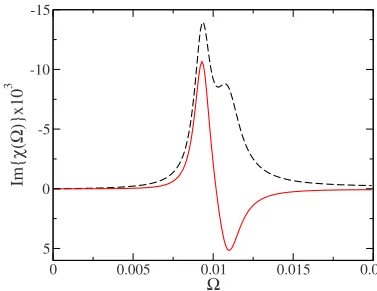
[image:2.609.353.517.67.264.2]A typical excitation spectrum is shown in Fig. 2, where we plot −ImAA+−共⍀兲 共dashed curve兲 for two complete mag-netic lines embedded in a nonmagmag-netic wire. Notice that this is not the quantity we use as a measure of the dynamical coupling. Two peaks are clearly visible, corresponding to acoustic共lower energy, in phase兲and optical共higher energy, FIG. 1. 共Color online兲Schematic representations of a section of the infinite metallic cylindrical nanowire with two lines containing magnetic atoms共shown as circles兲;共a兲complete共ordered兲magnetic lines and共b兲disordered magnetic lines. Nonmagnetic atoms occupy the vertices of the underlying lattice.
0 0.005 0.01 0.015 0.02
Ω -15
-10
-5
0
5
Im{
χ(Ω)
}x10
3
[image:2.609.339.528.539.685.2]out of phase兲 precession modes ofmជA andmជB. We will call
the energies of the acoustic and optical mode as⍀0and⍀1,
respectively. The existence of a frequency splitting between the two modes means that there is a static Ruderman-Kittel-Kasuya-Yoshida 共RKKY兲-type exchange coupling between
mជAandmជB,12which is proportional to the splitting. The solid
curve displays a measure of the dynamical coupling, −ImBA共⍀兲; its absolute value is proportional to the
ampli-tude of the magnetization precession induced on B by a transverse circularly polarized field applied onA. The sign of −ImAB共⍀兲 is related to the phase difference between the
precessing mជB and the field applied on A. The so-called
acoustic mode, which is excited in ferromagnetic resonance
共FMR兲 experiments, corresponds to a precession of mជB in
phase with the applied field atA; thus −ImAB共⍀兲is positive
at the corresponding frequency ⍀0. The finite width of the excitation spectrum −ImAA+−共⍀兲 is directly proportional to
the rate of damping ofmជA precession.
From this typical spectrum it is already possible to infer that the dynamical coupling should oscillate as a function of theABdistanceN, at least for sufficiently small values ofN. The value of −ImAB共⍀兲 for ⍀⬃⍀0 is influenced by the
existence of an optical mode, and such influence depends on the splitting between the two modes. The splitting is propor-tional to the static exchange coupling between mជA and mជB,
which is known to oscillate as a function ofN.12–14The static
coupling decays, for quasi-one-dimensional systems, asymp-totically as 1/N; hence oscillations in the dynamic coupling should be seen even for relatively large values ofN.
We may now inquire about the behavior of 兩AB共⍀兲兩2 as
the distanceNbetween ringsAandBis varied. It is expected that the spin current that couples dynamically the two mag-netizations should suffer the effects of quantum interferences as theAB distance is changed. Figure3 shows the dynamic coupling as a function of the distanceNbetween ringsAand
Bfor a few frequencies of the driving field. For all frequen-cies quantum oscillations are clearly visible, and the
cou-pling reaches afiniteasymptotic value for very largeN. This is in clear contrast with the behavior of the static coupling that, although long ranged, goes to zero asN→⬁. The spa-tial modulation of the dynamic coupling may be understood as a property of the system’s spin excitations. The spin pre-cession, which generates the spin current responsible for the dynamic coupling, is a collective excitation of the system. It may be resolved in a superposition of spin-wave modes with different wave vectors Q parallel to the rings, which decay into 共incoherent兲 Stoner excitations: a process analogous to Landau damping of plasmons in the electron gas. Only the uniform 共Q= 0兲 spin-wave component has infinite lifetime 共in the absence of spin-orbit coupling兲. This component is the origin of the very long range of the dynamic coupling predicted in magnetic multilayers.9If the magnetic region is
translationally invariant in the direction perpendicular to the flow of spin current, as is the case in this example, the domi-nant spin-wave component has Q= 0. Thus, after the Q⫽0 components have been damped, there remains considerable precession amplitude flowing through the nonmagnetic sub-strate.
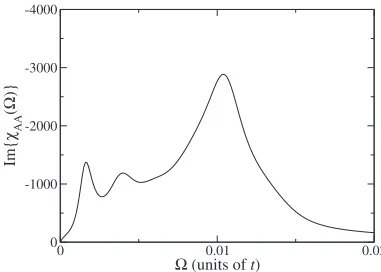
When translation symmetry is broken by, for example, introducing disorder, new modes appear that correspond to superpositions of finite Qmodes; an example of such spec-trum is shown in Fig.4. The magnetic volumes are now rings of 20 atoms, each where half the atoms have been randomly replaced by nonmagnetic atoms. It is clear that the spectrum has more structure, meaning that more modes are present with energy comparable to that of theQ= 0 mode.
It can be seen in Fig. 5 that the dynamic coupling at the frequencies associated with the newQ⫽0 modes decays to-ward zero as the distance between the magnetic volumes increase. This decaying is, as stated previously, a conse-quence of coherent spin-wave modes decaying into incoher-ent Stoner excitations共we remind the reader that there is no spin relaxation in our model兲. This kind of process can only be properly described in the framework of itinerant magne-tism.
Even in the presence of disorder, modes with frequencies close to that of the uniform mode have considerable ampli-tude in the Q= 0 component. We illustrate this point in Fig. 5共a兲. This means that if frequency can be tuned, long-range dynamic coupling can be obtained even in disordered sys-tems.
0 4 8
|
χ AB
|
2 (x1000)
0 4 8
0 100 200 300 400
N (atomic spacings) 0
3 6 9
|
χ AB
|
2 (x1000)
0 100 200 300 400
N (atomic spacings) 0
0.5 1 1.5
(a) (b)
[image:3.609.339.530.67.203.2](c) (d)
FIG. 3. 共Color online兲 Dynamical coupling between two mag-netic rings embedded in a nonmagmag-netic metallic nanowire as a func-tion of the distanceNbetween them for different frequencies of the driving field: 共a兲 ⍀= 0.008,共b兲 ⍀= 0.009t,共c兲 ⍀= 0.010t, and 共d兲 ⍀= 0.011t.
0 0.01 0.02
Ω(units oft) -4000
-3000
-2000
-1000
0
Im{
χAA
(
Ω
[image:3.609.53.291.68.244.2])}
From the theoretical point of viewAB is the best choice
to characterize the dynamic coupling between volumesAand
B. Experimentally, however, it can be a very difficult quan-tity to measure. Its direct measurement requires that a driv-ing field is applied toA, and thenmជBis measured. In systems
of nanoscopic dimensions this kind of measurement requires a spatial resolution not easily available presently. The sys-tem’s FMR spectrum, given by=AA+AB+BA+BB, is an
alternative way to measure the dynamic coupling although it provides a slightly different kind of information. The half-width at half maximum共HWHM兲of共⍀兲is proportional to the damping rate of the FMR mode, 1/. The FMR mode corresponds to an in-phase precession of all individual mag-netic moments in the system. To see how its lifetime is re-lated to the dynamic coupling it is useful to invoke once again the spin currents emitted by the precessing magnetiza-tions. If only volume A is in contact with the infinite sub-strate the current it emits flows away from it indefinitely, resulting in a damping rate, 1/0. If, however, volumeB is
also attached to the substrate, part of the current emitted byA
is absorbed byBcausingmជBto precess and emit itself a spin
current that will be partly absorbed by A. The end result of this multiple-scattering process will be a trapping of some of the spin current that would otherwise flow to the infinite substrate. Consequently the lifetime of the FMR mode is increased by the presence of a second magnetic volume. Thus, by comparing 0 with it is possible to identify the
dynamic coupling between A and B. For instance, the less strongly coupled the magnetic unities are, the more the FMR mode’s lifetime approaches that of a single magnetic unit. The dynamic coupling should lead, as discussed above, to larger lifetimes and thus smaller mode width. In Fig. 6 we present the half-width at half maximum⌬⍀of the calculated ferromagnetic resonance spectra of an infinite wire with two complete magnetic rings embedded in it, as the distance N
between the rings is varied. We compare those results with the value of⌬⍀singleextracted from the FMR spectrum of a
single complete magnetic ring embedded in a similar wire. It is clear that⌬⍀single⬍⌬⍀for all values ofNconsidered and
also that it oscillates around a reasonably constant value. It is interesting to notice that the trend observed in Fig. 6共a兲 is similar to what is seen in Fig. 3, which corresponds to the dynamic coupling carried by the uniform mode. This con-firms that ⌬⍀ is a good measure of the dynamic coupling although it can only provide information about a very narrow frequency interval around the resonance. In Figs. 6共b兲 and 6共c兲we can see the effect of spacial inhomogeneities on the dynamic coupling: in 共b兲 each magnetic ring has ten mag-netic atoms and ten nonmagmag-netic atoms distributed ran-domly; and in 共c兲 there is only one magnetic atom in each ring. The linewidths are clearly much closer to ⌬⍀single in both cases. However, since ⌬⍀ is essentially a property of the Q= 0 mode and this mode always lead to long-range coupling, neither of them are identical to ⌬⍀single.
To summarize, we investigated the properties of dynamic coupling between magnetic moments embedded in a low-dimensional metallic substrate. We showed that this coupling is large and long ranged in the absence of disorder. The dy-namic coupling displays strong oscillations as a function of the distance between magnetic volumes, a feature not ob-served in bulk systems. For disordered magnetic volumes there are several frequencies for which the coupling is size-able but decays toward zero as the distance between mag-netic volumes increase. This decaying is due to the presence of Stoner excitations that damp collective modes with non-zero wave vectors. Even in the presence of disorder, how-ever, it is possible to obtain a long-ranged dynamic coupling by choosing the pumping frequency appropriately. We also showed how the dynamic coupling manifests itself in the linewidths of FMR spectra, which are easily accessible ex-perimentally. The diversity of spatial modulations revealed by our calculations suggest that with clever material engi-neering, it may be possible to control long-distance
commu-0 500 1000 1500 2000
|Im{
χAB
(
Ω
)}|
0 100 200 300 400 N
0 300 600 900
|Im{
χAB
(
Ω
)}|
0 100 200 300 400 N
(a) (b)
[image:4.609.328.544.66.236.2](c) (d)
FIG. 5. 共Color online兲Dynamic coupling as a function of dis-tanceNbetween disordered magnetic volumesAandBfor selected mode energies:共a兲⍀= 0.01t,共b兲⍀= 0.0056t,共c兲⍀= 0.004t, and共d兲 ⍀= 0.014t.
0 0.001 0.002 0.003
0 0.003 0.006
∆Ω
0 100 200 300 400
N
[image:4.609.53.294.68.256.2]0 0.004 0.008
nication in nanoscale devices. The combination of a long-ranged exchange interaction with a dynamic coupling only limited by spin-flip scattering may lead to unusual excitation properties. Further investigation on this topic is presently underway.
A.T.C. and R.B.M. acknowledge financial support from CNPq and FAPERJ. M.S.F. acknowledges the financial sup-port from Science Foundation Ireland. D.M.L. acknowledges support from the U.S. Department of Energy through Grant No. FG03-84ER-45083.
1M. D. Stiles, J. Magn. Magn. Mater. 200, 322共1999兲.
2M. N. Baibich, J. M. Broto, A. Fert, F. Nguyen Van Dau, F.
Petroff, P. Etienne, G. Creuzet, A. Friederich, and J. Chazelas, Phys. Rev. Lett. 61, 2472共1988兲.
3S. Kaka, M. Pufall, W. Rippard, T. Silva, S. Russek, and J.
Ka-tine, Nature共London兲 437, 389共2005兲.
4J. Grollier, V. Cros, and A. Fert, Phys. Rev. B 73, 060409共R兲
共2006兲.
5A. T. Costa, R. B. Muniz, and D. L. Mills, Phys. Rev. B 73,
054426共2006兲.
6L. Berger, Phys. Rev. B 54, 9353共1996兲.
7J. C. Slonczewski, J. Magn. Magn. Mater. 195, L261共1999兲.
8K. Lenz, T. Tolinski, J. Lindner, E. Kosubek, and K. Baberschke,
Phys. Rev. B 69, 144422共2004兲.
9B. Heinrich, Y. Tserkovnyak, G. Woltersdorf, A. Brataas, R.
Ur-ban, and G. E. W. Bauer, Phys. Rev. Lett. 90, 187601共2003兲.
10Y. Tserkovnyak, A. Brataas, G. E. W. Bauer, and B. I. Halperin,
Rev. Mod. Phys. 77, 1375共2005兲.
11A. T. Costa, R. B. Muniz, and M. S. Ferreira, New J. Phys. 10,
063008共2008兲.
12A. T. Costa, D. F. Kirwan, and M. S. Ferreira, Phys. Rev. B 72,
085402共2005兲.
13A. T. Costa, C. G. Rocha, and M. S. Ferreira, Phys. Rev. B 76,
085401共2007兲.
14D. F. Kirwan, C. G. Rocha, A. T. Costa, and M. S. Ferreira,