Multi-Lingual Coreference Resolution With Syntactic Features
Xiaoqiang Luo and Imed Zitouni
1101 Kitchawan Road
IBM T.J. Watson Research Center
Yorktown Heights, NY 10598, U.S.A.
{
xiaoluo, izitouni
}
@us.ibm.com
Abstract
In this paper, we study the impact of a group of features extracted automatically from machine-generated parse trees on coreference resolution. One focus is on designing syn-tactic features using the binding theory as the guideline to improve pronoun resolution, al-though linguistic phenomenon such as apposi-tion is also modeled. These features are ap-plied to the Arabic, Chinese and English coref-erence resolution systems and their effective-ness is evaluated on data from the Automatic Content Extraction (ACE) task. The syntactic features improve the Arabic and English sys-tems significantly, but play a limited role in the Chinese one. Detailed analyses are done to un-derstand the syntactic features’ impact on the three coreference systems.
1 Introduction
A coreference resolution system aims to group together
mentions referring to the sameentity, where a mention is an instance of reference to an object, and the collection of mentions referring to the same object in a document form anentity. In the following example:
(I) “John believes himself to be the best student.” mentions are underlined. The three mentions “John”, “himself”, “the best student” are of type name, pronoun1, and nominal, respectively. They form anentitysince they all refer to the same person.
Syntactic information plays an important role in corefer-ence resolution. For example, the binding theory (Haege-man, 1994; Beatrice and Kroch, 2000) provides a good account of the constraints on the antecedent of English pronouns. The theory relies on syntactic parse trees to de-termine the governing category which defines the scope 1“Pronoun” in this paper refers to both anaphor and normal
pronoun.
of binding constraints. We will use the theory as a guide-line to help us design features in a machine learning framework.
Previous pronoun resolution work (Hobbs, 1976; Lappin and Leass, 1994; Ge et al., 1998; Stuckardt, 2001) explic-itly utilized syntactic information before. But there are unique challenges in this study: (1) Syntactic informa-tion is extracted from parse trees automatically generated. This is possible because of the availability of statistical parsers, which can be trained on human-annotated tree-banks (Marcus et al., 1993; Xia et al., 2000; Maamouri and Bies, 2004) for multiple languages; (2) The bind-ing theory is used as a guideline and syntactic structures are encoded as features in a maximum entropy corefer-ence system; (3) The syntactic features are evaluated on three languages: Arabic, Chinese and English (one goal is to see if features motivated by the English language can help coreference resolution in other languages). All con-trastive experiments are done on publicly-available data; (4) Our coreference system resolves coreferential rela-tionships among all the annotated mentions, not just for pronouns.
Using machine-generated parse trees eliminates the need of hand-labeled trees in a coreference system. How-ever, it is a major challenge to extract useful informa-tion from these noisy parse trees. Our approach is encod-ing the structures contained in a parse tree into a set of computable features, each of which is associated with a weight automatically determined by a machine learning algorithm. This contrasts with the approach of extracting rules and assigning weights to these rules by hand (Lap-pin and Leass, 1994; Stuckardt, 2001). The advantage of our approach is robustness: if a particular structure is helpful, it will be assigned a high weight; if a feature is extracted from a highly noisy parse tree and is not in-formative in coreference resolution, it will be assigned a small weight. By avoiding writing rules, we automati-cally incorporate useful information into our model and at the same time limit the potentially negative impact from noisy parsing output.
2 Statistical Coreference Resolution Model
Our coreference system uses a binary entity-mention modelPL(·|e, m)(henceforth “link model”) to score the action of linking a mentionmto an entitye. In ourim-plementation, the link model is computed as
PL(L= 1|e, m)≈max m0∈e
ˆ
PL(L= 1|e, m0, m), (1)
wherem0is one mention in entitye, and the basic model
building blockPˆL(L= 1|e, m0, m)is an exponential or
maximum entropy model (Berger et al., 1996):
ˆ
PL(L|e, m0, m) =
exp P
iλigi(e, m 0, m, L)
Z(e, m0, m) , (2)
whereZ(e, m0, m)is a normalizing factor to ensure that ˆ
PL(·|e, m0, m)is a probability,{gi(e, m0, m, L)}are fea-tures and{λi}are feature weights.
Anotherstartmodel is used to score the action of creating a new entity with the current mentionm. Since starting
a new entity depends on all the partial entities created in the history{ei}ti=1, we use the following approximation:
PS(S = 1|e1, e2,· · ·, et, m)≈
1− max
1≤i≤tPL(L= 1|ei, m) (3) In the maximum-entropy model (2), feature (typically bi-nary) functions{gi(e, m0, m,·)}provide us with a flex-ible framework to encode useful information into the the system: it can be as simple as “gi(e, m0, m, L =
1) = 1 if m0 andmhave the same surface string,” or
“gj(e, m0, m, L = 0) = 1 if e and m differ in num-ber,” or as complex as “gl(e, m0, m, L = 1) = 1ifm0 c-commandsmandm0 is a NAME mention andmis a
pronoun mention.” These feature functions bear similar-ity to rules used in other coreference systems (Lappin and Leass, 1994; Mitkov, 1998; Stuckardt, 2001), except that the feature weights{λi}are automatically trained over a corpus with coreference information. Learning feature weights automatically eliminates the need of manually assigning the weights or precedence of rules, and opens the door for us to explore rich features extracted from parse trees, which is discussed in the next section.
3 Syntactic Features
In this section, we present a set of features extracted from syntactic parse trees. We discuss how we approx-imately compute linguistic concepts such as governing category (Haegeman, 1994), apposition and dependency relationships from noisy syntactic parse trees. While parsing and parse trees depend on the target language, the automatic nature of feature extraction from parse trees makes the process language-independent.
V
(1) (GC)
(Sub) (gov) likes
NP1 NP2
S
John VP
himself.
VP V John likes
NP1 NP2
S(GC)
(Sub)
(2) (gov)
him.
V
VP
description NP5
Miss Smith’s believes
John
S
(gov) (Sub)
(GC)
(3)
NP1 NP2
NP6
NP3
of herself. NP4 P
[image:2.612.329.519.57.202.2]PP
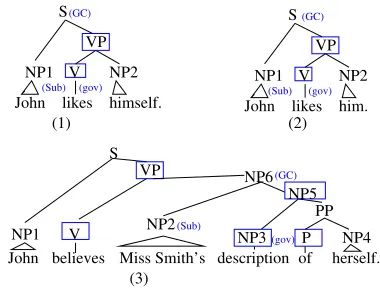
Figure 1: GC examples.
3.1 Features Inspired by Binding Theory
The binding theory (Haegeman, 1994) concerning pro-nouns can be summarized with the following principles: 1. A reflexive or reciprocal pronoun (e.g., “herself” or “each other”) must be bound in its governing cate-gory (GC).
2. A normal pronoun must be free in its governing cat-egory.
The first principle states that the antecedent of a reflexive or reciprocal pronoun is within its GC, while the second principle says that the antecedent of a normal pronoun is outside its GC. While the two principles are simple, they all rely on the concept of governing category, which is defined as the minimal domain containing the pronoun in question, its governor, and an accessible subject. The concept GC can best be explained with a few exam-ples in Figure 1, where the label of a head constituent is marked within a box, and GC, accessible subject, and governor constituents are marked in parentheses with “GC”, “Sub” and “gov.” Noun-phrases (NP) are num-bered for the convenience of referencing. For example, in sub-figure (1) of Figure 1, the governor of “himself” is “likes,” the subject is “John,” hence the GC is the en-tire sentence spanned by the root “S.” Since “himself” is reflexive, its antecedent must be “John” by Principle 1. The parse tree in sub-figure (2) is the same as that in sub-figure (1), but since “him” is a normal pronoun, its antecedent, according to Principle 2, has to be out-side the GC, that is, “him” cannot be coreferenced with “John.”. Sentence in sub-figure (3) is slightly more com-plicated: the governor of “herself” is “description,” and the accessible subject is “Miss Smith.” Thus, the govern-ing category is NP6. The first principle implies that the antecedent of “herself” must be “Miss Smith.”
and the minimal constituent dominating the pronoun, its governor and an accessible subject. Determining the ac-cessible subject itself entails checking other constraints such as number and gender agreement. The complexity of computing governing category, compounded with the noisy nature of machine-generated parse tree, prompts us to compute a set of features that characterize the struc-tural relationship between a candidate mention and a pro-noun, as opposed to explicitly identify GC in a parse tree. These features are designed to implicitly model the bind-ing constraints.
Given a candidate antecedent or mentionm1 and a
pro-noun mentionm2within a parsed sentence, we first test
if they have c-command relation, and then a set of count-ing features are computed. The features are detailed as follows:
(1) C-command ccmd(m1, m2) : A constituent X
c-commands another constituentY in a parse tree if the first
branching node dominatingXalso dominatesY. The
bi-nary featureccmd(m1, m2)is true if the minimum NP
dominatingm1c-commands the minimum NP
dominat-ingm2. In sub-figure (1) of Figure 1, NP1 c-commands
NP2 since the first branching node dominating NP1 isS
and it dominates NP2.
Ifccmd(m1, m2)is true, we then define the c-command
pathT(m1, m2)as the path from the minimum NP
dom-inatingm2to the first branching node that dominates the
minimum NP dominatingm1. In sub-figure (1) of
Fig-ure 1, the c-command pathT(“John”,“himself”)would
be “NP2-VP-S.”
(2) N P count(m1, m2): If ccmd(m1, m2) is true,
then N P count(m1, m2) counts how many NPs are
seen on the c-command path T(m1, m2),
exclud-ing two endpoints. In sub-figure (1) of Figure 1,
N P count(“John”,“himself”) = 0since there is no NP
onT(“John”,“himself”).
(3)V P count(m1, m2): similar toN P count(m1, m2),
except that this feature counts how many verb phrases (VP) are seen on the c-command path. In sub-figure (1) of Figure 1,V P count(“John”,“himself”)is true since there is one VP onT(“John”,“himself”).
(4) S count(m1, m2): This feature counts how many
clauses are seen on the c-command path when
ccmd(m1, m2) is true. In sub-figure (1) of Figure 1,
S count(“John”,“himself”) = 0since there is no clause label onT(“John”,“himself”).
These features are designed to capture information in the concept of governing category when used in conjunction with attributes (e.g., gender, number, reflexiveness) of in-dividual pronouns. Counting the intermediate NPs, VPs and sub-clauses implicitly characterizes the governor of a pronoun in question; the presence or absence of a sub-clause indicates whethere or not a coreferential relation is across clause boundary.
3.2 Dependency Features
In addition to features inspired by the binding theory, a set of dependency features are also computed with the help of syntactic parse trees. This is motivated by exam-ples such as “John is the president of ABC Corporation,” where “John” and “the president” refer to the same per-son and should be in the same entity. In scenarios like this, lexical features do not help, while the knowledge that “John” left-modifies the verb “is” and the “the presi-dent” right-modifies the same verb would be useful. Given two mentionsm1andm2in a sentence, we
com-pute the following dependency features:
(1)same head(m1, m2): The feature compares the
bi-lexical dependencies hm1, h(m1)i, and hm2, h(m2)i,
whereh(x)is the head word whichxmodifies. The
fea-ture is active only ifh(m1) = h(m2), in which case it
returnsh(m1).
(2)same P OS(m1, m2): To get good coverage of
de-pendencies, we compute a featuresame P OS(m1, m2),
which examines the same dependency as in (1) and returns the common head part-of-speech (POS) tag if
h(m1) =h(m2).
The head child nodes are marked with boxes in Figure 1. For the parse tree in sub-figure (1),
same head(“John”,“him”) would return “likes” as
“John” left-modifies “likes” while “him” right-modifies “likes,” and same P OS(“John”,“him”) would return
“V” as the POS tag of “likes” is “V.”
(3) mod(m1, m2): the binary feature is true if m1
modifies m2. For parse tree (2) of Figure 1,
mod(“John”,“him”) returns false as “John” does not
modify “him” directly. A reverse order feature
mod(m2, m1)is computed too.
(4)same head2(m1, m2): this set of features examine
second-level dependency. It compares the head word of
h(m1), orh(h(m1)), withh(m2)and returns the
com-mon head ifh(h(m1)) =h(m2). A reverse order feature
same head2(m2, m1)is also computed.
(5)same P OS2(m1, m2): similar to (4), except that it
computes the second-level POS. A reverse order feature
same P OS2(m2, m1)is computed too.
(6) same head22(m1, m2): it returns the common
second-level head ifh(h(m1)) =h(h(m2)).
3.3 Apposition and Same-Parent Features
Apposition is a phenomenon where two adjacent NPs re-fer to the same entity, as “Jimmy Carter” and “the former president” in the following example:
(II) “Jimmy Carter, the former president of US, is visit-ing Europe.”
parent and are separated by comma, but they are not ap-positive.
To compute the apposition feature appos(m1, m2) for
mention-pair(m1, m2), we first determine the minimum
dominating NP ofm1andm2. The minimum dominating
NP of a mention is the lowest NP, with an optional modi-fying phrase or clause, that spans the mention. If the two minimum dominating NPs have the same parent NP, and they are the only two NP children of the parent, the value ofappos(m1, m2)is true. This would exclude “Al” and
“Bob” in “John called Al, Bob, and Charlie last night” from being computed as apposition.
We also implement a feature same parent(m1, m2)
which tests if two mentionsm1 andm2 are dominated
by a common NP. The feature helps to prevent the system from linking “his” with “colleague” in the sentence “John called his colleague.”
All the features described in Section 3.1-3.3 are com-puted from syntactic trees generated by a parser. While the parser is language dependent, feature computation boils down to encoding the structural relationship of two mentions, which is language independent. To test the ef-fectiveness of the syntactic features, we integrate them into 3 coreference systems processing Arabic, Chinese and English.
4 Experimental Results
4.1 Data and System DescriptionAll experiments are done on true mentions of the ACE (NIST, 2004) 2004 data. We reserve part of LDC-released 2004 data as the development-test set (hence-forth “devtest”) as follows: documents are sorted by their date and time within each data source (e.g., broadcast news (bnews) and news wire (nwire) are two different sources) and the last25%documents of each data source
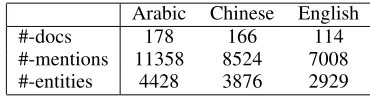
are reserved as the devtest set. Splitting data on chrono-logical order simulates the process of a system’s devel-opment and deployment in the real world. The devtest set statistics of three languages (Arabic, Chinese and English) is summarized in Table 1, where the number of documents, mentions and entities is shown on row 2 through 4, respectively. The rest of 2004 ACE data to-gether with earlier ACE data is used as training.
Arabic Chinese English
#-docs 178 166 114
#-mentions 11358 8524 7008
[image:4.612.91.276.591.639.2]#-entities 4428 3876 2929
Table 1: Devtest Set Statistics by Language
The official 2004 evaluation test set is used as the blind test set on which we run our system once after the system development is finished. We will report summary results
on this test set.
As for parser, we train three off-shelf maximum-entropy parsers (Ratnaparkhi, 1999) using the Arabic, Chinese and English Penn treebank (Maamouri and Bies, 2004; Xia et al., 2000; Marcus et al., 1993). Arabic words are segmented while the Chinese parser is a character-based parser. The three parsers have a label F-measure of77%,80%, and86% on their respective test sets. The three parsers are used to parse both ACE training and test data. Features described in Section 3 are computed from machine-generated parse trees.
Apart from features extracted from parse trees, our coref-erence system also utilizes other features such as lex-ical features (e.g., string matching), distance features characterized as quantized word and sentence distances, mention- and entity-level attribute information (e.g, ACE distinguishes 4 types of mentions: NAM(e), NOM(inal), PRE(modifier) and PRO(noun)) found in the 2004 ACE data. Details of these features can be found in (Luo et al., 2004).
4.2 Performance Metrics
The official performance metric in the ACE task is ACE-Value (NIST, 2004). The ACE-ACE-Value is an entity-based metric computed by subtracting a normalized cost from 1 (so it is unbounded below). The cost of a system is a weighted sum of costs associated with entity misses, false alarms and errors. This cost is normalized against the cost of a nominal system that outputs no entity. A perfect coreference system gets100%ACE-Value while
a system outputting many false-alarm entities could get a negative value.
The default weights in ACE-Value emphasize names, and severely discount pronouns: the relative importance of a pronoun is two orders of magnitude less than that of a name. So the ACE-Value will not be able to accurately re-flect a system’s improvement on pronouns2. For this rea-son, we compute anunweightedentity-constrained men-tion F-measure (Luo, 2005) and report all contrastive experiments with this metric. The F-measure is com-puted by first aligning system and reference entities such that the number of common mentions is maximized and each system entity is constrained to align with at most one reference entity, and vice versa. For exam-ple, suppose that a reference document contains three entities: {[m1],[m2, m3],[m4]}while a system outputs
four entities: {[m1, m2],[m3],[m5],[m6]}, where{mi :
i = 1,2,· · ·,6}are mentions, then the best alignment
from reference to system would be [m1] ⇔ [m1, m2],
[m2, m3]⇔[m3]and other entities are not aligned. The
number of common mentions of the best alignment is2
2Another possible choice is the MUC F-measure (Vilain et
(i.e., m1 andm3), thus the recall is 2
4 and precision is 2
5. Due to the one-to-one entity alignment constraint, the
F-measure here is more stringent than the accuracy (Ge et al., 1998; Mitkov, 1998; Kehler et al., 2004) computed on antecedent-pronoun pairs.
4.3 Effect of Syntactic Features
We first present the contrastive experimental results on the devtest described in sub-section 4.1.
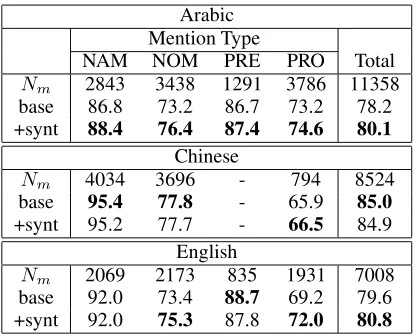
Two coreference systems are trained for each language: a baseline without syntactic features, and a system in-cluding the syntactic features. The entity-constrained F-measures with mention-type breakdown are presented in Table 2. Rows marked withNmcontain the number of mentions, while rows with “base” and “+synt” are F-measures for the baseline and the system with the syn-tactic features, respectively.
The syntactic features improve pronoun mentions across three languages – not surprising since features inspired by the binding theory are designed to improve pronouns. The pronoun improvement on the Arabic (from 73.2%
to74.6%) and English (from69.2%to72.0%) system is statistically significant (at above95%confidence level),
but change on the Chinese system is not. For Arabic, the syntactic features improve Arabic NAM, NOM and PRE mentions, probably because Arabic pronouns are sometimes attached to other types of mentions. For Chi-nese and English, the syntactic features do not practically change the systems’ performance.
As will be shown in Section 4.5, the baseline systems without syntactic features are already competitive, com-pared with the results on the coreference evaluation track (EDR-coref) of the ACE 2004 evaluation (NIS, 2004). So it is nice to see that syntactic features further improve a good baseline on Arabic and English.
Arabic Mention Type
NAM NOM PRE PRO Total
Nm 2843 3438 1291 3786 11358
base 86.8 73.2 86.7 73.2 78.2 +synt 88.4 76.4 87.4 74.6 80.1
Chinese
Nm 4034 3696 - 794 8524
base 95.4 77.8 - 65.9 85.0
+synt 95.2 77.7 - 66.5 84.9
English
[image:5.612.316.538.332.379.2]Nm 2069 2173 835 1931 7008 base 92.0 73.4 88.7 69.2 79.6 +synt 92.0 75.3 87.8 72.0 80.8 Table 2: F-measure(%) Breakdown by Mention Type: NAM(e), NOM(inal), PRE(modifier) and PRO(noun). Chinese data does not have the PRE type.
4.4 Error Analyses
From the results in Table 2, we know that the set of syn-tactic features are working in the Arabic and English sys-tem. But the results also raise some questions: Are there interactions among the the syntactic features and other features? Why do the syntactic features work well for Arabic and English, but not Chinese? To answer these questions, we look into each system and report our find-ings in the following sections.
4.4.1 English System
Our system uses a group of distance features. One ob-servation is that information provided by some syntactic features (e.g.,V P count(m1, m2)etc) may have
over-lapped with some of the distance features. To test if this is the case, we take out the distance features from the En-glish system, and then train two systems, one with the syntactic features, one without. The results are shown in Table 3, where numbers on the row “b-dist” are F-measures after removing the distance features from the baseline, and numbers on the row “b-dist+synt” are with the syntactic features.
Mention Type
NAM NOM PRE PRO Total b-dist 84.2 68.8 74.6 63.3 72.5 b-dist+synt 90.7 74.2 87.8 69.0 79.3 Table 3: Impact of Syntactic Features on English Sys-tem After Taking out Distance Features. Numbers are F-measures(%).
As can be seen, the impact of the syntactic features is much larger when the distance features are absent in the system: performance improves across all the four men-tion types after adding the syntactic features, and the overall F-measure jumps from 72.5% to 79.3%. The PRE type gets the biggest improvement since features ex-tracted from parse trees include apposition, same-parent test, and dependency features, which are designed to help mention pairs in close distance, just as in the case of PRE mentions.
Comparing the numbers in Table 3 with the English base-line of Table 2, we can also conclude that distance fea-tures and syntactic feafea-tures lead to about the same level of performance when the other set of features is not used. When the distance features are used, the syntac-tic features further help to improve the performance of the NOM and PRO mention type, albeit to a less degree because of information overlap between the two sets of features.
4.4.2 Chinese System
[image:5.612.82.292.486.654.2]first thing we look into is if there is any idiosyncrasy in the Chinese language.
In Table 4, we list the statistics collected over the training sets of the three languages: the second row are the total number of mentions, the third row the number of pronoun mentions, the fourth row the number of events where the c-command featureccmd(m1, m2)is used, and the last
row the average number of c-command features per pro-noun (i.e., the fourth row divided by the third row). A pronouns event is defined as a tuple of training instance
(e, m1, m2)wherem1 is a mention in entitye, and the
second mentionm2is a pronoun.
From Table 4, it is clear that Chinese pronoun distribution is very different: pronoun mentions account for about
8.7%of the total mentions in Chinese, while29.0%of
Arabic mentions and25.1%of English mentions are
[image:6.612.321.531.340.445.2]pro-nouns (the same disparity can be observed in the devtest set in Table 2). This is because Chinese is a pro-drop lan-guage (Huang, 1984): for example, in the Chinese Penn treebank version 4, there are 4933 overt pronouns, but 5750 pro-drops! The ubiquity of pro-drops in Chinese results in signigicantly less pronoun training events. Con-sequently, the pronoun-related features are not trained as well as in English and Arabic. One way to quantify this is by looking at the average number of c-command fea-tures on a per-pronoun basis: as shown in the last row of Table 4, the c-command feature is seen more than twice often in Arabic and English as in Chinese. Since low-count features are filtered out, the sparsity of pronoun events prevent many compound features (e.g., conjunc-tion of syntactic and distance features) from being trained in the Chinese system, which explains why the syntactic features do not help Chinese pronouns.
Arabic Chinese English #total-mentions 31706 33851 58202 #pron-mentions 9183 2941 14635 #-ccmd-event 10236 1260 13691
#ccmd/pron 1.14 0.428 0.936
Table 4: Distribution of Pronoun Mentions and Fre-quency of c-command Features
4.4.3 Arabic System
As stated in Table 4,29.0% of Arabic mentions are pro-nouns, compared to a slightly lower number (25.1%) for English. This explains the relatively high positive impact of the syntactic features on the Arabic coreference sys-tem, compared to English and Chinese systems. To un-derstand how syntactic features work in the Arabic sys-tem, we examine two examples extracted from the de-vtest set: (1) the first example shows the negative impact of syntactic features because of the noisy parsing output, and (2) the second example proves the effectiveness of the syntactic features to find the dependency between two
mentions. In both examples, the baseline system and the system with syntactic features give different results. Let’s consider the following sentence:
... AîDÖÞA«
Y®Ë@
ÉJKQå @ Q.
JªKð ...
... its-capital←Jerusalem←Israel←consider←and ...
...
é JKYÒÊË
ú
¯QåË@ Q¢ Ë@ àñJ J¢Ê ®Ë@ YKQK AÒJ ¯
of-the-city←the-Eastern←the-half←the-Palestininan←want←while
The English text shown above is a word-to-word trans-lation of the Arabic text (read from right-to-left). In this example, the parser wrongly put the nominal mention
Y ® Ë
@
(Jerusalem) and the pronominal mentioné JKYÖÏ@
(the-city) under the same constituent, which acti-vates thesame parentfeature. The use of the feature same parent(Y®Ë
@
,é JKYÖÏ@
) leads to the two mentions being put into different entities. This is because there are many cases in the training data where two mentions under the same parent are indeed in different entities: a similar English example is “John called his sister”, where “his” and “sister” belong to two different entities. Thesame parentfeature is a strong indicator of not putting
them into the same entity.
àð + ÈðA g + ø
+
àñJ¯A
¯ P
+
È@
+ àA
¿
è + ø
PA
m.' + È@ + H@ + Ém× + È@ + I.î E +
... +
Ñë
+ à
@ + ém.k + H.
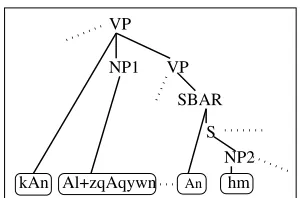
kAn +Al+zqAqywn+ y + HAwl + wn + nhb + Al + mHl + At + Al + tjAry + p + b + Hjp + An +hm+ ...
was +the+zqAqywn+present-verb-markery + trying +plural-verb-markerwn + to-steal + the + office + s + the + commercial + s + with + excuse + that +they+ ...
Table 5: An example where syntactic features help to link the PRO mention
Ñë
(hm) with its antecedent, the NAM mentionàñ J ¯A
¯ Q Ë@
(AlzqAqywn): top – Arabic sen-tence; middle – corresponding romanized sensen-tence; bot-tom – token-to-token English translation.Al+zqAqywn An
VP
NP1
SBAR VP
hm NP2 S
[image:7.612.109.259.56.155.2]kAn
Figure 2: A Portion of the Syntactic Tree.
4.5 ACE 2004 Results
To get a sense of the performance level of our system, we report the results on the ACE 2004 official test set with both the F-measure and the official ACE-Value metric. This data is used as the blind test set which we run our system only once.
Results are summarized in Table 6, where the second row (i.e. “base”) contains the baseline numbers, and the third row (i.e., “+synt”) contains the numbers from systems with the syntactic features. Columns under “F” are F-measure and those under “AV” are ACE-Value. The last rowNmcontains the number of mentions in the three test sets.
Arabic Chinese English
F AV F AV F AV
base 80.1 88.0 84.7 92.7 80.6 90.9 +synt 81.5 88.9 84.7 92.8 82.0 91.6
Nm 11358 11178 10336
Table 6: Summary Results on the 2004 ACE Evaluation Data.
The performance of three full (“+synt”) systems is re-markably close to that on the devtest set(cf. Table 2): For Arabic, F-measure is 80.1on the devtest vs. 81.5
here; For Chinese,84.9vs. 84.7; And for English,80.8
vs. 82.0. The syntactic features again help Arabic and English – statistically very significant in F-measure, but have no significant impact on Chinese. The performance consistency across the devtest and blind test set indicates that the systems are well trained.
The F-measures are computed on all types of mentions. Improvement on mention-types targeted by the syntactic features is larger than the lump-sum F-measure. For ex-ample, the F-measure for English pronouns on this test set is improved from69.5%to73.7%(not shown in Table 6
due to space limit). The main purpose of Table 6 is to get a sense of performance level correspondence between the F-measure and ACE-Value.
Also note that, for Arabic and English, the difference be-tween the “base” and “+synt” systems, when measured by ACE-Value, is much smaller. This is not surprising since ACE-Value heavily discounts pronouns and is
in-sensitive to improvement on pronouns – the very reason we adopt the F-measure in Section 4.3 and 4.4 when re-porting the contrastive experiment results.
5 Related Work
Many researchers have used the syntactic information in their coreference system before. For example, Hobbs (1976) uses a set of rules that are applied to parse trees to determine the antecedent of a pronoun. The rule prece-dence is determined heuristically and no weight is used. Lappin and Leass (1994) extracted rules from the out-put of the English Slot Grammar (ESG) (McCord, 1993). Rule weights are assigned manually and the system re-solves the third person pronouns and reflexive pronouns only. Ge et al. (1998) uses a non-parametrized statisti-cal model to find the antecedent from a list of candidates generated by applying the Hobbs algorithm to the English Penn Treebank. Kehler et al. (2004) experiments mak-ing use of predicate-argument structure extracted from a large TDT-corpus. Compared with these work, our work uses machine-generated parse trees from which trainable features are extracted in a maximum-entropy coreference system, while (Ge et al., 1998) assumes that correct parse trees are given. Feature weights are automatically trained in our system while (Lappin and Leass, 1994; Stuckardt, 2001) assign weights manually.
There are a large amount of published work (Morton, 2000; Soon et al., 2001; Ng and Cardie, 2002; Yang et al., 2003; Luo et al., 2004; Kehler et al., 2004) using machine-learning techniques in coreference resolution. But none of these work tried to compute complex lin-guistic concept such as governing category 3. Our work demonstrates how relevant linguistic knowledge can be derived automatically from system-generated parse trees and encoded into computable and trainable features in a machine-learning framework.
6 Conclusions
In this paper, linguistic knowledge is used to guide us to design features in maximum-entropy-based coreference resolution systems. In particular, we show how to com-pute a set of features to approximate the linguistic notions such as governing category and apposition, and how to compute the dependency features using syntactic parse trees. While the features are motivated by examining glish data, we see significant improvements on both En-glish and Arabic systems. Due to the language idiosyn-crasy (e.g., pro-drops), we do not see the syntactic fea-tures change the Chinese system significantly.
3Ng and Cardie (2002) used a BINDING feature, but it is
[image:7.612.75.293.356.419.2]Acknowledgments
This work was partially supported by the Defense Ad-vanced Research Projects Agency and monitored by SPAWAR under contract No. N66001-99-2-8916. The views and findings contained in this material are those of the authors and do not necessarily reflect the position of policy of the Government and no official endorsement should be inferred.
Suggestions for improving the paper from the anonymous reviewers are gratefully acknowledged.
References
Amit Bagga and Breck Baldwin. 1998. Algorithms for scoring coreference chains. InProceedings of the Linguistic Coreference Workshop at The First Interna-tional Conference on Language Resources and Evalua-tion (LREC’98), pages 563–566.
Santorini Beatrice and Anthony Kroch. 2000. The syn-tax of natural language: An online introduction using the Trees program. www.ling.upenn.edu/
beatrice/syntax-textbook.
Adam L. Berger, Stephen A. Della Pietra, and Vincent J. Della Pietra. 1996. A maximum entropy approach to natural language processing. Computational Linguistics, 22(1):39–71, March.
Niyu Ge, John Hale, and Eugene Charniak. 1998. A statistical approach to anaphora resolution. In Proc. of the sixth Workshop on Very Large Corpora.
Liliane Haegeman. 1994. Introduction to Government and Binding Theory. Basil Blackwell Inc., 2nd edition. J. Hobbs. 1976. Pronoun resolution. Technical report, Dept. of Computer Science, CUNY, Technical Report TR76-1.
C.-T. James Huang. 1984. On the distribution and refer-ence of empty pronouns.Linguistic Inquiry, 15:531–574. Andrew Kehler, Douglas Appelt, Lara Taylor, and Alek-sandr Simma. 2004. The (Non)utility of predicate-argument frequencies for pronoun interpretation. In Daniel Marcu Susan Dumais and Salim Roukos, editors,
HLT-NAACL 2004: Main Proceedings, Boston, Mas-sachusetts, USA, May 2 - May 7. Association for Com-putational Linguistics.
Shalom Lappin and Herbert J. Leass. 1994. An al-gorithm for pronominal anaphora resolution. Computa-tional Linguistics, 20(4), December.
Xiaoqiang Luo, Abe Ittycheriah, Hongyan Jing, Nanda Kambhatla, and Salim Roukos. 2004. A mention-synchronous coreference resolution algorithm based on the bell tree. InProc. of ACL.
Xiaoqiang Luo. 2005. On coreference resolution perfor-mance metrics. InProcs. of HLT/EMNLP.
Mohamed Maamouri and Ann Bies. 2004. Develop-ing an Arabic treebank: Methods, guidelines, procedures, and tools. InProceedings of the Workshop on Compu-tational Approaches to Arabic Script-based Languages, COLING.
M. Marcus, B. Santorini, and M. Marcinkiewicz. 1993. Building a large annotated corpus of English: the Penn treebank.Computational Linguistics, 19(2):313–330. Michael McCord. 1993. Heuristics for broad-coverage natural language parsing. InProc. ARPA Human Lan-guage Technology Workshop.
R. Mitkov. 1998. Robust pronoun resolution with limited knowledge. In Procs. of the 36th ACL/17th COLING, pages 869–875.
Thomas S. Morton. 2000. Coreference for NLP applica-tions. InIn Proceedings of the 38th Annual Meeting of the Association for Computational Linguistics.
Vincent Ng and Claire Cardie. 2002. Improving machine learning approaches to coreference resolution. InProc. of ACL, pages 104–111.
NIST. 2004. Proceedings of ACE Evaluation and PI Meeting 2004 Workshop, Alexandria, VA, September. NIST. 2004. The ACE evaluation plan. www.nist.gov/speech/tests/ace/index.htm.
Adwait Ratnaparkhi. 1999. Learning to parse natu-ral language with maximum entropy models. Machine Learning, 34:151–178.
Wee Meng Soon, Hwee Tou Ng, and Chung Yong Lim. 2001. A machine learning approach to coreference res-olution of noun phrases. Computational Linguistics, 27(4):521–544.
Roland Stuckardt. 2001. Design and enhanced evalua-tion of a robust anaphor resoluevalua-tion algorithm. Computa-tional Linguistics, 27(4).