T e x t - T r a n s l a t i o n A l i g n m e n t :
T h r e e L a n g u a g e s A r e B e t t e r T h a n T w o *
M i c h e l S i m a r d
Laboratoire de recherche appliqu4e en linguistique informatique (RALI) Universit4 de Montr6al
S imardM©IRO. UMontreal. CA
A b s t r a c t
In this article, we show how a bilingual text- translation alignment m e t h o d can be adapted to deal with more than two versions of a text. Experiments on a trilingual corpus demonstrate that this m e t h o d yields better
bilingual
align- ments t h a n can be obtained with bilingual text- alignment methods. Moreover, for a given num- ber of texts, the computational complexity of the multilingual m e t h o d is the same as for bilin- gual alignment.Introduction
While bilingual text corpora have been part of the computational linguistics scene for over ten years now, we have recently witnessed the ap- pearance of text corpora containing versions of texts in three or more languages, such as those developed within the C R A T E R (McEnery et al., 1997), M U L T E X T (Ide and V4ronis, 1994) and M U L T E X T - E A S T (Erjavec and Ide, 1998) projects. Access to this type of corpora raises a number of questions: Do they make new ap- plications possible? Can methods developed for handling bilingual texts be applied to multilin- gual texts? More generally: is there anything to gain in viewing multilingual documents as more than just multiple pairs of translations?
Bilingual alignments have so far shown that they can play multiple roles in a wide range of linguistic applications, such as computer as- sisted translation (Isabelle et al., 1993; Brown et al., 1990), terminology (Dagan and Church, 1994) lexicography (Langlois, 1996; Klavans and Tzoukermann, 1995; Melamed, 1996), and cross-language information retrieval (Nie et al., * This research was funded by the Canadian De- partment of Foreign Affairs and International Trade ( h t t p : / / ~ . d f a i t - m a e c i . g c . c a / ) , via the Agence de la francophonie ( h t t p : / / ~ . franeophonie, orE)
1998). However, the case for trilingual and mul- tilingual alignments is not as clear. True multi- lingual resources such as multilingual glossaries are not widely used, and most of the time, when such resources exist, the real purpose is usually to provide
bilingual
resources for multiple pairs of languages in a compact way.What we intend to show here is that while multilingual correspondences may not be inter- esting in themselves, multilingual text align- ment techniques can be useful as a means of extracting information on
bilingual correspon-
dences.
Our idea is that each additional version of a text should be viewed as valuable informa- tion that can be used to produce better align- ments. In other words: whatever the intended application, three languages are better t h a n two (and, more generally: the more languages, the merrier!).After going through some definitions and pre- liminary material (Section 1), we present a gen- eral m e t h o d for aligning three versions of a text (Section 2). We then describe some experiments that were carried out to evaluate this approach (Section 3) and various possible optimizations (Section 4). Finally, we report on some disturb- ing experiments (Section 5), and conclude with directions for future work.
1 T r i l i n g u a l A l i g n m e n t s
There are various ways in which the concept of alignment can be formalized. Here, we choose to view alignments as mathematical relations between linguistic entities:
Given two texts, A and B, seen as sets of
linguistic units: A = {al,a2,...,am}
and B = {bl, b2,...,bn},
we define abinary alignment
XAB
as a relation on A tj B:The interpretation of X A B is: (a, b) belongs to
XAB
if and only if some translation equivalence exists between a and b, total or partial.This definition of alignment, inspired from Kay and RSscheisen (1993), can be naturally ex- tended to accommodate any number of versions of a text. In general, we will say that, given N versions of a text
A1,...,AN,
a N - l i n g u a lalignment
XA~
is a relation onUiN=iAi.
Clearly, a N-lingual alignment can be ob- tained by combining pairwise bilingual align- ments. For example, with three texts A, B and C, and three alignments
XAB, XBC
andXCA,
one can easily obtain the trilingual alignment
XABC as XAB U XBC U XCA.
In fact, in all that follows, we indifferently refer to trilingual alignments as unique relations or as triples of bilingual alignments. Conversely, any smaller- degree alignment can be extracted as a subset of a N-lingual alignment, by projecting the re- lation onto a given "plane".Another thing that becomes apparent as soon as more t h a n two languages are involved is that text-translation alignments appear to be
equiva-
lence relations,
which means that they generally display the properties ofreflexivity, symmetry
and
transitivity:
• r e f l e x i v i t y : Any word or sequence of words aligns with i t s e l f - which is natural, insofar as we extend the notion of "transla- tion", so as to include the translation from one language to itself...
• s y m m e t r y : if a in language A is aligned with b in language B, then we expect b to align with a. In other words, alignment is not "directional".
• t r a n s i t i v i t y : if a aligns with b, and if b itself aligns with c, then a aligns with c. Although there are limits to the applicability of these mathematical properties to real-life trans- lations, the case of transitivity is particularly interesting, as we will see later on.
Translation equivalences can be viewed at dif- ferent levels of
resolution,
from the level of docu- ments to those of structural divisions (chapters, sections, etc.), paragraphs, sentences, words, morphemes and eventually, characters. In gen- eral, it seems quite clear that the smaller the units, the more interesting an alignment is likelyto be (although we can question the interest of a character-level alignment). However, in the ex- periments described here, we focus on alignment at the level of sentences, this for a number of reasons: First, sentence alignments have so far proven their usefulness in a number of appli- cations, e.g. bilingual lexicography (Langlois, 1996; Klavans and Tzoukermann, 1995; Da- gan and Church, 1994), automatic translation verification (Macklovitch, 1995; Macklovitch, 1996) and the automatic acquisition of knowl- edge about translation (Brown et al., 1993). Also, the sentence alignment problem has been widely studied, and we could even say that at this point in time, a certain consensus exists re- garding how the problem should be approached. On the other hand, not only is the com- putation of finer-resolution alignments, such as phrase- or word-level alignments, a much more complex operation, it also raises a num- ber of difficult problems related to evaluation (Melamed, 1998), which we wanted to avoid, at least at this point. Finally, we believe that the concepts, methods and results discussed here can be applied just as well to alignments at other levels of resolution.
2
A General M e t h o d for A l i g n i n g
M u l t i p l e V e r s i o n s o f a T e x tExisting alignment Mgorithms that rely on the optimality principle and dynamic programming to find the best possible sentence alignment, such as those of Gale and Church (1991), Brown et al. (1991), Simard et al. (1992), Chen (1993), Langlais and E1-B~ze (1997), Simard and Pla- m o n d o n (1998), etc. can be naturally extended to deal with three texts instead of two, or more generally to deal with N texts. While the res- olution of the bilingual problem is analogous to finding an optimal p a t h in a rectangular ma- trix, aligning N texts is analogous to the same problem, this time in a N-dimensional matrix. Normally, these methods produce alignments in the form of
parallel segmentations
of the texts into equal numbers of segments. These segmen- tations are such that 1) segmentation points co- incide with sentence boundaries and 2) the k thLa vraie question posde p a r c e t t e c o n t r o v e r s e e s t la suivante: ¶ qu'est ce que la pensde? 
Elle mystifie l'humanitd (seule, a p p a r e m m e n t , k pouvoir p e n s e r )
depuis des milldnalres. 
D e s o r d i n a t e u r s qui ne pensent pas o n t c e p e n d a n t rdorientd la question et ~limin~ diverses rdponses. 
La vraie r d p o n s e r e s t e e e p e n d a n t i n c o n n u e . ¶ L'esprit est-il un p r o g r a m m e d'ordinateur? ¶ J O H N S E A R L E 
N o n : 1"
un p r o g r a m m e manipule s e u l e m e n t d e s symboles, mais le
c e r v e a u leur d o n n e u n sens. 
B e h i n d this debate lies the question, W h a t does it ' m e a n to think? 
The issue h a s i n t r i g u e d p e o p l e (the only entities known to think) for millennia. 
C o m p u t e r s t h a t s o far do not t h i n k have given the question a
n e w slant and struck clown m a n y candidate answers. ¶ A definitive o n e r e m a i n s to be found. 
Is the b r a i n ' s Mind a C o m p u t e r Program?? ¶ NO.
A program merely manipulates symbols, whereas a brain at- taches m e a n i n g to them. 
by John It. Searle 
Figure 1: Bilingual Non-crossing Sentence Alignment - "¶" 's denote sentence boundaries; horizontal lines represent segmentation points.
This definition covers a subset of alignments as defined in Section 1. It is therefore always possible to represent a non-crossing alignment as an equivalence relation. However, the con- verse is not true: in particular, and as their name suggests, one cannot explicitly represent inversions with such alignments, i.e. situations where the order of sentences is not preserved across translation. In spite of this limitation, these alignments cover the vast majority of sit- uations encountered in real-life texts, at least at the level of sentences (Gale and Church, 1991). There is a problem with extending this class of alignment algorithms to deal with the gen- eral N-dimensional case, however: the compu- tational complexity of the algorithm increases multiplicatively with each new language. For instance, the space and time complexity of the trilingual version of the Gale and Church (1991) program would be O(N3). The use of such an algorithm quickly becomes prohibitive (for ex- ample: 1,000,000 computation steps for texts of 100 sentences each). Of course, in the case of bilingual alignment, it is common practice to restrict the search, for instance to a narrow corridor along the main "diagonal" (see Simard and P l a m o n d o n (1998), for example). But even with such heuristics, it is quite clear that in gen- eral, the search-space will grow multiplicatively with each new language.
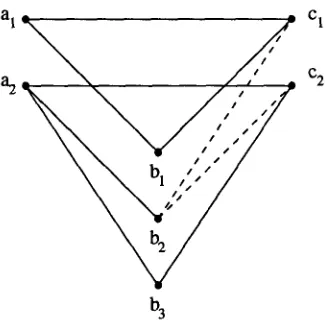
Nevertheless, the idea of aligning multiple versions of a text simultaneously is intuitively appealing: while the alignment operation will no doubt be more complex t h a n with two lan- guages, every new version brings some addi- tional information, which we should be able to make good use of (see Figure 2). Therefore, we will want to find a way to overcome the com- plexity issues.
We know that the multilingual alignment problem is related to a number of other sequence
a2 / " J c 2
Figure 2: Three texts are easier to align t h a n two - In the face of an uncertainty regarding correspondences between b2, Cl and c2: the ab- sence of evidence for (a2,cl) or (al, b2) corre- spondences suggests rejecting (b2, cl), while a similar reasoning supports (b2, c~).
[image:3.612.86.542.67.156.2] [image:3.612.352.515.207.367.2]first segmenting the input sequences at judicious points, and then aligning the subsequences). Of course, these strategies are also widely used in text-translation alignment.
However, the most widespread approach is to construct multiple alignments by iteratively combining smaller-degree alignments. While these methods are not generally optimal, they still produce good results in most situations. More importantly, for a given number of se- quences, they usually work in quadratic time and space. The general idea is to first com- pare sequences two-by-two, so as to measure their pairwise similarity; based on the result of this operation, an order of alignment is deter- mined - - typically, the most similar pairs will be aligned first; the final multiple alignment is pro- duced by gradually combining alignments (see, for example, Barton and Sternberg (1987)).
This approach can be directly adapted to the trilingual text alignment problem. The idea is simple: given three versions of a text A, B and C, in three different languages, we first deter- mine which of the three pairs
AB, BC
orAC
is the most "similar". Let us suppose that this is the
AB
pair. We then align this pair, using whatever bilingual alignment program we have at hand, producingXAB;
we then align text C with this alignment, thus producingXABC.
To implement this idea, we need to answer two questions: First, how to measure the simi- larity between different versions of a text? And second, what does it mean to align a text with an alignment?
There are certainly numerous possible an- swers to the first question. But actually, statis- tical alignment methods such as those derived from Gale and Church (1991) provide us with a simple solution: to find the best alignment, these methods explore different alignment hy- potheses, and select the one with the highest probability with regard to a certain statistical model of translation. Therefore, at the end of the operation, a statistical alignment program has at its disposal an overall score for the best alignment, in the form of a global probability. In practice, we observe that this score is a good indicator of the similarity between two texts. For instance, Gale and Church used this score to identify dubious regions in their alignments 1. 1Also recall that the dynamic programming approach
Therefore, to determine the most similar pair of texts, we propose to compute the bilingual
alignments XAB, XBC
andXAC,
and to com- pare the final alignment scores. Of course, for this exercise to be meaningful, we must make sure that the scores associated with the bilin- gual alignments are indeed comparable. In gen- eral, if the same alignment m e t h o d is used with comparable translation models for all pairs of languages, this should not be a problem.Once the most similar pair of versions has been identified, say A and B, and we have com- p u t e d a bilingual alignment for that pair, we are ready to tackle the problem of aligning the remaining text C with the
XAB
alignment. In practice, this will amount to aligning the ele- ments of C (in our case, sentences) with indi- vidual "couples" of theXAB
relation: whenever we align some sentence c E C with a sentence a E A, then this implies that c must also be aligned with all other sentences to which a is related within the transitive closure ofXAB.
In other words, this alignment m e t h o d is "inher- ently transitive".In practice, the alignment of
XAB
and C is dealt with just like a bilingual alignment: theXAB
alignment is viewed as a sequence of items, and dynamic programming is used to find the best alignment with the sentences of C. The only real difference lies in how individ- ual "triples" are scored. Here again, we t u r n to molecular biology, where experience seems to show that the "joint similarity" of multiple items can be measured as the linear combina- tion of all pairwise comparisons:s(al,...,aN) = Z s(ai, aj)
i<jThis sort of combination supposes that all bi- nary scoring functions
s(ai, aj)
are comparable (Carillo and Lipman, 1988). Once again, this will not be a problem if we plan to use analo- gous translation models for all language pairs.To sum up, given three versions of a text A, B and C, we propose the following trilingual alignment method:
1. C o m p u t e initial bilingual alignments
XAB,
XBC
andXAC;
2. Using the final alignment score, identify the most similar pair (say,
AB);
3. Align the remaining text (C) with the ini- tial alignment of the retained pair (XAB); the result is a trilingual alignment
XABC;
The computational complexity of this method is essentially the same as that of the underlying bilingual alignment method, both in terms of time and space. In practice, aligning three texts this way takes about the same amount of mem- ory as aligning one pair, and about four times as much computation time.
3 E v a l u a t i o n
We have implemented a trilingual sentence- alignment program called
trial,
based on the ap- proach presented in Section 2 and on a bilingual sentence-alignment program calledsfial,
which implements a modified version of the method of Simard et al. (1992). Insfial,
we essentially combine into a statistical framework two crite- ria: the length-similarity criterion proposed by Gale and Church (1991) and a "graphemic re- semblance" criterion based on the existence of cognate words between languages. This method was chosen because it is simple, it requires a minimum of language-specific knowledge, and because it is representative of the kind of ap- proaches that are typically used for this task, at least for aligning between closely-related lan- guages such as German, English, French, Span- ish, etc. Furthermore, in a recent sentence- alignment "competition" held within the AR- CADE project (Langlais et al., 1998), the three top-ranking systems relied at least partially on cognates, and two of them were derived directly from the Simard et al. (1992) method.To test the performance of the
trial
pro- gram, we needed a performance metric and a test corpus. Following the work of the AR- CADE project, we decided to measure perfor- mance in terms ofalignment recall, precision
and
F-measure,
computed on the basis of sen- tence lengths (measured in terms of characters). In our experience, this set of metrics is the most generally useful.Our test corpus was
The Gospel Accord-
ing to John,
in English(New International
Version),
French (Louis Segond translation)Languages
Spanish precision -French recall F French precision -English recall F English
-Spanish
precision recall F
sfial
0.997 0.989 0.993 0.956 0.941 0.948 0.952 0.936 0.944
trial
0.997 0.989 0.993 0.962 0.941 0.951 0.950 0.943 0.947
Table 1: Precision, recall and
F-measure
of alignments produced bysfial
andtrial,
onThe
Gospel According to John,
French, English and Spanish versions.and Spanish
(Reina Valera
version). All ver- sions were obtained via theBible Gateway
( h t t p : / / u v w . g o s p e l c o m . n e t ) . For the needs of the evaluation, we manually segmented all three versions of the text into sentences, and then produced reference sentence alignments, using the
Manual
system (Simard, 1998c). This corpus and its preparation axe described in more details in Simard (1998a).The test-corpus was submitted to both
sfial
and
trial;
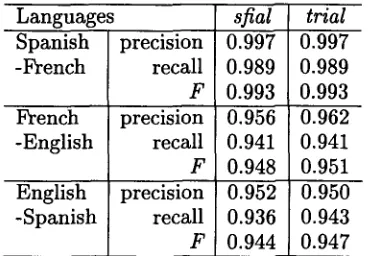
the results of this experiment are re- produced in Table 1. The Spanish-French pair was identified bytrial as
being the most similar (not surprisingly, English-Spanish was the most dissimilar). Since the alignment of the most similar pair is used as the basis of the trilingual alignment, the results obtained bysfial
andtrial
for this pair are identical. On the other hand, for the two other pairs, the
trial
method seems to improve the quality of the alignments, but the gains are minimal.A close examination of the results quickly reveals what is going on here: As mentioned earlier, our trilingual alignment method is "in- herently transitive"; in fact, it naturally pro- duces alignments which are transitively closed. In doing so, it sometimes run into some natural limitations of the applicability of transitivity to real-life translations. Take the following exam- ple: suppose that the word
weak
in an English text is rendered in French assans force
("with- out strength") and in Spanish assin fortaleza.
A transitively closed trilingual alignment will contain the correct correspondences
(sans, sin)
[image:5.612.337.523.63.191.2]Languages
French precision -English recall F English precision -Spanish recall F
before after 0.962 0.979 0.941 0.938 0.951 0.958 0.950 0.970 0.943 0.938 0.947 0.954 Table 2: Impact of re-segmenting couples in- volving more t h a n a single pair of sentences in the alignment produced by trial.
dences (sans, fortaleza) and (force, sin), which are superfluous. Such contractions and expan- sions h a p p e n all the time in real-life transla- tions, not only at the level of words, but at the level of sentences as well. As a result, transi- tively closed alignments of three texts or more will usually display a lower precision t h a n bilin- gual alignments.
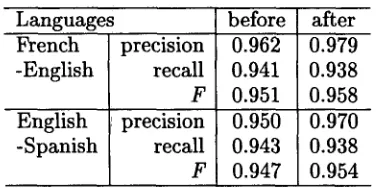
To compensate for this "transitivity noise", we decided to apply a final post-processing step: for each pair of languages, whenever the trilin- gual alignment produced by trial connects two pairs of sentences or more, we evaluate the im- pact of re-segmenting the corresponding region of text (in other words, we perform a local bilin- gual alignment). Typically, this operation can be carried out in near-linear time and space.
Table 2 shows the impact of this procedure on the trial alignments of The Gospel According to • John (the initial bilingual alignment is not sub- mitted to re-alignment, and so the results for the French-Spanish pair is not reproduced here). What we observe is a significant improvement of precision, and a slight decrease in recall. Com- pared to the sfial bilingual alignment, the over- all improvement (F-measure) is approximately 1%: all figures being in the 0.95 area, this cor- responds to a 20% reduction in the total error. Therefore, it would indeed seem that our final post-processing is effective, and that in the end,
"three languages are better than two".
4
Optimizations
In addition to all the usual optimizations to bilingual alignment methods, various things can be done to reduce computation times in the trilingual alignment m e t h o d of Section 2: for instance, individual bilingual scores from step 1 can be recorded in memory, to be later re-
used in step 3. Also, if multiple processors are available, the three initial alignments of step 1 can be done in parallel. By combining these optimizations, it is possible to align three texts in less t h a n twice the time necessary to align a single pair.
Another possible optimization is to initially segment the three texts in parallel, so as to per- form step 3 on smaller pieces. Of course, this idea is not new, but what makes it particularily appealing for trilingual alignment, in addition to the usual reduction in the needed time and space, is the potential for further improvements in the quality of the resulting alignments: In the m e t h o d outlined above, we have chosen to base the re-alignment on the initial alignment that connected the two most similar versions of the text. In reality, nothing proves that this similarity is "evenly distributed" on the total- ity of the texts. In fact, if we segmented the input texts at arbitrary points, we might very well discover that the most similar pair of lan- guages is not always the same. If this is the case, then we could improve our results by doing the re-alignment in small chunks, each time basing the re-alignment on the pair of languages that locally displays the best similarity.
On the other hand, this approach also carries its own risks. Indeed, by pre-segmenting the three texts in parallel, we will be fixing points in the alignment a priori, namely those points at the boundaries between segments. This is why it is crucially important to select segmenta- tion points judiciously: we will want these to lie in areas where all three initial alignments agree and each display a high level of confidence.
In practice, such "points of agreement" be- tween the initial bilingual alignments can be found by computing their transitive closure, i.e. by adding to the union of the three alignments all couples whose existence is predicted by tran- sitivity (a simple procedure for this can be found in Hopcroft and Ullman (1979)). From such transitively closed trilingual alignments emerge "islands of correspondence", i.e. groups of sen- tences that are all related to one another. In between these islands lie natural segmentation points, that can be viewed as points of agree- ment between the three initial alignments.
[image:6.612.89.277.65.159.2]to select among such points of agreement only those lying between pairs of islands of corre- spondence for which we have a high degree of confidence. To measure this "confidence", we currently use two criteria: first, the number of sentences of each language in the surrounding is- lands; and second, the alignment program's own scoring function. The first criterium is based on the simple observation that most alignment er- rors happen when the translation diverges from the usual pattern of "one sentence translates to one sentence" (Simard, 1998b); so we only con- sider points of agreement lying between "l-to- 1-to-l" islands. The second criterium is based on the observation by Gale and Church (1991) that good alignments usually coincide with high scoring regions of text.
To sum up, our optimized trilingual align- ment method follows these lines:
Given three versions of a text A, B and C,
1. Compute initial bilingual alignments
XAB,
XBC and
XAC;
2. Segment the texts:
(a) Identify points of agreement between
XAS, XBC
andXAC,
by computing the transitive closureX~B C
ofXAB U
X B C U XAC;(b) Among these points, select those points that lie between pairs of 1-1-1 triples within which individual bilin- gual alignment scores do not exceed some threshold T;
(c) Segment A, B and C at these points, thus producing sub-segments A1...An,
B1...Bn
and C1...C n.3. Jointly align each triple of segments
(Ai, Bi, Ci) as
with thetrial
method (Sec- tion 2), and obtain the final trilingual align- ment as the union of all partial alignmentsX A B C = UXAiBiCi ;
This optimization was implemented into the
trial
program, thus producing a program we calltrial++. The Gospel According to John,
in French, English and Spanish was then submit- ted to this new program. To a certain degree, the results of this experiment were a disappoint- ment, since they turned out to be virtually iden- tical to those obtained with thetrial
program.step
trial trial++
bilingual alignment 113 113 pre-segmentation - 12 re-alignment 69 18
Total 182 143
Table 3: Execution times in seconds for indi- vidual computation steps of
trial
andtrial++
(French, Spanish and English versions of
The
Gospel According to John).
A closer examination reveals what is going on: in 201 out of the 279 segments produced by the pre-segmentation procedure,
trial++
chose to base the re-alignment on the same alignment astrial,
i.e. the Spanish-French. No differences could therefore be expected between the two programs on these segments. Of the 78 remain- ing segments, 60 contained exactly one sentence per language, so not much improvement could be expected for those either. In the end, only 18 segments remained wheretrial
andtrial+ +
had the potential to produce different alignments; but even here, both programs produced birtu- ally identical results.The main difference between
trial
andtrial++
was execution times. Table 3 shows the times required for each of the computation steps of the two programs. What we observe is that pre-segmentation reduces execution times significantly, without hampering the quality of the alignments. We can therefore consider that this is a useful step, especially if we are dealing with long texts 2.5 A D i s t u r b i n g E x p e r i m e n t . . .
We mentioned earlier that to compute trilin- gual alignments, directly extending dynamic programming bilingual alignment methods was not a realistic approach from the point of view of computational complexity. However, it seems that the optimization described in Section 4 for pre-segmenting the three texts into small seg- ments before performing the trilingual align- ment could actually help resolve the problem: if we manage to segment the input texts into small enough chunks, then a cubic-order algo-
Languages Spanish -French French -English English -Spanish
precision recall F precision
recall F precision
recall F
sfial trial t r i a l - - 0.997 0.997 0.992 0.989 0.989 0.984 0.993:0.993 0.988 0.956 0.979 0.959 0.941 0.938 0.919 0.948 0.958 0.938 0.952 0.970 0.952 0.936 0.938 0.914 0.944 0.954 0.933 Table 4: Precision, recall and F-measure of s.fial,
trial and t r i a l - -
rithm may not be so problematic after all. To test this conjecture, we implemented the following method into a program called t r i a l - - (the origin of the name will become clear in a moment ):
Given three versions of a text A, B and C, 1. Compute initial bilingual alignments XAB,
X B e and XAC;
2. Pre-segment the texts, as in Section 4; 3. Align each triple of sub-segments
(Ai, Bi, Ci), using dynamic program- ming to find the optimal alignment XAiBiCl in the Ai x Bi x Ci space;
4. Obtain the final trilingual alignment as the union of all partial alignments XAB c ---- Ui = 1...nXAiBiCi;
Once again, and as in the trial and trial++ methods, we finish up with a final bilingual alignment pass to compensate for "transitivity noise".
This new program was succesful in aligning The Gospel According to John , using amounts of time and memory comparable to the trial++ program. However, the resulting alignments were quite different, as can be seen in the per- formance figures in Table 4.
The performance of this new program on The Gospel According to John turns out to be not only poorer than that of the trial program, but also poorer than that of the sfial program! What is going on, here? After all, we would expect t r i a l - - to be The optimal method, of which all others are heuristic approximations. Although we have no definitive answer to this
question, we see two different lines of explana- tion.
The first and most obvious possibility is that our initial assumption, namely that three lan- guages are better than two, is false. In other words: aligning three texts is at least as hard as aligning two, and possibly harder. Of course, this would also imply that the results obtained with the trial and trial++ methods were mere accidents. Although this explanation for the failure of the t r i a l - - approach clearly contra- dicts our initial intuitions, we cannot entirely reject it. We do not, however, pursue this line any further. (Besides, it doesn't go any further!) The second line of explanation leads us straight to the scoring function of our alignment methods. As in the trial and trial++ meth- ods, the scoring function used in t r i a l - - is the sum of all pairwise (bilingual) alignment scores. It could simply be that this way of measuring "trilingual fit" is inadequate.
However, we believe that our problems run deeper. To begin with, it could be argued that what a trilingual alignment program re- ally needs is a true "trilingual translation mod- el"; it is not at all clear that three bilingual translation models are an adequate substitute for this. Even if it were, we know that there are numerous problems with the "length" and "cognate" stochastic models on which the s fial scoring function is based. For instance, we know that while these models usually describe the phenomena observed in translations adequately, they are not necessarily as good when it comes to things that are not translations.
While these weaknesses do not appear to cause too many problems when computing bilin- gual alignments, it would not be surprising that a third language is all it takes for incoherences to creep out and performance to degrade. If this is indeed the case, then this is one more argu- ment in favor of the trial approach: by treating multilingual alignments the same way as bilin- gual alignments, this approach may let us get away with poor translation models, at least un- til we come up with something better!
C o n c l u s i o n a n d F u t u r e W o r k
[image:8.612.71.298.62.190.2]computational complexity of the resulting trilin- gual alignment method is the same as that of the underlying bilingual method, and various optimizations are possible. In experiments on English, French and Spanish versions of
The
Gospel According to John,
this approach pro- duced sentence alignments significantly better than those obtained using a bilingual alignment program.All tests reported here were conducted on a single, relatively small corpus of text. The con- tradictory results reported in Section 5 highlight the need for more work with regard to evalua- tion. Such an evaluation exercise would nor- mally imply putting together a much larger and more varied test corpus, segmented and aligned by hand, a process which is known to be costly. However, since the goal is to measure improve- ments relative to existing bilingual alignment methods, an interesting alternative would be to perform a relative evaluation instead: the pro- grams could then be tested on a much larger test-corpus, and the performance of each sys- tem would be measured on only those portions of text where the alignments differ. The details of such an evaluation need to be worked out.
Also, it remains to be seen how the
trial
approach would adapt to the general multi- lingual case (three languages or more) on the one hand, and to the more challenging prob- lem of finer-grained alignments on the other hand. Here again, we will likely encounter nu- merous complications, most notably regarding questions of evaluation. Ongoing work in the word-alignment track of the ARCADE project is likely to bring interesting results regarding this question (Langlals et al., 1998).
Finally, and probably more importantly, working with more than two languages has high- lighted weaknesses in the modeling of trans- lation that underlies our alignment methods. Much work remains to be done in this direction.
A c k n o w l e d g e m e n t s
Many of the ideas expressed here emerged from informal exchanges with Fathi Debili and Pierre Isabelle; I am greatly indebted to both for their constant support throughout this project. I also wish to thank the anonymous reviewers for their constructive comments on the paper.
R e f e r e n c e s
1991.
Proceedings of the 29th Annual Meeting of
the Association for Computational Linguis-
tics (A CL),
Berkeley, California, June. 1996.Proceedings of the Second Conference of
the Association for Machine Translation in
the Americas (AMTA),
Montr@al, Canada. Geoffrey J Barton and Michael J E Sternberg.1987. A Strategy for the Rapid Multiple Alignment of Proteine Sequences.
Journal of
Molecular Biology,
198:327-337.Peter F. Brown, John Cocke, Stephen A. Della Pietra, Vincent J. Della Pietra, Fredrick Je- linek, John D. Lafferty, Robert L. Mercer, and Paul S. Roossin. 1990. A statistical approach to machine translation.
Computa-
tional Linguistics,
16(2):79-85, June.Peter Brown, Jennifer C. Lai, and Robert Mer- cer. 1991. Aligning Sentences in Parallel Cor- pora. In ACL-29 (ACL, 1991).
Peter F. Brown, Stephen A. Della Pietra, Vin- cent J. Della Pietra, and Robert L. Mercer. 1993. The Mathematics of Machine Transla- tion: Parameter Estimation.
Computational
Linguistics,
19(2).Humberto Carillo and David Lipman. 1988. The Multiple Sequence Alignment Problem in Biology.
SIAM Journal of Applied Mathe-
matics,
48(5).S.C. Chan, A.K.C. Wong, and D.K.U. Chiu. 1992. A Survey Of Multiple Sequence Com- parison Methods.
Bulletin of Mathematical
Biology,
54(4):563-598.Stanley F. Chen. 1993. Aligning Sentences in Bilingual Corpora Using Lexical Information. In
Proceedings of the 31st Annual Meeting of
the Association /or Computational Linguis-
tics (A CL),
Columbus, Ohio, June.Ido Dagan and Ken W. Church. 1994. TER- MIGHT: Identifying and Translating Tech- nical Terminology. In
Proceedings off the
$th Conference on Applied Natural Language
Processing (ANLP).
Toma~ Erjavec and Nancy Ide. 1998. The MULTEXT-East Corpus. In LREC-1 (LRE, 1998).
William A. Gale and Kenneth W. Church. 1991. A Program for Aligning Sentences in Bilin- gual Corpora. In ACL-29 (ACL, 1991). John E. Hopcroft and Jeffrey D. Ullman.
guages and Computation. Computer Science. Addison-Wesley Publishing Company.
Nancy Ide and Jean V~ronis. 1994. MULTEXT (Multilingual T e x t Tools and Corpora). In Proceedings of the International Confer- ence on Computational Linguistics (COL- ING) 1994, Kyoto, Japan, August.
Pierre Isabelle, Marc Dymetman, George Fos- ter, Jean-Marc Jutras, Elliott Macklovitch, Francois Perrault, Xiaobo Ren, and Michel Simard. 1993. Translation Analysis and Translation Automation. In Proceedings of the 5th Conference on Theoretical and Methodological Issues in Machine Translation (TMI), Kyoto, Japan.
Martin Kay and Martin RSscheisen. 1993. Text-translation Alignment. Computational Linguistics, 19(1).
Judith Klavans. and Evelyne Tzoukermann. 1995. Combining Corpus and Machine- readable Dictionary Data for Building Bilin- gual Lexicons. Machine Translation, 10(3). Philippe Langlais and Marc E1-B~ze. 1997.
Alignement de corpus bilingues : algo- rithmes et dvaluation. In Proceedings of l~res Journdes Scientifiques et Techniques du Rdseau Francophone de l'Ingdnierie de la Langue de I'AUPELF-UREF (JST), Avi- gnon, April.
Philippe Langlais, Michel Simard, Jean Vdronis, Susan Armstrong, Patrice Bonhomme, Fathi Debili, Pierre Isabelle, Emna Souissi, and P. Th~ron. 1998. ARCADE: A Cooperative Research Project on Parallel Text Alignment Evaluation. In LREC-1 (LRE, 1998).
Lucie Langlois. 1996. Bilingual Concordances: A New Tool for Bilingual Lexicographers. In AMTA-2 (AMT, 1996).
1998. Proceedings of the First International Conference on Language Resources ~ Eval- uation (LREC), Granada, Spain.
Elliott Macklovitch. 1995. TransCheck - - or the Automatic Validation of Human Trans- lations. In Proceedings of the Fifth Machine
Translation Summit, Luxembourg.
Elliott Macklovitch. 1996. Peut-on vdrifier au- tomatiquement la coherence terminologique?
META, 41(3).
A.M. McEnery, A. Wilson, F. S£nchez-Leon, and A. Nieto-Serrano. 1997. MultilingualRe- sources for European Languages: Contribu-
tions of the CRATER Project. Literary and Linguistic Computing, 12(4).
I. Dan Melamed. 1996. Automatic Construc- tion of Clean Broad-coverage Translation Lexicons. In AMTA-2 (AMT, 1996).
I. Dan Melamed. 1998. Manual Annotation of Translational Equivalence: The Blinker Project. Technical Report 98-06, IRCS, Philadelphia PA.
Jian-Yun Nie, Pierre Isabelle, Pierre Plam- ondon, and George Foster. 1998. Using a Probabilistic Translation Model for Cross- language Information Retrieval. In Proceed- ings of the 6th A CL Workshop on Very Large Corpora (WVLC), Montrdal, Canada.
Michel Simard and Pierre Plamondon. 1998. Bilingual Sentence Alignment: Balancing Ro- bustness and Accuracy. Machine Translation,
13(1):59-80.
Michel Simard, George Foster, and Pierre Is-
abelle. 1992. Using Cognates to Align Sen-
tences in Bilingual Corpora. In
Proceedings
of the 4th Conference on Theoretical and Methodological Issues in Machine Translation
(TMI), MontrEal, QuEbec.
Michel Simard. 1998a. Projet TRIAL : Appariement de texte trilingue. URL:
http ://www-rali. iro. umontreal, ca/Trial.
Michel Simard. 1998b. RALI-ARCADE : Analyse des erreurs d'alignement commises par Salign sur les corpus BAF et JOC.
URL: http ://www-rali. iro.umontreal, ca/- at c-a2/analyse-erreur s.
Michel Simard. 1998c. The BAF: A Corpus of English-French Bitext. In LREC-1 (LRE, 1998).
M. J. E. Sternberg, editor. 1996. Protein Struc- ture Prediction - A Practical Approach. Ox- ford University Press, Oxford.