Translating with non-contiguous phrases
Michel Simard, Nicola Cancedda, Bruno Cavestro, Marc Dymetman, Eric Gaussier, Cyril Goutte, Kenji Yamada
Xerox Research Centre Europe [email protected]
Philippe Langlais
RALI/DIRO Universit´e de Montr´eal [email protected]
Arne Mauser RWTH Aachen University [email protected]
Abstract
This paper presents a phrase-based statis-tical machine translation method, based on non-contiguous phrases, i.e. phrases with gaps. A method for producing such phrases from a word-aligned corpora is proposed. A statistical translation model is also presented that deals such phrases, as well as a training method based on the maximization of translation accuracy, as measured with the NIST evaluation met-ric. Translations are produced by means of a beam-search decoder. Experimental re-sults are presented, that demonstrate how the proposed method allows to better gen-eralize from the training data.
1 Introduction
Possibly the most remarkable evolution of recent years in statistical machine translation is the step from word-based models to phrase-based models (Och et al., 1999; Marcu and Wong, 2002; Yamada and Knight, 2002; Tillmann and Xia, 2003). While in traditional word-based statistical models (Brown et al., 1993) the atomic unit that translation operates on is the word, phrase-based methods acknowledge the significant role played in language by multi-word expressions, thus incorporating in a statistical framework the insight behind Example-Based Ma-chine Translation (Somers, 1999).
However, Phrase-based models proposed so far only deal with multi-word units that are sequences
of contiguous words on both the source and the tar-get side. We propose here a model designed to deal with multi-word expressions that need not be con-tiguous in either or both the source and the target side.
The rest of this paper is organised as follows. Sec-tion 2 provides motivaSec-tions, definiSec-tion and extrac-tion procedure for non-contiguous phrases. The log-linear conditional translation model we adopted is the object of Section 3; the method used to train its parameters is described in Section 4. Section 5 briefly describes the decoder. The experiments we conducted to asses the effectiveness of using non-contiguous phrases are presented in Section 6.
2 Non-contiguous phrases
Why should it be a good thing to use phrases composed of possibly non-contiguous sequences of words? In doing so we expect to improve trans-lation quality by better accounting for additional linguistic phenomena as well as by extending the effect of contextual semantic disambiguation and example-based translation inherent in phrase-based MT. An example of a phenomenon best described using non-contiguous units is provided by English phrasal verbs. Consider the sentence “Mary switches her table lamp off”. Word-based statistical mod-els would be at odds when selecting the appropri-ate translation of the verb. If French were the target language, for instance, corpus evidence would come from both examples in which “switch” is translated as “allumer” (to switch on) and as “´eteindre” (to switch off). If many-to-one word alignments are not allowed from English to French, as it is usually the
2 3 1
Pierre
Pierre
ne mange pas
[image:2.612.126.245.54.116.2]does not eat
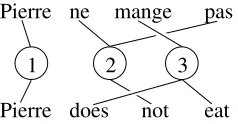
Figure 1: An example of a complex alignment asso-ciated with different syntax for negation in English and French.
case, then the best thing a word-based model could do in this case would be to align “off” to the empty word and hope to select the correct translation from “switch” only, basically a 50-50 bet. While han-dling inseparable phrasal verbs such as “to run out” correctly, previously proposed phrase-based models would be helpless in this case. A comparable behav-ior is displayed by German separable verbs. More-over, non-contiguous linguistic units are not limited to verbs. Negation is formed, in French, by inserting the words “ne” and “pas” before and after a verb re-spectively. So, the sentence “Pierre ne mange pas” and its English translation display a complex word-level alignment (Figure 1) current models cannot ac-count for.
Flexible idioms, allowing for the insertion of lin-guistic material, are other phenomena best modeled with non-contiguous units.
2.1 Definition and library construction
We define a bi-phrase as a pair comprising a source phrase and a target phrase: b =h˜s,˜ti. Each of the source and target phrases is a sequence of words and gaps (indicated by the symbol); each gap acts as a placeholder for exactly one unspecified word. For example,w˜ =w1w2w3 w4is a phrase of length
7, made up of two contiguous wordsw1 andw2, a
first gap, a third wordw3, two consecutive gaps and
a final wordw4. To avoid redundancy, phrases may
not begin or end with a gap. If a phrase does not contain any gaps, we say it is contiguous; otherwise it is non-contiguous. Likewise, a bi-phrase is said to be contiguous if both its phrases are contiguous.
The translation of a source sentencesis produced by combining together bi-phrases so as to cover the source sentence, and produce a well-formed target-language sentence (i.e. without gaps). A complete translation forscan be described as an ordered
se-quence of bi-phrasesb1...bK. When piecing together
the final translation, the target-language portion ˜t1
of the first bi-phraseb1is first layed down, then each
subsequent˜tk is positioned on the first “free” posi-tion in the target language sentence, i.e. either the leftmost gap, or the right end of the sequence. Fig-ure 2 illustrates this process with an example.
To produce translations, our approach therefore relies on a collection of bi-phrases, what we call a bi-phrase library. Such a library is constructed from a corpus of existing translations, aligned at the word level.
Two strategies come to mind to produce non-contiguous bi-phrases for these libraries. The first is to align the words using a “standard” word aligne-ment technique, such as the Refined Method de-scribed in (Och and Ney, 2003) (the intersection of two IBM Viterbi alignments, forward and reverse, enriched with alignments from the union) and then generate bi-phrases by combining together individ-ual alignments that co-occur in the same pair of sen-tences. This is the strategy that is usually adopted in other phrase-based MT approaches (Zens and Ney, 2003; Och and Ney, 2004). Here, the difference is that we are not restricted to combinations that pro-duce strictly contiguous bi-phrases.
The second strategy is to rely on a word-alignment method that naturally produces many-to-many alignments between non-contiguous words, such as the method described in (Goutte et al., 2004). By means of a matrix factorization, this method produces a parallel partition of the two texts, seen as sets of word tokens. Each token therefore belongs to one, and only one, subset within this par-tition, and corresponding subsets in the source and target make up what are called cepts. For example, in Figure 1, these cepts are represented by the circles numbered 1, 2 and 3; each cept thus connects word tokens in the source and the target, regardless of po-sition or contiguity. These cepts naturally constitute phrases, and can be used directly to produce a bi-phrase library.
con-danser le tango to tango
I do not want to tango anymore I do not want anymore
do
I want
Je ne veux plus danser le tango
Je I
ne plus veux
want do
not anymore
I
source =
bi−phrase 1 =
bi−phrase 2 =
bi−phrase 3 =
bi−phrase 4 =
[image:3.612.107.503.55.199.2]target =
Figure 2: Combining bi-phrases to produce a translation.
tiguous phrases, the number of bi-phrases that can be extracted from a single pair of sentences typically grows quadratically with the size of the sentences; with non-contiguous phrases, however, this growth is exponential. As it turns out, the number of avail-able bi-phrases for the translation of a sentence has a direct impact on the time required to compute the translation; we will therefore typically rely on vari-ous filtering techniques, aimed at keeping only those bi-phrases that are more likely to be useful. For ex-ample, we may retain only the most frequently ob-served bi-phrases, or impose limits on the number of cepts, the size of gaps, etc.
3 The Model
In statistical machine translation, we are given a source language input sJ1 = s1...sJ, and seek the
target-language sentencetI1 =t1...tIthat is its most
likely translation:
ˆ
tI1 = argmaxtI 1Pr(t
I
1|sJ1) (1)
Our approach is based on a direct approximation of the posterior probabilityPr(tI1|sJ1), using a log-linear model:
Pr(tI1|sJ1) = 1 ZsJ
1
exp M
X
m=1
λmhm(tI1, sJ1)
!
In such a model, the contribution of each feature function hm is determined by the corresponding
model parameterλm; ZsJ
1 denotes a normalization constant. This type of model is now quite widely
used for machine translation (Tillmann and Xia, 2003; Zens and Ney, 2003)1.
Additional variables can be introduced in such a model, so as to account for hidden characteristics, and the feature functions can be extended accord-ingly. For example, our model must take into ac-count the actual set of bi-phrases that was used to produce this translation:
Pr(tI1, bK1 |sJ1) = 1 ZsJ
1
exp M
X
m=1
λmhm(tI1, sJ1, bK1 )
!
Our model currently relies on seven feature func-tions, which we describe here.
• The bi-phrase feature function hbp: it
rep-resents the probability of producing tI1 using some set of bi-phrases, under the assump-tion that each source phrase produces a target phrase independently of the others:
hbp(tI1, sJ1, bK1 ) = K
X
k=1
logPr(˜tk|s˜k) (2)
Individual bi-phrase probabilities Pr(˜tk|s˜k)
are estimated based on occurrence counts in the word-aligned training corpus.
• The compositional bi-phrase feature function
hcomp: this is introduced to compensate for
1
hbp’s strong tendency to overestimate the prob-ability of rare bi-phrases; it is computed as in equation (2), except that bi-phrase probabilities are computed based on individual word transla-tion probabilities, somewhat as in IBM model 1 (Brown et al., 1993):
Pr(˜t|˜s) = 1
|s˜||˜t|
Y
t∈˜t
X
s∈˜s
Pr(t|s)
• The target language feature functionhtl: this
is based on a N-gram language model of the target language. As such, it ignores the source language sentence and the decomposition of the target into bi-phrases, to focus on the actual sequence of target-language words produced by the combination of bi-phrases:
htl(tI1, sJ1, bK1 ) = I
X
i=1
logPr(ti|tii−−1N+1)
• The word-count and bi-phrase count feature functionshwcandhbc: these control the length
of the translation and the number of bi-phrases used to produce it:
hwc(tI1, sJ1, bK1 ) =I hbc(tI1, sJ1, bK1 ) =K
• The reordering feature function
hreord(tI1, sJ1, bK1 ): it measures the amount of
reordering between bi-phrases of the source and target sentences.
• the gap count feature functionhgc: It takes as
value the total number of gaps (source and tar-get) within the bi-phrases ofbK1 , thus allowing the model some control over the nature of the bi-phrases it uses, in terms of the discontigui-ties they contain.
4 Parameter Estimation
The values of the λ parameters of the log-linear model can be set so as to optimize a given crite-rion. For instance, one can maximize the likely-hood of some set of training sentences. Instead, and as suggested by Och (2003), we chose to maximize directly the quality of the translations produced by the system, as measured with a machine translation evaluation metric.
Say we have a set of source-language sentences
S. For a given value ofλ, we can compute the set of corresponding target-language translationsT. Given a set of reference (“gold-standard”) translations R
for S and a function E(T, R) which measures the “error” inT relative toR, then we can formulate the parameter estimation problem as2:
ˆ
λ= argminλE(T, R)
As pointed out by Och, one notable difficulty with this approach is that, because the computation ofT
is based on an argmax operation (see eq. 1), it is not continuous with regard toλ, and standard gradient-descent methods cannot be used to solve the opti-mization. Och proposes two workarounds to this problem: the first one relies on a direct optimiza-tion method derived from Powell’s algorithm; the second introduces a smoothed (continuous) version of the error functionE(T, R) and then relies on a gradient-based optimization method.
We have opted for this last approach. Och shows how to implement it when the error function can be computed as the sum of errors on individual sen-tences. Unfortunately, this is not the case for such widely used MT evaluation metrics as BLEU (Pa-pineni et al., 2002) and NIST (Doddington, 2002). We show here how it can be done for NIST; a simi-lar derivation is possible for BLEU.
The NIST evaluation metric computes a weighted
n-gram precision between T and R, multiplied by a factorB(S, T, R)that penalizes short translations. It can be formulated as:
B(S, T, R)×
N
X
n=1
P
s∈SIn(ts, rs)
P
s∈SCn(ts)
(3)
whereN is the largestn-gram considered (usually
N = 4),In(ts, rs) is a weighted count of common
n-grams between the target (ts) and reference (rs)
translations of sentence s, and Cn(ts) is the total
number ofn-grams ints.
To derive a version of this formula that is a con-tinuous function ofλ, we will need multiple trans-lationsts,1, ..., ts,K for each source sentences. The
general idea is to weight each of these translations
2For the sake of simplicity, we consider a single reference
by a factor w(λ, s, k), proportional to the score
mλ(ts,k|s) that ts,k is assigned by the log-linear
model for a givenλ:
w(λ, s, k) =
"
mλ(ts,k|s)
P
k0mλ(ts,k0|s)
#α
where α is the smoothing factor. Thus, in the smoothed version of the NIST function, the term In(ts, rs) in equation (3) is replaced by P
kw(λ, s, k)In(ts,k, rs), and the term Cn(ts) is
replaced by P
kw(λ, s, k)Cn(ts,k). As for the
brevity penalty factor B(S, T, R), it depends on the total length of translation T, i.e. P
s|ts|. In
the smoothed version, this term is replaced by P
s
P
kw(λ, s, k)|ts,k|. Note that, when α → ∞,
thenw(λ, s, k) → 0for all translations ofs, except the one for which the model gives the highest score, and so the smooth and normal NIST functions pro-duce the same value. In practice, we determine some “good” value forαby trial and error (5 works fine). We thus obtain a scoring function for which we can compute a derivative relative toλ, and which can be optimized using gradient-based methods. In prac-tice, we use the OPT++ implementation of a quasi-Newton optimization (Meza, 1994). As observed by Och, the smoothed error function is not convex, and therefore this sort of minimum-error rate training is quite sensitive to the initialization values for the λ
parameters. Our approach is to use a random set of initializations for the parameters, perform the opti-mization for each initialization, and select the model which gives the overall best performance.
Globally, parameter estimation proceeds along these steps:
1. Initialize the training set: using random pa-rameter valuesλ0, for each source sentence of
some given set of sentences S, we compute multiple translations. (In practice, we use the
M-best translations produced by our decoder; see Section 5).
2. Optimize the parameters: using the method de-scribed above, we findλthat produces the best smoothed NIST score on the training set.
3. Iterate: we then re-translate the sentences ofS
with this newλ, combine the resulting multiple
translations with those already in the training set, and go back to step 2.
Steps 2 and 3 can be repeated until the smooothed NIST score does not increase anymore3.
5 Decoder
We implemented a version of the beam-search stack decoder described in (Koehn, 2003), extended to cope with non-contiguous phrases. Each transla-tion is the result of a sequence of decisions, each of which involves the selection of a bi-phrase and of a target position. The final result is obtained by com-bining decisions, as in Figure 2. Hypotheses, cor-responding to partial translations, are organised in a sequence of priority stacks, one for each number of source words covered. Hypotheses are extended by filling the first available uncovered position in the target sentence; each extended hypotheses is then inserted in the stack corresponding to the updated number of covered source words. Each hypothesis is assigned a score which is obtained as a combination of the actual feature function values and of admissi-ble heuristics, adapted to deal with gaps in phrases, estimating the future cost for completing a transla-tion. Each stack undergoes both threshold and his-togram pruning. Whenever two hypotheses are in-distinguishable as far as the potential for further ex-tension is concerned, they are merged and only the highest-scoring is further extended. Complete trans-lations are eventually recovered in the “last” priority stack, i.e. the one corresponding to the total num-ber of source words: the best translation is the one with the highest score, and that does not have any remaining gaps in the target.
6 Evaluation
We have conducted a number of experiments to eval-uate the potential of our approach. We were par-ticularly interested in assessing the impact of non-contiguous bi-phrases on translation quality, as well as comparing the different bi-phrase library contruc-tion strategies evoked in Seccontruc-tion 2.1.
3It can be seen that, as the set of possible translations for
6.1 Experimental Setting
All our experiments focused exclusively on French to English translation, and were conducted using the Aligned Hansards of the 36th Parliament of Canada, provided by the Natural Language Group of the USC Information Sciences Institute, and edited by Ulrich Germann. From this data, we extracted three dis-tinct subcorpora, which we refer to as the bi-phrase-building set, the training set and the test set. These were extracted from the so-called training, test-1 and test-2 portions of the Aligned Hansard, respec-tively. Because of efficiency issues, we limited our-selves to source-language sentences of 30 words or less. More details on the evaluation data is presented in Table 14.
6.2 Bi-phrase Libraries
From the bi-phrase-building set, we built a number of libraries. A first family of libraries was based on a word alignment “A”, produced using the Refined method described in (Och and Ney, 2003) (com-bination of two IBM-Viterbi alignments): we call these the A libraries. A second family of libraries was built using alignments “B” produced with the method in (Goutte et al., 2004): these are theB li-braries. The most notable difference between these two alignments is that B contains “native” non-contiguous bi-phrases, whileAdoesn’t.
Some libraries were built by simply extracting the cepts from the alignments of the bi-phrase-building corpus: these are theA1 andB1 libraries, and vari-ants. Other libraries were obtained by combining cepts that co-occur within the same pair of sen-tences, to produce “composite” bi-phrases. For in-stance, the A2 libraries contain combinations of 1 or 2 cepts from alignmentA;B3 contains combina-tions of 1, 2 or 3 cepts, etc.
Some libraries were built using a “gap-size” filter. For instance libraryA2-g3 contains those bi-phrases obtained by combining 1 or 2 cepts from alignment
A, and in which neither the source nor the target phrase contains more than 3 gaps. In particular, li-brary B1-g0 does not contain any non-contiguous bi-phrases.
4Preliminary experiments on different data sets allowed us
to establish that 800 sentences constituted an acceptable size for estimating model parameters. With such a corpus, the esti-mation procedure converges after just 2 or 3 iterations.
Finally, all libraries were subjected to the same two filtering procedures: the first excludes all bi-phrases that occur only once in the training corpus; the second, for any given source-language phrase, retains only the 20 most frequent target-language equivalents. While the first of these filters typically eliminates a large number of entries, the second only affects the most frequent source phrases, as most phrases have less than 20 translations.
6.3 Experiments
The parameters of the model were optimized inde-pendantly for each bi-phrase library. In all cases, we performed only 2 iterations of the training proce-dure, then measured the performance of the system on the test set in terms of the NIST and BLEU scores against one reference translation. As a point of com-parison, we also trained an IBM-4 translation model with the GIZA++ toolkit (Och and Ney, 2000), using the combined bi-phrase building and training sets, and translated the test set using the ReWrite decoder (Germann et al., 2001)5.
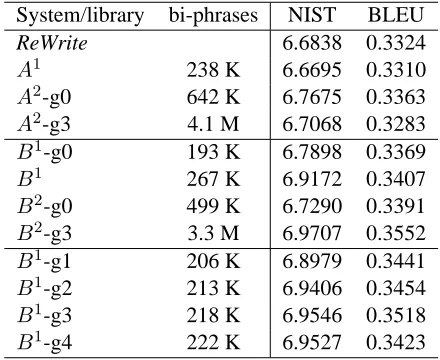
Table 2 describes the various libraries that were used for our experiments, and the results obtained for each.
System/library bi-phrases NIST BLEU
ReWrite 6.6838 0.3324
A1 238 K 6.6695 0.3310
A2-g0 642 K 6.7675 0.3363
A2-g3 4.1 M 6.7068 0.3283
B1-g0 193 K 6.7898 0.3369
B1 267 K 6.9172 0.3407
B2-g0 499 K 6.7290 0.3391
B2-g3 3.3 M 6.9707 0.3552
B1-g1 206 K 6.8979 0.3441
B1-g2 213 K 6.9406 0.3454
B1-g3 218 K 6.9546 0.3518
[image:6.612.316.536.400.580.2]B1-g4 222 K 6.9527 0.3423
Table 2: Bi-phrase libraries and results
The top part of the table presents the results for theAlibraries. As can be seen, libraryA1achieves approximately the same score as the baseline sys-tem; this is expected, since this library is essentially
5Both the ReWrite and our own system relied on a trigram
Subset sentences source words target words bi-phrase-building set 931,000 17.2M 15.2M
training set 800 11,667 10,601
test set 500 6726 6041
Table 1: Data sets.
made up of one-to-one alignments computed using IBM-4 translation models. Adding contiguous bi-phrases obtained by combining pairs of alignments does gain us some mileage (+0.1 NIST)6. Again, this
is consistent with results observed with other sys-tems (Tillmann and Xia, 2003). However, the addi-tion of non-contiguous bi-phrases (A2-g3) does not seem to help.
The middle part of Table 2 presents analogous re-sults for the correspondingB libraries, plus theB1 -g0 library, which contains only those cepts from the
B alignment that are contiguous. Interestingly, in the experiments reported in (Goutte et al., 2004), alignment methodBdid not compare favorably toA
under the widely used Alignment Error Rate (AER) metric. Yet, theB1-g0 library performs better than the analogous A1 library on the translation task. This suggests that AER may not be an appropriate metric to measure the potential of an alignment for phrase-based translation.
Adding non-contiguous bi-phrases allows another small gain. Again, this is interesting, as it sug-gests that “native” non-contiguous bi-phrases are in-deed useful for the translation task, i.e. those non-contiguous bi-phrases obtained directly as cepts in theBalignment.
Surprisingly, however, combining cepts from the
B alignment to produce contiguous bi-phrases (B2 -G0) does not turn out to be fruitful. Why this is so is not obvious and, certainly, more experi-ments would be required to establish whether this tendency continues with larger combinations (B3
-g0,B4-g0...). Composite non-contiguous bi-phrases produced with the B alignments (B2-g3) seem to bring improvements with regard to “basic” bi-phrases (B1), but it is not clear whether these are
significant.
6While the differences in scores in these and other
experi-ments are relatively small, we believe them to be significant, as they have been confirmed systematically in other experiments and, in our experience, by visual inspection of the translations.
Visual examination of the B1 library reveals that many non-contiguous bi-phrases contain long-spanning phrases (i.e. phrases containing long se-quences of gaps). To verify whether or not these were really useful, we tested a series ofB1libraries with different gap-size filters. It must be noted that, because of the final histogram filtering we apply on libraries (retain only the 20 most frequent transla-tions of any source phrase), library B1-g1 is not a strict subset of B1-g2. Therefore, filtering on gap-size usually represents a tradeoff between more frequent long-spanning bi-phrases and less frequent short-spanning ones.
The results of these experiments appear in the lower part of Table 2. While the differences in score are small, it seems that concentrating on bi-phrases with 3 gaps or less affords the best compromise. For small libraries such as those under consideration here, this sort of filtering may not be very important. However, for higher-order libraries (B2,B3, etc.) it becomes crucial, because it allows to control the ex-ponential growth of the libraries.
7 Conclusions
In this paper, we have proposed a phrase-based sta-tistical machine translation method based on non-contiguous phrases. We have also presented a esti-mation procedure for the parameters of a log-linear translation model, that maximizes a smooth version of the NIST scoring function, and therefore lends itself to standard gradient-based optimization tech-niques.
The second conclusion is that alignment quality is crucial in producing good translations with phrase-based methods. While this may sound obvious, our experiments shed some light on two specific aspects of this question. The first is that the alignment method that produces the most useful bi-phrases need not be the one with the best alignment error rate (AER). The second is that, depending on the alignments one starts with, constructing increasingly large bi-phrases does not necessarily lead to better translations. Some of our best results were obtained with relatively small libraries (just over 200,000 en-tries) of short bi-phrases. In other words, it’s not how many bi-phrases you have, it’s how good they are. This is the line of research that we intend to pursue in the near future.
Acknowledgments
The authors are grateful to the anonymous reviewers for their useful suggestions.7
References
Peter F. Brown, Stephen A. Della Pietra, Vincent J. Della Pietra, and Robert L. Mercer. 1993. The mathe-matics of statistical machine translation: Parameter es-timation. Computational Linguistics, 19(2):263–311.
David Chiang. 2005. A hierarchical phrase-based model for statistical machine translation. In Proceedings of the 43rd Annual Meeting of the ACL, pages 263–270, Ann Arbor, Michigan.
George Doddington. 2002. Automatic evaluation of ma-chine translation quality using n-gram co-occurrence statistics. In Proc. ARPA Workshop on Human Lan-guage Technology.
U. Germann, M. Jahr, K. Knight, D. Marcu, and K. Ya-mada. 2001. Fast Decoding and Optimal Decoding for Machine Translation. In Proceedings of ACL 2001, Toulouse, France.
Cyril Goutte, Kenji Yamada, and Eric Gaussier. 2004. Aligning words using matrix factorisation. In Proc. ACL’04, pages 503–510.
Philipp Koehn. 2003. Noun Phrase Translation. Ph.D. thesis, University of Southern California.
7This work was supported in part by the IST Programme
of the European Community, under the PASCAL Network of Excellence, IST-2002-506778. This publication only reflects the authors’ views.
Daniel Marcu and William Wong. 2002. A phrase-based, joint probability model for statistical machine transla-tion. In Proc. of the Conf. on Empirical Methods in Natural Language Processing (EMNLP 02), Philadel-phia, PA.
J. C. Meza. 1994. OPT++: An Object-Oriented Class Library for Nonlinear Optimization. Technical Report SAND94-8225, Sandia National Laboratories, Albu-querque, USA, March.
F. J. Och and H. Ney. 2000. Improved Statistical Align-ment Models. In Proceedings of ACL 2000, pages 440–447, Hongkong, China, October.
Franz Josef Och and Hermann Ney. 2003. A Systematic Comparison of Various Statistical Alignment Models. Computational Linguistics, 29(1):19–51, March.
Franz Josef Och and Hermann Ney. 2004. The Align-ment Template Approach to Statistical Machine Trans-lation. Computational Linguistics, 30(4):417–449.
Franz Josef Och, Christoph Tillmann, and Hermann Ney. 1999. Improved alignment models for statistical ma-chine translation. In Proc. of the Joint Conf. on Em-pirical Methods in Natural Language Processing and Very Large Corpora (EMNLP/VCL 99), College Park, MD.
Franz Och. 2003. Minimum error rate training in statis-tical machine translation. In ACL’03: 41st Ann. Meet. of the Assoc. for Computational Linguistics.
Kishore Papineni, Salim Roukos, Todd Ward, and Wei-Jing Zhu. 2002. Bleu: a method for automatic evalu-tion of machine translaevalu-tion. In Proceedings of the 40th Annual Meeting of the ACL, pages 311–318, Philadel-phia, USA.
Harold Somers. 1999. Review Article: Example-based Machine Translation. Machine Translation, 14:113– 157.
Christoph Tillmann and Fei Xia. 2003. A phrase-based unigram model for statistical machine translation. In Proc. of the HLT-NAACL 2003 Conference, Edmonton, Canada.
Kenji Yamada and Kevin Knight. 2002. A decoder for syntax-based statistical MT. In Proc. of the 40th An-nual Conf. of the Association for Computational Lin-guistics (ACL 02), Philadelphia, PA.