Entity based Q&A retrieval
Amit Singh
IBM Research Bangalore, India
Abstract
Bridging the lexical gap between the user’s question and the question-answer pairs in the Q&A archives has been a major challenge for Q&A retrieval. State-of-the-art approaches address this issue by implicitly expanding the queries with additional words using statistical translation models. While useful, the effec-tiveness of these models is highly dependant on the availability of quality corpus in the ab-sence of which they are troubled by noise is-sues. Moreover these models perform word based expansion in a context agnostic manner resulting in translation that might be mixed and fairly general. This results in degraded retrieval performance. In this work we ad-dress the above issues by extending the lex-ical word based translation model to incor-porate semantic concepts (entities). We ex-plore strategies to learn the translation proba-bilities between words and the concepts using the Q&A archives and a popular entity cata-log. Experiments conducted on a large scale real data show that the proposed techniques are promising.
1 Introduction
Over the past few years community-based ques-tion answering (CQA) portals like Naver, Ya-hoo! Answers, Baidu Zhidao and WikiAnswers have attracted great attention from both academia and industry (Adamic et al., 2008; Singh and Visweswariah, 2011). These portals foster collab-orative creation of content by allowing the users to both submit questions to be answered and answer
questions asked by other users. These portals aim to provide highly focused access to this information by directly returning pertinent question and answer (Q&A) pairs to the users questions, instead of a long list of ranked URLs. This is in noted contrast to the usual search paradigm, where the question is used to search the database of potential answers, in this case the question is used to search the database of pre-vious questions, which in turn are associated with answers. This involves addressing the word mis-match problem between the users question and the question-answer pairs in the archive. This is the ma-jor challenge for Q&A retrieval.
Researchers have proposed the use of translation models (Berger and Lafferty, 1999; Jeon et al., 2005; Xue et al., 2008) to solve this problem. As a princi-pled approach to capturing semantic word relations, statistical translation language models are built by using the IBM model 1 (Brown et al., 1993) and have been shown to outperform traditional docu-ment language models on Q&A retrieval task. The basic idea is to estimate the likelihood of translat-ing a document1to a query by exploiting the depen-dencies that exists between query words and doc-ument words. For example the docdoc-ument contain-ing the wordWheezingmay well answer the ques-tion containing the term Asthma. They learn the these dependencies (encoded as translation proba-bilities) between words using parallel mono-lingual corpora created from the Q&A pairs. While useful, the effectiveness of these models is highly depen-dant on the availability of quality corpus (Lee et al.,
1we will use (Q&A, document), (word, term) and (user
query, question) interchangeably
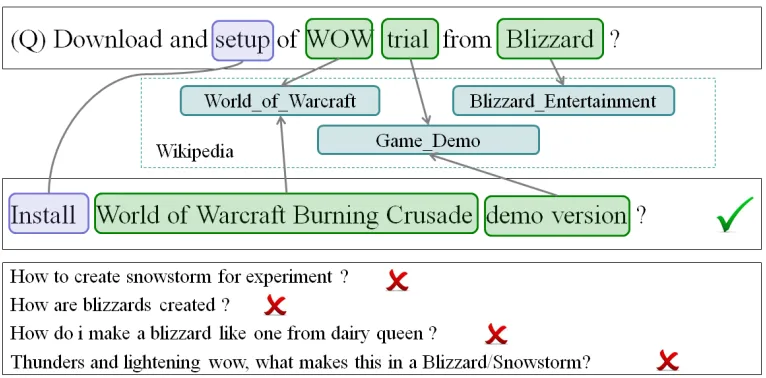
Figure 1: Need for entity based expansions
2008). Also these models only capture shallow se-mantics between words via the co-occurrence statis-tics, while some of the more explicit relationships between words and entities is freely available exter-nally. Being context agnostic (Zhou et al., 2007) is another very common criticism hailed on translation models as it results in noisy and generic translations. Example shown in Figure 1 captures these prob-lems. Specifically, the word Blizzard can refer to an American game development com-pany that develops World of Warcraft game or it could refer to a severe snowstorm. Expand-ing query without takExpand-ing the gamExpand-ing context es-tablished by the word WOW (acronym for World of Warcraft) into account would lead to topic drift. Also it would be difficult to learn relation-ships betweenWorld of Warcraft Burning Crusade and Blizzard from the Q&A corpus alone due to the sparsity of co-occurance counts as these can be expressed in several lexical forms, some of which are multi word phrases.
In this paper we argue that solution to all the above problems lies in a unified model in which en-tities are a primary citizen. The guiding hypothesis being, an entity based representation provides a less ambiguous representation of the users question and provides for a more semantically accurate expansion if the relationship between entities and words can be estimated more reliably. Our main contributions are
1. We propose Entity based Translation Language
Model (ETLM) for Q&A retrieval that accom-modates semantic information associated be-tween entities and words. Being closely re-lated to the general source-channel framework (Berger and Lafferty, 1999), the model enjoys its benefits, while mitigating some of its short-comings. Specifically it provides for context aware expansions of the query by exploiting entity annotations on both, the document and the query side. Entity annotations also provide a means to handle the “many-to-one” (Moore, 2004) translation limitation in the IBM model, due to which each word in the target document can be generated by at most one word in the question2. For the same reasons, it also al-leviates another related limitation by enabling translation between contiguous words across the query and documents (Moore, 2004).
2. We learn relationships between entities and terms by proposing new ways of organiz-ing monolorganiz-ingual parallel corpus and simul-taneously leveraging external resources like Wikipedia from which one can derive these re-lationships reliably. This helps alleviate the noise problem associated with learning transla-tion models on Q&A archive described above. An important point to note is that, our tech-nique has merits independent to the choice of the entity catalog. In this work we use
2
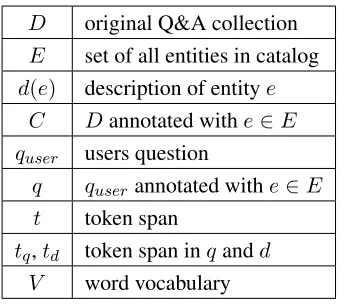
D original Q&A collection E set of all entities in catalog d(e) description of entitye
C Dannotated withe∈E quser users question
q quserannotated withe∈E
t token span
tq,td token span inqandd
[image:3.612.101.273.55.207.2]V word vocabulary
Table 1: Notation.
Wikipedia, as it is a popular choice due to its large and ever expanding coverage and its abil-ity to keep up with world events on a timely basis.
3. We provide detailed evaluation of impact of modelling assumptions and model components on retrieval performance on a large scale real data from Yahoo Answers comprising∼5 mil-lion Q&A pairs.
Rest of the paper is organized as follows: In the next section, we define ETLM and outline its de-tails. This is followed by Section 3 which gives the details of entity annotators and its performance. Section 4 describes our experiments on the retrieval method used Q&A retrieval. In Section 5 we com-pare and contrast related literature. Finally, we con-clude in Section 6.
2 Our Approach
Problem Definition: LetD=d1, d2, ..., dndenote
the Q&A collection. Heredi refers to the i-th Q&A
data consisting of a question qi and its answerai.
Given the user question quser, the task of Q&A
retrieval is to rankdi according toscore(quser, di).
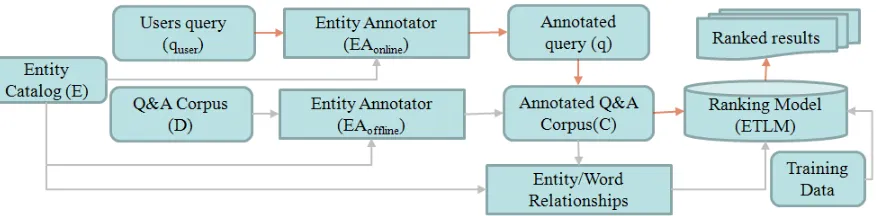
Figure 2 outlines the approach to compute this score in the ETLM framework.
Offline processing: Using the entity catalogE, we learn the entity annotation models EAof f line and
EAonlinefor annotation of entities in the Q&A
cor-pus and the query respectively. Refer Section 3 for details. For each di ∈ D, we then annotate
refer-ences to entities in Wikipedia using EAof f line
re-sulting in annotated Q&A corpusC. We then com-pute relationships between entities and words using C andE. These relationships are used to learn our ETLM model.
Online processing: At runtime, annotate the user queryquserwith entities using EAonlineto create an
enriched question q. Issue this query over the an-notated corpusC and rank the candidates as per the ETLM model described below.
2.1 ETLM Model
Let the annotated query q (and similarly annotated Q&A pair d) be composed of sequence of token spans Tq (and Td). Each token span tq (similarly
td) corresponds to sequence of contiguous words
oc-curring in the running text. These tq’s can
corre-spond to entity mentions, phrases or words. Leteq
denote the tokens spans that are annotated andneq
that are not (Tq = eq ∪neq). For example, in the
query ,What
| {z }
neq is
|{z}
neq a
|{z}
neq
Quadratic Formula
| {z }
eq
?,
token spanQuadratic Formulais linked to an entity corresponding to Quadratic Equation3, while all other token spans are marked asneq.
For the sake of simplicity, in this work we do not identify phrases i.e. neq is always of unit word
length4. In the ETLM framework, the similarity be-tween a queryqand a documentdwithin a collection Cis given by the probability
score(q, d) ∼ P(q|d) = Y
tq∈q
tq=eq∪neq
P(tq|d)
P(tq|d) = (1−λ)Pml(tq|d) +λPml(tq|C)
Pml(tq|d) =
X
td∈d
T(tq|td)Pml(td|d) (1)
Intuitively this indicates a generative process for cre-atingqfromd. Ideally bothqanddare “only” com-posed ofei.e. ∀tq ∈ q; tq ∈ EU, whereEU is the
universal set of entities5(similarly for alltd). This
is because when the document was created, each and everytd ∈ dhad a sense attached to it. however in
reality, for various reasons, set of target entities are clearly a subset ofEU (for e.g. E: set of all entities
3
http://en.wikipedia.org/wiki/Quadratic equation
4its not a restriction as the model is valid forne
qconsisting
of more than one word.
5
Figure 2: ETLM Architecture (gray and brown arrows indicate offline and online processes respectively
in the catalog) also not all of them may be recog-nized by the annotation system.
T(tq|td) in Equation 1 denotes the probability
that a token spantq is the translation of token span
td. This induces the desired query expansion effect.
The key task is to estimatePml(tq|C),T(tq|td)and
Pml(td|d);tq∈eq∪neqandtd∈ed∪ned
2.2 Estimating Model Parameters
We adopt 2 different approach for estimating T(tq|td), leading to 2 different configurations of
ETLM system . As the name suggests, ETLMqais
estimated from Q&A data (CandD) while we lever-age the entity catalog (in our case it is Wikipedia) for ETLMwiki.
2.3 ETLMqa: Estimate from parallel corpus
Following (Xue et al., 2008) we pool the question and answers fromDto create a master parallel cor-pusP = (q1, a1), ..,(qn, an)∪(a1, q1), .,(an, qn).
This is used for learningT(ne|ne0)6. Similarly we createP∗ fromC. We then derive 2 different paral-lel corpora fromP andP∗as follows
Pentity We remove all non linked tokens ne from
P∗thereby reducing it to parallel corpus overe. This is used for learningT(e|e0)i.e. translation probabilities between two entitieseande0inE.
Phybrid This is hybrid of Pentity and P where in
one part of Q&A pair consists on onlynewhile other consists of onlye. This is used for learn-ingT(ne|e)andT(e|ne).
To handle entitiese, we introduce special id’s in the nespace. Thus our universal token span set is given
6subscript ofqanddhas been dropped as translation
proba-bility learnt agnostic to it, due to pooling.
by V ∪E. This is done so that T(tq|td) is learnt
fromP, Pentity andPhybrid, w/o any modification
to the corresponding translation algorithm (Brown et al., 1993). Lets call this approach ETLMqa0.
We explored another intuitive approach ETLMqa,
to learn T(e|e0), T(e|ne), T(ne|e) and T(ne|ne0)
directly by using only P∗ as our parallel corpus. We do so by redistributing the probability mass i.e. when calculatingT(e|e0), we redistribute prob-ability mass spread over all the ne to e given by Equation 2 and 3. Similar process is followed for T(e|ne),T(ne|e)andT(ne|ne0).
S(e|e0) = T(e|e
0)
P
t∈V T(t|e0)
(2)
T(e|e0) = S(e|e
0)
P
t∈ET(t|e0)
(3)
Remaining model components are calculated using Equation 4 and 5. Heredrefers to question part of the Q&A pair.
Pml(tq|C) =
tftq,C+ 1
P
t0∈Ctft0,C+|C| (4)
Pml(tq|d) =
tftq,d
P
t0∈dtft0,d (5)
2.4 ETLMwiki: Estimating from Wikipedia
T(ne|ne0)as follows: .
T(e|e0) = co(e, e
0)
P
e00co(e00, e0)
(6)
T(ne|ne0) = cf(ne, ne
0)
P
ne00cf(ne00, ne0)
(7)
T(ne|e) = tfne,D(e)+ 1
|D(e)|+|V| (8)
T(e|ne) = P tfne,D(e)+ 1
e0∈Etfne,D(e0)+|E| (9)
Here d(e) represents the page corresponding to entity e. D(e) represents concatenation of d(e)
and all context of size 5 surrounding anchor text in Wikipedia that link toe. cf(ne, ne0) is the number context windows of fixed size containing both ne and ne0 in Wikipedia. In our case, we set the window size at 10 (because this size turned out to be reasonable in our pilot experiments). tft,d(e) is the
frequency of t in d(e); co(e, e0) indicates number of entities in Wikipedia that have a hyperlink to both e and e0. As links from pages with a small number of outgoing links are generally considered to be more valuable than links from pages with a high outgoing link degree, we tried with weighted version of 6 where the co-citations are weighted by the outdegree of Wikipedia page corresponding to entity s that link to e and e0. Lets denote the weighted version by ETLMwiki and unweighted
version by ETLMwiki0. Pml(tq|C) and Pml(tq|d) are estimated as per Equation 4 and 5 respectively.
2.5 Self translation probability
To make sure self translation probability is not un-derestimated i.e. T(t|t) ≥ T(t0|t) always holds true, we introduce new parameter γ as T(t|t0) =
γ+ (1−γ)T(t|t0);γ = 0whent6=t0andγ >0.5
otherwise.
2.6 ETLMcombo: Combining ETLMqaand
ETLMwiki
Often, combining language models yields better re-sults than any of the individual language models themselves. Linear interpolation is often the tech-nique of choice in language modelling for combin-ing models to exploit complementary features of the component models. It involves taking a weighted
sum of the probabilities given by the component lan-guage models. An advantage of the linear interpola-tion is that it is simple and fast to calculate. If the inputs are probability estimates, also the output is a probability estimate. The mixture translation model Tcombo(e|e0)overM component models is given by
Equation 10.
Tcombo(t|t0) = M
X
j=1
αjTj(t|t0)
t∈E∪V;
M
X
j=1
αj = 1; αj ≥0
(10)
One can immediately notice that Tcombo(t|t0) has
one global weight for each of the M component models which might not be ideal. With access to large training data one could employ more power-ful context dependent interpolation techniques (Liu et al., 2008). In our case we have 2 components Tqa and Twiki and four classes for each ; α
(e,e0)
wiki7,
α(wikie,ne),α(ne,ne 0)
wiki andα
(ne,e)
wiki ), one corresponding to
each class ofT(t|t0). respectively.
3 Entity Annotation
In this section we describe our entity annotation system. Recently there has been lot of work ad-dressing the problem of annotating text with links to Wikipedia entities (Mihalcea and Csomai, 2007; Bunescu and Pasca, 2006; Milne and Witten, 2008; Kulkarni et al., 2009; Ratinov et al., 2011; Ferrag-ina and Scaiella, 2010). We adopt a similar ap-proach, wherein we first find the best disambigua-tion (BESTDISAMBIGUATION) for a given mention and then decide to prune it (PRUNE), via the dummy mappingNA(similar to “no assignment” (Kulkarni et al., 2009)).
3.1 BESTDISAMBIGUATION
As defined earlier, e ∈ E represent an entity cor-responding to URN of a Wikipedia article. Let Em = {em,1, em,2,· · · , em,|Em|} em,i ∈ E repre-sent the set of possible disambiguations for a men-tionm (mis an index over all mentions in the cor-pus). Given a mentionm, task is to find best disam-biguationefrom Wikipedia. Without loss of
gener-7α(e,e0)
qa = 1−α(e,e
0
)
ality, we considerem,∗ ∈Em as the correct answer.
Letφ(m, em,j)represent the mapping onto features
between an entity mentionmand the Wikipedia en-tityem,j and−→ω be the corresponding weight vector
andD(em,j) = −→ω φ(m, em,j)represent the
disam-biguation score. The task is to learn −→ω such that
argmax
em,j
D(em,j)gives the best disambiguation for
the mention m.
We pose this as a ranking problem and solve it using max-margin technique (Joachims, 2002; Joachims, 2006) as follows
minimize
− →ω ,−→ξ
1 2
−
→ω · −→ω +CX
ξi,j
subject to
∀m,∀em,j ∈Em−em,∗:
− →ω φ(m, e
m,∗)>−→ω φ(m, em,j) +ξi,j
∀i,∀j:ξi,j ≥0
(11)
where P
ξi,j is the total training error that upper
bounds the number of pair preferences violations. This is controlled by adjusting the parameter C. Note that Equation 11 means pairwise comparison be-tween the correct disambiguationem,∗and other
dis-ambiguation candidates em,j such that j 6= index
corresponding to *.
3.2 PRUNE
The disambiguation phase produces one candidate disambiguation per mention. To discard any un-meaningful annotations a simple strategy similar to LOCAL(Kulkarni et al., 2009) is followed where the D(em,∗)is compared against a predefined threshold
ρna, so that ifD(em,∗) < ρna then that annotation
for mentonmis discarded by linkingmtoNA. The parameterρnaallows the algorithm to back-off when
short of evidence.
3.3 FEATUREMAPφ(m, em,j)
Sense probability prior (SP):It represents the prior probability that a mention namespoints to a specific entity in Wikipedia. For example, without any other information, mention name “tree” will more likely refer to the entity woody plant8, rather than the less
8
en.wikipedia.org/wiki/Tree
popular notion related to graphs9.
Entity Probability prior (EP): It captures the pop-ularity knowledge as a distribution of entities, i.e., the EP(ei) should be larger than EP(ej) if ei is
more popular thanej.This score is independent of
the mention name.
Context specific features: It captures the tex-tual similarity between weighted word vectors cor-responding to the context of the mention (window around the mention) and textual description associ-ated with the entity (Wikipedia page).
Let EAonline and EAof f line represent
config-urations for annotating user question and corpus respectively. For EAonline, user question
repre-sents the document from which context specific features are computed. For EAof f line, question
and the answer(best) is concatenated to represents the document. Based on the “one sense per dis-course” assumption, one additional heuristic is used in EAof f linewhere, for the same Q&A pair, if same
name mention is repeated multiple times across the question and the answer then one with the maximum D(em,∗)> ρna is annotated for all instances.
3.4 Annotation Experiments
We used 2010 version of Wikipedia as our knowl-edge base. It contains more than 2.5 million en-tities. Annotations were done by volunteers fluent in english. Volunteers were told to be as exhaus-tive as possible and tag all possible name mentions, even if to mark them as ”NA”. Inter-annotator agree-ment=92.1%; Kappa coefficient = 0.72. As our cor-pus, we collected 8.3K manual annotations spanning 1315 Q&A pairs. 2.8K of the annotations were as-signed toNA. 2.1K annotations (out of 8.3K) were made in the question of which 551 were assigned to NA. We use Precision, Recall and F1 score
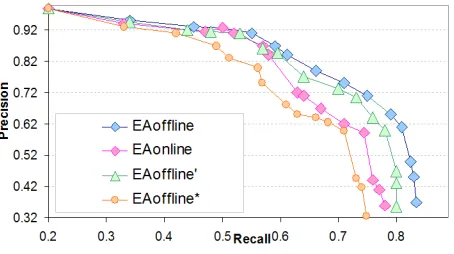
micro-averaged across documents as the evaluation mea-sures. We do a linear scan of data to identify en-tity mentions by first tokenizing and then identify-ing token sequences that maximally match an en-tity ID in the enen-tity name dictionary (constructed using Wikipedia anchor text, redirect pages). Fig-ure 3 outlines the performance of EAof f line and
EAonline. We measured EAof f line in 3 test data
configurations; (1) EAof f line: measured over entire
9
Figure 3: Precision v/s Recall
annotation set; 2) EAof f line0 is measured only on annotations made in question. this is done to com-pare it with EAonline; 3) EAof f line∗ is similar to (2), only difference is that for (2) entire Q&A pair is the context, while here only question part is the context. This is done to check if separate annotators are required for online and online phase. As seen in Figure 3, this indeed is necessary as EAof f line∗ performs worse than EAonline. Closer look at the
feature weights revealed that in EAof f line context
specific features have much more weightage when compared to its weight in EAonline, on the contrary
EAonlineweighs SP significantly higher.
4 Evaluation
We now describe the empirical evaluation where we compare our techniques against the baseline techniques. We use several standard measures (R-Precision, MAP, MRR, Precision@k) in evaluation. We first describe the dataset used followed by de-scribing an exhaustive set of results across tech-niques and performance measures.
4.1 Dataset
We crawled a dataset of ∼5 million questions and answers from Yahoo! Answers spanning all the leaf level categories. Tokenization and stop word re-moval were the only preprocessing steps performed. We have used a stoplist10having a vocabulary of 429 common words to remove the stopwords.
In our retrieval experiments we used 339 queries (average length 5.6 words). We employed pool-ing technique used in the TREC conference series.
10
http://truereader.com/manuals/onix/stopwords1.html
We pooled the top 25 Q&A pairs from retrieval re-sults generated by varying the retrieval algorithms and the search field. Relevance judgments were marked by human annotators without disclosing the identity of method used for retrieval. The annota-tors were asked to label candidate as “relevant” or “irrelevant” based on semantic similarity with the query. Answer quality/correctness was not a crite-ria. In case of disagreement between two volunteers, authors made the final judgment. Inter-annotator agreement was 87.9% and Kappa coefficient = 0.68. Over all we had collected more than 12K relevance judgements corresponding to these queries, of which >2.3K were marked as relevant.
4.2 Baselines
To evaluate the effectiveness of our models we compared them against the following baselines
Traditional models: VSM (Zobel and Moffat, 2006) and OKAPI BM25 (Robertson et al., 1996) (k1, b, and k3 are parameters that are set to 1.2, 0.75 and∞respectively).
Translation based language models: TLM (Jeon et al., 2005), TransLM (using answers) (Xue et al., 2008) and CTM (Lee et al., 2008).
For our experiments we used a set of 50 queries to select the model parameters. Translation based lan-guage model use 2 parameters; smoothing parameter λin the Language Model andβ to control the self-translation impact in the TransLM. Final values of parameters used in our experiments were λ = 0.2
(Zhai and Lafferty, 2004) and β = 0.75 (Xue et al., 2008). For CTM, we used tf-idf based weigh-ing scheme (Lee et al., 2008) to remove words from the (QkA) corpusP. Word elimination threshold of
20%was selected based on the above 50 queries. Fi-nal values of ETLM parameters used in our experi-ments wereλ= 0.18andγ = 0.65.
4.3 Result Analysis
MAP %chg MRR %chg R-Prec %chg Prec@5 %chg Prec@10 %chg
VSM 0.221 0.421 0.21 0.202 0.15
OKAPI 0.298 0.532 0.271 0.264 0.214
TLM 0.337 0.583 0.318 0.297 0.239
TransLM 0.352 0.612 0.347 0.332 0.261
CTM 0.361 0.641 0.351 0.341 0.279
ETLMqa 0.390† 8.03 0.699† 9.05 0.379† 7.98 0.367† 7.62 0.302† 8.24
ETLMwiki 0.413† 14.40 0.719† 12.17 0.399† 13.68 0.391† 14.66 0.323† 15.77
[image:8.612.75.555.60.225.2]ETLMcombo 0.427† 18.28 0.726† 13.26 0.413† 17.66 0.407† 19.35 0.331† 18.64
Table 2: Comparisons of retrieval models.†indicate a statistically significant improvement over the CTM using paired t-test with p-value<0.05. %chg indicates change over CTM as it is the most competitive baseline
query expansion in ETLM, leads to an improved performance as compared to the all the baseline methods that do not consider this signal. This is validated by the fact that ETLMqa and ETLMwiki
can achieve statistically significant improvements in terms of all the measures. The reason for this im-provement is the context sensitive computation of T(t|t0)leading to reduced spurious expansions and improved top expansions, this is made possible be-cause of entity disambiguation. This computation in baselines happens on word by word basis without exploiting contextual information. ETLMqa
per-forms worse than ETLMwiki. On close
inspec-tion of failure cases and translainspec-tion probability ta-bles we found thatT(e|e0) for ETLMqawas much
worse than ETLMwiki. This is because for getting
good estimates ofT(e|e0), we need enough instances where both eande0 need to be correctly annotated in the same Q&A pair. Failure in this leads to sparse counts thereby reducing the gap in T(e|e0) scores for related and unrelated e. Figure 4 shows the impact of choices made for learning the translation probabilitiesT(t|t0). We found that ETLMwiki
per-forms slightly better than ETLMwiki0, indicating the utility of weighted co-citation measure for comput-ingT(e|e0). We believe that embedding other mea-sures that are better in capturing relationships from Wikipedia, should improve the performance. Simi-larly ETLMqaalso performs better than ETLMqa0. This is because for creating Pentity all ne are
re-moved. This leads to count sparsity problem
dis-Figure 4: Performance of ETLM configurations
cussed above, but slightly worse. Due to absence of ne, in ETLMqa0 e0 in d are thought be being generated “only” from ein q. On the contrary in ETLMqa, e0 had an option of mapping to ne inq.
An interesting observation is that while the perfor-mances of different configurations vary, all of them perform better than CTM which is the best baseline.
4.4 Impact of Annotations on retrieval
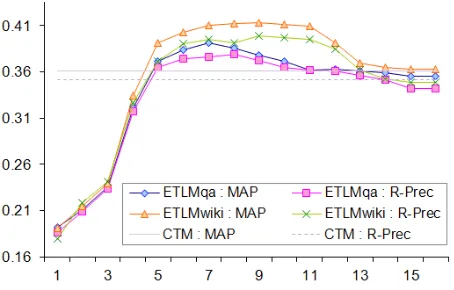
Since entities are central in our model, impact of entity annotation on quser is one of the most
im-portant aspect to be studied. Figure 5 shows the plot of retrieval measures obtained by varyingρna
in EAonline. CTM is shown by horizontal lines. As
explained in Section 3, value ofρnais inversely
pro-portional to aggressiveness of annotation. Which implies for high values, EAonlinewill annotate only
[image:8.612.318.537.279.389.2]Figure 5: Impact of query annotation on retrieval. x-axis represents value ofρnaused to control annotation
This is represented on the extreme right in Figure 5. One important observation is that, even with no an-notations made in query, performance of ETLMqa
and ETLMwiki is competitive to CTM. This is
ev-idence for addressing the noise related issue for which CTM is designed. For large range of values, all ETLM configurations are above CTM. As we de-creaseρnaperformance increases smoothly and then
after a certain point (ρna= 5) is starts decreasing.
4.5 ETLMcombo
We believe thatT(t|t0)learnt from one source would encode word association characteristics which might not be exactly the same across sources.ETLMcombo
tries to address this by combining the two models. Values for mixing parameters are : α(wikie,e0) = 0.9511,
αwiki(e,ne) = 0.75,αwiki(ne,ne0) = 0.7andα(wikine,e)= 0.75). The interpolation weights were obtained by optimiz-ing the retrieval performance by dooptimiz-ing a usoptimiz-ing grid search over the parameter space. Same 50 queries were used for tuning. As seen entity relationships obtained from Wikipedia are far superior to one from Q&A corpus. As seen in Table 2 combining the two models improves the performance.
5 Related Work
Recently Q&A retrieval has been garnering lot of at-tention. Translation model (TLM) (Jeon et al., 2005) has been extensively employed in question search and has been shown to outperform the traditional IR methods significantly (VSM, BM25, LM). Existing
11α(e,e0)
qa = (1−0.95)
work can be broadly grouped under the following topics:
(a) Improved training of translation models by
ex-ploiting answer content/inter-word co-occurrence relations and restriction to reliable parallel
cor-pora: Translation-based language model (TRLM)
(Xue et al., 2008) improved stability of TLM by providing better probability estimates and also ex-ploited answers for question retrieval. It further im-proved the retrieval results and obtained the state-of-the-art performance. Another line of work on trans-lation models focused on providing suitable parallel data to learn the translation probabilities. Compact translation models (CTM) (Lee et al., 2008) tried to further improve the translation probabilities based on question-answer pairs by selecting the most im-portant terms to build compact translation models. We show that such special-purpose models to con-trol noisy translations may not be necessary because models learnt using entity annotations are robust to noise in Q&A data.
Instead of using noisy Q&A data, new approach (Bernhard and Gurevych, 2009) to build parallel cor-pus from reliable sources has showed improvements. They proposed to use as a parallel training data com-prising of set the definitions and glosses provided for the same term by different lexical semantic re-sources. We move beyond terms and capture rela-tionships between entities and terms using the page contents and link structure in Wikipedia.
Apart from translation models there are other approaches (Gao et al., 2004) that try to extend the existing language models for adhoc retrieval by incorporating term relationships or dependencies. Some expand queries using word relationships derived from co-occurrence thesaurus (Bai et al., 2005; Qiu and Frei, 1993), hand-crafted thesaurus (Liu et al., 2004; Voorhees, 1994) and combination of both (Cao et al., 2005).
(b) Incorporation of query context information in
translation models using latent factor modeling
and smoothing approaches: All these existing
by decomposing a document into a set of weighted topic signatures and use it for model smoothing. This model turns out to be inefficient when con-fronted with ambiguous words and phrases because it is unable to disambiguate the sense of topic signatures. Others (Liu and Croft, 2004) perform semantic smoothing by means of clustering. Re-cently (Tu et al., 2010; Cai et al., 2011; Zhou et al., 2011) showed improved performance by performing sense based smoothing for document retrieval, latent topic mining and phase based retrieval respectively. Contrary to these approaches we used entity disambiguation to capture contextual information for improving Q&A retrieval.
(c) Complementary ideas for improving retrieval
performance that can be used alongside translation
models: Other work on question retrieval include
the use of category information available (Cao et al., 2010), learning-to-rank techniques (Bian et al., 2008; Surdeanu et al., 2008; Bunescu and Huang, 2010), proposed a syntactic tree matching ((Wang et al., 2009) or question structure for important phrase matching (Duan et al., 2008)). These methods seem orthogonal to ours, in some cases complementary and can be leveraged to get an even better perfor-mance
There also exists work where exploiting entity based representation has been found helpful in in-formation retrieval (Singh et al., 2009; Egozi et al., 2011; Meij et al., 2008; Grootjen and van der Weide, 2006). In our work we use entity annotations in Q&A retrieval context. There is also some work on using Wikipedia in general web search (Xu et al., 2009).
6 Conclusion
In this work we extend word based model to in-corporate semantic concepts for addressing the lex-ical gap issue in retrieval models for large online Q&A collections. Compared to the existing trans-lation based model, our model is more robust and effective in that it can perform context aware expan-sions. We proposed ways to embed rich information freely available in Wikipedia into our models and combine it one learnt from Q&A corpus. Experi-ments performed on a large real Q&A data
demon-strate that all configurations of ETLM significantly outperforms existing models for Q&A retrieval.
Acknowledgments
Thanks to Srujana Merugu for helpful discussions. Thanks to the anonymous reviewers for helping us improve the presentation.
References
Lada A. Adamic, Jun Zhang, Eytan Bakshy, and Mark S. Ackerman. 2008. Knowledge sharing and yahoo an-swers: everyone knows something. InProceedings of the 17th international conference on World Wide Web, WWW ’08, pages 665–674, New York, NY, USA. ACM.
Jing Bai, Dawei Song, Peter Bruza, Jian-Yun Nie, and Guihong Cao. 2005. Query expansion using term relationships in language models for information re-trieval. In Proceedings of the 14th ACM interna-tional conference on Information and knowledge man-agement, CIKM ’05, pages 688–695, New York, NY, USA. ACM.
Adam Berger and John Lafferty. 1999. Information retrieval as statistical translation. In Proceedings of the 22nd annual international ACM SIGIR conference on Research and development in information retrieval, SIGIR ’99, pages 222–229, New York, NY, USA. ACM.
Delphine Bernhard and Iryna Gurevych. 2009. Combin-ing lexical semantic resources with question & answer archives for translation-based answer finding. In ACL-IJCNLP ’09: Proceedings of the Joint Conference of the 47th Annual Meeting of the ACL and the 4th Inter-national Joint Conference on Natural Language Pro-cessing of the AFNLP: Volume 2, pages 728–736, Mor-ristown, NJ, USA. Association for Computational Lin-guistics.
Jiang Bian, Yandong Liu, Eugene Agichtein, and Hongyuan Zha. 2008. Finding the right facts in the crowd: factoid question answering over social media. In WWW ’08: Proceeding of the 17th international conference on World Wide Web, pages 467–476, New York, NY, USA. ACM.
Peter F. Brown, Vincent J. Della Pietra, Stephen A. Della Pietra, and Robert L. Mercer. 1993. The mathemat-ics of statistical machine translation: parameter esti-mation. Comput. Linguist., 19:263–311, June. Razvan Bunescu and Yunfeng Huang. 2010. Learning
’10, pages 97–107, Stroudsburg, PA, USA. Associa-tion for ComputaAssocia-tional Linguistics.
R. Bunescu and M. Pasca. 2006. Using encyclopedic knowledge for named entity disambiguation. In Pro-ceedings of EACL, volume 6, pages 9–16.
Li Cai, Guangyou Zhou, Kang Liu, and Jun Zhao. 2011. Learning the latent topics for question retrieval in com-munity qa. In Proceedings of 5th International Joint Conference on Natural Language Processing, pages 273–281, Chiang Mai, Thailand, November. Asian Federation of Natural Language Processing.
Guihong Cao, Jian-Yun Nie, and Jing Bai. 2005. Inte-grating word relationships into language models. In Proceedings of the 28th annual international ACM SI-GIR conference on Research and development in in-formation retrieval, SIGIR ’05, pages 298–305, New York, NY, USA. ACM.
Xin Cao, Gao Cong, Bin Cui, and Christian S. Jensen. 2010. A generalized framework of exploring category information for question retrieval in community ques-tion answer archives. In WWW ’10: Proceedings of the 19th international conference on World wide web, pages 201–210, New York, NY, USA. ACM.
Huizhong Duan, Yunbo Cao, Chin yew Lin, and Yong Yu. 2008. Searching questions by identifying ques-tion topic and quesques-tion focus. In In Proceedings of 46th Annual Meeting of the Association for Compu-tational Linguistics: Human Language Tchnologies (ACL:HLT).
Ofer Egozi, Shaul Markovitch, and Evgeniy Gabrilovich. 2011. Concept-based information retrieval using ex-plicit semantic analysis. ACM Trans. Inf. Syst., 29(2):8:1–8:34, April.
Paolo Ferragina and Ugo Scaiella. 2010. Tagme: on-the-fly annotation of short text fragments (by wikipedia entities). In Proceedings of the 19th ACM interna-tional conference on Information and knowledge man-agement, CIKM ’10, pages 1625–1628, New York, NY, USA. ACM.
Jianfeng Gao, Jian-Yun Nie, Guangyuan Wu, and Gui-hong Cao. 2004. Dependence language model for information retrieval. In Proceedings of the 27th annual international ACM SIGIR conference on Re-search and development in information retrieval, SI-GIR ’04, pages 170–177, New York, NY, USA. ACM. F. A. Grootjen and Th. P. van der Weide. 2006. Concep-tual query expansion. Data Knowl. Eng., 56(2):174– 193, February.
Jiwoon Jeon, W. Bruce Croft, and Joon Ho Lee. 2005. Finding similar questions in large question and an-swer archives. In Proceedings of the 14th ACM in-ternational conference on Information and knowledge management, CIKM ’05, pages 84–90, New York, NY, USA. ACM.
Thorsten Joachims. 2002. Optimizing search engines using clickthrough data. InProceedings of the eighth ACM SIGKDD international conference on Knowl-edge discovery and data mining, KDD ’02, pages 133– 142, New York, NY, USA. ACM.
Thorsten Joachims. 2006. Training linear svms in lin-ear time. In Proceedings of the 12th ACM SIGKDD international conference on Knowledge discovery and data mining, KDD ’06, pages 217–226, New York, NY, USA. ACM.
S. Kulkarni, A. Singh, G. Ramakrishnan, and S. Chakrabarti. 2009. Collective annotation of wikipedia entities in web text. In Proceedings of the 15th ACM SIGKDD international conference on Knowledge discovery and data mining, pages 457–466. ACM.
Jung-Tae Lee, Sang-Bum Kim, Young-In Song, and Hae-Chang Rim. 2008. Bridging lexical gaps between queries and questions on large online q&a collec-tions with compact translation models. InProceedings of the Conference on Empirical Methods in Natural Language Processing, EMNLP ’08, pages 410–418, Stroudsburg, PA, USA. Association for Computational Linguistics.
Xiaoyong Liu and W. Bruce Croft. 2004. Cluster-based retrieval using language models. In Proceedings of the 27th annual international ACM SIGIR conference on Research and development in information retrieval, SIGIR ’04, pages 186–193, New York, NY, USA. ACM.
Shuang Liu, Fang Liu, Clement Yu, and Weiyi Meng. 2004. An effective approach to document retrieval via utilizing wordnet and recognizing phrases. In Pro-ceedings of the 27th annual international ACM SIGIR conference on Research and development in informa-tion retrieval, SIGIR ’04, pages 266–272, New York, NY, USA. ACM.
Xunying Liu, Mark J. F. Gales, and Philip C. Woodland. 2008. Context dependent language model adaptation. In INTERSPEECH 2008, 9th Annual Conference of the International Speech Communication Association, Brisbane, Australia, September 22-26, 2008, pages 837–840. ISCA.
Olena Medelyan, David Milne, Catherine Legg, and Ian H. Witten. 2009. Mining meaning from wikipedia. Int. J. Hum.-Comput. Stud., 67:716–754, September. Edgar Meij, Dolf Trieschnigg, Maarten de Rijke, and
Wessel Kraaij. 2008. Parsimonious concept model-ing. InProceedings of the 31st annual international ACM SIGIR conference on Research and development in information retrieval, SIGIR ’08, pages 815–816, New York, NY, USA. ACM.
documents to encyclopedic knowledge. InCIKM, vol-ume 7, pages 233–242.
D. Milne and I.H. Witten. 2008. Learning to link with wikipedia. InProceeding of the 17th ACM conference on Information and knowledge management, pages 509–518. ACM.
Robert C. Moore. 2004. Improving ibm word-alignment model 1. InProceedings of the 42nd Annual Meeting on Association for Computational Linguistics, ACL ’04, Stroudsburg, PA, USA. Association for Compu-tational Linguistics.
Yonggang Qiu and Hans-Peter Frei. 1993. Concept based query expansion. In Proceedings of the 16th annual international ACM SIGIR conference on Re-search and development in information retrieval, SI-GIR ’93, pages 160–169, New York, NY, USA. ACM. Lev Ratinov, Dan Roth, Doug Downey, and Mike An-derson. 2011. Local and global algorithms for dis-ambiguation to wikipedia. InProceedings of the 49th Annual Meeting of the Association for Computational Linguistics: Human Language Technologies - Volume 1, HLT ’11, pages 1375–1384, Stroudsburg, PA, USA. Association for Computational Linguistics.
S.E. Robertson, S. Walker, S. Jones, M.M. Hancock-Beaulieu, and M. Gatford. 1996. Okapi at trec-3. pages 109–126.
Amit Singh and Karthik Visweswariah. 2011. CQC: classifying questions in cqa websites. InProceedings of the 20th ACM international conference on Informa-tion and knowledge management, CIKM ’11, pages 2033–2036, New York, NY, USA. ACM.
Amit Singh, Sayali Kulkarni, Somnath Banerjee, Ganesh Ramakrishnan, and Soumen Chakrabarti. 2009. Cu-rating and searching the annotated web. InIn SIGKDD Conference, 2009. ACM.
Mihai Surdeanu, Massimiliano Ciaramita, and Hugo Zaragoza. 2008. Learning to rank answers on large online qa collections. In In Proceedings of the 46th Annual Meeting for the Association for Computational Linguistics: Human Language Technologies (ACL-08: HLT, pages 719–727.
Xinhui Tu, Tingting He, Long Chen, Jing Luo, and Maoyuan Zhang. 2010. Wikipedia-based semantic smoothing for the language modeling approach to in-formation retrieval. In Proceedings of the 32nd Eu-ropean conference on Advances in Information Re-trieval, ECIR’2010, pages 370–381, Berlin, Heidel-berg. Springer-Verlag.
Ellen M. Voorhees. 1994. Query expansion using lexical-semantic relations. InProceedings of the 17th annual international ACM SIGIR conference on Re-search and development in information retrieval, SI-GIR ’94, pages 61–69, New York, NY, USA. Springer-Verlag New York, Inc.
Kai Wang, Zhaoyan Ming, and Tat-Seng Chua. 2009. A syntactic tree matching approach to finding similar questions in community-based qa services. In Pro-ceedings of the 32nd international ACM SIGIR con-ference on Research and development in information retrieval, SIGIR ’09, pages 187–194, New York, NY, USA. ACM.
Yang Xu, Gareth J.F. Jones, and Bin Wang. 2009. Query dependent pseudo-relevance feedback based on wikipedia. In Proceedings of the 32nd international ACM SIGIR conference on Research and development in information retrieval, SIGIR ’09, pages 59–66, New York, NY, USA. ACM.
Xiaobing Xue, Jiwoon Jeon, and W. Bruce Croft. 2008. Retrieval models for question and answer archives. In Proceedings of the 31st annual international ACM SI-GIR conference on Research and development in in-formation retrieval, SIGIR ’08, pages 475–482, New York, NY, USA. ACM.
Chengxiang Zhai and John Lafferty. 2004. A study of smoothing methods for language models applied to in-formation retrieval. ACM Trans. Inf. Syst., 22(2):179– 214, April.
Xiaohua Zhou, Xiaohua Hu, and Xiaodan Zhang. 2007. Topic signature language models for ad hoc retrieval. IEEE Trans. on Knowl. and Data Eng., 19(9):1276– 1287, September.
Guangyou Zhou, Li Cai, Jun Zhao, and Kang Liu. 2011. Phrase-based translation model for question retrieval in community question answer archives. In Pro-ceedings of the 49th Annual Meeting of the Associa-tion for ComputaAssocia-tional Linguistics: Human Language Technologies - Volume 1, HLT ’11, pages 653–662, Stroudsburg, PA, USA. Association for Computational Linguistics.