A Simple Language Model based on PMI Matrix Approximations
Oren Melamud
IBM Research
Yorktown Heights, NY, USA [email protected]
Ido Dagan
Computer Science Dept. Bar-Ilan University, Israel
Jacob Goldberger
Faculty of Engineering Bar-Ilan University, Israel [email protected]
Abstract
In this study, we introduce a new approach for learning language models by training them to estimate word-context pointwise mutual information (PMI), and then de-riving the desired conditional probabili-ties from PMI at test time. Specifically, we show that with minor modifications to word2vec’s algorithm, we get principled language models that are closely related to the well-established Noise Contrastive Es-timation (NCE) based language models. A compelling aspect of our approach is that our models are trained with the same sim-ple negative sampling objective function that is commonly used inword2vecto learn word embeddings.
1 Introduction
Language models (LMs) learn to estimate the prob-ability of a word given a context of preceding words. Recurrent Neural Network (RNN) language models recently outperformed traditionaln-gram LMs across a range of tasks (Jozefowicz et al.,
2016). However, an important practical issue asso-ciated with such neural-network LMs is the high computational cost incurred. The key factor that limits the scalability of traditional neural LMs is the computation of the normalization term in the softmax output layer, whose cost is linearly propor-tional to the size of the word vocabulary.
Several methods have been proposed to cope with this scaling issue by replacing the softmax with a more computationally efficient component at train time.1 These include importance
sam-1An alternative recent approach for coping with large word vocabularies is to represent words as compositions of sub-word units, such as individual characters. This approach has notable merits (Jozefowicz et al.,2016;Sennrich et al.,2016), but is out of the scope of this paper.
pling (Bengio and et al,2003), hierarchical softmax (Minh and Hinton,2008), BlackOut (Ji et al.,2016) and Noise Contrastive Estimation (NCE) (Gutmann and Hyvarinen,2012). NCE has been applied to train neural LMs with large vocabularies (Mnih and Teh,2012) and more recently was also suc-cessfully used to train LSTM-RNN LMs (Vaswani et al.,2013;Chen et al.,2015;Zoph et al.,2016). NCE-based language models achieved near state-of-the-art performance on language modeling tasks (Jozefowicz et al., 2016;Chen et al., 2016), and as we later show, are closely related to the method presented in this paper.
Continuous word embeddings were initially in-troduced as a ‘by-product’ of learning neural lan-guage models (Bengio and et al,2003). However, they were later adopted in many other NLP tasks, and the most popular recent word embedding learn-ing models are no longer proper language models. In particular, the skip-gram with negative sampling (NEG) embedding algorithm (Mikolov et al.,2013) as implemented in the word2vec toolkit, has be-come one of the most popular such models today. This is largely attributed to its scalability to huge volumes of data, which is critical for learning high-quality embeddings. Recently,Levy and Goldberg
(2014) offered a motivation for the NEG objective function, showing that by maximizing this function, the skip-gram algorithm implicitly attempts to fac-torize a word-context pointwise mutual information (PMI) matrix. Melamud and Goldberger (2017) rederived this result by offering an information-theory interpretation of NEG.
The NEG objective function is considered a sim-plification of the NCE’s objective, unsuitable for learning language models (Dyer,2014). However, in this study, we show that despite its simplicity, it can be used in a principled way to effectively train a language model, based on PMI matrix fac-torization. More specifically, we use NEG to train
a model for estimating the PMI between words and their preceding contexts, and then derive con-ditional probabilities from PMI at test time. The obtainedPMI-LMcan be viewed as a simple vari-ant ofword2vec’s algorithm, where the context of a predicted word is the preceding sequence of words, rather than a single word within a context window (skip-gram), or a bag-of-context-words (CBOW).
Our analysis shows that the proposed PMI-LM is very closely related to NCE language models (NCE-LMs). Similar to NCE-LMs, PMI-LM avoids the dependency of train run-time on the size of the word vocabulary by sampling from a negative (noise) distribution. Furthermore, conveniently, it also has a notably more simplified objective func-tion formulafunc-tion inherited fromword2vec, which allows it to avoid the heuristic components and initialization procedures used in various implemen-tations of NCE language models (Vaswani et al.,
2013;Chen et al.,2015;Zoph et al.,2016). Finally, we report on a perplexity evaluation of PMI and NCE language models on two stan-dard language modeling datasets. The evaluation yielded comparable results, supporting our theoret-ical analysis.
2 NCE-based Language Modeling
Noise Contrastive Estimation (NCE) has recently been used to learn language models efficiently. NCE transforms the parameter learning problem into a binary classifier training problem. Letp(w|c)
be the probability of a wordwgiven a contextc that represents its entire preceding context, and let p(w) be a ‘noise’ word distribution (e.g. a uni-gram distribution). The NCE approach assumes that the wordwis sampled from a mixture distri-bution 1
k+1(p(w|c) +kp(w)) such that the noise samples arektimes more frequent than samples from the ‘true’ distributionp(w|c). Letybe a bi-nary random variable such thaty = 0andy = 1
correspond to a noise sample and a true sample, respectively, i.e. p(w|c, y = 0) = p(w) and p(w|c, y = 1) =p(w|c). Assume the distribution p(w|c)has the following parametric form:
pnce(w|c) = Z1
cexp(~w·~c+bw) (1)
such that ~wand~care vector representations of the wordwand its contextc. Applying Bayes rule, it
can be easily verified that:
pnce(y= 1|w, c) = (2)
σ(~w·~c+bw−logZc−log(p(w)k))
whereσ()is the sigmoid function.
NCE uses Eq. (2) and the following objective function to train a binary classifier that decides which distribution was used to samplew:
Snce=
X
w,c∈D
h
logp(1|w, c) +Xk
i=1
logp(0|ui, c)
i
(3) such that w, c go over all the word-context co-occurrences in the learning corpusDandu1, ..., uk
are ‘noise’ samples drawn from the word unigram distribution.
Note that the normalization factorZcis not a free
parameter and to obtain its value, one needs to com-puteZc=Pw∈V exp(~w·~c+bw)for each context
c, whereV is the word vocabulary. This computa-tion is typically not feasible due to the large vocab-ulary size and the exponentially large number of possible contexts and therefore it was heuristically circumvented by prior work.Mnih and Teh(2012) found empirically that settingZc= 1didn’t hurt
the performance (see also discussion in (Andreas and Klein,2015)).Chen et al.(2015) reported that settinglog(Zc) = 9gave them the best results.
Re-cent works (Vaswani et al.,2013;Zoph et al.,2016) usedZc= 1and also initialized NCE’s bias term
from Eq. (2) tobw =−log|V|. They reported that
without these heuristics the training procedure did not converge to a meaningful model.
In the following section, we describe our pro-posed language model, which is derived from word2vec’s interpretation as a low-rank PMI matrix approximation. Interestingly, this model turns out to be a close variant of NCE language models, but with a simplified objective function that avoids the need for the normalization factorZcand the bias
terms.
3 PMI-based Language Modeling
have similar vector representations. The algorithm optimizes the following NEG objective function (Mikolov et al.,2013):
Sneg=
X
w,c∈D
h
logσ(~w·~c) +Xk
i=1
logσ(−~ui·~c)
i
(4) such that w, c go over all the word-context co-occurrences in the learning corpus D, u1, ..., uk
are words independently sampled from the word unigram distribution,~xis the embedding ofxand σ()is the sigmoid function. The objective function Snegcan be viewed as a log-likelihood function of
a binary logistic regression classifier that treats a sample from a joint word-context distribution as a positive instance, and two independent samples from the word and context unigram distributions as a negative instance, whilek is the proportion between negative and positive instances.Levy and Goldberg(2014) showed that this objective func-tion achieves its maximal value when for every word-context pairw, c:
~w·~c=pmik(w, c) = logpkp(w|c(w)) (5)
where pmik(w, c)is the word-contextPMI matrix. Actually achieving this maximal value is typically infeasible, since the embedding dimensionality is intentionally limited. Therefore, learning word and context embeddings that optimize skip-gram’s NEG objective function (4) can be viewed as find-ing a low-rank approximation of the word-context PMI matrix. An explicit expression of the approxi-mation criterion optimized by the skip-gram algo-rithm can be found in (Melamud and Goldberger,
2017).
Our study is based on two simple observations regarding this finding ofLevy and Goldberg(2014). First, Equation (5) can be reformulated as follows to derive an estimate of the conditional distribution p(w|c):
ˆ
p(w|c)∝exp(~w·~c)p(w) (6)
where the constantkis dropped sincep(w|c)is a distribution. Second, while the above analysis had been originally applied to the case of word-context joint distributionsp(w, c), it is easy to see that the PMI matrix approximation analysis also holds for every Euclidean embedding of a joint distribution p(x, y)of any two given random variablesXand
Y. In particular, we note that it holds for word-context joint distributions p(w, c), where w is a single word, butcrepresents its entire preceding context, rather than just a single context word, and ~cis a vector representation of this entire context. Altogether, this allows us to useword2vec’s NEG objective function (4) to approximate the language modeling conditional probabilitypˆ(w|c)(6), withc being the entire preceding context of the predicted wordw.
We next describe the design details of the pro-posed PMI-based language modeling. We use a simple lookup table for the word representation ~w, and an LSTM recurrent neural network to obtain a low dimensional representation of the entire preced-ing context~c. These representations are trained to maximize the NEG objective in Eq. (4), where this timewgoes over every word token in the corpus, andcis its preceding context. We showed above that optimizing this objective seeks to obtain the best low-dimensional approximation of the PMI matrix associated with the joint distribution of the word and its preceding context (Eq. (5)). Hence, based on Eq. (6), for a reasonable embedding di-mensionality and a good model for representing the preceding context, we expectpˆ(w|c)to be a good estimate of the language modeling conditional dis-tribution.
At test time, to obtain a proper distribution, we perform a normalization operation as done by all other comparable models. The train and test steps of the proposed language modeling algorithm are shown in algorithm box1.
Note that while the NCE approach (1) learns to explicitly estimate normalized conditional distri-butions, our model learns to approximate the PMI matrix. Hence, we have no real motivation to in-clude additional learned normalization parameters, as considered in comparable NCE language models (Mnih and Teh,2012;Zoph et al.,2016).
The NEG and NCE objective functions share a similar form:
S =X
w,c
h
logs(w, c)+Xk
i=1
log(1−s(ui, c))
i (7)
Training objective function Test probability estimate NCE-LM s(w, c) =σ(~w·~c+bw−logZc−log(kp(w))) ˆp(w|c)∝exp(~w·~c+bw)
[image:4.595.96.498.62.106.2]PMI-LM s(w, c) =σ(~w·~c) pˆ(w|c)∝exp(~w·~c)p(w)
Table 1: Comparison of the training objective functions (see Eq. (7)) and the respective test-time conditional word probability functions for NCE-LM and PMI-LM algorithms.
Algorithm 1PMI Language Modeling
Training phase:
- Use a simple lookup table for the word repre-sentation and an LSTM recurrent neural network to obtain the preceding context representation. - Train the word and preceding context embed-dings to maximize the objective:
Sneg =
X
w,c∈D
h
logσ(~w·~c)+Xk
i=1
logσ(−~ui·~c)
i
such thatwandcgo over every word and it pre-ceding context in the corpusD, andu1, ..., uk
are words independently sampled from the uni-gram distributionp(w).
Test phase:
The conditional probability estimate for a wordwgiven a preceding contextcis:
ˆ
p(w|c) = Pexp(~w·~c)p(w)
v∈V exp(~v·~c)p(v)
whereV is the word vocabulary.
therefore potentially more difficult to concentrate around zero with low variance to facilitate effec-tive back-propagation. This may explain heuristics used by prior work for initializing the values ofbw
(Vaswani et al.,2013;Zoph et al.,2016).
4 Experiments
The goal of the evaluation described in this sec-tion is to empirically establish PMI-LM as a sound language model. We do so by comparing its perfor-mance with the well-established NCE-LM, using the popular perplexity measure on two standard datasets, under the same terms. We describe our hyperparameter choices below and stress that for a fair comparison, we followed prior best practices and avoided hyperparameter optimization in favor of PMI-LM. All of the models described hereafter were implemented using the Chainer toolkit (Tokui et al.,2015).
For our NCE baseline, we used the heuristics that worked well in (Vaswani et al.,2013;Zoph et al.,
2016), initializing NCE’s bias term from Eq. (2) to bw =−log|V|, whereV is the word vocabulary,
and usingZc= 1.
The first dataset we used is a version of the Penn Tree Bank (PTB), commonly used to evalu-ate language models.2 It consists of 929K training
words, 73K validation words and 82K test words with a 10K word vocabulary. To build and train the compared models in this setting, we followed the work of Zaremba et al. (2014), who achieved excellent results on this dataset. Specifically, we used a 2-layer 300-hidden-units LSTM with a 50% dropout ratio to represent the preceding (left-side) context of a predicted word.3 We represented
end-of-sentence as a special<eos>token and predicted this token like any other word. During training, we performed truncated back-propagation-through-time, unrolling the LSTM for 20 steps at a time without ever resetting the LSTM state. We trained our model for 39 epochs using Stochastic Gradient Descent (SGD) with a learning rate of 1, which is decreased by a factor of 1.2 after every epoch starting after epoch 6. We clipped the norms of the gradient to 5 and used a mini-batch size of 20. We set the negative sampling parameter to k = 100
following Zoph et al. (2016), who showed highly competitive performance with NCE LMs trained with this number of samples.
As the second dataset, we used the much larger WMT 1B-word benchmark introduced by Chelba et al. (2013). This dataset comprises about 0.8B train-ing words and has a held-out set partitioned into 50 subsets. The test set is the first subset in the held-out, comprising 159K words, including the<eos> tokens. We used the second subset as the validation set with 165K words. The original vocabulary size of this dataset is 0.8M words after converting all
2Available from Tomas Mikolov at: http: //www.fit.vutbr.cz/˜imikolov/rnnlm/ simple-examples.tgz
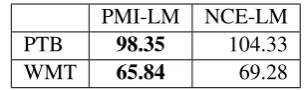
PMI-LM NCE-LM PTB 98.35 104.33
[image:5.595.103.256.61.106.2]WMT 65.84 69.28
Table 2: Perplexity results on test sets.
words that occur less than 3 times in the corpus to an<unk>token. However, we followed previous works (Williams et al.,2015;Ji et al.,2016) and trimmed the vocabulary further down to the top 64K most frequent words in order to successfully fit a neural model to this data using reasonably modest compute resources. To build and train our models, we used a similar method to the one used with PTB, with the following differences. We used a single-layer 512-hidden-unit LSTM to represent the preceding context. We followed Jozefowicz et al. (2016), who found a 10% dropout rate to be suf-ficient for relatively small models fitted to this large training corpus. We trained our model for only one epoch using the Adam optimizer (Kingma and Ba,
2014) with default parameters, which we found to converge more quickly and effectively than SGD. We used a mini-batch size of 1000.
The perplexity results achieved by the compared models appear in Table2. As can be seen, the per-formance of our PMI-LM is competitive, slightly outperforming the NCE-LM on both test sets. To put these numbers in a broader context, we note that state-of-the-art results on these datasets are no-tably better. For example, on the small PTB test set,
Zaremba et al.(2014) achieved 78.4 perplexity with a larger LSTM model and using the more costly softmax component. On the larger WMT dataset,
Jozefowicz et al.(2016) achieved 46.1 and 43.7 per-plexity numbers using NCE and importance sam-pling respectively, and with much larger LSTM models trained over the full vocabulary, rather than our trimmed one. They also achieved 23.7 with an ensemble method, which is the best result on this dataset to date. Yet, as intended, we argue that our experimental results affirm the claim that PMI-LM is a sound language model on par with NCE-LM.
5 Conclusions
In this work, we have shown thatword2vec’s nega-tive sampling objecnega-tive function, popularized in the context of learning word representations, can also be used to effectively learn parametric language models. These language models are closely re-lated to NCE language models, but utilize a simpler,
potentially more robust objective function. More generally, our theoretical analysis shows that any word2vec model trained with negative sampling can be used in a principled way to estimate the conditional distributionp(w|c), by following our proposed procedure at test time.
Acknowledgments
This work is supported by the Intel Collaborative Research Institute for Computational Intelligence (ICRI-CI).
References
J. Andreas and D. Klein. 2015. When and why are
log-linear models self-normalizing? InNAACL.
Y. Bengio and J. Senecal et al. 2003. Quick training of probabilistic neural nets by importance sampling. In
AISTATS.
C. Chelba, T. Mikolov, M. Schuster, Q. Ge, T. Brants, P. Koehn, and T. Robinson. 2013. One billion word benchmark for measuring progress in statistical
lan-guage modeling.arXiv preprint arXiv:1312.3005.
W. Chen, D. Grangier, and M. Auli. 2016. Strategies for training large vocabulary neural language
mod-els. CoRR, abs/1512.04906.
X. Chen, X. Liu, M. Gales, and P. C. Woodland. 2015. Recurrent neural network language model training with noise contrastive estimation for speech recogni-tion. InICASSP.
C. Dyer. 2014. Notes on noise contrastive
esti-mation and negative sampling. arXiv preprint
arXiv:1410.8251.
M. U. Gutmann and A. Hyvarinen. 2012. Noise-contrastive estimation of unnormalized statistical models, with applications to natural image statistics.
Journal of Machine Learning Research, 13:307– 361.
S. Ji, S. Vishwanathan, N. Satish, A. Nadathur, J. Michael, and P. Dubey. 2016. Blackout: Speeding up recurrent neural network language models with very large vocabularies. ICLR.
R. Jozefowicz, O. Vinyals, M. Schuster, N. Shazeer, and Y. Wu. 2016. Exploring the limits of language
modeling. arXiv preprint arXiv:1602.02410.
D. Kingma and J. Ba. 2014. Adam: A method
for stochastic optimization. arXiv preprint
arXiv:1412.6980.
O. Melamud and J. Goldberger. 2017. Information-theory interpretation of the skip-gram
negative-sampling objective function. In Proceedings of
ACL.
T. Mikolov, I. Sutskever, K. Chen, G. Corrado, and J. Dean. 2013. Distributed representations of words and phrases and their compositionality. InAdvances in Neural Information Processing Systems.
A. Minh and G. E. Hinton. 2008. A scalable
hierar-chical distributed language model. InAdvances in
Neural Information Processing Systems.
A. Mnih and Y. W. Teh. 2012. A fast and simple algo-rithm for training neural probabilistic language mod-els. InICML.
R. Sennrich, B. Haddow, and A. Birch. 2016. Neu-ral machine translation of rare words with subword
units. CoRR, abs/1508.07909.
S. Tokui, K. Oono, S. Hido, and J. Clayton. 2015. Chainer: a next-generation open source framework
for deep learning. InWorkshop on Machine
Learn-ing Systems (LearnLearn-ingSys) in The 29th Annual Con-ference on Neural Information Processing Systems. A. Vaswani, Y. Zhao, V. Fossum, and D. Chiang. 2013.
Decoding with large-scale neural language models
improves translation. InEMNLP.
W. Williams, N. Prasad, D. Mrva, T. Ash, and T. Robin-son. 2015. Scaling recurrent neural network lan-guage models. ICASSP.
W. Zaremba, I. Sutskever, and O. Vinyals. 2014.
Recur-rent neural network regularization. arXiv preprint
arXiv:1409.2329.
B. Zoph, A. Vaswani, J. May, and K. Knight. 2016. Simple, fast noise-contrastive estimation for large