Event extraction from Twitter using Non-Parametric Bayesian Mixture
Model with Word Embeddings
Deyu Zhou† Xuan Zhang† Yulan He§
†School of Computer Science and Engineering, Key Laboratory of Computer Network
and Information Integration, Ministry of Education, Southeast University, China
§School of Engineering and Applied Science, Aston University, UK
{d.zhou, xuanzhang}@seu.edu.cn, [email protected]
Abstract
To extract structured representations of newsworthy events from Twitter, unsuper-vised models typically assume that tweets involving the same named entities and ex-pressed using similar words are likely to belong to the same event. Hence, they group tweets into clusters based on the co-occurrence patterns of named entities and topical keywords. However, there are two main limitations. First, they require the number of events to be known beforehand, which is not realistic in practical applica-tions. Second, they don’t recognise that the same named entity might be referred to by multiple mentions and tweets us-ing different mentions would be wrongly assigned to different events. To over-come these limitations, we propose a non-parametric Bayesian mixture model with word embeddings for event extraction, in which the number of events can be in-ferred automatically and the issue of lex-ical variations for the same named entity can be dealt with properly. Our model has been evaluated on three datasets with sizes ranging between 2,499 and over 60 million tweets. Experimental results show that our model outperforms the baseline approach on all datasets by 5-8% in F-measure.
1 Introduction
Event extraction from texts is to automatically ex-tract key information of events such as what hap-pened to whom, when and where. Previous re-search mainly focused on news articles, the best and abundant source of newsworthy events. With the increasing popularity of social media plat-forms, events are also reported and discussed in
Table 1: An example of several tweets describ-ing the same event about “Space shuttle Atlantis landed at Kennedy Space Center in Florida on 2011/07/08’’.
Boom! #shuttle #Atlantis is back!
The shuttle is down, welcome back Atlantis, goodbye shuttle program.
Atlantis lands safely in Florida, marking the end of NASA’s 30-yr space shuttle pro-gramme.
Space shuttle Atlantis lands at Kennedy space center, ending NASA’s 30-year shuttle pro-gram.
social media apart from news articles. It was re-ported in (Petrovic et al., 2013) that even 1% of public Twitter stream covers 95% of all events on newswire. Extracting events from social me-dia makes it possible to quickly understand what is being discussed. It can be further integrated into downstream applications such as tracking the public’s viewpoints towards a certain event. How-ever, due to the difficulty in acquiring annotated data for training and the short and informal text commonly appeared in social media, traditional approaches (Grishman et al., 2005; Tanev et al., 2008; Piskorski et al., 2008) to event extraction from new articles are no longer applicable in social media data. Nevertheless, one important charac-teristic of social media data is that for most news-worthy events, there might be a high volume of re-dundant messages referring to the same event. An example of several tweets describing one event is given in Table 1.
Approaches to event extraction from social me-dia have largely explored the redundancy charac-teristic (Xia et al., 2015; Popescu et al., 2011; Ab-delhaq et al., 2013). Most of the pervious meth-ods aim to discover new or previously
fied events without extracting structured represen-tations of events. Ritter et al. (2012) presented a system called TwiCal to extract and categorize events from Twitter. The strength of association between each named entity y and date dis mea-sured based on the number of co-occurring tweets in order to form a binary tuple hy, di to repre-sent an event. However, TwiCal relies on a super-vised sequence labeler trained on tweets annotated with event mentions for the identification of event-related phrases.
Assuming that each tweet message m ∈ {1..M}is assigned to one event instancee, while
eis modeled as a joint distribution over the named entities y, the date/time d when the event oc-curred, the locationlwhere the event occurred and the event-related keywordsk, Zhou et al. (2014; 2015) proposed an unsupervised Bayesian model called latent event model (LEM) for event extrac-tion from Twitter. However, LEM requires the number of events to be known beforehand, which is not realistic in practical applications. To address this limitation, in this paper, a non-parametric mixture model for event extraction is proposed, in which the number of events is inferred automat-ically from data. Moreover, the lexical variation of the same named entity, for example, “Charles” and “The Prince of Wales”, if identified properly, could be exploited to help in detecting the same event described in tweets with different mentions. To this end, we further extend the non-parametric mixture model to incorporate word embeddings generated using neural language modelling.
The main contributions of the paper are summa-rized below:
• We propose a non-parametric approach called the Dirichlet Process Event Mixture Model (DPEMM) to extract structured events information. It avoids the problem of pre-setting the number of events, a common issue in latent Dirichlet allocation (LDA) based ap-proaches.
• We extend DPEMM by incorporating word embeddings to deal with the issue of using multiple mentions to refer to the same named entity.
• The proposed approaches have been evalu-ated on three datasets and a significant im-provement on F-measure compared to the baseline approach is observed.
2 Related Work
Research on event extraction of tweets can be di-vided into domain-specific and open domain ap-proaches. Domain-specific approaches typically focus on one particular type of events. For ex-ample, Panem et al. (2014) proposed an algo-rithm to extract attribute-value pairs and map such pairs to manually generated schemas for natural disaster events. Evaluation was carried out on 58,000 tweets for 20 events and the system can fill such event schemas with an F-measure of 60%. TSum4act (Nguyen et al., 2015) was designed for disaster responses based on tweets and has been evaluated on a dataset containing 230,535 tweets. Anantharam et al. (Anantharam et al., 2014) fo-cused on extracting city events by solving a se-quence labeling problem. Evaluation was carried out on a real-world dataset consisting of event re-ports and tweets collected over four months from San Francisco Bay Area.
Open domain event extraction approaches are not limited to a specific event type or topic. Ben-son et al. (2011) proposed a structured graphi-cal model which simultaneously analyzed individ-ual messages, clustered, and induced a canonical value for each event. Popescu et al. (2011) fo-cused on detecting events involving known enti-ties from Twitter. Experimental results showed that events centered on specific entities can be ex-tracted with 70% precision and 64% recall. Liu et al. (2012) worked on social events extrac-tion for social network construcextrac-tion using a fac-tor graph by harvesting the redundancy in tweets. Experiments were conducted on manually anno-tated data set and results showed that it achieved a gain of 21% in F-measure. In (Abdelhaq et al., 2013), a system called EvenTweet was con-structed to extract localized events from a stream of tweets in real-time. The extracted events are described by start time, location and a number of related keywords. Armengo et al. (2015) pro-posed a model named Tweet-SCAN based on hi-erarchical Dirichlet process to detect events from geo-located tweets. To extract more information, a system called SEEFT (Wang et al., 2015) used links in tweets and combined tweets and linked articles to identify events. Xia et al. (2015) pro-posed a framework combining text, image and geo-location information to detect events with low spatial and temporal deviation.
do-main category. Different from the previous meth-ods, our model can automatically identify the number of events in the corpus and deal with lex-ical variations of named entities using word em-beddings generating from neural language mod-elling.
3 Methodology
Our proposed model for event extraction is based on a typical non-parametric mixture model, Dirichlet Process Mixture Model (DPMM) (Green and Richardson, 2001; Ishwaran and Zarepour, 2002) in which the number of active clusters is au-tomatically learned from the data. We first give a brief introduction to DPMM. In DPMM, observa-tionxiis assumed to be derived from the following
model:
π|α ∼ Dirichlet(α/K, ..., α/K)
ci|π ∼ Multinomial(π)
φk|G0 ∼ G0
xi|ci,{φk}kK=1 ∼ F(φci)
where K denoting the number of components in the mixture model and can go to infinity,π is the mixture weights of each component,φk is the
pa-rameter of thekth component,cidenotes the index
of components,F(φci)denotes the distribution of
xi with parameter φci. In this model, π can be
generated by stick-breaking model (Pitman, 2002) and Chinese restaurant process (Aldous, 1985).
Suppose that all the observations are generated by DPMM and the variable of observationxiisθi,
which has the following conditional distribution:
θi|θ1, ..., θi−1 ∼
K X
k=1
nk
i−1 +αδφk+
α
i−1 +αG0
where φ1, ..., φk are the distinct values of θ, nk
is the number of observations that belong to com-ponent k, δφk is a probability measure
concen-trated onφk, which returns1whenθi =φk,G0is the base probability measure and generates newφ
with probability α i−1+α.
3.1 Dirichlet Process Event Mixture Model (DPEMM)
We propose a Dirichlet Process Event Mixture Model (DPEMM) in which each event is repre-sented as a 4-tuplehy, l, k, di, whereystands for non-location named entity, l for location, k for
event-related keyword anddfor date. It is worth noting thaty, l, kis not atomic and could be a set by itself. One event can have multiple named en-tities, locations or keywords. Also, some elements of the 4-tuple might be absent if no associated in-formation can be found in tweets. Assuming that the data contains an infinite number of events and each event is modeled as a joint distribution overy,
l,kandd, the model can be viewed as a Bayesian mixture model.
The generative process of the proposed model is given below.
• Draw event distribution π ∼
Dirichlet(Kα, ...,Kα).
• For each evente, draw multinomial distribu-tion θe ∼ Dirichlet(β), ψe ∼ Dirichlet(η),
ωe∼Dirichlet(λ),φe∼Dirichlet(γ).
• For each tweett:
– Draw an event from event distribution
e∼Multinomial(π).
– For each non-location named entity oc-curred in t, choose a named entityy ∼
Multinomial(θe).
– For each location occurred int, choose a locationl∼Multinomial(ψe).
– For each keyword occurred int, choose a keywordk∼Multinomial(ωe). – For each date occurred in t, choose a
dated∼Multinomial(φe).
Here, K is the number of events and can go to infinity. To estimate the parameters of the model, we employ Markov chain sampling meth-ods (Neal, 2000). AsKgoes to infinity, we cannot represent the infinite number ofθe,ψe,ωeandφe
explicitly. Therefore, we perform Gibbs sampling for only those parameters that are currently associ-ated with some observations. Gibbs sampling for the event labeleiof tweetiis based on the
follow-ing conditional probabilities:
Ifeiis assigned with a previously seen evente,
P(ei=e|e−i, si, t−i) =b n
−i e
n−1 +α
Y
y∈yi
Z
Fy(θe)dHy(θe) Y
l∈li
Z
Fl(ψe)dHl(ψe)
Y
k∈ki
Z
Fk(ωe)dHk(ωe) Y
d∈di
Z
Ifeiis assigned with a new event,
P(ei=enew|e−i, sidi, t−i) =bn−α1 +α
Y
y∈yi
Z
Fy(θ)dG0(θ)
Y
l∈li
Z
Fl(ψ)dG0(ψ)
Y
k∈ki
Z
Fk(ω)dG0(ω)
Y
d∈di
Z
Fd(φ)dG0(φ)
, where bis the normalizing constant that makes the probabilities sum to 1,e−iis the event
assign-ment of all the other tweets excluding the data fromith tweet, si is the four-tuple hyi, li, ki, dii,
n is the total number of tweets, n−i
e is the
num-ber of tweets assigned with event labeleexcluding the current assignment,Fy(θe)is the multinomial
distribution over non-location named entities with prior θe, Fl(ψe) over locations with ψe, Fk(ωe)
over keywords with ωe, and Fd(φe) over dates
withφe.Hy(θe)is the posterior distribution of
pa-rameters based on the priorG0(θe)∼Dirichlet(β)
and all observationsyjfor whichj6=iandej =e,
and similarly forHl(ψe),Hk(ωe)andHd(φe).
We then derive the following formulae: Ifeiis assigned with a previously seen evente,
P(ei=e|e−i, si, t−i) =b n
−i e
n−1 +α
Y
y∈yi
n−i e,y+β
ΣY
t=1(n−e,y,ti +β) Y
l∈li
n−i e,l +η
ΣL
t=1(n−e,l,ti +η) Y
k∈ki
n−e,ki +λ
ΣK
t=1(n−e,k,ti +λ) Y
d∈di
n−e,di +γ
ΣD
t=1(n−e,d,ti +γ)
Ifeiis assigned with a new evente0,
P(ei=e0|e−i, si, t−i)
=b α
n−1 +α
Y
y∈yi
1
Y
Y
l∈li
1
L
Y
k∈ki
1
K
Y
d∈di
1
D
, where the superscript−idenotes a count exclud-ing data fromith tweet, n−i
e,y, n−e,li,n−e,ki, and n−e,di
denotes the occurrence count of non-locationy, lo-cationl, keywordkand datedin evente, respec-tively. t−i denotes all other tweets. β, η, λ, γare
the hyperparameters and are set to the same value 1in the experiments in the paper.
3.2 DPEMM With Word Embeddings
In the proposed model described above, each dis-tinct word is treated separately without
consider-ing their semantic relations. However, the knowl-edge of semantic relations of words might be use-ful for event extraction. For example, “Putin” and “The President of Russia” are two different mentions referring to the same person. Knowing such knowledge would help to clus-ter the following two tweets together, “President of Russia attended the opening ceremony of the 119th session of the International Olympic Com-mittee.” and “Putin took part in the presentation of Sochi, at the 119th of the IOC.”, and hence identify a single event. Moreover, there might ex-ist partitive relations between two location names. For example,Croydonis a part ofLondon. The information will help to identify the same event described as happened inCroydonandLondon and subsequently improve the accuracy of event extraction.
To incorporate such information about seman-tic relations between words, we propose another model by employing word embeddings to describe the semantic relations among y or l, which is called DPEMM-WE. Word embedding for each word is often represented in a vector form. In the embedded hyperspace, words that are more se-mantically or syntactically similar to each other are located closer. We use neural language mod-eling (Collobert et al., 2011) to learn word repre-sentations by discriminating the legitimate phrase from incorrect phrases. Given a sequence of words
p= (w1, w2, ..., wd)with window sized, the goal
of the model is to discriminate the sequence of words p (the correct phrase) from a random se-quence of wordspr. Thus, the objective function
of the model is to minimize the ranking loss with respect to parametersθ:
X
p∈p
X
r∈R
max(0,1−fθ(p) +fθ(pr)) (1)
, where pis the set of all possible text sequences with d words coming from the corpus U, R is the dictionary of words, pr denotes the window
of words obtained by replacing the central word of p by the word r and fθ(p) is the score of p.
The dataset for learning the language model can be constructed by considering all the word sequences in the corpus. Positive examples are the word se-quences from the corpus, while negative examples are the same word sequence with the central word replaced by a random one.
as-sumed to follow Gaussian distribution to incor-porate word embeddings and their prior distri-butions are assumed to follow Normal-Inverse-Wishart (NIW) distribution, which is conjugated with Gaussian distribution. The probability den-sity function is
NIW(µ,Σ|µ0, λ,Ψ, ν)
=N(µ|µ0,λ1Σ)W−1(Σ|Ψ, ν)
N (µ|µ0,λ1Σ) = e
−1
2(µ−µ0)T(Σ/λ)−1(µ−µ0)
p
|2πΣ/λ|
W−1(Σ|Ψ, ν) = |Σ|
ν
2
2νp2Γp(ν2)|Σ|
−ν+p2+1e−1
2tr(ΨΣ−1)
whereΣandΨarep×ppositive definite matri-ces andΓp(·)is the multivariate gamma function.
The graphical model of DPEMM-WE is shown in Figure 1.
e
y k d l
ȝy Ȉy
ȝy0 Sy0 ȣy0 țy0
ȝl Ȉl
ȝl0 Sl0 ȣl0 țl0
Ȧ
Ȝ ij
Ȗ K
Figure 1: Plate notation of the graphical model DPEMM-WE.
The generative process of DPEMM-WE is given below.
• Draw event distribution π ∼
Dirichlet(α
K, ...,Kα).
• For each event, draw Graussian distribu-tion θe ∼ NIW(β), ψe ∼ NIW(η); draw
Multinomial distributionωe ∼ Dirichlet(λ),
φe ∼Dirichlet(γ).
• For each tweett:
– Draw an event from event distribution
e∼Multinomial(π).
– For each named entity occurred in
t, choose a named entity y ∼
Gaussian(θe).
– For each location occurred int, choose a locationl∼Gaussian(ψe).
– For each keyword occurred int, choose a keywordk∼Multinomial(ωe). – For each date occurred in t, choose a
dated∼Multinomial(φe).
, whereβ = (κy0, µy0, νy0, Sy0), θe = (µy,Σy),
η= (κl0, µl0, νl0, Sl0),ψe = (µl,Σl).
Similar to DPEMM, parameters of the model can be estimated by Gibbs sampling. The sam-pling equation is given as below:
Ifeiis assigned with a previously seen evente,
P(ei=e|e−i, si, t−i) =b n
−i e
n−1 +α
Y
y∈yi
Z
p(y|θ)p(θ|νe,y0, κe,y0, µe,y0, Se,y0, t−i)dθ
Y
l∈li
Z
p(l|ψ)p(ψ|νe,l0, κe,l0, µe,l0, Se,l0, t−i)dψ
Y
k∈ki
Z
p(k|ω)p(ω|λ, t−i)dω
Y
d∈di
Z
p(d|φ)p(φ|γ, t−i)dφ
Ifeiis assigned with a new evente0,
P(ei=e0|e−i, si, t−i) =bn−α1 +α Y
y∈yi
Z
p(y|θ)p(θ|νe0,y0, κe0,y0, µe0,y0, Se0,y0)dθ
Y
l∈li
Z
p(l|ψ)p(ψ|νe0,l0, κe0,l0, µe0,l0, Se0,l0)dψ
Y
k∈ki
Z
p(k|ω)p(ω|λ)dω Y
d∈di
Z
p(d|φ)p(φ|γ)dφ
, whereθandψdenote parameter(µ,Σ). As
Z
N(x|θ)NIW(θ|ν, κ, µ, S)dθ=
T(ν−D+ 1, µ,κ(νS(−κD+ 1)+ 1))
given as:
κe,y = κy0+Ne
νe,y = νy0+Ne
µe,y = κy0µy0κ+Neve,y
e,y
Se,y = Se0+Ce,y
+κκe, ye0Ne(ve,y−µe0)(ve,y−µe0)T
ve,y =
P y∈evy
Ne
Ce,y =
X
y∈e
(vy−ve,y)(vy−ve,y)T
, wherevy means the word embedding of entityy.
The parameters of locations’ T distribution can be calculated similarly.
3.3 Post-Processing
DPEMM or DPEMM-WE essentially outputs tweet clusters where each cluster represents one event. To further extract structured representa-tion of an event, such as named entities, loca-tions, dates and keywords, from each cluster, we simultaneously look into the probabilities of each event element returned by our models and their co-occurrence frequencies. We assumed that non-location named entities were the most important since an event is usually operated by somebody or something. If an event happened in some-place like “A bomb attack was happened in Lon-don”, the location is the most important. There-fore, we first select the top 3 non-location named entities ranked by the probability θe. For each
non-location named entity y, its occurrence fre-quency needs to exceed Ty. If no such entities
exist, the top 3 locations ranked by the proba-bility ψe are chosen; otherwise, the locationl is
chosen based on its co-occurrences with the se-lected non-location named entities. After that, keywordskare chosen among the top 10ωe. Only
those keywords with correlation coefficients with the chosen named entities and locations exceeding
Tcare selected. Then date d is chosen in a
sim-ilar way. Here, we define the correlation coeffi-cient betweenaandbasCorr(a, b) = log#(#(a,bb)), where#(a, b)denotes the co-occurrence count of
aand b in the same tweet within a tweet cluster and#(b)denotes the occurrence count ofbin all tweets within a tweet cluster. In our experiments, we set the thresholdsTy = 0.2, Tc= 0.4.
If the entity or location is in the form of word embeddings, its occurrence frequency is calcu-lated as the occurrence frequencies of all the neighboring words which have cosine similarity values greater than 0.85. The rationale behind our post-processing step is that although tweets have been filtered in the pre-processing step, tweet clus-ters generated by the proposed models still con-tain noisy event elements. As such, we select event elements from tweet clusters not only based on their probability distributions given by the pro-posed models but also taking into account their co-occurrences in each tweet cluster.
4 Experiments
We evaluate the proposed models on three datasets. Dataset I is the First Story Detection (FSD) dataset (Petrovic et al., 2013) containing 2,499 tweets manually annotated with 27 events. These tweets were published between 7th July and 12th September 2011, covering a range of cate-gories such as accidents and science discoveries. Considering that events mentioned in a very few tweets are less likely to be significant, we remove events mentioned in less than 15 tweets and are left with 2,453 tweets annotated with 20 events. Dataset II and III were collected from tweets pub-lished in the month of December in 2010 using the Twitter streaming API. Dataset II consists of 6,297 tweets manually annotated with 73 events. All the annotated events in Dataset II are men-tioned in at least 15 tweets. Dataset III contains 60 millions unlabelled tweets. We chose LEM (Zhou et al., 2014), the state-of-art approach based on Bayesian modelling for event extraction, as the baseline to compare with the proposed model. For all datasets, pre-processing is done as described in baseline(Zhou et al., 2014). A named entity tag-ger1 specifically built for Twitter is used for ex-tracting named entities including locations from tweets. A Twitter Part-of-Speech tagger (Gimpel et al., 2011) is used for POS tagging and only words tagged with nouns, verbs or adjectives are kept as candidate keywords. Word embeddings are trained on Dataset III (60 million tweets) us-ing Word2Vec2. In this model, a word is used as an input to a log-linear classifier with continuous projection layer and the objective is to predict its neighboring words.
We train DPEMM, DPEMM-WE and LEM on an IBM 3850 X5 Linux server equipped with 1.86 Ghz processor and 8 GB DDR3 RAM. The num-ber of Gibbs sampling iterations is set to 1,000 for LEM for all the datasets. For DPEMM, it con-verges in 16 iterations on Dataset I and 20 itera-tions on Dataset II and III. While for DPEMM-WE, it converges in 20 iterations on both Dataset II and III.
4.1 Experimental Results
To evaluate the performance of the proposed ap-proaches, we calculate precision, recall, and F-measureon Dataset I and II and onlyprecisionon Dataset III since it is hard to know exactly how many events are mentioned in such a large dataset.
The precision is defined based on the following
criteria: 1) Do the entityy, locationland the date
drefer to the same event? 2) Are the keywordskin accord with the event that other extracted elements
y,l,drefer to and are they informative enough to tell us what happened? If the extracted events does not have any keyword, such events are considered as incorrect.
The performance comparison of event extrac-tion results is presented in Table 2. It can be ob-served that the proposed DPEMM achieves better performance on all the three datasets compared to the baseline approach, with the improvement in F-measure being 6.1% and 7.7% on Dataset I and II, respectively. After incorporating word embed-dings into DPEMM, the proposed DPEMM-WE further improves upon DPEMM slightly by 1.45% in F-measure on Dataset II, but more significantly by 4.16% in precision on Dataset III. It verifies our hypothesis that the knowledge about the semantic relations of entities and locations could potentially improve the performance of event extraction. We also compared the proposed models with K-means on Dataset I to justify whether these proposed gen-erative models are better than traditional clustering methods based on co-occurrence. The feature set was constructed by organizing the words in four categories such asy, l, k, dand concatenating the four one-hot feature sets together.
It is worth noting that we did not apply DPEMM-WE on Dataset I because this dataset is very small, consisting of less than 2500 tweets. It is thus unreliable to learn word embeddings from such a small dataset. It is also hard to pre-train word embedding from extra dataset like Wikipedia
Table 2: Comparison of the performance of event extraction on the three datasets.
Dataset I
Method Precision(%) Recall(%) F-measure(%)
K-means 91.23 55.40 68.93
LEM 79.17 85.00 81.98
DPEMM 86.21 90.00 88.06
Dataset II
Method Precision(%) Recall(%) F-measure(%)
LEM 62.35 68.49 65.28
DPEMM 70.80 75.34 73.00
DPEMM-WE 71.15 78.08 74.45
Dataset III
Method Precision(%) Number of correctly Events
LEM 68.25 215
DPEMM 68.60 342
DPEMM-WE 72.76 353
corpus for Dataset I because some words in so-cial media are informal and some words were only mentioned in some specific time slots such as “Dream Act”. Also, word embeddings learned from Dataset III are not beneficial for event ex-traction in Dataset I since tweets collected in these two datasets were in different periods and a large number of words in Dataset I cannot be found in Dataset III. For example, more than 20% named entities in Dataset I can not be found in the word vocabulary constructed based on Dataset III.
Examples of events extracted by DPEMM and DPEMM-WE are shown in Table 3. It can be ob-served that the extracted results from DPEMM-WE contain more detailed and accurate infor-mation describing the events. For example, for the first event, DPEMM-WE is able to extraction the location information while DPEMM failed to do so. For the third event, DPEMM-WE gives more accurate location information compared to DPEMM. It might attribute to the advantage of in-corporating word embeddings which are able to map semantically similar words into nearby loca-tions in the embedding hyperspace. As such, al-though two tweets might contain different men-tions of named entities and locamen-tions, they might still be clustered together if these named entities or locations have similar word embeddings.
Table 3: Examples of extracted events based on DPEMM and DPEMM-WE.
Event Method Entities Locations Keywords Date
1 DPEMM-WEDPEMM Biden, ObamaBiden WhiteHouse- inevit marriage gay saymarrige gay inevit say 2010-12-242010-12-24
2 DPEMM-WEDPEMM Charles, CamillaCharles London, UKLondon protest car demonstrators attack 2010-12-09car protest attack contain 2010-12-09
3 DPEMM-WEDPEMM -- Europ, London, GatwickLondon snow delay runaway airportsnow close airport ice 2010-12-182010-12-18
4 DPEMM-WE DreamAct, Harry, ReidDPEMM DreamAct, Reid Senate- vote pass debate billpass bill vote will 2010-12-092010-12-09
5 DPEMM-WEDPEMM WorldCup, FIFAWorldCup Russia, QatarRussia announce will host chosenews host win will 2010-12-032010-12-03
0 <0.1 <0.2 <0.3 <0.4 <0.5 <0.6 <0.7 <0.8 <0.9 0%
10% 20% 30% 40% 50% 60% 70% 80% 90% 100%
Purity of Event Cluster
Percentage of Event Clusters
≤1 LEM
[image:8.595.71.313.79.381.2]DPEMM
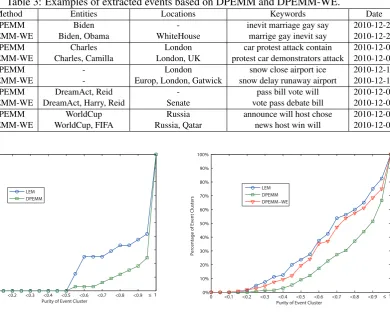
Figure 2: Purities of the clusters on Dataset I.
4.2 Quality of Clusters
As the proposed approaches essentially group tweets into different clusters with each cluster cor-responding to an event, we conduct experiments to explore the quality of clusters by a measure of purity, which is defined asPe= nne, wherene
de-notes the number of tweets describing the event
eextracted from a cluster andndenotes the total number of tweets in the cluster. Since it is diffi-cult to calculate the purity on Dataset III, we only report the results on Dataset I and Dataset II as shown in Figure 2 and 3 respectively.
Each point(x, y)in the figures denotes the per-centagey of the clusters whose purity is less than
x. Obviously, if the curve is steeper, it means that the percentage of the clusters with low purity is smaller and the quality of the clusters is better. It can be observed that DPEMM achieves the best quality of cluster on both Dataset I and Dataset II, whose precision is lower than DPEMM-WE. Specifically, on Dataset I, more than80%of clus-ters generated by DPEMM has the purity value greater than0.9, compared to only70%in LEM. It might be attributed to the property of DPEMM
0 <0.1 <0.2 <0.3 <0.4 <0.5 <0.6 <0.7 <0.8 <0.9 0%
10% 20% 30% 40% 50% 60% 70% 80% 90% 100%
Purity of Event Cluster
Percentage of Event Clusters
≤1
[image:8.595.310.524.102.380.2]LEM DPEMM DPEMM−WE
Figure 3: Purities of the clusters on Dataset II.
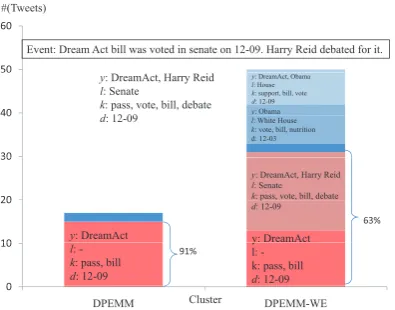
Figure 4: Example tweet clustering results gener-ated by DPEMM and DPEMM-WE.
On the contrary, DPEMM-WE generated a larger cluster and for some tweets, it successfully ex-tracted the location “Senate”. However, more spu-rious tweets are included because “Harry Reid” is close to both “DreamAct” and “Obama”, and “White House” is close to “Senate” in the word embedding space. Therefore, although DPEMM-WE gives better extraction results overall com-pared to DPEMM as shown in Table 2, it returns lower purity results because of some noisy infor-mation introduced through word embeddings.
5 Conclusions and Future Work
In this paper, we have proposed a model based on the Dirichlet Process mixture model to ex-tract structured event information from social me-dia data. Different from previous approaches for event extraction which require setting the number of events beforehand, it can infer the number of events automatically from data. It is specifically appealing for processing large-scale social media data. Moreover, considering different mentions of names could refer to the same person (and simi-larly for other named entities such as location), we have proposed to incorporate word embeddings into DPEMM so as to more effectively capture se-mantically similar words. Experiments have been conducted on three datasets and the proposed ap-proaches achieve better performance on all the datasets in comparison with the baseline approach. In the future, we plan to investigate more effec-tive way in reducing the noise introduced by word embeddings and incorporate emotion information into the proposed models to simultaneously
ex-tract public opinions of the exex-tracted event. Acknowledgments
We would like to thank the anonymous review-ers for their valuable comments and sugges-tions. This work was funded by the National Natural Foundation of China (61528302), the Natural Science Foundation of Jiangsu Province of China (BK20161430), the National Key Re-search and Development Program of China (2016YFC1306704) and the Collaborative Inno-vation Center of Wireless Communications Tech-nology.
References
Hamed Abdelhaq, Christian Sengstock, and Michael Gertz. 2013. Eventweet: Online localized event de-tection from twitter. Proceedings of the VLDB En-dowment, pages 1326–1329.
David J. Aldous. 1985. Exchangeability and related topics. Springer.
Pramod Anantharam, Payam Barnaghi, T. K. Prasad, and Amit P. Sheth. 2014. Extracting city traffic events from social streams. ACM Transactions on Intelligent Systems and Technology, 9(10):e110206. Edward Benson, Aria Haghighi, and Regina Barzi-lay. 2011. Event discovery in social media feeds. In Proceedings of the 49th Annual Meeting of the Association for Computational Linguistics: Human Language Technologies - Volume 1, pages 389–398, Stroudsburg, PA, USA. Association for Computa-tional Linguistics.
Joan Capdevila, Jess Cerquides, Jordi Nin, and Jordi Torres. 2015. Tweet-scan: An event discovery technique for geo-located tweets. In Artificial In-telligence Research and Development: Proceedings of the 18th International Conference of the Catalan Association for Artificial Intelligence, volume 277, pages 110–119.
Ronan Collobert, Jason Weston, L´eon Bottou, Michael Karlen, Koray Kavukcuoglu, and Pavel Kuksa. 2011. Natural language processing (almost) from scratch. The Journal of Machine Learning Re-search, 12:2493–2537.
Peter J. Green and Sylvia Richardson. 2001. Mod-elling heterogeneity with and without the dirich-let process. Scandinavian journal of statistics, 28(2):355–375.
Ralph Grishman, David Westbrook, and Adam Meyers. 2005. Nyu’s english ace 2005 system description. InACE 05 Evaluation Workshop.
Hemant Ishwaran and Mahmoud Zarepour. 2002. Ex-act and approximate sum representations for the dirichlet process. Canadian Journal of Statistics, 30(2):269–283.
Xiaohua Liu, Xiangyang Zhou, Zhongyang Fu, Furu Wei, and Ming Zhou. 2012. Exacting social events for tweets using a factor graph. In Proceedings of the Twenty-Sixth AAAI Conference on Artificial In-telligence, pages 1692–1698.
Radford M. Neal. 2000. Markov chain sampling meth-ods for dirichlet process mixture models. Computa-tional and Graphical Statistics.
Minh-Tien Nguyen, Asanobu Kitamoto, and Tri-Thanh Nguyen. 2015. Tsum4act: A framework for re-trieving and summarizing actionable tweets during a disaster for reaction. InAdvances in Knowledge Discovery and Data Mining, pages 64–75. Springer. Sandeep Panem, Manish Gupta, and Vasudeva Varma. 2014. Structured information extraction from natu-ral disaster events on twitter. InProceedings of the 5th International Workshop on Web-scale Knowl-edge Representation Retrieval & Reasoning, Web-KR ’14, pages 1–8, New York, NY, USA. ACM. Saˇsa Petrovic, Miles Osborne, Richard McCreadie,
Craig Macdonald, Iadh Ounis, and Luke Shrimpton. 2013. Can twitter replace newswire for breaking news? InProceedings of the 7th International AAAI Conference on Weblogs and Social Media.
Jakub Piskorski, Hristo Tanev, Martin Atkinson, and Erik Van Der Goot. 2008. Cluster-centric approach to news event extraction. In International Confer-ence on New Trends in Multimedia and Network In-formation Systems, pages 276–290.
Jim Pitman. 2002. Poisson–dirichlet and gem invariant distributions for split-and-merge transformations of an interval partition. Combinatorics, Probability & Computing, 11(05):501–514.
Ana-Maria Popescu, Marco Pennacchiotti, and Deepa Paranjpe. 2011. Extracting events and event de-scriptions from twitter. InProceedings of the 20th international conference companion on World Wide Web (WWW), pages 105–106.
Alan Ritter, Mausam, Oren Etzioni, and Sam Clark. 2012. Open domain event extraction from twitter. In Proceedings of the 18th ACM SIGKDD Inter-national Conference on Knowledge Discovery and Data Mining, KDD ’12, pages 1104–1112, New York, NY, USA. ACM.
Hristo Tanev, Jakub Piskorski, and Martin Atkinson. 2008. Real-time news event extraction for global crisis monitoring. In13th International Conference on Applications of Natural Language to Information Systems (NLDB), pages 207–218.
Yu Wang, David Fink, and Eugene Agichtein. 2015. Seeft: Planned social event discovery and attribute extraction by fusing twitter and web content. In
Ninth International AAAI Conference on Web and Social Media.
Chaolun Xia, Jun Hu, Yan Zhu, and Mor Naaman. 2015. What is new in our city? a framework for event extraction using social media posts. In Ad-vances in Knowledge Discovery and Data Mining, pages 16–32. Springer.
Deyu Zhou, Liangyu Chen, and Yulan He. 2014. A simple bayesian modelling approach to event extrac-tion from twitter. InProceedings of the The 51st An-nual Meeting of the Association for Computational Linguistics (ACL), pages 700–705.
Deyu Zhou, Liangyu Chen, and Yulan He. 2015. An unsupervised framework of exploring events on twitter: Filtering, extraction and categorisation. In