Avoiding Unnecessary Calculations in Robot Navigation
Weiya Yue, John Franco
∗Abstract— For solving problems of robot navigation over un-known and changing terrain, many algorithms have been in-vented. For example, D* Lite, which is a dynamic, incremen-tal search algorithm, is the most successful one. The improved performance of the D* Lite algorithm over other replanning al-gorithms is largely due to updating terrain cost estimates rather than recalculating them between robot movements. However, the D* Lite algorithm performs some recalculation every time a change in terrain is discovered. In this paper, it is shown that re-calculation is often not necessary, particularly when several opti-mal solutions (shortest paths) exist, and an efficient test for deter-mining this is presented. These ideas are packaged in a modified version of D* Lite which we call ID* Lite for Improved D* Lite. We present experimental results that show the speedups possible for a variety of benchmarks. Also, a novel realistic benchmark is described.
Keywords: robot navigation, uncertainty, planning
1 Introduction
Advances in robot replanning have made possible the devel-opment of serious autonomous vehicles that may be used to explore other planets, gather data in areas considered too dan-gerous for humans, and even park themselves without human involvement. Notable among these advances is the marriage of incremental search algorithms with sophisticated search heuristics that exploit learned terrain information to narrow the search space and thereby speed up the replanning process. The D* Lite algorithm [3, 4] represents the state-of-the-art in such replanning algorithm development. A descendant of the A* and D* [1, 2] algorithms, D* Lite is easily implemented and its “experimental properties show that D* Lite is at least as efficient as D*.” It has been used successfully in a variety of roles.
The terrain information that is used by D* Lite is repre-sented abstractly as a directed graph G(V, E) with distin-guished start vertexvs, goal vertex vg, and positive integer costsc:V ×V 7→Z+on edges. A “robot” initially occupies
vsand moves along edges tovg. On every movement through a single edge, called atransition, edge costs can change. The cost of a robot’s path fromvstovgis the sum of the costs of the edges traversedwhen they are traversed. D* Lite attempts to determine the lowest cost sequence of transitions that will take a robot fromvstovg. The problem is complicated by the fact that edge cost changes are not predictable.
∗Department of Computer Science, University of Cincinnati, Cincinnati
OH, 45220. Email: [email protected], [email protected]
It is unlikely that D* Lite will find the lowest cost sequence of transitions that advances the robot fromvstovgbecause it never has complete information about edge cost changes un-til the last transition. Moreover, current edge costs are known to D* Lite only within the robot’sviewwhich consists of the edges out to vertices that are within a fixed distance, called the
sensor-radius, from the current position of the robot, which we will always designate as vc below. But D* Lite can al-ways find the lowest cost sequence fromvctovgbased on the known edge costs within the view and assuming that current estimates of other edge costs are their actual costs. We will use the termshortest pathto refer to such a sequence and we will usece(w, u)to represent the estimated cost of any edge hw, ui: ifhw, uiis in the view thence(w, u) =c(w, u), other-wisece(w, u)does not change from round to round. When a shortest path is computed, the algorithm moves the robot along that path, one transition per round, until the edge cost assump-tion is violated at some vertexvxthat is within the view and on the path. At that point D* Lite recomputes a new shortest path fromvc tovg and repeats the above two steps until the robot occupiesvg.
D* Lite is assisted by two functions which take a vertexvas input and return the cost of the shortest path fromvtovgbased on current edge costs and estimated costs. One function,g(v), is identical to the function of the same name that is used by the A* algorithm to estimate costs fromvsbut in this role es-timates the cost tovg. The other,rhs(v), is a more informed, one-level-lookahead function whose output is expressed as
rhs(v) = min
v0∈Succ(v)g(v 0) +c
e(v, v0)
ifv 6= vgand otherwiserhs(vg) = 0, whereSucc(v)is the set of all vertices, referred to as successorsbelow, that are reachable fromvthrough a single edge. A vertexvfor which rhs(v) = g(v) is said to be locallyconsistent. If g(v) > rhs(v)thenvis locallyoverconsistentand ifg(v)< rhs(v)
thenvisunderconsistent. Shortest path costs from all vertices tovgare known precisely if and only if all vertices are locally consistent. In that case, shortest paths can be computed by following minimum edge costs, ties being broken arbitrarily.
underconsistent vertices since, intuitively, it is more likely that the shortest path traverses overconsistent vertices.
The improvement to D* Lite that is proposed here is motivated by the observation that in many replanning problems there are typically more than one shortest path fromvctovg. The im-provement is to find one of thealternativeshortest paths that is not affected by the terrain change which invoked the replan-ning step, if one exists. If the cost of an alternative shortest path is no greater that the current shortest path, a switch to the new path may be made without recomputing any values ofg. Also, we will show that if the new path is shorter, only part of the changes need to be propagated.
In Section 2 an overview of the proposed modification to D* Lite will be introduced and pseudo code presented. In Sec-tion 3 an example will be discussed. In SecSec-tion 4 the results of some experiments on random benchmarks will be shown. Section 5 contains an analysis and some theoretical results.
2 Improved D* Lite
This section contains the motivation for and description of an algorithm we call ID* Lite which is short for Improved D* Lite. ID* Lite follows D* Lite in searching from goal to start and in selecting the next edge to traverse. ID* Lite also uses rhs, andgas D* Lite does and it maintains a priority queue as D* Lite does. As in the case of D* Lite, ID* Lite traverses a current shortest path tovguntil an inconsistency is detected. However, in computing a new shortest path, ID* Lite may only calculate part of the changes or even skip all the recalculation. The conditions that allow recalculations to be skipped will be given later along with a proof that they do not prevent ID* Lite from finding a shortest path tovg. Upon completion of the algorithm it may be the case that at least some skipped g(v)were never recomputed. Because of this, ID* Lite can potentially outperform D* Lite, especially if there are many shortest paths tovg, or the new path will not be longer.
Some definitions are needed prior to discussing ID* Lite. In Succ(v), all the verticesv0 whoseg(v0) +c(v, v0) =rhs(v) are calledchildrenofv, andvwill be calledv0’sparent. I.e., on vertexv, robot can choose arbitrary vertex inchildrenof it for next move. Atypein the form of a number will be assigned to every vertex during execution of ID* Lite as follows:
−3: The vertex is temporarily unavailable because it is not locally consistent and caused by the changes. This is also calledinconsistent source.
−2: The vertex is temporarily unavailable, but caused by in-consistent source. Because the shortest path between it andvgmust cross a type−3vertex.
−1: The vertex has never been searched. I.e., never appears in priority queue before.
0: The vertex has been visited but is not in the current short-est path.
≥1: The vertex has been visited, is in the current shortest path, and the type number is the number of children whose type value is not−3and−2it has.
Thelengthof a path is the number of edges it contains. The
distancebetween two vertices is the minimum length of paths connecting those two vertices. All vertices that are no further than distancesensor-radiusaway fromvcare said to be in the
view of vc and those that are exactly distance sensor-radius away fromvc are said to befringevertices. Complete path information is always known within the view ofvc. The cost of the current shortest path will be designated asΩ.
The goal of ID* Lite, when an inconsistency is discovered at a vertexw, is to consider replacing the current shortest path with an alternative shortest path fromvc tovg which passes through some vertexuon the path fromvc towwith priority in increasing order of distance fromutow. If there exists such a path with cost less thanΩ, that path will replace the current shortest path. Otherwise, if the current shortest path is unaf-fected by the inconsistency, it will remain the shortest path into the next round. If neither of the above applies a new shortest path will have to be computed in the same manner that a new shortest path is computed by D* Lite. In other words, there are two cases where a new shortest path is partially and fully recomputed and vertex information is recomputed to be made consistent respectively: 1) when a path to vg that is shorter that the current shortest path is found; and 2) when all shortest paths from brothers that are successors tovc are affected by the inconsistency.
Reduced processing time for ID* Lite depends on the abil-ity to find the shorter path and unaffected alternative shortest paths; one of the new shortest paths will be found if there are more than one. The shorter path can be found by partially computing where only the potential vertices which may lead to a better solution will be processed. Alternative paths can be located with a simple and efficient test and, if determined to exist, they can be efficiently computed by traversing a chain of vertices according to vertex type, possibly changing the type of some vertices during the traversal. The test is merely to determine whether ce(w, u) has changed for some wand u vertices in the view. There may be several such changes on a round and all may be taken into account when looking for a shortest path tovg. This is different than for D* Lite and its variants: they will always eagerly recomputegandrhsto remove inconsistencies and then compute a new shortest path based on the new values. If ID* Lite is not forced to recompute gandrhsvalues it will not do; that presents the opportunity to seek and investigate alternative shortest paths. If recom-pute cannot be avoided, similar to delayed D*lite [5], ID*lite will try to only update part of the changes. But unlike delayed D*lite, the need to test whether to recompute more than once in every round to guarantee optimality is avoided by ID*lite.
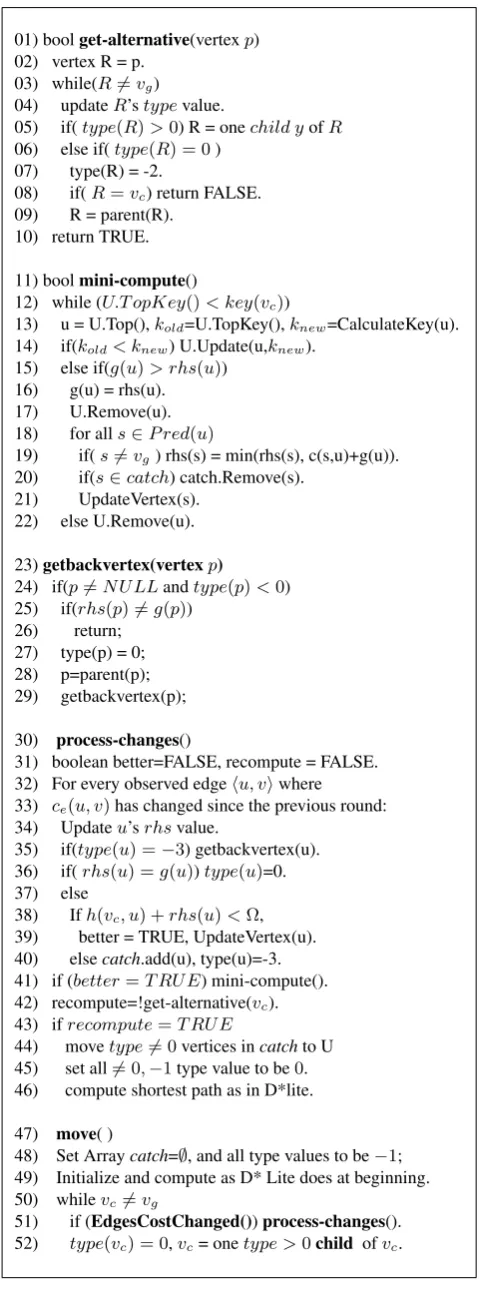
ex-01) boolget-alternative(vertexp) 02) vertex R = p.
03) while(R6=vg)
04) updateR’stypevalue.
05) if(type(R)>0) R = onechild yofR
06) else if(type(R) = 0) 07) type(R) = -2.
08) if(R=vc) return FALSE.
09) R = parent(R). 10) return TRUE.
11) boolmini-compute()
12) while (U.T opKey()< key(vc))
13) u = U.Top(),kold=U.TopKey(),knew=CalculateKey(u).
14) if(kold< knew) U.Update(u,knew).
15) else if(g(u)> rhs(u)) 16) g(u) = rhs(u). 17) U.Remove(u). 18) for alls∈P red(u)
19) if(s6=vg) rhs(s) = min(rhs(s), c(s,u)+g(u)).
20) if(s∈catch) catch.Remove(s). 21) UpdateVertex(s).
22) else U.Remove(u).
23)getbackvertex(vertexp)
24) if(p6=N U LLandtype(p)<0) 25) if(rhs(p)6=g(p))
26) return; 27) type(p) = 0; 28) p=parent(p); 29) getbackvertex(p);
30) process-changes()
31) boolean better=FALSE, recompute = FALSE. 32) For every observed edgehu, viwhere 33) ce(u, v)has changed since the previous round: 34) Updateu’srhsvalue.
35) if(type(u) =−3) getbackvertex(u). 36) if(rhs(u) =g(u))type(u)=0. 37) else
38) Ifh(vc, u) +rhs(u)<Ω,
39) better = TRUE, UpdateVertex(u). 40) elsecatch.add(u), type(u)=-3. 41) if (better=T RU E) mini-compute(). 42) recompute=!get-alternative(vc).
43) ifrecompute=T RU E
44) movetype6= 0vertices incatchto U 45) set all6= 0,−1type value to be0. 46) compute shortest path as in D*lite.
47) move( )
48) Set Arraycatch=∅, and all type values to be−1; 49) Initialize and compute as D* Lite does at beginning. 50) whilevc6=vg
[image:3.595.50.290.68.718.2]51) if (EdgesCostChanged())process-changes(). 52) type(vc) = 0,vc= onetype >0child ofvc.
Figure 1: Main functions of ID* Lite
ample, every time a vertex is added into priority queue (U), its type value will be set as0, the other modifications of type value have been shown in outline. The reader is referred to [4] for a description of those functions.
The function that determines what happens on a round is process-changes. For every changed edgee=< u, v >,rhs value of vertexuwill be updated. In line35, if a vertex had been changed before, functiongetbackvertexwill be called. We will explain this function later. In line38, if a change may cause a shorter path, line39will executed, or this change will be temporarily stored in catch. Lines 41and42will find a path if the length of the new shortest path is less than or equal to the length of the old one. If it fails, the last three lines of process-changesare invoked to perform a D* Lite recomputa-tion. Functiongetbackvertexis used to get back the vertices which are abandoned by a previous change. mini-compute will only propagate the vertices for which rhs < g (over-consistent), so only better solutions can be found in function mini-compute; if there is vertices withrhs > g (undercon-sistent), it must has been catched, so we can delete it directly. get-alternative will find a path from pto vg if and only if there exists one. The main function ismovewhich is invoked one time, at startup. Its operation is similar to that of themove function of D* Lite except that on every round it calls process-changesto try to avoid recomputation ofgandrhsvalues.
As a note, in line05, when a child ofRis chosen, it is better to get the one withtype >0if possible. This way, if the old shortest path can be still used, it will be found with priority. Upon termination ofprocess-changes, only part of vertices in
catchneed to be transferred toU with the order of increasing keyvalue. More vertices incatchwill be moved intoU if and only if no shortest path has been found. It follows that the in-formation incatchandU should be synchronized. However, for simplicity we chose not to do this in running our experi-ments. Also because we are investigating a new method which can even skipcatch. For space limit, this wont be discussed here.
3 An example
Figure 2 presents a simple example of grid world that shows how ID* Lite can avoid recomputation that is required by D* Lite and delayed D*. It is a3×5 grid-world where shaded squares are impassable obstacles. A vertex is a square and is identified by its row and column position; the vertex associ-ated with theithrow andjthcolumn is referred to asv
i,j. It is 4-directional. The cost of each edge connecting two unshaded squares is 1. The start vertex isv1,0andvgisv1,4. The
Figure 2:3×54-directional Grid World
Figure 3: Example of ID* Lite Execution
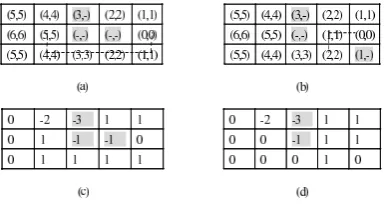
Now the robot moves from(1,0)to(1,1), and(0,2)is found to be blocked as shown in Figure 3(a). After updating rhs of those vertices,h((1,1),(0,2))+rhs((0,2)) = 0+∞>Ω, so mini-computeis not needed. Inget-alternative, going from
(1,1)to(0,1), because of the blockage of(0,2),(0,1)’s type value is0, so its type value is updated to be−2and the algo-rithm backtracks to(1,1). Then(1,1)’s type value is updated to be1now, and the only child is(2,1). The new shortest path is shown by the dotted line in Figure 3(a). Figure 3(c) is the type graph corresponding to Figure 3(a). In D*lite, recompu-tation is needed: both(0,2),(0,1)will be inserted into prior-ity queue to propagate the change. Here, if the robot is still on(1,1)and finds(0,2)is unblocked,getbackvertexwill be used: vertices(0,1)and(0,2)will be set available again.
Now, considering robot is on vertex(2,3), two changes are observed: (1,3)is unblocked and(2,4)is blocked as shown in Figure 3(b) with the old path weightΩ = 2. After updating rhs, becauseh((2,3),(1,3))+rhs((1,3)) = 0+1<Ω, vertex
(1,3)will be inserted into priority queue andmini-compute is triggered. Similarly, as(0,2)in Figure 3(a), it is not nec-essary to insert(2,4)into the priority queue. After execution ofmini-compute, the(g, rhs)value will be as in Figure 3(b). Thenget-alternativeis called. The corresponding type value is shown in Figure 3(d), and the new shortest path is shown as the dotted line in Figure 3(b). In D*lite, it is necessary for both changed vertices to be inserted into the priority queue to propagate.
D* Lite would have found all the changes torhsvalues that ID* Lite did. Then it would have begun a new search, updating allg andrhsvalues as usual. Algorithm delayed D* would have operated as D* Lite except that it would need to make an extra check to make sure it has the shortest path: i.e., there is no inconsistent vertices on its current path. This step is necessary to be sure the path found by delayed D* is shortest.
4 Experiments
In this section, the performance of ID* Lite is compared exper-imentally to the D* Lite and delayed D* algorithms on random grid world terrains. In each experiment the initial terrain is a blank square 8-direction grid world ofsize2vertices, where
vsandvg are chosen randomly. Several other parameters are used: 1. percentis used for exactlypercent%∗size2of the
vertices are selected randomly and blocked; 2. sensor-radius
is used as the maximum distance to a node that is observable from the current robot position. First, results of random rock-and-garden benchmarks is given: i.e., a blockage is found it will not move or disappear later. Then, experiments are run on a collection of benchmarks that model robot navigation through changing terrain. The results are average of more than 100 independent runs of each algorithm.
1.00^{3} 2.50^{3} 4.00^{3} 5.50^{3} 7.00^{3}
2 5 10 15 20
Heap Percolations
sensor-radius D* lite delayed D* ID* lite
0 0.2 0.4 0.6 0.8 1 1.2 1.4 1.6
2 5 10 15 20
# recomputes per inconsistency discovery
[image:4.595.315.543.276.361.2]sensor-radius D* lite delayed D* ID* lite
Figure 4:size= 200andpercent= 30
In Figure 4, the results in rock-and-garden benchmarks are shown: the graph on the left shows the relation between num-ber ofheap operationsandsensor-radiusgiven the other pa-rameters. Heap operations make the most significant contribu-tion to time complexity in such algorithms and the plots show only the heap operations in recomputation: i.e., they do not count the number of operations used when initializing a short-est path fromvstovg, because all of the family of algorithms discussed here do the same as the A* algorithm in this phase. On the right side of the figure is a graph showing the ratio of the number of recomputations to the number of changes ob-served. The D*lite, curve is flat at 1 because every time an inconsistency is observed, exactly one recomputation must be performed. The delayed D* curve is always above 1 because at least one recomputation must be performed for every round in order to guarantee local optimality [5]. The curve for ID*lite stays much below 1 since recomputations are skipped when alternatives are found. We note that the numbers plotted in the figure include calls to mini-compute.
To some extent, the graph explains why ID*lite can outper-form the other algorithms. The right graph of Figure 4 shows that ID* lite can save almost 90% of the recomputations that would be done by D* Lite. However, this does not mean that a corresponding savings applies for heap operations since changes are transferred from catch to the priority queue every time a full recomputation occurs.
speaking, decreasing changes can affect more vertices than in-creasing changes. In rock-and-garden benchmarks there are only increasing changes and in the benchmarks below there are many decreasing changes.
In [5] significant delayed D* performance advantages are re-ported. In particular, delayed D* performs well when there are only a few decreasing changes that cause overconsistent vertices. But in rock-and-garden benchmarks, there are no de-creasing changes so the performance of delayed D* is not as good as the other algorithms. Delayed D* performance also suffers in the terrain changing benchmarks since half of the inconsistent vertices are overconsistent. This is especially true when robot movement is blocked. Since showing the perfor-mance results of delay D* would force a change of scale of the plots, we do not show them.
The second set of benchmarks is intended to model robot nav-igating in terrain changes, for example if a robot is moving in a parking lot along other vehicles. In these benchmarks a fixed percentage of vertices are initially blocked and, on succeeding rounds, each of the blocked vertices moves to some adjacent vertex with probability0.5, the particular target vertex being chosen randomly from all available adjacent vertices. The periments are done in the same way as the rock-and-garden ex-periments except we also plot, in Figure 7, the effect of chang-ing the percentage of blocked vertices for fixed sensor-radius.
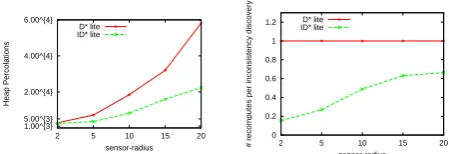
Figures 5 to 6, left, show that ID* Lite uses fewer heap op-erations to compute a path from vs tovg. In the right plot of Figure 6 the ratio of the number of recalculations to the number of changes tends to1 as sensor-radius is increased. But we note that significantly many recomputations are calls tomini-computewhich complete faster than a full recompu-tation. From Figure 7, we can see that the number of re-computations done in ID*Lite remains below that of D*Lite for a wide range of blocking percentages. We conclude that for these benchmarks ID*lite has a better ability to handle in-tensely changing environments. Because ID* lite can skip re-computations and then update all the changes at one time, it is more efficient to update changes per round.
In the case of the terrain changing benchmarks, although all three algorithms find and traverse optimal cost paths in every round, they can find different final paths if they use differ-ent ways to break ties when there is more than one child to consider. Because ID* Lite exploits alternative shortest paths which try to avoid the area with more intense changes, ID* lite has a better ability to avoid crashes with sliding obstacles.
5 Analysis and theoretical results
In this section it is shown that on every round, given a current shortest path fromvctovg, ID* Lite computes a new shortest path, if one exists: that is, a path whose cost is the minimum over all pathsPfromvctovgof the sum of costsceof edges inP. It is assumed that the cost of any edge with at most one endpoint in the view does not conflict with thegvalues of any of its endpoints that are not in the view. Finally, it
1.00^{3} 5.00^{3} 2.00^{4} 4.00^{4} 6.00^{4}
2 5 10 15 20
Heap Percolations
sensor-radius D* lite ID* lite
0 0.2 0.4 0.6 0.8 1 1.2
2 5 10 15 20
# recomputes per inconsistency discovery
[image:5.595.316.541.82.159.2]sensor-radius D* lite ID* lite
Figure 5:size= 200and percent vertices blocked = 30
0.00^{0} 3.50^{4} 7.00^{4} 1.05^{5} 1.40^{5} 1.75^{5}
2 5 10 20 30
time to compute path (sec)
sensor-radius D* lite ID* lite
0 0.2 0.4 0.6 0.8 1 1.2
2 5 10 20 30
# recomputes per inconsistency discovery
[image:5.595.317.540.192.265.2]sensor-radius D* lite ID* lite
Figure 6:size= 300and percent vertices blocked = 30
0.0^0 1.5^4 3.0^4 4.5^4 6.0^4 7.5^4
10 20 30 40
time to compute path (sec)
percent D* lite ID* lite
0 0.2 0.4 0.6 0.8 1 1.2
10 20 30 40
# recomputes per inconsistency discovery
[image:5.595.317.541.291.373.2]percent D* lite ID* lite
Figure 7:size= 200and sensor-radius = 20
is assumed that the heuristic functionh(w, u)is the same as that of D* Lite and is therefore always a lower bound on the minimum cost path fromw touusing ce costs and is such that the triangle inequality holds. We will usee =hw, uito denote an edge inprocess-changesof ID* Lite that is in the view, whose costce(w, u)has changed to bec0e(w, u)since the previous round.
Lemma 5.1 Ifeis greater than it was in the previous round, then any path passing throughewithout decreased edges has a cost that is greater thanΩwhich is the cost of previous round shortest path.
proof 1 Assume there is a pathpof cost less than or equal toΩand passing through ewithout a decreased edge. It is straightforward to see that the cost ofpin the previous round is less thanΩ. This contradicts the hypothesis thatΩis the shortest path of the previous round.
Lemma 5.2 e = hw, ui’s cost has been decreased. If after updating rhsofw, u, h(vc, w) +rhs(w)is no less thanΩ
of previous round, then any path passing throughe, without other decreased edges afterealong the path, has a cost that is not less thanΩ.
proof 2 Suppose an arbitrary pathppassing throughe, then the cost ofp,η, has the property: η≥h(vc, w) +c0e(w, u) + g(u). By definition ofrhs, we haveη ≥h(vc, w) +rhs(w).
Lemma 5.3 If ine=hw, ui,w’s type value is−1, then any path passing throughewithout other decreased edges aftere
along that path has a cost that is not less thanΩwhich is the cost of previous round shortest path.
proof 3 Ifw’s type value is−1, i.e.,whas not been inserted into the priority queue, thenkey(u)≥Ω. Therefore, any path
ppassing throughewill have costη≥h(vc, w) +c0e(w, u) + g(u)≥h(vc, u) +g(u)≥Ω.
Theorem 5.4 Only thee, whose cost is less than it was on the previous round and after updating rhs has h(vc, w) + rhs(w)<Ωmay cause a shorter path then the shortest path in previous round.
proof 4 By Lemma 5.1, 5.2 and 5.3, we can see that the only non-trivial condition needed to be proved is whether one path
phaving more than one decreased edge may be shorter. With-out loss of generality, supposingphase =hw, uias the last decreased edge with the direction fromvctovg. Thene
satis-fies the precondition of 5.2, i.e.,p≥Ω.
Lemma 5.5 In ID* lite, only vertices which may cause shorter path than the shortest path in previous round will be propagated in functionmini-compute.
proof 5 By theorem 5.4 and line 38,39,41in Figure 1, this lemma can be proved straightforwardly.
Lemma 5.6 Function get-alternative returns T RU E if and only if a shortest consistent path fromvctovgis found.
proof 6 get-alternative returnsT RU E if and only if a path fromvctovghas been found. By the way the next step is
cho-sen, no abandoned (i.e., inconsistent) vertices will be chocho-sen, so the path must be one of the shortest consistent paths.
Theorem 5.7 Functionprocess-changeswill find the shortest path in every round if and only if there exists one.
proof 7 If the new shortest path is shorter than the one in the previous round then, by Lemma 5.5, all the shorter paths will be found by function mini-computeand will be updated to be consistent. If the new shortest path is as long as the one in the previous round, then the shortest path in the previous round is not affected by changes and will still be consistent. By Lemma 5.6, all shortest paths can be found correctly.
Therefore, lines43to46in Figure 1 will be executed if and only if the new shortest path is greater than the one in pre-vious round. In this case ID*Lite behaves like D* lite so the correctness of the new shortest path follows from the correct-ness of D* lite.
Lemma 5.8 The changes which have been skipped in a round when the shortest path’s cost is Ω, will not affect the result anymore unless the new shortest path is greater thanΩ.
proof 8 For a change ofe = hw, ui, if it was skipped, then the low boundηof any path passing through it hasη ≥Ω. If the new shortest path’s lengthΩ0is not greater thanΩ, then
we haveη ≥Ω0. So it will not affect the new shortest path.
Theorem 5.9 ID* Lite finds a shortest path fromvc tovgon
a round, if and only if one exists.
proof 9 Follows directly from theorem 5.7 and Lemma 5.8.
The following theorem explains, in part, the relative efficiency of searching for alternative shortest paths.
Proposition 5.10 After a full recomputation, all the new shortest paths will be found.
proof 10 Since ID* Lite uses the same data structures as D* Lite, if one child of a vertex has been updated to be consistent, then all the children of it will be updated to be consistent. So if one shortest has been found, supposing an arbitrary pathp
fromvc tovg is also shortest, then the child ofvc onpmust
be updated and consistent too. Iteratively, all the vertices on
pare updated and consistent. I.e., it has been found.
6 Conclusion
A modification to the D* Lite algorithm for planning has been introduced and packaged as an algorithm called ID* Lite. The modification is to update vertices as less as possible and to seek alternative shortest paths when inconsistencies are dis-covered, rather than recompute to remove all inconsistencies before finding a new shortest path. It is shown that the modifi-cation results in far better performance on random grid prob-lems. The modifications proposed for D* Lite can coexist with other D* Lite variants such as delayed D* Lite easily.
References
[1] Anthony Stentz,“Optimal and Efficient Path Planning for Partially-Known Environments,”IEEE International Conference on Robotics and Automation, San Diego,CA, pp. 3310–3317, 5/94.
[2] Anthony Stentz, “The Focussed D* Algorithm for Real-Time Replanning,” Proceedings of the International Joint Conference on Artificial Intelligence, Montral, Qubec, Canada, pp. 1652–1659, 8/95.
[3] Sven Koenig, Maxim Likhachev, “Improved Fast Re-planning for Robot Navigation in Unknown Terrain,”
IEEE International Conference on Robotics and Au-tomation, Washington DC, pp. 968–975, 8/02.
[4] Sven Koenig, Maxim Likhachev, “D*lite,” Eighteenth national conference on Artificial intelligence,Menlo Park, CA, USA, pp. 476–483, 2002.