Unsupervised Word Alignment Using Frequency Constraint in Posterior
Regularized EM
Hidetaka Kamigaito1,2, Taro Watanabe2, Hiroya Takamura1, Manabu Okumura1 1Tokyo Institute of Technology, Precision and Intelligence Laboratory
4259 Nagatsuta-cho Midori-ku Yokohama, Japan
2National Institute of Information and Communication Technology 3-5 Hikari-dai, Seika-cho, Soraku-gun, Kyoto, Japan
Abstract
Generative word alignment models, such as IBM Models, are restricted to one-to-many alignment, and cannot explicitly represent many-to-many relationships in a bilingual text. The problem is par-tially solved either by introducing heuris-tics or by agreement constraints such that two directional word alignments agree with each other. In this paper, we fo-cus on the posterior regularization frame-work (Ganchev et al., 2010) that can force two directional word alignment models to agree with each other during train-ing, and propose new constraints that can take into account the difference between function words and content words. Ex-perimental results on French-to-English and Japanese-to-English alignment tasks show statistically significant gains over the previous posterior regularization baseline. We also observed gains in Japanese-to-English translation tasks, which prove the effectiveness of our methods under gram-matically different language pairs.
1 Introduction
Word alignment is an important component in sta-tistical machine translation (SMT). For instance phrase-based SMT (Koehn et al., 2003) is based on the concept of phrase pairs that are automat-ically extracted from bilingual data and rely on word alignment annotation. Similarly, the model for hierarchical phrase-based SMT is built from exhaustively extracted phrases that are, in turn, heavily reliant on word alignment.
The Generative word alignment models, such as the IBM Models (Brown et al., 1993) and HMM (Vogel et al., 1996), are popular methods for au-tomatically aligning bilingual texts, but are re-stricted to represent one-to-many correspondence
of each word. To resolve this weakness, vari-ous symmetrization methods are proposed. Och and Ney (2003) and Koehn et al. (2003) propose various heuristic methods to combine two direc-tional models to represent many-to-many relation-ships. As an alternative to heuristic methods, fil-tering methods employ a threshold to control the trade-off between precision and recall based on a score estimated from the posterior probabili-ties from two directional models. Matusov et al. (2004) proposed arithmetic means of two mod-els as a score for the filtering, whereas Liang et al. (2006) reported better results using geometric means. The joint training method (Liang et al., 2006) enforces agreement between two directional models. Posterior regularization (Ganchev et al., 2010) is an alternative agreement method which directly encodes agreement during training. DeN-ero and Macherey (2011) and Chang et al. (2014) also enforce agreement during decoding.
However, these agreement models do not take into account the difference in language pairs, which is crucial for linguistically different lan-guage pairs, such as Japanese and English: al-though content words may be aligned with each other by introducing some agreement constraints, function words are difficult to align.
We focus on the posterior regularization frame-work and improve upon the previous frame-work by proposing new constraint functions that take into account the difference in languages in terms of content words and function words. In particular, we differentiate between content words and func-tion words by frequency in bilingual data, follow-ing Setiawan et al. (2007).
Experimental results show that the proposed methods achieved better alignment qualities on the French-English Hansard data and the Japanese-English Kyoto free translation task (KFTT) mea-sured by AER and F-measure. In translation eval-uations, we achieved statistically significant gains
in BLEU scores in the NTCIR10.
2 Statistical word alignment with posterior regularization framework
Given a bilingual sentencex= (xs,xt)wherexs andxtdenote a source and target sentence, respec-tively, the bilingual sentence is aligned by a many-to-many alignment of y. We represent posterior probabilities from two directional word alignment models as−→pθ(−→y|x)and←−pθ(←y−|x)with each ar-row indicating a particular direction, and useθto denote the parameters of the models. For instance, −
→y is a subset ofy for the alignment from xs to xtunder the model ofp(xt,−→y|xs). In the case of IBM Model 1, the model is represented as follows:
p(xt,−→y|xs) =Y
i
1 |xs|+ 1pt(x
t
i|xs−→yi). (1)
where we define the index of xt, xs asi, j(1 ≤
i≤ |xt|,1≤j≤ |xs|)and the posterior probabil-ity for the word pair(xt
i, xsj)is defined as follows: −
→p(i, j|x) = pt(xti|xsj)
P
j0pt(xti|xsj0). (2)
Herein, we assume that the posterior probabil-ity for wrong directional alignment is zero (i.e., −
→p(←−y|x) = 0).1 Given the two directional
mod-els, Ganchev et al. defined a symmetric feature for each target/source position pair,i, jas follows:
φi,j(x,y) =
+1 (−→y ⊂y)∩(−→yi=j), −1 (←y−⊂y)∩(←−yj=i),
0 otherwise. (3)
The feature assigns1for the subset of word align-ment for −→y, but assigns −1 for ←y−. As a result, if a word pair i, j is aligned with equal posterior probabilities in two directions, the expectation of the feature value will be zero. Ganchev et al. de-fined a joint model that combines two directional models using arithmetic means:
pθ(y|x) = 12−→pθ(y|x) + 12←−pθ(y|x). (4) Under the posterior regularization framework, we instead useqthat is derived by maximizing the fol-lowing posterior probability parametrized byλfor each bilingual data xas follows (Ganchev et al., 2010):
qλ(y|x) =
−
→pθ(−→y|x) +←−pθ(←y−|x)
2 (5)
·exp{−λZ·φ(x,y)}
1No alignment is represented by alignment into a special
token ”null”.
= −→q(−→y|x)
Z−→q
−
→pθ(x)+←−q(
←−y|x) Z←−q
←−pθ(x)
2Z ,
Z = 1
2(
Z−→q
− →pθ +Z
←−q
←p−θ ), −
→q(−→y|x) = 1 Z−→q
−
→pθ(−→y,x)exp{−λ·φ(x,y)},
Z→−q = X − →y
− →p
θ(−→y,x)exp{−λ·φ(x,y)},
←−q(←−y|x) = 1 Z←−q
←−pθ(←y−,x)exp{−λ·φ(x, y)},
Z←−q = X ←−y
←−pθ(←y−,x)exp{−λ·φ(x,y)},
such that Eqλ[φi,j(x,y)] = 0. In the E-step of
EM-algorithm, we employqλinstead ofpθ to
ac-cumulate fractional counts for its use in the M-step. λis efficiently estimated by the gradient as-cent for each bilingual sentencex. Note that pos-terior regularization is performed during parame-ter estimation, and not during testing.
3 Posterior Regularization with Frequency Constraint
The symmetric constraint method represented in Equation (3) assumes a strong one-to-one rela-tion for any word, and does not take into account the divergence in language pairs. For linguisti-cally different language pairs, such as Japanese-English, content words may be easily aligned one-to-one, but function words are not always aligned together. In addition, Japanese is a pro-drop lan-guage which can easily violate the symmetric con-straint when proper nouns in the English side have to be aligned with a “null” word. In addition, low frequency words may cause unreliable estimates for adjusting the weighing parametersλ.
In order to solve the problem, we improve Ganchev’s symmetric constraint so that it can con-sider the difference between content words and function words in each language. In particular, we follow the frequency-based idea of Setiawan et al. (2007) that discriminates content words and func-tion words by their frequencies. We propose con-straint features that take into account the differ-ence between content words and function words, determined by a frequency threshold.
3.1 Mismatching constraint
The constraint is represented asf2c(function to content) constraint:
φf2ci,j(x,y) = (6)
+1 (−→y ⊂y)∩(−→yi=j)∩((xti∈ Ct∩xsj∈ Fs)
∪(xt
i∈ Ft∩xsj∈ Cs))∩(δi,j(x,y)>0),
0 (←y−⊂y)∩(←−yj=i)∩((xti∈ Ct∩xsj∈ Fs) ∪(xt
i∈ Ft∩xsj∈ Cs))∩(δi,j(x,y)>0),
0 (−→y ⊂y)∩(−→yi=j)∩((xti∈ Ct∩xsj∈ Fs)
∪(xt
i∈ Ft∩xsj∈ Cs))∩(δi,j(x,y)<0),
−1 (←y−⊂y)∩(←−yj=i)∩((xti∈ Ct∩xsj∈ Fs) ∪(xt
i∈ Ft∩xsj∈ Cs))∩(δi,j(x,y)<0). where δi,j(x,y) = −→pθ(i, j|x) − ←−pθ(i, j|x) is the difference in the posterior probabilities be-tween the source-to-target and the target-to-source alignment. Cs andCt represent content words in the source sentence and target sentence, respec-tively. Similarly, Fs andFt are function words in the source and target sentence, respectively. In-tuitively, when there exists a mismatch in content word and function word for a word pair(i, j), the constraint function returns a non-zero value for the model with the highest posterior probability. When coupled with the constraint such that the ex-pectation of the feature value is zero, the constraint function decreases the posterior probability of the highest direction and discourages agreement with each other.
Note that when this constraint is not fired, we fall back to the constraint function in Equation (3) for each word pair.
3.2 Matching constraint
In contrast to the mismatching constraint, our second constraint function rewards alignment for
function to function word matching, namely f2f. The f2f constraint function is defined as follows:
φf2fi,j(x,y) = (7)
+1 (−→y ⊂y)∩(−→yi=j)∩
(xt
i∈ Ft∩xsj∈ Fs)∩(δi,j(x,y)>0),
0 (←y−⊂y)∩(←−yj=i)∩
(xt
i∈ Ft∩xsj∈ Fs)∩(δi,j(x,y)>0),
0 (−→y ⊂y)∩(−→yi=j)∩
(xt
i∈ Ft∩xsj∈ Fs)∩(δi,j(x,y)<0), −1 (←y−⊂y)∩(←−yj=i)∩
(xt
i∈ Ft∩xsj∈ Fs)∩(δi,j(x,y)<0).
This constraint function returns a non-zero value for a word pair (i, j) when they are function words. As a result, the pair of function words are encouraged to agree with each other, but not other pairs. Thecontent to contentword matching function c2c can be defined similarly by replac-ingFsandFt byCsandCt, respectively. Like-wise, thefunction to contentword matching
func-tion f2c is defined by considering the matching of content words and function words in two lan-guages. As noted in the mismatch function, when no constraint is fired, we fall back to Eq (3) for each word pair.
4 Experiment
4.1 Experimental Setup
The data sets used in our experiments are the French-English Hansard Corpus, and two data sets for Japanese-English tasks: the Kyoto free trans-lation task (KFTT) and NTCIR10. The Hansard Corpus consists of parallel texts drawn from of-ficial records of the proceedings of the Canadian Parliament. The KFTT (Neubig, 2011) is derived from Japanese Wikipedia articles related to Ky-oto, which is professionally translated into En-glish. NTCIR10 comes from patent data employed in a machine translation shared task (Goto et al., 2013). The statistics of these data are presented in Table 1.
Sentences of over 40 words on both source and target sides are removed for training alignment models. We used a word alignment toolkit ci-cada 2 for training the IBM Model 4 with our
proposed methods. Training is bootstrapped from IBM Model 1, followed by HMM and IBM Model 4. When generating the final bidirectional word alignment, we use a grow-diag-final heuristic for the Japanese-English tasks and an intersection heuristic in the French-English task, judged by preliminary studies.
Following Bisazza and Federico (2012), we automatically decide the threshold for word fre-quency to discriminate between content words and function words. Specifically, the threshold is de-termined by the ratio of highly frequent words. The thresholdth is the maximum frequency that satisfies the following equation:
P
w∈P(freq(w)>th)freq(w)
w∈allfreq(w) > r. (8) Here, we empirically setr = 0.5by preliminary studies. This method is based on the intuition that content words and function words exist in a docu-ment at a constant rate.
4.2 Word alignment evaluation
We measure the impact of our proposed meth-ods on the quality of word alignment measured
Table 1: The statistics of the data sets
hansard kftt NTCIR10
French English Japanese English Japanese English
train sentence 1.13M 329.88K 2.02M
word 23.3M 19.8M 6.08M 5.91M 53.4M 49.4M
vocabulary 78.1K 57.3K 114K 138K 114K 183K
dev sentence 1.17K 2K
word 26.8K 24.3K 73K 67.3K
vocabulary 4.51K 4.78K 4.38K 5.04K
test WA sentence 447 582
word 7.76K 7.02K 14.4K 12.6K
vocabulary 1,92K 1.69K 2.57K 2.65K
TR sentence 1.16K 8.6K
word 28.5K 26.7K 334K 310K
vocabulary 4.91K 4.57K 10.4K 12.7K
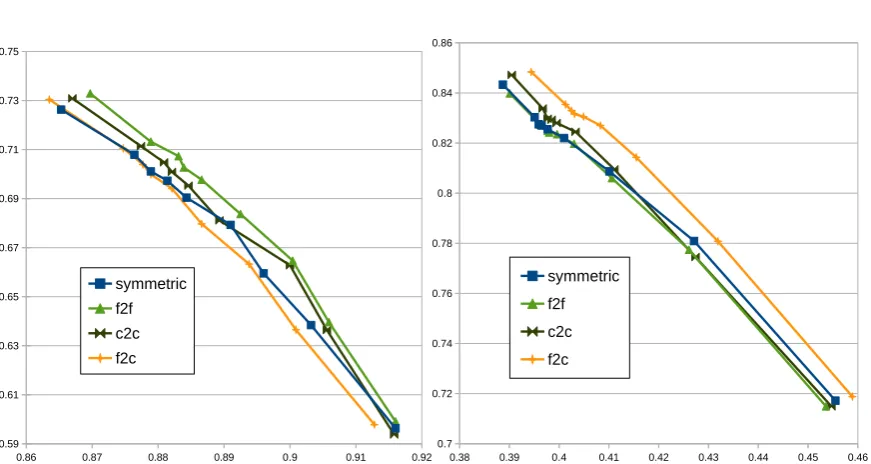
Figure 1: Precision Recall graph in Hansard
French-English Figure 2: Precision Recall graph in KFTT
[image:4.595.74.510.249.481.2] [image:4.595.74.512.544.735.2]Table 2: Results of word alignment evaluation with the heuristics-based method (GDF)
KFTT Hansard (French-English)
method precision recall AER F precision recall AER F symmetric 0.4595 0.5942 48.18 0.5182 0.7029 0.8816 7.29 0.7822 f2f 0.4633 0.5997 47.73 0.5227 0.7042 0.8851 7.29 0.7844 c2c 0.4606 0.5964 48.02 0.5198 0.7001 0.8816 7.34 0.7804 f2c 0.4630 0.5998 47.74 0.5226 0.7037 0.8871 7.10 0.7848
by AER and F-measure (Och and Ney, 2003). Since there exists no distinction for sure-possible alignments in the KFTT data, we use only sure alignment for our evaluation, both for the French-English and the Japanese-French-English tasks. Table 2 summarizes our results.
The baseline method is symmetric constraint (Ganchev et al., 2010) shown in Table 2. The num-bers in bold and in italics indicate the best score and the second best score, respectively. The dif-ferences between f2f,f2c and baseline in KFTT are statistically significant at p<0.05 using the sign-test, but in hansard corpus, there exist no signifi-cant differences between the baseline and the pro-posed methods. In terms of F-measure, it is clear that the f2f method is the most effective method in KFTT, and both f2f and f2c methods exceed the original posterior regularized model of Ganchev et al. (2010).
We also compared these methods with filtering methods (Liang et al., 2006), in addition to heuris-tic methods. We plot precision/recall curves and AER by varying the threshold between 0.1 and 0.9 with 0.1 increments. From Figures, it can be seen that our proposed methods are superior to the baseline in terms of both precision-recall and AER.
4.3 Translation evaluation
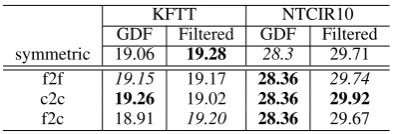
Next, we performed a translation evaluation, mea-sured by BLEU (Papineni et al., 2002). We compared the grow-diag-final and filtering method (Liang et al., 2006) for creating phrase tables. The threshold for the filtering factor was set to 0.1 which was the best setting in the word align-ment experialign-ment in section 4.2 under KFTT. From the English side of the training data, we trained a word using the 5-gram model with SRILM (Stol-cke and others, 2002). “Moses” toolkit was used as a decoder (Koehn et al., 2007) and the model parameters were tuned by k-best MIRA (Cherry and Foster, 2012). In order to avoid tuning insta-bility, we evaluated the average of five runs (Hop-kins and May, 2011). The results are summarized
Table 3: Results of translation evaluation
KFTT NTCIR10
GDF Filtered GDF Filtered symmetric 19.06 19.28 28.3 29.71
f2f 19.15 19.17 28.36 29.74 c2c 19.26 19.02 28.36 29.92
f2c 18.91 19.20 28.36 29.67
in Table 3. Our proposed methods achieved large gains in NTCIR10 task with the filtered method, but observed no gain in the KFTT with the filtered method. In NTCIR10 task with GDF, the gain in BLEU was smaller than that of KFTT. We cal-culate p-values and the difference between sym-metric and c2c (the most effective proposed con-straint) are lower than 0.05 in kftt with GDF and NTCIR10 with filtered method. There seems to be no clear tendency in the improved alignment qualities and the translation qualities, as shown in numerous previous studies (Ganchev et al., 2008).
5 Conclusion
In this paper, we proposed new constraint func-tions under the posterior regularization frame-work. Our constraint functions introduce a fine-grained agreement constraint considering the frequency of words, a assuming that the high frequency words correspond to function words whereas the less frequent words may be treated as content words, based on the previous work of Setiawan et al. (2007). Experiments on word alignment tasks showed better alignment quali-ties measured by F-measure and AER on both the Hansard task and KFTT. We also observed large gain in BLEU, 0.2 on average, when compared with the previous posterior regularization method under NTCIR10 task.
References
Arianna Bisazza and Marcello Federico. 2012. Cutting the long tail: Hybrid language models for translation style adaptation. InProceedings of the 13th Confer-ence of the European Chapter of the Association for Computational Linguistics, pages 439–448. Associ-ation for ComputAssoci-ational Linguistics.
Peter F Brown, Vincent J Della Pietra, Stephen A Della Pietra, and Robert L Mercer. 1993. The mathemat-ics of statistical machine translation: Parameter esti-mation. Computational linguistics, 19(2):263–311. Yin-Wen Chang, Alexander M. Rush, John DeNero,
and Michael Collins. 2014. A constrained viterbi relaxation for bidirectional word alignment. In Pro-ceedings of the 52nd Annual Meeting of the Associa-tion for ComputaAssocia-tional Linguistics (Volume 1: Long Papers), pages 1481–1490, Baltimore, Maryland, June. Association for Computational Linguistics. Colin Cherry and George Foster. 2012. Batch
tun-ing strategies for statistical machine translation. In
Proceedings of the 2012 Conference of the North American Chapter of the Association for Computa-tional Linguistics: Human Language Technologies, pages 427–436. Association for Computational Lin-guistics.
John DeNero and Klaus Macherey. 2011. Model-based aligner combination using dual decomposi-tion. InProceedings of the 49th Annual Meeting of the Association for Computational Linguistics: Hu-man Language Technologies, pages 420–429, Port-land, Oregon, USA, June. Association for Computa-tional Linguistics.
Kuzman Ganchev, Jo˜ao V. Grac¸a, and Ben Taskar. 2008. Better alignments = better translations? In Proceedings of ACL-08: HLT, pages 986–993, Columbus, Ohio, June. Association for Computa-tional Linguistics.
Kuzman Ganchev, Joao Grac¸a, Jennifer Gillenwater, and Ben Taskar. 2010. Posterior regularization for structured latent variable models. The Journal of Machine Learning Research, 99:2001–2049. Isao Goto, Ka Po Chow, Bin Lu, Eiichiro Sumita, and
Benjamin K Tsou. 2013. Overview of the patent machine translation task at the ntcir-10 workshop. InProceedings of the 10th NTCIR Workshop Meet-ing on Evaluation of Information Access Technolo-gies: Information Retrieval, Question Answering and Cross-Lingual Information Access, NTCIR-10. Mark Hopkins and Jonathan May. 2011. Tuning as
ranking. InProceedings of the 2011 Conference on Empirical Methods in Natural Language Process-ing, pages 1352–1362, Edinburgh, Scotland, UK., July. Association for Computational Linguistics. Philipp Koehn, Franz Josef Och, and Daniel Marcu.
2003. Statistical phrase-based translation. In
Proceedings of the 2003 Conference of the North
American Chapter of the Association for Computa-tional Linguistics on Human Language Technology-Volume 1, pages 48–54. Association for Computa-tional Linguistics.
Philipp Koehn, Hieu Hoang, Alexandra Birch, Chris Callison-Burch, Marcello Federico, Nicola Bertoldi, Brooke Cowan, Wade Shen, Christine Moran, Richard Zens, et al. 2007. Moses: Open source toolkit for statistical machine translation. In Pro-ceedings of the 45th Annual Meeting of the ACL on Interactive Poster and Demonstration Sessions, pages 177–180. Association for Computational Lin-guistics.
Percy Liang, Ben Taskar, and Dan Klein. 2006. Align-ment by agreeAlign-ment. InProceedings of the Human Language Technology Conference of the NAACL, Main Conference, pages 104–111, New York City, USA, June. Association for Computational Linguis-tics.
E. Matusov, R. Zens, and H. Ney. 2004. Symmetric Word Alignments for Statistical Machine Transla-tion. InProceedings of COLING 2004, pages 219– 225, Geneva, Switzerland, August 23–27.
Graham Neubig. 2011. The Kyoto free translation task. http://www.phontron.com/kftt.
Franz Josef Och and Hermann Ney. 2003. A sys-tematic comparison of various statistical alignment models. Computational linguistics, 29(1):19–51. Kishore Papineni, Salim Roukos, Todd Ward, and
Wei-Jing Zhu. 2002. Bleu: a method for automatic evaluation of machine translation. InProceedings of the 40th annual meeting on association for compu-tational linguistics, pages 311–318. Association for Computational Linguistics.
Hendra Setiawan, Min-Yen Kan, and Haizhou Li. 2007. Ordering phrases with function words. In
Proceedings of the 45th annual meeting on associ-ation for computassoci-ational linguistics, pages 712–719. Association for Computational Linguistics.
Andreas Stolcke et al. 2002. Srilm-an extensible lan-guage modeling toolkit. InINTERSPEECH. Stephan Vogel, Hermann Ney, and Christoph Tillmann.