A Dynamic Programming Algorithm for Computing N-gram Posteriors
from Lattices
Do˘gan Can
Department of Computer Science University of Southern California
Los Angeles, CA, USA [email protected]
Shrikanth S. Narayanan Department of Electrical Engineering
University of Southern California Los Angeles, CA, USA [email protected]
Abstract
Efficient computation ofn-gram posterior probabilities from lattices has applications in lattice-based minimum Bayes-risk de-coding in statistical machine translation and the estimation of expected document frequencies from spoken corpora. In this paper, we present an algorithm for com-puting the posterior probabilities of alln -grams in a lattice and constructing a mini-mal deterministic weighted finite-state au-tomaton associating eachn-gram with its posterior for efficient storage and retrieval. Our algorithm builds upon the best known algorithm in literature for computing n -gram posteriors from lattices and lever-ages the following observations to signifi-cantly improve the time and space require-ments: i) then-grams for which the poste-riors will be computed typically comprises all n-grams in the lattice up to a certain length, ii) posterior is equivalent to ex-pected count for ann-gram that do not re-peat on any path, iii) there are efficient al-gorithms for computing n-gram expected counts from lattices. We present exper-imental results comparing our algorithm with the best known algorithm in literature as well as a baseline algorithm based on weighted finite-state automata operations. 1 Introduction
Many complex speech and natural language processing (NLP) pipelines such as Automatic Speech Recognition (ASR) and Statistical Ma-chine Translation (SMT) systems store alternative hypotheses produced at various stages of process-ing as weighted acyclic automata, also known as lattices. Each lattice stores a large number of hypotheses along with the raw system scores as-signed to them. While single-best hypothesis is
typically what is desired at the end of the pro-cessing, it is often beneficial to consider a large number of weighted hypotheses at earlier stages of the pipeline to hedge against errors introduced by various subcomponents. Standard ASR and SMT techniques like discriminative training, rescoring with complex models and Minimum Bayes-Risk (MBR) decoding rely on lattices to represent in-termediate system hypotheses that will be fur-ther processed to improve models or system out-put. For instance, lattice based MBR decoding has been shown to give moderate yet consistent gains in performance over conventional MAP decoding in a number of speech and NLP applications in-cluding ASR (Goel and Byrne, 2000) and SMT (Tromble et al., 2008; Blackwood et al., 2010; de Gispert et al., 2013).
Most lattice-based techniques employed by speech and NLP systems make use of posterior quantities computed from probabilistic lattices. In this paper, we are interested in two such posterior quantities: i)n-gram expected count, the expected number of occurrences of a particular n-gram in a lattice, and ii)n-gram posterior probability, the total probability of accepting paths that include a particularn-gram. Expected counts have applica-tions in the estimation of language model statis-tics from probabilistic input such as ASR lattices (Allauzen et al., 2003) and the estimation term frequencies from spoken corpora while posterior probabilities come up in MBR decoding of SMT lattices (Tromble et al., 2008), relevance ranking of spoken utterances and the estimation of docu-ment frequencies from spoken corpora (Karakos et al., 2011; Can and Narayanan, 2013).
The expected countc(x|A) ofn-gram x given latticeAis defined as
c(x|A) = X y∈Σ∗
#y(x)p(y|A) (1)
where#y(x) is the number of occurrences ofn
gramxin hypothesisyandp(y|A)is the posterior probability of hypothesisy given latticeA. Simi-larly, the posterior probabilityp(x|A)ofn-gramx given latticeAis defined as
p(x|A) = X y∈Σ∗
1y(x)p(y|A) (2)
where 1y(x) is an indicator function taking the
value1when hypothesisyincludesn-gramxand
0 otherwise. While it is straightforward to com-pute these posterior quantities from weighted n -best lists by examining each hypothesis separately and keeping a separate accumulator for each ob-servedn-gram type, it is infeasible to do the same with lattices due to the sheer number of hypothe-ses stored. There are efficient algorithms in lit-erature (Allauzen et al., 2003; Allauzen et al., 2004) for computingn-gram expected counts from weighted automata that rely on weighted finite state transducer operations to reduce the compu-tation to a sum over n-gram occurrences elimi-nating the need for an explicit sum over accept-ing paths. The rather innocent lookaccept-ing difference between Equations 1 and 2, #y(x) vs. 1y(x),
makes it hard to develop similar algorithms for computing n-gram posteriors from weighted au-tomata since the summation of probabilities has to be carried out over paths rather than n-gram oc-currences (Blackwood et al., 2010; de Gispert et al., 2013).
The problem of computing n-gram posteriors from lattices has been addressed by a number of recent works (Tromble et al., 2008; Allauzen et al., 2010; Blackwood et al., 2010; de Gispert et al., 2013) in the context of lattice-based MBR for SMT. In these works, it has been reported that the time required for lattice MBR decoding is domi-nated by the time required for computingn-gram posteriors. Our interest in computingn-gram pos-teriors from lattices stems from its potential appli-cations in spoken content retrieval (Chelba et al., 2008; Karakos et al., 2011; Can and Narayanan, 2013). Computation of document frequency statis-tics from spoken corpora relies on estimating n -gram posteriors from ASR lattices. In this con-text, a spoken document is simply a collection of ASR lattices. Then-grams of interest can be word, syllable, morph or phoneme sequences. Unlike in the case of lattice-based MBR for SMT where the n-grams of interest are relatively short – typically up to 4-grams –, then-grams we are interested in
are in many instances relatively long sequences of subword units.
In this paper, we present an efficient algorithm for computing the posterior probabilities of alln -grams in a lattice and constructing a minimal de-terministic weighted finite-state automaton asso-ciating eachn-gram with its posterior for efficient storage and retrieval. Ourn-gram posterior com-putation algorithm builds upon the custom forward procedure described in (de Gispert et al., 2013) and introduces a number of refinements to signifi-cantly improve the time and space requirements:
• The custom forward procedure described in (de Gispert et al., 2013) computes unigram posteriors from an input lattice. Higher or-dern-gram posteriors are computed by first transducing the input lattice to ann-gram lat-tice using an order mapping transducer and then running the custom forward procedure on this higher order lattice. We reformulate the custom forward procedure as a dynamic programming algorithm that computes pos-teriors for successively longer n-grams and reuses the forward scores computed for the previous order. This reformulation subsumes the transduction of input lattices to n-gram lattices and obviates the need for construct-ing and applyconstruct-ing order mappconstruct-ing transducers. • Comparing Eq. 1 with Eq. 2, we can observe that posterior probability and expected count are equivalent for ann-gram that do not re-peat on any path of the input lattice. The key idea behind our algorithm is to limit the costly posterior computation to only thosen -grams that can potentially repeat on some path of the input lattice. We keep track of repeatingn-grams of ordernand use a sim-ple impossibility argument to significantly re-duce the number ofn-grams of order n+ 1
for which posterior computation will be per-formed. The posteriors for the remaining n-grams are replaced with expected counts. This filtering ofn-grams introduces a slight bookkeeping overhead but in return dramat-ically reduces the runtime and memory re-quirements for longn-grams.
com-Table 1: Common semirings.
SEMIRING SET ⊕ ⊗ 0 1
Boolean {0,1} ∨ ∧ 0 1
Probability R+∪ {+∞} + × 0 1
Log R∪ {−∞,+∞} ⊕log + +∞ 0
Tropical R∪ {−∞,+∞} min + +∞ 0
a⊕logb=−log(e−a+e−b)
pute the expected counts for alln-grams in the input lattice and represent them as a min-imal deterministic weighted finite-state au-tomaton, known as a factor automaton (Al-lauzen et al., 2004; Mohri et al., 2007), us-ing the approach described in (Allauzen et al., 2004). Finally we use general weighted au-tomata algorithms to merge the weighted fac-tor automaton representing expected counts with the weighted prefix tree representing posteriors to obtain a weighted factor au-tomaton representing posteriors that can be used for efficient storage and retrieval.
2 Preliminaries
This section introduces the definitions and nota-tion related to weighted finite state automata and transducers (Mohri, 2009).
2.1 Semirings
Definition 1 A semiring is a 5-tuple
(K,⊕,⊗,0,1)where (K,⊕,0)is a commutative monoid,(K,⊗,1)is a monoid,⊗distributes over
⊕and0is an annihilator for⊗.
Table 1 lists common semirings. In speech and language processing, two semirings are of particu-lar importance. Thelog semiringis isomorphic to the probability semiring via the negative-log mor-phism and can be used to combine probabilities in the log domain. The tropical semiring, provides the algebraic structure necessary for shortest-path algorithms and can be derived from the log semir-ing ussemir-ing the Viterbi approximation.
2.2 Weighted Finite-State Automata
Definition 2 A weighted finite-state automaton (WFSA)Aover a semiring(K,⊕,⊗,0,1)is a 7-tuple A = (Σ, Q, I, F, E, λ, ρ) where: Σ is the finite input alphabet; Q is a finite set of states;
I, F ⊆ Q are respectively the set of initial and
final states; E ⊆ Q×(Σ∪ {ε})×K×Q is a finite set of arcs; λ : I → K, ρ : F → Kare respectively the initial and final weight functions.
Given an arc e ∈ E, we denote by i[e]its in-put label,w[e]its weight,s[e]its source or origin state andt[e]its target or destination state. A path π=e1· · ·ekis an element ofE∗with consecutive
arcs satisfyingt[ei−1] = s[ei], i = 2, . . . , k.We
extendtandsto paths by settingt[π] =s[ek]and
s[π] = t[e1]. The labeling and the weight
func-tions can also be extended to paths by defining i[π] = i[e1]. . . i[ek] andw[π] = w[e1]⊗. . .⊗
w[ek]. We denote byΠ(q, q0)the set of paths from
qtoq0and byΠ(q, x, q0)the set of paths fromqto
q0with input stringx∈Σ∗. These definitions can
also be extended to subsetsS, S0 ⊆Q, e.g.
Π(S, x, S0) = [ q∈S,q0∈S0
Π(q, x, q0).
Anacceptingpath in an automatonAis a path in
Π(I, F). A stringxis accepted byAif there exists an accepting pathπlabeled withx.Ais determin-istic if it has at most one initial state and at any state no two outgoing transitions share the same input label. The weight associated by an automa-tonAto a stringx∈Σ∗is given by
JAK(x) = M π∈Π(I,x,F)
λ(s[π])⊗w[π]⊗ρ(t[π])
andJAK(x),0whenΠ(I, x, F) =∅.
A weighted automatonAdefined over the prob-ability semiring (R+,+,×,0,1) is said to be
probabilistic if for any state q ∈ Q, the sum of the weights of all cycles at q, ⊕π∈Π(q,q)w[π], is
well-defined and inR+andPx∈Σ∗JAK(x) = 1.
2.3 N-gram Mapping Transducer
We denote byΦnthen-gram mapping transducer
of ordern. This transducer maps label sequences ton-gram sequences of ordern. Φnis similar in
form to the weighted finite-state transducer rep-resentation of a backoff n-gram language model (Allauzen et al., 2003). We denote byAn then
-gram lattice of ordernobtained by composing lat-ticeAwithΦn, projecting the resulting transducer
onto its output labels, i.e. n-grams, to obtain an automaton, removingε-transitions, determinizing and minimizing (Mohri, 2009). An is a compact
lattice ofn-gram sequences of ordernconsistent with the labels and scores of latticeA. An
typi-cally has more states thanAdue to the association of distinctn-gram histories with states.
2.4 Factor Automata
Definition 3 Given two strings x, y ∈ Σ∗, x is
a factor (substring) of y if y = uxv for some
u, v ∈ Σ∗. More generally, x is a factor of a
languageL ⊆ Σ∗ if x is a factor of some string
y ∈ L. The factor automaton S(y) of a string
yis the minimal deterministic finite-state automa-ton recognizing exactly the set of factors ofy. The factor automatonS(A)of an automatonAis the minimal deterministic finite-state automaton rec-ognizing exactly the set of factors ofA, that is the set of factors of the strings accepted byA.
Factor automaton (Mohri et al., 2007) is an ef-ficient and compact data structure for representing a full index of a set of strings, i.e. an automaton. It can be used to determine if a stringxis a factor in time linear in its lengthO(|x|). By associating a weight with each factor, we can generalize the fac-tor automaton structure to weighted automata and use it for efficient storage and retrieval ofn-gram posteriors and expected counts.
3 Computation of N-gram Posteriors In this section we present an efficient algorithm based on then-gram posterior computation algo-rithm described in (de Gispert et al., 2013) for computing the posterior probabilities of all n -grams in a lattice and constructing a weighted fac-tor automaton for efficient sfac-torage and retrieval of these posteriors. We assume that the input lattice is anε-free acyclic probabilistic automaton. If that is not the case, we can use general weighted au-tomataε-removal and weight-pushing algorithms (Mohri, 2009) to preprocess the input automaton.
Algorithm 1 reproduces the original algo-rithm of (de Gispert et al., 2013) in our
no-tation. Each iteration of the outermost loop starting at line 1 computes posterior probabili-ties of all unigrams in the n-gram lattice An = (Σn, Qn, In, Fn, En, λn, ρn), or equivalently all
n-grams of order n in the lattice A. The inner loop starting at line 6 is essentially a custom for-ward procedure computing not only the standard forward probabilitiesα[q], the marginal probabil-ity of paths that lead to stateq,
α[q] = M π∈Π(I,q)
λ(s[π])⊗w[π] (3)
= M
e∈E t[e] =q
α[s[e]]⊗w[e] (4)
but also the label specific forward probabilities
˜
α[q][x], the marginal probability of paths that lead to stateqand include labelx.
˜
α[q][x] = M π∈Π(I,q)
∃u,v∈Σ∗:i[π] =uxv
λ(s[π])⊗w[π] (5)
= M
e∈E t[e] =q i[e] =x
α[s[e]]⊗w[e]
⊕ M
e∈E t[e] =q i[e]6=x
˜
α[s[e]][x]⊗w[e] (6)
Algorithm 1Compute N-gram Posteriors 1 forn←1, . . . , Ndo
2 An←Min(Det(RmEps(ProjOut(A◦Φn)))) 3 α[q]←λn(q), ∀stateq ∈Qn
4 α˜[q][x]←0, ∀stateq ∈Qn, ∀labelx∈Σn
5 p(x|A)←0, ∀labelx∈Σn
6 for eachstates∈Qndo .In topological order 7 for eacharc (s, x, w, q)∈Endo
8 α[q]←α[q]⊕α[s]⊗w 9 α˜[q][x]←α˜[q][x]⊕α[s]⊗w 10 for eachlabely∈α˜[s]do
11 ify66=xthen
12 α˜[q][y]←α˜[q][y]⊕α˜[s][y]⊗w 13 ifs∈Fnthen
14 for eachlabelx∈α˜[s]do
15 p(x|A)←p(x|A)⊕α˜[s][x]⊗ρn(s) 16 P ←Min(ConstructPrefixTree(p))
and adding the resulting value to the accumulator (lines 13-15). It should be noted that this algo-rithm is a form of marginalization (de Gispert et al., 2013), rather than a counting procedure, due to the conditional on line 11. If that conditional were to be removed, this algorithm would com-puten-gram expected counts instead of posterior probabilities.
The key idea behind our algorithm is to re-strict the computation of posteriors to only those n-grams that may potentially repeat on some path of the input lattice and exploit the equivalence of expected counts and posterior probabilities for the remainingn-grams. It is possible to extend Algo-rithm 1 to implement this restriction by keeping track of repeatingn-grams of ordernand replac-ing the output labels of appropriate arcs inΦn+1
with ε labels. Alternatively we can reformulate Algorithm 1 as in Algorithm 2. In this formulation we computen-gram posteriors directly on the in-put latticeAwithout constructing then-gram lat-ticeAn. We explicitly associate states in the
orig-inal lattice with distinctn-gram histories which is implicitly done in Algorithm 1 by constructing the n-gram lattice An. This explicit association lets
us reuse forward probabilities computed at order nwhile computing the forward probabilities at or-der n + 1. Further, we can directly restrict the n-grams for which posterior computation will be performed.
In Algorithm 2, α´[n][q][h] represents the
his-tory specific forward probability of state q, the marginal probability of paths that lead to stateq and include lengthnstringhas a suffix.
´
α[n][q][h] = M π∈Π(I,q)
∃z∈Σ∗:i[π] =zh
λ(s[π])⊗w[π] (7)
= M
e∈E t[e] =q g∈α´[n−1][s[e]]
gi[e] =h ´
α[n−1][s[e]][g]⊗w[e]
(8)
´
α[n][q][h]is the analogue ofα[q]in Algorithm 1. It splits the forward probability of stateq (Equa-tion 3), among length n suffixes (or histories) of paths that lead to state q. We can interpret
´
α[n][q][h]as the forward probability of state(q, h)
in then-gram latticeAn+1. Here(q, h) ∈ Qn+1
denotes the unique state corresponding to stateq in the original latticeAand statehin the mapping transducerΦn+1.αˆ[q][h][x]represents the history
Algorithm 2Compute N-gram Posteriors (Reformulation) 1 R[0]← {ε}
2 α´[0][q][ε]←α[q], ∀stateq∈Q 3 forn←1, . . . , Ndo
4 R[n]← ∅
5 α´[n][q][x]←0, ∀stateq ∈Q, ∀ngramx∈Σn
6 αˆ[q][h][x]←0, ∀stateq∈Q, ∀historyh∈Σn−1, ∀ngramx∈Σn 7 p(x|A)←0, ∀ngramx∈Σn
8 for eachstates∈Qdo .In topological order
9 for eachhistoryg∈α´[n−1][s]whereg∈R[n−1]do 10 for eacharc (s, i, w, q)∈Edo
11 x←gi .Concatenate history and label 12 h←x[1 :n] .Drop first label
13 ifh∈R[n−1]then
14 α´[n][q][x]←α´[n][q][x]⊕α´[n−1][s][g]⊗w 15 αˆ[q][h][x]←αˆ[q][h][x]⊕α´[n−1][s][g]⊗w 16 for eachngramy∈αˆ[s][g]do
17 ify66=xthen
18 αˆ[q][h][y]←αˆ[q][h][y]⊕αˆ[s][g][y]⊗w
19 else
20 R[n]←R[n]∪ {y}
21 ifs∈F then
22 for eachhistoryg∈αˆ[s]do 23 for eachngramx∈αˆ[s][g]do
24 p(x|A)←p(x|A)⊕αˆ[s][g][x]⊗ρ(s) 25 P0←ConstructPrefixTree(p)
26 C←ComputeExpectedCounts(A, N)
27 P ←Min(Det(RmEps((C−RmWeight(P0))⊕P0)))
includen-gramxas a substring.
ˆ
α[q][h][x] = M π∈Π(I,q)
∃z∈Σ∗:i[π] =zh ∃u,v∈Σ∗:i[π] =uxv
λ(s[π])⊗w[π]
(9)
= M
e∈E t[e] =q g∈α´[|h|][s[e]]
gi[e] =x ´
α[|h|][s[e]][g]⊗w[e]
⊕ M
e∈E t[e] =q g∈αˆ[s[e]]
gi[e]6=x ˆ
α[s[e]][g][x]⊗w[e]
(10)
ˆ
α[q][h][x]is the analogue ofα˜[q][x]in Algorithm 1. R[n]represents the set of n-grams of order n
that repeat on some path ofA. We start by defin-ing R[0] , {ε}, i.e. the only repeatingn-gram of order 0 is the empty string ε, and computing
´
α[0][q][ε]≡α[q]using the standard forward algo-rithm. Each iteration of the outermost loop start-ing at line 3 computes posterior probabilities of all n-grams of ordern directly on the lattice A. At iterationn, we visit the states in topological order and examine each lengthn−1historygassociated withs, the state we are in. For each historyg, we go over the set of arcs leaving states, construct the currentn-gramxby concatenatinggwith the cur-rent arc labeli(line 11), construct the lengthn−1
historyhof the target stateq(line 12), and update the forward probabilities for the target state his-tory pair(q, h)in accordance with the recursions in Equations 8 and 10 by propagating the forward probabilities computed for the state history pair
eachn-gram of ordernobserved on paths reach-ing that state is updated by multiplyreach-ing then-gram specific forward probability and the final weight associated with that state and adding the resulting value to the accumulator (lines 21-24).
We track repeating n-grams of order n to re-strict the costly posterior computation operation to only thosen-grams of ordern+ 1that can poten-tially repeat on some path of the input lattice. The conditional on line 17 checks if any of then-grams observed on paths reaching state history pair(s, g)
is the same as the currentn-gramx, and if so adds it to the set of repeatingn-grams. At each iteration n, we check if the current lengthn−1 historyg of the state we are in is inR[n−1], the set of re-peatingn-grams of ordern−1(line 9). If it is not, then non-gramx=gican repeat on some path of Asince that would requiregto repeat as well. Ifg is inR[n−1], then for each arce= (s, i, w, q)we check if the lengthn−1historyh=g[1 :n−1]i of the next stateq is in R[n−1](line 13). If it is not, then then-gram x = g[0]h can not repeat either.
We keep the posteriorsp(x|A)forn-grams that can potentially repeat on some path of the input lattice in a deterministic WFSA P0 that we
con-struct on the fly. P0 is a prefix tree where each
path π corresponds to an n-gram posterior, i.e. i[π] = x =⇒ w[π] = ρ(t[π]) = p(x|A). Once the computation of posteriors for possibly repeating n-grams is finished, we use the algo-rithm described in (Allauzen et al., 2004) to con-struct a weighted factor automatonCmapping all n-grams observed inA to their expected counts, i.e. ∀π in C, i[π] = x =⇒ w[π] = c(x|A). We use P0 andC to construct another weighted
factor automatonPmapping alln-grams observed inAto their posterior probabilities, i.e. ∀π inP, i[π] = x =⇒ w[π] =p(x|A). First we remove then-grams accepted byP0 fromCusing the
dif-ference operation (Mohri, 2009), C0 =C−RmWeight(P0)
then take the union of the remaining automatonC0
andP0, and finally optimize the result by
remov-ingε-transitions, determinizing and minimizing P = Min(Det(RmEps(C0⊕P0))). 4 Experiments and Discussion
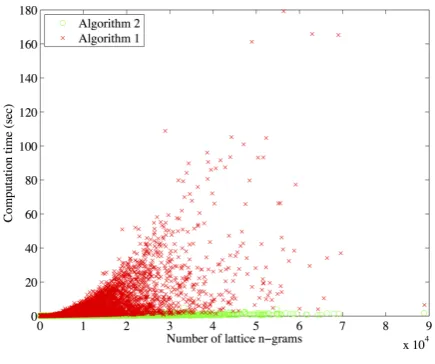
[image:7.595.307.525.72.254.2]In this section we provide experiments comparing the performance of Algorithm 2 with Algorithm 1
[image:7.595.307.525.299.475.2]Figure 1: Runtime comparison
Figure 2: Memory use comparison
as well as a baseline algorithm based on the ap-proach of (Tromble et al., 2008). All algorithms were implemented in C++using the OpenFst Li-brary (Allauzen et al., 2007). Algorithm 1 imple-mentation is a thin wrapper around the reference implementation. All experiments were conducted on the 88K ASR lattices (total size: #states + #arcs = 33M, disk size: 481MB) generated from the training subset of the IARPA Babel Turkish lan-guage pack, which includes 80 hours of conversa-tional telephone speech. Lattices were generated with a speaker dependent DNN ASR system that was trained on the same data set using IBM’s At-tila toolkit (Soltau et al., 2010). All lattices were pruned to a logarithmic beam width of 5.
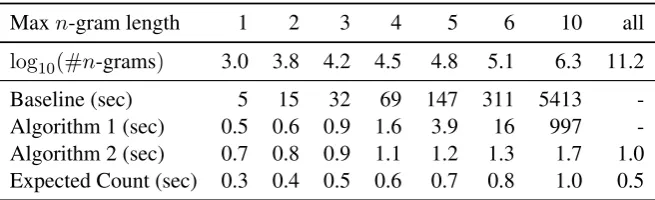
Table 2: Runtime Comparison
Maxn-gram length 1 2 3 4 5 6 10 all
log10(#n-grams) 3.0 3.8 4.2 4.5 4.8 5.1 6.3 11.2 Baseline (sec) 5 15 32 69 147 311 5413 -Algorithm 1 (sec) 0.5 0.6 0.9 1.6 3.9 16 997 -Algorithm 2 (sec) 0.7 0.8 0.9 1.1 1.2 1.3 1.7 1.0 Expected Count (sec) 0.3 0.4 0.5 0.6 0.7 0.8 1.0 0.5
represents one of the 88K lattices in our data set. Similarly, Figure 2 gives a scatter plot of the max-imum memory used by the program (maxmax-imum resident set size) during the computation of pos-teriors vs. the number of lattice n-grams (up to 5-grams). Algorithm 2 requires significantly less resources, particularly in the case of larger lattices with a large number of uniquen-grams.
To better understand the runtime characteris-tics of Algorithms 1 and 2, we conducted a small experiment where we randomly selected 100 lat-tices (total size: #states + #arcs = 81K, disk size: 1.2MB) from our data set and analyzed the re-lation between the runtime and the maximum n -gram lengthN. Table 2 gives a runtime compari-son between the baseline posterior computation al-gorithm described in (Tromble et al., 2008), Algo-rithm 1, AlgoAlgo-rithm 2 and the expected count com-putation algorithm of (Allauzen et al., 2004). The baseline method computes posteriors separately for eachn-gram by intersecting the lattice with an automaton accepting only the paths including that n-gram and computing the total weight of the re-sulting automaton in log semiring. Runtime com-plexities of the baseline method and Algorithm 1 are exponential in N due to the explicit enu-meration ofn-grams and we can clearly see this trend in the 3rd and 4th rows of Table 2. Algo-rithm 2 (5th row) takes advantage of the WFSA based expected count computation algorithm (6th row) to do most of the work for long n-grams, hence does not suffer from the same exponential growth. Notice the drops in the runtimes of Algo-rithm 2 and the WFSA based expected count com-putation algorithm when alln-grams are included into the computation regardless of their length. These drops are due to the expected count compu-tation algorithm that processes alln-grams simul-taneously using WFSA operations. Limiting the maximumn-gram length requires pruning longn -grams, which in general can increase the sizes of
intermediate WFSAs used in computation and re-sult in longer runtimes as well as larger outputs.
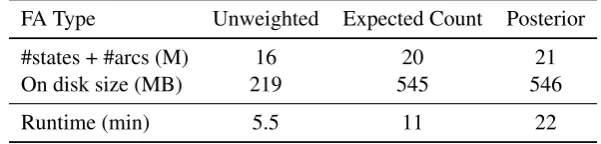
When there is no limit on the maximumn-gram length, the output of Algorithm 2 is a weighted factor automaton mapping each factor to its pos-terior. Table 3 compares the construction and storage requirements for posterior factor automata with similar factor automata structures. We use the approach described in (Allauzen et al., 2004) for constructing both the unweighted and the ex-pected count factor automata. We construct the unweighted factor automata by first removing the weights on the input lattices and then applying the determinization operation on the tropical semir-ing so that path weights are not added together. The storage requirements of the posterior factor automata produced by Algorithm 2 is similar to those of the expected count factor automata. Un-weighted factor automata, on the other hand, are significantly more compact than their weighted counterparts even though they accept the same set of strings. This difference in size is due to ac-commodating path weights which in general can significantly impact the effectiveness of automata determinization and minimization.
5 Related Work
con-Table 3: Factor Automata Comparison
FA Type Unweighted Expected Count Posterior #states + #arcs (M) 16 20 21 On disk size (MB) 219 545 546
Runtime (min) 5.5 11 22
text of building an index for spoken utterance re-trieval (SUR) (Saraclar and Sproat, 2004). This is the approach used for constructing the weighted factor automaton C in Algorithm 2. While ex-pected count works well in practice for ranking spoken utterances containing a query term, poste-rior probability is in theory a better metric for this task. The weighted factor automatonP produced by Algorithm 2 can be used to construct an SUR index weighted with posterior probabilities.
The problem of computing n-gram posteriors from lattices was first addressed in (Tromble et al., 2008) in the context of lattice-based MBR for SMT. This is the baseline approach used in our experiments and it consists of building a separate FSA for eachn-gram of interest and intersecting this automaton with the input lattice to discard those paths that do not include that n-gram and summing up the weights of remaining paths. The fundamental shortcoming of this approach is that it requires separate intersection and shortest distance computations for eachn-gram. This shortcoming was first tackled in (Allauzen et al., 2010) by in-troducing a counting transducer for simultaneous computation of posteriors for alln-grams of order nin a lattice. This transducer works well for un-igrams since there is a relatively small number of unique unigrams in a lattice. However, it is less efficient for n-grams of higher orders. This inef-ficiency was later addressed in (Blackwood et al., 2010) by employingn-gram mapping transducers to transduce the input lattices ton-gram lattices of ordernand computing unigram posteriors on the higher order lattices. Algorithm 1 was described in (de Gispert et al., 2013) as a fast alternative to counting transducers. It is a lattice specialization of a more general algorithm for computingn-gram posteriors from a hypergraph in a single inside pass (DeNero et al., 2010). While this algorithm works really well for relatively shortn-grams, its time and space requirements scale exponentially with the maximum n-gram length. Algorithm 2 builds upon this algorithm by exploiting the
equiv-alence of expected counts and posteriors for non-repeatingn-grams and eliminating the costly pos-terior computation operation for mostn-grams in the input lattice.
6 Conclusion
We have described an efficient algorithm for com-putingn-gram posteriors from an input lattice and constructing an efficient and compact data struc-ture for storing and retrieving them. The runtime and memory requirements of the proposed algo-rithm grow linearly with the length of then-grams as opposed to the exponential growth observed with the original algorithm we are building upon. This is achieved by limiting the posterior compu-tation to only those n-grams that may repeat on some path of the input lattice and using the rela-tively cheaper expected count computation algo-rithm for the rest. This filtering of n-grams in-troduces a slight bookkeeping overhead over the baseline algorithm but in return dramatically re-duces the runtime and memory requirements for longn-grams.
Acknowledgments
[image:9.595.147.448.87.159.2]References
Cyril Allauzen, Mehryar Mohri, and Brian Roark. 2003. Generalized algorithms for constructing sta-tistical language models. In Proceedings of the 41st Annual Meeting on Association for Computa-tional Linguistics - Volume 1, ACL ’03, pages 40– 47, Stroudsburg, PA, USA. Association for Compu-tational Linguistics.
Cyril Allauzen, Mehryar Mohri, and Murat Saraclar. 2004. General indexation of weighted automata: Application to spoken utterance retrieval. In HLT-NAACL Workshop on Interdisciplinary Approaches to Speech Indexing and Retrieval, pages 33–40, Boston, MA, USA.
Cyril Allauzen, Michael Riley, Johan Schalkwyk, Wo-jciech Skut, and Mehryar Mohri. 2007. OpenFst: A general and efficient weighted finite-state transducer library. In Proceedings of the Ninth International Conference on Implementation and Application of Automata, (CIAA 2007), volume 4783 of Lecture Notes in Computer Science, pages 11–23. Springer.
http://www.openfst.org.
Cyril Allauzen, Shankar Kumar, Wolfgang Macherey, Mehryar Mohri, and Michael Riley. 2010. Expected sequence similarity maximization. InHLT-NAACL, pages 957–965. The Association for Computational Linguistics.
Graeme Blackwood, Adri`a de Gispert, and William Byrne. 2010. Efficient path counting transducers for minimum bayes-risk decoding of statistical ma-chine translation lattices. InProceedings of the ACL 2010 Conference Short Papers, pages 27–32, Upp-sala, Sweden, July. Association for Computational Linguistics.
Dogan Can and Shrikanth Narayanan. 2013. On the computation of document frequency statistics from spoken corpora using factor automata. In INTER-SPEECH 2013, 14th Annual Conference of the Inter-national Speech Communication Association, pages 6–10, Lyon, France.
Ciprian Chelba, Timothy J. Hazen, and Murat Sar-aclar. 2008. Retrieval and browsing of spoken con-tent. Signal Processing Magazine, IEEE, 25(3):39– 49, May.
Adri`a de Gispert, Graeme Blackwood, Gonzalo Igle-sias, and William Byrne. 2013. N-gram poste-rior probability confidence measures for statistical machine translation: an empirical study. Machine Translation, 27(2):85–114.
John DeNero, Shankar Kumar, Ciprian Chelba, and Franz Och. 2010. Model combination for machine translation. InHuman Language Technologies: The 2010 Annual Conference of the North American Chapter of the Association for Computational Lin-guistics, HLT ’10, pages 975–983, Stroudsburg, PA, USA. Association for Computational Linguistics.
Vaibhava Goel and William J Byrne. 2000. Minimum bayes-risk automatic speech recognition. Computer Speech & Language, 14(2):115–135.
Damianos Karakos, Mark Dredze, Ken Ward Church, Aren Jansen, and Sanjeev Khudanpur. 2011. Es-timating document frequencies in a speech corpus. In David Nahamoo and Michael Picheny, editors, ASRU, pages 407–412. IEEE.
Mehryar Mohri, Pedro Moreno, and Eugene Weinstein. 2007. Factor automata of automata and applica-tions. In Implementation and Application of Au-tomata, pages 168–179. Springer.
Mehryar Mohri. 2009. Weighted automata algo-rithms. In Manfred Droste, Werner Kuich, and Heiko Vogler, editors, Handbook of Weighted Au-tomata, Monographs in Theoretical Computer Sci-ence. An EATCS Series, pages 213–254. Springer Berlin Heidelberg.
Murat Saraclar and Richard Sproat. 2004. Lattice-based search for spoken utterance retrieval. InProc. HLT-NAACL, pages 129–136, Boston, MA, USA. Hagen Soltau, George Saon, and Brian Kingsbury.
2010. The ibm attila speech recognition toolkit. In Spoken Language Technology Workshop (SLT), 2010 IEEE, pages 97–102, Dec.