Learning Spatial Knowledge for Text to 3D Scene Generation
Angel X. Chang, Manolis Savva and Christopher D. Manning
Stanford University
{angelx,msavva,manning}@cs.stanford.edu
Abstract
We address the grounding of natural lan-guage to concrete spatial constraints, and inference of implicit pragmatics in 3D en-vironments. We apply our approach to the task of text-to-3D scene generation. We present a representation for common sense spatial knowledge and an approach to ex-tract it from 3D scene data. In text-to-3D scene generation, a user provides as in-put natural language text from which we extract explicit constraints on the objects that should appear in the scene. The main innovation of this work is to show how to augment these explicit constraints with learned spatial knowledge to infer missing objects and likely layouts for the objects in the scene. We demonstrate that spatial knowledge is useful for interpreting natu-ral language and show examples of learned knowledge and generated 3D scenes.
1 Introduction
To understand language, we need an understanding of the world around us. Language describes the world and provides symbols with which we rep-resent meaning. Still, much knowledge about the world is so obvious that it is rarely explicitly stated. It is uncommon for people to state that chairs are usually on the floor and upright, and that you usu-ally eat a cake from a plate on a table. Knowledge of such common facts provides the context within which people communicate with language. There-fore, to create practical systems that can interact with the world and communicate with people, we need to leverage such knowledge to interpret lan-guage in context.
Spatial knowledge is an important aspect of the world and is often not expressed explicitly in nat-ural language. This is one of the biggest
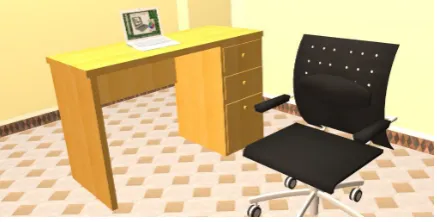
chal-Figure 1: Generated scene for “There is a room with a chair and a computer.” Note that the system infers the presence of a desk and that the computer should be supported by the desk.
lenges in grounding language and enabling natu-ral communication between people and intelligent systems. For instance, if we want a robot that can follow commands such as “bring me a piece of cake”, it needs to be imparted with an understand-ing of likely locations for the cake in the kitchen and that the cake should be placed on a plate.
The pioneering WordsEye system (Coyne and Sproat, 2001) addressed the text-to-3D task and is an inspiration for our work. However, there are many remaining gaps in this broad area. Among them, there is a need for research into learning spa-tial knowledge representations from data, and for connecting them to language. Representing un-stated facts is a challenging problem unaddressed by prior work and the focus of our contribution. This problem is a counterpart to the image descrip-tion problem (Kulkarni et al., 2011; Mitchell et al., 2012; Elliott and Keller, 2013), which has so far remained largely unexplored by the community.
We present a representation for this form of spa-tial knowledge that we learn from 3D scene data and connect to natural language. We will show how this representation is useful for grounding language and for inferring unstated facts, i.e., the pragmatics of language describing physical envi-ronments. We demonstrate the use of this repre-sentation in the task of text-to-3D scene
[image:1.595.308.527.205.316.2]Room
Table
Plate
Cake
color(red) “There is a room with
a table and a cake. There is a red chair to the right of the table.”
a) Scene Template Input Text
supports(o0,o1) supports(o0,o2)
right(o2,o1)
o3
cake
c) 3D Scene
o0
room
o1
table
o2
chair
supports(o1,o4)
supports(o4,o3) o4
plate
Parse
Infer
Ground
Layout
b) Geometric Scene
Render
View
Chair
Figure 2: Overview of our spatial knowledge representation for text-to-3D scene generation. We parse input text into a scene template and infer implicit spatial constraints from learned priors. We then ground the template to a geometric scene, choose 3D models to instantiate and arrange them into a final 3D scene.
tion, where the input is natural language and the desired output is a 3D scene.
We focus on the text-to-3D task to demonstrate that extracting spatial knowledge is possible and beneficial in a challenging scenario: one requiring the grounding of natural language and inference of rarely mentioned implicit pragmatics based on spa-tial facts. Figure 1 illustrates some of the inference challenges in generating 3D scenes from natural language: the desk was not explicitly mentioned in the input, but we need to infer that the computer is likely to be supported by a desk rather than di-rectly placed on the floor. Without this inference, the user would need to be much more verbose with text such as “There is a room with a chair, a com-puter, and a desk. The computer is on the desk, and the desk is on the floor. The chair is on the floor.”
Contributions We present a spatial knowledge
representation that can be learned from 3D scenes and captures the statistics of what objects occur in different scene types, and their spatial posi-tions relative to each other. In addition, we model spatial relations (left, on top of, etc.) and learn a mapping between language and the geometric con-straints that spatial terms imply. We show that using our learned spatial knowledge representa-tion, we can infer implicit constraints, and generate plausible scenes from concise natural text input.
2 Task Definition and Overview
We define text-to-scene generation as the task of taking text that describes a scene as input, and gen-erating a plausible 3D scene described by that text as output. More concretely, based on the input text, we select objects from a dataset of 3D models and arrange them to generate output scenes.
The main challenge we address is in transform-ing a scene template into a physically realizable 3D scene. For this to be possible, the system must be
able to automatically specify the objects present and their position and orientation with respect to each other as constraints in 3D space. To do so, we need to have a representation of scenes (§3). We need good priors over the arrangements of objects in scenes (§4) and we need to be able to ground textual relations into spatial constraints (§5). We break down our task as follows (see Figure 2): Template Parsing (§6.1): Parse the textual de-scription of a scene into a set of constraints on the objects present and spatial relations between them. Inference(§6.2): Expand this set of constraints by accounting for implicit constraints not specified in the text using learned spatial priors.
Grounding(§6.3): Given the constraints and pri-ors on the spatial relations of objects, transform the scene template into a geometric 3D scene with a set of objects to be instantiated.
Scene Layout(§6.4): Arrange the objects and op-timize their placement based on priors on the rel-ative positions of objects and explicitly provided spatial constraints.
3 Scene Representation
To capture the objects present and their arrange-ment, we represent scenes as graphs where nodes are objects in the scene, and edges are semantic re-lationships between the objects.
We represent the semantics of a scene using a
0.0 0.1 0.2 0.3 0.4 0.5 0.6 0.7 0.8 0.9 1.0 p(Scene|Knife+Table)
Kitchen Counter Dining Table
[image:3.595.72.291.125.232.2]Living Room Kitchen
Figure 3: Probabilities of different scene types given the presence of “knife” and “table”.
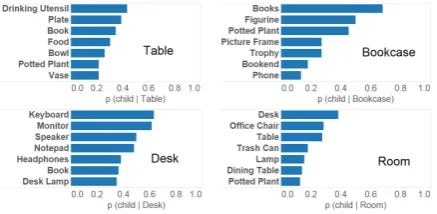
Figure 4: Probabilities of support for some most likely child object categories given four different parent object categories, from top left clockwise: dining table, bookcase, room, desk.
3.1 Scene Template
A scene template T = (O,C, Cs) consists of a set of object descriptions O = {o1, . . . , on} and constraintsC = {c1, . . . , ck} on the relationships between the objects. A scene template also has a scene typeCs.
Each object oi, has properties associated with it such as category label, basic attributes such as color and material, and number of occurrences in the scene. For constraints, we focus on spatial re-lations between objects, expressed as predicates of the formsupported_by(oi, oj)orleft(oi, oj)where
oiandojare recognized objects.1 Figure 2a shows an example scene template. From the scene tem-plate we instantiate concrete geometric 3D scenes. To infer implicit constraints on objects and spa-tial support we learn priors on object occurrences in 3D scenes (§4.1) and their support hierarchies (§4.2).
3.2 Geometric Scene
We refer to the concrete geometric representation of a scene as a “geometric scene”. It consists of a set of 3D model instances – one for each ob-ject – that capture the appearance of the obob-ject. A transformation matrix that represents the position, orientation, and scaling of the object in a scene is also necessary to exactly position the object. We generate a geometric scene from a scene template by selecting appropriate models from a 3D model database and determining transformations that
op-1Our representation can also support other relationships such aslarger(oi, oj).
timize their layout to satisfy spatial constraints. To inform geometric arrangement we learn priors on the types of support surfaces (§4.2) and the relative positions of objects (§4.4).
4 Spatial Knowledge
Our model of spatial knowledge relies on the idea of abstract scene types describing the occurrence and arrangement of different categories of objects within scenes of that type. For example, kitchens typically contain kitchen counters on which plates and cups are likely to be found. The type of scene and category of objects condition the spatial rela-tionships that can exist in a scene.
We learn spatial knowledge from 3D scene data, basing our approach on that of Fisher et al. (2012) and using their dataset of 133 small indoor scenes created with 1723 Trimble 3D Warehouse mod-els (Fisher et al., 2012).
4.1 Object Occurrence Priors
We learn priors for object occurrence in different scene types (such as kitchens, offices, bedrooms).
Pocc(Co|Cs) =countcount(Co(CinCs) s)
This allows us to evaluate the probability of dif-ferent scene types given lists of object occurring in them (see Figure 3). For example given input of the form “there is a knife on the table” then we are likely to generate a scene with a dining table and other related objects.
4.2 Support Hierarchy Priors
We observe the static support relations of objects in existing scenes to establish a prior over what ob-jects go on top of what other obob-jects. As an exam-ple, by observing plates and forks on tables most of the time, we establish that tables are more likely to support plates and forks than chairs. We esti-mate the probability of a parent categoryCp sup-porting a given child categoryCcas a simple con-ditional probability based on normalized observa-tion counts.2
Psupport(Cp|Cc) = countcount(Cc(onC Cp) c)
We show a few of the priors we learn in Figure 4 as likelihoods of categories of child objects being statically supported by a parent category object.
Figure 5: Predicted positions using learned rela-tive position priors forchairgivendesk(top left),
poster-room(top right),mouse-desk(bottom left),
keyboard-desk(bottom right).
4.3 Support Surface Priors
To identify which surfaces on parent objects sup-port child objects, we first segment parent models into planar surfaces using a simple region-growing algorithm based on (Kalvin and Taylor, 1996). We characterize support surfaces by the direction of their normal vector, limited to the six canonical directions: up, down, left, right, front, back. We learn a probability of supporting surface normal di-rectionSngiven child object categoryCc. For ex-ample, posters are typically found on walls so their support normal vectors are in the horizontal di-rections. Any unobserved child categories are as-sumed to havePsurf(Sn=up|Cc) = 1since most things rest on a horizontal surface (e.g., floor).
Psurf(Sn|Cc) = count(Cccounton surface with(C Sn) c)
4.4 Relative Position Priors
We model the relative positions of objects based on their object categories and current scene type: i.e., the relative position of an object of category
Cobj is with respect to another object of category
Cref and for a scene typeCs. We condition on the relationship R between the two objects, whether they are siblings (R = Sibling) or child-parent (R =ChildP arent).
Prelpos(x, y, θ|Cobj, Cref, Cs, R)
When positioning objects, we restrict the search space to points on the selected support surface. The position x, yis the centroid of the target ob-ject proob-jected onto the support surface in the se-mantic frame of the reference object. Theθis the angle between the front of the two objects. We rep-resent these relative position and orientation pri-ors by performing kernel density estimation on the
Relation P(relation)
[image:4.595.324.508.61.149.2]inside(A,B) V olV ol(A(∩AB)) outside(A,B) 1 -V olV ol(A(∩AB)) left_of(A,B) V ol(AV ol∩left_of(A)(B)) right_of(A,B) V ol(AV ol∩right_of(A) (B)) near(A,B) 1(dist(A, B)< tnear) faces(A,B) cos(front(A), c(B)−c(A))
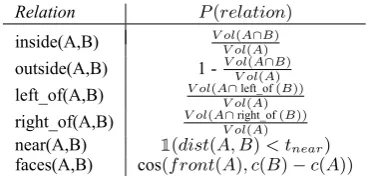
Table 1: Definitions of spatial relation using bounding boxes. Note: dist(A, B)is normalized against the maximum extent of the bounding box ofB. front(A)is the direction of the front vector ofAandc(A)is the centroid ofA.
Keyword Top Relations and Scores
behind (back_of,0.46),(back_side,0.33) adjacent (front_side,0.27),(outside,0.26)
below (below,0.59),(lower_side,0.38)
front (front_of,0.41),(front_side,0.40)
left (left_side,0.44),(left_of,0.43)
above (above,0.37),(near,0.30)
opposite (outside,0.31),(next_to,0.30)
on (supported_by,0.86),(on_top_of,0.76) near (outside,0.66),(near,0.66)
next (outside,0.49),(near,0.48)
under (supports,0.62),(below,0.53) top (supported_by,0.65),(above,0.61)
inside (inside,0.48),(supported_by,0.35)
[image:4.595.71.292.62.187.2]right (right_of,0.50),(lower_side,0.38) beside (outside,0.45),(right_of,0.45)
Table 2: Map of top keywords to spatial relations (appropriate mappings inbold).
observed samples. Figure 5 shows predicted posi-tions of objects using the learned priors.
5 Spatial Relations
We define a set of formal spatial relations that we map to natural language terms (§5.1). In addi-tion, we collect annotations of spatial relation de-scriptions from people, learn a mapping of spatial keywords to our formal spatial relations, and train a classifier that given two objects can predict the likelihood of a spatial relation holding (§5.2).
5.1 Predefined spatial relations
For spatial relations we use a set of predefined rela-tions: left_of, right_of, above, below, front, back, supported_by, supports, next_to, near, inside, out-side, faces, left_out-side, right_side.3 These are
mea-sured using axis-aligned bounding boxes from the viewer’s perspective; the involved bounding boxes are compared to determine volume overlap or clos-est distance (for proximity relations; see Table 1).
Feature # Description
delta(A, B) 3 Delta position(x, y, z)between the centroids ofAandB
dist(A, B) 1 Normalized distance (wrtB) between the centroids ofAandB
overlap(A, f(B)) 6 Fraction ofAinside left/right/front/back/top/bottom regions wrtB: V olV ol(A∩(fA()B))
overlap(A, B) 2 V olV ol(A(A∩B))and V olV ol(A(B∩B))
[image:5.595.95.502.63.137.2]support(A, B) 2 supported_by(A, B)andsupports(A, B)
[image:5.595.306.527.173.370.2]Table 3: Features for trained spatial relations predictor.
Figure 6: Our data collection task.
Since these spatial relations are resolved with re-spect to the view of the scene, they correspond to view-centric definitions of spatial concepts.
5.2 Learning Spatial Relations
We collect a set of text descriptions of spatial rela-tionships between two objects in 3D scenes by run-ning an experiment on Amazon Mechanical Turk. We present a set of screenshots of scenes in our dataset that highlight particular pairs of objects and we ask people to fill in a spatial relationship of the form “The __ is __ the __” (see Fig 6). We col-lected a total of 609 annotations over 131 object pairs in 17 scenes. We use this data to learn pri-ors on view-centric spatial relation terms and their concrete geometric interpretation.
For each response, we select one keyword from the text based on length. We learn a mapping of the top 15 keywords to our predefined set of spa-tial relations. We use our predefined relations on annotated spatial pairs of objects to create a binary indicator vector that is set to 1 if the spatial relation holds, or zero otherwise. We then create a simi-lar vector for whether the keyword appeared in the annotation for that spatial pair, and then compute the cosine similarity of the two vectors to obtain a score for mapping keywords to spatial relations. Table 2 shows the obtained mapping. Using just the top mapping, we are able to map 10 of the 15
Above
Above On
Left Right
Front Behind
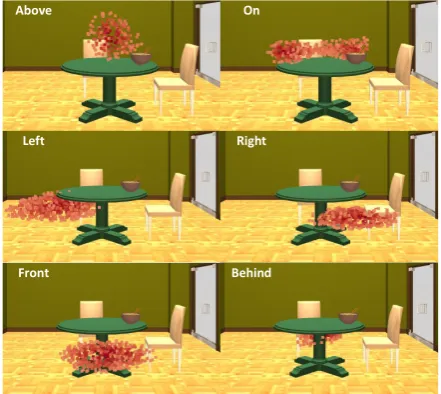
Figure 7: High probability regions where the cen-ter of another object would occur for some spatial relations with respect to a table: above (top left),
on(top right),left(mid left),right(mid right), in front(bottom left),behind(bottom right).
keywords to an appropriate spatial relation. The 5 keywords that are not well mapped are proximity relations that are not well captured by our prede-fined spatial relations.
Using the 15 keywords as our spatial relations, we train a log linear binary classifier for each key-word over features of the objects involved in that spatial relation (see Table 3). We then use this model to predict the likelihood of that spatial re-lation in new scenes.
[image:5.595.74.291.187.324.2]Dependency Pattern Example Text
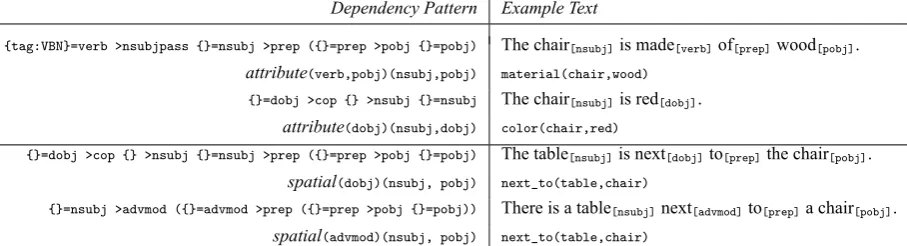
{tag:VBN}=verb >nsubjpass {}=nsubj >prep ({}=prep >pobj {}=pobj) The chair[nsubj]is made[verb]of[prep]wood[pobj].
attribute(verb,pobj)(nsubj,pobj) material(chair,wood)
{}=dobj >cop {} >nsubj {}=nsubj The chair[nsubj]is red[dobj].
attribute(dobj)(nsubj,dobj) color(chair,red)
{}=dobj >cop {} >nsubj {}=nsubj >prep ({}=prep >pobj {}=pobj) The table[nsubj]is next[dobj]to[prep]the chair[pobj].
spatial(dobj)(nsubj, pobj) next_to(table,chair)
{}=nsubj >advmod ({}=advmod >prep ({}=prep >pobj {}=pobj)) There is a table[nsubj]next[advmod]to[prep]a chair[pobj].
[image:6.595.76.530.63.186.2]spatial(advmod)(nsubj, pobj) next_to(table,chair)
Table 4: Example dependency patterns for extracting attributes and spatial relations.
6 Text to Scene generation
We generate 3D scenes from brief scene descrip-tions using our learned priors.
6.1 Scene Template Parsing
During scene template parsing we identify the scene type, the objects present in the scene, their attributes, and the relations between them. The input text is first processed using the Stanford CoreNLP pipeline (Manning et al., 2014). The scene type is determined by matching the words in the utterance against a list of known scene types from the scene dataset.
To identify objects, we look for noun phrases and use the head word as the category, filtering with WordNet (Miller, 1995) to determine which objects are visualizable (under the physical object synset, excluding locations). We use the Stanford coreference system to determine when the same object is being referred to.
To identify properties of the objects, we extract other adjectives and nouns in the noun phrase. We also match dependency patterns such as “X is made of Y” to extract additional attributes. Based on the object category and attributes, and other words in the noun phrase mentioning the object, we identify a set of associated keywords to be used later for querying the 3D model database.
Dependency patterns are also used to extract spatial relations between objects (see Table 4 for some example patterns). We use Semgrex patterns to match the input text to dependencies (Cham-bers et al., 2007). The attribute types are deter-mined from a dictionary using the text express-ing the attribute (e.g., attribute(red)=color, at-tribute(round)=shape). Likewise, spatial relations are looked up using the learned map of keywords to spatial relations.
As an example, given the input “There is a room with a desk and a red chair. The chair is to the left
of the desk.” we extract the following objects and spatial relations:
Objects category attributes keywords
o0 room room
o1 desk desk
o2 chair color:red chair, red
Relations: left(o2, o1)
6.2 Inferring Implicits
From the parsed scene template, we infer the pres-ence of additional objects and support constraints. We can optionally infer the presence of addi-tional objects from object occurrences based on the scene type. If the scene type is unknown, we use the presence of known object categories to pre-dict the most likely scene type by using Bayes’ rule on our object occurrence priors Pocc to get
P(Cs|{Co}) ∝ Pocc({Co}|Cs)P(Cs). Once we
have a scene typeCs, we samplePocc to find ob-jects that are likely to occur in the scene. We re-strict sampling to the topn= 4object categories. We can also use the support hierarchy priors
Psupportto infer implicit objects. For instance, for
each objectoi we find the most likely supporting object category and add it to our scene if not al-ready present.
After inferring implicit objects, we infer the sup-port constraints. Using the learned text to prede-fined relation mapping from §5.2, we can map the keywords “on” and “top” to thesupported_by re-lation. We infer the rest of the support hierarchy by selecting for each objectoithe parent objectoj that maximizesPsupport(Coj|Coi).
6.3 Grounding Objects
There is a desk and a keyboard and a
monitor.
Input Text Basic +Support Hierarchy +Relative Positions
There is a coffee table and there is a lamp behind the coffee table. There is a chair in front of
the coffee table.
UPDATE UPDATE
[image:7.595.78.528.62.248.2]No Relations Predefined Relations Learned Relations
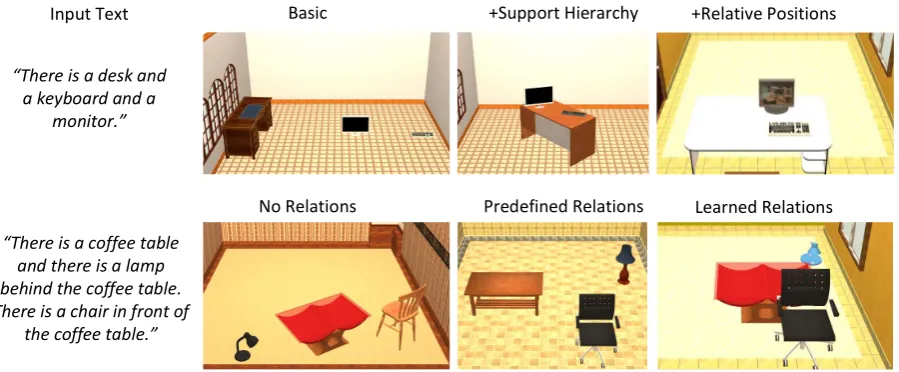
Figure 8: TopGenerated scenes for randomly placing objects on the floor (Basic), with inferredSupport Hierarchy, and with priors onRelative Positions. BottomGenerated scenes with no understanding of spatial relations (No Relations), scoring usingPredefined RelationsandLearned Relations.
the appropriate category and keywords.
We use a 3D model dataset collected from Google 3D Warehouse by prior work in scene syn-thesis and containing about 12490 mostly indoor objects (Fisher et al., 2012). These models have text associated with them in the form of names and tags. In addition, we semi-automatically annotated models with object category labels (roughly 270 classes). We used model tags to set these labels, and verified and augmented them manually.
In addition, we automatically rescale models so that they have physically plausible sizes and orient them so that they have a consistent up and front direction (Savva et al., 2014). We then indexed all models in a database that we query at run-time for retrieval based on category and tag labels.
6.4 Scene Layout
Once we have instantiated the objects in the scene by selecting models, we aim to optimize an over-all layout scoreL = λobjLobj +λrelLrel that is a weighted sum of object arrangementLobj score and constraint satisfactionLrelscore:
Lobj =
∑
oi
Psurf(Sn|Coi)
∑
oj∈F(oi)
Prelpos(·)
Lrel =
∑
ci
Prel(ci)
whereF(oi)are the sibling objects and parent ob-ject ofoi. We useλobj = 0.25andλrel= 0.75for the results we present.
[image:7.595.306.526.318.412.2]We use a simple hill climbing strategy to find a reasonable layout. We first initialize the positions
Figure 9: Generated scene for “There is a room with a desk and a lamp. There is a chair to the right of the desk.” The inferred scene hierarchy is overlayed in the center.
of objects within the scene by traversing the sup-port hierarchy in depth-first order, positioning the children from largest to first and recursing. Child nodes are positioned by first selecting a supporting surface on a candidate parent object through sam-pling ofPsurf. After selecting a surface, we sam-ple a position on the surface based onPrelpos. Fi-nally, we check whether collisions exist with other objects, rejecting layouts where collisions occur. We iterate by randomly jittering and repositioning objects. If there are any spatial constraints that are not satisfied, we also remove and randomly repo-sition the objects violating the constraints, and it-erate to improve the layout. The resulting scene is rendered and presented to the user.
7 Results and Discussion
Figure 10: Generated scene for “There is a room with a poster bed and a poster.”
Figure 11: Generated scene for “living room”.
also discuss interesting aspects of using spatial knowledge in view-based object referent resolu-tion (§7.2) and in disambiguating geometric inter-pretations of “on” (§7.3).
Model Comparison Figure 8 shows a
compari-son of scenes generated by our model versus sev-eral simpler baselines. The top row shows the im-pact of modeling the support hierarchy and the rel-ative positions in the layout of the scene. The bot-tom row shows that the learned spatial relations can give a more accurate layout than the naive predefined spatial relations, since it captures prag-matic implicatures of language, e.g., left is only used for directly left and not top left or bottom left (Vogel et al., 2013).
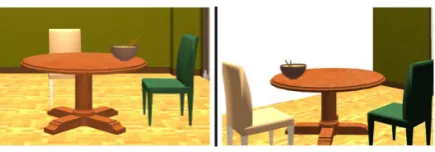
Figure 12: Left: chair is selected using “the chair to the right of the table” or “the object to the right of the table”. Chair is not selected for “the cup to the right of the table”. Right: Different view results in different chair being selected for the input “the chair to the right of the table”.
7.1 Generated Scenes
Support Hierarchy Figure 9 shows a generated
scene along with the input text and support hier-archy. Even though the spatial relation between lamp and desk was not mentioned, we infer that the lamp is supported by the top surface of the desk.
Disambiguation Figure 10 shows a generated
scene for the input “There is a room with a poster bed and a poster”. Note that the system differen-tiates between a “poster” and a “poster bed” – it correctly selects and places the bed on the floor, while the poster is placed on the wall.
Inferring objects for a scene type Figure 11
shows an example of inferring all the objects present in a scene from the input “living room”. Some of the placements are good, while others can clearly be improved.
7.2 View-centric object referent resolution
After a scene is generated, the user can refer to ob-jects with their categories and with spatial relations between them. Objects are disambiguated by both category and view-centric spatial relations. We use the WordNet hierarchy to resolve hyponym or hy-pernym referents to objects in the scene. In Fig-ure 12 (left), the user can select a chair to the right of the table using the phrase “chair to the right of the table” or “object to the right of the table”. The user can then change their viewpoint by rotating and moving around. Since spatial relations are re-solved with respect to the current viewpoint, a dif-ferent chair is selected for the same phrase from a different viewpoint in the right screenshot.
7.3 Disambiguating “on”
As shown in §5.2, the English preposition “on”, when used as a spatial relation, corresponds strongly to the supported_by relation. In our trained model, the supported_byfeature also has a high positive weight for “on”.
[image:8.595.73.291.615.691.2]Figure 13: From top left clockwise: “There is a cup on the table”, “There is a cup on the book-shelf”, “There is a poster on the wall”, “There is a hat on the chair”. Note the different geometric interpretations of “on”.
Given the input “There is a poster on the wall”, a poster is pasted on the wall, while with the input “There is a hat on the chair” the hat is placed on the seat of the chair.
7.4 Limitations
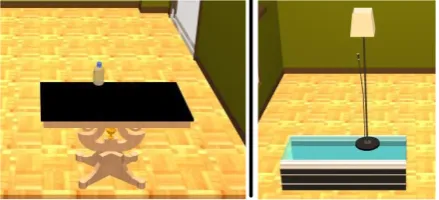
While the system shows promise, there are still many challenges in text-to-scene generation. For one, we did not address the difficulties of resolving objects. A failure case of our system stems from using a fixed set of categories to identify visualiz-able objects. For example, the sense of “top” refer-ring to a spinning top, and other uncommon object types, are not handled by our system as concrete objects. Furthermore, complex phrases including object parts such as “there’s a coat on the seat of the chair” are not handled. Figure 14 shows some
Figure 14: Left: A water bottle instead of wine bottle is selected for “There is a bottle of wine on the table in the kitchen”. In addition, the selected table is inappropriate for a kitchen.Right: A floor lamp is incorrectly selected for the input “There is a lamp on the table”.
example cases where the context is important in selecting an appropriate object and the difficulties of interpreting noun phrases.
In addition, we rely on a few dependency pat-terns for extracting spatial relations so robustness to variations in spatial language is lacking. We only handle binary spatial relations (e.g., “left”, “behind”) ignoring more complex relations such as “around the table” or “in the middle of the room”. Though simple binary relations are some of the most fundamental spatial expressions and a good first step, handling more complex expressions will do much to improve the system.
Another issue is that the interpretation of sen-tences such as “the desk is covered with paper”, which entails many pieces of paper placed on the desk, is hard to resolve. With a more data-driven approach we can hope to link such expressions to concrete facts.
Finally, we use a traditional pipeline approach for text processing, so errors in initial stages can propagate downstream. Failures in depen-dency parsing, part of speech tagging, or coref-erence resolution can result in incorrect interpre-tations of the input language. For example, in the sentence “there is a desk with a chair in front of it”, “it” is not identified as coreferent with “desk” so we fail to extract the spatial relation front_of(chair,desk).
8 Related Work
There is related prior work in the topics of mod-eling spatial relations, generating 3D scenes from text, and automatically laying out 3D scenes.
8.1 Spatial knowledge and relations
[image:9.595.72.292.578.678.2]implicit spatial knowledge. Many priors on real world spatial facts are typically unstated in text and remain largely unaddressed.
8.2 Text to Scene Systems
Early work on the SHRDLU system (Winograd, 1972) gives a good formalization of the linguis-tic manipulation of objects in 3D scenes. By re-stricting the discourse domain to a micro-world with simple geometric shapes, the SHRDLU sys-tem demonstrated parsing of natural language in-put for manipulating scenes. However, generaliza-tion to more complex objects and spatial relageneraliza-tions is still very hard to attain.
More recently, a pioneering text-to-3D scene generation prototype system has been presented by WordsEye (Coyne and Sproat, 2001). The authors demonstrated the promise of text to scene genera-tion systems but also pointed out some fundamen-tal issues which restrict the success of their system: much spatial knowledge is required which is hard to obtain. As a result, users have to use unnatural language (e.g., “the stool is 1 feet to the south of the table”) to express their intent. Follow up work has attempted to collect spatial knowledge through crowd-sourcing (Coyne et al., 2012), but does not address the learning of spatial priors.
We address the challenge of handling natural language for scene generation, by learning spatial knowledge from 3D scene data, and using it to in-fer unstated implicit constraints. Our work is simi-lar in spirit to recent work on generating 2D clipart for sentences using probabilistic models learned from data (Zitnick et al., 2013).
8.3 Automatic Scene Layout
Work on scene layout has focused on determining good furniture layouts by optimizing energy func-tions that capture the quality of a proposed layout. These energy functions are encoded from design guidelines (Merrell et al., 2011) or learned from scene data (Fisher et al., 2012). Knowledge of ob-ject co-occurrences and spatial relations is repre-sented by simple models such as mixtures of Gaus-sians on pairwise object positions and orientations. We leverage ideas from this work, but they do not focus on linking spatial knowledge to language.
9 Conclusion and Future Work
We have demonstrated a representation of spatial knowledge that can be learned from 3D scene data
and how it corresponds to natural language. We also showed that spatial inference and grounding is critical for achieving plausible results in the text-to-3D scene generation task. Spatial knowledge is critically useful not only in this task, but also in other domains which require an understanding of the pragmatics of physical environments.
We only presented a deterministic approach for mapping input text to the parsed scene template. An interesting avenue for future research is to automatically learn how to parse text describing scenes into formal representations by using more advanced semantic parsing methods.
We can also improve the representation used for spatial priors of objects in scenes. For instance, in this paper we represented support surfaces by their orientation. We can improve the representation by modeling whether a surface is an interior or exte-rior surface.
Another interesting line of future work would be to explore the influence of object identity in de-termining when people use ego-centric or object-centric spatial reference models, and to improve resolution of spatial terms that have different in-terpretations (e.g., “the chair to the left of John” vs “the chair to the left of the table”).
Finally, a promising line of research is to explore using spatial priors for resolving ambiguities dur-ing parsdur-ing. For example, the attachment of “next to” in “Put a lamp on the table next to the book” can be readily disambiguated with spatial priors such as the ones we presented.
Acknowledgments
We thank the anonymous reviewers for their thoughtful comments. We gratefully acknowl-edge the support of the Defense Advanced Re-search Projects Agency (DARPA) Deep Explo-ration and Filtering of Text (DEFT) Program under Air Force Research Laboratory (AFRL) contract no. FA8750-13-2-0040. Any opinions, findings, and conclusion or recommendations expressed in this material are those of the authors and do not necessarily reflect the view of the DARPA, AFRL, or the US government.
References
Nathanael Chambers, Daniel Cer, Trond Grenager, David Hall, Chloe Kiddon, Bill MacCartney, Marie-Catherine de Marneffe, Daniel Ramage, Eric Yeh, and Christopher D. Manning. 2007. Learning align-ments and leveraging natural logic. InProceedings of the ACL-PASCAL Workshop on Textual Entail-ment and Paraphrasing.
Bob Coyne and Richard Sproat. 2001. WordsEye: an automatic text-to-scene conversion system. In Pro-ceedings of the 28th annual conference on Computer graphics and interactive techniques.
Bob Coyne, Richard Sproat, and Julia Hirschberg. 2010. Spatial relations in text-to-scene conversion. InComputational Models of Spatial Language Inter-pretation, Workshop at Spatial Cognition.
Bob Coyne, Alexander Klapheke, Masoud Rouhizadeh, Richard Sproat, and Daniel Bauer. 2012. Annota-tion tools and knowledge representaAnnota-tion for a text-to-scene system. Proceedings of COLING 2012: Tech-nical Papers.
Desmond Elliott and Frank Keller. 2013. Image de-scription using visual dependency representations. In Proceedings of Empirical Methods in Natural Language Processing (EMNLP).
Matthew Fisher, Daniel Ritchie, Manolis Savva, Thomas Funkhouser, and Pat Hanrahan. 2012. Example-based synthesis of 3D object arrangements. ACM Transactions on Graphics (TOG).
Nicholas FitzGerald, Yoav Artzi, and Luke Zettle-moyer. 2013. Learning distributions over logical forms for referring expression generation. In Pro-ceedings of Empirical Methods in Natural Language Processing (EMNLP).
Dave Golland, Percy Liang, and Dan Klein. 2010. A game-theoretic approach to generating spatial de-scriptions. InProceedings of Empirical Methods in Natural Language Processing (EMNLP).
Alan D. Kalvin and Russell H. Taylor. 1996. Super-faces: Polygonal mesh simplification with bounded error. Computer Graphics and Applications, IEEE.
Jayant Krishnamurthy and Thomas Kollar. 2013. Jointly learning to parse and perceive: Connecting natural language to the physical world.Transactions of the Association for Computational Linguistics.
Girish Kulkarni, Visruth Premraj, Sagnik Dhar, Siming Li, Yejin Choi, Alexander C. Berg, and Tamara L. Berg. 2011. Baby talk: Understanding and generat-ing simple image descriptions. InComputer Vision and Pattern Recognition (CVPR), 2011 IEEE Con-ference on.
Christopher D. Manning, Mihai Surdeanu, John Bauer, Jenny Finkel, Steven J. Bethard, and David Mc-Closky. 2014. The Stanford CoreNLP natural lan-guage processing toolkit. In Proceedings of the 52nd Annual Meeting of the Association for Com-putational Linguistics: System Demonstrations.
Cynthia Matuszek, Nicholas Fitzgerald, Luke Zettle-moyer, Liefeng Bo, and Dieter Fox. 2012. A joint model of language and perception for grounded at-tribute learning. InInternational Conference on Ma-chine Learning (ICML).
Paul Merrell, Eric Schkufza, Zeyang Li, Maneesh Agrawala, and Vladlen Koltun. 2011. Interactive furniture layout using interior design guidelines. In ACM Transactions on Graphics (TOG).
George A. Miller. 1995. WordNet: a lexical database for English.Communications of the ACM.
Margaret Mitchell, Xufeng Han, Jesse Dodge, Alyssa Mensch, Amit Goyal, Alex Berg, Kota Yamaguchi, Tamara Berg, Karl Stratos, and Hal Daumé III. 2012. Midge: Generating image descriptions from com-puter vision detections. InProceedings of the 13th Conference of the European Chapter of the Associa-tion for ComputaAssocia-tional Linguistics.
Manolis Savva, Angel X. Chang, Gilbert Bernstein, Christopher D. Manning, and Pat Hanrahan. 2014. On being the right scale: Sizing large collections of 3D models. Stanford University Technical Report CSTR 2014-03.
Adam Vogel and Dan Jurafsky. 2010. Learning to fol-low navigational directions. InProceedings of ACL.
Adam Vogel, Christopher Potts, and Dan Jurafsky. 2013. Implicatures and nested beliefs in approxi-mate Decentralized-POMDPs. InProceedings of the 51st Annual Meeting of the Association for Compu-tational Linguistics.
Terry Winograd. 1972. Understanding natural lan-guage. Cognitive psychology.