Automatic Generation of Related Work Sections in Scientific Papers:
An Optimization Approach
Yue Hu and Xiaojun Wan
Institute of Computer Science and Technology
The MOE Key Laboratory of Computational Linguistics
Peking University, Beijing, China
{ayue.hu,wanxiaojun}@pku.edu.cn
Abstract
In this paper, we investigate a challeng-ing task of automatic related work gener-ation. Given multiple reference papers as input, the task aims to generate a related work section for a target paper. The gen-erated related work section can be used as a draft for the author to complete his or her final related work section. We propose our Automatic Related Work Generation system called ARWG to ad-dress this task. It first exploits a PLSA model to split the sentence set of the giv-en papers into differgiv-ent topic-biased parts, and then applies regression models to learn the importance of the sentences. At last it employs an optimization frame-work to generate the related frame-work section. Our evaluation results on a test set of 150 target papers along with their reference papers show that our proposed ARWG system can generate related work sec-tions with better quality. A user study is also performed to show ARWG can achieve an improvement over generic multi-document summarization baselines.
1
Introduction
The related work section is an important part of a paper. An author often needs to help readers to understand the context of his or her research problem and compare his or her current work with previous works. A related work section is often used for this purpose to show the differ-ences and advantages of his or her work, com-pared with related research works. In this study, we attempt to automatically generate a related
work section for a target academic paper with its reference papers. This kind of related work sec-tions can be used as a basis to reduce the author’s time and effort when he or she wants to complete his or her final related work section.
Automatic related work section generation is a very challenging task. It can be considered a
top-ic-biased, multiple-document summarization
problem. The input is a target academic paper, which has no related work section, along with its reference papers. The goal is to create a related work section that describes the related works and addresses the relationship between the target pa-per and the reference papa-pers. Here we assume that the set of reference papers has been given as part of the input. Existing works in the NLP and recommendation systems communities have al-ready focused on the task of finding reference papers. For example, citation prediction (Nal-lapati et al., 2008) aims at finding individual pa-per citation patterns.
Generally speaking, automatic related work section generation is a strikingly different prob-lem and it is much more difficult in comparison with general multi-document summarization tasks. For example, multi-document summariza-tion of news articles aims at synthesizing con-tents of similar news and removing the redundant information contained by the different news arti-cles. However, each scientific paper has much specific content to state its own work and contri-bution. Even for the papers that investigate the same research topic, their contributions and con-tents can be totally different. The related work section generation task needs to find the specific contributions of individual papers and arrange them into one or several paragraphs.
In this study, we focus on the problem of au-tomatic related work section generation and pro-pose a novel system called ARWG to address the
problem. For the target paper, we assume that the abstract and introduction sections have already been written by the author and they can be used to help generate the related work section. For the reference papers, we only consider and extract the abstract, introduction, related work and con-clusion sections, because other sections like the method and evaluation sections always describe the extreme details of the specific work and they are not suitable for this task. Then we generate the related work section using both sentence sets which are extracted from the target paper and reference papers, respectively.
Firstly, we use a PLSA model to group both sentence sets of the target paper and its reference papers into different topic-biased clusters. Sec-ondly, the importance of each sentence in the target paper and the reference papers is learned by using two different Support Vector Regres-sion (SVR) models. At last, a global optimization framework is proposed to generate the related work section by selecting sentences from both the target paper and the reference papers. Mean-while, the framework selects sentences from dif-ferent topic-biased clusters globally.
Experimental results on a test set of 150 target papers show our method can generate related work sections with better quality than those of several baseline methods. With the ROUGE toolkit, the results indicate the related work sec-tions generated by our system can get higher ROUGE scores. Moreover, our related work sec-tions can get higher rating scores based on a user study. Therefore, our related work sections can be much more suitable for the authors to prepare their final related work sections.
2
Related Work
There are few studies to directly address auto-matic related work generation. Hoang and Kan (2010) proposed a related work summarization system given the set of keywords arranged in a hierarchical fashion that describes the paper’s topic. They used two different rule-based strate-gies to extract sentences for general topics as well as detailed ones.
A few studies focus on multi-document scien-tific article summarization. Agarwal et al., (2011) introduced an unsupervised approach to the prob-lem of multi-document summarization. The input is a list of papers cited together within the same source article. The key point of this approach is a topic based clustering of fragments extracted from each co-cited article. They rank all the
clus-ters using a query generated from the context surrounding the co-cited list of papers. Yeloglu et al., (2011) compared four different approaches for multi-document scientific articles summariza-tion: MEAD, MEAD with corpus specific vo-cabulary, LexRank and W3SS.
Other studies investigate mainly on the single-document scientific article summarization. Early works including (Luhn 1958; Baxendale 1958; Edumundson 1969) tried to use various features specific to scientific text (e.g., sentence position, or rhetorical clues features). They have proved that these features are effective for the scientific article summarization. Citation information has been already shown effective in summarize the scientific articles. Works including (Mei and Zhai 2008; Qazvinian and Radev 2008; Schwartz and Hearst 2006; Mohammad et al., 2009) em-ployed citation information for the single scien-tific article summarization. Earlier work (Nakov et al., 2004) indicated that citation sentences may contain important concepts that can give useful descriptions of a paper.
Various methods have been proposed for news document summarization, including rule-based methods (Barzilay and Elhadad 1997; Marcu and Daniel 1997), graph-based methods (Mani and Bloedorn 2000; Erkan and Radev 2004; Michal-cea and Tarau 2005), learning-based methods (Conroy et al., 2001; Shen et al., 2007; Ouyang et al., 2007; Galanis et al., 2008), optimization-based methods (McDonald 2007; Gillick et al., 2009; Xie et al., 2009; Berg-Kirkpatrick et al., 2011; Lei Huang et al., 2011; Woodsend et al., 2012; Galanis 2012), etc.
The most relevant work is (Hoang and Kan, 2010) as mentioned above. They also assumed the set of reference papers was given as part of the input. They also adopt the hierarchical topic tree that describes the topic structure in the target paper as an essential input for their system. However, it is non-trivial to build the hierar-chical topic tree. Moreover, they do not consider the content of the target paper to construct the related work section, which is actually crucial in the related work section. To the best of our knowledge, no previous works have used super-vised learning and optimization framework to deal with the multiple scientific article summari-zation tasks.
3
Problem Analysis and Corpus
We firstly analyze the structure of related work sections briefly. By using examples for illustra-tion, we can gain insight on how to generate
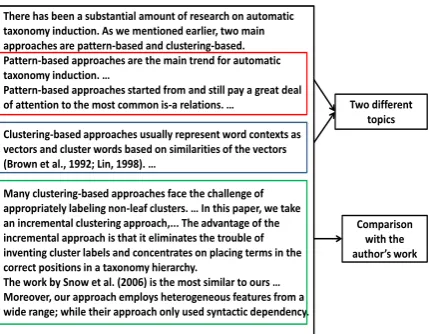
re-lated work sections. A specific rere-lated work ex-ample is shown in Figure 1.
This related work section introduces previous related works for a paper on Automatic Taxono-my Induction. From Figure 1, we can have a glance at the structure of related work sections. Related work sections usually discuss several
different topics, such as “pattern-based” and
“cluster-based” approaches shown in the Figure 1. Besides the knowledge of previous works, the author often compares his own work with the previous works. The differences and advantages are generally mentioned. The example in Figure 1 also indicates this phenomenon.
Therefore, we design our system to generate related work sections according to the related work section structure mentioned above. Our system takes the target paper for which a related work section needs to be drafted besides its ref-erence papers as input. The goal of our system is to generate a related work section with the above structure. The generated related work section should have several topic-biased parts. The au-thor's own work is also needed to be described and its difference with other works is needed to be emphasized on.
3.2 Corpus and Preprocessing
We build a corpus that contains academic papers and their corresponding reference papers. The academic papers are selected from the ACL
An-thology1. The ACL Anthology currently hosts
1http://aclweb.org/anthology/
over 24,500 papers from major conferences such as ACL, EMNLP, COLING in the fields of com-putational linguistics and natural language pro-cessing. We remove the papers that contain relat-ed work sections with very short length, and ran-domly select 1050 target papers to construct our whole corpus.
The papers are all in PDF format. We extract
their texts by using PDFlib2 and detect their
physical structures of paragraphs, subsections
and sections by using ParsCit3. For the target
papers, the related work sections are directly ex-tracted as the gold summaries. The references are also extracted. For the references that can be found in the ACL Anthology, we download them from the ACL Anthology. The other reference papers are searched and downloaded by using Google Scholar. References to books and PhD theses are discarded, for their verbosity may change the problem drastically (Mihalcea and Ceylan, 2007).
The input of our system includes the abstract and introduction sections of the target paper, and the abstract, introduction, related work and con-clusion sections of the reference papers. As men-tioned above, the method and evaluation sections in the reference papers are not used as input be-cause these sections usually describe extreme details of the methods and evaluation results and they are not suitable for related work generation. Note that it is reasonable to make use of the ab-stract and introduction sections of the target pa-per to help generate the related work section, because an author usually has already written the abstract and introduction sections before he or she wants to write the related work section for the target paper. Otherwise, we cannot get any information about the author’s own work. All other sections in the target paper are not used.
4
Our Proposed System
4.1 Overview
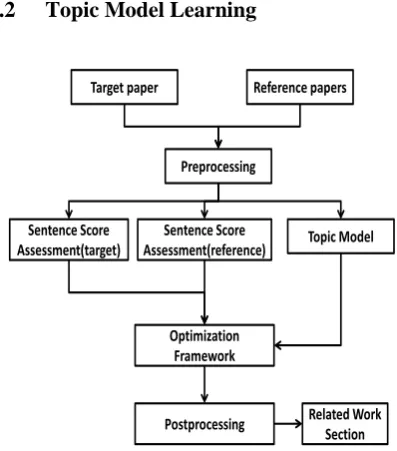
In this paper, we propose a system called ARWG to automatically generate a related work section for a given target paper. The architecture of our system is shown in Figure 2. We take both the target paper and its reference papers as input and they are represented by several sections men-tioned in Section 3.2. After preprocessing, we extract the feature vectors for sentences in the target paper and the reference papers,
2http://www.pdflib.com/
[image:3.595.78.293.124.291.2]3http://aye.comp.nus.edu.sg/parsCit/ Figure 1: A sample related work section (Yang and
Callan 2009)
There has been a substantial amount of research on automatic taxonomy induction. As we mentioned earlier, two main approaches are pattern-based and clustering-based. Pattern-based approaches are the main trend for automatic taxonomy induction. …
Pattern-based approaches started from and still pay a great deal of attention to the most common is-a relations. …
Clustering-based approaches usually represent word contexts as vectors and cluster words based on similarities of the vectors (Brown et al., 1992; Lin, 1998). …
Many clustering-based approaches face the challenge of appropriately labeling non-leaf clusters. … In this paper, we take an incremental clustering approach,... The advantage of the incremental approach is that it eliminates the trouble of inventing cluster labels and concentrates on placing terms in the correct positions in a taxonomy hierarchy.
The work by Snow et al. (2006) is the most similar to ours … Moreover, our approach employs heterogeneous features from a wide range; while their approach only used syntactic dependency.
Two different topics
ly. The importance scores for sentences in the target paper and the reference papers are as-signed by using two SVR based sentence scoring models. The two SVR models are trained for sentences in the target paper and the reference papers, respectively. Meanwhile, a topic model is applied to the whole set of sentences in both the target paper and reference papers. The sentences are grouped into several different topic-biased clusters. The sentences with importance scores and topic cluster information are taken as the input for the global optimization framework. The optimization framework extracts sentences to describe both the author’s own work and back-ground knowledge. More details of each part will be discussed in the following sections.
4.2 Topic Model Learning
As mentioned in the previous section, the related work section usually addresses several different topics. The topics may be different research themes or different aspects of a broad research theme. The related work section should describe the specific details for each topic, respectively.
Therefore, we aim to discover the hidden top-ics of the input papers, and we use the Probabil-istic latent semantic analysis (PLSA) (Hofmann, 1999) to solve this problem.
The PLSA approach models each word in a document as a sample from a mixture model. The mixture components are multinomial ran-dom variables that can be viewed as representa-tions of “topics”. Different words in a document may be generated from different topics. Each document is represented a list of mixing propor-tions for these mixture components and can be
reduced to a probability distribution on a fixed set of topics.
Considering that the sentences in one paper may relate to different topics, we treat each
sen-tence as a “document” d. We treat the noun
phases in the sentences as the “words” w. In
or-der to extract the noun phrases, chunking
imple-mented by the OpenNLP toolkit 4 is applied to
the sentences. Noun phrases that contain words such as “paper” and “data” are discarded.
Then the sentences with their corresponding noun phrases are taken as input into the PLSA model. Here both the sentences in the target pa-per and the sentences in the reference papa-pers are treated the same in the model. Finally, we can get the sentence set with topic information and use it in the subsequent steps. Each sentence has
a topic weight t in each topic.
4.3 Sentence Important Assessment
In our proposed system, sentence importance assessment aims to assign an importance score to each sentence in the target paper and reference papers. The score of each sentence will be used in the subsequent optimization framework. We propose to use the support vector regression model to achieve this goal. In the above topic model learning process, we do not distinguish the sentences in the target paper and reference pa-pers. In contrast, we train two different support vector regression models separately for the sen-tences in the target paper and the sensen-tences in the reference papers. In the related work section, the sentences that describe the author’s own work usually address the differences from the related works, while the sentences that describe the re-lated works often focus on the specific details. We think the two kinds of sentences should be treated differently.
Scoring Method
To construct training data based on the papers collected, we apply a similarity scoring method to assign the importance scores to the sentences in the papers. The main hypothesis is that the sentences in the gold related work sections should summarize the target paper and reference papers as well. Thus the sentences in the papers which are more similar to the sentences in the gold related work sections should be considered more important and suitable to be selected. Our scoring method should assign higher scores to them.
[image:4.595.77.276.283.509.2]
4http://opennlp.apache.org/ Figure 2: System Architecture
Target paper Reference papers
Preprocessing
Topic Model Sentence Score
Assessment(target)
Sentence Score Assessment(reference)
Optimization Framework
We define the importance score of a sentence in the papers as below:
𝑠𝑐𝑜𝑟𝑒(𝑠) = 𝑚𝑎𝑥
𝑠𝑖∗∈𝑆∗(𝑠𝑖𝑚(𝑠, 𝑠𝑖
∗)) (1)
where s is a sentence in the papers, 𝑆∗ is the set
of the sentences in the corresponding gold relat-ed work section. The standard cosine measure is employed as the similarity function.
Considering the difference between the sen-tences that describe the author’s work and the sentences that describe the related works, we split the set of sentences in the gold related work section into two parts: one discusses the author’s own work and the other introduces the related works. We observe that sentences related to the author’s own work often feature specific words or phrases (such as “we”, “our work”, “in this paper” etc.) in the related work section. So we check the sentences about whether they contain clue words or phrases (i.e., “in this paper”, “our work” and 18 other phrases). If the clue phrase check fails, the sentence belongs to the related work part. If not, it belongs the own work part.
Thus for the sentences in the target paper, 𝑆∗
is the set of sentences in the own work part of the gold related work section, while for the sentences
in the reference papers, 𝑆∗ is the set of sentences
in the related work part of the gold related work section. Then we can use the scoring method to compute the target scores of the sentences in the training set. It is noteworthy that two SVR mod-els can be trained on the two parts of the training data, respectively.
Feature
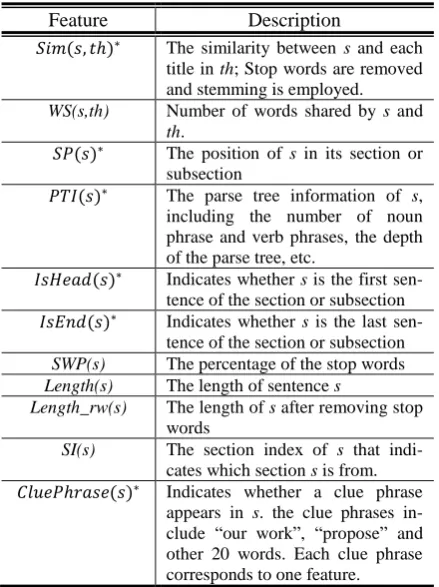
[image:5.595.300.520.95.389.2]Each sentence is represented by a set of features. The common features used for the sentences of the target paper and reference papers are shown in Table 1. The additional features applied to the sentences of the target paper are introduced in Table 2.
Here, s is a sentence that needs to extract
fea-tures. th is paper title, section headings and
sub-section headings set of the reference papers or target paper for the two SVR models, respective-ly. Each feature with “*” represent a feature set that contains similar features.
All the features are scaled into [0, 1]. Thus we can learn SVR models based on the features and importance scores of the sentences, and then use the models to predict an importance score for each sentence in the test set. The SVR models are trained and applied for the target paper and reference papers, respectively.
Table 1: Common features employed in the SVR models
Feature Description
𝑆𝑖𝑚(𝑠, 𝑡ℎ)∗ The similarity between s and each
title in th; Stop words are removed and stemming is employed.
WS(s,th) Number of words shared by s and
th.
𝑆𝑃(𝑠)∗ The position of s in its section or
subsection
𝑃𝑇𝐼(𝑠)∗ The parse tree information of s,
including the number of noun phrase and verb phrases, the depth of the parse tree, etc.
𝐼𝑠𝐻𝑒𝑎𝑑(𝑠)∗ Indicates whether s is the first
sen-tence of the section or subsection
𝐼𝑠𝐸𝑛𝑑(𝑠)∗ Indicates whether s is the last
sen-tence of the section or subsection
SWP(s) The percentage of the stop words
Length(s) The length of sentence s
Length_rw(s) The length of s after removing stop words
SI(s) The section index of s that indi-cates which section s is from.
𝐶𝑙𝑢𝑒𝑃ℎ𝑟𝑎𝑠𝑒(𝑠)∗ Indicates whether a clue phrase
[image:5.595.299.519.425.531.2]appears in s. the clue phrases in-clude “our work”, “propose” and other 20 words. Each clue phrase corresponds to one feature.
Table 2: Additional features for sentences in the target paper
Feature Description
HasCitation(s) Indicates whether s contains a citation
𝑃h𝑟𝑎𝑠𝑒𝐹𝑜𝑟𝐶𝑚𝑝(𝑠)∗ Indicates whether s contains
words or phrases used for com-parison such as “in contrast”, “instead” and other 26 words. Each word or phrase corre-sponds to one feature.
4.4 A Global Optimization Framework
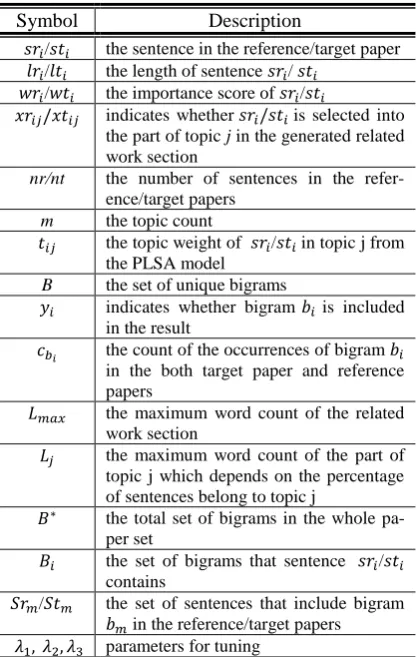
In the above steps, we can get the predicted im-portance score and topic information for each sentence in the target paper and reference papers. Here, we introduce a global optimization frame-work to generate the related frame-work section.
According to the structure of the related work section mentioned above, the related work sec-tion usually discusses several topics. In each top-ic, the related works and their details are intro-duced. Besides, the author often compares his own work with these previous works.
Table 3: Notations used in this section
Symbol Description
𝑠𝑟𝑖/𝑠𝑡𝑖 the sentence in the reference/target paper 𝑙𝑟𝑖/𝑙𝑡𝑖 the length of sentence 𝑠𝑟𝑖/ 𝑠𝑡𝑖
𝑤𝑟𝑖/𝑤𝑡𝑖 the importance score of 𝑠𝑟𝑖/𝑠𝑡𝑖
𝑥𝑟𝑖𝑗/𝑥𝑡𝑖𝑗 indicates whether 𝑠𝑟𝑖/𝑠𝑡𝑖 is selected into
the part of topic j in the generated related work section
nr/nt the number of sentences in the refer-ence/target papers
m the topic count
𝑡𝑖𝑗 the topic weight of 𝑠𝑟𝑖/𝑠𝑡𝑖in topic j from
the PLSA model
B the set of unique bigrams
𝑦𝑖 indicates whether bigram 𝑏𝑖 is included in the result
𝑐𝑏𝑖 the count of the occurrences of bigram 𝑏𝑖
in the both target paper and reference papers
𝐿𝑚𝑎𝑥 the maximum word count of the related
work section
𝐿𝑗 the maximum word count of the part of
topic j which depends on the percentage of sentences belong to topic j
𝐵∗ the total set of bigrams in the whole
pa-per set
𝐵𝑖 the set of bigrams that sentence 𝑠𝑟𝑖/𝑠𝑡𝑖
contains
𝑆𝑟𝑚/𝑆𝑡𝑚 the set of sentences that include bigram 𝑏𝑚 in the reference/target papers
𝜆1, 𝜆2, 𝜆3 parameters for tuning
To design the objective function, three aspects should be considered:
1) First, the related work section we generate
should introduce the previous works well. In our assumption, sentences with higher im-portance scores are better to be selected. In addition, very short sentences should be pe-nalized. So we introduce the first part of our objective function below:
∑ (𝑙𝑟𝑖𝑤𝑟𝑖∑𝑚 𝑡𝑖𝑗𝑥𝑟𝑖𝑗) 𝑗=1
𝑛𝑟
𝑖=1 (2)
We add the sentence length as a multipli-cation factor in order to penalize the very short sentences, or the objective function tends to select more and shorter sentences. At the same time, the objective function does not tend to select the very long sentences. The total length of the sentences selected is fixed. So if the objective function tends to select the longer sentences, the fewer sen-tences can be selected. A tradeoff needs to be made between the number and the average length of the sentences selected.
The constraints introduced below ensure that the sentence can only be selected into one topic and the topic weight is used to measure the degree that the sentence is rele-vant to the specific topic.
2) Second, similar to the first part, we should
consider the own work part of the related work section. Thus the second part of our ob-jective function is shown as follows:
∑𝑛𝑡𝑖=1(𝑙𝑡𝑖𝑤𝑡𝑖∑𝑚𝑗=1𝑡𝑖𝑗𝑥𝑡𝑖𝑗) (3)
3) At last, redundancy reduction should be
con-sidered in the objective function. The last part of the objective function is shown below:
∑ 𝑐𝑏𝑖𝑦𝑖 |𝐵|
𝑖=1 (4)
The intuition is that the more unique bi-grams the related work section contains, the less redundancy the related work section has.
We add 𝑐𝑏𝑖 as the weight of the bigram in
or-der to include more important bigrams.
By combing all the parts defined above, we have the following full objective function:
max
𝑥𝑟,𝑥𝑡𝜆1∑ ( 𝑙𝑟𝑖
𝛼𝐿𝑚𝑎𝑥𝑤𝑟𝑖∑ 𝑡𝑖𝑗𝑥𝑟𝑖𝑗) 𝑚
𝑗=1 +
𝑛𝑟 𝑖=1
𝜆2∑ ( 𝑙𝑡𝑖
(1−𝛼)𝐿𝑚𝑎𝑥𝑤𝑡𝑖∑ 𝑡𝑖𝑗𝑥𝑡𝑖𝑗) 𝑚
𝑗=1 𝑛𝑡
𝑖=1 +
𝜆3∑ 𝑐𝑏𝑖𝑦𝑖 |𝐵∗| |𝐵|
𝑖=1 (5)
Subject to:
∑𝑛𝑟𝑖=1𝑙𝑟𝑖𝑥𝑟𝑖𝑗+ ∑𝑛𝑡𝑖=1𝑙𝑡𝑖𝑥𝑡𝑖𝑗 < 𝐿𝑗, 𝑓𝑜𝑟 𝑗 = 1, … , 𝑚 (6)
∑ ∑𝑚 𝑙𝑟𝑖𝑥𝑟𝑖𝑗 𝑗=1 𝑛𝑟
𝑖=1 < 𝛼𝐿𝑚𝑎𝑥 (7)
∑𝑛𝑡𝑖=1∑𝑚𝑗=1𝑙𝑡𝑖𝑥𝑡𝑖𝑗< (1 − 𝛼)𝐿𝑚𝑎𝑥 (8) ∑𝑚 𝑥𝑟𝑖𝑗
𝑗=1 ≤ 1, 𝑓𝑜𝑟 𝑖 = 1, … , 𝑛𝑟 (9) ∑𝑚𝑗=1𝑥𝑡𝑖𝑗 ≤ 1, 𝑓𝑜𝑟 𝑖 = 1, … , 𝑛𝑡 (10) ∑𝑏𝑘∈𝐵𝑖𝑦𝑘 ≥ |𝐵𝑖| ∑𝑚 𝑥𝑟𝑖𝑗
𝑗=1 , 𝑓𝑜𝑟 𝑖 = 1, … , 𝑛𝑟 (11) ∑𝑏𝑘∈𝐵𝑖𝑦𝑘 ≥ |𝐵𝑖| ∑ 𝑥𝑡𝑖𝑗
𝑚
𝑗=1 , 𝑓𝑜𝑟 𝑖 = 1, … , 𝑛𝑡 (12)
∑ ∑𝑚 𝑥𝑟𝑖𝑗
𝑗=1 + ∑𝑠𝑡𝑖∈𝑆𝑡𝑘∑𝑚𝑗=1𝑥𝑡𝑖𝑗
𝑠𝑟𝑖∈𝑆𝑟𝑘 ≥ 𝑦𝑘,
𝑘 = 1, … |𝐵| (13)
𝑥𝑟𝑖𝑗, 𝑥𝑡𝑖𝑗, 𝑦𝑖 ∈ {0,1} (14) All the three parts in the objective function are normalized to [0, 1] by using the maximum
length 𝐿𝑚𝑎𝑥 and the total number of bigrams |𝐵∗|.
𝜆1, 𝜆2 and 𝜆3 are parameters for tuning the three
parts and we set 𝜆1+𝜆2+𝜆3= 1.
We explain the constraints as follows:
Constraint (6): It ensures that the total word
count of the part of topic j does not exceed 𝐿𝑗.
Constraints (7), (8): The two constraints try to balance the lengths of the previous works part
and the own work part, respectively. 𝛼 is set to
2/3.
Constraints (11), (12): When these two con-straints hold, all bigrams that 𝑠𝑖 has are selected
if 𝑠𝑖 is selected.
Constraint (13): This constraint makes sure
that at least one sentence in 𝑆𝑟𝑚 or 𝑆𝑡𝑚 is
select-ed if bigram 𝑏𝑚 is selected.
Therefore, we transform our optimization problem into a linear programing problem. We solve this linear programming problem by using
the IBM CPLEX optimizer5. It generally takes
tens of seconds to solve the problem and it is very efficient.
Finally, ARWG post-processes sentences to improve readability, including replacing agentive forms with a citation to the specific article (e.g.,
“our work” → “(Hoang and Kan, 2010)”) for the
sentences extracted from reference papers. The sentences belonging to different topics are placed separately.
5
Evaluation
5.1 Evaluation Setup
To set up our experiments, we divide our dataset which contains 1050 target papers and their ref-erence papers into two parts: 700 target papers for training, 150 papers for test and the other 200 papers for validation. The PLSA topic model is applied to the whole dataset. We train two SVR regression models based on the own work part and the previous work part of the training data and apply the models to the test data. The global optimization framework is used to generate the related work sections. We set the maximum word count of the generated related work section to be equal to that of the gold related work section.
The parameter values of 𝜆1, 𝜆2 and 𝜆3 are set to
0.3, 0.1 and 0.6, respectively. The parameter val-ues are tuned on the validation data.
We compare our system with five baseline sys-tems: MEAD-WT, LexRank-WT, ARWG-WT,
MEAD and LexRank. MEAD6 (Radev et al.,
2004) is an open-source extractive
multi-document summarizer. LexRank 7 (Eran and
Radev, 2004) is a multi-document summarization system which is based on a random walk on the similarity graph of sentences. We also implement the MEAD, LexRank baselines and our method
5 www-01.ibm.com/software/integration/optimization/cplex-optimizer/
6http://www.summarization.com/mead/
7In our experiments, LexRank performs much better than the more complex variant - C-LexRank (Qazvinian and Radev, 2008), and thus we choose LexRank, rather than C-LexRank, to represent graph-based summarization methods for comparison in this paper.
with only the reference papers (i.e. the target pa-per’s content is not considered). Those methods are signed by “-WT”.
To evaluate the effectiveness of the SVR mod-els we employ, we implement a baseline system RWGOF that uses the random walk scores as the important scores of the sentences and take the scores as inputs for the same global optimization framework as our system to generate the related work section. The random walk scores are com-puted for the sentences in the reference papers and the target paper, respectively.
We use the ROUGE toolkit to evaluate the content quality of the generated related work sec-tions. ROUGE (Lin, 2004) is a widely used au-tomatic summarization evaluation method based on n-gram comparison. Here, we use the F-Measure scores of ROUGE-1, ROUGE-2 and ROUGE-SU4. The model texts are set as the gold related work sections extracted from the target papers, and word stemming is utilized. ROUGE-N is an n-gram based measure between a candidate text and a reference text. The recall oriented score, the precision oriented score and the F-measure score for ROUGE-N are comput-ed as follows:
𝑅𝑂𝑈𝐺𝐸 − 𝑁𝑅𝑒𝑐𝑎𝑙𝑙
= ∑𝑆∈{𝑅𝑒𝑓𝑒𝑟𝑒𝑛𝑐𝑒 𝑇𝑒𝑥𝑡}∑𝑔𝑟𝑎𝑚𝑛𝐶𝑜𝑢𝑛𝑡𝑚𝑎𝑡𝑐ℎ(𝑔𝑟𝑎𝑚𝑛) /
∑𝑆∈{𝑅𝑒𝑓𝑒𝑟𝑒𝑛𝑐𝑒 𝑇𝑒𝑥𝑡}∑𝑔𝑟𝑎𝑚𝑛𝐶𝑜𝑢𝑛𝑡(𝑔𝑟𝑎𝑚𝑛) (15)
𝑅𝑂𝑈𝐺𝐸 − 𝑁𝑃𝑟𝑒𝑐𝑖𝑠𝑖𝑜𝑛
= ∑𝑆∈{𝑅𝑒𝑓𝑒𝑟𝑒𝑛𝑐𝑒 𝑇𝑒𝑥𝑡}∑𝑔𝑟𝑎𝑚𝑛𝐶𝑜𝑢𝑛𝑡𝑚𝑎𝑡𝑐ℎ(𝑔𝑟𝑎𝑚𝑛) /
∑𝑆∈{𝐶𝑎𝑛𝑑𝑖𝑑𝑎𝑡𝑒 𝑇𝑒𝑥𝑡}∑𝑔𝑟𝑎𝑚𝑛𝐶𝑜𝑢𝑛𝑡(𝑔𝑟𝑎𝑚𝑛) (16)
𝑅𝑂𝑈𝐺𝐸 − 𝑁𝐹−𝑚𝑒𝑎𝑠𝑢𝑟𝑒
= 2 ∗ 𝑅𝑂𝑈𝐺𝐸 − 𝑁𝑅𝑒𝑐𝑎𝑙𝑙∗ 𝑅𝑂𝑈𝐺𝐸 − 𝑁𝑃𝑟𝑒𝑐𝑖𝑠𝑖𝑜𝑛 /
𝑅𝑂𝑈𝐺𝐸 − 𝑁𝑅𝑒𝑐𝑎𝑙𝑙+ 𝑅𝑂𝑈𝐺𝐸 − 𝑁𝑃𝑟𝑒𝑐𝑖𝑠𝑖𝑜𝑛 (17)
where n stands for the length of the n-gram
𝑔𝑟𝑎𝑚𝑛 , and 𝐶𝑜𝑢𝑛𝑡𝑚𝑎𝑡𝑐ℎ(𝑔𝑟𝑎𝑚𝑛) is the
maxi-mum number of n-grams co-occurring in a can-didate text and a reference text.
1) Correctness: Is the related work section ac-tually related to the target paper?
2) Readability: Is the related work section
easy for the readers to read and grasp the key content?
3) Usefulness: Is the related work section
useful for the author to prepare their final related work section?
Paired T-Tests are applied to both the ROUGE scores and rating scores for comparing ARWG and baselines and comparing the systems with WT and without WT.
5.2 Results and Discussion
Table 4: ROUGE F-measure comparison results
Method ROUGE-1 ROUGE-2
ROUGE-SU4
Mead-WT
0.39720 0.08785 0.14694
LexRank-WT
0.43267 0.09228 0.16312
ARWG-WT
0.45077∗{1,2} 0.09987∗{1,2} 0.16731∗{1}#{2}
Mead 0.41012∗{1} 0.09642∗{1} 0.15441∗{1}
LexRank 0.44235∗{2} 0.10090∗{2} 0.17067∗{2} ARWG 𝟎. 𝟒𝟕𝟗𝟒𝟎∗{𝟏−𝟓} 𝟎. 𝟏𝟐𝟏𝟕𝟔∗{𝟏−𝟓} 𝟎. 𝟏𝟖𝟔𝟏𝟖∗{𝟏−𝟓}
(* represents pairwise t-test value p < 0.01; #
rep-resents p < 0.05; the numbers in the brackets
rep-resent the indices of the methods compared, e.g. 1 for MEAD-WT, 2 for LexRank-WT, etc.)
Table 5: Average rating scores of judges
Method Correctness Readability Usefulness
Mead 2.971 2.664 2.716
LexRank 2.958 2.847 2.784
ARWG 3.433∗# 3.420∗# 3.382∗#
(*# represents pairwise t-test value p < 0.01,
compared with Mead and LexRank, respectively.)
Table 6: ROUGE F-measure comparison of dif-ferent sentence importance scores
Method ROUGE-1 ROUGE-2 ROUGE-SU4
RWGOF 0.46932 0.11791 0.18426
ARWG 0.47940 0.12176 0.18618
The evaluation results over ROUGE metrics are presented in Table 4. It shows that our proposed system can get higher ROUGE scores, i.e., better content quality. In our system, we split the sen-tence set into different topic-biased parts, and the importance scores of sentences in the target pa-per and reference papa-pers are learned differently. So the obtained importance scores of the sen-tences are more reliable.
The global optimization framework considers the extraction of both the previous work part and the own work part. We can see the importance of the own work part by comparing the results of the methods with or without considering the own work part. MEAD, LexRank and our method all get a significant improvement after considering the own work part by extracting sentences from the target paper. The results also prove our as-sumption about the related work section structure.
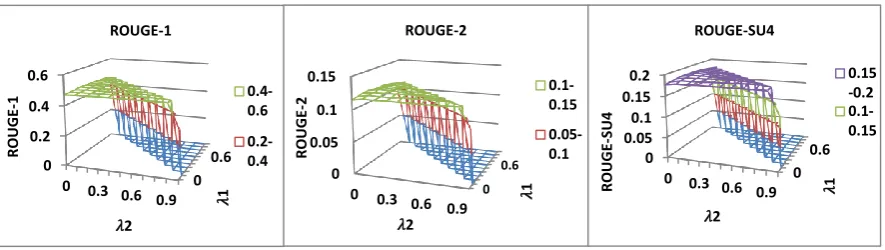
Figure 3 presents the fluctuation of ROUGE
scores when tuning the parameters λ1, λ2 and λ3.
We can see our method generally performs better than the baselines. All the three parts in the ob-jective function are useful to generate related work sections with good quality.
The average scores rated by human judges for each method are showed in Table 5. We can see that the related work sections generated by our system are more related to the target papers. Moreover, because of the good structure of our generated related work sections, our generated related work sections are considered more reada-ble and more useful for the author to prepare the final related work sections.
T-test results show that the performance im-provements of our method over baselines are statistically significant on both automatic and manual evaluations. Most of p-values for t-test are far smaller than 0.01.
Overall, the results indicate that our method can generate much better related work sections
0 0.6 0
0.2 0.4 0.6
0
0.3 0.6 0.9 𝜆1
R
O
U
G
E-1
𝜆2 ROUGE-1
0.4-0.6
0.2-0.4
0 0.6 0
0.05 0.1 0.15
0
0.3 0.6 0.9 𝜆1
R
O
U
G
E-2
𝜆2 ROUGE-2
0.1-0.15
0.05-0.1
0 0.6 0
0.05 0.1 0.15 0.2
0
0.3 0.6 0.9 𝜆1
R
O
U
G
E-SU4
𝜆2 ROUGE-SU4
[image:8.595.74.517.78.203.2]0.15 -0.2 0.1-0.15
than the baselines on both automatic and human evaluations.
Table 6 shows the comparison results between ARWG and RWGOF. We can see ARWG per-forms better than RWGOF. It proves that the SVR models can better estimate the importance scores of the sentences. For the SVR models are trained from the large dataset, the sentence scores predicted by the SVR models can be more reliable to be used in the global optimization framework.
6
Conclusion and Future Work
This paper proposes a novel system called ARWG to generate related work sections for ac-ademic papers. It first exploits a PLSA model to split the sentence set of the given papers into dif-ferent topic-biased parts, and then applies regres-sion models to learn the importance scores of the sentences. At last an optimization framework is proposed to generate the related work section. Evaluation results show that our system can gen-erate much better related work sections than the baseline methods.
In future work, we will make use of citation sentences to improve our system. Citation sen-tences are the sensen-tences that contains an explicit reference to another paper and they usually high-light the most important aspects of the cited pa-pers. So citation sentences are likely to contain important and rich information for generating related work sections.
Acknowledgments
The work was supported by National Natural Science Foundation of China (61170166, 61331011), Beijing Nova Program (2008B03) and National Hi-Tech Research and Develop-ment Program (863 Program) of China (2012AA011101). We also thank the anonymous reviewers for very helpful comments. The corre-sponding author of this paper, according to the meaning given to this role by Peking University, is Xiaojun Wan.
Reference
Nitin Agarwal, Kiran Gvr, Ravi Shankar Reddy, and Carolyn Penstein Rosé. 2011. Towards multi-document summarization of scientific articles: making interesting comparisons with SciSumm. In Proceedings of the Workshop on Automatic Summarization for Different Genres, Media, and Languages, pp. 8-15. Association for Computa-tional Linguistics.
Phyllis B. Baxendale. 1958. Machine-made index for technical literature: an experiment. IBM Journal of Research and Development 2, no. 4: 354-361.
Taylor Berg-Kirkpatrick, Dan Gillick, and Dan Klein. 2011. Jointly learning to extract and compress. In Proceedings of the 49th Annual Meeting of the Association for Computational Linguistics: Human Language Technologies-Volume 1, pp. 481-490. Association for Computational Linguistics.
Chih-Chung Chang, and Chih-Jen Lin. 2011. LIBSVM: a library for support vector ma-chines. ACM Transactions on Intelligent Systems and Technology (TIST) 2, no. 3: 27.
John M. Conroy, and Dianne P. O'leary. 2001. Text
summarization via hidden markov models.
In Proceedings of the 24th annual international ACM SIGIR conference on Research and develop-ment in information retrieval, pp. 406-407. ACM.
Harold P. Edmundson. 1969. New methods in auto-matic extracting. Journal of the ACM (JACM) 16, no. 2: 264-285.
Günes Erkan, and Dragomir R. Radev. 2004. LexPag-eRank: Prestige in Multi-Document Text Summa-rization. In EMNLP, vol. 4, pp. 365-371.
Günes Erkan, and Dragomir R. Radev. 2004. LexRank: Graph-based lexical centrality as sali-ence in text summarization. J. Artif. Intell. Res.(JAIR) 22, no. 1: 457-479.
Dimitrios Galanis, Gerasimos Lampouras, and Ion
Androutsopoulos. 2012. Extractive
Multi-Document Summarization with Integer Linear Pro-gramming and Support Vector Regression. In COLING, pp. 911-926.
Dimitrios Galanis, and Prodromos Malakasiotis. 2008. Aueb at tac 2008. InProceedings of the TAC 2008 Workshop.
Dan Gillick, and Benoit Favre. 2009. A scalable glob-al model for summarization. InProceedings of the Workshop on Integer Linear Programming for Natural Langauge Processing, pp. 10-18. Associa-tion for ComputaAssocia-tional Linguistics.
Cong Duy Vu Hoang, and Min-Yen Kan. 2010. To-wards automated related work summarization. In Proceedings of the 23rd International Confer-ence on Computational Linguistics: Posters, pp. 427-435. Association for Computational Linguis-tics.
Thomas Hofmann. 1999. Probabilistic latent semantic indexing. In Proceedings of the 22nd annual inter-national ACM SIGIR conference on Research and development in information retrieval, pp. 50-57. ACM.
Chin-Yew Lin. 2004. Rouge: A package for automatic evaluation of summaries. InText Summarization Branches Out: Proceedings of the ACL-04 Work-shop, pp. 74-81.
Hans Peter Luhn. 1958. The automatic creation of literature abstracts. IBM Journal of research and development 2, no. 2: 159-165.
Inderjeet Mani, and Eric Bloedorn. 1999. Summariz-ing similarities and differences among related doc-uments. Information Retrieval 1, no. 1-2: 35-67.
Ryan McDonald. 2007. A study of global inference algorithms in multi-document summarization. Springer Berlin Heidelberg.
Qiaozhu Mei, and ChengXiang Zhai. 2008. Generat-ing Impact-Based Summaries for Scientific Litera-ture. In ACL, vol. 8, pp. 816-824.
Rada Mihalcea, and Paul Tarau. 2005. A language independent algorithm for single and multiple doc-ument summarization.
Rada Mihalcea, and Hakan Ceylan. 2007.
Explora-tions in Automatic Book Summarization.
In EMNLP-CoNLL, pp. 380-389.
Saif Mohammad, Bonnie Dorr, Melissa Egan, Ahmed Hassan, Pradeep Muthukrishan, Vahed Qazvinian, Dragomir Radev, and David Zajic. 2009. Using ci-tations to generate surveys of scientific paradigms. In Proceedings of Human Language Technologies: The 2009 Annual Conference of the North Ameri-can Chapter of the Association for Computational Linguistics, pp. 584-592. Association for Computa-tional Linguistics.
Preslav Nakov, Ariel Schwartz, and M. Hearst. 2004. Citation sentences for semantic analysis of biosci-ence text. In Proceedings of the SIGIR'04 work-shop on Search and Discovery in Bioinformatics.
Ramesh M. Nallapati, Amr Ahmed, Eric P. Xing, and William W. Cohen. 2008. Joint latent topic models for text and citations. In Proceedings of the 14th ACM SIGKDD international conference on Knowledge discovery and data mining, pp. 542-550. ACM.
Vahed Qazvinian, and Dragomir R. Radev. 2008. Sci-entific paper summarization using citation sum-mary networks. In Proceedings of the 22nd Inter-national Conference on Computational Linguistics-Volume 1, pp. 689-696. Association for Computa-tional Linguistics.
You Ouyang, Sujian Li, and Wenjie Li. 2007. Devel-oping learning strategies for topic-based
summari-zation. In Proceedings of the sixteenth ACM con-ference on Concon-ference on information and knowledge management, pp. 79-86. ACM.
Dragomir Radev, Timothy Allison, Sasha Blair-Goldensohn, John Blitzer, Arda Celebi, Stanko Dimitrov, Elliott Drabek et al. 2004. MEAD-a plat-form for multidocument multilingual text summa-rization. Proceedings of the 4th International Con-ference on Language Resources and Evaluation (LREC 2004).
Ariel S. Schwartz, and Marti Hearst. 2006. Summariz-ing key concepts usSummariz-ing citation sentences. In Proceedings of the Workshop on Linking Natu-ral Language Processing and Biology: Towards Deeper Biological Literature Analysis, pp. 134-135. Association for Computational Linguistics.
Dou Shen, Jian-Tao Sun, Hua Li, Qiang Yang, and Zheng Chen. 2007. Document Summarization Us-ing Conditional Random Fields. In IJCAI, vol. 7, pp. 2862-2867.
Andreas Stolcke, Klaus Ries, Noah Coccaro, Eliza-beth Shriberg, Rebecca Bates, Daniel Jurafsky, Paul Taylor, Rachel Martin, Carol Van Ess-Dykema, and Marie Meteer. 2000. Dialogue act modeling for automatic tagging and recognition of conversational speech. Computational linguis-tics 26, no. 3: 339-373.
Kristian Woodsend, and Mirella Lapata. 2012. Multi-ple aspect summarization using integer linear pro-gramming. In Proceedings of the 2012 Joint Con-ference on Empirical Methods in Natural Lan-guage Processing and Computational Natural Language Learning, pp. 233-243. Association for Computational Linguistics.
Shasha Xie, Benoit Favre, Dilek Hakkani-Tür, and Yang Liu. 2009. Leveraging sentence weights in a concept-based optimization framework for extrac-tive meeting summarization. In INTERSPEECH, pp. 1503-1506.
Hui Yang, and Jamie Callan. 2009. A metric-based framework for automatic taxonomy induction. In Proceedings of the Joint Conference of the 47th Annual Meeting of the ACL and the 4th Interna-tional Joint Conference on Natural Language Pro-cessing of the AFNLP: Volume 1-Volume 1, pp. 271-279. Association for Computational Linguis-tics.