Effects of Empty Categories on Machine Translation
Tagyoung Chung and Daniel Gildea
Department of Computer Science University of Rochester
Rochester, NY 14627
Abstract
We examine effects that empty categories have on machine translation. Empty categories are elements in parse trees that lack corresponding overt surface forms (words) such as dropped pronouns and markers for control construc-tions. We start by training machine trans-lation systems with manually inserted empty elements. We find that inclusion of some empty categories in training data improves the translation result. We expand the experiment by automatically inserting these elements into a larger data set using various methods and training on the modified corpus. We show that even when automatic prediction of null ele-ments is not highly accurate, it nevertheless improves the end translation result.
1 Introduction
An empty category is an element in a parse tree that does not have a corresponding surface word. They include traces such as Wh-traces which indi-cate movement operations in interrogative sentences and dropped pronouns which indicate omission of pronouns in places where pronouns are normally expected. Many treebanks include empty nodes in parse trees to represent non-local dependencies or dropped elements. Examples of the former include traces such as relative clause markers in the Penn Treebank (Bies et al., 1995). An example of the lat-ter include dropped pronouns in the Korean bank (Han and Ryu, 2005) and the Chinese Tree-bank (Xue and Xia, 2000).
In languages such as Chinese, Japanese, and Ko-rean, pronouns are frequently or regularly dropped
when they are pragmatically inferable. These lan-guages are calledpro-droplanguages. Dropped pro-nouns are quite a common phenomenon in these lan-guages. In the Chinese Treebank, they occur once in every four sentences on average. In Korean the Treebank, they are even more frequent, occurring in almost every sentence on average. Translating these pro-drop languages into languages such as En-glish where pronouns are regularly retained could be problematic because English pronouns have to be generated from nothing.
There are several different strategies to counter this problem. A special NULL word is typically used when learning word alignment (Brown et al., 1993). Words that have non-existent counterparts can be aligned to the NULLword. In phrase-based translation, the phrase learning system may be able to learn pronouns as a part of larger phrases. If the learned phrases include pronouns on the target side that are dropped from source side, the system may be able to insert pronouns even when they are miss-ing from the source language. This is an often ob-served phenomenon in phrase-based translation sys-tems. Explicit insertion of missing words can also be included in syntax-based translation models (Ya-mada and Knight, 2001). For the closely related problem of inserting grammatical function particles in English-to-Korean and English-to-Japanese ma-chine translation, Hong et al. (2009) and Isozaki et al. (2010) employ preprocessing techniques to add special symbols to the English source text.
In this paper, we examine a strategy of automat-ically inserting two types of empty elements from the Korean and Chinese treebanks as a
Korean
*T* 0.47 trace of movement
(NP *pro*) 0.88 dropped subject or object (WHNP *op*) 0.40 empty operator in relative
constructions
*?* 0.006 verb deletion, VP ellipsis, and others
Chinese
(XP (-NONE- *T*)) 0.54 trace of A’-movement (NP (-NONE- *)) 0.003 trace of A-movement (NP (-NONE- *pro*)) 0.27 dropped subject or object (NP (-NONE- *PRO*)) 0.31 control structures (WHNP (-NONE- *OP*)) 0.53 empty operator in relative
[image:2.612.75.304.52.249.2]constructions (XP (-NONE- *RNR*)) 0.026 right node raising (XP (-NONE- *?*)) 0 others
Table 1: List of empty categories in the Korean Treebank (top) and the Chinese Treebank (bottom) and their per-sentence frequencies in the training data of initial experi-ments.
ing step. We first describe our experiments with data that have been annotated with empty categories, fo-cusing on zero pronouns and traces such as those used in control constructions. We use these an-notations to insert empty elements in a corpus and train a machine translation system to see if they im-prove translation results. Then, we illustrate differ-ent methods we have devised to automatically insert empty elements to corpus. Finally, we describe our experiments with training machine translation sys-tems with corpora that are automatically augmented with empty elements. We conclude this paper by discussing possible improvements to the different methods we describe in this paper.
2 Initial experiments
2.1 Setup
We start by testing the plausibility of our idea of preprocessing corpus to insert empty cate-gories with ideal datasets. The Chinese Treebank (LDC2005T01U01) is annotated with null elements and a portion of the Chinese Treebank has been translated into English (LDC2007T02). The Korean Treebank version 1.0 (LDC2002T26) is also anno-tated with null elements and includes an English translation. We extract null elements along with tree terminals (words) and train a simple
phrase-BLEU Chi-Eng No null elements 19.31
w/ *pro* 19.68
w/ *PRO* 19.54
w/ *pro* and *PRO* 20.20 w/ all null elements 20.48
Kor-Eng No null elements 20.10
w/ *pro* 20.37
w/ all null elements 19.71
Table 2: BLEU score result of initial experiments. Each experiment has different empty categories added in. *PRO* stands for the empty category used to mark con-trol structures and *pro* indicates dropped pronouns for both Chinese and Korean.
based machine translation system. Both datasets have about 5K sentences and 80% of the data was used for training, 10% for development, and 10% for testing.
We used Moses (Koehn et al., 2007) to train machine translation systems. Default parameters were used for all experiments. The same number of GIZA++ (Och and Ney, 2003) iterations were used for all experiments. Minimum error rate train-ing (Och, 2003) was run on each system afterwards, and the BLEU score (Papineni et al., 2002) was cal-culated on the test sets.
There are several different empty categories in the different treebanks. We have experimented with leaving in and out different empty categories for dif-ferent experiments to see their effect. We hypoth-esized that nominal phrasal empty categories such as dropped pronouns may be more useful than other ones, since they are the ones that may be missing in the source language (Chinese and Korean) but have counterparts in the target (English). Table 1 summa-rizes empty categories in Chinese and Korean tree-bank and their frequencies in the training data.
2.2 Results
[image:2.612.328.524.55.181.2]in-word P(e| ∗pro∗) word P(e| ∗PRO∗)
the 0.18 to 0.45
i 0.13 NULL 0.10
it 0.08 the 0.02
to 0.08 of 0.02
they 0.05 as 0.02
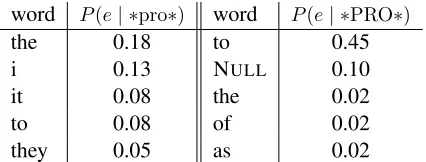
Table 3: A lexical translation table from the Korean-English translation system (left) and a lexical transla-tion from the Chinese-English translatransla-tion system (right). For the Korean-English lexical translation table, the left column is English words that are aligned to a dropped pronoun (*pro*) and the right column is the conditional probability of P(e | ∗pro∗). For the Chinese-English lexical translation table, the left column is English words that are aligned to a control construction marker (*PRO*) and the right column is the conditional probability of
P(e| ∗PRO∗).
ferable pronouns, helped to improve translation re-sults the most. For the Korean to English experi-ment, the dropped pronoun is the only empty cate-gory that seems to improve translation.
For the Korean to English experiment, we also tried annotating whether the dropped pronouns are a subject, an object, or a complement using informa-tion from the Treebank’s funcinforma-tion tags, since English pronouns are inflected according to case. However, this did not yield a very different result and in fact was slightly worse. This is possibly due to data spar-sity created when dropped pronouns are annotated. Dropped pronouns in subject position were the over-whelming majority (91%), and there were too few dropped pronouns in object position to learn good parameters.
2.3 Analysis
Table 3 and Table 4 give us a glimpse of why having these empty categories may lead to better transla-tion. Table 3 is the lexical translation table for the dropped pronoun (*pro*) from the Korean to En-glish experiment and the marker for control con-structions (*PRO*) from the Chinese to English ex-periment. For the dropped pronoun in the Korean to English experiment, although there are errors, the table largely reflects expected translations of a dropped pronoun. It is possible that the system is in-serting pronouns in right places that would be miss-ing otherwise. For the control construction marker
[image:3.612.80.293.54.135.2]in the Chinese to English experiment, the top trans-lation for *PRO* is the English wordto, which is ex-pected since Chinese clauses that have control con-struction markers often translate to English as to-infinitives. However, as we discuss in the next para-graph, the presence of control construction markers may affect translation results in more subtle ways when combined with phrase learning.
Table 4 shows how translations from the system trained with null elements and the system trained without null elements differ. The results are taken from the test set and show extracts from larger sen-tences. Chinese verbs that follow the empty node for control constructions (*PRO*) are generally trans-lated to English as a verb in to-infinitive form, a gerund, or a nominalized verb. The translation re-sults show that the system trained with this null el-ement (*PRO*) translates verbs that follow the null element largely in such a manner. However, it may not be always closest to the reference. It is exempli-fied by the translation of one phrase.
Experiments in this section showed that prepro-cessing the corpus to include some empty elements can improve translation results. We also identified which empty categories maybe helpful for improv-ing translation for different language pairs. In the next section, we focus on how we add these ele-ments automatically to a corpus that is not annotated with empty elements for the purpose of preprocess-ing corpus for machine translation.
3 Recovering empty nodes
There are a few previous works that have attempted restore empty nodes for parse trees using the Penn English Treebank. Johnson (2002) uses rather sim-ple pattern matching to restore empty categories as well as their co-indexed antecedents with surpris-ingly good accuracy. Gabbard et al. (2006) present a more sophisticated algorithm that tries to recover empty categories in several steps. In each step, one or more empty categories are restored using pat-terns or classifiers (five maximum-entropy and two perceptron-based classifiers to be exact).
Chinese English Reference System trained w/ nulls System trained w/o nulls *PRO*贯彻 implementing implementation implemented
[image:4.612.64.539.53.104.2]*PRO*逐步形成 have gradually formed to gradually form gradually formed *PRO*吸引外资作为 attracting foreign investment attracting foreign investment attract foreign capital
Table 4: The first column is a Chinese word or a phrase that immediately follows empty node marker for Chinese control constructions. The second column is the English reference translation. The third column is the translation output from the system that is trained with the empty categories added in. The fourth column is the translation output from the system trained without the empty categories added, which was given the test set without the empty categories. Words or phrases and their translations presented in the table are part of larger sentences.
a couple of empty categories that would help ma-chine translation. Third, we are not interested in re-covering antecedents. The linguistic differences and the empty categories we are interested in recovering made the task much harder than it is for English. We will discuss this in more detail later.
From this section on, we will discuss only Chinese-English translation because Chinese presents a much more interesting case, since we need to recover two different empty categories that are very similarly distributed. Data availability was also a consideration since much larger datasets (bilingual and monolingual) are available for Chinese. The Korean Treebank has only about 5K sentences, whereas the version of Chinese Treebank we used includes 28K sentences.
The Chinese Treebank was used for all experi-ments that are mentioned in the rest of this Section. Roughly 90% of the data was used for the training set, and the rest was used for the test set. As we have discussed in Section 2, we are interested in recover-ing dropped pronouns (*pro*) and control construc-tion markers (*PRO*). We have tried three different relatively simple methods so that recovering empty elements would not require any special infrastruc-ture.
3.1 Pattern matching
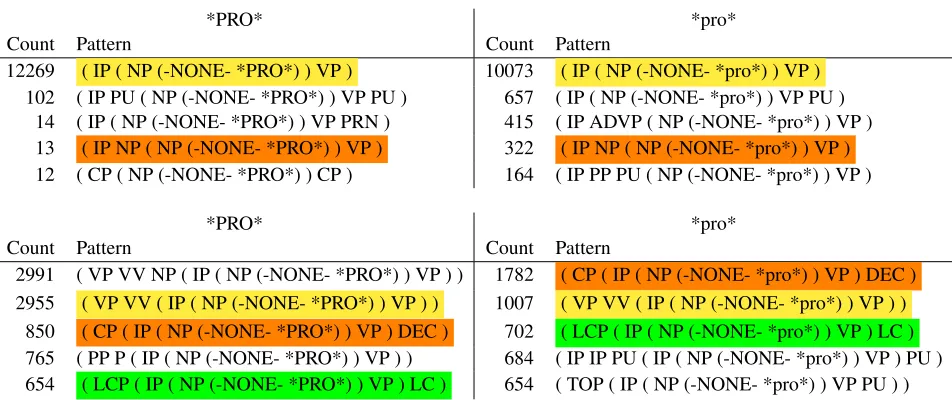
Johnson (2002) defines a pattern for empty node re-covery to be a minimally connected tree fragment containing an empty node and all nodes co-indexed with it. Figure 1 shows an example of a pattern. We extracted patterns according this definition, and it became immediately clear that the same definition that worked for English will not work for Chinese. Table 5 shows the top five patterns that match con-trol constructions (*PRO*) and dropped pronouns (*pro*). The top pattern that matches *pro* and
*PRO* are both exactly the same, since the pat-tern will be matched against parse trees where empty nodes have been deleted.
When it became apparent that we cannot use the same definition of patterns to successfully restore empty categories, we added more context to the pat-terns. Patterns needed more context for them to be able to disambiguate between sites that need to be inserted with *pro*s and sites that need to be in-serted with *PRO*s. Instead of using minimal tree fragments that matched empty categories, we in-cluded the parent and siblings of the minimal tree fragment in the pattern (pattern matching method 1). This way, we gained more context. However, as can be seen in Table 5, there is still a lot of over-lap between patterns for the two empty categories. However, it is more apparent that at least we can choose the pattern that will maximize matches for one empty category and then discard that pattern for the other empty category.
IP
NP-SBJ
-NONE-*pro*
VP
VV
谢谢
NP-OBJ
PN
各位 PU
。
→ IP
VP
VV
谢谢
NP-OBJ
PN
各位 PU
。
[image:5.612.173.469.98.261.2](IP (NP-SBJ (-NONE- *pro*)) VP PU) (IP VP PU)
Figure 1: An example of a tree with an empty node (left), the tree stripped of an empty node (right), and a pattern that matches the example. Sentences are parsed without empty nodes and if a tree fragment (IP VP PU) is encountered in a parse tree, the empty node may be inserted according to the learned pattern (IP (NP-SBJ (-NONE- *pro*)) VP PU).
*PRO* *pro*
Count Pattern Count Pattern
12269 ( IP ( NP (-NONE- *PRO*) ) VP ) 10073 ( IP ( NP (-NONE- *pro*) ) VP ) 102 ( IP PU ( NP (-NONE- *PRO*) ) VP PU ) 657 ( IP ( NP (-NONE- *pro*) ) VP PU )
14 ( IP ( NP (-NONE- *PRO*) ) VP PRN ) 415 ( IP ADVP ( NP (-NONE- *pro*) ) VP ) 13 ( IP NP ( NP (-NONE- *PRO*) ) VP ) 322 ( IP NP ( NP (-NONE- *pro*) ) VP ) 12 ( CP ( NP (-NONE- *PRO*) ) CP ) 164 ( IP PP PU ( NP (-NONE- *pro*) ) VP )
*PRO* *pro*
Count Pattern Count Pattern
2991 ( VP VV NP ( IP ( NP (-NONE- *PRO*) ) VP ) ) 1782 ( CP ( IP ( NP (-NONE- *pro*) ) VP ) DEC ) 2955 ( VP VV ( IP ( NP (-NONE- *PRO*) ) VP ) ) 1007 ( VP VV ( IP ( NP (-NONE- *pro*) ) VP ) )
850 ( CP ( IP ( NP (-NONE- *PRO*) ) VP ) DEC ) 702 ( LCP ( IP ( NP (-NONE- *pro*) ) VP ) LC ) 765 ( PP P ( IP ( NP (-NONE- *PRO*) ) VP ) ) 684 ( IP IP PU ( IP ( NP (-NONE- *pro*) ) VP ) PU ) 654 ( LCP ( IP ( NP (-NONE- *PRO*) ) VP ) LC ) 654 ( TOP ( IP ( NP (-NONE- *pro*) ) VP PU ) )
[image:5.612.77.553.402.602.2]training data.
After the patterns are extracted, we performed pruning similar to the pruning that was done by Johnson (2002). The patterns that have less than 50% chance of matching are discarded. For exam-ple, if (IP VP) occurs one hundred times in a tree-bank that is stripped of empty nodes and if pattern (IP (NP (-NONE- *PRO*)) VP) occurs less than fifty times in the same treebank that is annotated with empty nodes, it is discarded.1 We also found that we can discard patterns that occur very rarely (that occur only once) without losing much accu-racy. In cases where there was an overlap between two empty categories, the pattern was chosen for either *pro* or *PRO*, whichever that maximized the number of matchings and then discarded for the other.
3.2 Conditional random field
We tried building a simple conditional random field (Lafferty et al., 2001) to predict null elements. The model examines each and every word boundary and decides whether to leave it as it is, insert *pro*, or insert *PRO*. The obvious disadvantage of this method is that if there are two consecutive null el-ements, it will miss at least one of them. Although there were some cases like this in the treebank, they were rare enough that we decided to ignore them. We first tried using only differently sized local win-dows of words as features (CRF model 1). We also experimented with adding the part-of-speech tags of words as features (CRF model 2). Finally, we exper-imented with a variation where the model is given each word and its part-of-speech tag and its imme-diate parent node as features (CRF model 3).
We experimented with using different regulariza-tions and different values for regularizaregulariza-tions but it did not make much difference in the final results. The numbers we report later usedL2regularization.
3.3 Parsing
In this approach, we annotated nonterminal symbols in the treebank to include information about empty categories and then extracted a context free gram-mar from the modified treebank. We parsed with the modified grammar, and then deterministically
re-1See Johnson (2002) for more details.
*PRO* *pro*
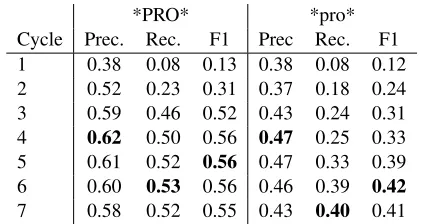
[image:6.612.322.534.53.165.2]Cycle Prec. Rec. F1 Prec Rec. F1 1 0.38 0.08 0.13 0.38 0.08 0.12 2 0.52 0.23 0.31 0.37 0.18 0.24 3 0.59 0.46 0.52 0.43 0.24 0.31 4 0.62 0.50 0.56 0.47 0.25 0.33 5 0.61 0.52 0.56 0.47 0.33 0.39 6 0.60 0.53 0.56 0.46 0.39 0.42 7 0.58 0.52 0.55 0.43 0.40 0.41
Table 6: Result using the grammars output by the Berke-ley state-splitting grammar trainer to predict empty cate-gories
covered the empty categories from the trees. Fig-ure 2 illustrates how the trees were modified. For every empty node, the most immediate ancestor of the empty node that has more than one child was an-notated with information about the empty node, and the empty node was deleted. We annotated whether the deleted empty node was *pro* or *PRO* and where it was deleted. Adding where the child was necessary because, even though most empty nodes are the first child, there are many exceptions.
We first extracted a plain context free grammar af-ter modifying the trees and used the modified gram-mar to parse the test set and then tried to recover the empty elements. This approach did not work well. We then applied the latent annotation learning pro-cedures of Petrov et al. (2006)2 to refine the non-terminals in the modified grammar. This has been shown to help parsing in many different situations. Although the state splitting procedure is designed to maximize the likelihood of of the parse trees, rather than specifically to predict the empty nodes, learning a refined grammar over modified trees was also ef-fective in helping to predict empty nodes. Table 6 shows the dramatic improvement after each split, merge, and smoothing cycle. The gains leveled off after the sixth iteration and the sixth order grammar was used to run later experiments.
3.4 Results
Table 7 shows the results of our experiments. The numbers are very low when compared to accuracy reported in other works that were mentioned in the beginning of this Section, which dealt with the Penn English Treebank. Dropped pronouns are especially
IP
NP-SBJ
-NONE-*pro*
VP
VV
谢谢
NP-OBJ
PN
各位 PU
。
→ SPRO0IP
VP
VV
谢谢
NP-OBJ
PN
各位 PU
[image:7.612.180.471.58.190.2]。
Figure 2: An example of tree modification
*PRO* *pro*
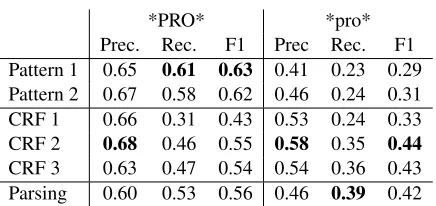
Prec. Rec. F1 Prec Rec. F1 Pattern 1 0.65 0.61 0.63 0.41 0.23 0.29 Pattern 2 0.67 0.58 0.62 0.46 0.24 0.31 CRF 1 0.66 0.31 0.43 0.53 0.24 0.33 CRF 2 0.68 0.46 0.55 0.58 0.35 0.44 CRF 3 0.63 0.47 0.54 0.54 0.36 0.43 Parsing 0.60 0.53 0.56 0.46 0.39 0.42
Table 7: Result of recovering empty nodes
hard to recover. However, we are dealing with a dif-ferent language and difdif-ferent kinds of empty cate-gories. Empty categories recovered this way may still help translation. In the next section, we take the best variation of the each method use it to add empty categories to a training corpus and train machine translation systems to see whether having empty cat-egories can help improve translation in more realis-tic situations.
3.5 Analysis
The results reveal many interesting aspects about re-covering empty categories. The results suggest that tree structures are important features for finding sites where markers for control constructions (*PRO*) have been deleted. The method utilizing patterns that have more information about tree structure of these sites performed better than other methods. The fact that the method using parsing was better at pre-dicting *PRO*s than the methods that used the con-ditional random fields also corroborates this finding. For predicting dropped pronouns, the method using the CRFs did better than the others. This suggests that rather than tree structure, local context of words
and part-of-speech tags maybe more important fea-tures for predicting dropped pronouns. It may also suggest that methods using robust machine learning techniques are better outfitted for predicting dropped pronouns.
It is interesting to note how effective the parser was at predicting empty categories. The method us-ing the parser requires the least amount of supervi-sion. The method using CRFs requires feature de-sign, and the method that uses patterns needs hu-man decisions on what the patterns should be and pruning criteria. There is also room for improve-ment. The split-merge cycles learn grammars that produce better parse trees rather than grammars that predict empty categories more accurately. By modi-fying this learning process, we may be able to learn grammars that are better suited for predicting empty categories.
4 Experiments
4.1 Setup
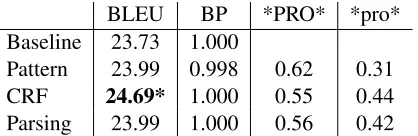
[image:7.612.79.297.226.329.2]train-BLEU BP *PRO* *pro* Baseline 23.73 1.000
Pattern 23.99 0.998 0.62 0.31
CRF 24.69* 1.000 0.55 0.44
Parsing 23.99 1.000 0.56 0.42
Table 8: Final BLEU score result. The asterisk indicates statistical significance atp < 0.05with 1000 iterations of paired bootstrap resampling. BP stands for the brevity penalty in BLEU. F1 scores for recovering empty cate-gories are repeated here for comparison.
ing, development, and test sets to insert empty nodes for each experiment. The baseline system was also trained using the raw data.
We used Moses (Koehn et al., 2007) to train machine translation systems. Default parameters were used for all experiments. The same number of GIZA++ (Och and Ney, 2003) iterations were used for all experiments. Minimum error rate train-ing (Och, 2003) was run on each system afterwards and the BLEU score (Papineni et al., 2002) was cal-culated on the test set.
[image:8.612.85.294.54.122.2]4.2 Results
Table 8 summarizes our results. Generally, all sys-tems produced BLEU scores that are better than the baseline, but the best BLEU score came from the system that used the CRF for null element insertion. The machine translation system that used training data from the method that was overall the best in predicting empty elements performed the best. The improvement is 0.96 points in BLEU score, which represents statistical significance atp <0.002based on 1000 iterations of paired bootstrap resampling (Koehn, 2004). Brevity penalties applied for cal-culating BLEU scores are presented to demonstrate that the baseline system is not penalized for produc-ing shorter sentences compared other systems.3
The BLEU scores presented in Table 8 represent the best variations of each method we have tried for recovering empty elements. Although the dif-ference was small, when the F1 score were same for two variations of a method, it seemed that we could get slightly better BLEU score with the varia-tion that had higher recall for recovering empty
ele-3
We thank an anonymous reviewer for tipping us to examine the brevity penalty.
ments rather the variation with higher precision. We tried a variation of the experiment where the CRF method is used to recover *pro* and the pattern matching is used to recover *PRO*, since these rep-resent the best methods for recovering the respective empty categories. However, it was not as successful as we thought would be. The resulting BLEU score from the experiment was 24.24, which is lower than the one that used the CRF method to recover both *pro* and *PRO*. The problem was we used a very naïve method of resolving conflict between two dif-ferent methods. The CRF method identified 17463 sites in the training data where *pro* should be added. Of these sites, the pattern matching method guessed 2695 sites should be inserted with *PRO* rather than *pro*, which represent more than 15% of total sites that the CRF method decided to in-sert *pro*. In the aforementioned experiment, wher-ever there was a conflict, both *pro* and *PRO* were inserted. This probably lead the experiment to have worse result than using only the one best method. This experiment suggest that more sophisti-cated methods should be considered when resolving conflicts created by using heterogeneous methods to recover different empty categories.
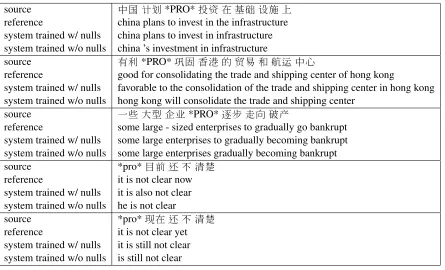
Table 9 shows five example translations of source sentences in the test set that have one of the empty categories. Since empty categories have been auto-matically inserted, they are not always in the cor-rect places. The table includes the translation results from the baseline system where the training and test sets did not have empty categories and the transla-tion results from the system (the one that used the CRF) that is trained on an automatically augmented corpus and given the automatically augmented test set.
5 Conclusion
In this paper, we have showed that adding some empty elements can help building machine transla-tion systems. We showed that we can still benefit from augmenting the training corpus with empty el-ements even when empty element prediction is less than what would be conventionally considered ro-bust.
sophisti-source 中国计划*PRO*投资在 基础设施上 reference china plans to invest in the infrastructure system trained w/ nulls china plans to invest in infrastructure system trained w/o nulls china ’s investment in infrastructure
source 有利*PRO*巩固香港的贸易和航运中心
reference good for consolidating the trade and shipping center of hong kong
system trained w/ nulls favorable to the consolidation of the trade and shipping center in hong kong system trained w/o nulls hong kong will consolidate the trade and shipping center
source 一些大型企业*PRO*逐步走向破产
reference some large - sized enterprises to gradually go bankrupt system trained w/ nulls some large enterprises to gradually becoming bankrupt system trained w/o nulls some large enterprises gradually becoming bankrupt source *pro*目前还不清楚
reference it is not clear now system trained w/ nulls it is also not clear system trained w/o nulls he is not clear
[image:9.612.88.533.52.322.2]source *pro*现在还不清楚 reference it is not clear yet system trained w/ nulls it is still not clear system trained w/o nulls is still not clear
Table 9: Sample translations. The system trained without nulls is the baseline system where the training corpus and test corpus did not have empty categories. The system trained with nulls is the system trained with the training corpus and the test corpus that have been automatically augmented with empty categories. All examples are part of longer sentences.
cated methods, perhaps resembling the work of Gab-bard et al. (2006) may be necessary for more accu-rate recovery of empty elements. We can also con-sider simpler methods where different algorithms are used for recovering different empty elements, in which case, we need to be careful about how recov-ering different empty elements could interact with each other as exemplified by our discussion of the pattern matching algorithm in Section 3 and our ex-periment presented in Section 4.2.
There are several other issues we may consider when recovering empty categories that are miss-ing in the target language. We only considered empty categories that are present in treebanks. How-ever, there might be some empty elements which are not annotated but nevertheless helpful for improv-ing machine translation. As always, preprocessimprov-ing the corpus to address a certain problem in machine translation is less principled than tackling the prob-lem head on by integrating it into the machine trans-lation system itself. It may be beneficial to include consideration for empty elements in the decoding process, so that it can benefit from interacting with
other elements of the machine translation system.
Acknowledgments We thank the anonymous re-viewers for their helpful comments. This work was supported by NSF grants 0546554 and IIS-0910611.
References
Ann Bies, Mark Ferguson, Karen Katz, and Robert Mac-Intyre. 1995. Bracketing guidelines for treebank II style. Penn Treebank Project, January.
Peter F. Brown, Stephen A. Della Pietra, Vincent J. Della Pietra, and Robert L. Mercer. 1993. The mathematics of statistical machine translation: Parameter estima-tion. Computational Linguistics, 19(2):263–311. Pi-Chuan Chang, Michel Galley, and Christopher
Man-ning. 2008. Optimizing Chinese word segmentation for machine translation performance. InProceedings of the Third Workshop on Statistical Machine Transla-tion, pages 224–232.
City, USA, June. Association for Computational Lin-guistics.
Na-Rae Han and Shijong Ryu. 2005. Guidelines for Penn Korean Treebank version 2.0. Technical report, IRCS, University of Pennsylvania.
Gumwon Hong, Seung-Wook Lee, and Hae-Chang Rim. 2009. Bridging morpho-syntactic gap between source and target sentences for English-Korean statistical ma-chine translation. InProceedings of the ACL-IJCNLP 2009 Conference Short Papers, pages 233–236. Hideki Isozaki, Katsuhito Sudoh, Hajime Tsukada, and
Kevin Duh. 2010. Head finalization: A simple re-ordering rule for sov languages. InProceedings of the Joint Fifth Workshop on Statistical Machine Transla-tion and Metrics, pages 244–251.
Mark Johnson. 2002. A simple pattern-matching al-gorithm for recovering empty nodes and their an-tecedents. InProceedings of the 40th Annual Confer-ence of the Association for Computational Linguistics (ACL-02), Philadelphia, PA.
Philipp Koehn, Hieu Hoang, Alexandra Birch, Chris Callison-Burch, Marcello Federico, Nicola Bertoldi, Brooke Cowan, Wade Shen, Christine Moran, Richard Zens, Chris Dyer, Ondrej Bojar, Alexandra Con-stantin, and Evan Herbst. 2007. Moses: Open source toolkit for statistical machine translation. In Proceed-ings of ACL, Demonstration Session, pages 177–180. Philipp Koehn. 2004. Statistical significance tests for
machine translation evaluation. In 2004 Conference on Empirical Methods in Natural Language Process-ing (EMNLP), pages 388–395, Barcelona, Spain, July. John Lafferty, Andrew McCallum, and Fernando Pereira. 2001. Conditional random fields: Probabilistic mod-els for segmenting and labeling sequence data. In Ma-chine Learning: Proceedings of the Eighteenth Inter-national Conference (ICML 2001), Stanford, Califor-nia.
Franz Josef Och and Hermann Ney. 2003. A system-atic comparison of various statistical alignment mod-els. Computational Linguistics, 29(1):19–51.
Franz Josef Och. 2003. Minimum error rate training for statistical machine translation. InProceedings of the 41th Annual Conference of the Association for Com-putational Linguistics (ACL-03).
Kishore Papineni, Salim Roukos, Todd Ward, and Wei-Jing Zhu. 2002. BLEU: A method for automatic eval-uation of machine translation. InProceedings of the 40th Annual Conference of the Association for Com-putational Linguistics (ACL-02).
Slav Petrov, Leon Barrett, Romain Thibaux, and Dan Klein. 2006. Learning accurate, compact, and inter-pretable tree annotation. InProceedings of the 21st In-ternational Conference on Computational Linguistics
and 44th Annual Meeting of the Association for Com-putational Linguistics, pages 433–440, Sydney, Aus-tralia, July. Association for Computational Linguistics. Nianwen Xue and Fei Xia. 2000. The bracketing guide-lines for the Penn Chinese Treebank. Technical Report IRCS-00-08, IRCS, University of Pennsylvania. Kenji Yamada and Kevin Knight. 2001. A syntax-based