An Efficient Algorithm for Unsupervised Word Segmentation with
Branching Entropy and MDL
Valentin Zhikov
Interdisciplinary Graduate School of Science and Engineering Tokyo Institute of Technology
Hiroya Takamura
Precision and Intelligence Laboratory Tokyo Institute of Technology
Manabu Okumura
Precision and Intelligence Laboratory Tokyo Institute of Technology
Abstract
This paper proposes a fast and simple unsuper-vised word segmentation algorithm that uti-lizes the local predictability of adjacent char-acter sequences, while searching for a least-effort representation of the data. The model uses branching entropy as a means of con-straining the hypothesis space, in order to ef-ficiently obtain a solution that minimizes the length of a two-part MDL code. An evaluation with corpora in Japanese, Thai, English, and the ”CHILDES” corpus for research in lan-guage development reveals that the algorithm achieves an accuracy, comparable to that of the state-of-the-art methods in unsupervised word segmentation, in a significantly reduced computational time.
1 Introduction
As an inherent preprocessing step to nearly all NLP tasks for writing systems without orthographical marking of word boundaries, such as Japanese and Chinese, the importance of word segmentation has lead to the emergence of a micro-genre in NLP fo-cused exclusively on this problem.
Supervised probabilistic models such as Condi-tional Random Fields (CRF) (Lafferty et al., 2001) have a wide application to the morphological anal-ysis of these languages. However, the development of the annotated training corpora necessary for their
functioning is a labor-intensive task, which involves multiple stages of manual tagging. Because of the scarcity of labeled data, the domain adaptation of morphological analyzers is also problematic, and semi-supervised algorithms that address this issue have also been proposed (e.g. Liang, 2005; Tsuboi et al., 2008).
Recent advances in unsupervised word segmen-tation have been promoted by human cognition re-search, where it is involved in the modeling of the mechanisms that underlie language acquisition. An-other motivation to study unsupervised approaches is their potential to support the domain adaptation of morphological analyzers through the incorporation of unannotated training data, thus reducing the de-pendency on costly manual work. Apart from the considerable difficulties in discovering reliable cri-teria for word induction, the practical application of such approaches is impeded by their prohibitive computational cost.
In this paper, we address the issue of achiev-ing high accuracy in a practical computational time through an efficient method that relies on a combina-tion of evidences: the local predictability of charac-ter patcharac-terns, and the reduction of effort achieved by a given representation of the language data. Both of these criteria are assumed to play a key role in native language acquisition. The proposed model allows experimentation in a more realistic setting, where the learner is able to apply them simultaneously. The
method shows a high performance in terms of accu-racy and speed, can be applied to language samples of substantial length, and generalizes well to corpora in different languages.
2 Related Work
The principle of least effort (Zipf, 1949) postulates that the path of minimum resistance underlies all human behavior. Recent research has recognized its importance in the process of language acquisi-tion (Kit, 2003). Compression-based word induc-tion models comply to this principle, as they reor-ganize the data into a more compact representation while identifying the vocabulary of a text. The min-imum description length framework (MDL) (Ris-sanen, 1978) is an appealing means of formalizing such models, as it provides a robust foundation for learning and inference, based solely on compres-sion.
The major problem in MDL-based word segmen-tation is the lack of standardized search algorithms for the exponential hypothesis space (Goldwater, 2006). The representative MDL models compare favorably to the current state-of-the-art models in terms of accuracy. Brent and Cartwright (1996) car-ried out an exhaustive search through the possible segmentations of a limited subset of the data. Yu (2000) proposed an EM optimization routine, which achieved a high accuracy, in spite of a lower com-pression than the gold standard segmentation.
As a solution to the aforementioned issue, the pro-posed method incorporates the local predictability of character sequences into the inference process. Nu-merous studies have shown that local distributional cues can serve well the purpose of inducing word boundaries. Behavioral science has confirmed that infants are sensitive to the transitional probabilities found in speech (Saffran et al., 1996). The increase in uncertainty following a given word prefix is a well studied criterion for morpheme boundary pre-diction (Harris, 1955). A good deal of research has been conducted on methods through which such lo-cal statistics can be applied to the word induction problem (e.g. Kempe, 1999; Huang and Powers, 2003; Jin and Tanaka-Ishii, 2006). Hutchens and Adler (1998) noticed that entropic chunking has the effect of reducing the perplexity of a text.
Most methods for unsupervised word segmenta-tion based solely on local statistics presume a cer-tain – albeit minimum – level of acquaintance with the target language. For instance, the model of Huang and Powers (2003) involves some parame-ters (Markov chain order, numerous threshold val-ues) that allow its adaptation to the individuality of written Chinese. In comparison, the method pro-posed in this paper generalizes easily to a variety of languages and domains, and is less dependent on an-notated development data.
The state-of-the-art in unsupervised word seg-mentation is represented by Bayesian models. Gold-water et al. (2006) justified the importance of context as a means of avoiding undersegmentation, through a method based on hierarchical Dirichlet processes. Mochihashi et al. (2009) proposed ex-tensions to this method, which included a nested character model and an optimized inference proce-dure. Johnson and Goldwater (2009) have proposed a novel method based on adaptor grammars, whose accuracy surpasses the aforementioned methods by a large margin, when appropriate assumptions are made regarding the structural units of a language.
3 Proposed Method
3.1 Word segmentation with MDL
The proposed two-part code incorporates some ex-tensions of models presented in related work, aimed at achieving a more precise estimation of the repre-sentation length. We first introduce the general two-part code, which consists of:
• the model, embodied by a codebook, i.e., a lexi-con of unique word typesM ={w1, ..., w|M|},
• the source textD, obtained through encoding the corpus using the lexicon.
The total description length amounts to the num-ber of bits necessary for simultaneous transmission of the codebook and the source text. Therefore, our objective is to minimize the combined description length of both terms:
L(D, M) =L(M) +L(D|M).
L(D|M) =−
|M| X
j=1
#wjlog2P(wj),
where#wjstands for the frequency of the wordwj in the text.
Different strategies have been proposed in the lit-erature for the calculation of the codebook cost. A common technique in segmentation and morphology induction models is to calculate the product of the total length in characters of the lexicon and an esti-mate of the per-character entropy. In this way, both the probabilities and lengths of words are taken into consideration. The use of a constant value is an ef-fective and easily computable approach, but it is far from precise. For instance, in Yu (2000) the average entropy per character is measured against the orig-inal corpus, but this model does not capture the ef-fects of the word distributions on the observed char-acter probabilities. For this reason, we propose a different method: the codebook is modeled as a sep-arate Markov chain of characters.
A lexicon of characters M0 is defined. The de-scription length of the lexicon dataD0 givenM0 is then calculated as:
L(D0|M0) =−
|C| X
i=1
#cilog2P(ci),
where #ci denotes the frequency of a character ci in the lexicon of hypothesis M. The term L(M0)
is constant for any choice of hypothesis, as is repre-sents the character set of a corpus.
The total description length under the proposed model is thus calculated as:
L(M) +L(D|M) =L(M0) +L(D0|M0) +L(D|M) =
−
|C| X
i=1
#cilog2P(ci)− |M| X
j=1
#wjlog2P(wj) +O(1).
A rigorous definition should include two addi-tional terms,L(θ|M)andL(θ0|M0), which give the representation cost of the parameters of both mod-els. TheL(θ|M)can be calculated as:
L(θ|M) = |M| −1
2 ∗log2S,
where|M| −1gives the number of parameters (de-grees of freedom), andS is the size of the dataset
(the total length of the text in characters). The para-metric complexity term is calculated in the same way for the lexicon. For a derivation of the above formula, refer to e.g. Li (1998).
MDL is closely related to Bayesian inference. De-pending on the choice of a universal code, the two approaches can overlap, as is the case with the two-part code discussed in this paper. It can be shown that the model selection in our method is equiva-lent to a MAP inference, conducted under the as-sumption that the prior probability of a model de-creases exponentially with its length (Goldwater, 2006). Thus, the task that we are trying to accom-plish is to conduct a focused search through the hy-pothesis space that will allow us to obtain an approx-imation of the MAP solution in a reasonable time.
The MDL framework does not provide standard search algorithms for obtaining the hypotheses that minimize the description length. In the rest of this section, we will describe an efficient technique suit-able for the word segmentation task.
3.2 Obtaining an initial hypothesis
First, a rough initial hypothesis is built by an algo-rithm that combines the branching entropy and MDL criteria.
Given a setX, comprising all the characters found in a text, the entropy of branching at positionkof the text is defined as:
H(Xk|xk−1, ..., xk−n) =
−X
x∈X
P(x|xk−1, ..., xk−n) log2P(x|xk−1, ..., xk−n),
wherexk represents the character found at position
k, andnis the order of the Markov model over char-acters. For brevity, hereafter we shall denote the ob-served sequence{xk−1, ..., xk−n}as{xk−1:k−n}.
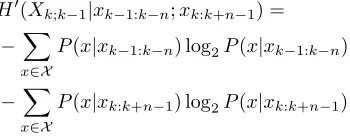
H0(Xk;k−1|xk−1:k−n;xk:k+n−1) =
−X
x∈X
P(x|xk−1:k−n) log2P(x|xk−1:k−n)
−X
x∈X
P(x|xk:k+n−1) log2P(x|xk:k+n−1).
Suffix arrays are employed during the collection of frequency statistics. For a character model of or-dern over a testing corpus of sizet and a training corpus of size m, suffix arrays allow these to be acquired in O(tnlogm) time. Faster implementa-tions reduce the complexity toO(t(n+ logm)). For further discussion, see Manber and Myers (1991). During the experiments, we did not use the caching functionality provided by the suffix array library, but instead kept the statistics for the current iterative pass (n-gram order and direction) in a local table.
The chunking technique we adopt is to insert a boundary when the branching entropy measured in sequences of length n exceeds a certain threshold value (H(X|xk−1:k−n)> β). Bothnandβare fixed.
Within the described framework, the increase in context length n promotes precision and recall at first, but causes a performance degradation when the entropy estimates become unreliable due to the re-duced frequencies of long strings. High threshold values produce a combination of high precision and low recall, while low values result in low precision and high recall.
Since the F-score curve obtained as decreasing values are assigned to the threshold is typically uni-modal as in many applications of MDL, we employ a bisection search routine for the estimation of the threshold (Algorithm 1).
All positions of the dataset are sorted by their en-tropy values. At each iteration, at most two new hypotheses are built, and their description lengths are calculated in time linear to the data size. The computational complexity of the described routine isO(tlogt), wheretis the corpus length in charac-ters.
The order of the Markov chainnused during the entropy calculation is the only input variable of the proposed model. Since different values perform the best across the various languages, the most appro-priate settings can be obtained with the help of a small annotated corpus. However, the MDL objec-tive also enables unsupervised optimization against
Algorithm 1Generates an initial hypothesis. thresholds[] := sortedH(Xk)values;
threshold := median of thresholds[]; step := length of thresholds[]/4; direction := ascending;
minimum :=+∞;
whilestep >0do
nextThreshold := thresholds[] value one step in last direction;
DL = calculateDL(nextThreshold);
ifDL < minimumthen
minimum:= DL; threshold := nextThreshold; step := step/2; continue;
end if
reverse direction;
nextThreshold := thresholds[] value one step in last direction;
ifDL < minimumthen
minimum:= DL; threshold := nextThreshold; step := step/2; continue;
end if
reverse direction; step := step/2;
end while
Corpus [1] [2] [3] [4]
[image:4.612.98.273.58.128.2]CHILDES 394655.52 367711.66 368056.10 405264.53 Kyoto 1.291E+07 1.289E+07 1.398E+07 1.837E+07
Table 1: Length in bits of the solutions proposed by Al-gorithm 1 with respect to the character n-gram order.
a sufficiently large unlabeled dataset. The order that minimizes the description length of the data can be discovered in a few iterations of Algorithm 1 with increasing values ofn, and it typically matches the optimal value of the parameter (Table 1).
Although an acceptable initial segmentation can be built using the described approach, it is possible to obtain higher accuracy with an extended model that takes into account the statistics of Markov chains from several orders during the entropy calcu-lation. This can be done by summing up the entropy estimates, in the way introduced earlier for combin-ing the values in both directions:
H00(Xk;k−1|xk−1:k−n;xk:k+n−1) =
−
nmax X
n=1
(X x∈X
P(x|xk−1:k−n) log2P(x|xk−1:k−n)
+X
x∈X
wherenmax is the index of the highest order to be taken into consideration.
3.3 Refining the initial hypothesis
In the second phase of the proposed method, we will refine the initial hypothesis through the reorganiza-tion of local co-occurrences which produce redun-dant description length. We opt for greedy optimiza-tion, as our primary interest is to further explore the impact that description length minimization has on accuracy. Of course, such an approach is unlikely to obtain global minima, but it is a feasible means of conducting the optimization process, and guarantees a certain increase in compression.
Since a preliminary segmentation is available, it is convenient to proceed by inserting or removing boundaries in the text, thus splitting or merging the already discovered tokens. The ranked positions in-volved in the previous step can be reused here, as this is a way to bias the search towards areas of the text where boundaries are more likely to occur. Boundary insertion should start in regions where the branching entropy is high, and removal should first occur in regions where the entropy is close to zero. A drawback of this approach is that it omits loca-tions where the gains are not immediately obvious, as it cannot assess the cumulative gains arising from the merging or splitting of all occurrences of a cer-tain pair (Algorithm 2).
A clean-up routine, which compensates for this shortage, is also implemented (Algorithm 3). It op-erates directly on the types found in the lexicon pro-duced by Algorithm 2, and is capable of modify-ing a large number of occurrences of a given pair in a single step. The lexicon types are sorted by their contribution to the total description length of the corpus. For each word type, splitting or merg-ing is attempted at every letter, beginnmerg-ing from the center. The algorithm eliminates unlikely types with low contribution, which represent mostly noise, and redistributes their cost among more likely ones. The design of the merging routine makes it impossible to produce types longer than the ones already found in the lexicon, as an exhaustive search would be pro-hibitive.
The evaluation of each hypothetical change in the segmentation requires that the description length of the two-part code is recalculated. In order to
Algorithm 2Compresses local token co-occurrences. path[][]:= positions sorted byH(Xk)values;
minimum := DL of model produced at initialization;
repeat
fori = maxH(Xk)to minH(Xk)do
pos:= path[i][k];
ifno boundary exists at posthen
leftToken := token to the left; rightToken := token to the right; longToken := leftToken + rightToken; calculate DL after splitting;
ifDL < minimumthen
accept split, update model, update DP vari-ables;
end if end if end for
fori = minH(Xk)to maxH(Xk)do
merge leftToken and rightToken into longToken if DL will decrease (analogous to splitting)
end for
untilno change is evident in model
Algorithm 3A lexicon clean-up procedure. types[] := lexicon types sorted by cost;
minimum := DL of model produced by Algorithm 2;
repeat
fori = min cost to max costdo
forpos = middle to both ends of types[i]do
longType := types[i];
leftType := sequence from first character to pos;
rightType:= sequence from pos to last charac-ter;
calculate DL after splitting longType into left-Type and rightleft-Type;
ifDL < minimumthen
accept split, update model, update DP vari-ables;
break out of inner loop;
end if end for end for
types[] := lexicon types sorted by cost;
fori = max cost to min costdo
forpos = middle to both ends of types[i]do
merge leftType and rightType into longType if DL will decrease (analogous to splitting) break out of inner loop;
end for end for
make this optimization phase computationally fea-sible, dynamic programming is employed in Algo-rithms 2 and 3. The approach adopted for the re-calculation of the source text term L(D|M) is ex-plained below. The estimation of the lexicon cost is analogous. The termL(D|M)can be rewritten as:
L(D|M) =−
|M| X
j=1
#wjlog2
#wj
N =
−
|M| X
j=1
#wjlog2#wj+Nlog2N =T1+T2,
where#wjis the frequency ofwjin the segmented corpus, andN = P|M|
j=1#wj is the cumulative to-ken count. In order to calculate the new length, we keep the values of the termsT1 andT2 obtained at the last change of the model. Their new values are computed for each hypothetical split or merge on the basis of the last values, and the expected description length is calculated as their sum. If the produced es-timate is lower, the model is modified and the new values ofT1andT2are stored for future use.
In order to maintain precise token counts, Algo-rithms 2 and 3 recognize the fact that recurring se-quences (”byebye” etc.) appear in the corpora, and handle them accordingly. Known boundaries, such as the sentence boundaries in the CHILDES corpus, are also taken into consideration.
4 Experimental Settings
We evaluated the proposed model against four datasets. The first one isthe Bernstein-Ratner cor-pus for language acquisition based on transcripts from the CHILDES database (Bernstein-Ratner, 1987). It comprises phonetically transcribed utter-ances of adult speech directed to 13 through 21-month-old children. We evaluated the performance of our learner in the cases when the few boundaries among the individual sentences are available to it (B), and when it starts from a blank state (N). The
Kyoto University Corpus (Kurohashi and Nagao,
1998) is a standard dataset for Japanese morpho-logical and dependency structure analysis, which comprises newspaper articles and editorials from the Mainichi Shimbun. TheBESTcorpus for word seg-mentation and named entity recognition in Thai lan-guage combines text from a variety of sources
in-Corpus Language Size (MB)
Chars (K)
Tokens (K)
Types (K)
CHILDES-B/N
English 0.1 95.8 33.3 1.3
[image:6.612.314.540.54.188.2]Kyoto Japanese 5.02 1674.9 972.9 39.5 WSJ English 5.22 5220.0 1174.2 49.1 BEST-E Thai 12.64 4360.2 1163.2 26.2 BEST-N Thai 18.37 6422.7 1659.4 36.3 BEST-A Thai 4.59 1619.9 438.7 13.9 BEST-F Thai 16.18 5568.0 1670.8 22.6 Wikipedia Japanese 425.0 169069.3 / / Asahi Japanese 337.2 112401.1 / / BEST-All Thai 51.2 17424.0 4371.8 73.4
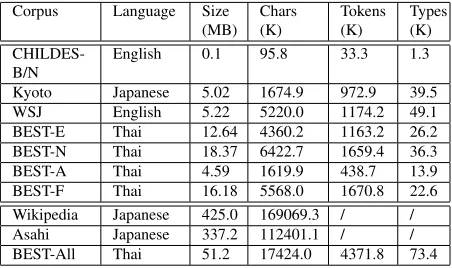
Table 2: Corpora used during the evaluation. Precise to-ken and type counts have been omitted for Wikipedia and Asahi, as no gold standard segmentations are available.
cluding encyclopedias (E), newspaper articles (N), scientific articles (A), and novels (F). TheWSJ sub-set of the Penn Treebank II Corpus incorporates selected stories from the Wall Street Journal, year 1989 (Marcus et al., 1994). Both the original text (O), and a version in which all characters were con-verted to lower case (L) were used.
The datasets listed above were built by remov-ing the tags and blank spaces found in the corpora, and concatenating the remaining text. We added two more training datasets for Japanese, which were used in a separate experiment solely for the acqui-sition of frequency statistics. One of them was created from 200,000 randomly chosen Wikipedia articles, stripped from structural elements. The other one contains text from the year 2005 issues of Asahi Newspaper. Statistics regarding all described datasets are presented in Table 2.
One whole corpus is segmented in each experi-ment, in order to avoid the statement of an extended model that would allow the separation of training and test data. This setting is also necessary for the direct comparison between the proposed model and other recent methods evaluated against the entire CHILDES corpus.
We report the obtained precision, recall and F-score values calculated using boundary, token and type counts. Precision (P) and recall (R) are defined as:
P= #correct units #output units, R=
#correct units
#gold standard units.
Model Corpus & Settings B-Prec B-Rec B-F T-Prec T-Rec T-F DL (bits)
Ref.DL (bits)
Time (ms) 1 CHILDES,α= 1.2, n = [1-6] 0.8667 0.8898 0.8781 0.6808 0.6990 0.6898 344781.74 1060.2 2a (H0) CHILDES,n= 2 0.7636 0.9109 0.8308 0.5352 0.6384 0.5823 367711.66 300490.52 753.1 2b (H00) CHILDES,nmax= 3 0.8692 0.8865 0.8777 0.6792 0.6927 0.6859 347633.07 885.3 1 Kyoto,α= 0, n = [1-6] 0.8208 0.8208 0.8208 0.5784 0.5784 0.5784 1.325E+07 54958.8 2a (H0) Kyoto,n= 2 0.8100 0.8621 0.8353 0.5934 0.6316 0.6119 1.289E+07 1.120E+07 22909.7 2b (H00) Kyoto,n
[image:7.612.69.544.54.137.2]max= 2 0.8024 0.9177 0.8562 0.6093 0.6969 0.6501 1.248+E07 23212.8
Table 3: Comparison of the proposed method (2a, 2b) with the model of Jin and Tanaka-Ishii (2006) (1). Execution times include the obtaining of frequency statistics, and are represented by averages over 10 runs.
harmonic averages of the corresponding precision and recall values (F = 2P R/(P + R)). As a rule, boundary-based evaluation produces the high-est scores among the three evaluation modes, as it only considers the correspondence between the pro-posed and the gold standard boundaries at the indi-vidual positions of the corpora. Token-based evalua-tion is more strict – it accepts a word as correct only if its beginning and end are identified accurately, and no additional boundaries lie in between. Lexicon-based evaluation reflects the extent to which the vo-cabulary of the original text has been recovered. It provides another useful perspective for the error analysis, which in combination with token scores can give a better idea of the relationship between the accuracy of induction and item frequency.
The system was implemented in Java, however it handled the suffix arrays through an external C li-brary called Sary.1 All experiments were conducted on a 2 GHz Core2Duo T7200 machine with 2 GB RAM.
5 Results and Discussion
The scores we obtained using the described instan-tiations of the branching entropy criterion at the ini-tialization phase are presented in Table 3, along with those generated by our own implementation of the method presented in Jin and Tanaka-Ishii (2006), where the threshold parameterαwas adjusted man-ually for optimal performance.
The heuristic of Jin and Tanaka-Ishii takes advan-tage of the trend that branching entropy decreases as the observed character sequences become longer; sudden rises can thus be regarded as an indication of locations where a boundary is likely to exist. Their method uses a common value for thresholding the
1http://sary.sourceforge.net
entropy change throughout all n-gram orders, and combines the boundaries discovered in both direc-tions in a separate step. These properties of the method would lead to complications if we tried to employ it in the first phase of our method (i.e. a step parameter for iterative adjustment of the threshold value, rules for combining the boundaries, etc.).
The proposed criterion with an automatically de-termined threshold value produced slightly worse results than that of Jin and Tanaka-Ishii at the CHILDES corpus. However, we found out that our approach achieves approximately 1% higher score when the best performing threshold value is selected from the candidate list. There are two observations that account for the suboptimal threshold choice by our algorithm. On one hand, the correspondence between description length and F-score is not abso-lutely perfect, and this may pose an obstacle to the optimization process for relatively small language samples. Another issue lies in the bisection search routine, which suggests approximations of the de-scription length minima. The edge that our method has on the Kyoto corpus can be attributed to a better estimation of the optimal treshold value due to the larger amount of data.
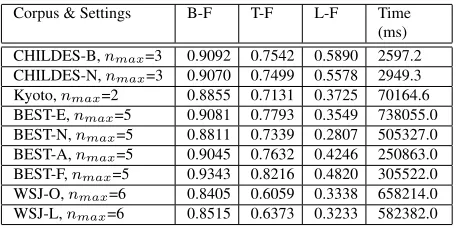
The experimental results obtained at the comple-tion of Algorithm 3 are summarized in Tables 4 and 5. Presented durations include the obtaining of fre-quency statistics. Thenmax parameter is set to the value which maximizes the compression during the initial phase, in order to make the results representa-tive of the case in which no annotated development corpora are accessible to the algorithm.
Corpus & Settings B-F T-F L-F Time (ms) CHILDES-B,nmax=3 0.9092 0.7542 0.5890 2597.2 CHILDES-N,nmax=3 0.9070 0.7499 0.5578 2949.3 Kyoto,nmax=2 0.8855 0.7131 0.3725 70164.6 BEST-E,nmax=5 0.9081 0.7793 0.3549 738055.0 BEST-N,nmax=5 0.8811 0.7339 0.2807 505327.0 BEST-A,nmax=5 0.9045 0.7632 0.4246 250863.0 BEST-F,nmax=5 0.9343 0.8216 0.4820 305522.0 WSJ-O,nmax=6 0.8405 0.6059 0.3338 658214.0 WSJ-L,nmax=6 0.8515 0.6373 0.3233 582382.0
Table 4: Results obtained after the termination of Algo-rithm 3.
Corpus & Settings Description Length (Proposed)
Description Length (Total) CHILDES-B,nmax=3 290592.30 300490.52 CHILDES-N,nmax=3 290666.12 300490.52 Kyoto,nmax=2 1.078E+07 1.120E+07 BEST-E,nmax=5 1.180E+07 1.252E+07 BEST-N,nmax=5 1.670E+07 1.809E+07 BEST-A,nmax=5 4438600.32 4711363.62 BEST-F,nmax=5 1.562E+07 1.634E+07 WSJ-O,nmax=6 1.358E+07 1.460E+07 WSJ-L,nmax=6 1.317E+07 1.399E+07
Table 5: Description length - proposed versus reference segmentation.
We conducted experiments involving various ini-tialization strategies: scattering boundaries at ran-dom throughout the text, starting from entirely un-segmented state, or considering each symbol of the text to be a separate token. The results obtained with random initialization confirm the strong rela-tionship between compression and segmentation ac-curacy, evident in the increase of token F-score be-tween the random initialization and the termination of the algorithm, where description length is lower (Table 6). They also reveal the importance of the branching entropy criterion to the generation of hy-potheses that maximize the evaluation scores and compression, as well as the role it plays in the re-duction of computational time.
[image:8.612.86.287.606.656.2]T-F-Score Description Time Random Init Refinement Length (ms) 0.0441 (0.25) 0.3833 387603.02 6660.4 0.0713 (0.50) 0.3721 383279.86 4975.1 0.0596 (0.75) 0.2777 412743.67 3753.3
Table 6: Experimental results for CHILDES-N with ran-domized initialization and search path. The numbers in brackets represent the seed boundaries/character ratios.
The greedy algorithms fail to suggest any opti-mizations that improve the compression in the ex-treme cases when the boundaries/character ratio is either 0 or 1. When no boundaries are given, split-ting operations produce unique types with a low frequency that increase the cost of both parts of the MDL code, and are rejected. The algorithm runs slowly, as each evaluation operates on candi-date strings of enormous length. Similarly, when the corpus is broken down into single-character tokens, merging individual pairs does not produce any in-crease in compression. This could be achieved by an algorithm that estimates the total effect from merg-ing all instances of a given pair, but such an algo-rithm would be computationally infeasible for large corpora.
Finally, we tried randomizing the search path for Algorithm 2 after an entropy-guided initialization, to observe a small deterioration in accuracy in the final segmentation (less than 1% on average).
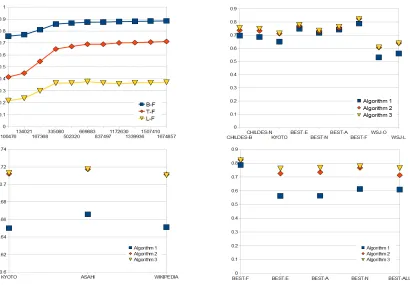
Figure 1a illustrates the effect that training data size has on the accuracy of segmentation for the Ky-oto corpus. The learning curves are similar through-out the different corpora. For the CHILDES cor-pus, which has a rather limited vocabulary, token F-score above 70% can be achieved for datasets as small as 5000 characters of training data, provided that reasonable values are set for thenmaxparameter (we used the values presented in Table 4 throughout these experiments).
Figure 1b shows the evolution of token F-score by stage for all corpora. The initialization phase seems to have the highest contribution to the formation of the final segmentation, and the refinement phase is highly dependent on the output it produces. As a consequence, results improve when a more adequate language sample is provided during the learning of local dependencies at initialization. This is evident in the experiments with the larger unlabeled Thai and Japanese corpora.
Figure 1: a) corpus size / accuracy relationship (Kyoto); b) accuracy levels by phase; c) accuracy levels by phase with various corpora for frequency statistics (Kyoto); d) accuracy levels by phase with different corpora for frequency statistics (BEST).
to the higher degree of correspondence between the domains of the Asahi and Kyoto corpora (Figure 1c).
Experiments with the BEST corpus reveal bet-ter the influence of domain-specific data on the ac-curacy of segmentation. Performance deteriorates significantly when out-of-domain training data is used. In spite of its size, the assorted composite cor-pus, in which in-domain and out-of-domain training data are mixed, produces worse results than the cor-pora which include only domain-specific data (Fig-ure 1d).
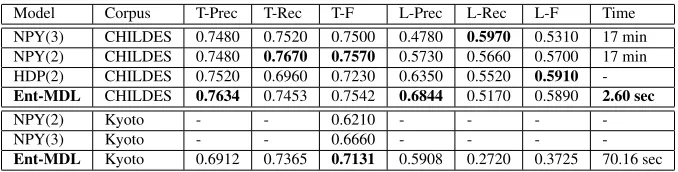
Finally, a comparison of the proposed method with Bayesian n-gram models is presented in Ta-ble 7. Through the increase of compression in the refinement phase of the algorithm, accuracy is im-proved by around 3%, and the scores approach those of the explicit probabilistic models of Goldwater et al. (2009) and Mochihashi et al. (2009). The pro-posed learner surpasses the other unsupervised word induction models in terms of processing speed. It should be noticed that a direct comparison of
accu-racy is not possible with Mochihashi et al. (2009), as they evaluated their system with separate datasets for training and testing. Furthermore, different seg-mentation standards exist for Japanese, and there-fore the ”ground truth” provided by the Kyoto cor-pus cannot be considered an ideal measure of accu-racy.
6 Conclusions and Future Work
[image:9.612.100.510.54.339.2]Model Corpus T-Prec T-Rec T-F L-Prec L-Rec L-F Time NPY(3) CHILDES 0.7480 0.7520 0.7500 0.4780 0.5970 0.5310 17 min NPY(2) CHILDES 0.7480 0.7670 0.7570 0.5730 0.5660 0.5700 17 min HDP(2) CHILDES 0.7520 0.6960 0.7230 0.6350 0.5520 0.5910 -Ent-MDL CHILDES 0.7634 0.7453 0.7542 0.6844 0.5170 0.5890 2.60 sec
NPY(2) Kyoto - - 0.6210 - - -
-NPY(3) Kyoto - - 0.6660 - - -
[image:10.612.137.476.53.139.2]-Ent-MDL Kyoto 0.6912 0.7365 0.7131 0.5908 0.2720 0.3725 70.16 sec
Table 7: Comparison of the proposed method (Ent-MDL) with the methods of Mochihashi et al., 2009 (NPY) and Goldwater et al., 2009 (HDP).
performance in terms of both accuracy and speed. Possible improvements of the proposed method include modeling the dependencies among neigh-boring tokens, which would allow the evaluation of the context to be reflected in the cost func-tion. Mechanisms for stochastic optimization imple-mented in the place of the greedy algorithms could provide an additional flexibility of search for such more complex models. As the proposed approach provides significant performance improvements, it could be utilized in the development of more so-phisticated novel word induction schemes, e.g. en-semble models trained independently with different data. Of course, we are also going to explore the model’s potential in the setting of semi-supervised morphological analysis.
References
Bernstein-Ratner, Nan 1987. The phonology of parent – child speech. Childrens Language, 6:159–174
Brent, Michael R and Timothy A. Cartwright. 1996. Dis-tributional Regularity and Phonotactic Constraints are Useful for Segmentation.Cognition61: 93–125
Goldwater, Sharon. 2006. Nonparametric Bayesian Models of Lexical Acquisition. Brown University, Ph.D. Thesis
Goldwater, Sharon, Thomas L. Griffiths and Mark John-son. 2006. Contextual dependencies in unsupervised word segmentation. Proceedings of the 21st Interna-tional Conference on ComputaInterna-tional Linguistics and the 44th annual meeting of the Association for Com-putational Linguistics, Sydney, 673–680
Goldwater, Sharon, Thomas L. Griffiths and Mark John-son. 2009. A Bayesian framework for word segmen-tation: Exploring the effects of context. Cognition, 112:1, 21–54.
Harris, Zellig. 1955. From Phoneme to Morpheme. Lan-guage, 31(2):190-222.
Huang, Jin H. and David Powers. 2003. Chinese Word Segmentation Based on Contextual Entropy. Proceed-ings of 17th Pacific Asia Conference, 152–158 Hutchens, Jason L. and Michael D. Alder. 1998. Finding
structure via compression. Proceedings of the Inter-national Conference on Computational Natural Lan-guage Learning, 79–82
Jin, Zhihui and Kumiko Tanaka-Ishii. 2006. Unsuper-vised Segmentation of Chinese Text by Use of Branch-ing Entropy. Proceedings of the COLING/ACL on Main conference poster sessions, 428–435
Johnson, Mark and Sharon Goldwater. 2009. Improving nonparameteric Bayesian inference: experiments on unsupervised word segmentation with adaptor gram-mars.Proceedings of Human Language Technologies: The 2009 Annual Conference of the North American Association for Computational Linguistics, 317–325. Kempe, Andre. 1999. Experiments in Unsupervised
Entropy Based Corpus Segmentation. Proceedings of CoNLL’99, pp. 371–385
Kit, Chunyu. 2003. How does lexical acquisition begin? A cognitive perspective. Cognitive Science1(1): 1– 50.
Kurohashi, Sadao and Makoto Nagao. 1998. Building a Japanese Parsed Corpus while Improving the Pars-ing System. Proceedings of the First International Conference on Language Resources and Evaluation, Granada, Spain, 719–724
Lafferty, John, Andrew McCallum and Fernando Pereira. 2001. Conditional Random Fields: Probabilistic Mod-els for Segmenting and Labeling Sequence Data. Pro-ceedings of the International Conference on Machine Learning.
Li, Hang. 1998. A Probabilistic Approach to Lexical Semantic Knowledge Acquisition and Structural Dis-ambiguation. University of Tokyo, Ph.D. Thesis Liang, Percy. 2005. Semi-Supervised Learning for
Nat-ural Language. Massachusets Institute of Technology, Master’s Thesis.
Marcus, Mitchell, Grace Kim, Mary Ann Marcinkiewicz, Robert MacIntyre, Ann Bies, Mark Ferguson, Karen Katz and Britta Schasberger. 1994. The Penn Tree-bank: Annotating Predicate Argument Structure. Hu-man Language Technology, 114–119
Mochihashi, Daiichi, Takeshi Yamada and Naonori Ueda. 2009. Bayesian unsupervised word segmentation with nested Pitman-Yor language modeling. Proceedings of the Joint Conference of the 47th Annual Meeting of the ACL and the 4th International Joint Conference on Natural Language Processing of the Asian Federation of Natural Language Processing, 1: 100–108
Rissanen, Jorma. 1978. Modeling by Shortest Data De-scription. Aulomatica, 14:465–471.
Saffran, Jenny R., Richard N. Aslin and Elissa L. New-port. 1996. Statistical learning in 8-month-old infants
Science; 274:1926-1928
Tsuboi, Yuta, Hisashi Kashima., Hiroki Oda, Shinsuke Mori and Yuji Matsumoto. 2008. Training Condi-tional Random Fields Using Incomplete Annotations.
Proceedings of the 22nd International Conference on Computational Linguistics - Volume 1,897–904. Yu, Hua. 2000. Unsupervised word induction using
MDL criterion. Proceedings of tne International Sym-posium of Chinese Spoken Language Processing, Bei-jing.