Kernel-based Approach for Automatic Evaluation of Natural Language
Generation Technologies: Application to Automatic Summarization
Tsutomu Hirao
NTT Communication Science Labs. NTT Corp.
Manabu Okumura Precision and Intelligence Labs.
Tokyo Institute of Technology
Hideki Isozaki
NTT Communication Science Labs. NTT Corp.
Abstract
In order to promote the study of auto-matic summarization and translation, we need an accurate automatic evaluation method that is close to human evalua-tion. In this paper, we present an eval-uation method that is based on convolu-tion kernels that measure the similarities between texts considering their substruc-tures. We conducted an experiment us-ing automatic summarization evaluation data developed for Text Summarization Challenge 3 (TSC-3). A comparison with conventional techniques shows that our method correlates more closely with hu-man evaluations and is more robust.
1 Introduction
Automatic summarization, machine translation, and paraphrasing have attracted much attention recently. These tasks include text-to-text language genera-tion. Evaluation workshops are held in the U.S. and Japan, e.g., the Document Understanding Con-ference (DUC)1, NIST Machine Translation Evalu-ation2 as part of the TIDES project, the Text Sum-marization Challenge (TSC)3of the NTCIR project, and the International Workshop on Spoken Lan-guage Translation (IWSLT)4.
These evaluation workshops employ human eval-uations, which are essential in terms of achieving
1http://duc.nist.gov 2
http://www.nist.gov/speech/tests/mt/
3
http://www.lr.titech.ac.jp/tsc
4http://www.slt.atr.co.jp/IWSLT2004
high quality evaluations results. However, human evaluations require a huge effort and the cost is con-siderable. Moreover, we cannot automatically eval-uate a new system even if we use the corpora built for these workshops, and we cannot conduct re-evaluation experiments.
To cope with this situation, there is a particular need to establish a high quality automatic evalua-tion method. Once this is done, we can expect great progress to be made on natural language generation. In this paper, we propose a novel automatic evaluation method for natural language generation technologies. Our method is based on the Ex-tended String Subsequence Kernel (ESK) (Hirao et al., 2004b) which is a kind of convolution ker-nel (Collins and Duffy, 2001). ESK allows us to calculate the similarities between a pair of texts tak-ing account of word sequences, their word sense se-quences and their combinations.
We conducted an experimental evaluation using automatic summarization evaluation data developed for TSC-3 (Hirao et al., 2004a). The results of the comparison with ROUGE-N (Lin and Hovy, 2003; Lin, 2004a; Lin, 2004b), ROUGE-S(U) (Lin, 2004b; Lin and Och, 2004) and ROUGE-L (Lin, 2004a; Lin, 2004b) show that our method correlates more closely with human evaluations and is more robust.
2 Related Work
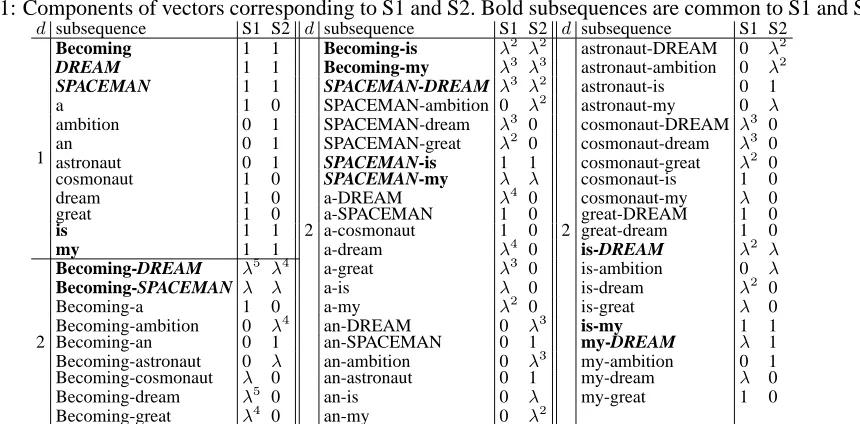
Table 1: Components of vectors corresponding to S1 and S2. Bold subsequences are common to S1 and S2.
subsequence S1 S2 subsequence S1 S2 subsequence S1 S2
Becoming 1 1 Becoming-is
astronaut-DREAM 0
DREAM 1 1 Becoming-my astronaut-ambition 0
SPACEMAN 1 1 SPACEMAN-DREAM
astronaut-is 0 1
a 1 0 SPACEMAN-ambition 0
astronaut-my 0
ambition 0 1 SPACEMAN-dream 0 cosmonaut-DREAM 0
1 an 0 1 SPACEMAN-great
0 cosmonaut-dream 0
astronaut 0 1 SPACEMAN-is 1 1 cosmonaut-great
0
cosmonaut 1 0 SPACEMAN-my cosmonaut-is 1 0
dream 1 0 a-DREAM
0 cosmonaut-my 0
great 1 0 a-SPACEMAN 1 0 great-DREAM 1 0
is 1 1 2 a-cosmonaut 1 0 2 great-dream 1 0
my 1 1 a-dream
0 is-DREAM
Becoming-DREAM
a-great 0 is-ambition 0
Becoming-SPACEMAN a-is 0 is-dream
0
Becoming-a 1 0 a-my
0 is-great 0
Becoming-ambition 0
an-DREAM 0 is-my 1 1
2 Becoming-an 0 1 an-SPACEMAN 0 1 my-DREAM 1
Becoming-astronaut 0 an-ambition 0 my-ambition 0 1
Becoming-cosmonaut 0 an-astronaut 0 1 my-dream 0
Becoming-dream 0 an-is 0 my-great 1 0
Becoming-great
0 an-my 0
2002; Lin and Hovy, 2003; Lin, 2004a; Lin, 2004b; Soricut and Brill, 2004).
Hori et. al (2003) proposed an automatic eval-uation method for speech summarization based on word recognition accuracy. They reported that their method is superior to BLEU (Papineni et al., 2002) in terms of the correlation between human assess-ment and automatic evaluation. Lin (2004a; 2004b) and Lin and Och (2004) proposed an LCS-based au-tomatic evaluation measure called ROUGE-L. They applied ROUGE-L to the evaluation of summariza-tion and machine translasummariza-tion. The results showed that the LCS-based measure is comparable to N-gram-based automatic evaluation methods. How-ever, these methods tend to be strongly influenced by word order.
Various N-gram-based methods have been pro-posed since BLEU, which is now widely used for the evaluation of machine translation. Lin et al. (2003) proposed a recall-oriented measure, ROUGE-N, whereas BLEU is precision-oriented. They reported that ROUGE-N performed well as regards automatic summarization. In particular, ROUGE-1, i.e., uni-gram matching, provides the best correlation with human evaluation. Soricut et. al (2004) proposed a unified measure. They integrated a precision-oriented measure with a recall-precision-oriented measure by using an extension of the harmonic mean formula. It performs well in evaluations of machine translation, automatic summarization, and question answering.
However, N-gram based methods have a critical problem; they cannot consider co-occurrences with gaps, although the LCS-based method can deal with them. Therefore, Lin and Och (2004) introduced skip-bigram statistics for the evaluation of machine translation. However, they did not consider longer skip-n-grams such as skip-trigrams. Moreover, their method does not distinguish between bigrams and skip-bigrams.
3 Kernel-based Automatic Evaluation
The above N-gram-based methods correlated closely with human evaluations. However, we think some skip-n-grams (n ) are useful. In this paper, we employ the Extended String Subsequence Kernel (ESK), which considers both n-grams and skip-n-grams. In addition, the ESK allows us to add word senses to each word. The use of word senses enables flexible matching even when paraphrasing is used.
The ESK is a kind of convolution kernel (Collins and Duffy, 2001). Convolution kernels have recently attracted attention as a novel similarity measure in natural language processing.
3.1 ESK
The ESK is an extension of the String Subsequence Kernel (SSK) (Lodhi et al., 2002) and the Word Se-quence Kernel (WSK) (Cancedda et al., 2003).
and maps each of them into a high-dimensional vec-tor space. The kernel’s value is simply the inner product of the two vectors in the vector space. In order to discount long-skip-n-grams, the decay pa-rameter is introduced.
We explain the computation of the ESK’s value whose inputs are the sentences (S1 and S2) shown below. In the example, word senses are shown in braces.
S1 Becoming a cosmonaut: SPACEMAN is my great
dream: DREAM
S2 Becoming an astronaut: SPACEMAN is my
ambi-tion: DREAM
In this case, “cosmonaut” and “astronaut” share the same sense SPACEMAN and “ambition” and
“dream” also share the same sense DREAM . We
can use WordNet for English and Goitaikei (Ikehara et al., 1997) for Japanese.
Table 1 shows the subsequences derived from S1 and S2 and its weights. Note that the subsequence length is two or less. From the table, there are fif-teen subsequences5 that are common to S1 and S2. Therefore,! "#%$'&)(*+,*-#%
*+/.*
/01*)321*4351*637 . For reference, there are three
unigrams, one bigram, zero trigrams and three skip-bigrams common to S1 and S2.
Formally, the ESK is defined as follows. 8 and9
are node sequences.
ESK:;=<?>@BADC
:
EGFIH JLKNMPO QSRSMUT
V
E
;=WYXZ>Z[/\SA (1)
V
E
;=W]XZ>Z[/\^ADC _"`
a
;=WYXb>Z[/\A if cdCfe Vhg
EjiH ;=W]XZ>Z[3\A/k
_"`
a
;=W]XZ>Z[3\A otherwise
(2)
Here,l is the upper bound of the subsequence length
and monp
Nqr] ]sutv$ is defined as follows. q^r is thew -th
node of8 . sxt is they -th node of 9 . The function zx{|
} ]q"$ returns the number of attributes common to
given nodes} andq .
V
g
E
;=W]XZ>Z[3\SADC
~
if UC'e
V g
E
;=W X>b[ \ i/H
A3 V gg
E
;=W X>Z[ \ iH
A otherwise
(3)
monn
p
Nq^r] ]sxt$ is defined as follows:
V
gg
E
;=W]XZ>Z[3\SADC
~
if Cfe
Vhgg
E
;=W]X iH
>Z[/\SA3
V
E
;=W]X iH
>b[/\SA
(4)
5Bold subsequences in Table 1.
Finally, we define the similarity measure between
8 and9 by normalizing ESK. This similarity can be
regarded as an extension of the cosine measure.
Sim: Z ;=<?>^@BADC
ESK: ;=<>]@BA
ESK: ;=<?>Z<AESK: ;@>^@BA
(5)
3.2 Automatic Evaluation based on ESK
Suppose, is a system output, which consists of
sentences, and is a human written reference,
which consists of sentences. ^r is a sentence in
, and t is a sentence in . We define two scoring
functions for automatic evaluation. First, we define a precision-oriented measure as follows:
:
Z ;=>Z1ADC
e
X
FIH1 HD
\
E
Sim: b=
;= X>Z \ A (6)
Symmetrically, we define a recall-oriented mea-sure as follows:
:
b= ;=>b1ADC
e
c
E
\
FIH 1 HD
X
Sim
:
Z
;=XN>b\A (7)
Finally, we define a unified measure, i.e., F-measure, as follows:
:
b= ;=>Z1ADC
;De¡h¢
Au£
Z ;=>Z1Au£
Z ;=>¤1A
b=
;=>¤1A/1¢
£
b= ;=>¤1A
(8)
¥
is a cost parameter for ¦¨§©Nª and«§©Nª .
¥
’s value is selected depending on the evaluation task. Since summary should not miss important information given in the human reference, recall is more impor-tant than precision. Therefore,a large
¥
will yield good results.
3.3 Extension for Multiple References
When multiple human references (correct answers) are available, we define a simple function for multi-ple references as follows:
¬ ZD® b=
;=>
ADC
e
¯
°
X
FIH
Z=
;=>Z XA> (9)
Here, equation (9) gives the average score. ¦
in-dicates a set of references;¦±&6³²P "´"´"´U ]¶µ .
4 Experimental Evaluation
evaluation data and our additional data.
4.1 Task and Evaluation Metrics in TSC-3
The task of TSC-3 is multiple document summariza-tion. Participants were given a set of documents about a certain event and required to generate two different length summaries for the entire document set. The lengths were about 5% and 10% of the total number of characters in the document set, respec-tively. Thirty document sets were provided for the official run evaluation. There were ten participant systems; one provided by the TSC organizers as a baseline system.
The evaluation metric follows DUC’s SEE eval-uation scheme (Harman and Over, 2004). For each document set, one human subject makes a reference summary and uses it as a basis for evaluating ten system outputs. This human evaluation procedure consists of the following steps:
Step 1 For each reference sentence·tU¸¹³$, repeat
Steps 2 and 3.
Step 2 For t , the human assessor finds the most
relevant sentence setº from the system output.
Step 3 The assessor assigns a score, »vN·t "º'$ , ¼ ¼%½
% "´"´"´· " ½L¼%½
1.0 means perfect. in terms of how much of the content oft can be
repro-duced by using only sentences inº .
Step 4 Finally, the evaluation score of output for reference is defined
¾
N¿ ]f$&
t
»N
t
"º'$ÀÁ-Á.
The final score of a system is calculated by applying the above procedure and normalized by the number of topics, i.e., .Â
Ã
²
¾
N
Ã
]
Ã
$À%
¼
. When multiple references ¦&1¿% "´"´"´· ]oµ%$
are available, the scores are given as follows:
¾Ä §ÅÆ
¦ ]f$& Ç
¾
N
Ç
]f$ÀÁ¦Á.
4.2 Variation of Human Assessors
In TSC-3’s official run evaluation, system outputs were compared with one human written reference summary for each topic. There were five topic sets and five human assessors (A-E in Table 2) for each topic set.
Before we use the one human written reference summary as the gold-standard-reference, to exam-ine variations among human assessors, we prepared two additional human summaries for each topic sets.
Table 2: The relationship between topics and refer-ence summary creators, i.e., human assessors. º'ÈÉ$
indicates a subject A’s evaluation score for all sys-tems for corresponding topics.
topic-ID Ê
H
Ê
Ê
ÊËYÌ]Í
1 - 6 Î (A) Î (E) Î (C) mean(Î (A),Î (E),Î (C))
7 - 12 Î (B) Î (A) Î (D) mean(Î (B),Î (A),Î (D))
13 - 18 Î (C) Î (B) Î (E) mean(Î (C),Î (B),Î (E))
19 - 24 Î (D) Î (C) Î (A) mean(Î (D),Î (C),Î (A))
[image:4.612.313.555.214.337.2]25 - 30 Î (E) Î (D) Î (B) mean(Î (E),Î (D),Î (B))
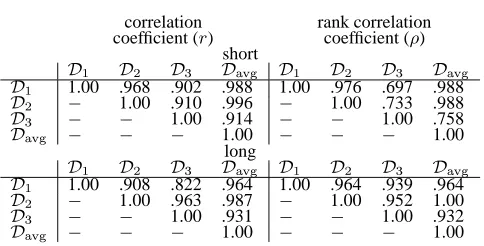
Table 3: Correlations between human judgments.
correlation rank correlation coefficient ( ) coefficient (Ï )
short
Ê
H
Ê
Ê
Ê
bÐYÑ
Ê
H
Ê
Ê
Ê
bÐYÑ
Ê
H 1.00 .968 .902 .988 1.00 .976 .697 .988
Ê
Ò
1.00 .910 .996 Ò
1.00 .733 .988
Ê
Ò Ò
1.00 .914 Ò Ò
1.00 .758
Ê
bÐYÑ
Ò Ò Ò
1.00 Ò Ò Ò
1.00 long
Ê
H
Ê
Ê
Ê
bÐYÑ
Ê
H
Ê
Ê
Ê
bÐYÑ
Ê
H 1.00 .908 .822 .964 1.00 .964 .939 .964
Ê
Ò
1.00 .963 .987 Ò
1.00 .952 1.00
Ê
Ò Ò
1.00 .931 Ò Ò
1.00 .932
Ê
bÐYÑ
Ò Ò Ò
1.00 Ò Ò Ò
1.00
Therefore, we obtained three reference summaries and evaluation results for each topic sets (Table 2).
Moreover, we prepared unified evaluation results of three human judgment asÓ
ÅYÔÕ , which is
calcu-lated as the average of three human scores.
The relationship between topics and human asses-sors is shown in Table 2. For example, subject B generates summaries and evaluates all systems for topics 7-12, 13-18 and 25-30 on Ó ² , Ó
, and Ó
.
respectively. Note that each human subject, A to E, was a retired professional journalist; that is, they shared a common background.
Table 3 shows the Pearson’s correlation coeffi-cient ( ) and Spearman’s rank correlation coefficient
Ö
4.3 Compared Automatic Evaluation Methods
We compared our method with ROUGE-N and ROUGE-L described below. We used only content words to calculate the ROUGE scores because the correlation coefficient decreased if we did not re-move functional words.
WSK-based method
We use WSK instead of ESK in equation (6)-(8).
ROUGE-N
ROUGE-N is an N-gram-based evaluation mea-sure defined as follows (Lin, 2004b):
ROUGE-N;=>Z1ADC × MSØ ÑDÙ= ¬Ú M × ÛÜÝ·ÞUß ¬ NàLá¤â ;ãä hå A × MØ ÑDÙL ¬ Ú M × ÛÜÝ·ÞUß ;ãä å A (10)
Here,æBç%èéêvNë%ìí%îï¨$ is the number of an N-gram
andæBç%èéê
Ä
ÅðbñóòôNë%ìí%î1ï¨$ denotes the number of
n-gram co-occurrences in a system output and the ref-erence.
ROUGE-S
ROUGE-S is an extension of ROUGE-2 defined as follows (Lin, 2004b):
ROUGE-S;=>b1ADC ;De¡h¢ A¡£ =]õö ;=>b1A¡£ =Yõö ;=>¤1A ]õö ;=>Z1A3h¢ =Yõö ;=>b1A (11) Where¦¨©Nªø÷úù and«©Zª÷úù
are defined as follows:
û
=Yõö
;=>Z1ADC üøýUþÿ
;=>Z1A
# of skip bigram
(12) ]õö ;=>Z1ADC üSývþÿ ;=>Z1A
# of skip bigram
(13)
Here, function Skip2 returns the number of skip-bi-grams that are common to and .
ROUGE-SU
ROUGE-SU is an extension of ROUGE-S, which includes unigrams as a feature defined as fol-lows (Lin, 2004b):
ROUGE-SU;=>Z1ADC ;De¡1¢ Au£ ;=>b1AG£ ;=>b1A ;=>Z1A/1¢ ;=>¤1A (14)
Where¦ © and« © are defined as follows:
û
;=>b1ADC
ü
;=>Z1A
(# of skip bigrams + # of unigrams)
(15)
;=>Z1ADC ü
;=>Z1A
(# of skip bigrams + # of unigrams)
(16)
Here, function SU returns the number of skip-bi-grams and uniskip-bi-grams that are common to and .
ROUGE-L
ROUGE-L is an LCS-based evaluation measure defined as follows (Lin, 2004b):
ROUGE-L;=>Z1ADC ;De¡1¢ A¡£ áZ ;=>Z1A¡£ áZ ;=>b1A áZ ;=>Z1A/1¢ áb ;=>Z1A (17)
where¦úñ© and«úñ© are defined as follows:
áb ;=>b1ADC e [ KMØ
LCSô;= X>ZA (18)
áb ;=>b1ADC e _ KNMSØ LCS ;="XN>bA (19)
Here, LCSôN·r] ]f$ is the LCS score of the union
longest common subsequence between reference sentencesr and .s and
z
are the number of words contained in , and , respectively.
The multiple reference version of ROUGE-N S, SU or L, RN
Ä §ÅÆ RS Ä §ÅÆ RSU Ä §ÅÆ RL Ä §ÅÆ can be defined in accordance with equation (9).
4.4 Evaluation Measures
We evaluate automatic evaluation methods by using Pearson’s correlation coefficient ( )
and Spearman’s rank correlation coefficient (Ö
). Since we have ten systems, we make a vector B&1f²P
"´"´"´v ur^ "´"´"´U B²
Â
$ from the
results of an automatic evaluation. Here,
xr]&1%À% ¼ . à ² N à ]ôr à $.
à indicates a
ref-erence for theq -th topic.
indicates an automatic evaluation function such as§©Zª ,©Nª , ROUGE-N,
ROUGE-S, ROUGE-SU and ROUGE-L. Next, we make another vector '&h ²
"´"´"´U r "´"´"´v ²
Â
$
from the human evaluation results. Here,
3r]&%À% ¼ . à ² ¾ N à ]Ir Ã
$ . Finally, we
com-pute and
Ö
between and
6.
4.5 Evaluation Results and Discussions
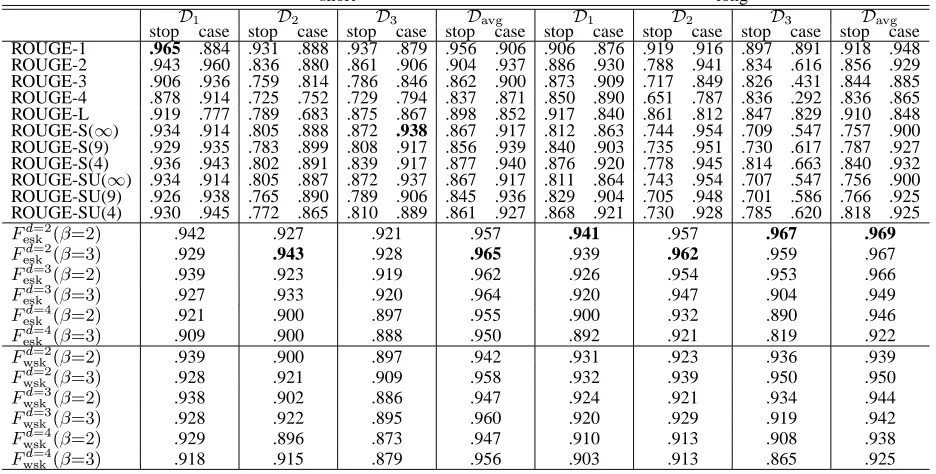
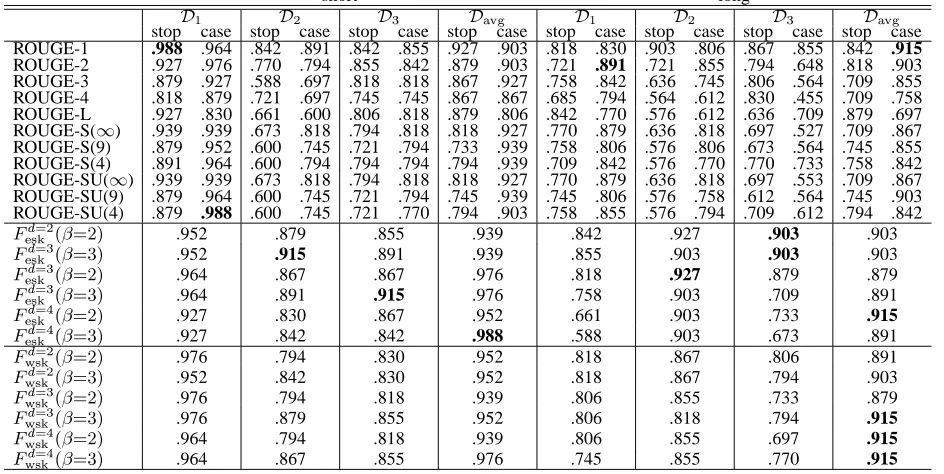
Table 4 shows the evaluation results obtained by using Pearson’s correlation coefficient . Table 5
shows the evaluation results obtained with Spear-man’s rank correlation coefficient Ö
. The
ta-6When using multiple references, functions
and for
making vectors and! are substituted for
Table 4: Results obtained with Pearson’s correlation coefficient.“stop” indicates with stop word exclusion, “case” indicates w/o stop word exclusion.
short long
Ê
H
Ê
Ê
Ê
¤Ð]Ñ
Ê
H
Ê
Ê
Ê
¤Ð]Ñ
stop case stop case stop case stop case stop case stop case stop case stop case ROUGE-1 .965 .884 .931 .888 .937 .879 .956 .906 .906 .876 .919 .916 .897 .891 .918 .948 ROUGE-2 .943 .960 .836 .880 .861 .906 .904 .937 .886 .930 .788 .941 .834 .616 .856 .929 ROUGE-3 .906 .936 .759 .814 .786 .846 .862 .900 .873 .909 .717 .849 .826 .431 .844 .885 ROUGE-4 .878 .914 .725 .752 .729 .794 .837 .871 .850 .890 .651 .787 .836 .292 .836 .865 ROUGE-L .919 .777 .789 .683 .875 .867 .898 .852 .917 .840 .861 .812 .847 .829 .910 .848 ROUGE-S(" ) .934 .914 .805 .888 .872 .938 .867 .917 .812 .863 .744 .954 .709 .547 .757 .900
ROUGE-S(9) .929 .935 .783 .899 .808 .917 .856 .939 .840 .903 .735 .951 .730 .617 .787 .927 ROUGE-S(4) .936 .943 .802 .891 .839 .917 .877 .940 .876 .920 .778 .945 .814 .663 .840 .932 ROUGE-SU(" ) .934 .914 .805 .887 .872 .937 .867 .917 .811 .864 .743 .954 .707 .547 .756 .900
ROUGE-SU(9) .926 .938 .765 .890 .789 .906 .845 .936 .829 .904 .705 .948 .701 .586 .766 .925 ROUGE-SU(4) .930 .945 .772 .865 .810 .889 .861 .927 .868 .921 .730 .928 .785 .620 .818 .925
:
F
b= ;=¢C
A .942 .927 .921 .957 .941 .957 .967 .969
:
F
b=
;=¢C$#A .929 .943 .928 .965 .939 .962 .959 .967
:
F
b= ;=¢C
A .939 .923 .919 .962 .926 .954 .953 .966
:
F
b=
;=¢C$#A .927 .933 .920 .964 .920 .947 .904 .949
:
F
b= ;=¢C
A .921 .900 .897 .955 .900 .932 .890 .946
:
F
b=
;=¢C$#A .909 .900 .888 .950 .892 .921 .819 .922
:
F
% ;=¢C
A .939 .900 .897 .942 .931 .923 .936 .939
:
F
%
;=¢C$#A .928 .921 .909 .958 .932 .939 .950 .950
:
F
% ;=¢C
A .938 .902 .886 .947 .924 .921 .934 .944
:
F
%
;=¢C$#A .928 .922 .895 .960 .920 .929 .919 .942
:
F
% ;=¢C
A .929 .896 .873 .947 .910 .913 .908 .938
:
F
%
;=¢C$#A .918 .915 .879 .956 .903 .913 .865 .925
bles show results obtained with and without stop word exclusion for the entire ROUGE family. For ROUGE-S and ROUGE-SU, we use three varia-tions following (Lin, 2004b): the maximum skip dis-tances are 4, 9 and infinity7. In addition, we
exam-ine
¥
& # and for the ESK-based and WSK-based
methods. The decay parameter for§©Zª and&©Nª
is set at 0.5. We will discuss these parameter values in Section 4.6.
From the tables, ROUGE-N’s and
Ö
decrease monotonically with N when we exclude stop words. In most cases, the performance is improved by in-cluding stop words for N ( 1# ). There is a large
difference between ROUGE-1 and ROUGE-4. The ROUGE-S family is comparable to the ROUGE-SU family and their performance is close to ROUGE-1 without stop words and ROUGE-2 with stop words. ROUGE-L is better than both ROUGE-3 and ROUGE-4 but worse than ROUGE-1 or ROUGE-2. On the other hand, §©Nª ’s correlation coefficients
( ) do not change very much with respect tol . Even
if l is set at 4, we can obtain good correlations.
The behavior of rank correlation coefficients (Ö
) is
7We use
¢ =1,2, and 3. However there are little difference
among correlation coefficient regardless of¢ because the
num-ber of the words in reference and the numnum-ber of the words in system output are almost the same.
similar to the above. The difference between the ROUGE family and our method is particularly large for long summaries. By setting l/&1# , our method
gives the good results. The optimal¥
is varied in the data sets. However, the difference between¥
&6#
and
¥
&1 is small.
ForÖ
, our method outperforms the ROUGE fam-ily except forÓ² . By contrast, we can see l/&1 or
l3&(' provided the best results. The differences
be-tween our method and the ROUGE family are larger than for .
For both and
Ö
, when multiple references are available, our method outperforms the ROUGE fam-ily.
Although ROUGE-1 sometimes provides better results than our method for short summaries, it has a critical problem; ROUGE-1 disregards word se-quences making it easy to cheat. For instance, we can easily obtain a high ROUGE-1 score by using a sequence of high Inverse Document Frequency (IDF) words. Such a summary is incomprehensi-ble and meaningless but we obtain a good ROUGE-1 score comparable to those of the top TSC-3 systems. By contrast, it is difficult to cheat other members of the ROUGE family or our method.
Table 5: Results obtained with Spearman’s correlation coefficient. “stop” indicates with stop word exclu-sion, “case” indicates w/o stop word exclusion.
short long
Ê
H
Ê
Ê
Ê
¤Ð]Ñ
Ê
H
Ê
Ê
Ê
¤Ð]Ñ
stop case stop case stop case stop case stop case stop case stop case stop case ROUGE-1 .988 .964 .842 .891 .842 .855 .927 .903 .818 .830 .903 .806 .867 .855 .842 .915 ROUGE-2 .927 .976 .770 .794 .855 .842 .879 .903 .721 .891 .721 .855 .794 .648 .818 .903 ROUGE-3 .879 .927 .588 .697 .818 .818 .867 .927 .758 .842 .636 .745 .806 .564 .709 .855 ROUGE-4 .818 .879 .721 .697 .745 .745 .867 .867 .685 .794 .564 .612 .830 .455 .709 .758 ROUGE-L .927 .830 .661 .600 .806 .818 .879 .806 .842 .770 .576 .612 .636 .709 .879 .697 ROUGE-S(" ) .939 .939 .673 .818 .794 .818 .818 .927 .770 .879 .636 .818 .697 .527 .709 .867
ROUGE-S(9) .879 .952 .600 .745 .721 .794 .733 .939 .758 .806 .576 .806 .673 .564 .745 .855 ROUGE-S(4) .891 .964 .600 .794 .794 .794 .794 .939 .709 .842 .576 .770 .770 .733 .758 .842 ROUGE-SU(" ) .939 .939 .673 .818 .794 .818 .818 .927 .770 .879 .636 .818 .697 .553 .709 .867
ROUGE-SU(9) .879 .964 .600 .745 .721 .794 .745 .939 .745 .806 .576 .758 .612 .564 .745 .903 ROUGE-SU(4) .879 .988 .600 .745 .721 .770 .794 .903 .758 .855 .576 .794 .709 .612 .794 .842
:
F
b= ;=¢C
A .952 .879 .855 .939 .842 .927 .903 .903
:
F
b=
;=¢C$#A .952 .915 .891 .939 .855 .903 .903 .903
:
F
b= ;=¢C
A .964 .867 .867 .976 .818 .927 .879 .879
:
F
b=
;=¢C$#A .964 .891 .915 .976 .758 .903 .709 .891
:
F
b= ;=¢C
A .927 .830 .867 .952 .661 .903 .733 .915
:
F
b=
;=¢C$#A .927 .842 .842 .988 .588 .903 .673 .891
:
F
% ;=¢C
A .976 .794 .830 .952 .818 .867 .806 .891
:
F
%
;=¢C$#A .952 .842 .830 .952 .818 .867 .794 .903
:
F
% ;=¢C
A .976 .794 .818 .939 .806 .855 .733 .879
:
F
%
;=¢C$#A .976 .879 .855 .952 .806 .818 .794 .915
:
F
% ;=¢C
A .964 .794 .818 .939 .806 .855 .697 .915
:
F
%
;=¢C$#A .964 .867 .855 .976 .745 .855 .770 .915
Table 6: Best scores for each data set.
Pearson’s Correlation Coefficient Length Ê
H
Ê
Ê
Ê
bÐYÑ
short .945 .946 .933 .967
( >^%>b¢ ) (2,0.7,2) (2,0.7,4) (2,0.1,3) (2,0.7,3)
long .941 .962 .971 .972
( >^%>b¢ ) (2,0.6,2) (2,0.6,3) (2,0.7,2) (2,0.8,2)
Spearman’s Rank Correlation Coefficient Length Ê
H
Ê
Ê
Ê
bÐYÑ
short .964 .915 .915 .988
( >^%>b¢ ) (3,0.9,4) (2,0.3,4) (3,0.5,3) (4,0.7,4)
long .855 .927 .915 .939
( >^%>b¢ ) (2,0.8,4) (3,0.5,2) (2,0.5,4) (2,0.8,3)
for l and length of summary and correlates closely
with human evaluation results. Moreover, it includes no trivial way of obtaining a good score. These are significant advantages over ROUGE family. In addition, our method outperformed the WSK-based method in most cases. This result confirms the effec-tiveness of semantic information and the significant advantage of the ESK.
4.6 Effects of Parameters
Our method has three parameters, l3 " , and
¥
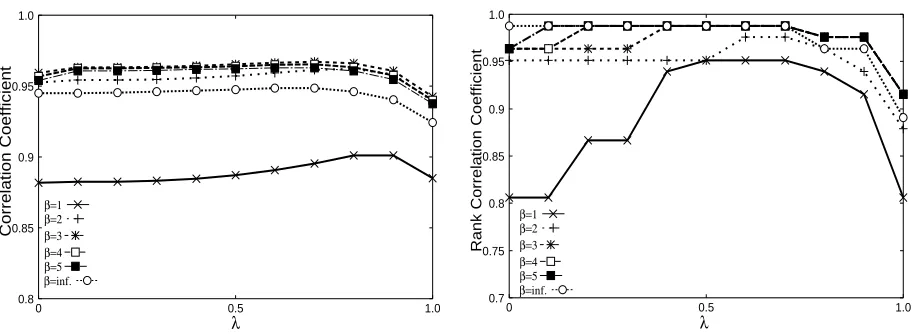
. In this section, we discuss the effects of these param-eters. Figure 1 shows and
Ö
for various and
¥
values with respect toÓ ÅYÔÕ . Note that we set l at
2 in the figure because the tendency is similar when we use other values, namelyl3&1¨ç%ì)'$ . From Fig.
1, we can see that¥
&1 is not good. With automatic
summarization, ‘precision’ is not necessarily a good evaluation measure because highly redundant sum-maries may obtain a very high precision. On the other hand, ‘recall’ is not good when a system’s out-put is redundant. Therefore, equal treatment of ‘pre-cision’ and ‘recall’ does not give a good evaluation measure. The figure shows that ¥
&h#% " and 5 are
good for and
¥
&h% ' +* and infinity are good for
Ö
. Moreover, we can see a significant differences be-tween¶&) and others from the figure. This implies
an advantage of our method compared to ROUGE-S and ROUGE-SU, which cannot handle decay factor for skip-n-grams.
From Fig. 1, we can see thatÖ
is more sensitive to
¥
than . Here,
¥
&1% ' +* and infinity obtained the
best results. ¥
&1 was again the worst. This result
indicates that we have to determine the parameter value properly for different tasks. does not greatly
affect the correlation forl3&h% ' +* and infinity as
re-gards the middle range.
Table 6 show the best results when we exam-ined all parameter combinations. In the brackets, we show the best settings of these parameter com-binations. For , l3&)# provides the best result and
middle range and
¥
&1# or 3 are good in most cases.
On the other hand, the best settings forÖ
[image:7.612.74.293.346.470.2]0.8 0.85 0.9 0.95 1.0
0 0.5 1.0
Correlation Coefficient
λ
β=1 β=2 β=3 β=4 β=5 β=inf.
0.7 0.75 0.8 0.85 0.9 0.95 1.0
0 0.5 1.0
Rank Correlation Coefficient
β=1 β=2 β=3 β=4 β=5 β=inf.
[image:8.612.81.538.53.220.2]λ
Figure 1: Correlation coefficients for various values of, and- on.0/132 .
the data set.46587 is not always good for9 .
In short, we can see that the decay parameter for skips is significant and long skip-n-grams are effec-tive especially9 .
These results show that our method has an ad-vantage over the ROUGE family. In addition, our method is robust and sufficiently good even if close attention is not paid to the parameters.
5 Conclusion
In this paper, we described an automatic evalua-tion method based on the ESK, which is a method for measuring the similarities between texts based on sequences of words and word senses. Our ex-periments showed that our method is comparable to ROUGE family for short summaries and outper-forms it for long summaries. In order to prove that our method is language independent, we will con-duct an experimental evaluation by using DUC’s evaluation data. We believe that our method will also be useful for other natural language generation tasks. We are now planning to apply our method to an evaluation of machine translation.
References
N. Cancedda, E. Gaussier, C. Goutte, and J-M. Renders. 2003. Word Sequence Kernels. Journal of Machine Learning Re-search, 3(Feb):1059–1082.
M. Collins and N. Duffy. 2001. Convolution Kernels for Nat-ural Language. In Proc. of NeNat-ural Information Processing Systems (NIPS’2001).
D. Harman and P. Over. 2004. The Effects of Human Variation in DUC Summarization Evaluation. In Proc. of Workshop on Text Summarization Branches Out, pages 10–17.
T. Hirao, T. Fukusima, M. Okumura, C. Nobata, and H. Nanba. 2004a. Corpus and Evaluation Measures for Multiple Docu-ment Summarization with Multiple Sources. In Proc. of the COLING, pages 535–541.
T. Hirao, J. Suzuki, H. Isozaki, and E. Maeda. 2004b. Dependency-based Sentence Alignment for Multiple Docu-ment Summarization. In Proc. of the COLING, pages 446– 452.
C. Hori, T. Hori, and S. Furui. 2003. Evaluation Methods for Automatic Speech Summarization. In Proc. of the Eu-rospeech2003, pages 2825–2828.
S. Ikehara, M. Miyazaki, S. Shirai, A. Yokoo, H. Nakaiwa, K. Ogura, Y. Ooyama, and Y. Hayashi. 1997. Goi-Taikei – A Japanese Lexicon (in Japanese). Iwanami Shoten.
C-Y. Lin and E. Hovy. 2003. Automatic Evaluation of Sum-maries Using N-gram Co-occurrence Statistics. In Proc. of the NAACL/HLT, pages 150–157.
C-Y. Lin and F.J. Och. 2004. Automatic Evaluation of Machine Translation Quality Using Longest Common Subsequence and Skip-Bigram Statistics. In Proc. of the ACL, pages 606– 613.
C-Y. Lin. 2004a. Looking for a Good Metrics: ROUGE and its Evaluation. In Proc. of the NTCIR Workshops, pages 1–8.
C-Y. Lin. 2004b. ROUGE: A Package for Automatic Evalua-tion of Summaries. In Proc. of Workshop on Text Summa-rization Branches Out, pages 74–81.
H. Lodhi, C. Saunders, J. Shawe-Taylor, N. Cristianini, and C. Watkins. 2002. Text Classification using String Kernel. Journal of Machine Learning Research, 2(Feb):419–444.
K. Papineni, S. Roukos, T. Ward, and Zhu W-J. 2002. BLEU: a Method for Automatic Evaluation of Machine Translation. In Proc. of the ACL, pages 311–318.