Improving LSA-based Summarization with Anaphora Resolution
Josef Steinberger University of West Bohemia Univerzitni 22, Pilsen 30614,
Czech Republic [email protected]
Mijail A. Kabadjov University of Essex
Wivenhoe Park, Colchester CO4 3SQ, United Kingdom
Massimo Poesio University of Essex
Wivenhoe Park, Colchester CO4 3SQ, United Kingdom
Olivia Sanchez-Graillet University of Essex
Wivenhoe Park, Colchester CO4 3SQ, United Kingdom
Abstract
We propose an approach to summarization exploiting both lexical information and the output of an automatic anaphoric re-solver, and using Singular Value Decom-position (SVD) to identify the main terms.
We demonstrate that adding anaphoric information results in significant perfor-mance improvements over a previously developed system, in which only lexical terms are used as the input toSVD. How-ever, we also show that how anaphoric in-formation is used is crucial: whereas using this information to add new terms does re-sult in improved performance, simple sub-stitution makes the performance worse.
1 Introduction
Many approaches to summarization can be very broadly characterized as TERM-BASED: they
at-tempt to identify the main ‘topics,’ which gen-erally are TERMS, and then to extract from the document the most important information about these terms (Hovy and Lin, 1997). These ap-proaches can be divided again very broadly in ‘lex-ical’ approaches, among which we would include
LSA-based approaches, and ‘coreference-based’ ap-proaches . Lexical apap-proaches to term-based sum-marization use lexical relations to identify cen-tral terms (Barzilay and Elhadad, 1997; Gong and Liu, 2002); coreference- (or anaphora-) based ap-proaches (Baldwin and Morton, 1998; Boguraev and
Kennedy, 1999; Azzam et al., 1999; Bergler et al., 2003; Stuckardt, 2003) identify these terms by run-ning a coreference- or anaphoric resolver over the text.1 We are not aware, however, of any attempt to use both lexical and anaphoric information to iden-tify the main terms. In addition, to our knowledge no authors have convincingly demonstrated that feed-ing anaphoric information to a summarizer signif-icantly improves the performance of a summarizer using a standard evaluation procedure (a reference corpus and baseline, and widely accepted evaluation measures).
In this paper we compare two sentence extraction-based summarizers. Both use Latent Semantic Analysis (LSA) (Landauer, 1997) to identify the main terms of a text for summarization; however, the first system (Steinberger and Jezek, 2004), dis-cussed in Section 2, only uses lexical information to identify the main topics, whereas the second sys-tem exploits both lexical and anaphoric information. This second system uses an existing anaphora reso-lution system to resolve anaphoric expressions,GUI -TAR (Poesio and Kabadjov, 2004); but, crucially, two different ways of using this information for summarization were tested. (Section 3.) Both sum-marizers were tested over theCASTcorpus (Orasan et al., 2003), as discussed in Section 4, and
sig-1
The terms ’anaphora resolution’ and ’coreference resolu-tion’ have been variously defined (Stuckardt, 2003), but the lat-ter lat-term is generally used to refer to the coreference task as de-fined inMUCandACE. We use the term ’anaphora resolution’ to refer to the task of identifying successive mentions of the same discourse entity, realized via any type of noun phrase (proper noun, definite description, or pronoun), and whether such dis-course entities ’refer’ to objects in the world or not.
nificant improvements were observed over both the baselineCAST system and our previous LSA-based summarizer.
2 An LSA-based Summarizer Using Lexical Information Only
LSA (Landauer, 1997) is a technique for extracting
the ‘hidden’ dimensions of the semantic representa-tion of terms, sentences, or documents, on the basis of their contextual use. It is a very powerful tech-nique already used forNLP applications such as in-formation retrieval (Berry et al., 1995) and text seg-mentation (Choi et al., 2001) and, more recently, multi- and single-document summarization.
The approach to using LSA in text summariza-tion we followed in this paper was proposed in (Gong and Liu, 2002). Gong and Liu propose to start by creating a term by sentences matrix A = [A1, A2, . . . , An], where each column vectorAi
rep-resents the weighted term-frequency vector of sen-tenceiin the document under consideration. If there are a total ofmterms andnsentences in the docu-ment, then we will have anm×nmatrixAfor the document. The next step is to apply Singular Value Decomposition (SVD) to matrixA. Given anm×n
matrixA, theSVDofAis defined as:
(1) A=UΣVT
whereU = [uij]is an m×ncolumn-orthonormal
matrix whose columns are called left singular vec-tors, Σ = diag(σ1, σ2, . . . , σn) is an n ×n
di-agonal matrix, whose didi-agonal elements are non-negative singular values sorted in descending order, andV = [vij]is ann×northonormal matrix, whose
columns are called right singular vectors.
From a mathematical point of view, applying
SVDto a matrix derives a mapping between them
-dimensional space spawned by the weighted term-frequency vectors and the r-dimensional singular vector space. From aNLPperspective, what theSVD
does is to derive the latent semantic structure of the document represented by matrixA: a breakdown of the original document intorlinearly-independent base vectors (‘topics’). Each term and sentence from the document is jointly indexed by these ‘topics’.
A unique SVD feature is that it is capable of cap-turing and modelling interrelationships among terms so that it can semantically cluster terms and
sen-tences. Furthermore, as demonstrated in (Berry et al., 1995), if a word combination pattern is salient and recurring in document, this pattern will be cap-tured and represented by one of the singular vec-tors. The magnitude of the corresponding singular value indicates the importance degree of this pattern within the document. Any sentences containing this word combination pattern will be projected along this singular vector, and the sentence that best repre-sents this pattern will have the largest index value with this vector. As each particular word combi-nation pattern describes a certain topic in the doc-ument, each singular vector can be viewed as repre-senting a salient topic of the document, and the mag-nitude of its corresponding singular value represents the degree of importance of the salient topic.
The summarization method proposed by Gong and Liu (2002) should now be easy to understand. The matrixVT describes the importance degree of each ’implicit topic’ in each sentence: the summa-rization process simply chooses the most informa-tive sentence for each term. In other words, thekth sentence chosen is the one with the largest index value in thekth right singular vector in matrixVT.
The summarization method proposed by Gong and Liu has some disadvantages as well, the main of which is that it is necessary to use the same number of dimensions as is the number of sentences we want to choose for a summary. However, the higher the number of dimensions of reduced space is, the less significant topic we take into a summary. In order to remedy this problem, we (Steinberger and Jezek, 2004) proposed the following modifications to Gong and Liu’s summarization method. After computing theSVDof a term by sentences matrix, we compute the length of each sentence vector in matrixV. This is to favour the index values in the matrix V that correspond to the highest singular values (the most significant topics). Formally:
(2) sk= qPr
i=1vk,i2 ·σi2,
whereskis the length of the vector ofk’th sentence
2004) that this modification results in a significant improvement over Gong and Liu’s method.
3 Using Anaphora Resolution for Summarization
3.1 The case for anaphora resolution
Words are the most basic type of ’term’ that can be used to characterize the content of a document. However, being able to identify the most important objects mentioned in the document clearly would lead to an improved analysis of what is important in a text, as shown by the following news article cited by Boguraev and Kennedy (1999):
(3) PRIEST IS CHARGED WITH POPE ATTACK
A Spanish priest was charged here today with attempt-ing to murder the Pope. Juan Fernandez Krohn, aged 32, was arrested after a man armed with a bayonet
ap-proached the Pope while he was saying prayers at Fa-tima on Wednesday night. According to the police, Fer-nandez told the investigators today that he trained for
the past six months for the assault. . . . If found guilty, the Spaniard faces a prison sentence of 15-20 years.
As Boguraev and Kennedy point out, the title of the article is an excellent summary of the content: an en-tity (the priest) did something to another enen-tity (the pope). Intuitively, understanding that Fernandez and the pope are the central characters is crucial to pro-vide a good summary of texts like these.2 Among the clues that help us to identify such ‘main charac-ters’, the fact that an entity is repeatedly mentioned is clearly important.
Purely lexical methods, including the LSA-based methods discussed in the previous section, can only capture part of the information about which enti-ties are frequently repeated in the text. As exam-ple (3) shows, stylistic conventions forbid verbatim repetition, hence the six mentions of Fernandez in the text above contain only one lexical repetition, ’Fernandez’. The main problem are pronouns, that tend to share the least lexical similarity with the form used to express the antecedent (and anyway are usually removed by stopword lists, therefore do not
2It should be noted that for many newspaper articles, indeed
many non-educational texts, only a ‘entity-centered’ structure can be clearly identified, as opposed to a ‘relation-centered’ structure of the type hypothesized in Rhetorical Structures The-ory (Knott et al., 2001; Poesio et al., 2004).
get included in theSVDmatrix). The form of defi-nite descriptions (the Spaniard) doesn’t always over-lap with that of their antecedent, either, especially when the antecedent was expressed with a proper name. The form of mention which more often over-laps to a degree with previous mentions is proper nouns, and even then at least some way of dealing with acronyms is necessary (cfr. European Union / E.U.). The motivation for anaphora resolution is that it should tell us which entities are repeatedly mentioned.
In this work, we tested a mixed approach to in-tegrate anaphoric and word information: using the output of the anaphoric resolverGUITAR to modify the SVDmatrix used to determine the sentences to extract. In the rest of this section we first briefly in-troduce GUITAR, then discuss the two methods we tested to use its output to help summarization.
3.2 GUITAR: A General-Purpose Anaphoric Resolver
The system we used in these experiments,GUITAR
(Poesio and Kabadjov, 2004), is an anaphora resolu-tion system designed to be high precision, modular, and usable as an off-the-shelf component of a NL processing pipeline. The current version of the sys-tem includes an implementation of the MARS pro-noun resolution algorithm (Mitkov, 1998) and a par-tial implementation of the algorithm for resolving definite descriptions proposed by Vieira and Poe-sio (2000). The current verPoe-sion ofGUITARdoes not include methods for resolving proper nouns.
3.2.1 Pronoun Resolution
3.2.2 Definite Description Resolution
The Vieira / Poesio algorithm (Vieira and Poesio, 2000) attempts to classify each definite description as either direct anaphora, discourse-new, or bridg-ing description. The first class includes definite de-scriptions whose head is identical to that of their an-tecedent, as in a house . . . the house. Discourse-new descriptions are definite descriptions that refer to objects not already mentioned in the text and not related to any such object. Bridging descriptions are all definite descriptions whose resolution depends on knowledge of relations between objects, such as definite descriptions that refer to an object related to an entity already introduced in the discourse by a relation other than identity, as in the flat . . . the living room. The Vieira / Poesio algorithm also at-tempts to identify the antecedents of anaphoric de-scriptions and the anchors of bridging ones. The current version ofGUITARincorporates an algorithm for resolving direct anaphora derived quite directly from Vieira / Poesio, as well as a statistical version of the methods for detecting discourse new descrip-tions (Poesio et al., 2005).
3.3 SVD over Lexical and Anaphoric Terms
SVDcan be used to identify the ‘implicit topics’ or main terms of a document not only when on the basis of words, but also of coreference chains, or a mix-ture of both. We tested two ways of combining these two types of information.
3.3.1 The Substitution Method
The simplest way of integrating anaphoric in-formation with the methods used in our earlier work is to use anaphora resolution simply as a pre-processing stage of the SVD input matrix creation. Firstly, all anaphoric relations are identified by the anaphoric resolver, and anaphoric chains are identi-fied. Then a second document is produced, in which all anaphoric nominal expressions are replaced by the first element of their anaphoric chain. For exam-ple, suppose we have the text in (4).
(4) S1: Australia’s new conservative government on Wednesday began selling its tough deficit-slashing bud-get, which sparked violent protests by Aborigines, unions, students and welfare groups even before it was announced.
S2: Two days of anti-budget street protests preceded
spending cuts officially unveiled by Treasurer Peter
Costello.
S3: ”If we don’t do it now, Australia is going to be in
deficit and debt into the next century.”
S4: As the protesters had feared, Costello revealed a
cut to the government’s Aboriginal welfare commission among the hundreds of measures implemented to claw back the deficit.
An ideal resolver would find 8 anaphoric chains:
Chain 1 Australia - we - Australia
Chain 2 its new conservative government (Australia’s new
conservative government) - the government
Chain 3 its tough deficit-slashing budget (Australia’s tough
deficit-slashing budget) - it
Chain 4 violent protests by Aborigines, unions, students and
welfare groups - anti-budget street protests
Chain 5 Aborigines, unions, students and welfare groups - the
protesters
Chain 6 spending cuts - it - the hundreds of measures
imple-mented to claw back the deficit
Chain 7 Treasurer Peter Costello - Costello
Chain 8 deficit - the deficit
By replacing each element of the 8 chains above in the text in (4) with the first element of the chain, we get the text in (5).
(5) S1: Australia’s new conservative government on Wednesday began selling Australia’s tough deficit-slashing budget, which sparked violent protests by Abo-rigines, unions, students and welfare groups even be-fore Australia’s tough deficit-slashing budget was an-nounced.
S2: Two days of violent protests by Aborigines, unions,
students and welfare groups preceded spending cuts of-ficially unveiled by Treasurer Peter Costello.
S3: ”If Australia doesn’t do spending cuts now,
Aus-tralia is going to be in deficit and debt into the next century.”
S4: As Aborigines, unions, students and welfare groups had feared, Treasurer Peter Costello revealed a cut to Australia’s new conservative government’s Abo-riginal welfare commission among the spending cuts.
This text is then used to create theSVDinput matrix, as done in the first system.
3.3.2 The Addition Method
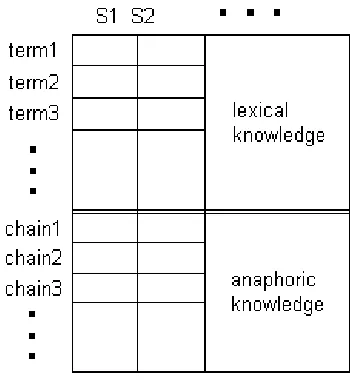
chains. In other words, our representation of sen-tences would specify not only if they contain a cer-tain word, but also if they concer-tain a mention of a discourse entity (See Figure 1.) This matrix would then be used as input toSVD.
Figure 1: Addition method.
The chain ‘terms’ tie together sentences that con-tain the same anaphoric chain. If the terms are lexically the same (direct anaphors - like deficit and the deficit) the basic summarizer works suffi-ciently. However, Gong and Liu showed that the best weighting scheme is boolean (i.e., all terms have the same weight); our own previous results confirmed this. The advantage of the addition method is the opportunity to give higher weights to anaphors.
4 Evaluation
4.1 The CAST Corpus
To evaluate our system, we used the corpus of manually produced summaries created by theCAST
project3 (Orasan et al., 2003). The CAST cor-pus contains news articles taken from the Reuters Corpus and a few popular science texts from the British National Corpus. It contains information about the importance of the sentences (Hasler et al., 2003). Sentences are marked as essential or
im-portant. The corpus also contains annotations for
3The goal of this project was to investigate to what extent
Computer-Aided Summarization can help humans to produce high quality summaries with less effort.
linked sentences, which are not significant enough to be marked as important/essential, but which have to be considered as they contain information estial for the understanding of the content of other sen-tences marked as essential/important.
Four annotators were used for the annotation, three graduate students and one postgraduate. Three of the annotators were native English speakers, and the fourth had advanced knowledge of English. Un-fortunately, not all of the documents were annotated by all of the annotators. To maximize the reliability of the summaries used for evaluation, we chose the documents annotated by the greatest number of the annotators; in total, our evaluation corpus contained 37 documents.
For acquiring manual summaries at specified lengths and getting the sentence scores (for relative utility evaluation) we assigned a score 3 to the sen-tences marked as essential, a score 2 to important sentences and a score 1 to linked sentences. The sentences with highest scores are then selected for ideal summary (at specified lenght).
4.2 Evaluation Measures
Evaluating summarization is a notoriously hard problem, for which standard measures like Preci-sion and Recall are not very appropriate. The main problem with P&R is that human judges often dis-agree what are the top n% most important sentences in a document. Using P&R creates the possibility that two equally good extracts are judged very dif-ferently. Suppose that a manual summary contains sentences [1 2] from a document. Suppose also that two systems, A and B, produce summaries consist-ing of sentences [1 2] and [1 3], respectively. Us-ing P&R, system A will be ranked much higher than system B. It is quite possible that sentences 2 and 3 are equally important, in which case the two systems should get the same score.
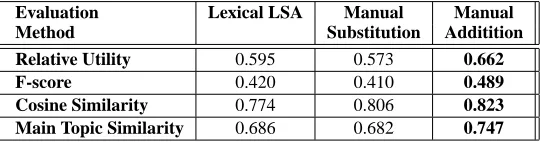
Evaluation Lexical LSA Manual Manual
Method Substitution Additition
Relative Utility 0.595 0.573 0.662
F-score 0.420 0.410 0.489
Cosine Similarity 0.774 0.806 0.823
[image:6.612.181.451.55.126.2]Main Topic Similarity 0.686 0.682 0.747
Table 1: Evaluation of the manual annotation improvement - summarization ratio: 15%.
Evaluation Lexical LSA Manual Manual
Method Substitution Addition
Relative Utility 0.645 0.662 0.688
F-score 0.557 0.549 0.583
Cosine Similarity 0.863 0.878 0.886
Main Topic Similarity 0.836 0.829 0.866
Table 2: Evaluation of the manual annotation improvement - summarization ratio: 30%.
4/1 5/2]. The second number in each pair indicates the degree to which the given sentence should be part of the summary according to a human judge. This number is called the utility of the sentence. Utility depends on the input document, the summary length, and the judge. In the example, the system that selects sentences [1 2] will not get a higher score than a system that chooses sentences [1 3] given that both summaries [1 2] and [1 3] carry the same number of utility points (5+4). Given that no other combination of two sentences carries a higher util-ity, both systems [1 2] and [1 3] produce optimal extracts. To compute relative utility, a number of judges,(N ≥1)are asked to assign utility scores to allnsentences in a document. The topesentences according to utility score4are then called a sentence extract of sizee. We can then define the following system performance metric:
(6) RU =
Pn j=1δj
PN i=1uij
Pn j=1ǫj
PN i=1uij
,
whereuij is a utility score of sentencejfrom
anno-tatori,ǫjis 1 for the topesentences according to the
sum of utility scores from all judges andδj is equal
to 1 for the topesentences extracted by the system. For details see (Radev et al., 2000).
The second measure we used is Cosine Similarity, according to the standard formula:
(7) cos(X, Y) =
P ixi·yi pP
i(xi)2· pP
i(yi)2 ,
4
In the case of ties, some arbitrary but consistent mecha-nism is used to decide which sentences should be included in the summary.
where X and Y are representations of a system sum-mary and its reference sumsum-mary based on the vector space model. The third measure is Main Topic Sim-ilarity. This is a content-based evaluation method based on measuring the cosine of the angle between first left singular vectors of a system summary’s and its reference summary’s SVDs. (For details see (Steinberger and Jezek, 2004).) Finally, we mea-suredROUGEscores, with the same settings as in the
Document Understanding Conference (DUC) 2004.
4.3 How Much May Anaphora Resolution Help? An Upper Bound
We annotated all the anaphoric relations in the 37 documents in our evaluation corpus by hand us-ing the annotation toolMMAX(Mueller and Strube,
2003).5 Apart from measuring the performance of
GUITARover the corpus, this allowed us to establish the upper bound on the performance improvements that could be obtained by adding an anaphoric re-solver to our summarizer. We tested both methods of adding the anaphoric knowledge to the summa-rizer discussed above. Results for the 15% and 30% ratios6are presented in Tables 1 and 2. The baseline is our own previously developed LSA-based
sum-marizer without anaphoric knowledge. The result is that the substitution method did not lead to sig-nificant improvement, but the addition method did:
5
We annotated personal pronouns, possessive pronouns, def-inite descriptions and also proper nouns, who will be handled by a futureGUITARversion.
6We used the same summarization ratios as in
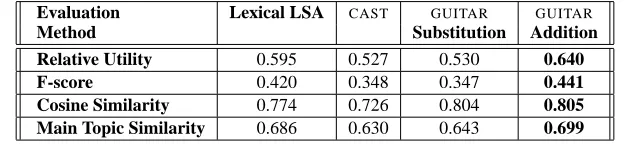
Evaluation Lexical LSA CAST GUITAR GUITAR
Method Substitution Addition
Relative Utility 0.595 0.527 0.530 0.640
F-score 0.420 0.348 0.347 0.441
Cosine Similarity 0.774 0.726 0.804 0.805
[image:7.612.157.469.55.127.2]Main Topic Similarity 0.686 0.630 0.643 0.699
Table 3: Evaluation of theGUITARimprovement - summarization ratio: 15%.
Evaluation Lexical LSA CAST GUITAR GUITAR
Method Substitution Addittion
Relative Utility 0.645 0.618 0.626 0.678
F-score 0.557 0.522 0.524 0.573
Cosine Similarity 0.863 0.855 0.873 0.879
Main Topic Similarity 0.836 0.810 0.818 0.868
Table 4: Evaluation of theGUITARimprovement - summarization ratio: 30%.
addition could lead to an improvement in Relative Utility score from .595 to .662 for the 15% ratio, and from .645 to .688 for the 30% ratio. Both of these improvements were significant by t-test at 95% con-fidence.
4.4 Results with GUITAR
To useGUITAR, we first parsed the texts using
Char-niak’s parser (Charniak, 2000). The output of the parser was then converted into the MAS-XML for-mat expected by GUITAR by one of the
preproces-sors that come with the system. (This step includes heuristic methods for guessing agreement features.) Finally, GUITAR was ran to add anaphoric
infor-mation to the files. The resulting files were then processed by the summarizer.
GUITARachieved a precision of 56% and a recall
of 51% over the 37 documents. For definite descrip-tion resoludescrip-tion, we found a precision of 69% and a recall of 53%; for possessive pronoun resolution, the precision was 53%, recall was 53%; for personal pronouns, the precision was 44%, recall was 46%.
The results with the summarizer are presented in Tables 3 and 4 (relative utility, f-score, cosine, and main topic). The contribution of the differ-ent anaphora resolution compondiffer-ents is addressed in (Kabadjov et al., 2005). All versions of our summa-rizer (the baseline version without anaphora resolu-tion and those using substituresolu-tion and addiresolu-tion) out-performed theCASTsummarizer, but we have to em-phasize thatCAST did not aim at producing a high-performance generic summarizer; only a system that
could be easily used for didactical purposes. How-ever, our tables also show that usingGUITARand the addition method lead to significant improvements over our baseline LSA summarizer. The improve-ment in Relative Utility measure was significant by t-test at 95% confidence. Using the ROUGE mea-sure we obtained improvement (but not significant). On the other hand, the substitution method did not lead to significant improvements, as was to be ex-pected given that no improvement was obtained with ’perfect’ anaphora resolution (see previous section).
5 Conclusion and Further Research
References
S. Azzam, K. Humphreys and R. Gaizauskas. 1999. Using coreference chains for text summarization. In Proceedings of the ACL Workshop on Coreference. Maryland.
B. Baldwin and T. S. Morton. 1998. Dynamic coreference-based summarization. In Proceedings of EMNLP. Granada, Spain.
R. Barzilay and M. Elhadad. 1997. Using lexical chains for text summarization. In Proceedings of the ACL/EACL Workshop on Intelligent Scalable Text Summarization. Madrid, Spain.
S. Bergler, R. Witte, M. Khalife, Z. Li, and F. Rudzicz. 2003. Using Knowledge-poor Coreference Resolution for Text Summarization. In Proceedings of DUC. Edmonton.
M. W. Berry, S. T. Dumais and G. W. O’Brien. 1995. Using Linear Algebra for Intelligent IR. In SIAM Review, 37(4).
B. Boguraev and C. Kennedy. 1999. Salience-based content characterization of text documents. In I. Mani and M. T. Maybury (eds), Advances in Automatic Text Summarization, MIT Press. Cambridge, MA.
E. Charniak. 2000. A maximum-entropy-inspired parser. In Proceedings of NAACL. Philadelphia.
F. Y. Y. Choi, P. Wiemer-Hastings and J. D. Moore. 2001. La-tent Semantic Analysis for Text Segmentation. In Proceed-ings of EMNLP. Pittsburgh.
Y. Gong and X. Liu. 2002. Generic Text Summarization Us-ing Relevance Measure and Latent Semantic Analysis. In Proceedings of ACM SIGIR. New Orleans.
L. Hasler, C. Orasan and R. Mitkov. 2003. Building better corpora for summarization. In Proceedings of Corpus Lin-guistics. Lancaster, United Kingdom.
E. Hovy and C. Lin. 1997. Automated text summarization in SUMMARIST. In ACL/EACL Workshop on Intelligent Scal-able Text Summarization. Madrid, Spain.
M. A. Kabadjov, M. Poesio and J. Steinberger. 2005. Task-Based Evaluation of Anaphora Resolution: The Case of Summarization. In RANLP Workshop ”Crossing Barriers in Text Summarization Research”. Borovets, Bulgaria.
A. Knott, J. Oberlander, M. O’Donnell, and C. Mellish. 2001. Beyond elaboration: The interaction of relations and focus in coherent text. In Sanders, T., Schilperoord, J., and Spooren, W. (eds), Text representation: linguistic and psycholinguistic aspects. John Benjamins.
T. K. Landauer and S. T. Dumais. 1997. A solution to Plato’s problem: The latent semantic analysis theory of the acqui-sition, induction, and representation of knowledge. In Psy-chological Review, 104, 211-240.
R. Mitkov. 1998. Robust pronoun resolution with limited knowledge. In Proceedings of COLING. Montreal.
C. Mueller and M. Strube. 2001. MMAX: A Tool for the Anno-tation of Multi-modal Corpora. In Proceedings of the IJCAI Workshop on Knowledge and Reasoning in Practical Dia-logue Systems. Seattle.
C. Orasan, R. Mitkov and L. Hasler. 2003. CAST: a Computer-Aided Summarization Tool. In Proceedings of EACL. Bu-dapest, Hungary.
M. Poesio and M. A. Kabadjov. 2004. A General-Purpose, off-the-shelf Anaphora Resolution Module: Implementation and Preliminary Evaluation. In Proceedings of LREC. Lisbon, Portugal.
M. Poesio, R. Stevenson, B. Di Eugenio, and J. M. Hitzeman. 2004. Centering: A parametric theory and its instantiations. Computational Linguistics, 30(3).
M. Poesio, M. A. Kabadjov, R. Vieira, R. Goulart, and O. Uryupina. 2005. Do discourse-new detectors help def-inite description resolution? In Proceedings of IWCS. Tilburg, The Netherlands.
D. R. Radev, H. Jing, and M. Budzikowska. 2000. Centroid-based summarization of multiple documents. In ANLP/NAACL Workshop on Automatic Summarization. Seattle.
J. Steinberger and K. Jezek. 2004. Text Summarization and Singular Value Decomposition. In Proceedings of ADVIS. Izmir, Turkey.
R. Stuckardt. 2003. Coreference-Based Summarization and Question Answering: a Case for High Precision Anaphor Resolution. In International Symposium on Reference Reso-lution. Venice, Italy.