Touch-Based Pre-Post-Editing of Machine Translation Output
Benjamin Marie LIMSI-CNRS, Orsay, France Lingua et Machina, Le Chesnay, France
Aur´elien Max
LIMSI-CNRS, Orsay, France Univ. Paris Sud, Orsay, France
Abstract
We introduce pre-post-editing, possibly
the most basic form of interactive trans-lation, as a touch-based interaction with iteratively improved translation hypothe-ses prior to classical post-editing. We re-port simulated experiments that yield very large improvements on classical evalua-tion metrics (up to 21 BLEU) as well as on a parameterized variant of the TER metric that takes into account the cost of
matching/touching tokens, confirming the
promising prospects of the novel transla-tion scenarios offered by our approach.
1 Introduction
As shown by oracle studies (Wisniewski et al., 2010; Turchi et al., 2012; Marie and Max, 2013), Statistical Machine Translation (SMT) systems produce results that are of significantly lower qual-ity than what could be produced from their avail-able resources. As a pragmatic solution, human intervention is commonly used for improving
au-tomatic draft translations, in so-calledpost-editing
(PE), but is also studied earlier in the translation process in a variety of interactive strategies, in-cluding e.g. completion assistance and local trans-lation choices (e.g. (Foster et al., 2002; Koehn and Haddow, 2009; Gonz´alez-Rubio et al., 2013)).
Al-thoughinteractive machine translationdoes
facil-itate the work of the SMT system in certain situa-tions by allowing it to make efficient use of knowl-edge contributed by the human translator, post-editing has been shown to remain a faster alter-native (Green et al., 2014). Nevertheless, this ac-tivity usually requires complex intervention from an expert translator (Carl et al., 2011).
In this work we reduce interaction with an SMT system to its most basic form: similarly to what a human translator is likely to do when first reading
a draft translation to post-edit, we require a user
to simply spot those segments of a draft
tion that can participate in an acceptable transla-tion. The corresponding information is then used by a SMT system in a soft way to improve the draft translation. This process may be iteratively repeated as long as enough improvements are ob-tained, and terminates with classical post-editing
on the obtained translation, hence we dub it
pre-post-editing (PPE). We resort to simulated pre-post-editing and pre-post-editing, as in other works (Carl et al., 2011; Denkowski et al., 2014), to measure translation performance on some avail-able reference translation using both classical met-rics and a variant of the TER metric (Snover et al., 2006), where, essentially, the cost of a token
matchingoperation is a parameterized fraction of the cost of the other token edit operations. With the implementation of appropriate strategies in the SMT system, we show under reasonable assump-tions that this approach has the potential to signifi-cantly reduce the amount of human effort required to obtain a final translation.
In the remainder of this article, we describe the technical details of pre-post-editing (Section 2), report experiments conducted on two translation directions and two domains (Section 3), and fi-nally discuss our proposal and introduce our future work (Section 4).
2 Touch-based pre-post-editing
In our PPE framework, the humanpre-post-editor
has to mark n-grams from a translation
hypoth-esis that can take part in a correct translation.1
The annotatedn-grams are counted, as ann-gram
can appear more than once in the same sentence, and a “positive” 6-gram language model (LM)
1A touch-based interface when a keyboard is not available
or typing is inconvenient lends itself particularly well to PPE.
(positive-lm) is trained on these counts2. A
“negative” LM (negative-lm) is also trained
on the counted n-grams left unannotated. Then,
all bi-phrases from the SMT system’s phrase
ta-ble that match an annotatedn-gram, according to
the source token alignments provided by the de-coder, are removed from the main phrase table and stored in a separate “positive” phrase table (positive-pt). Conversely, n-grams contain-ing at least one token left unannotated are consid-ered as incorrect, and the set of bi-phrases
match-ing these n-grams are removed and stored in a
“negative” phrase table (negative-pt).
As source tokens can appear more than once in a
source text, they arelocated: an identifier is
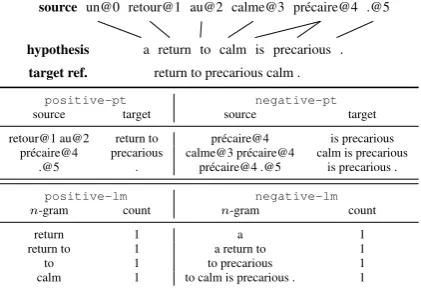
con-catenated to each token to make it unique in the source text. Tokens of the source phrases in the phrase table are accordingly also located, so each bi-phrase is duplicated as needed to cover all lo-cated tokens. Using lolo-cated tokens allows our PPE framework to treat differently source tokens that are correctly translated from incorrectly translated ones in the same sentence or text. Figure 1 shows an example of phrase table extraction, using
lo-cated source tokens3, for one iteration of PPE.
If ann-gram is annotated as correct, all its
in-nern-grams of lower order are also deemed
cor-rect. Although annotating translations of high quality may be less expensive by explicitely
anno-tating incorrect n-grams instead of correct ones,
such annotations would not permit to identify
cor-rect n-grams inside incorrect ones, as illustrated
in Figure 2. PPE can thus be worded as a simple
problem for the pre-post-editor: which sequences
of tokens should appear in the final translation?
The newly extracted phrase tables and LMs4,
along with the remainder of the original phrase table and the original LM, are used to re-decode the source text in a first iteration of PPE. A new PPE annotation can then be performed on the new translations. The newly extracted “positive” and “negative” phrase tables are merged with the cor-responding phrase table of the previous iteration.
The extractedn-gram counts from the current
iter-ation and the counts of the previous iteriter-ations are summed, and the LMs are re-trained with the up-dated counts. A new iteration of PPE is then
per-2We used SRILM (Stolcke, 2002) to train the LMs with
Witten-Bell smoothing.
3Subsequent examples do not use located tokens. 4The extracted LMs are sentence-level, and are only used
on their specific sentence during PPE.
source un@0 retour@1 au@2 calme@3 pr´ecaire@4 .@5
hypothesis a return to calm is precarious . target ref. return to precarious calm .
positive-pt negative-pt
source target source target retour@1 au@2 return to pr´ecaire@4 is precarious
pr´ecaire@4 precarious calme@3 pr´ecaire@4 calm is precarious .@5 . pr´ecaire@4 .@5 is precarious .
positive-lm negative-lm
n-gram count n-gram count
return 1 a 1
return to 1 a return to 1
to 1 to precarious 1
[image:2.595.312.523.65.209.2]calm 1 to calm is precarious . 1
Figure 1: Examples of some of the bi-phrases and
n-grams extracted for phrase tables and language
models according to a reference translation.
source son impopularit´e semble ˆetre en grande partie due au chˆomage PPE#0 his unpopularity seems to be owing largely to unemployment PPE#1 his unpopularity seems to be largely owing to unemployment target ref his unpopularity seems to be largely owing to unemployment
Figure 2: Annotation example for two correct
to-kens forming an incorrectn-gram. At the first PPE
iteration a reordering is performed and the new hy-pothesis now matches the reference translation.
formed with the updated models. The weights for all, old or new, models in the log-linear combina-tion are found by tuning on a development set for
each PPE iteration.5 Figure 3 illustrates 4
itera-tions of PPE from an initial translation hypothesis assuming a given target reference translation.
3 Experiments 3.1 Data and systems
We ran experiments on two translation tasks of different domains: the WMT’14 Medical
trans-lation task (medical) and the WMT’11 news
translation task (news) for the language pair en-fr
on both translation directions. For both tasks we trained two competitive phrase-based SMT
sys-tems usingMoses(Koehn et al., 2007) and WMT
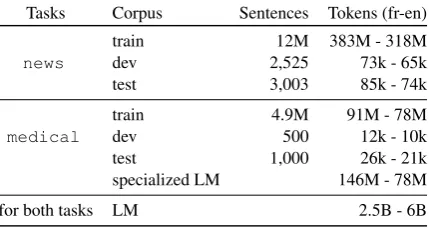
data6 (see Table 1). The tuning for all systems,
including our iteration-specific PPE systems, was
performed with kb-mira (Cherry and Foster,
2012).
3.2 An adapted evaluation metric: TERPPE Classical MT evaluation metrics cannot take into account the interactive cost of PPE, and thus do
source c’ est la r´eponse `a une nouvelle prise de conscience selon laquelle les entreprises chinoises sont indispensables `a la survie ´economique de Taiwan
PPE#0 this is the answer to a new awareness that Chinese companies are essential to the economic survival of Taiwan
PPE#1 it is the response to a new awareness that Chinese firms are essential to Taiwan’s economic survival .
PPE#2 it is the reply to a new awareness that Chinese enterprises is essential to Taiwan’s economic survival .
PPE#3 it is responding to a new awareness that Chinese businesses is essential to Taiwan’s economic survival .
PPE#4 it is responding to a new awareness that Chinese business is essential to Taiwan’s economic survival .
[image:3.595.75.290.240.355.2]target ref it is responding to a new awareness that Chinese business is essential to Taiwan’s economic survival .
Figure 3: Example of a pre-post-edition trace for French to English translation (using thenews task,
cf. Section 3) using a given implicit target reference translation for simulating pre-editing and post-editing. Each newly touched phrase is indicated with a green background. Phrases with a gray back-ground indicate previously touched phrases but their tokens remain individually touchable by the user.
Tasks Corpus Sentences Tokens (fr-en)
news traindev 2,52512M 383M - 318M73k - 65k
test 3,003 85k - 74k
medical traindev 4.9M500 91M - 78M12k - 10k
test 1,000 26k - 21k
specialized LM 146M - 78M
for both tasks LM 2.5B - 6B
Table 1: Data used in this work.
not allow us to make direct comparisons with PE. We thus adapt the TER (Snover et al., 2006) metric, which typically uses 4 types of token
edits: substitution (s), insertion (i),
deletion(d) andshift(f). While these edit types all have a (debatable) uniform cost of 1, the
operation ofmatching (m) a correct token is
ig-nored. We posit that this operation is in fact per-formed by a human translator during PE (at the minimum, by recognizing and skipping tokens), and that it can be directly compared to our touch-based selection of tokens for PPE. However, we cannot at this stage of our work provide a realistic cost value for this operation, and so we introduce
a match cost parameterα, and use the following
as our PPE-aware metric:
TERPPE= #s+ #d+ #r+i+ #αr f +α#m (1)
wherer is the number of tokens in the reference
translation. Note that a null value for α makes
TERPPE correspond to TER, while a value of 1
would indicate that a token matching/touch (m)
is e.g. as costly as a token rewriting (s). We
antic-ipate that a realistic value forαgiven a reasonably
skilled user should be rather small, but we will
provide TERPPEresults for the full range[0,1].
3.3 Experimental results
To validate our approach, we initially used a sim-ulated post-editing paradigm (Carl et al., 2011; Denkowski et al., 2014) in which non-post-edited reference translations are used in lieu of human post-editions. Results on TER (Snover et al., 2006) and BLEU (Papineni et al., 2002), tuning
on both metrics, are provided in Tables 2 (news)
and 3 (medical).
First, we observe that whatever the metric and the task, the first iteration of PPE always yields
a significant improvement over theMosesinitial
system (e.g. up to +9.8 BLEU and -8.2 TER for
news fr→en). Unsurprisingly, tuning on a
met-ric yields better results for the same metmet-ric for the first iteration; however, we note that this is not always true for the TER metric at later
itera-tions (cf. news en→fr). More generally, tuning
on the TER metric results in lower improvements
for news, which are mostly concentrated on the
first iterations; as systems tuned on BLEU have been found to produce better translations than sys-tems tuned on TER (Cer et al., 2010), only BLEU
tuning was used formedical.7
Improvements follow an interesting pattern
over PPE iterations: for instance, on news
fr→en, BLEU scores steadily increase after each new touch-based iteration and reach a gain of +21.1 BLEU and -12.3 TER over the initial
Moses translation after 5 PPE iterations. Re-sults are very comparable on both language pairs and both domains, e.g. gains of +12.1 BLEU
and -9.7 TER are obtained on fr→enmedical.
The lesser amplitude of the gains obtained after 5 iterations may be attributed to the higher
ini-7We have observed a tendency of the TER tuning to shrink
Iteration tuned with TERfr→tuned with BLEUen tuned with TERen→tuned with BLEUfr
TER BLEU TER BLEU TER BLEU TER BLEU
Moses 51.1 28.2 52.7 28.6 52.3 29.7 51.8 31.1
PPE iteration 1 42.9 35.4 46.7 38.4 44.4 35.0 47.3 39.6
PPE iteration 2 40.8 37.3 43.7 43.4 43.0 36.3 44.6 43.9
PPE iteration 3 40.8 37.8 42.2 46.2 42.5 36.4 43.5 46.6
PPE iteration 4 39.9 37.9 40.9 48.3 42.3 36.5 42.3 48.2
[image:4.595.141.459.64.156.2]PPE iteration 5 39.9 37.9 40.4 49.7 42.2 36.6 41.0 49.5
Table 2: PPE results on thenewstask.
tial quality of the translations in the medical
task (e.g. 37.1 BLEU vs 28.6 BLEU in fr→en for
Moseswith BLEU tuning).
Iteration tuned with BLEUfr→en tuned with BLEUen→fr
TER BLEU TER BLEU
Moses 42.2 37.1 44.0 38.8
PPE iteration 1 36.9 44.9 37.2 48.3
PPE iteration 2 34.8 47.5 35.3 51.1
PPE iteration 3 34.1 48.5 33.5 52.9
PPE iteration 4 32.9 49.2 32.4 54.0
[image:4.595.330.501.200.492.2]PPE iteration 5 32.5 49.2 32.1 54.8
Table 3: PPE results on themedicaltask.
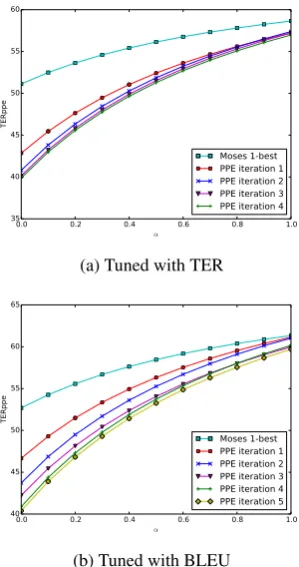
Figures 4 and 5 show how our TERPPE metric
varies for different values of ourαparameter
(re-call thatα = 0corresponds to TER). Essentially,
whatever the value of α, we observe that any
it-eration of PPE dominates PE (Moses 1-best),
but with a tendency to become as costly as PE for
high, but probably unrealistic values ofα. Tuning
with BLEU allows us to bring regular improve-ments as the number of iteration increases, while tuning with TER makes the amplitude of the gains decrease faster.
Furthermore, results shown in Table 4 point out the complementarity between negative
models (negative-lm and negative-pt)
and positive models (positive-lm and
positive-pt), with a drop of almost 10 BLEU points compared to the corresponding config-uration using all models when removing one type of models on both translation directions.
The language models (negative-lm and
positive-lm) seem to play a more impor-tant role during PPE than the phrase tables (negative-pt and positive-pt), with
a drop of 9.6 BLEU points on news fr→en
when removing the language models against a significantly lower drop of 4.4 BLEU points when removing the phrase tables.
0.0 0.2 0.4 0.6 0.8 1.0
α
42 44 46 48 50 52 54 56 58 60
TERppe
Moses 1-best PPE iteration 1 PPE iteration 2 PPE iteration 3 PPE iteration 4 PPE iteration 5
(a) Tuned with TER
0.0 0.2 0.4 0.6 0.8 1.0
α
40 45 50 55 60
TERppe
Moses 1-best PPE iteration 1 PPE iteration 2 PPE iteration 3 PPE iteration 4 PPE iteration 5
(b) Tuned with BLEU
Figure 4: PPE results on the en→frnewstask.
4 Discussion and future work
We have introducedpre-post-editing, a minimalist
interactive machine translation paradigm where a user is only asked to spot text fragments that may be used in the final translation. Our approach is quite comparable to the two-pass procedure de-scribed by Luong et al. (2014) using word-level confidence estimation (e.g. (Bach et al., 2011)) to update the cost of the search graph hypotheses. However, contrarily to Luong et al.’s work, our PPE framework is efficiently multi-pass, updates the models over iterations and relies on more
in-formative annotations made atn-gram-level. Our
[image:4.595.84.279.259.351.2]Configuration tuned with BLEUfr→en tuned with BLEUen→fr
TER BLEU TER BLEU
Moses 52.7 28.6 51.8 31.1
PPE w/ all models 40.4 49.7 41.0 49.5
PPE w/onegative-ptandnegative-lm 45.2 39.4 47.1 39.0
PPE w/opositive-ptandpositive-lm 46.7 39.8 48.3 39.8
PPE w/onegative-ptandpositive-pt 45.0 45.3 46.5 44.9
[image:5.595.150.450.63.166.2]PPE w/onegative-lmandpositive-lm 42.7 40.1 43.2 42.0
Table 4: PPE results for thenewstask after 5 iterations using various configurations.
0.0 0.2 0.4 0.6 0.8 1.0
α
35 40 45 50 55 60
TERppe
Moses 1-best PPE iteration 1 PPE iteration 2 PPE iteration 3 PPE iteration 4
(a) Tuned with TER
0.0 0.2 0.4 0.6 0.8 1.0
α
40 45 50 55 60 65
TERppe
Moses 1-best PPE iteration 1 PPE iteration 2 PPE iteration 3 PPE iteration 4 PPE iteration 5
(b) Tuned with BLEU
Figure 5: PPE results on the fr→ennewstask.
is very different from that expected of a post-editor or in existing interactive translation modes, and lends itself nicely to touch-based interaction. Fur-thermore, our proposal may in fact define a new
rolein Computer-Assisted Translation, with PPE
being performed on-the-go on mobile devices by more people than available human translators, and even possibly by monolinguals of the target lan-guage whose contribution may be more efficiently exploited than that of monolinguals of the source language (e.g. (Resnik et al., 2010)).
In terms of usability, our future work will
fo-cus on two important questions: (a) study the
actual use of PPE in an interactive setting and
tune the α parameter for our TERPPE metric on
HTER (Snover et al., 2006) traces, and (b) study
whether PPE alters in any positive way the work of the human translator performing the
resid-ual post-editing, hoping that PE could become
a less tedious task by nature. We further an-ticipate that some additions would improve our approach, including dealing early with out-of-vocabulary phrases, proposing local drop-down options (e.g. (Koehn and Haddow, 2009)), possi-bly clustered by senses, allowing the user to eas-ily fix reordering issues, and adapting PPE to be discourse-aware (e.g. (Ture et al., 2012)).
5 Acknowledgements
The authors would like to thank the anonymous reviewers for their helpful comments and sugges-tions. The work of the first author is supported by a CIFRE grant from French ANRT.
References
Nguyen Bach, Fei Huang, and Yaser Al-Onaizan. 2011. Goodness: A Method for Measuring Ma-chine Translation Confidence. In Proceedings of ACL, Portland, USA.
Michael Carl, Dragsted Barbara, Jakob Elming, Hardt Daniel, and Jakobsen Arnt Lykke. 2011. The Pro-cess of Post-Editing: A pilot study. InCopenhagen Studies in Language.
Daniel Cer, Christopher D. Manning, and Daniel Juraf-sky. 2010. The best lexical metric for phrase-based statistical mt system optimization. InProceedings of NAACL, Los Angeles, USA.
Colin Cherry and George Foster. 2012. Batch Tun-ing Strategies for Statistical Machine Translation. In
Proceedings of NAACL, Montr´eal, Canada.
Michael Denkowski, Chris Dyer, and Alon Lavie. 2014. Learning from Post-Editing : Online Model Adaptation for Statistical Machine Translation. In
Proceedings of EACL, Gothenburg, Sweden. George Foster, Philippe Langlais, and Guy Lapalme.
[image:5.595.105.255.216.500.2]Jes´us Gonz´alez-Rubio, Daniel Ortiz-Mart´ınez, Jos´e-Miguel Benedi, and Francisco Casacuberta. 2013. Interactive Machine Translation using Hierarchical Translation Models. In Proceedings of EMNLP, Seattle, USA.
Spence Green, Sida Wang, Jason Chuang, Jeffrey Heer, Sebastian Schuster, and Christopher D. Manning. 2014. Human Effort and Machine Learnability in Computer Aided Translation. In Proceedings of EMNLP, Doha, Qatar.
Philipp Koehn and Barry Haddow. 2009. Interactive assistance to human translators using statistical ma-chine translation methods. In Proceedings of MT Summit, Ottawa, Canada.
Philipp Koehn, Hieu Hoang, Alexandra Birch, Chris Callison-Burch, Marcello Federico, Nicola Bertoldi, Brooke Cowan, Wade Shen, Christine Moran, Richard Zens, Chris Dyer, Ondrej Bojar, Alexandra Constantin, and Evan Herbst. 2007. Moses: Open Source Toolkit for Statistical Machine Translation. InProceedings of ACL, demo session, Prague, Czech Republic.
Benjamin Marie and Aur´elien Max. 2013. A Study in Greedy Oracle Improvement of Translation Hy-potheses. In Proceedings of IWSLT, Heidelberg, Germany.
Luong Ngoc Quang, Laurent Besacier, and Lecouteux Benjamin. 2014. An Efficient Two-Pass Decoder for SMT Using Word Confidence Estimation. In
Proceedings of EAMT, Dubrovnik, Croatia.
Kishore Papineni, Salim Roukos, Todd Ward, and Wei-jing Zhu. 2002. BLEU: a Method for Automatic Evaluation of Machine Translation. InProceedings of ACL, Philadelphia, USA.
Philip Resnik, Olivia Buzek, Chang Hu, Yakov Kron-rod, Alex Quinn, and Benjamin B. Bederson. 2010. Improving Translation via Targeted Paraphrasing. InProceedings of EMNLP, Cambridge, USA.
Matthew Snover, Bonnie Dorr, Richard Schwartz, Lin-nea Micciulla, and John Makhoul. 2006. A Study of Translation Edit Rate with Targeted Human Annota-tion. InProceedings of AMTA, Cambridge, USA.
Andreas Stolcke. 2002. SRILM - an extensible lan-guage modeling toolkit. InProceedings of ICSLP, Denver, USA.
Marco Turchi, Tijl De Bie, Cyril Goutte, and Nello Cristianini. 2012. Learning to Translate: A Sta-tistical and Computational Analysis. Advances in Artificial Intelligence.
Ferhan Ture, Douglas W. Oard, and Philip Resnik. 2012. Encouraging Consistent Translation Choices. InProceedings of NAACL, Montr´eal, Canada.