Semantic Relation Classification via Convolutional Neural Networks with
Simple Negative Sampling
Kun Xu1, Yansong Feng∗1, Songfang Huang2and Dongyan Zhao1 1ICST, Peking University, Beijing, China
2IBM China Research Lab, Beijing, China
{xukun,fengyansong,zhaodongyan}@pku.edu.cn [email protected]
Abstract
Syntactic features play an essential role in identifying relationship in a sentence. Pre-vious neural network models directly work on raw word sequences or constituent parse trees, thus often suffer from irrele-vant information introduced when subjects and objects are in a long distance. In this paper, we propose to learn more robust re-lation representations from shortest depen-dency paths through a convolution neu-ral network. We further take the relation directionality into account and propose a straightforward negative sampling strategy to improve the assignment of subjects and objects. Experimental results show that our method outperforms the state-of-the-art approaches on the SemEval-2010 Task 8 dataset.
1 Introduction
The relation extraction (RE) task can be defined as follows: given a sentence S with a pair of nomi-nalse1 ande2, we aim to identify the relationship
between e1 ande2. RE is typically investigated in a classification style, where many features have been proposed, e.g., Hendrickx et al. (2010) de-signed 16 types of features including POS, Word-Net, FrameWord-Net, dependency parse features, etc. Among them, syntactic features are considered to bring significant improvements in extraction accu-racy (Bunescu and Mooney, 2005a). Earlier at-tempts to encode syntactic information are mainly kernel-based methods, such as the convolution tree kernel (Qian et al., 2008), subsequence kernel (Bunescu and Mooney, 2005b), and dependency tree kernel (Bunescu and Mooney, 2005a).
With the recent success of neural networks in natural language processing, different neural net-work models are proposed to learn syntactic fea-tures from raw sequences of words or constituent
parse trees (Zeng et al., 2014; Socher et al., 2012), which have been proved effective, but, often suf-fer from irrelevant subsequences or clauses, espe-cially when subjects and objects are in a longer distance. For example, in the sentence, “The [singer]e1, who performed three of the nominated
songs, also caused a [commotion]e2 on the red
carpet”, thewhoclause is used to modify subject
e1, but is unrelated to the Cause-Effect
relation-ship betweensinger andcommotion. Incorporat-ing such information into the model will hurt the extraction performance. We therefore propose to learn a more robust relation representation from a convolution neural network (CNN) model that works on the simple dependency path between subjects and objects, which naturally characterizes the relationship between two nominals and avoids negative effects from other irrelevant chunks or clauses.
Our second contribution is the introduction of a negative sampling strategy into the CNN mod-els to address the relation directionality, i.e., prop-erly assigning the subject and object within a re-lationship. In the above singerexample, (singer,
commotion) hold theCause-Effect relation, while (commotion, singer) not. Previous works (Liu et al., 2015) do not fully investigate the differ-ences between subjects and objects in the utter-ance, and simply transform a (K+1)-relation task into a (2×K+1) classification task, where 1 is the
other relation. Interestingly, we find that depen-dency paths naturally offer the relative positions of subjects and objects through the path directions. In this paper, we propose to model the relation di-rectionality by exploiting the dependency path to learn the assignments of subjects and objects us-ing a straightforward negative samplus-ing method, which adopts the shortest dependency path from the object to the subject as a negative sample. Ex-perimental results show that the negative sampling method significantly improves the performance,
and our model outperforms the-state-of-the-art methods on the SemEval-2010 Task 8 dataset.
2 The Shortest Path Hypothesis
If e1 and e2 are two nominals mentioned in the same sentence, we assume that the shortest path between e1 and e2 describes their relationship.
This is because (1) ife1 ande2 are arguments of the same predicate, then their shortest path should pass through that predicate; (2) ife1ande2belong
to different predicate-argument structures, their shortest path will pass through a sequence of pred-icates, and any consecutive predicates will share a common argument. Note that, the order of the predicates on the path indicates the proper assign-ments of subjects and objects for that relation. For example, in Figure 1, the dependency path consec-utively passes throughcarriedandreceives, which together implies that in theInstrument-Agency lation, the subject and object play a sender and re-ceiver role, respectively.
burst by pressure
max pooling
tanh(W2 x )
W3 x
W1 x
Input
Lookup Table
Convolution
Dependency Feature
Output Window Processing
nsubjpass prep dobj
Hidden layer 1
Hidden layer 2
[image:2.595.75.295.363.619.2]caused
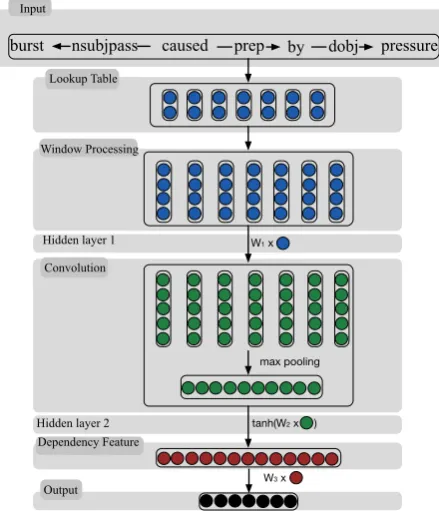
Figure 2: Architecture of the convolution neural network.
3 A Convolutional Neural Network Model
Our model successively takes the shortest depen-dency path (i.e, the words, dependepen-dency edge direc-tions, and dependency labels) from the subject to the object as input, passes it through the lookup
table layer, produces local features around each node on the dependency path, and combines these features into a global feature vector that are then fed to a softmax classifier. Each dimension of the output vector indicates the confidence score of the corresponding relation.
In thelookup table step, each node (i.e. word, label or arrow) in the dependency path is trans-formed into a vector by looking up the embedding matrixWe∈ Rd×|V|, wheredis the dimension of
a vector andVis a set of all nodes we consider.
Convolution To capture the local features around each node of the dependency path, we con-sider a fixed size window of nodes around each node in the window processing component, pro-ducing a matrix of node features of fixed size
dw ×1, wheredw = d×wandwis the window
size. This matrix can be built by concatenating the vectors of nodes within the window, which are then fed to the convolutional layer.
In the convolutional layer, we use a linear trans-formationW1 ∈ Rn1×dw to extract local features
around each window of the given sequence, where
n1is the size of hidden layer 1. The resulting ma-trixZhas size ofn1×t, wheretis the number of
nodes in the input dependency path.
We can see thatZ captures local contextual in-formation in the dependency path. However, iden-tifying a relationship requires considerations for thewholedependency path. We therefore perform a max pooling overZ to produce a global feature vector in order to capture the most useful local features produced by the convolutional layer (Col-lobert et al., 2011), which has a fixed size ofn1,
independent of the dependency path length.
Dependency based Relation Representation
To extract more meaningful features, we choose hyperbolic tanh as the non-linearity function in the second hidden layer, which has the advantage of being slightly cheaper to compute, while leaving the generalization performance unchanged. W2 ∈ Rn2×n1 is the linear transformation matrix, where
n2 is the size of hidden layer 2. The output
vec-tor can be considered as higher level syntactic fea-tures, which is then fed to a softmax classifier.
Objective Function and Learning The softmax classifier is used to predict aK-class distribution
receiverInstrument-Agency recipient receiver carried radio through
Therecipientreceives the call through a miniature radioreceiver carried on his person
[image:3.595.107.498.63.109.2]receives recipient
Figure 1: The shortest dependency path representation for an example sentence from SemEval-08.
Train Strategy Test Strategy F1(%)
Blind Blind 79.3
Sighted Blind 81.3
Sighted Sighted 89.2
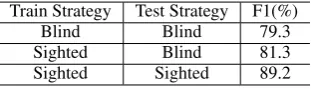
Table 1: Performances on the development set with different train and testing strategies.
distribution vector1: the entrytk(x) is the
proba-bility that the dependency path describes thek-th relation. We compute the cross entropy error be-tweent(x)andd(x), and further define the objec-tive function over all training data:
J(θ) =−X
x K X
k=1
tk(x) logdk(x) +λ||θ||2
whereθ= (We, W1, W2, W3)is the set of model
parameters to be learned, andλis a vector of reg-ularization parameters. The model parameters θ
can be efficiently computed via backpropagation through network structures. To minimize J(θ), we apply stochastic gradient descent (SGD) with AdaGrad (Duchi et al., 2011) in our experiments.
4 Negative Sampling
We start by presenting three pilot experiments on the development set. In the first one, we assume that the assignment of the subject and object for a relation is not given (blind), we simply extract features from e1 toe2, and test it in a blind
set-ting as well. In the second one, we assume that the assignment is given (sighted) during training, but still blind in the test phase. The last one is as-sumed to give the assignment during both training and test steps. The results are listed in Table 1.
The third experiment can be seen as an upper bound, where we do not need to worry about the assignments of subjects and objects. By com-paring the first and the second one, we can see that when adding assignment information during training, our model can be significantly improved,
1Note that, there may be more than one relation existing between two nominals. A dependency path thus may corre-spond to multiple relations.
indicating that our dependency based representa-tion can be used to learn the assignments of sub-jects/objects, and injecting better understandings of such assignments during training is crucial to the performance. We admit that models with more complex structures can better handle these con-siderations. However, we find that this can be achieved by simply feeding typical negative sam-ples to the model and let the model learn from such negative examples to correctly choose the right as-signments of subjects and objects. In practice, we can treat the opposite assignments of subjects and the objects as negative examples. Note that, the dependency path of the wrong assignment is dif-ferent from that of the correct assignment, which essentially offers the information for the model to learn to distinguish the subject and the object.
5 Experimental Evaluation
We evaluate our model on the SemEval-2010 Task 8 (Hendrickx et al., 2010), which contains 10,717 annotated examples, including 8,000 instances for training and 2,717 for test. We randomly sampled 2,182 samples from the training data for valida-tion.
Given a sentence, we first find the shortest de-pendency path connecting two marked nominals, resulting in two dependency paths corresponding to two opposite subject/object directions, and then make predictions for the two paths, respectively. We choose the relationother if and only ifboth predictions areother. And for the rest cases, we choose the non-other relation with highest confi-dence as the output, since ideally, for a non-other
instance, our model will output the correct label for the right subject/object direction and another
label for the wrong direction. We evaluate our models by macro-averaged F1 using the official evaluation script.
We initialized We with 50-dimensional word
[image:3.595.104.260.159.204.2]Method Feature Sets F1
SVM 16 types of features 82.2
RNN - 74.8
+POS, NER, WordNet 77.6
MVRNN - 79.1
+POS, NER, WordNet 82.4
CNN - 78.9
(Zeng et al., 2014) +WordNet,words around nominals 82.7
DepNN +NER 83.6
depCNN - 81.3
depLCNN - 81.9
depLCNN +WordNet,words around nominals 83.7
depLCNN+NS - 84.0
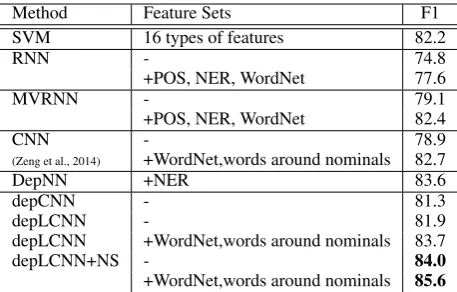
[image:4.595.72.301.61.207.2]+WordNet,words around nominals 85.6 Table 2: Comparisons of our models with other methods on the SemEval 2010 task 8.
Negative sampling schemes F1
No negative examples 81.3
Randomly sampled negative examples from NYT 83.5 Dependency paths from the object to subject 85.4 Table 3: Comparisons of different negtive sam-pling methods on the development set.
forWe,W1,W2andW3. The best setting was
ob-tained with the values: 3, 200, 100, 10−4, 10−3,
10−4and2×10−3, respectively.
Results and Discussion Table 2 summarizes the performances of our model, depLCNN+NS(+), and state-of-the-art models, SVM (Hendrickx et al., 2010), RNN, MV-RNN (Socher et al., 2012), CNN (Zeng et al., 2014) and DepNN (Liu et al., 2015). For fair comparisons, we also add two types of lexical features, WordNet hypernyms and words around nominals, as part of input vector to the finalsoftmaxlayer.
We can see that our vanilla depLCNN+NS, without extra lexical features, still outperforms, by a large margin, previously reported best systems, MVRNN+ and CNN+, both of which have taken extra lexical features into account, showing that our treatment to dependency path can learn a ro-bust and effective relation representation. When augmented with similar lexical features, our de-pLCNN+NS further improves by 1.6%, signifi-cantly better than any other systems.
Let us first see the comparisons among plain versions of depLCNN (taking both dependency di-rections and labels into account), depCNN (con-sidering the directions of dependency edges only), MVRNN and CNN, which all work in a 2×K+1 fashion. We can see that the both of our depCNN and depLCNN outperforms MVRNN and CNN by at least 2.2%, indicating that our treatment is better
than previous conventions in capturing syntactic structures for relation extraction. And note that de-pLCNN, with extra considerations for dependency labels, performs even better than depCNN, show-ing that dependency labels offer more discrimina-tive information that benefits the relation extrac-tion task.
And when we compare plain depLCNN and depLCNN+NS (without lexical features), we can see that our Negative Sampling strategy brings an improvement of 2.1% in F1. When both of the two models are augmented with extra lexical fea-tures, our NS strategy still gives an improvement of 1.9%. These comparisons further show that our NS strategy can drive our model to learn proper assignments of subjects/objects for a relation.
Next, we will have a close look at the effect of our Negative Sampling method. We conduct additional experiments on the development set to compare two different negative sampling methods. As a baseline, we randomly sampled 8,000 nega-tive examples from the NYT dataset (Chen et al., 2014). For our proposed NS, we create a nega-tive example from eachnon-otherinstance in the training set, 6,586 in total. As shown in Table 2, it is no doubt that introducing more negative ex-amples improves the performances. We can see that our model still benefits from the randomly sampled negative examples, which may help our model learn to refine the margin between the pos-itive and negative examples. However, with sim-ilar amount of negative examples, treating the re-versed dependency paths from objects to subjects as negative examples can achieve a better perfor-mance (85.4% F1), improving random samples by 1.9%. This again proves that dependency paths provide useful clues to reveal the assignments of subjects and objects, and a model can learn from such reversed paths as negative examples to make correct assignments. Beyond the relation extrac-tion task, we believed the proposed Negative Sam-pling method has the potential to benefit other NLP tasks, which we leave for future work.
6 Conclusion
within a relationship. Experimental results show that our model significantly outperforms state-of-the-art systems and our treatment to dependency paths can well capture the syntactic features for relation extraction.
Acknowledgments
We would like to Sheng Zhang, Weiwei Sun and Liwei Chen for their helpful discussions. This work was supported by National High Technology R&D Program of China (Grant No. 2015AA015403, 2014AA015102), Natural Sci-ence Foundation of China (Grant No. 61202233, 61272344, 61370055) and the joint project with IBM Research. Any correspondence please refer to Yansong Feng.
References
Razvan C. Bunescu and Raymond J. Mooney. 2005a. A shortest path dependency kernel for relation ex-traction. In HLT/EMNLP 2005, Human Language Technology Conference and Conference on Empiri-cal Methods in Natural Language Processing, Pro-ceedings of the Conference, 6-8 October 2005, Van-couver, British Columbia, Canada.
Razvan C. Bunescu and Raymond J. Mooney. 2005b. Subsequence kernels for relation extraction. In Advances in Neural Information Processing Sys-tems 18 [Neural Information Processing SysSys-tems, NIPS 2005, December 5-8, 2005, Vancouver, British Columbia, Canada], pages 171–178.
Liwei Chen, Yansong Feng, Songfang Huang, Yong Qin, and Dongyan Zhao. 2014. Encoding relation requirements for relation extraction via joint infer-ence. InProceedings of the 52nd Annual Meeting of the Association for Computational Linguistics, ACL 2014, June 22-27, 2014, Baltimore, MD, USA, Vol-ume 1: Long Papers, pages 818–827.
Ronan Collobert, Jason Weston, L´eon Bottou, Michael Karlen, Koray Kavukcuoglu, and Pavel P. Kuksa. 2011. Natural language processing (almost) from scratch. Journal of Machine Learning Research, 12:2493–2537.
John C. Duchi, Elad Hazan, and Yoram Singer. 2011. Adaptive subgradient methods for online learning and stochastic optimization. Journal of Machine Learning Research, 12:2121–2159.
Iris Hendrickx, Su Nam Kim, Zornitsa Kozareva, Preslav Nakov, Diarmuid ´O S´eaghdha, Sebastian Pad´o, Marco Pennacchiotti, Lorenza Romano, and Stan Szpakowicz. 2010. Semeval-2010 task 8: Multi-way classification of semantic relations between pairs of nominals. In Proceedings of SemEval-2, Uppsala, Sweden.
Yang Liu, Furu Wei, Sujian Li, Heng Ji, Ming Zhou, and Houfeng WANG. 2015. A dependency-based neural network for relation classification. In Pro-ceedings of the 53rd Annual Meeting of the Associ-ation for ComputAssoci-ational Linguistics and the 7th In-ternational Joint Conference on Natural Language Processing (Volume 2: Short Papers), pages 285– 290, Beijing, China, July. Association for Computa-tional Linguistics.
Longhua Qian, Guodong Zhou, Fang Kong, Qiaom-ing Zhu, and Peide Qian. 2008. ExploitQiaom-ing con-stituent dependencies for tree kernel-based semantic relation extraction. In COLING 2008, 22nd Inter-national Conference on Computational Linguistics, Proceedings of the Conference, 18-22 August 2008, Manchester, UK, pages 697–704.
Richard Socher, Brody Huval, Christopher D. Man-ning, and Andrew Y. Ng. 2012. Semantic com-positionality through recursive matrix-vector spaces. In Proceedings of the 2012 Joint Conference on Empirical Methods in Natural Language Process-ing and Computational Natural Language Learn-ing, EMNLP-CoNLL 2012, July 12-14, 2012, Jeju Island, Korea, pages 1201–1211.
Joseph P. Turian, Lev-Arie Ratinov, and Yoshua Ben-gio. 2010. Word representations: A simple and gen-eral method for semi-supervised learning. InACL 2010, Proceedings of the 48th Annual Meeting of the Association for Computational Linguistics, July 11-16, 2010, Uppsala, Sweden, pages 384–394. Daojian Zeng, Kang Liu, Siwei Lai, Guangyou Zhou,