Generalized Agreement for Bidirectional Word Alignment
Chunyang Liu†, Yang Liu†∗, Huanbo Luan†, Maosong Sun†, and Heng Yu‡†State Key Laboratory of Intelligent Technology and Systems Tsinghua National Laboratory for Information Science and Technology
Department of Computer Science and Technology, Tsinghua University, Beijing 100084, China ‡Samsung R&D Institute of China, Beijing 100028, China
{liuchunyang2012,liuyang.china,luanhuanbo}@gmail.com, [email protected] [email protected]
Abstract
While agreement-based joint training has proven to deliver state-of-the-art ment accuracy, the produced word align-ments are usually restricted to one-to-one mappings because of the hard cons-traint on agreement. We propose a ge-neral framework to allow for arbitrary loss functions that measure the disagreement between asymmetric alignments. The loss functions can not only be defined between asymmetric alignments but al-so between alignments and other latent structures such as phrase segmentations. We use a Viterbi EM algorithm to train the joint model since the inference is intractable. Experiments on Chinese-English translation show that joint training with generalized agreement achieves sig-nificant improvements over two state-of-the-art alignment methods.
1 Introduction
Word alignment is a natural language process-ing task that aims to specify the correspondence between words in two languages (Brown et al., 1993). It plays an important role in statistical machine translation (SMT) as word-aligned bi-lingual corpora serve as the input of translation rule extraction (Koehn et al., 2003; Chiang, 2007; Galley et al., 2006; Liu et al., 2006).
Although state-of-the-art generative alignment models (Brown et al., 1993; Vogel et al., 1996) have been widely used in practical SMT systems, they fail to model the symmetry of word align-ment. While word alignments in real-world bi-lingual data usually exhibit complicated mappings (i.e., mixed with one-to-one, one-to-many, many-to-one, and many-to-many links), these models as-sume that each target word is aligned to exactly
∗Corresponding author: Yang Liu.
one source word. To alleviate this problem, heuris-tic methods (e.g., grow-diag-final) have been pro-posed to combine two asymmetric alignments (source-to-target and target-to-source) to generate symmetric bidirectional alignments (Och and Ney, 2003; Koehn and Hoang, 2007).
Instead of using heuristic symmetrization, Liang et al. (2006) introduce a principled approach that encourages the agreement between asymmetric alignments in two directions. The basic idea is to favor links on which both uni-directional models agree. They associate two models via the agreement constraint and show that agreement-based joint training improves align-ment accuracy significantly.
However, enforcing agreement in joint training faces a major problem: the two models are restrict-ed to one-to-one alignments (Liang et al., 2006). This significantly limits the translation accuracy, especially for distantly-related language pairs such as Chinese-English (see Section 5). Although pos-terior decoding can potentially address this prob-lem, Liang et al. (2006) find that many-to-many alignments occur infrequently because posteriors are sharply peaked around the Viterbi alignments. We believe that this happens because their model imposes ahard constraint on agreement: the two models must share the same alignment when esti-mating the parameters by calculating the products of alignment posteriors (see Section 2).
In this work, we propose a general framework for imposing agreement constraints in joint train-ing of unidirectional models. The central idea is to use the expectation of a loss function, which mea-sures the disagreement between two models, to replace the original probability of agreement. This allows for many possible ways to quantify agree-ment. Experiments on Chinese-English translation show that our approach outperforms two state-of-the-art baselines significantly.
China ‘s head of state will attend the unofficial 2002 APEC summit . 中
国元首将参加
2002
亚 太经合组织非正
式 峰 会。
China ‘s head of state will attend the unofficial 2002 APEC summit . 中
国元首将 参加
2002
亚 太经合组织非正
式 峰 会。
China ‘s head of state will attend the unofficial 2002 APEC summit . 中
国 元 首
将 参 加
2002
亚 太 经 合 组 织 非 正 式 峰 会。
China ‘s head of state will attend the unofficial 2002 APEC summit . 中
国 元 首
将 参 加
2002
亚 太 经 合 组 织 非 正 式 峰 会。
China ‘s head of state will attend the unofficial 2002 APEC summit . 中
国元首将 参加
2002
亚 太经合组织
非 正 式 峰 会。
China ‘s head of state will attend the unofficial 2002 APEC summit . 中
国元首将 参加
2002
亚 太经合组织非正
式 峰 会。
CE
EC
independent training
w/o agreement w/ agreementjoint training
joint training w/ generalized agreement
[image:2.595.100.502.61.344.2](a) (b) (c)
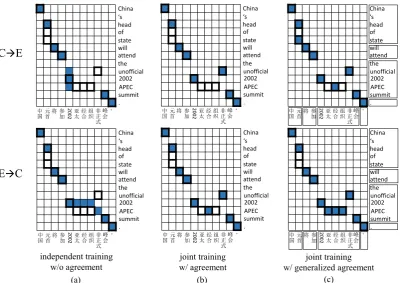
Figure 1: Comparison of (a) independent training without agreement, (b) joint training with agreement, and (c) joint training with generalized agreement. Bold squares are gold-standard links and solid squares are model predictions. The Chinese and English sentences are segmented into phrases in (c). Joint training with agreement achieves a high precision but generally only produces one-to-one alignments. We propose generalized agreement to account for not only the consensus between asymmetric alignments, but also the conformity of alignments to other latent structures such as phrase segmentations.
2 Background
2.1 Asymmetric Alignment Models
Given a source-language sentence e ≡ eI
1 =
e1, . . . , eI and a target-language sentence f ≡ fJ
1 = f1, . . . , fJ, a source-to-target translation
model (Brown et al., 1993; Vogel et al., 1996) can be defined as
P(f|e;θ1) =
X
a1
P(f,a1|e;θ1) (1)
where a1 denotes the source-to-target alignment and θ1 is the set of source-to-target translation model parameters.
Likewise, the target-to-source translation model is given by
P(e|f;θ2) =
X
a2
P(e,a2|f;θ2) (2)
where a2 denotes the target-to-source alignment and θ2 is the set of target-to-source translation model parameters.
Given a training setD = {hf(s),e(s)i}S s=1, the two models are trained independently to maximize the log-likelihood of the training data for each direction, respectively:
L(θ1) =
S X
s=1
logP(f(s)|e(s);θ1) (3)
L(θ2) =
S X
s=1
logP(e(s)|f(s);θ
2) (4)
asym-metric alignments (Och and Ney, 2003; Koehn and Hoang, 2007).
2.2 Alignment by Agreement
Rather than using heuristic symmetrization meth-ods, Liang et al. (2006) propose a principled approach to jointly training of the two models via enforcingagreement:
J(θ1,θ2)
=
S X
s=1
logP(f(s)|e(s);θ1) +
logP(e(s)|f(s);θ 2) +
logX
a
P(a|f(s),e(s);θ1)×
P(a|e(s),f(s);θ2) (5) Note that the last term in Eq. (5) encourages the two models to agree on asymmetric alignments. While this strategy significantly improves align-ment accuracy, the joint model is prone to generate one-to-one alignments because it imposes ahard constraint on agreement: the two models must share the same alignment when estimating the parameters by calculating the products of align-ment posteriors. In Figure 1(b), the two one-to-one alignments are almost identical except for one link. This makes the posteriors to be sharply peaked around the Viterbi alignments (Liang et al., 2006). As a result, the lack of many-to-many alignments limits the benefits of joint training to end-to-end machine translation.
3 Generalized Agreement for Bidirectional Alignment
Our intuition is that the agreement between two alignments can be defined as a loss function, which enables us to consider various ways of quantification (Section 3.1) and even to incorpo-rate the dependency between alignments and oth-er latent structures such as phrase segmentations (Section 3.2).
3.1 Agreement between Word Alignments
The key idea of generalizing agreement is to lever-ageloss functionsthat measure the difference be-tween two unidirectional alignments. For exam-ple, the last term in Eq. (5) can be re-written as
X
a
P(a|f(s),e(s);θ1)P(a|e(s),f(s);θ2)
= X
a1 X
a2
P(a1|f(s),e(s);θ1)×
P(a2|e(s),f(s);θ2)×
δ(a1,a2) (6)
Note that the last term in Eq. (6) is actually the expected value of agreement:
Ea1|f(s),e(s);θ1
"
Ea2|e(s),f(s);θ2
δ(a1,a2)
#
(7)
Our idea is to replaceδ(a1,a2)in Eq. (6) with an arbitrary loss function∆(a1,a2)that measures the difference between a1 and a2. This gives the new joint training objective with generalized agreement:
J(θ1,θ2)
=
S X
s=1
logP(f(s)|e(s);θ1) +
logP(e(s)|f(s);θ 2)−
logX
a1 X
a2
P(a1|f(s),e(s);θ1)×
P(a2|e(s),f(s);θ2)×
∆(a1,a2) (8)
Obviously, Liang et al. (2006)’s training objec-tive is a special case of our framework. We refer to its loss function ashard matching:
∆HM(a1,a2) = 1−δ(a1,a2) (9)
We are interested in developing a soft version of the hard matching loss function because this will help to produce many-to-many symmetric ments. For example, in Figure 1(c), the two align-ments share most links but still allow for dis-agreed links to capture one-to-many and many-to-one links. Note that the union of the two asymmet-ric alignments is almost the same with the gold-standard alignment in this example.
While there are many possible ways to define asoft matchingloss function, we choose the dif-ference between disagreed and agreed link counts because it is easy and efficient to calculate during search:
China ‘s head of state will attend the unofficial 2002 APEC summit . 中
国元首将 参加
2002
亚 太经合组织非正
式 峰 会。
China ‘s head of state will attend the unofficial 2002 APEC summit . 中
国元首将 参加
2002
亚 太经合组织
非 正 式 峰 会。
C
E
E
C
B E B E B I I I I E S B
I I I E B E B I I I E S
B I I I E B E B I I I E S
B E B E B I I I I E S
+ + + + +
-+ +
-+ + +
[image:4.595.148.449.64.253.2]+ - - + - - + + + +
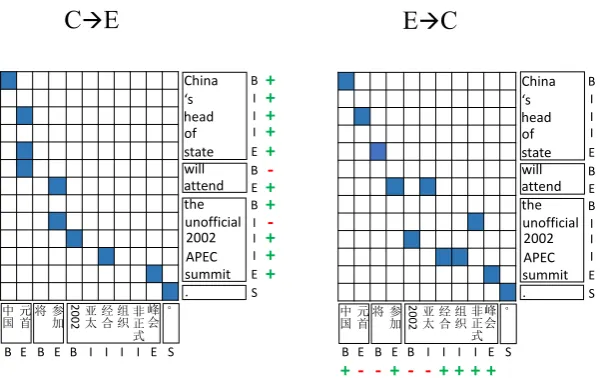
Figure 2: Generalized agreement between word alignments and phrase segmentations. The Chinese and English sentences are segmented into phrases using B (beginning), I (internal), E (ending), S (single) labels. We expect that word alignment does not violate the phrase segmentation. The word “unofficial” in the C→E alignment is labeled with “-” because “unofficial” and “2002” belong to the same English phrase but their counterparts are separated in two Chinese phrases. Words that do not violate the phrase alignment are labeled with “+”. See Section 3.2 for details.
3.2 Agreement between Word Alignments and Phrase Segmentations
Our framework is very general and can be extended to include the agreement between word alignment and other latent structures such as phrase segmentations.
The words in a Chinese sentence often con-stitute phrases that are translated as units in English and vice versa. Inspired by the alignment consistency constraint widely used in translation rule extraction (Koehn et al., 2003), we make the following assumption to impose a structural agreement constraint between word alignment and phrase segmentation: source words in one source phrase should be aligned to target words belong-ing to the same target phrase and vice versa.
For example, consider the C →E alignment in Figure 2. We segment Chinese and English sen-tences into phrases, which are sequences of con-secutive words. Since “2002” and “APEC” belong to the same English phrase, their counterparts on the Chinese side should also belong to one phrase. While this assumption can potentially improve the correlation between word alignment and phrase-based translation, a question naturally a-rises: how to segment sentences into phrases? Instead of leveraging chunking, we treat phrase segmentation as a latent variable and train the
joint alignment and segmentation model from unlabeled data in an unsupervised way.
Formally, given a target-language sentencef ≡
fJ
1 = f1, . . . , fJ, we introduce a latent variable
b ≡ bJ
1 =b1, . . . , bJ to denote aphrase
segmen-tation. Each label bj ∈ {B, I, E, S}, where B
denotes the beginning word of a phrase,Idenotes the internal word,Edenotes the ending word, and
S denotes the one-word phrase. Figure 2 shows the label sequences for the sentence pair.
We use a first-order HMM to model phrase seg-mentation of a target sentence:
P(f;λ1) =
X
b1
P(f,b1;λ1) (11)
Similarly, the hidden Markov model for the phrase segmentation of the source sentence can be defined as
P(e;λ2) =
X
b2
P(e,b2;λ2) (12)
Then, we can combine word alignment and phrase segmentation and define the joint training objective as
J(θ1,θ2,λ1,λ2)
= XS
s=1
1: procedureVITERBIEM(D) 2: InitializeΘ(0)
3: for allk= 1, . . . , K do
4: Hˆ(k)←SEARCH(D,Θ(k−1)) 5: Θ(k) ←UPDATE(D,Hˆ(k))
6: end for
7: returnHˆ(K),Θ(K) 8: end procedure
Algorithm 1: A Viterbi EM algorithm for learning the joint word alignment and phrase segmentation model from bilingual corpus.Dis a bilingual cor-pus,Θ(k)is the set of model parameters at thek-th iteration,H(k)is the set of Viterbi latent variables at thek-th iteration.
logP(e(s)|f(s);θ2) +
logP(f(s);λ1) +
logP(e(s);λ2)−
logE(f(s),e(s),θ
1,θ2,λ1,λ2) (13)
where the expected loss is given by
E(f(s),e(s),θ1,θ2,λ1,λ2)
= X
a1 X
a2 X
b1 X
b2
P(a1|f(s),e(s);θ1)×
P(a2|e(s),f(s);θ2)×
P(b1|f(s);λ1)×
P(b2|e(s);λ2)×
∆(a1,a2,b1,b2) (14) We define a new loss function segmentation violationto measure the degree that an alignment violates phrase segmentations.
∆SV(a1,a2,b1,b2)
= JX−1
j=1
β(a1, j,b1,b2) +
I−1
X
i=1
β(a2, i,b2,b1)
(15) whereβ(a1, j,b1,b2)evaluates whether two links
l1 = (j, aj) and l2 = (j + 1, aj+1) violate the phrase segmentation:
1. fj andfj+1 belong to one phrase buteaj and eaj+1 belong to two phrases, or
2. fj andfj+1belong to two phrases buteaj and eaj+1 belong to one phrase.
Theβfunction returns 1 if there is violation and 0 otherwise.
1: procedureSEARCH(D,Θ) 2: Hˆ ← ∅
3: for alls∈ {1, . . . , S}do 4: ˆa1 ←ALIGN(f(s),e(s),θ1) 5: ˆa2 ←ALIGN(e(s),f(s),θ2) 6: bˆ1 ←SEGMENT(f(s),λ1) 7: bˆ2 ←SEGMENT(e(s),λ2) 8: h0 ← haˆ1,ˆa2,bˆ1,bˆ2i
9: hˆ ←HILLCLIMB(f(s),e(s),h0,Θ) 10: Hˆ ←Hˆ ∪ {h}ˆ
11: end for
12: returnHˆ 13: end procedure
Algorithm 2: A search algorithm for finding the Viterbi latent variables. aˆ1 andˆa2 denote Viter-bi alignments, bˆ1 and bˆ2 denote Viterbi seg-mentations. They form a starting point h0 for the hill climbing algorithm, which keeps chang-ing alignments and segmentations until the model score does not increase.hˆis the final set of Viterbi latent variables for one sentence.
In Figure 2, we use “+” to label words that do not violate the phrase segmentations and “-” to label violations.
In practice, we combine the two loss functions to enable word alignment and phrase segmentation to benefit each other in a joint search space:
∆SM+SV(a1,a2,b1,b2)
= ∆SM(a1,a2) + ∆SV(a1,a2,b1,b2) (16) 4 Training
Liang et al. (2006) indicate that it is intractable to train the joint model. For simplicity and efficien-cy, they exploit a simple heuristic procedure that leverages the product of posterior marginal prob-abilities. The intuition behind the heuristic is that links on which two models disagree should be dis-counted because the products of the marginals are small (Liang et al., 2006).
Unfortunately, it is hard to develop a similar heuristic for our model that allows for arbitrary loss functions. Alternatively, we resort to a Viterbi EM algorithm, as shown in Algorithm 1. The algorithm takes the training data D =
{hf(s),e(s)i}S
s=1 as input (line 1). We useΘ(k) =
(a) MOVE
(b) MERGE
[image:6.595.88.283.67.228.2](c) SPLIT
Figure 3: Operators used in the HILLCLIMB
pro-cedure.
and segmentationsHˆ(k)using the SEARCH proce-dure (line 4) and updating model parameters using the UPDATEprocedure (line 5). The algorithm
ter-minates after running forKiterations.
It is challenging to search for the Viterbi align-ments and segmentations because of complicat-ed structural dependencies. As shown in Al-gorithm 2, our strategy is first to find Viter-bi alignments and segmentations independently using the ALIGNand SEGMENTprocedures (lines
4-7), which then serve as a starting point for the HILLCLIMBprocedure (lines 8-9).
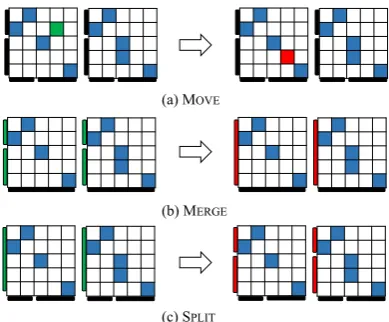
Figure 3 shows three operators we use in the HILLCLIMB procedure. The MOVE operator
moves a link in an alignment, the MERGE
oper-ator merges two phrases into one phrase, and the SPLIT operator splits one phrase into two
small-er phrases. Note that each opsmall-erator can be furthsmall-er divided into two variants: one for the source side and another for the target side.
5 Experiments
5.1 Setup
We evaluate our approach on Chinese-English alignment and translation tasks.
The training corpus consists of 1.2M sentence pairs with 32M Chinese words and 35.4M English words. We used the SRILM toolkit (Stolcke, 2002) to train a 4-gram language model on the Xinhua portion of the English GIGAWORD cor-pus, which contains 398.6M words. For alignment evaluation, we used the Tsinghua Chinese-English
word alignment evaluation data set.1 The
evalu-ation metric is alignment error rate (AER) (Och and Ney, 2003). For translation evaluation, we used the NIST 2006 dataset as the development set and the NIST 2002, 2003, 2004, 2005, and 2008 datasets as the test sets. The evaluation metric is case-insensitive BLEU (Papineni et al., 2002).
We used both phrase-based (Koehn et al., 2003) and hierarchical phrase-based (Chiang, 2007) translation systems to evaluate whether our approach improves translation performance. For the phrase-based model, we used the open-source toolkit Moses (Koehn and Hoang, 2007). For the hierarchical phrase-based model, we used an in-house re-implementation on par with state-of-the-art open-source decoders.
We compared our approach with two state-of-the-art generative alignment models:
1. GIZA++ (Och and Ney, 2003): unsupervised
training of IBM models (Brown et al., 1993) and the HMM model (Vogel et al., 1996) us-ing EM,
2. BERKELEY (Liang et al., 2006):
unsuper-vised training of joint HMMs using EM. For GIZA++, we trained IBM Model 4 in two
directions with the default setting and used the grow-diag-final heuristic to generate symmetric alignments. For BERKELEY, we trained joint
HMMs using the default setting. The hyper-parameter of posterior decoding was optimized on the development set.
We used first-order HMMs for both word alignment and phrase segmentation. Our joint alignment and segmentation model were trained using the Viterbi EM algorithm for five iterations. Note that the Chinese-to-English and English-to-Chinese alignments are generally non-identical but share many links (see Figure 1(c)). Then, we used the grow-diag-final heuristic to generate symmetric alignments.
5.2 Comparison with GIZA++ and
BERKELEY
Table 1 shows the comparison of our approach with GIZA++ and BERKELEY in terms of AER
and BLEU. GIZA++ trains two asymmetric
system training agreement loss sym. AER BLEU
GIZA++ indep. N/A N/A GDF 21.35 24.46
BERKELEY joint word-word HM PD 20.52 24.54
[image:7.595.99.497.62.133.2]this work joint word-word, word-phrase SM+SVword-word SM GDF 22.19 25.1122.01 25.78
Table 1: Comparison with GIZA++ and BERKELEY. “word-word” denotes the agreement between
Chinese-to-English and English-to-Chinese word alignments. “word-phrase” denotes the agreement be-tween word alignments and phrase segmentations. “HM” denotes the hard matching loss function, “SM” denotes soft matching, and “SV” denotes segmentation violation. “GDF” denotes grow-diag-final. “PD” denotes posterior decoding. The BLEU scores are evaluated on NIST08 test set.
alignment loss translation NIST06 NIST02 NIST03 NIST04 NIST05 NIST08 GIZA++ N/A phrasehier. 29.5730.72 31.8233.90 31.6733.12 32.2033.54 30.4832.28 24.4624.72 BERKELEY HM phrasehier. 29.8729.52 32.2133.59 32.4832.70 32.0632.95 30.5929.52 24.5424.29
this work SM
phrase 30.04∗ 32.75∗∗++ 32.35∗∗ 32.47∗+ 30.86∗+ 25.11∗∗++
hier. 30.71++ 34.50∗∗++ 33.89∗∗++ 34.02∗++ 32.83∗∗++ 24.32
SM+SV phrasehier. 30.6030.88∗∗++++ 33.3734.53∗∗∗∗++++ 33.2434.04∗∗∗∗++++ 33.6633.15++∗∗++ 32.9331.57∗∗∗∗++++ 25.1725.78∗∗∗++++
Table 2: Results on (hierarchical) phrase-based translation. The evaluation metric is case-insensitive BLEU. “HM” denotes the hard matching loss function, “SM” denotes soft matching, and “SV” denotes segmentation violation. “*”: significantly better than GIZA++ (p <0.05). “**”: significantly better than
GIZA++ (p < 0.01). “+”: significantly better than BERKELEY (p < 0.05). “++”: significantly better
than BERKELEY(p <0.01).
trains two models jointly with the hard-matching (i.e., HM) loss function and uses posterior decod-ing for symmetrization.
For our approach, we distinguish between two variants:
1. Imposing agreement between word align-ments (i.e., word-word) that uses the soft matching loss function (i.e., SM) (see Section 3.1);
2. Imposing agreement between word align-ments and phrase segmentations (i.e., word-word, word-phrase) that uses both the soft matching and segmentation violation loss functions (i.e., SM+SV) (see Section 3.2).
We used the grow-diag-final heuristic for symmetrization.
For the alignment evaluation, we find that our approach achieves higher AER scores than the two baseline systems. One possible reason is that links in the intersection of two symmetric alignments or two symmetric models agree usually correspond to sure links in the gold-standard annotation. Our approach loosens the hard constraint on agreement
and makes the posteriors less peaked around the Viterbi alignments.
For the translation evaluation, we used the phrase-based system Moses to report BLEU s-cores on the NIST 2008 test set. We find that both the two variants of our approach significantly out-performs the two baselines (p <0.01).
5.3 Results on (Hierarchical) Phrase-based Translation
Table 2 shows the results on phrase-based and hierarchical phrase-based translation systems. We find that our approach systematically outperforms GIZA++ and BERKELEYon all NIST datasets.
In particular, generalizing the agreement to model the discrepancy between word alignment and phrase segmentation is consistently beneficial for improving translation quality, suggesting that it is important to introduce structural constraints into word alignment to increase the correlation between alignment and translation.
system loss |AC→E| |AE→C| |AC→E∩ AE→C| F1
GIZA++ N/A 29.39M 27.64M 17.07M 59.86
BERKELEY HM 29.12M 28.09M 21.30M 74.46
[image:8.595.123.473.63.132.2]this work SM+SVSM 29.84M30.04M 29.31M29.50M 20.24M20.54M 68.4269.00
Table 3: Agreement evaluation of GIZA++, BERKELEY and our approach. The F1 score reflects how
well two asymmetric alignments agree with each other.
loss function can better account for phrase-based rather than hierarchical phrase-based translation. It is possible to design new loss functions tailored to hierarchical phrase-based translation.
We also find that the BLEU scores of BERKE -LEY on hierarchical phrase-based translation are
much lower than those on phrase-based transla-tion. This might result from the fact that BERKE -LEY is prone to produce one-to-one alignments,
which are not optimal for hierarchical phrase-based translation.
5.4 Agreement Evaluation
Table 3 compares how well two asymmetric models agree with each other among GIZA++,
BERKELEY and our approach. We use F1 score
to measure the degree of agreement:
2|AC→E∩ AE→C|
|AC→E|+|AE→C| (17)
where AC→E is the set of Chinese-to-English
alignments on the training data andAE→C is the
set of English-to-Chinese alignments.
It is clear that independent training leads to low agreement and joint training results in high agree-ment. BERKELEY achieves the highest value of
agreement because of the hard constraint.
6 Related Work
This work is inspired by two lines of research: (1) agreement-based learning and (2) joint modeling of multiple NLP tasks.
6.1 Agreement-based Learning
The key idea of agreement-based learning is to train a set of models jointly by encouraging them to agree on the hidden variables (Liang et al., 2006; Liang et al., 2008). This can also be seen as a particular form of posterior constraint or poste-rior regularization (Grac¸a et al., 2007; Ganchev et al., 2010). The agreement is prior knowledge and
indirect supervision, which helps to train a more reasonable model with biased guidance.
While agreement-based learning provides a principled approach to training a generative mod-el, it constrains that the sub-models must share the same output space. Our work extends (Liang et al., 2006) to introduce arbitrary loss functions that can encode prior knowledge. As a result, Liang et al. (2006)’s model is a special case of our frame-work. Another difference is that our framework allows for including the agreement between word alignment and other structures such as phrase seg-mentations and parse trees.
6.2 Joint Modeling of Multiple NLP Tasks
It is well accepted that different NLP tasks can help each other by providing additional informa-tion for resolving ambiguities. As a result, joint modeling of multiple NLP tasks has received in-tensive attention in recent years, including phrase segmentation and alignment (Zhang et al., 2003), alignment and parsing (Burkett et al., 2010), tok-enization and translation (Xiao et al., 2010), pars-ing and translation (Liu and Liu, 2010), alignment and named entity recognition (Chen et al., 2010; Wang et al., 2013).
Among them, Zhang et al. (2003)’s integrat-ed search algorithm for phrase segmentation and alignment is most close to our work. They use Point-wise Mutual Information to identify possi-ble phrase pairs. The major difference is we train models jointly instead of integrated decoding.
7 Conclusion
significant improvements over two baselines for (hierarchical) phrase-based MT systems. In the fu-ture, we plan to investigate more loss functions to account for syntactic constraints.
Acknowledgments
Yang Liu and Maosong Sun are supported by the 863 Program (2015AA011808), the National Nat-ural Science Foundation of China (No. 61331013 and No. 61432013), and Samsung R&D Institute of China. Huanbo Luan is supported by the Na-tional Natural Science Foundation of China (No. 61303075). This research is also supported by the Singapore National Research Foundation un-der its International Research Centre@Singapore Funding Initiative and administered by the IDM Programme. We sincerely thank the reviewers for their valuable suggestions. We also thank Yue Zhang, Meng Zhang and Shiqi Shen for their in-sightful discussions.
References
Peter F. Brown, Stephen A. Della Pietra, Vincen-t J. Della PieVincen-tra, and RoberVincen-t L. Mercer. 1993. The mathematics of statistical machine translation: Parameter estimation. Computational Linguistics, 19(2):263–311.
David Burkett, John Blitzer, and Dan Klein. 2010. Joint parsing and alignment with weakly synchro-nized grammars. In Proceedings of NAACL-HLT 2010.
Yufeng Chen, Chengqing Zong, and Keh-Yih Su. 2010. On jointly recognizing and aligning bilingual named entities. InProceedings of ACL 2010.
David Chiang. 2007. Hierarchical phrase-based trans-lation. Computational Linguistics, 33(2):201–228.
Michel Galley, Jonathan Graehl, Kevin Knight, Daniel Marcu, Steve DeNeefe, Wei Wang, and Ignacio Thayer. 2006. Scalable inference and training of context-rich syntactic translation models. In
Pro-ceedings of COLING-ACL 2006, pages 961–968,
Sydney, Australia, July.
Kuzmann Ganchev, Jo˜ao Grac¸a, Jennifer Gillenwater, and Ben Taskar. 2010. Posterior regularization for structured latent variable models. Journal of Ma-chine Learning Research.
Joao V Grac¸a, Kuzman Ganchev, and Ben Taskar. 2007. Expectation maximization and posterior con-straints. InProceedings of NIPS 2007.
Philipp Koehn and Hieu Hoang. 2007. Factored translation models. In Proceedings of
EMNLP-CoNLL 2007, pages 868–876, Prague, Czech
Re-public, June.
Philipp Koehn, Franz J. Och, and Daniel Marcu. 2003. Statistical phrase-based translation. InProceedings
of HLT-NAACL 2003, pages 127–133, Edmonton,
Canada, May.
Percy Liang, Ben Taskar, and Dan Klein. 2006. Align-ment by agreeAlign-ment. InProceedings of HLT-NAACL 2006, pages 104–111, New York City, USA, June. Percy Liang, Dan Klein, and Michael I. Jordan. 2008.
Agreement-based learning. In Advances in Neural Information Processing Systems (NIPS).
Yang Liu and Qun Liu. 2010. Joint parsing and trans-lation. InProceedings of COLING 2010.
Yang Liu, Qun Liu, and Shouxun Lin. 2006. Tree-to-string alignment template for statistical machine translation. InProceedings of COLING/ACL 2006. Franz J. Och and Hermann Ney. 2003. A systematic
comparison of various statistical alignment models.
Computational Linguistics, 29(1):19–51.
Kishore Papineni, Salim Roukos, Todd Ward, and Wei-Jing Zhu. 2002. Bleu: a methof for automatic e-valuation of machine translation. InProceedings of
ACL 2002.
Andreas Stolcke. 2002. Srilm - an extensible language modeling toolkit. InProceedings of ICSLP 2002. Stephan Vogel, Hermann Ney, and Christoph
Tillman-n. 1996. Hmm-based word alignment in statistical translation. InProceedings of COLING 1996. Mengqiu Wang, Wanxiang Che, and Christopher D.
Manning. 2013. Joint word alignment and bilingual named entity recognition using dual decomposition. InProceedings of ACL 2013.
Xinyan Xiao, Yang Liu, Young-Sook Hwang, Qun Li-u, and Shouxun Lin. 2010. Joint tokenization and translation. InProceedings of COLING 2010. Ying Zhang, Stephan Vogel, and Alex Waibel. 2003.
Integrated phrase segmentation and alignment algo-rithm for statistical machine translation. In Proceed-ings of Natural Language Processing and