Joint Mention Extraction and Classification with Mention Hypergraphs
Wei Lu
Singapore University of Technology and Design
Dan Roth
University of Illinois at Urbana-Champaign [email protected]
Abstract
We present a novel model for the task of joint mention extraction and classifi-cation. Unlike existing approaches, our model is able to effectively capture over-lapping mentions with unbounded lengths. The model is highly scalable, with a time complexity that is linear in the number of words in the input sentence and linear in the number of possible mention classes. Our model can be extended to additionally capture mention heads explicitly in a joint manner under the same time complexity. We demonstrate the effectiveness of our model through extensive experiments on standard datasets.
1 Introduction
One of the essential goals in natural language pro-cessing (NLP) is the development of effective sys-tems that can capture the underlying semantics conveyed by human languages. An important step towards such a goal is the development of practi-cal systems that can efficiently extract useful shal-low semantic information such as entities and at the same time identify their semantic classes (e.g., person, organization, etc).
Such a task is often known as named entity recognition and classification (NERC), one of the standard tasks in information extraction (IE). While such a task focuses on the extraction and classification of entities in the texts which are named, recently researchers also showed inter-est in a closely related task –mention extraction and classification/typing. Unlike a named entity, a mention is typically defined as a reference to an entity in natural language text that can be ei-ther named, nominal or pronominal (Florian et al., 2004). The task of mention detection and track-ing has received substantial attention, largely due
to its important role in conducting several down-stream tasks, such asrelation extraction(Mintz et al., 2009), entity linking (Guo et al., 2013), and
coreference resolution(Chang et al., 2013). While most existing work on named entity recognition and mention extraction and classifi-cation have been effective, there remain several key limitations associated with existing models. In fact, one can view these problems as instances of the more general problem ofsemantic tagging – the task of assigning appropriate semantic tags to certain text spans for a given input sentence. Un-like part-of-speech (POS) tagging, which has been extensively studied in the past few decades by the community, such a semantic tagging task presents several additional new challenges. First, a men-tion can consist of multiple words, so its length can be arbitrarily long. Second, the mentions can overlap with one another. Popular models used for POS tagging, such as linear-chain conditional ran-dom fields (Lafferty et al., 2001) or semi-Markov conditional random fields (Sarawagi and Cohen, 2004) have difficulties coping with these issues. While approaches on addressing these issues ex-ist, current algorithms typically suffer from high time complexity (Finkel and Manning, 2009) and are therefore difficult to scale to large datasets. On the other hand, the problem of designing ef-ficient and scalable models for mention extraction and classification from natural language texts be-comes increasingly important in this era where a large volume of textual data is becoming available on the Web every day – users need systems which are able to scale to extremely large datasets to sup-port efficient semantic analysis for timely decison-making.
In this paper, we tackle the above-mentioned is-sue by introducing a novel model for joint mention extraction and classification. We make the follow-ing major contributions in this work:
• We propose a model that is able to effectively
handle overlapping mentions with unbounded lengths.
• The learning and inference algorithms of our proposed model have a time complexity that is linear in the number of words in the input sen-tence and also linear in the number of possi-ble semantic classes/types, making our model scalable to extremely large datasets.
• Our model can additionally capture mentions’ head information in a joint manner under the same time complexity.
Our system and code are available for download fromhttp://statnlp.org/research/ie/.
2 Related Work
Existing work has been largely focused on the task of named entity recognition and classifica-tion (NERC). The survey of (Nadeau and Sekine, 2007) is a comprehensive study of this topic.
Most prior work took a supervised learning ap-proach. Zhou and Su (2002) presented a system for recognizing named entities using an HMM-based approach. Florian et al. (2003) presented a system for named entity recognition by combining different classifiers. McDonald and Pereira (2005) used conditional random fields for extracting gene and protein mentions from biomedical texts. Rati-nov and Roth (2009) presented a systematic anal-ysis over several issues related to the design of a named entity recognition and classification system where issues such as chunk representations and the choice of inference algorithms were discussed. Researchers also looked into semi-supervised and unsupervised approaches for such a task (Cuc-chiarelli and Velardi, 2001; Etzioni et al., 2005). Additional efforts on addressing the NERC prob-lem under a multilingual or cross lingual setting also exist (Florian et al., 2004; Che et al., 2013; Wang et al., 2013).
As pointed out by Finkel and Manning (2009), named entities are often nested. This fact was of-ten ignored by the community largely due to tech-nical reasons. They therefore proposed to use a constituency parser with aO(n3)time complexity (n is the number of words in the input sentence) to handle nested entities, and showed its effective-ness across several datasets. Alex et al. (2007) also presented several approaches by building models on top of linear-chain conditional random fields for recognizing nested entities in biomedical texts. Hoffmann et al. (2011) looked into a separate
issue, which is to identify overlapping relations
amongst entities.
Named entity recognition and classification still remains a popular topic in the field of statistical natural language processing. Ritter et al. (2011) looked into recognizing entities from social me-dia data that involves informal and potentially noisy texts. Pasupat and Liang (2014) looked into the issue of zero-shot entity extraction from Web pages with natural language queries where minimal supervision was used. Neelakantan and Collins (2014) looked into the problem of auto-matically constructing dictionaries with minimal supervision for improved named entity extraction. Li and Ji (2014) presented an approach to perform the task of extraction of mentions and their rela-tions in a joint and incremental manner.
3 Approach
3.1 Mentions and Their Combinations
Typically, a mention that appears in a natural lan-guage sentence consists of a contiguous sequence of natural language words. Consider a sentence that consists of n words where each word is in-dexed with its position in the sentence. A men-tion m can be uniquely represented with a tuple hbm, em, τi, where bm and em are the indices of
the first and last word of the mention, respectively, andτ is its semantic class (type).
We can see that for a given sentence consisting ofnwords, there are altogethertn(n+ 1)/2 pos-sible different mention candidates, wheretis the total number of possible mention types. Now, for each such candidate in the given sentence, it can be either a mention, or not a mention. This leads to a total number of 2tn(n+1)/2 possible mention combinations. This number is prohibitively large even for small values ofnandt, which prevents us from exhaustively enumerating all of them during learning and inference.
One approach to performing inference over such a large space is to introduce compact rep-resentations that are able to encode exponentially many mentions that would enable tractable infer-ence algorithms to be employed. We discuss in the next section our novel mention hypergraph repre-sentation proposed for such a purpose.
3.2 Mention Hypergraphs
A A
E E
T1
Tj
Tm
T1
Tj
Tm
X X
X
Ij Ij
.. .
.. .
.. .
.. . ..
.
.. .
.. .
.. .
[image:3.595.114.259.64.243.2]k k+ 1
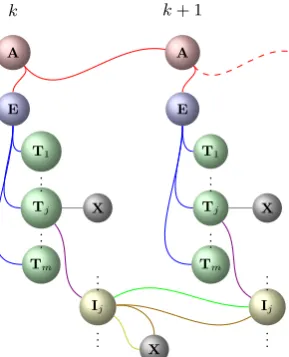
Figure 1: The (partial) hypergraph for representing all possi-ble combinations of mention occurrences. Links that belong to the same hyperedge are highlighted with the same color, and different hyperedges are highlighted with different col-ors,e.g., the green link that connects two Inodes forms a single hyperedge, while the two brown links that connect two
Inodes and oneXnode form a separate single hyperedge.
compactly represent exponentially many possible combinations of potentially overlapping, length-unbounded mentions of different types.
A hypergraphis a generalization of a conven-tional graph, whose edges (a.k.a. hyperedges) can connect two or more nodes. In this work, we con-sider a special class of hypergraphs, where each hyperedge consists of a designated parent node and an orderedlist of child nodes. Hypergraphs have also been used in other fields, such as syntac-tic parsing (Klein and Manning, 2001), semansyntac-tic parsing (Lu, 2015) and machine translation (Cme-jrek et al., 2013).
Our mention hypergraphs consist of five types of nodes which are used to compactly represent many mentions of different semantic types and boundaries, namely,Anodes,Enodes,Tnodes,I nodes, andXnodes. A partial mention hypergraph is depicted in Figure 1. We describe the definition of each type of nodes next.
• Anodes.These nodes are used to sequentially arrange mentions with different left bound-aries. Specifically, each A node at position
k (the k-th word), or Ak, is used to
com-pactly represent all such mentions in the sen-tence whose left boundaries areexactly at or strictly afterk.
• Enodes. The nodeEk is used to compactly
represent all possible mentions (possibly of length zero) whose left boundaries areexactly atthe current positionk.
• T nodes. The nodeTk
j is used to compactly
represent all mentions (possibly of length zero) whose left boundaries areexactly at po-sitionk, andhave the mention typej.
• I nodes. The node Ik
j is used to compactly
represent all incompletementions which con-tain the current word at position k as part of the mention, and have the mention typej. • Xnodes.These are the “terminal” nodes
indi-cating the completion of a path. No additional node will be attached to such nodes as a child. There are also various hyperedges that con-nect different nodes in the mention hypergraph. We usehα←β1, . . . , βni to denote a hyperedge
which connects a parent nodeα and child nodes
β1, . . . , βn. Each hyperedge essentially provides
one possible way of re-expressing the semantics conveyed by the parent node using the child nodes. For example, as shown in Figure 1, the hyperedge connecting the parent nodeAkand the child nodes
Ek,Ak+1 explains the fact that any mention cov-ered byAk either has a left boundary that is “
ex-actly at k” (Ek), or “exactly at or strictly after k+ 1” (Ak+1).
Similarly, for each Inode, there exist 3 hyper-edges that connect it to other child nodes. The top hyperedge (in green) encodes the fact that the cur-rent word appears in the middle of a mention; the bottom hyperedge (in yellow) encodes the fact that the current word appears in a mention as the last word; the middle hyperedge (in brown) encodes the fact that both cases can occur at the same time (i.e., the current word belongs to multiple over-lapping mentions of the same type). We have the following theorem:
Theorem 3.1 Any combination of mentions in a sentence can be represented with exactly one sub-hypergraph of the complete mention sub-hypergraph.
He also talked with the Egyptian president .
[PER]
[ PER ]
[GPE]
A A A A A A A A
E E E E E E E E
T2 T2 T2 T2 T2 T2 T2 T2
T1 T1 T1 T1 T1 T1 T1 T1
I2 I2 I2 I2
I1
X X X X X X X
X X X X X X
X X
[image:4.595.110.496.63.241.2]X
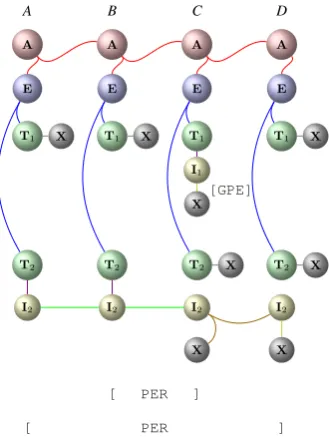
Figure 2: An example sub-hypergraph structure for jointly representing all the three mentions that appear in the sentence “He also talked with the Egyptian president .” For simplicity and the ease of illustration, we assume there are only two possible mention types:PERandGPE.
are jointly represented. The mention hypergraph defined over the input sentence contains exponen-tially many such sub-hypergraph structures.
We note that the converse of Theorem 3.1 is not true. In certain cases, it is possible for two differ-ent overlapping mdiffer-ention combinations to share the same mention hypergraph.
A B C D
[ PER ]
[ PER ]
[GPE]
A A A A
E E E E
T2 T2 T2 T2
T1 T1 T1 T1
I2 I2 I2 I2
I1
X X X
X X
X X
X
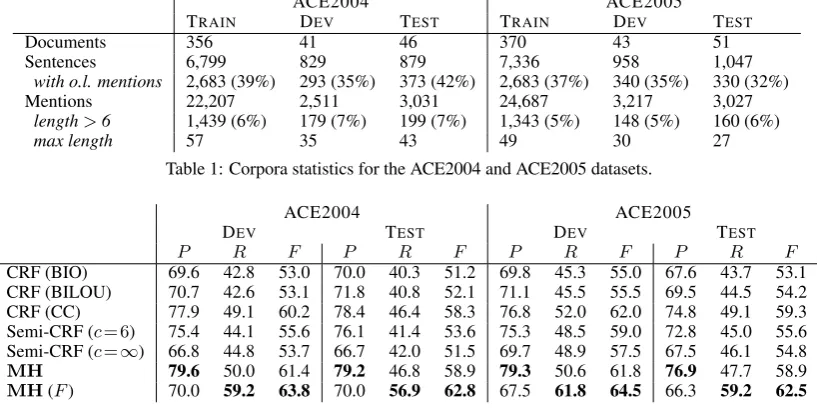
Figure 3: An example illustrating the converse of Theorem 3.1 is not true.
For example, consider a toy example sentenceA B C Dshown in Figure 3, bothB CandA B C Dare mentions of the same typePER(i.e.one is strictly contained by the other. We call such combinations type-I combinations). The above sub-hypergraph shows how to encode such a combination. How-ever, if bothA B CandB C Dare mentions of the same typePER(i.e., two mentions overlap but no one is contained by the other. We call such
com-binations type-II comcom-binations), such a combina-tion shares the same representacombina-tion as the above sub-hypergraph. Note that such an ambiguity hap-pens only when two overlapping mentions have the same type, and one mention is strictly con-tained by the other and their boundaries are all dif-ferent. In practice, however, we found that in the two datasets that we used for evaluations, if two mentions overlap with one another, they almost al-ways form a type-I combination, and type-II com-binations are very rare. Empirically, as we will see later in our experiments, our model is effective in handling overlapping mentions.
3.3 Log-Linear Modeling
Following the conditional random fields (Lafferty et al., 2001), we adopted a log-linear approach for such a joint mention extraction and typing task. Specifically, for a given input sentencex, the prob-ability of predicting a possible outputy(a mention sub-hypergraph that represents a particular combi-nation of mentions) is given as follows:
p(y|x) = Pexp(wTf(x,y))
y0exp(wTf(x,y0)) (1)
wheref(x,y)is the feature vector defined over the input-output pair(x,y), and the weight vectorw gives the parameters of the model.
Our objective is to minimize the regularized negative joint log-likelihood of the dataset:
L(w) =X
i
logX
y0
exp(wTf(xi,y0))
−X
i
[image:4.595.77.242.397.616.2]where(xi,yi) refers to thei-th training instance,
and the last term is aL2regularization term withλ being a positive scalar (fixed to 0.01 in this work). The gradient of the above objective function is:
∂L(w)
∂wk =
X
i
Ep(y0|xi)[fk(xi,y0)]
−X
i
fk(xi,yi) + 2λwk (3)
wherewkis the weight of thek-th featurefk. We note that unlike many recent latent-variable approaches to structured prediction (Petrov and Klein, 2007; Blunsom et al., 2008), we are able to represent each of our outputsywith a single fully-observed structure. Thus, our objective function essentially defines a standard regularized softmax regression model, and is therefore convex (Boyd and Vandenberghe, 2004), where a global opti-mum can be found.
The objective function defined in Equation 2 can be optimized with standard gradient-based methods. We used L-BFGS (Liu and Nocedal, 1989) as our optimization method.
3.4 Algorithms
In order to solve the optimization problem de-scribed above, one needs to compute the values of the gradient scores in Equation 3. Computa-tion of the second and third terms in this equa-tion is straightforward. The first term in Equa-tion 3 involves the computaEqua-tion of an expecta-tion of feature values over all possible menexpecta-tion combinations for a given input sentence. Follow-ing classic dynamic programmFollow-ing algorithms used in graphical models, we develop analogous effi-cient dynamic programming algorithms that work on hypergraphs and generalize the conventional forward-backward/inside-outside algorithm to ef-ficiently compute such values.
Time Complexity At each time stepk, we need to compute scores formInodes,mTnodes, 1E node, and 1Anode. Hence, the overall time com-plexity for our algorithm is inO(mn) (assuming computation of the feature scores at each node in-volves a constant time), wheremis the total num-ber of possible mention types, and n is the total number of words in the given sentence.1
1Note that the time complexity for the linear chain CRF is
inO(m2n)due to their first-order assumption.
3.5 Features
The features that we use are inspired by the work of (Carreras et al., 2002). Specifically, we consider the following features defined over the inputs:
• Words (and POS tags, if available) that appear around the current word (with position infor-mation), with a window of size 3.
• Wordn-grams (and POSn-grams, if available) that contain the current word (with position in-formation), forn= 2,3,4.
• Bag of words around the current word, with a window of size 5.
• Word pattern features2.
Note that these are the indicator functions de-fined over the inputs. The final set of features are defined over(x,y)tuples, which is obtained as a cross-product between the above indicator func-tions and the following indicator function:
• The type of the node (such asTorI).
In addition, we also introduce the following fea-ture defined over the output strucfea-ture only:
• The number of such hyperedges that exactly connect oneTnode and oneInode.
We call this featuremention penalty. This fea-ture learns a global preference of the number of mentions that should appear in any input sentence.
3.6 Joint Modeling of Mention Heads
One additional assumption for the mention extrac-tion and typing task is that each menextrac-tion comes with ahead. A head is strictly a substring of the mention and provides important information about the mention. It is possible to extend our model to support joint modeling of mention heads, while still maintaining the same time complexity.
Due to space limitations, we could only give a relatively brief description of this extension in this section. The idea is to replace the I nodes with three different types of nodes, namelyIj–B
nodes (used to represent words that appear within a mention of type j and before its head), Ij–W
nodes (used to represent words that appearwithin
the head of a mention of typej), andIj–Anodes
(used to represent words that appear within a men-tion of typejandafterits head). The hyperedges also need to be established accordingly in order to properly model all possible mention and head
2all-caps, all-digits, all-alphanumeric, contains-digits,
ACE2004 ACE2005
TRAIN DEV TEST TRAIN DEV TEST
Documents 356 41 46 370 43 51
Sentences 6,799 829 879 7,336 958 1,047
with o.l. mentions 2,683 (39%) 293 (35%) 373 (42%) 2,683 (37%) 340 (35%) 330 (32%)
Mentions 22,207 2,511 3,031 24,687 3,217 3,027
length>6 1,439 (6%) 179 (7%) 199 (7%) 1,343 (5%) 148 (5%) 160 (6%)
[image:6.595.94.503.66.274.2]max length 57 35 43 49 30 27
Table 1: Corpora statistics for the ACE2004 and ACE2005 datasets.
ACE2004 ACE2005
DEV TEST DEV TEST
P R F P R F P R F P R F
CRF (BIO) 69.6 42.8 53.0 70.0 40.3 51.2 69.8 45.3 55.0 67.6 43.7 53.1 CRF (BILOU) 70.7 42.6 53.1 71.8 40.8 52.1 71.1 45.5 55.5 69.5 44.5 54.2 CRF (CC) 77.9 49.1 60.2 78.4 46.4 58.3 76.8 52.0 62.0 74.8 49.1 59.3 Semi-CRF (c=6) 75.4 44.1 55.6 76.1 41.4 53.6 75.3 48.5 59.0 72.8 45.0 55.6 Semi-CRF (c=∞) 66.8 44.8 53.7 66.7 42.0 51.5 69.7 48.9 57.5 67.5 46.1 54.8
MH 79.6 50.0 61.4 79.2 46.8 58.9 79.3 50.6 61.8 76.9 47.7 58.9
MH(F) 70.0 59.2 63.8 70.0 56.9 62.8 67.5 61.8 64.5 66.3 59.2 62.5
Table 2: Results on ACE2004 and ACE2005. The last two rows give the results of this work.
combinations. Since in such a new hypergraph, at each time step, only a constant number (2) of addi-tional nodes are involved, the time complexity for learning and inference with such a model remains the same, which is inO(mn).
3.7 Optimization ofF measure
One standard evaluation metric for named entity recognition is the F (F1) measure. In our task, the F measure is defined as the harmonic mean of the precision (P) and recall (R) scores, where precision is the ratio between the number of cor-rectly predicted mentions and the total number of predicted mentions, and recall is the ratio between the number of correctly predicted mentions and the total number of gold mentions. We will also adopt these metrics in our evaluations later. Un-fortunately, the model only optimizes its objec-tive function defined in Equation 2, which is the negative (regularized) joint log-likelihood. Previ-ous work showed it was possible to optimize the
F measure in a log-linear model (Suzuki et al., 2006). Culotta and McCallum (2004) also pro-posed a method for optimizing information extrac-tion performance based on confidence estimaextrac-tion. Their work is based on linear-chain CRF and es-timate the confidence of extracted fields based on marginal probabilities. The technique is not di-rectly applicable to our task where a hypergraph representation is used to encode overlapping men-tions. In this work, we used a very simple and intuitive technique for optimizing theF measure. The idea is to further tune the weight of a single parameter – mention penalty based on the devel-opment set, after the training process completes.
This is based on the observation that by increas-ing the value of the mention penalty, we are essen-tially forcing our model to predict more mentions. Therefore the recall is a monotonic function with respect to the mention penalty. Based on this fact, we use a simple search algorithm with a fixed step size (we set it to 0.01) to determine the optimal value of the modified mention penalty so that the
F measure of the development set is optimized.
4 Experiments
In this section, we present empirical evaluations. Our main experiments were conducted on the stan-dard ACE2004 and ACE2005 datasets which contain overlapping mentions. Two additional ex-periments on the GENIAand CONLL2003 dataset were also conducted .
4.1 Results on ACE
Our primary experiments were conducted based on the English portion of the ACE2004 dataset3
and the ACE2005 dataset4. Following previous
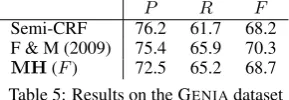
work, for ACE2004, we considered all documents from arabic treebank, bnews, chinese treebank, and nwire, and for ACE2005, we considered all documents frombc, bn, nw, andwl. We randomly split the documents for each dataset into three por-tions: 80% for training, 10% for development, and the remaining 10% for evaluations. The statistics of the datasets are summarized in Table 15. We
3https://catalog.ldc.upenn.edu/LDC2005T09 4https://catalog.ldc.upenn.edu/LDC2006T06
5Exact train/dev/test splits information can be found on
can observe that overlapping mentions are com-mon – over 30% of the sentences contain overlap-ping mentions (see row 3 of the table). Mentions can also be very long – over 5% of the mentions consist of more than 6 words, and the longest men-tion consists of 57 words.
We compared our system’s performance with those of several baseline approaches. We first built two simple baseline approaches based on se-quence labelling models using the conditional ran-dom fields (CRFs). Such approaches can not han-dle overlapping mentions. To train such mod-els, whenever two mentions overlap with one an-other in the training set, we remove the mention that is shorter in length. Following (Ratinov and Roth, 2009), we considered the BIO (Begin, In-side, Outside) approach and the BILOU (Begin, Inside, Last, Outside, Unit) approach for design-ing the output labels. Results show the BILOU ap-proach yields better results. Similar observations were reported in Ratinov and Roth (2009).
In the work of (Alex et al., 2007), the authors proposed several approaches for building mod-els to handle nested named entities in biomedi-cal texts. Their best results were obtained from a
cascadedapproach where they built one model for each named entity class. Outputs from one model can then served as the inputs to the next model for predicting the named entity class of a differ-ent type. One fundamdiffer-ental limitation of such an approach is that it being unable to handle overlap-ping mentions of the same type. Nevertheless, this approach worked very well on both datasets. The results are shown in the row of “CRF (CC)”.6
Another class of models that is often used in in-formation extraction are the semi-Markov condi-tional random fields (semi-CRFs) (Sarawagi and Cohen, 2004). Semi-CRF models are able to cap-ture the non-Markovian properties of mentions. However, they are unable to handle nested or over-lapping mentions. We thus used the same method as discussed above to exclude certain mentions for training. Such semi-CRF models typically as-sume there is a length restriction for the mentions – each mention can consist of up tocwords – in order to scale linearly. When such a restriction is lifted, the time complexity of such models be-comes quadratic in the number of words in the
in-6For all such linear chain CRF-related experiments, we
used the CRF++ toolkit (https://code.google.com/p/crfpp/) with L-BFGS, which gives us the most competitive re-sults over several different CRF implementations (see: http://www.chokkan.org/software/crfsuite/benchmark.html).
7 TYPES 14 TYPES 28 TYPES
#f w/s #f w/s #f w/s
CRF 3.6M 1219 13.6M 305 51.9M 76
[image:7.595.310.522.63.103.2]MH 4.2M 1532 8.4M 733 16.9M 430
Table 3: The decoding time and the number of features change as we increase the number of possible types. (#f: number of features created (in millions). w/s: number of words processed per second.) Experiments are conducted on the ACE 2004 dataset.
put sentence. We train two models: one with a length restriction, wherec= 6, and the other with-out a length restriction (c =∞). For features de-fined over the inputs, besides the Markovian fea-tures described in Sec 3.5, we also used the sur-face forms of complete mention spans as features. The results of these two models are reported in the fourth and fifth row of Table 2, respectively. Inter-estingly, imposing the length restriction appears to be helpful for precision, and as a result it makes a positive contribution towards the finalFmeasure. Our basic model (MH: mention hypergraph) that optimizes the negative joint log likelihood is able to obtain the best precision across these two datasets. When the model is further augmented with theFmeasure optimization step described in Sec 3.7 (MH(F)) it consistently yields the best results in terms of both recall score andFmeasure across these two datasets.
4.1.1 Running Time
We also conducted controlled experiments to re-port the actual execution time of our model and make a comparison with the linear-chain CRF model (BILOU approach). The experiments are all conducted on the ACE2004 dataset on the same machine. To make a proper comparison here, we implemented the linear-chain CRF model us-ing Java (the same language is used when imple-menting our model), and employed the same data structures for creating features as well as the same learning and inference routines used by our men-tion hypergraph model.
re-ACE2004 ACE2005
DEV TEST DEV TEST
P R F P R F P R F P R F
CRF (CC-S) 57.0 35.9 44.1 52.7 31.2 39.2 56.5 38.3 45.6 54.2 35.5 42.9 CRF (CC-F) 51.5 32.5 39.9 47.4 28.0 35.2 53.3 36.1 43.1 51.3 33.6 40.6 CRF (CC-L) 64.4 40.6 49.9 61.6 36.4 45.8 66.6 45.1 53.8 65.3 42.8 51.7 CRF (CC-CC) 63.6 40.5 49.5 60.8 36.1 45.3 65.9 44.8 53.3 64.2 42.0 50.7
MH(L) 66.7 41.9 51.5 64.7 38.2 48.1 70.5 45.0 55.0 69.2 43.0 53.0
MH(Joint) 78.6 47.4 59.1 79.0 44.1 56.6 79.2 48.7 60.3 70.1 45.1 54.8
[image:8.595.101.497.63.161.2]MH(JointF) 73.9 52.4 61.3 74.4 50.0 59.8 70.2 57.4 63.2 63.4 53.8 58.3
Table 4: Results on joint mention boundary, type, and head prediction on ACE2004 and ACE2005.
sulting in 28 different mention types in total. Our purpose of doing so is to understand how the mod-els behave when the number of possible mention types becomes large. We found that training on the entire training set of ACE2004 using the linear-chain CRF model with a large number of men-tion types was very expensive due to the extremely large number of features involved. We instead trained the models on the development set and pre-sented decoding time on the test set.
Table 3 shows the results. We empirically cap-tured the relationship between the speed of each system (average number of words processed per second) and the number of mention types. Specif-ically, we found that as we linearly increased the number of mention types, for the linear-chain CRF model, the number of features grew quadratically and the speed dropped quadratically, whereas for our model, the number of features grew linearly and the speed dropped linearly. This indicates that our model is more scalable to large, practical datasets with a large number of fine-grained men-tion types.
4.1.2 Joint Modeling of Heads
We also conducted experiments on these two datasets for the task of joint modeling of mention boundaries, types and heads. We used the same training and tuning methodology for optimizing theF measure. In such experiments, we adopted a very strict evaluation criterion: a predicted men-tion is regarded as correct iff and only if its bound-aries, type and head all exactly match those of the gold standard.
We compared our system’s results with those of several baseline approaches based on CRF where the cascaded BILOU approach described above was always used. Specifically, we considered ap-proaches that always regarded the complete span (CC-S), the first word (CC-F), and the last word (CC-L) as the predicted mention’s head, respec-tively. We also considered a cascaded approach (CC-CC) where we first predicted mentions, and
then predicted their heads by following a simi-lar approach used for predicting overlapping men-tions discussed above. The first four rows of Ta-ble 4 give the results of these baseline approaches. We can observe that always predicting the last word as the head gives the best performance. In-spired by this, we performed a simple approach by training a model presented in the previous sec-tion without considering head informasec-tion. When making predictions, we always regarded the last word of each predicted mention as its head. The results for such an approach are given in the fifth row of Table 4. The sixth row shows the results ob-tained by optimizing our model’s objective func-tion. The last row gives the results obtained by tuning the mention penalty based on the develop-ment set. As seen, our joint models significantly outperformed all those baseline approaches. We are not aware of any prior work in the literature that performs joint modeling of mention bound-aries, types, and heads.
4.2 Additional Experiments
We also additionally evaluated on the GENIA dataset (v3.02) whose focus was on biomedical related named entity recognition and classifica-tion, where the entities may overlap with one an-other. Furthermore, to see how our model works on datasets where mentions do not overlap with one another, we also conducted evaluations on the standard CONLL2003 NER dataset.
4.2.1 Results on GENIA
We followed the description of Finkel and Man-ning (2009) to set up our experiments on the GE -NIAdataset. Specifically, we used the first 90% of the sentences as the training data and the remain-ing 10% as the evaluation data. We also adhered to the paper’s prescription of collapsing all DNA
subtypes intoDNA;RNA subtypes intoRNA; and allproteinsubtypes intoprotein. We keptcell line
P R F Semi-CRF 76.2 61.7 68.2 F & M (2009) 75.4 65.9 70.3
[image:9.595.308.525.62.113.2]MH(F) 72.5 65.2 68.7 Table 5: Results on the GENIAdataset
training set into two portions. We trained a model using the first 90% of the training data, and used the remaining 10% for development. For features, no POS and no bag-of-words features are used.
We compared our model’s performance with that of a model based on a constituency parser pro-posed by (Finkel and Manning, 2009), as well as the semi-CRF model reported there. The results are shown in Table 5. Our model yields a better
F measure than the semi-CRF model, but gives a lower performance than the model of (Finkel and Manning, 2009). We note that, however, these results are not directly comparable. Specifically, both of these two previous models relied on an ad-ditional 200 million words from PubMed abstracts to learn word clusters as additional features, which we do not have access to.
One distinctive advantage of our model is the efficiency and scalability. The model of (Finkel and Manning, 2009) had a time complexity that is cubic in the number of words in the input sentence. In contrast, our model scales linearly as the length of the input sentence increases.7
4.2.2 Results on CONLL2003
To understand how well our model works on datasets where mentions or entities do not overlap with one another, we conducted additional experi-ments on the standard dataset used in the CONLL 2003 shared task (Tjong Kim Sang and De Meul-der, 2003), where the named entities strictly do not overlap with one another. We compared our system’s performance against that of a baseline version of the state-of-the-art Illinois NER sys-tem (Ratinov and Roth, 2009). Their syssys-tem per-formed sequential prediction over the input words and adopted the BILOU approach. Their full model also incorporates external knowledge re-sources (e.g., gazetteers and word class).
In order to make a proper comparison with the baseline version of their model, besides the gen-eral features we mentioned earlier, we also
fol-7In our experiments, for this dataset our model tagged
over 5,000 words/second. In (Finkel and Manning, 2009), the authors mentioned that their model tagged about 38 words/second, and the semi-CRF model tagged about 45 words/second. However, we note these numbers are not di-rectly comparable due to the advancement of CPU speed.
DEV TEST
P R F P R F
Illinois (b) - - 89.3 - - 83.7
MH 94.7 83.0 88.5 91.4 76.5 83.3
[image:9.595.108.253.63.113.2]MH(F) 91.4 86.7 89.2 87.3 80.7 83.8 Table 6: Results on the CONLL2003. Illinois (b): baseline version of (Ratinov and Roth, 2009).
lowed (Ratinov and Roth, 2009) in incorporat-ing word’s prefixes and suffixes (of length up to 5) as features, and normalized words referring to months, dates and numbers. Table 6 shows that our system gives an F measure that is compara-ble to that of the baseline version of their system, where no external resources are used.
This additional experiment showed that while our model is designed for handling more real-istic scenarios where mentions can overlap, it yields a performance competitive to a state-of-the-art system which only handles datasets with non-overlapping mentions.
5 Conclusions
In this work, we have introduced a novel model for the task of joint modeling of mention bound-aries, types, as well as their heads. Unlike many previous research efforts for mention extraction and classification, our novel mention hypergraph
representations for compactly representing expo-nentially many possible mentions enables a men-tion’s boundaries, type and head information to be jointly learned in a single framework. The model scales linearly with respect to the number of words in the input sentence, and performs exact learning where a unique global optimum can be found. Em-pirically, we have demonstrated the effectiveness of such a model across several standard datasets.
Future work include explorations of efficient al-gorithms for other information extraction tasks, such as joint mention and relation extraction (Li and Ji, 2014) and event extraction (Li et al., 2013). Our system and code can be downloaded from
http://statnlp.org/research/ie/.
Acknowledgements
References
Beatrice Alex, Barry Haddow, and Claire Grover. 2007. Recognising nested named entities in biomed-ical text. InBioNLP, pages 65–72. Association for Computational Linguistics.
Phil Blunsom, Trevor Cohn, and Miles Osborne. 2008. A Discriminative Latent Variable Model for Statisti-cal Machine Translation. InACL, pages 200–208.
Stephen Boyd and Lieven Vandenberghe. 2004. Con-vex optimization. Cambridge university press.
Xavier Carreras, Lluis Marquez, and Llu´ıs Padr´o. 2002. Named entity extraction using adaboost.
CONLL, pages 167–170.
Kai-Wei Chang, Rajhans Samdani, and Dan Roth. 2013. A Constrained Latent Variable Model for Coreference Resolution. In EMNLP, pages 601– 612.
Wanxiang Che, Mengqiu Wang, Christopher D Man-ning, and Ting Liu. 2013. Named Entity Recog-nition with Bilingual Constraints. InNAACL-HLT, pages 52–62.
Martin Cmejrek, Haitao Mi, and Bowen Zhou. 2013. Flexible and efficient hypergraph interactions for joint hierarchical and forest-to-string decoding. In
EMNLP, pages 545–555.
Alessandro Cucchiarelli and Paola Velardi. 2001. Un-supervised named entity recognition using syntactic and semantic contextual evidence. Computational Linguistics, 27(1):123–131.
Aron Culotta and Andrew McCallum. 2004. Con-fidence estimation for information extraction. In
HLT-NAACL, pages 109–112.
Oren Etzioni, Michael Cafarella, Doug Downey, Ana-Maria Popescu, Tal Shaked, Stephen Soderland, Daniel S Weld, and Alexander Yates. 2005. Un-supervised named-entity extraction from the web: An experimental study. Artificial Intelligence, 165(1):91–134.
Jenny Rose Finkel and Christopher D Manning. 2009. Nested named entity recognition. InEMNLP, pages 141–150. Association for Computational Linguis-tics.
Radu Florian, Abe Ittycheriah, Hongyan Jing, and Tong Zhang. 2003. Named entity recognition through classifier combination. In CONLL, pages 168–171. Association for Computational Linguis-tics.
Radu Florian, Hany Hassan, Abraham Ittycheriah, Hongyan Jing, Nanda Kambhatla, Xiaoqiang Luo, H Nicolov, and Salim Roukos. 2004. A statistical model for multilingual entity detection and tracking. InHLT-NAACL, pages 1–8. DTIC Document.
Stephen Guo, Ming-Wei Chang, and Emre Kiciman. 2013. To Link or Not to Link? A Study on End-to-End Tweet Entity Linking. In NAACL-HLT, pages 1020–1030.
Raphael Hoffmann, Congle Zhang, Xiao Ling, Luke Zettlemoyer, and Daniel S Weld. 2011. Knowledge-based weak supervision for information extraction of overlapping relations. InACL, pages 541–550. Association for Computational Linguistics.
Dan Klein and Christopher D. Manning. 2001. Parsing and hypergraphs. InIWPT, pages 123–134.
John Lafferty, Andrew McCallum, and Fernando CN Pereira. 2001. Conditional random fields: Prob-abilistic models for segmenting and labeling se-quence data. InICML.
Qi Li and Heng Ji. 2014. Incremental Joint Extraction of Entity Mentions and Relations. In ACL, pages 402–412.
Qi Li, Heng Ji, and Liang Huang. 2013. Joint Event Extraction via Structured Prediction with Global Features. InACL, pages 73–82.
Dong C Liu and Jorge Nocedal. 1989. On the limited memory BFGS method for large scale optimization.
Mathematical programming, 45(1-3):503–528.
Wei Lu. 2015. Constrained semantic forests for im-proved discriminative semantic parsing. InACL.
Ryan McDonald and Fernando Pereira. 2005. Identi-fying gene and protein mentions in text using condi-tional random fields. BMC bioinformatics, 6(S6). Mike Mintz, Steven Bills, Rion Snow, and Dan
Juraf-sky. 2009. Distant supervision for relation extrac-tion without labeled data. In ACL-IJCNLP, pages 1003–1011. Association for Computational Linguis-tics.
David Nadeau and Satoshi Sekine. 2007. A sur-vey of named entity recognition and classification.
Lingvisticae Investigationes, 30(1):3–26.
Arvind Neelakantan and Michael Collins. 2014. Learning Dictionaries for Named Entity Recogni-tion using Minimal Supervision. In EACL, pages 452–461.
Panupong Pasupat and Percy Liang. 2014. Zero-shot Entity Extraction from Web Pages. InACL, pages 391–401.
Slav Petrov and Dan Klein. 2007. Discriminative log-linear grammars with latent variables. InNIPS, pages 1153–1160.
Lev Ratinov and Dan Roth. 2009. Design challenges and misconceptions in named entity recognition. In
Alan Ritter, Sam Clark, Mausam, and Oren Etzioni. 2011. Named entity recognition in tweets: an exper-imental study. InEMNLP, pages 1524–1534. Asso-ciation for Computational Linguistics.
Sunita Sarawagi and William W Cohen. 2004. Semi-markov conditional random fields for information extraction. InNIPS, pages 1185–1192.
Jun Suzuki, Erik McDermott, and Hideki Isozaki. 2006. Training conditional random fields with multivariate evaluation measures. InCOLING/AC, pages 217–224.
Erik F Tjong Kim Sang and Fien De Meulder. 2003. Introduction to the CoNLL-2003 shared task: Language-independent named entity recognition. In
CONLL, pages 142–147. Association for Computa-tional Linguistics.
Mengqiu Wang, Wanxiang Che, and Christopher D Manning. 2013. Joint Word Alignment and Bilin-gual Named Entity Recognition Using Dual Decom-position. InACL, pages 1073–1082.
GuoDong Zhou and Jian Su. 2002. Named entity recognition using an hmm-based chunk tagger. In