Automatic Idiom Identification in Wiktionary
Grace MuznyandLuke Zettlemoyer Computer Science & Engineering
University of Washington Seattle, WA 98195
{muznyg,lsz}@cs.washington.edu
Abstract
Online resources, such as Wiktionary, provide an accurate but incomplete source of idiomatic phrases. In this paper, we study the problem of automatically identifying idiomatic dictio-nary entries with such resources. We train an idiom classifier on a newly gathered cor-pus of over 60,000 Wiktionary multi-word definitions, incorporating features that model whether phrase meanings are constructed compositionally. Experiments demonstrate that the learned classifier can provide high quality idiom labels, more than doubling the number of idiomatic entries from 7,764 to 18,155 at precision levels of over 65%. These gains also translate to idiom detection in sen-tences, by simply using known word sense disambiguation algorithms to match phrases to their definitions. In a set of Wiktionary def-inition example sentences, the more complete set of idioms boosts detection recall by over 28 percentage points.
1 Introduction
Idiomatic language is common and provides unique challenges for language understanding systems. For example, a diamond in the roughcan be the literal unpolished object or a crude but lovable person. Un-derstanding such distinctions is important for many applications, including parsing (Sag et al., 2002) and machine translation (Shutova et al., 2012).
We use Wiktionary as a large, but incomplete, ref-erence for idiomatic entries; individual entries can be marked as idiomatic but, in practice, most are
not. Using these incomplete annotations as super-vision, we train a binary Perceptron classifier for identifying idiomatic dictionary entries. We intro-duce new lexical and graph-based features that use WordNet and Wiktionary to compute semantic re-latedness. This allows us to learn, for example, that the words in the phrase diamond in the rough are more closely related to the words in its literal defi-nition than the idiomatic one. Experiments demon-strate that the classifier achieves precision of over 65% at recall over 52% and that, when used to fill in missing Wiktionary idiom labels, it more than dou-bles the number of idioms from 7,764 to 18,155.
These gains also translate to idiom detection in sentences, by simply using the Lesk word sense disambiguation (WSD) algorithm (1986) to match phrases to their definitions. This approach allows for scalable detection with no restrictions on the syn-tactic structure or context of the target phrase. In a set of Wiktionary definition example sentences, the more complete set of idioms boosts detection recall by over 28 percentage points.
2 Related Work
To the best of our knowledge, this work represents the first attempt to identify dictionary entries as id-iomatic and the first to reduce idiom detection to identification via a dictionary.
Previous idiom detection systems fall in one of two paradigms: phrase classification, where a phrasepis always idiomatic or literal, e.g. (Gedigian et al., 2006; Shutova et al., 2010), ortoken classifi-cation, where each occurrence of a phrasepcan be idiomatic or literal, e.g. (Katz and Giesbrecht, 2006;
Birke and Sarkar, 2006; Li and Sporleder, 2009). Most previous idiom detection systems have focused on specific syntactic constructions. For instance, Shutova et al. (2010) consider subject/verb ( cam-paign surged) and verb/direct-object idioms (stir ex-citement) while Fazly and Stevenson (2006), Cook et al. (2007), and Diab and Bhutada (2009) de-tect verb/noun idioms (blow smoke). Fothergill and Baldwin (2012) are syntactically unconstrained, but only study Japanese idioms. Although we focus on identifying idiomatic dictionary entries, one advan-tage of our approach is that it enables syntactically unconstrained token-level detection for any phrase in the dictionary.
3 Formal Problem Definitions
Identification For identification, we assume data of the form {(hpi, dii, yi) : i = 1. . . n} where
pi is the phrase associated with definition di and
yi ∈ {literal, idiomatic}. For example, this would include both the literal pairh “leave for dead”, “To abandon a person or other living creature that is in-jured or otherwise incapacitated, assuming that the death of the one abandoned will soon follow.”i and the idiomatic pairh“leave for dead”, “To disregard or bypass as unimportant.”i. Givenhpi, dii, we aim to predictyi.
Detection To evaluate identification in the con-text of detection, we assume data {(hpi, eii, yi) :
i = 1. . . n}. Here, pi is the phrase in exam-ple sentence ei whose idiomatic status is labeled
yi ∈ {idiomatic, literal}. One such idiomatic pair is h“heart to heart”, “They sat down and had a long overdue heart to heart about the future of their relationship.”i. Givenhpi, eii, we again aim to pre-dictyi.
4 Data
We gathered phrases, definitions, and example sen-tences from the English-language Wiktionary dump from November 13th, 2012.1
Identification Phrase, definition pairshp, diwere gathered with the following restrictions: the title of the Wiktionary entry must be English,pmust com-posed of two or more wordsw, andhp, dimust be in
1
We used the Java Wiktionary Library (Zesch et al., 2008).
Data Set Literal Idiomatic Total
All 56,037 7,764 63,801
Train 47,633 6,600 54,233
[image:2.612.318.535.60.147.2]Unannotated Dev 2,801 388 3,189 Annotated Dev 2,212 958 3,170 Unannotated Test 5,603 776 6,379 Annotated Test 4,510 1,834 6,344
Figure 1: Number of dictionary entries with each class for the Wiktionary identification data.
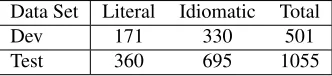
Data Set Literal Idiomatic Total
Dev 171 330 501
Test 360 695 1055
Figure 2: Number of sentences of each class for the Wik-tionary detection data.
its base form—senses that are not defined as a dif-ferent tense of a phrase—e.g. the pairh“weapons of mass destruction”, “Plural form of weapon of mass destruction”iwas removed while the pairh“weapon of mass destruction”, “A chemical, biological, radio-logical, nuclear or other weapon that ... ”iwas kept. Each pair hp, di was assigned label y according to the idiom labels in Wiktionary, producing the Train, Unannotated Dev, and Unannotated Test data sets. In practice, this produces a noisy assignment because a majority of the idiomatic senses are not marked. The development and test sets were anno-tated to correct these potential omissions. Annota-tors used the definition of an idiom as a “phrase with a non-compositional meaning” to produce the An-notated Dev and AnAn-notated Test data sets. Figure 1 presents the data statistics.
We measured inter-annotator agreement on 1,000 examples. Two annotators marked each dictionary entry as literal, idiomatic, or indeterminable. Less than one half of one percent could not be deter-mined2—the computed kappa was 81.85. Given this high level of agreement, the rest of the data were only labeled by a single annotator, follow-ing the methodology used with the VNC-Tokens Dataset (Cook et al., 2008).
Detection For detection, we gathered the example sentences provided, when available, for each defi-nition used in our annotated identification data sets. These sentences provide a clean source of
develop-2
[image:2.612.344.510.186.224.2]ment and test data containing idiomatic and literal phrase usages. In all, there were over 1,300 unique phrases, half of which had more than one possible dictionary definition in Wiktionary. Figure 2 pro-vides the complete statistics.
5 Identification Model
For identification, we use a linear model that pre-dicts classy∗ ∈ {literal, idiomatic}for an input pair
hp, diwith phrasepand definitiond. We assign the class:
y∗ = arg max
y θ·φ(p, d, y)
given features φ(p, d, y) ∈ Rn with associated pa-rametersθ∈Rn.
Learning In this work, we use the averaged Per-ceptron algorithm (Freund and Schapire, 1999) to perform learning, which was optimized in terms of iterations T, bounded by range [1, 100], by maxi-mizing F-measure on the development set.
The models described correspond to the features they use. All models are trained on the same, unan-notated training data.
Features The features that were developed fall into two categories: lexical and graph-based fea-tures. The lexical features were motivated by the intuition that literal phrases are more likely to have closely related words indto those inpbecause lit-eral phrases do not break the principle of compo-sitionality. All words compared are stemmed ver-sions. Let count(w, t) = number of times word w
appears in textt.
• synonym overlap: Let S be the set of syn-onyms as defined in Wiktionary for all words inp. Then, we define the synonym overlap =
1
|S|
P
s∈Scount(s, d).
• antonym overlap: LetAbe the set of antonyms as defined in Wiktionary for all words in
p. Then, we define the antonym overlap = 1
|A|
P
a∈Acount(a, d).
• average number of capitals:3 The value of
number of capital letters inp
number of words inp .
3
In practice, this feature identifies most proper nouns.
Graph-based features use the graph structure of WordNet 3.0 to calculate path distances. Let
distance(w, v, rel, n)be the minimum distance via links of type rel in WordNet from a word w to a wordv, up to a threshold max integer valuen, and 0 otherwise. The features compute:
• closest synonym:
min
w∈p,v∈ddistance(w, v, synonym,5)
• closest antonym:4
min
w∈p,v∈ddistance(w, v, antonym,5)
• average synonym distance:
1 |p|
X
w∈p,v∈d
distance(w, v, synonym,5)
• average hyponym:
1 |p|
X
w∈p,v∈d
distance(w, v, hyponym,5)
• synsets connected by an antonym: This feature in-dicates whether the following is true. The set of synsetsSynp, all synsets from all words inp, and
the set of synsetsSynd, all synsets from all words
ind, are connected by a shared antonym. This fea-ture follows an approach described by Budanitsky et al. (2006).
6 Experiments
We report identification and detection results, vary-ing the data labelvary-ing and choice of feature sets.
6.1 Identification
Random Baseline We use a proportionally
ran-dom baseline for the identification task that classi-fies according to the proportion of literal definitions seen in the training data.
Results Figure 3 provides the results for the base-line, the full approach, and variations with subsets of the features. Results are reported for the origi-nal, unannotated test set, and the same test examples with corrected idiom labels. All models increased
4The first relation expanded was the antonym relation. All
Data Set Model Rec. Prec. F1 Unannotated Lexical 85.8 21.9 34.9
Graph 62.4 26.6 37.3 Lexical+Graph 70.5 28.1 40.1
Baseline 12.2 11.9 12.0 Annotated Lexical 81.2 49.3 61.4 Graph 64.3 51.3 57.1 Lexical+Graph 75.0 52.9 62.0
[image:4.612.313.552.58.197.2]Baseline 29.5 12.5 17.6
Figure 3: Results for idiomatic definition identification.
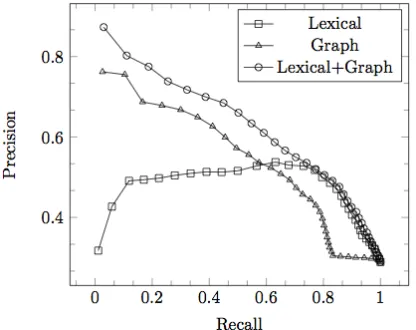
Figure 4: Precision and recall with varied features on the annotated test set.
over their corresponding baselines by more than 22 points and both feature families contributed.5
Figure 4 shows the complete precision, recall curve. We selected our operating point to optimize F-measure, but we see that the graph features per-form well across all recall levels and that adding the lexical features provides consistent improvement in precision. However, other points are possible, es-pecially when aiming for high precision to extend the labels in Wiktionary. For example, the original 7,764 entries can be extended to 18,155 at 65% pre-cision, 9,594 at 80%, or 27,779 at 52.9%.
Finally, Figures 5 and 6 present qualitative results, including newly discovered idioms and high scoring false identifications. Analysis reveals where our sys-tem has room to improve—errors most often occur with phrases that are specific to a certain field, such
5
We also ran ablations demonstrating that removing each feature from the Lexical+Graph model hurt performance, but omit the detailed results for space.
Phrase Definition
feel free You have my permission.
live down To get used to something shameful. nail down To make something
(e.g. a decision or plan) firm or certain. make after To chase.
get out To say something with difficulty. good riddance A welcome departure.
to bad rubbish
[image:4.612.77.294.61.169.2]as all hell To a great extent or degree; very. roll around To happen, occur, take place.
Figure 5: Newly discovered idioms.
Phrase Definition
put asunder To sunder; disjoin; separate; disunite; divorce; annul; dissolve. add up To take a sum.
peel off To remove (an outer layer or covering, such as clothing). straighten up To become straight, or straighter. wild potato The edible root of this plant. shallow embedding The act of representing one logic
or language with another by providing a syntactic translation.
Figure 6: High scoring false identifications.
as sports or mathematics, and with phrases whose words also appear in their definitions.
6.2 Detection
Approach We use the Lesk (1986) algorithm to
perform WSD, matching an input phrasepfrom sen-tenceeto the definitiondin Wiktionary that defines the sensepis being used in. The final classificationy
is then assigned tohp, diby the identification model.
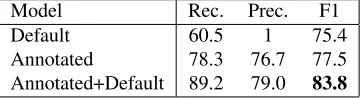
Results Figure 7 shows detection results. The baseline for this experiment is a model that assigns the default labels within Wiktionary to the disam-biguated definition. The Annotated model is the Lexical+Graph model shown in Figure 3 evaluated on the annotated data. The +Default setting aug-ments the identification model by labeling thehp, ei
as idiomatic if either the model or the original label within Wiktionary identifies it as such.
7 Conclusions
[image:4.612.80.288.209.374.2]dou-Model Rec. Prec. F1
Default 60.5 1 75.4
[image:5.612.96.278.61.110.2]Annotated 78.3 76.7 77.5 Annotated+Default 89.2 79.0 83.8
Figure 7: Detection results.
bles the number of marked idioms in Wiktionary, even when training on incomplete data. When com-bined with the Lesk word sense algorithm, this ap-proach provides a complete idiom detector for any phrase in the dictionary.
We expect that semi-supervised learning tech-niques could better recover the missing labels and boost overall performance. We also think it should be possible to scale the detection approach, perhaps with automatic dictionary definition discovery, and evaluate it on more varied sentence types.
Acknowledgments
The research was supported in part by the Na-tional Science Foundation (IIS-1115966) and a Mary Gates Research Scholarship. The authors thank Nicholas FitzGerald, Sarah Vieweg, and Mark Yatskar for helpful discussions and feedback.
References
J. Birke and A. Sarkar. 2006. A clustering approach for nearly unsupervised recognition of nonliteral lan-guage. In Proceedings of the Conference of the Eu-ropean Chapter of the Association for Computational Linguistics.
A. Budanitsky and G. Hirst. 2006. Evaluating wordnet-based measures of lexical semantic relatedness. Com-putational Linguistics, 32(1):13–47.
P. Cook, A. Fazly, and S. Stevenson. 2007. Pulling their weight: Exploiting syntactic forms for the automatic identification of idiomatic expressions in context. In Proceedings of the workshop on a broader perspective on multiword expressions.
P. Cook, A. Fazly, and S. Stevenson. 2008. The vnc-tokens dataset. In Proceedings of the Language Resources and Evaluation Conference Workshop To-wards a Shared Task for Multiword Expressions. M. Diab and P. Bhutada. 2009. Verb noun construction
mwe token supervised classification. InProceedings of the Workshop on Multiword Expressions: Identifica-tion, InterpretaIdentifica-tion, Disambiguation and Applications.
A. Fazly and S. Stevenson. 2006. Automatically con-structing a lexicon of verb phrase idiomatic combina-tions. In Proceedings of the Conference of the Eu-ropean Chapter of the Association for Computational Linguistics.
R. Fothergill and T. Baldwin. 2012. Combining re-sources for mwe-token classification. InProceedings of the First Joint Conference on Lexical and Compu-tational Semantics-Volume 1: Proceedings of the main conference and the shared task, and Volume 2: Pro-ceedings of the Sixth International Workshop on Se-mantic Evaluation.
Y. Freund and R.E. Schapire. 1999. Large margin clas-sification using the perceptron algorithm. Machine learning, 37(3):277–296.
M. Gedigian, J. Bryant, S. Narayanan, and B. Ciric. 2006. Catching metaphors. In Proceedings of the Third Workshop on Scalable Natural Language Un-derstanding.
G. Katz and E. Giesbrecht. 2006. Automatic identi-fication of non-compositional multi-word expressions using latent semantic analysis. InProceedings of the Workshop on Multiword Expressions: Identifying and Exploiting Underlying Properties.
M. Lesk. 1986. Automatic sense disambiguation using machine readable dictionaries: How to tell a pine cone from an ice cream cone. In Proceedings of Special Interest Group on the Design of Communication. L. Li and C. Sporleder. 2009. Classifier combination for
contextual idiom detection without labelled data. In Proceedings of the Conference on Empirical Methods in Natural Language Processing.
I. Sag, T. Baldwin, F. Bond, A. Copestake, and D. Flickinger. 2002. Multiword expressions: A pain in the neck for nlp. InComputational Linguistics and Intelligent Text Processing. Springer.
E. Shutova, L. Sun, and A. Korhonen. 2010. Metaphor identification using verb and noun clustering. In Pro-ceedings of the International Conference on Computa-tional Linguistics.
E. Shutova, S. Teufel, and A. Korhonen. 2012. Statisti-cal metaphor processing. Computational Linguistics, 39(2):301–353.