Linking Entities to a Knowledge Base with Query Expansion
Swapna Gottipati
School of Information Systems Singapore Management University
Singapore
Jing Jiang
School of Information Systems Singapore Management University
Singapore
Abstract
In this paper we present a novel approach to entity linking based on a statistical lan-guage model-based information retrieval with query expansion. We use both local con-texts and global world knowledge to expand query language models. We place a strong emphasis on named entities in the local con-texts and explore a positional language model to weigh them differently based on their dis-tances to the query. Our experiments on the TAC-KBP 2010 data show that incor-porating such contextual information indeed aids in disambiguating the named entities and consistently improves the entity linking per-formance. Compared with the official re-sults from KBP 2010 participants, our system shows competitive performance.
1 Introduction
When people read news articles, Web pages and other documents online, they may encounter named entities which they are not familiar with and there-fore would like to look them up in an encyclope-dia. It would be very useful if these entities could be automatically linked to their corresponding encyclo-pedic entries. This task of linking mentions of enti-ties within specific contexts to their corresponding
entries in an existing knowledge base is called
en-tity linkingand has been proposed and studied in the Knowledge Base Population (KBP) track of the Text Analysis Conference (TAC) (McNamee and Dang, 2009). Besides improving an online surfer’s brows-ing experience, entity linkbrows-ing also has potential
us-age in many other applications such as normalizing entity mentions for information extraction.
The major challenge of entity linking is to resolve name ambiguities. There are generally two types of ambiguities: (1) Polysemy: This type of ambigu-ities refers to the case when more than one entity
shares the same name. E.g. George Bushmay
re-fer to the 41st President of the U.S., the 43rd Presi-dent of the U.S., or any other individual who has the same name. Clearly polysemous names cause diffi-culties for entity linking. (2) Synonymy: This type of ambiguities refers to the case when more than one name variation refers to the same entity. E.g.
Metro-Goldwyn-Mayer Inc. is often abbreviated as
MGM. Synonymy affects entity linking when the
en-tity mention in the document uses a name variation not covered in the entity’s knowledge base entry.
Intuitively, to disambiguate a polysemous entity name, we should make use of the context in which the name occurs, and to address synonymy, exter-nal world knowledge is usually needed to expand acronyms or find other name variations. Indeed both strategies have been explored in existing litera-ture (Zhang et al., 2010; Dredze et al., 2010; Zheng et al., 2010). However, most existing work uses supervised learning approaches that require careful feature engineering and a large amount of training data. In this paper, we take a simpler unsupervised approach using statistical language model-based in-formation retrieval. We use the KL-divergence re-trieval model (Zhai and Lafferty, 2001) and ex-pand the query language models by considering both the local contexts within the query documents and global world knowledge obtained from the Web.
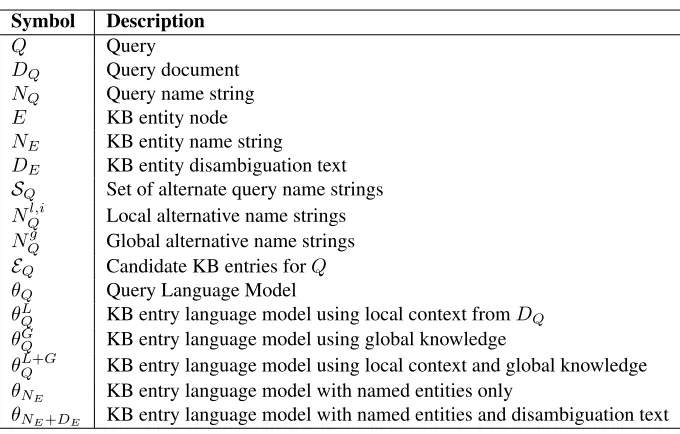
Symbol Description
Q Query
DQ Query document
NQ Query name string
E KB entity node NE KB entity name string
DE KB entity disambiguation text SQ Set of alternate query name strings
NQl,i Local alternative name strings
NQg Global alternative name strings EQ Candidate KB entries forQ
θQ Query Language Model
θL
Q KB entry language model using local context fromDQ
θG
Q KB entry language model using global knowledge
θQL+G KB entry language model using local context and global knowledge θNE KB entry language model with named entities only
[image:2.612.136.476.53.270.2]θNE+DE KB entry language model with named entities and disambiguation text Table 1: Notation
We evaluate our retrieval method with query ex-pansion on the 2010 TAC-KBP data set. We find that our expanded query language models can indeed improve the performance significantly, demonstrat-ing the effectiveness of our principled and yet sim-ple techniques. Comparison with the official results from KBP participants also shows that our system is competitive. In particular, when no disambiguation text from the knowledge base is used, our system can achieve an overall 85.2% accuracy and 9.3% relative improvement over the best performance reported in KBP 2010.
2 Task Definition and System Overview
Following TAC-KBP (Ji et al., 2010), we define the entity linking task as follows. First, we assume the existence of a Knowledge Base (KB) of
enti-ties. Each KB entry E represents a unique entity
and has three fields: (1) a name string NE, which
can be regarded as the official name of the entity,
(2) an entity typeTE, which is one of{PER, ORG,
GPE, UNKNOWN}, and (3) some disambiguation
textDE. Given a queryQwhich consists of a query
name stringNQ and a query document DQ where
the name occurs, the task is to return a single KB
entry to which the query name string refers orNilif
there is no such KB entry.
It is fairly natural to address entity linking by ranking the KB entries given a query. In this section
we present an overview of our system, which con-sists of two major stages: a candidate selection stage to identify a set of candidate KB entries through name matching, and a ranking stage to link the query entity to the most likely KB entry. In both stages, we consider the query’s local context in the query document and world knowledge obtained from the Web. It is important to note that the selection stage is based on string matching where the order of the word matters. It is different from the ranking stage where a probabilistic retrieval model based on bag-of-word representation is used. Our preliminary ex-periments demonstrate that without the first candi-date selection stage the linking process results in low performance.
2.1 Selecting Candidate KB Entries
The first stage of our system aims to filter out irrel-evant KB entries and select only a set of candidates that are potentially the correct match to the query. Intuitively, we determine whether two entities are the same by comparing their name strings. We
there-fore need to compare the query name stringNQwith
the name string NE of each KB entry. However,
because of the name ambiguity problem, we cannot expect the correct KB entry to always have exactly the same name string as the query. To address this problem, we use a set of alternative name strings
strings match at least one of them. These alterna-tive name strings come from two sources: the query
documentDQand the Web.
First, we observe that some useful alternative name strings come from the query document. For example, a PER query name string may contain only a person’s last name but the query document con-tains the person’s full name, which is clearly a less ambiguous name string to use. Similarly, a GPE query name string may contain only the name of a city or town but the query document contains the state or province, which also helps disambiguate the query entity. Based on this observation, we do the
following. Given queryQ, letSQ denote the set of
alternative query name strings. InitiallySQcontains
onlyNQ. We then use an off-the-shelf NER tagger
to identify named entities from the query document
DQ. For PER and ORG queries, we select named
entities in DQ that contain NQ as a substring. For
GPE queries, we select named entities that are of the type GPE, and we then combine each of them with
NQ. We denote these alternative name strings as
{NQl,i}KQ
i=1, wherelindicates that these name strings
come locally fromDQandKQis the total number of
such name strings. {NQl,i}are added toSQ. Figure
1 and Figure 2 show two example queries together with theirSQ.
Sometimes alternative name strings have to come from external knowledge. For example, one of the queries we have contains the name string “AMPAS,” and the query document also uses only this acronym to refer to this entity. But the full name of the entity, “Academy of Motion Pictures Arts and Sciences,” is needed in order to locate the correct KB entry. To tackle this problem, we leverage Wikipedia to find the most likely official name. Given query name
stringNQ, we check whether the following link
ex-ists: http://en.wikipedia.org/NQ. IfNQ
is an abbreviation, Wikipedia will redirect the link to the Wikipedia page of the corresponding entity with its official name. So if the link exists, we use the title of the Wikipedia page as another alternative
name string forNQ. We refer to this name string as
NQg to indicate that it is a global name variant.NQg is
also added toSQ. Figure 2 shows such an example.
For each name stringNinSQ, we find KB entries
whose name strings matchN. We take the union of
Query name string(NQ):Mobile
Query document(DQ): The site is near Mount
Ver-non in the Calvert community on the Tombigbee River, some 25 miles (40 kilometers) north of Mobile. It’s on a river route to the Gulf of Mexico and near Mobile’s rails and interstates. Along with tax breaks and$400 million (euro297 million) in financial incentives, Al-abama offered a site with a route to a Brazil plant that will provide slabs for processing in Mobile.
Alternative Query Strings(SQ):
from local context: Mobile, Mobile Mount Vernon, Mobile Calvert, Mobile River, Mobile Mexico, Mobile Alabama, Mobile Brazil
Figure 1: An exampleGPEquery from TAC 2010.
Query name string(NQ):Coppola
Query document (DQ): I had no idea of all these
semi-obscure connections, felicia! Alex Greenwald and Claire Oswalt aren’t names I’m at all familiar with, but Jason Schwartzman I’ve heard of. Isn’t he Sophia Coppola’s cousin? I think I once saw a pic-ture of him sometime ago
Alternative Query Strings(SQ):
from local context:Coppola, Sophia Coppola, Sofia Coppola
from world knowledge(Wikipedia):Sofia Coppola
Figure 2: An examplePERquery from TAC 2010.
these sets of KB entries and refer to it asEQ. These
are the candidate KB entries for queryQ.
2.2 Ranking KB Entries
Given the candidate KB entries EQ, we need to
decide which one of them is the correct match. We adopt the widely-used KL-divergence retrieval model, a statistical language model-based retrieval method proposed by Lafferty and Zhai (2001).
Given a KB entryEand queryQ, we scoreEbased
on the KL-divergence defined below:
s(E, Q) =−Div(θQ∥θE) =− ∑
w∈V
p(w|θQ) log
p(w|θQ)
p(w|θE)
.
(1)
HereθQandθE are the query language model and
the KB entry language model, respectively. A lan-guage model here is a multinomial distribution over
words (i.e. a unigram language model). V is the
vocabulary andwis a single word.
To estimate θE, we follow the standard
smooth-ing (Zhai and Lafferty, 2004):
p(w|θE) =
c(w, E) +µp(w|θC)
|E|+µ , (2)
where c(w, E) is the count of w in E, |E|is the
number of words in E, θC is a background
lan-guage model estimated from the whole KB, andµ
is the Dirichlet prior. Recall thatEcontainsNE,TE
andDE. We consider using eitherNE only or both
NE and DE to obtain c(w, E) and|E|. We refer
to the former estimatedθE asθNE and the latter as
θNE+DE.
To estimateθQ, typically we can use the empirical
query word distribution:
p(w|θQ) =
c(w, NQ) |NQ|
, (3)
wherec(w, NQ)is the count ofwinNQand|NQ|
is the length ofNQ. We call this model theoriginal
query language model.
After ranking the candidate KB entries inEQ
us-ing Equation (1), we perform entity linkus-ing as fol-lows. First, using an NER tagger, we determine the
entity type of the query name stringNQ. LetTQ
de-note this entity type. We then pick the top-ranked
KB entry whose score is higher than a thresholdτ
and whoseTE is the same asTQ. The system links
the query entity to this KB entry. If no such entry
exists, the system returnsNil.
3 Query Expansion
We have shown in Section 2.1 that using the
origi-nal query name stringNQ itself may not be enough
to obtain the correct KB entry, and additional words from both the query document and external knowl-edge can be useful. However, in the KB entry se-lection stage, these additional words are only used to enlarge the set of candidate KB entries; they have not been used to rank KB entries. In this section, we
discuss how to expand the query language modelθQ
with these additional words in a principled way in order to rank KB entries based on how likely they match the query entity.
3.1 Using Local Contexts
Let us look at the example from Figure 2 again.
During the KB entry ranking stage, if we use θQ
estimated from NQ, which contains only the word
“Coppola,” the retrieval function is unlikely to rank the correct KB entry on the top. But if we include the contextual word “Sophia” from the query doc-ument when estimating the query language model, KL-divergence retrieval model is likely to rank the correct KB entry on the top. This idea of using contextual words to expand the query is very sim-ilar to (pseudo) relevance feedback in information
retrieval. We can treat the query documentDQ as
our only feedback document.
Many different (pseudo) relevance feedback methods have been proposed. Here we apply the relevance model (Lavrenko and Croft, 2001), which has been shown to be effective and robust in a re-cent comparative study (Lv and Zhai, 2009). We first briefly review the relevance model. Given a set
of (pseudo) relevant documentsDr, where for each
D ∈ Dr there is a document language model θD,
we can estimate a feedback language model θfbQ as
follows:
p(w|θfbQ) ∝ ∑
D∈Dr
p(w|θD)p(θD)p(Q|θD). (4)
For our problem, since we have only a single
feed-back documentDQ, the equation above can be
sim-plified. In fact, in this case the feedback language model is the same as the document language model
of the only feedback document, i.e.θDQ.
We then linearly interpolate the feedback lan-guage model with the original query lanlan-guage model to form an expanded query language model:
p(w|θL
Q) = αp(w|θQ) + (1−α)p(w|θDQ), (5)
whereαis a parameter between 0 and 1, to control
the amount of feedback. The largerαis, the less we
rely on the local context. Lindicates that the query
expansion comes from local context. This θLQ can
then replaceθQin Equation (1) to rank KB entries.
Special Treatment of Named Entities
Usually the document language modelθDQ is
es-timated using the entire text from DQ. For entity
linking, we suspect that named entities surrounding
the query name string inDQare particularly useful
NE and non-NE words differently. In the extreme case, we can use only NEs to estimate the document
language modelθDQ as follows:
p(w|θDQ) = 1
KQ KQ ∑
i=1
c(w, NQl,i)
|NQl,i| , (6)
where{NQl,i}are defined in Section 2.
Positional Model
Another observation is that words closer to the query name string in the query document are likely to be more important than words farther away. Intu-itively, we can use the distance between a word and the query name string to help weigh the word. Here we apply a recently proposed positional pseudo rel-evance feedback method (Lv and Zhai, 2010). The
document language modelθDQnow has the
follow-ing form:
p(w|θDQ) = 1
KQ KQ ∑
i=1
f(pi, q)·
c(w, NQl,i) |NQl,i|
, (7)
where pi and q are the absolute positions of NQl,i
andNQinDQ. The functionf is Gaussian function
defined as follows:
f(p, q) = √ 1 2πσ2exp
(−(p−q)2 2σ2
)
. (8)
where varianceσcontrols the spread of the curve.
3.2 Using Global World Knowledge
Similar to the way we incorporate words fromDQ
into the query language model, we can also con-struct a feedback language model using the most likely official name of the query entity obtained from Wikipedia. Specifically, we define
p(w|θNQg) =
c(w, NQg)
|NQ|g . (9)
We can then linearly interpolateθNg
Q with the
orig-inal query language modelθQ to form an expanded
query language modelθQG:
p(w|θQG) =αp(w|θQ) + (1−α)p(w|θNQg). (10)
Here G indicates that the query expansion comes
from global world knowledge.
[image:5.612.342.503.56.108.2]Entity Type %Nil %non-Nil GPE 32.8% 67.2 % ORG 59.5% 40.5 % PER 71.7% 28.3 %
Table 2: Percentages of Nil and non-Nil queries.
3.3 Combining Local Context and World Knowledge
We can further combine the two kinds of additional words into the query language model as follows:
p(w|θQL+G) = αp(w|θQ) + (1−α) (
βp(w|θDQ) +(1−β)p(w|θNg
Q) )
. (11)
Note that here we have two parametersαandβ to
control the amount of contributions from the local context and from global world knowledge.
4 Experiments
4.1 Experimental Setup
Data Set: We evaluate our system on the TAC-KBP 2010 data set (Ji et al., 2010). The knowledge base was constructed from Wikipedia with 818,741 en-tries. The data set contains 2250 queries and query documents come from news wire and Web pages. Around 45% of the queries have non-Nil entries in the KB. Some statistics of the queries are shown in Table 2.
Tools: In our experiments, to extract named entities
withinDQand to determineTQ, we use the Stanford
NER tagger1. An example output of the NER tagger
is shown below:
<PERSON>Hugh Jackman<PERSON> is Jacked!!
This piece of text comes from a query document where the query name string is “Jackman.” We can see that the NER tagger can help locate the full name of the person.
We use the Lemur/Indri2 search engine for
re-trieval. It implements the KL-divergence retrieval model as well as many other useful functionalities.
Evaluation Metric: We adopt theMicro-averaged accuracymetric, which is the mean accuracy over all queries. It was used in TAC-KBP 2010 (Ji et
al., 2010) as the official metric to evaluate the per-formance of entity linking. This metric is simply defined as the percentage of queries that have been correctly linked.
Methods to Compare: Recall that our system con-sists of a KB entry selection stage and a KB entry
ranking stage. At the selection stage, a set SQ of
alternative name strings are used to select candidate KB entries. We first define a few settings where dif-ferent alternative name string sets are used to select candidate KB entries:
• Q represents the baseline setting which uses
only the original query name stringNQ to
se-lect candidate KB entries.
• Q+L represents the setting where alternative
name strings obtained from the query
docu-mentDQare combined withNQto select
can-didate KB entries.
• Q+Grepresents the setting where the
alterna-tive name string obtained from Wikipedia is
combined withNQ to select candidate KB
en-tries.
• Q+L+Grepresents the setting as we described in Section 2.1, that is, alternative name strings
from bothDQand Wikipedia are used together
withNQto select candidate KB entries.
After selecting candidate KB entries, in the KB entry ranking stage, we have four options for the query language model and two options for the KB entry language model. For the query language
model, we have (1)θQ, the original query language
model, (2)θLQ, an expanded query language model
using local context fromDQ, (3) θGQ, an expanded
query language model using global world
knowl-edge, and (4) θLQ+G, an expanded query language
model using both local context and global world knowledge. For the KB entry language model, we can choose whether or not to use the KB
disam-biguation textDE and obtainθNE andθNE+DE,
re-spectively.
4.2 Results and Discussion
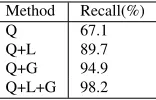
First, we compare the performance of KB entry se-lection stage for all four settings on non-Nil queries. The performance measure recall is defined as
recall= {
1, if E that ref ers to Q, exists inEQ 0, otherwise
The recall statistics in Table 3 shows that, Q+L+G has the highest recall of the KB candidate entries.
Method Recall(%)
Q 67.1
[image:6.612.389.467.130.180.2]Q+L 89.7 Q+G 94.9 Q+L+G 98.2
Table 3: Comparing the effect of candidate entry selec-tion using different methods - KB entry selecselec-tion stage recall.
Before examining the effect of query expansion in ranking, we now compare the effect of using dif-ferent sets of alternative query name strings in the candidate KB entry selection stage. For this set of
experiments, we fix the query language model toθQ
and the KB entry language model toθNEin the
rank-ing stage.
Table 4 shows the performance of all the settings in terms of micro-averaged accuracy. The results shown in Tables 4, 5 and 6 are based on the opti-mum parameter settings. We can see that in terms of the overall performance, both Q+L and Q+G give better performance than Q with a 7.7% and a 9.9% relative improvement, respectively. Q+L+G gives the best performance with a 12.8% relative improve-ment over Q. If we further zoom into the results, we see that for ORG and PER queries, when no correct KB entry exists (i.e. the Nil case), the performance of Q, Q+L, Q+G and Q+L+G is very close, indicat-ing that the additional alternative query name strindicat-ings do not help. It shows that the alternative query name strings are most useful for queries that do have their correct entries in the KB.
We now further analyze the impact of the
ex-panded query language models θL
Q, θGQ and θQL+G.
We first analyze the results without using the KB
disambiguation text, i.e. usingθNE. Table 5 shows
the comparison between θQ and other expanded
All Nil Non-Nil
Method ALL GPE ORG PER GPE ORG PER GPE ORG PER
[image:7.612.118.494.57.117.2]Q 0.6916 0.5714 0.6533 0.8495 0.8618 0.9888 0.9963 0.4294 0.1612 0.4789 Q+L 0.7449 0.7156 0.6533 0.8655 0.9472 0.9888 0.9944 0.6024 0.1612 0.5399 Q+G 0.7604 0.7009 0.6893 0.8908 0.9431 0.9888 0.9944 0.5825 0.2500 0.6291 Q+L+G 0.7800 0.7583 0.6893 0.8921 0.9431 0.9888 0.9944 0.6680 0.2500 0.6338
Table 4: Comparing the performance of using different sets of query name strings for candidate KB entry selection.
θQandθNEare used in KB entry ranking.
All Nil Non-Nil
Method QueryModel ALL GPE ORG PER GPE ORG PER GPE ORG PER
Q+L θQ 0.7449 0.7156 0.6533 0.8655 0.9472 0.9888 0.9944 0.6024 0.1612 0.5399 θL
Q 0.7689 0.7850 0.6533 0.8682 0.9309 0.9888 0.9944 0.7137 0.1612 0.5493
Q+G θQ 0.7604 0.7009 0.6893 0.8908 0.9431 0.9888 0.9944 0.5825 0.2500 0.6291 θG
Q 0.8160 0.7423 0.7867 0.9188 0.9106 0.9372 0.9796 0.6600 0.5658 0.7653
Q+L+G θQ 0.7800 0.7583 0.6893 0.8921 0.9431 0.9888 0.9944 0.6680 0.2500 0.6338
[image:7.612.86.526.154.245.2]θQL+G 0.8516 0.8278 0.7867 0.9401 0.8821 0.9372 0.9814 0.8012 0.5658 0.8357
Table 5: Comparison between the performance ofθQand expanded query language models in terms of micro average
accuracy.θNEwas used in ranking.
On the other hand, again we observe that the ef-fects on the Nil and the non-Nil queries are differ-ent. While in Table 4 the alternative name strings do not affect the performance much for Nil queries, now the expanded query language models actually hurt the performance for Nil queries. It is not sur-prising to see this result. When we expand the query language model, we can possibly introduce noise, especially when we use the external knowledge ob-tained from Wikipedia, which largely depends on what Wikipedia considers to be the most popular official name of a query name string. With noisy terms in the expanded query language model we in-crease the chance to link the query to a KB entry which is not the correct match. The challenge is that we do not know when additional terms in the ex-panded query language model are noise and when they are not, because for non-Nil queries we do ob-serve a substantial amount of improvement brought by query expansion, especially with external world knowledge. We will further investigate this research question in the future.
We now further study the impact of using the KB disambiguation text associated with each entry to es-timate the KB entry language model used in the KL-divergence ranking function. The results are shown
in Table 6 for all the methods onθNE vs. θNE+DE
using the expanded query language models. We can see that for all methods the impact of using the KB disambiguation text is very minimal and is observed
only for GPE and ORG queries. Table 7 shows an example of the KL-divergence scores for a query,
Mobile whose context is previously shown in the Figure 1. Without the KB disambiguation text both
the KB entryMobile Alabamaand the entryMobile
Riverare given the same score, resulting in
inaccu-rate linking in theθNE case. But withθNE+DE,
Mo-bile Alabamawas scored higher, resulting in an ac-curate linking. However, we observe that such cases are very rare in the TAC 2010 query list and thus the overall improvement observed is minimal.
KB Entry KB Name w/o text w/ text E0583976 Mobile Alabama -6.28514 -6.3839 E0183287 Mobile River -6.28514 -6.69372
Table 7: The KL-divergence scores of KB entities for the queryMobile.
fea-All Nil Non-Nil
Method KB Text ALL GPE ORG PER GPE ORG PER GPE ORG PER
Q θNE 0.6916 0.5714 0.6533 0.8495 0.8618 0.9888 0.9963 0.4294 0.1612 0.4789
θNE+DE 0.6888 0.5607 0.6533 0.8495 0.8618 0.9888 0.9963 0.4135 0.1612 0.4789
Q+L θNE 0.7689 0.7850 0.6533 0.8682 0.9309 0.9888 0.9944 0.7137 0.1612 0.5493
θNE+DE 0.7707 0.7904 0.6533 0.8682 0.9390 0.9888 0.9944 0.7177 0.1612 0.5493
Q+G θNE 0.8160 0.7423 0.7867 0.9188 0.9106 0.9372 0.9796 0.6600 0.5658 0.7653 θNE+DE 0.8222 0.7450 0.7827 0.9387 0.8902 0.9372 0.9814 0.6740 0.5559 0.8310 Q+L+G θNE 0.8516 0.8278 0.7867 0.9401 0.8821 0.9372 0.9814 0.8012 0.5658 0.8357
[image:8.612.95.519.55.178.2]θNE+DE 0.8524 0.8291 0.7880 0.9401 0.8740 0.9372 0.9814 0.8072 0.5691 0.8357
Table 6: Comparing the performance using KB text and without using KB text for all methods using expanded query models in terms of micro average accuracy on 2250 queries. θNE+DE represents method using KB text andθNE represents methods without using KB text.
ture set is an expensive task. Their overall accu-racy is 1.5% higher than our model. Table 8 shows that the performance of ORG entities is lower when compared with the TAC results when we used KB text. In our analysis, we observed that, even though some entities like AMPAS are linked correctly, the entities like CCC (Consolidated Contractors Com-pany) failed due to ambiguity in the title. Here, we may benefit by leveraging more global knowledge,
i.e, we should expand theNQg with Wikipedia global
context entities together with the title to fully benefit from global knowledge. In particular, when KB text is not used, our system outperforms the highest TAC results for all three types of queries.
From the analysis by Ji et al. (2010), overall the participating teams generally performed the best on PER queries and the worst on GPE queries. With our system, we can achieve good performance on GPE queries.
KB Text Usage Type Our System TAC Highest
θNE+DE
All 0.8524 0.8680 GPE 0.8291 0.7957 ORG 0.7880 0.8520 PER 0.9401 0.9601
θNE
[image:8.612.327.519.480.612.2]All 0.8516 0.7791 GPE 0.8278 0.7076 ORG 0.7867 0.7333 PER 0.9401 0.9001
Table 8: Comparison of the best configuration of our sys-tem (Q+L+G withθQL+G) with the TAC-KBP 2010 results
in terms of micro-averaged accuracy.θNE+DErepresents the method using KB disambiguation text andθNE repre-sents the method without using KB disambiguation text.
4.3 Parameter Sensitivity
In all our experiments, we set the Dirichlet priorµto
2500 following previous studies. For the thresholdτ
we empirically set it to -12.0 in all the experiments based on preliminary results. Recall that all the ex-panded query language models also have a control
parameters α. The local context-based models θL
Q
and θLQ+G have an additional parameter σ which
controls the proximity weighing. TheθQL+G model
has another additional parameterβ that controls the
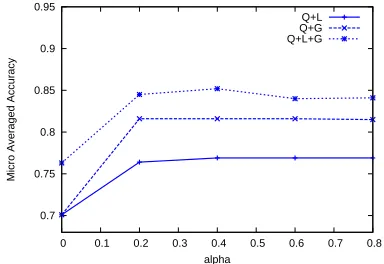
balance between local context and world knowledge. In this subsection, we study the sensitivity of these parameters. We plot the sensitivity graphs for all the
methods that involveα(βset to 0.5) in Figure 3. As
we can see, all the curves appear to be stable and
α=0.4 appears to work well.
0.7 0.75 0.8 0.85 0.9 0.95
0 0.1 0.2 0.3 0.4 0.5 0.6 0.7 0.8
Micro Averaged Accuracy
alpha
Q+L Q+G Q+L+G
Figure 3: Sensitivity of αin regard to micro-averaged accuracy.
Similarly, we set α=0.4 and examine how β
af-fects micro averaged accuracy. We plot the
sensi-tivity curve forβ for the Q+L+G setting withθQL+G
in Figure 5. As we can see, the best performance
[image:8.612.72.303.521.631.2]0.76 0.77 0.78 0.79 0.8 0.81 0.82 0.83 0.84 0.85 0.86
0 0.2 0.4 0.6 0.8 1
Micro Averaged Accuracy
beta
[image:9.612.89.276.61.191.2]Q+L+G
Figure 4: Sensitivity of β in regard to micro-averaged accuracy.
context and the global world knowledge are weighed equally for aiding disambiguation and improving the entity linking performance.
0.7 0.75 0.8 0.85 0.9 0.95
40 60 80 100 120
Micro Averaged Accuracy
sigma
Q+L Q+L+G
Figure 5: Sensitivity ofσwith respect to micro-averaged accuracy.
Furthermore, we systematically test a fixed set of
σvalues from 25 to 125 with an intervals of 25 and
examine howσaffects micro averaged accuracy. We
set α=0.4 and β=0.5, which is the best parameter
setting as discussed above. We plot the sensitivity
curves for the parameter σ for methods that utilize
the local context, i.e. θQLandθLQ+G, in Figure 5. We
observe that all the curves are stable and 75 <=σ
<= 100appears to work well. We setσ=100 for all our experiments. Moreover, after 100, the graph be-comes stable, which indicates that proximity has less impact on the method from this point on. This im-plies that an equal weighing scheme actually would work the same for these experiments. Part of the reason may be that by using only named entities in the context rather than all words, we have effectively picked the most useful contextual terms. Therefore, positional feedback models do have exhibit much benefit for our problem.
5 Related Work
Bunescu and Pasca (2006) and Cucerzan (2007) ex-plored the entity linking task using Vector Space Models for ranking. They took a classification ap-proach together with the novel idea of exploiting Wikipedia knowledge. In their pioneering work, they used Wikipedia’s category information for en-tity disambiguation. They show that using differ-ent background knowledge, we can find efficidiffer-ent ap-proaches for disambiguation. In their work, they took an assumption that every entity has a KB en-try and thus the NIL entries are not handled.
Similar to other researchers, Zhang et al. (2010) took an approach of classification and used a two-stage approach for entity liking. They proposed a supervised model with SVM ranking to filter out the candidates and deal with disambiguation effectively. For entity diambiguation they used the contextual comparisons between the Wikipedia article and the KB article. However, their work ignores the possi-bilities of acronyms in the entities. Also, the am-biguous geo-political names are not handled in their work.
Dredze et al. (2010) took the approach that large number of entities will be unlinkable, as there is a probability that the relevant KB entry is unavail-able. Their algorithm for learning NIL has shown very good results. But their proposal for handling the alias name or stage name via multiple lists is not scalable. Unlike their approach, we use the global knowledge to handle the stage names and thus this gives an optimized solution to handle alias names. Similarly, for acronyms we use the global knowl-edge that aids unabbreviating and thus entity dis-ambiguation. Similar to other approaches, Zheng et al. (2010) took a learning to rank approach and compared list-wise rank model to the pair-wise rank model. They achieved good results on the list-wise ranking approach. They handled acronyms and dis-ambiguity through wiki redirect pages and the an-chor texts which is similar to others ideas.
[image:9.612.88.279.288.419.2]fea-ture engineering and heterogenous training data, our method is simple as we use simple similarity mea-sures. At the same time, we propose a statistical language modeling approach to the linking prob-lem. Many researchers have proposed efficient ideas in their works. We integrated some of their ideas like world knowledge with our new techniques to achieve efficient entity linking accuracy.
6 Conclusions
In this paper we proposed a novel approach to entity linking based on statistical language model-based information retrieval with query expansion using the local context from the query document as well as world knowledge from the Web. Our model is a sim-ple unsupervised one that follows princisim-pled exist-ing information retrieval techniques. And yet it per-forms the entity linking task effectively compared with the best performance achieved in the TAC-KBP 2010 evaluation.
Currently our model does not exploit world knowledge from the Web completely. World knowl-edge, especially obtained from Wikipedia, has shown to be useful in previous studies. As our future work, we plan to explore how to further incorporate such world knowledge into our model in a principled way.
References
Razvan Bunescu and Marius Pasca. 2006. Using ency-clopedic knowledge for named entity disambiguation. InProceesings of the 11th Conference of the European Chapter of the Association for Computational Linguis-tics (EACL-06), pages 9–16, Trento, Italy.
Silviu Cucerzan. 2007. Large-scale named entity dis-ambiguation based on Wikipedia data. InProceedings of the 2007 Joint Conference on Empirical Methods in Natural Language Processing and Computational Natural Language Learning, pages 708–716.
Mark Dredze, Paul McNamee, Delip Rao, Adam Ger-ber, and Tim Finin. 2010. Entity disambiguation for knowledge base population. InProceedings of the 23rd International Conference on Computational Lin-guistics, pages 277–285.
Heng Ji, Ralph Grishman, Hoa Trang Dang, Kira Grif-fitt, and Joe Ellis. 2010. Overview of the TAC 2010 knowledge base population track. InProceedings of the Third Text Analysis Conference.
John Lafferty and ChengXiang Zhai. 2001. Document language models, query models, and risk minimiza-tion for informaminimiza-tion retrieval. InProceedings of the 24th Annual International ACM SIGIR Conference on Research and Development in Information Retrieval, pages 111–119.
Victor Lavrenko and W. Bruce Croft. 2001. Rele-vance based language models. InProceedings of the 24th Annual International ACM SIGIR Conference on Research and Development in Information Retrieval, pages 120–127.
John Lehmann, Sean Monahan, Luke Nezda, Arnold Jung, and Ying Shi. 2010. Lcc approaches to knowl-edge base population at tac 2010. InProceedings TAC 2010 Workshop. TAC 2010.
Yuanhua Lv and ChengXiang Zhai. 2009. A compar-ative study of methods for estimating query language models with pseudo feedback. In Proceeding of the 18th ACM Conference on Information and Knowledge Management, pages 1895–1898.
Yuanhua Lv and ChengXiang Zhai. 2010. Positional rel-evance model for pseudo-relrel-evance feedback. In Pro-ceeding of the 33rd Annual International ACM SIGIR Conference on Research and Development in Informa-tion Retrieval, pages 579–586.
Paul McNamee and Hoa Trang Dang. 2009. Overview of the TAC 2009 knowledge base population track. In
Proceedings of the Second Text Analysis Conference. ChengXiang Zhai and John Lafferty. 2001. Model-based
feedback in the language modeling approach to infor-mation retrieval. In Proceedings of the 10th Inter-national Conference on Information and Knowledge Management, pages 403–410.
Chengxiang Zhai and John Lafferty. 2004. A study of smoothing methods for language models applied to in-formation retrieval.ACM Transactions on Information Systems, 22(2):179–214, April.
Wei Zhang, Jian Su, Chew Lim Tan, and Wen Ting Wang. 2010. Entity linking leveraging automatically gener-ated annotation. In Proceedings of the 23rd Interna-tional Conference on ComputaInterna-tional Linguistics (Col-ing 2010), pages 1290–1298.