Semi-Markov Phrase-based Monolingual Alignment
Xuchen Yao and Benjamin Van Durme
Johns Hopkins University Baltimore, MD, USA
Chris Callison-Burch∗ University of Pennsylvania
Philadelphia, PA, USA
Peter Clark
Allen Institute for Artificial Intelligence Seattle, WA, USA
Abstract
We introduce a novel discriminative model for phrase-based monolingual alignment using a semi-Markov CRF. Our model achieves state-of-the-art alignment accuracy on two phrase-based alignment datasets (RTE and para-phrase), while doing significantly better than other strong baselines in both non-identical alignment and phrase-only alignment. Addi-tional experiments highlight the potential ben-efit of our alignment model to RTE, para-phrase identification and question answering, where even a naive application of our model’s alignment score approaches the state of the art.
1 Introduction
Various NLP tasks can be treated as an alignment problem: machine translation (aligning words in one language with words in another language), ques-tion answering (aligning quesques-tion words with the an-swer phrase), textual entailment recognition (align-ing premise with hypothesis), paraphrase detection (aligning semantically equivalent words), etc. Even though most of these tasks involve only a single lan-guage, alignment research has primarily focused on the bilingual setting (i.e., machine translation) rather than monolingual. Moreover, most work has con-sidered token-based approaches over phrase-based.1 Here we seek to address this imbalance by proposing better phrase-based models for monolingual word alignment.
∗
Performed while faculty at Johns Hopkins University.
1In this paper we use the term token-based alignment for
one-to-one alignment and phrase-based for non one-to-one alignment, and word alignment in general for both.
Most token-based alignment models can extrin-sically handle phrase-based alignment to some ex-tent. For instance, in the case of NYC align-ing to New York City, the single source word NYC may align three times separately to the tar-get words:NYC↔New,NYC↔York,NYC↔City. Or in the case of identical alignment, New York City aligning to New York City is simply New↔New, York↔York, City↔City. How-ever, it is not as clear how to token-alignNew York (as a city) withNew York City. The problem is more prominent when aligning phrasal paraphrases or multiword expressions, such aspass awayand kick the bucket. This suggests an intrinsi-cally phrase-based alignment model.
The token aligner jacana-align (Yao et al., 2013a) has achieved state-of-the-art result on the task of monolingual alignment, based on previous work of Blunsom and Cohn (2006). It employs a Conditional Random Field (Lafferty et al., 2001) to align tokens from the source sentence to tokens in the target sen-tence, by treating source tokens as “observation” and target tokens as “hidden states”. However, it is not designed to handle phrase-based alignment, largely due to the Markov nature of the underlying model: a state can only span one token each time, making it unable to align multiple consecutive tokens (i.e. a phrase). We extend this model by introducing semi-Markov states for phrase-based alignment: a state can instead span multiple consecutive time steps, thus aligning phrases on the source side. Also, we merge phrases on the target side to phrasal states, allowing the model to align phrases on the target side as well. We evaluate the resulting semi-Markov
CRF model on the task of phrase-based alignment, and then show a basic application in the NLP tasks of recognizing textual entailment, paraphrase iden-tification, and question answering sentence ranking. The final phrase-based aligner is open-source.2
2 Related Work
Most work in monolingual alignment employs de-pendency tree/graph matching algorithms, includ-ing tree edit distance (Punyakanok et al., 2004; Kouylekov and Magnini, 2005; Heilman and Smith, 2010; Yao et al., 2013b), Particle Swarm Optimiza-tion (Mehdad, 2009), linear regression/classificaOptimiza-tion models (Chambers et al., 2007; Wang and Manning, 2010), and min-cut (Roth and Frank, 2012). These works inherently only support token-based align-ment, with phrase-like alignment achieved by first merging tokens to phrases as apreprocessingstep.
The MANLI aligner (MacCartney et al., 2008) and its derivations (Thadani and McKeown, 2011; Thadani et al., 2012) are the first known phrase-based aligners specifically designed for aligning En-glish sentence pairs. It applies discriminative per-ceptron learning with various features and handles phrase-based alignment of arbitrary phrase lengths. MANLI suffers from slow decoding time due to its large search space. This was optimized by Thadani and McKeown (2011) through Integer Linear Pro-gramming (ILP), where benefiting from modern ILP solvers they showed an order-of-magnitude speedup in decoding. Also, various syntactic constraints can be easily added, significantly improving exact align-ment match rate for whole sentence pairs. Besides the common application of textual entailment and question answering, monolingual alignment has also been applied in the field of text generation (Barzilay and Lee, 2003; Pang et al., 2003).
Word alignment has been more explored in ma-chine translation. The IBM models (Brown et al., 1993) allow many-to-one alignment and are essen-tially asymmetric. Phrase-based MT historically relied on heuristics (Koehn, 2010) to merge two sets of word alignment in opposite directions to yield phrasal alignment. Later, researchers explored non-heuristic phrase-based methods. Among them, Marcu and Wong (2002) described a joint
proba-2http://code.google.com/p/jacana/
bility model that generates both the source and tar-get sentences simultaneously. All possible pairs of phrases in both sentences are enumerated and then pruned with statistical evidence. Deng and Byrne (2008) explored token-to-phrase alignment based on HMM models (Vogel et al., 1996) by explic-itly modeling the token-to-phrase probability and phrase lengths. However, the token-to-phrase align-ment is only in one direction: each target state still only spans one source word, and thus alignment on the source side is limited to tokens. Andr´es-Ferrer and Juan (2009) extended the HMM-based method to Hidden Semi-Markov Models (HSMM) (Osten-dorf et al., 1996), allowing phrasal alignments on the source side. Finally, Bansal et al. (2011) unified the HSMM models with the alignment by agreement framework (Liang et al., 2006), achieving phrasal alignment that agreed in both directions.
Despite successful usage of generative semi-Markov models in bilingual alignment, this has not been followed with models in discriminative mono-lingual alignment. Essentially monomono-lingual align-ment would benefit more from discriminative mod-els with various feature extractions (just like those defined in MANLI) than generative models without any predefined feature (just like how they were used in bilingual alignment). To combine the strengths of both semi-Markov models and discriminative train-ing, we propose to use the semi-Markov Conditional Random Field (Sarawagi and Cohen, 2004), which was first used in information extraction to tag con-tinuous segments of input sequences and outper-formed conventional CRFs in the task of named en-tity recognition. We describe this model in the fol-lowing section.
3 The Alignment Model
3.1 Token-based Model
Given a source sentencesof lengthM, and a target sentencetof lengthN, the alignment fromstotis a sequence of target word indicesa, whereai∈[1,M]∈
[0, N]. We specify that whenai= 0, source wordsi
is aligned to aNULLstate, i.e., deleted. This models a many-to-one alignment from source to target: mul-tiple source words can be aligned to the same target word, but not vice versa. One-to-many alignment can be obtained by running the aligner in the other direction. The probability of alignment sequencea conditioned on bothsandtis then:
p(a|s,t) = exp(
P
i,kλkfk(ai−1, ai,s,t))
Z(s,t)
This assumes a first-order Conditional Random Field (Lafferty et al., 2001). Since the word align-ment task is evaluated over F1, instead of directly
optimizing it, we choose a much easier objective (Gimpel and Smith, 2010) and add a cost function to the normalizing function Z(s,t) in the denomi-nator:
Z(s,t) = X ˆ a
exp(X
i,k
λkfk(ˆai−1,ˆai,s,t)
+cost(ay,ˆa))
whereay is the true alignments. cost(ay,ˆa)can
be viewed as special “features” that encourage de-coding to be consistent with true labels. It is only computed during training in the denominator be-cause in the numerator cost(ay,ay) = 0.
Ham-ming cost is used in practice without learning the weights (i.e., uniform weights). The more inconsis-tence there is betweenayandˆa, the more penalized
is the decoding sequence ˆa through the cost func-tion.
3.2 Phrase-based Model
The token-based model supports 1 : 1 alignment. We first extend it in the direction of ls : 1, where
a target state spans ls words on the source side (ls
source words align to 1 target word). Then we ex-tend it in the direction of1 : lt, where ltis the
tar-get phrase length a source word aligns to (1 source word aligns tolttarget words). The final combined
shopsShops are closed up for now until March NULL
closed temp. are Shops
down
shops -are
...-... 7..14 0
1
2
3
4
5
6
[image:3.612.314.535.58.302.2]closed-down 15
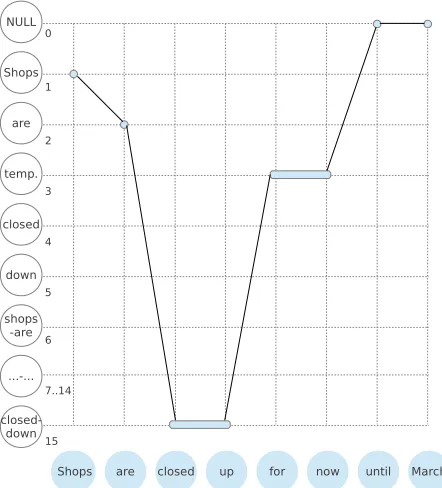
Figure 1: A semi-Markov phrase-based model example and the desired Viterbi decoding path. Shaded horizontal circles represent the source sentence (Shops are closed up for now until March) and hollow vertical circles repre-sent the hidden states with state IDs for the target sentence (Shops are temporarily closed down). State 0, aNULLstate, is designated for dele-tion. One state (e.g. state 3 and 15) can span multi-ple consecutive source words (a semi-Markov prop-erty) for aligning phrases on the source side. States with an ID larger than the target sentence length indicate “phrasal states” (states 6-15 in this exam-ple), where consecutive target tokens are merged for aligning phrases on the target side. Combining the semi-Markov property and phrasal states yields for instance, a2×2alignment betweenclosed upin the source andclosed downin the target.
model supportsls : lt alignment. Throughout this
section we use Figure 1 as an illustrative example, which shows phrasal alignment between the source sentence: (Shops are closed up for now until March) and the target sentence: (Shops are temporarily closed down).
1 : 1alignment is a special case of ls : 1
align-ment where the target side state spansls = 1source
si aligns to one stateai and the next aligned state
ai+1 only depends on the current stateai. This is
the Markovian property of the CRF. Whenls > 1,
during the time frame [i, i+ls), all source words
[ai, ai+ls)share the same stateai. Or in other words,
the stateai“spans” the followinglstime steps. The
Markovian property still holds “outside” the time framels, i.e.,ai+ls still only depends onai, the
pre-vious statelstime steps ago. But “within” the time
framels, the Markovian property does not hold any
more: [ai, ..., ai+ls−1]are essentially the same state
ai. This is the semi-Markov property . States can be
distinguished by this property into two types: semi-Markovian statesandMarkovian states.
We have generalized the regular CRF to a semi-Markov CRF. Now we define it by generalizing the feature function:
p(a|s,t) = exp(
P
i,k,lsλkfk(ai−ls, ai,s,t))
Z(s,t)
At time i, the k-th feature function fk mainly
extracts features from the pair of source words
(si−ls, ..., si] and target wordtai (still with a
spe-cial case thatai = 0marks for deletion). Inference
is still Viterbi-like: except for the fact during maxi-mization, the Viterbi algorithm not only checks the previous onetime step, butall ls time steps.
Sup-pose the allowed maximal source phrase length is Ls, defineVi(a|s,t)as the highest score along the
decoding path until timeiending with statea:
Vi(a|s,t) = max a1,a2,...ai−1
p(a1, a2, . . . , ai=a|s,t)
then the recursive maximization is:
Vi(a|s,t) = max a0
max
ls=1...Ls
[Vi−ls(a
0 |s,t)
+Ψi(a
0
, a, ls,s,t)]
with factor:
Ψi(a
0
, a, ls,s,t) = X
k
λkfk(a
0
i−ls, ai,s,t)
and the best alignmentacan be obtained by back-tracking the last stateaM fromVM(aM |s,t).
Training a semi-Markov CRF is very similar to the inference, except for replacing maximization with summation. The forward-backward algorithm should also be used to dynamically compute the nor-malization function Z(s,t). Compared to regular CRFs, a semi-Markov CRF has a decoding time complexity of O(LsM N2), a constant factor Ls
(usually 3 or 4) slower.
To extend from1 : 1alignment to1 :ltalignment
with one source word aligning to lt target words,
we simply explode the state space byLttimes with
Ltthe maximal allowed target phrase length. Thus
the states can be represented as an N × Lt
ma-trix. The state at(j, lt) represents the target phrase
[tj, ..., tj+lt). In this paper we distinguish states by
three types: NULLstate (j = 0, lt = 0),token state
(lt= 1) andphrasal state(lt>1).
To efficiently store and compute these states, we linearize the two dimensional matrix with a linear function mapping uniquely between the stateIDand the target phrase offset/span. Suppose the target phrase tj of length ltj ∈ [1, Lt] holds a position
ptj ∈ [1, N], and the source word si is aligned to
this state (ptj, ltj), a tuple for (position, span). Then
stateIDasi is computed as:
asi(ptj, ltj) =
(
ptj ltj = 1
N + (ptj −1)×Lt+ltj 1< ltj ≤Lt
Assume in Figure 1,Lt = 2, then the state IDfor
the phrasal state (5, 2)closed-downwithptj = 5
for the position of word downandltj = 2 for the
span of 2 words (looking “backward” from the word down) is:5 + (5−1)×2 + 2 = 15.
Similarly, given a state idasi, the original target
phrase position and length can be recovered through integer division and modulation. Thus during decod-ing, if one output state is 15, we would know that it uniquely comes from the phrasal state (5,2), repre-senting the target phraseclosed down.
This two dimensional definition of state space ex-pands the number of states from 1 + N to 1 +
LtN. Thus the decoding complexity becomes
O(M(LtN)2) = O(L2tM N2) with a usual value
of 3 or 4 forLt.
Now we have defined separately thels : 1model
have anls : ltalignment model. The semi-Markov
property makes it possible for any target states to align phrases on the source side, while the two di-mensional state mapping makes it possible for any source words to align phrases on the target side. For instance, in Figure 1, the phrasal state a15
repre-sents the two-word phrase closed down on the target side, while still spanning for two words on the source side, allowing a2×2alignment. Statea15is
phrasal, and at source word position 3 and 4 (span-ningclosed up) it is semi-Markovian. The final decoding complexity isO(LsL2tM N2), a factor of
30 ∼ 60 times slower than the token-based model (with a typical value of3or4forLsandLt).
In the following we describe features.
3.3 Feature Design
We reused features in the original token-based model based on string similarity, POS tags, position, WordNet, distortion and context. Then we used an additional chunker to mark phrase boundaries only
for feature extraction:
Chunking Features are binary indicators of whether the phrase types of two phrases match. Also, we added indicators for mappings between source phrase types and target phrase types, such as “vp2np”, meaning that a verb phrase in the source is mapped to a noun phrase in the target.
Moreover, we introduced the following lexical features:
PPDB Features (Ganitkevitch et al., 2013) in-clude various similarity scores derived from a para-phrase database with 73 million phrasal and 8 mil-lion lexical paraphrases. Various paraphrase condi-tional probability was employed. For instance, for the ADJP/VPphrase paircapable of andable to, there are the following minus-log probabilities:
p(lhs|e1) = 0.1, p(lhs|e2) = 0.3, p(e1|lhs) = 5.0
p(e1|e2) = 1.3, p(e2|lhs) = 6.7, p(e2|e1) = 2.8
p(e1|e2, lhs) = 0.6, p(e2|e1, lhs) = 2.3
where e1/e2 are the phrase pair, and lhs is the left hand side syntactic non-terminal symbol. We did not use the syntactic part (e.g., the N P of
N N S↔the N N S of N P) of PPDB as we did not
make the assumption that the input sentence pairs were well-formed (and newswire-like) English, or
even of a language with a parser available. Also, for phrasal alignments, we ruled out those paraphrases spanning multiple syntactic structures, or of differ-ent syntactic structures (indicated as[X]in PPDB), for instance,and crazy↔, mad.
Semantic Relatedness Featureis a single scaled number in [0,1] from the best performing system (Han et al., 2013) of the *Sem 2013 Semantic Tex-tual Similarity (STS) task. We included this fea-ture mainly to deal with cases where “related” words cannot be well measured by either paraphrases or distributional similarities. For instance, in one align-ment dataset annotators aligned married with wife. Adding a few other words as comparison, the Han et al. (2013) system gives the following similar-ity scores:
married/wife: 0.85 married/husband: 0.84
married/child: 0.10 married/stone: 0.01
Name Phylogeny Feature(Andrews et al., 2012) is a similarity feature with a string transducer to model how one name evolves to another. Examples below show how similar is the nameBill associ-ated with other names in log probability:
Bill/Bill: -0.8
Bill/Billy: -5.2 Bill/William: -13.6
Bill/Mary: -18.6
Finally, one decision we made during feature design was not to use any parsing-based features, with a permissive assumption that the input might not be well-formed English, or even not complete sentences (such as fragmented snippets from web search). The “deepest” linguistic processing stays at the level of tagging and chunking, making the model more easily extendable to other languages.
3.4 Feature Value
train test length %align.
MSR06 800 800 29/11 36%
[image:6.612.73.298.70.111.2]Edinburgh++ 715 305 22/22 78%
Table 1: Statistics of the two manually aligned cor-pora, divided into training and test in sentence pairs. The length column shows average lengths of source and target sentences in a pair. %align. is the per-centage of aligned tokens.
To illustrate this in a simplified way, take closed up↔closed downin Figure 1, and as-sume the only feature is the normalized number of matching tokens in the pair. Then this feature firing on the following pairs would have values (the nor-malization factor is the maximal phrase length):
closed↔closed 1.0 closed up↔closed 0.5 closed up↔up 0.5 closed up↔closed down 0.5
...↔... ...
The desired alignment closed up↔closed down would not have survived the state com-petition due to its weak feature value. In this case the model would simply prefer a token align-mentclosed↔closedand up↔... (probably NULL).
Thus we upweighted feature values by the max-imum source or target phrase length to encour-age phrasal alignments, in this case closed up ↔closed down:1.0. Then this alignment would have a better chance to be picked out with additional features, such as with the PPDB and Semantic Relat-edness Features, which are also upweighted by max-imum phrase lengths.
4 Experiment
4.1 Data Preparation
There are two annotated datasets for training and testing. MSR063 (Brockett, 2007) has annotated alignments on the 2006 PASCAL RTE2 develop-ment and test corpora, with 1600 pairs in total.
3
http://www.cs.biu.ac.il/˜nlp/files/RTE_ 2006_Aligned.zip
1x1 1x2 1x3 2x2 2x3 3x3 more
[image:6.612.313.539.70.110.2]MSR06 89.2 1.9 0.3 5.7 0.0 1.9 0.8 EDB++ 81.9 3.5 0.8 8.3 0.4 3.0 2.1 Table 2: Percentage of various alignment sizes (undirectional, e.g., 1x2 and 2x1 are merged) af-ter synthesizing phrasal alignment from token align-ment in thetrainingportion of two corpora.
Semantically equivalent words and phrases in the premise and hypothesis sentences are aligned in a manner analogous to alignments in statistical ma-chine translation. This dataset is asymmetric: on average the premises contain 29 words and the hy-potheses 11 words. Edinburgh++4(Thadani et al., 2012) is a revised version of the Edinburgh para-phrase corpus(Cohn et al., 2008) with sentences from the following resources: 1. the Multiple-Translation Chinese corpus; 2. Jules Verne’s novel Twenty Thousand Leagues Under the Sea. 3. the Microsoft Research paraphrase corpus (Dolan et al., 2004). The corpus is more balanced and symmetric: the source and target sentences are both 22 words long on average. Table 1 shows some statistics.
Both corpora contain mostly token-based align-ment. For MSR06, MacCartney et al. (2008) showed that setting the allowable phrase size to be greater than one only increased F1 by 0.2%. For
Ed-inburgh++, the annotation guideline5 explicitly in-structs to “prefer smaller alignments whenever pos-sible”. Statistics shows that single token alignment counts96%and95%of total alignments in these two corpora separately. With such a heavy imbalance to-wards only token-based alignment, a phrase-based aligner would learn feature weights that award token alignments more than phrasal alignments.
Thus we synthesized phrasal alignments from continuous monotonic token alignments in these two corpora. We first ran the OpenNLP chunker through the corpora. Then for each phrase pair, if each token in the source phrase is aligned to a token in the tar-get phrase in a monotonic way, and vice versa, we
4
http://www.ling.ohio-state.edu/˜scott/ #edinburgh-plusplus
5
merge these alignments to form one single phrasal alignment.6 Table 2 lists the percentage of vari-ous alignment sizes after the merge. Two obser-vations can be made: first, the portion of phrasal alignments increases to10% ∼20%after merging; second, allowing a maximal phrase length of 3 cov-ers 98% ∼ 99% of total alignments, thus a phrase length larger than 3 would be a bad trade-off for cov-erage vs speed.
4.2 Baselines and Evaluation Metrics
MacCartney et al. (2008) and Yao et al. (2013a) showed that the traditional MT bilingual aligner GIZA++ (Och and Ney, 2003) presented weak re-sults on the task of monolingual alignment. Thus we instead used four other strong baselines:
Meteor (Denkowski and Lavie, 2011): a sys-tem for evaluating machine translation by aligning MT output with reference sentences. It is designed for the task of monolingual alignment and supports phrasal alignment. We used version 1.4 and default weights to optimize by maximum accuracy.
MANLI-constraint (Thadani and McKeown, 2011): a re-implemented MANLI system with ILP-powered decoding for speed and hard syntactic con-straints to boost exact match rate, with reported numbers on MSR06.
MANLI-joint (Thadani et al., 2012): an im-proved version of MANLI-constraint that not only models phrasal alignments, but also alignments be-tween dependency arcs, with reported numbers on the original Edinburgh paraphrase corpus.
jacana-token (Yao et al., 2013a): a token-based aligner with state-of-the-art performance on MSR06.
Note that the jacana-token aligner is open-source, so we were able to re-train it with exactly the same feature set used by our phrase-based model. This allows a fair comparison of model performance (token-based vs. phrase-based). The MANLI* sys-tems are not available, thus we only reported their numbers from published papers.
The standard evaluation metrics for alignments are precision (P), recall (R),F1, and exact matching
6
a few examples: two Atlanta-based companies↔two Atlanta companies, the UK↔the UK, the 17-year-old↔the teenager, was held↔was held.
rate (E) based on either tokens (two tokens are con-sidered aligned iff they are aligned) or phrases (two tokens are considered aligned iff they are contained within phrases that are aligned). Following Thadani et al. (2012), we only report the results based on token alignments (which allows a partial credit if their containing phrases are not aligned), even for the phrase-based alignment task. The reasoning is that if a phrase-based aligner is already doing bet-ter than a token aligner in bet-terms of token alignment scores, then the difference in terms of phrase align-ment scores will be even larger. Thus showing the superiority of token alignment scores is sufficient.
4.3 Implementation and Training
The elements in the phrase-based model: dynamic state indices, semi-Markov and phrasal states, are not typically found in standard CRF implementa-tions. Thus we implemented the phrase-based model in the Scala programming language, which is fully interoperable with Java, using one semi-Markov CRF package7 as a reference. We used the L2 reg-ularizer and LBFGS for optimization. OpenNLP8 provided the POS tagger and chunker and JWNL9 interfaced with WordNet (Fellbaum, 1998).
4.4 Results
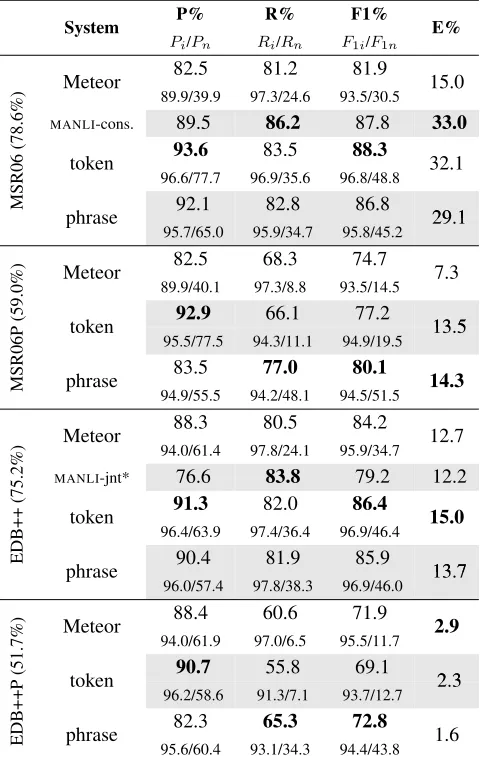
Table 3 gives scores (in bigger fonts) of different aligners on MSR06 and Edinburgh++ and their cor-responding phrasal versions. Overall, the token-based aligner did the best on the original corpora, in which single token alignment counts more than95%
of total alignment. The phrase-based aligner did slightly worse. We think the main reason was that it output more phrasal alignment, which in turn harms scores in token-based evaluation (for instance, if the gold alignment is New↔New, York↔York, then the phrasal alignment ofNew York↔New York would only have half the precision because it inher-ently also aligns New in the source with York in the target.). Further investigation showed that on the Edinburgh++ corpus, over-generated phrase-based alignment, when evaluated under just token align-ment, contributed hurting about1.1%of overallF1,
7
http://crf.sf.net
8http://opennlp.apache.org/
a gap that would make the phrase aligner (85.9%) outperform the token aligner (86.4%).
On the phrasal alignment corpora (represented by MSR06P andEDB++Pin Table 3), the phrase-based aligner did significantly better. Note that the over-all F1 and exact match rate are still much lower
than those scores obtained from the original corpora, suggesting that the phrasal corpora present a much harder task. Furthermore, as a more “fair” com-parison between the two aligners, we synthesized phrasal alignments from the output of the token-based aligner, just as how the phrased-token-based corpora were prepared, then evaluated its performance again. Still, on the EDB++P corpus, the token aligner was about1.6%(current difference is69.1%vs.72.8%) worse than the phrase-based aligner.
Also, we want to emphasize that since the token-based aligner and the phrase-token-based aligner shared exactly the same features and lexical resources, the performance boost of the phrase-based aligner on the phrasal corpora results from a better model de-sign: it is the semi-Markov property and phrasal states making the phrase-based aligner better.
To further investigate the performance of aligners with respect to different types of alignment, we di-vided the scores into those for identical alignments (such as New↔New) and non-identical alignments (such as wife↔spouse), indicated by the sub-scripts i and n in Table 3. In terms of identical alignment, most aligners were able to score more than90%, but for non-identical alignment there was noticeable decrease. Still, on the phrasal alignment corpora, the phrase-based model has a much larger recall score for non-identical alignment than others. We also divided scores with respect to token-only alignment and phrase-only alignment. Due to space limit, we only show results on synthesized Edin-burgh++, in Table 4. Meteor and the token aligner inherently have either very limited or no support for phrasal alignment, thus they had very low scores on phrase-only alignment. We then ran the align-ers in two directions and merged the results with the “union” MT heuristic to get better phrase support. But that still did not bringF1p’s up to over5%.
The phrase-based aligner baseline Meteor did worse than our aligners. We think there are two rea-sons: First, Meteor was not trained on these corpora. Second, Meteor only does strict word, stem,
syn-System P% R% F1% E%
Pi/Pn Ri/Rn F1i/F1n
MSR06
(78.6%)
Meteor 82.5 81.2 81.9 15.0
89.9/39.9 97.3/24.6 93.5/30.5
MANLI-cons. 89.5 86.2 87.8 33.0
token 93.6 83.5 88.3 32.1
96.6/77.7 96.9/35.6 96.8/48.8
phrase 92.1 82.8 86.8 29.1
95.7/65.0 95.9/34.7 95.8/45.2 29.1
MSR06P
(59.0%)
Meteor 82.5 68.3 74.7 7.3
89.9/40.1 97.3/8.8 93.5/14.5
token 92.9 66.1 77.2 13.5
95.5/77.5 94.3/11.1 94.9/19.5 13.5
phrase 83.5 77.0 80.1 14.3 94.9/55.5 94.2/48.1 94.5/51.5
EDB++
(75.2%)
Meteor 88.3 80.5 84.2 12.7
94.0/61.4 97.8/24.1 95.9/34.7
MANLI-jnt* 76.6 83.8 79.2 12.2
token 91.3 82.0 86.4 15.0 96.4/63.9 97.4/36.4 96.9/46.4
phrase 90.4 81.9 85.9 13.7
96.0/57.4 97.8/38.3 96.9/46.0 13.7
EDB++P
(51.7%)
Meteor 88.4 60.6 71.9 2.9 94.0/61.9 97.0/6.5 95.5/11.7
token 90.7 55.8 69.1 2.3
96.2/58.6 91.3/7.1 93.7/12.7 2.3
phrase 82.3 65.3 72.8 1.6
[image:8.612.314.554.71.453.2]95.6/60.4 93.1/34.3 94.4/43.8 Table 3: Results on original (mostly token) and phrasal (P) alignment corpora, where (x%) indicates how much alignment is identical alignment, such asNew↔New. E% stands for exact (perfect) match rate. Subscriptistands for corresponding scores for “identical” alignment andn for “non-identical”. *: scores ofMANLI-joint were for the original Edinburgh corpus instead of Edinburgh++ (with hand corrections) so it is not a direct comparison.
onym and paraphrase matching but does not use any string similarity measures; this can be supported by the large difference between, for instance, F1i and
F1n. In general Meteor did well on identical
align-ment, but not so well on non-identical alignment.
5 Applications
System P% R% F1% E%
Pt/Pp Rt/Rp F1t/F1p
EDB++P
Meteor 88.4 60.6 71.9 2.9 59.5/14.9 90.6/1.1 71.8/2.0
token 90.7 55.8 69.1 2.3
59.4/21.4 85.5/0.9 70.1/1.7 2.3
phrase 82.3 65.3 72.8 1.6
[image:9.612.311.531.58.430.2]73.3/48.0 73.5/44.2 73.4/46.0
Table 4: Same results on the phrasal Edinburgh++ cor-pus but with scores divided by token-only alignment (subscriptt) and phrase-only alignment (subscriptp).
it is another topic, we simply show in this section us-ingjustalignment scores in binary prediction prob-lems. Specifically, we pick the tasks of recognizing textual entailment (RTE), paraphrase identification (PP), and question answering sentence ranking (QA) described in Heilman and Smith (2010):
RTE: predicting whether a hypothesis can be in-ferred from the premise, with training data from RTE-1/2 and RTE-3 dev, and test from RTE-3 test.
PP: predicting whether two sentences are para-phrases, with training and test data from the MSR Paraphrase Corpus (Dolan et al., 2004).
QA: predicting whether a sentence contains the answer to the question, with training data from TREC-8 to TREC-12 and test data from TREC-13.
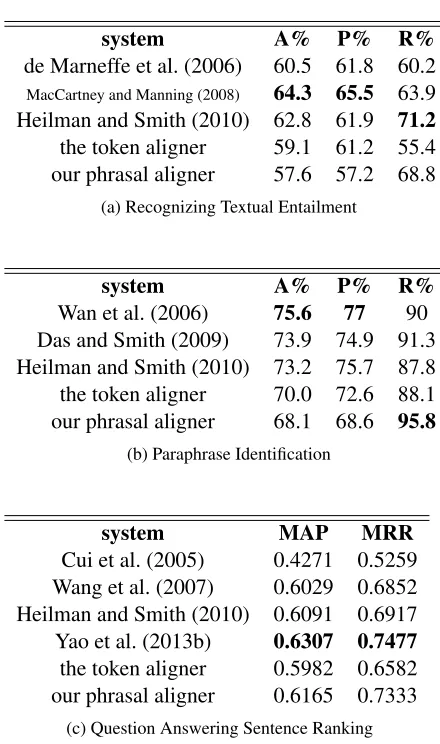
For each aligned pair, we can compute a normal-ized decoding score. Following MacCartney et al. (2008), we select a threshold score and predict true if the decoding score is above this threshold. For the tasks of RTE and PP, we tuned this threshold w.r.t the maximal accuracy on the training set, then re-ported performance on the test set. For the task of QA, since the evaluation methods in Mean Average Precision and Mean Reciprocal Rank only need a ranked list of answer sentences, and the scores on the test set are sufficient to provide the ranking, we did not tune anything on training but instead directly ran the aligner on the test set. All three tasks shared the same aligner model trained on the superset of MSR06 and Edinburgh++. Results are reported in Table 5. We could not report on Meteor as Meteor does not explicitly output alignment scores.
We did not expect the aligners to beat any of the
system A% P% R%
de Marneffe et al. (2006) 60.5 61.8 60.2 MacCartney and Manning (2008) 64.3 65.5 63.9 Heilman and Smith (2010) 62.8 61.9 71.2 the token aligner 59.1 61.2 55.4 our phrasal aligner 57.6 57.2 68.8
(a) Recognizing Textual Entailment
system A% P% R%
Wan et al. (2006) 75.6 77 90 Das and Smith (2009) 73.9 74.9 91.3 Heilman and Smith (2010) 73.2 75.7 87.8 the token aligner 70.0 72.6 88.1 our phrasal aligner 68.1 68.6 95.8
(b) Paraphrase Identification
system MAP MRR
Cui et al. (2005) 0.4271 0.5259 Wang et al. (2007) 0.6029 0.6852 Heilman and Smith (2010) 0.6091 0.6917 Yao et al. (2013b) 0.6307 0.7477 the token aligner 0.5982 0.6582 our phrasal aligner 0.6165 0.7333
(c) Question Answering Sentence Ranking
Table 5: Results (Accuracy, Precision, Recall, Mean Average Precision, Mean Reciprocal Rank) on the tasks of RTE, PP and QA.
state-of-the-art result since no sophisticated models were additionally used but only the alignment score. Still, the aligners showed competitive performance. It still follows the pattern from the alignment exper-iment that the phrasal aligner had higher recall and lower precision than the token aligner in the task of RTE and PP. In the QA task, the phrasal aligner per-formed better than all systems except for the top one.
6 Conclusion
[image:9.612.73.289.68.178.2]phrase-based aligner performed the best on two phrasal alignment corpora and showed its potential usage in three NLP tasks. Future work includes aligning discontinuous (gappy) phrases and integrating align-ment more closely in NLP applications.
Acknowledgement
We thank Vulcan Inc. for funding this work. We also thank Jason Smith, Travis Wolfe, Frank Ferraro and the three anonymous reviewers for their comments and suggestion.
References
Jes´us Andr´es-Ferrer and Alfons Juan. 2009. A phrase-based hidden semi-markov approach to machine trans-lation. In Procedings of European Association for Machine Translation (EAMT), Barcelona, Spain, May. European Association for Machine Translation. Nicholas Andrews, Jason Eisner, and Mark Dredze.
2012. Name phylogeny: a generative model of string variation. InProceedings of EMNLP 2012.
Mohit Bansal, Chris Quirk, and Robert Moore. 2011. Gappy phrasal alignment by agreement. In Proceed-ings of ACL, Portland, Oregon, June.
Regina Barzilay and Lillian Lee. 2003. Learning to paraphrase: An unsupervised approach using multiple-sequence alignment. InProceedings of NAACL, pages 16–23.
Phil Blunsom and Trevor Cohn. 2006. Discriminative word alignment with conditional random fields. In Proceedings of ACL2006, pages 65–72.
Chris Brockett. 2007. Aligning the RTE 2006 corpus. Technical report, Microsoft Research.
Peter F Brown, Vincent J Della Pietra, Stephen A Della Pietra, and Robert L Mercer. 1993. The mathematics of statistical machine translation: Parameter estima-tion. Computational linguistics, 19(2):263–311. Nathanael Chambers, Daniel Cer, Trond Grenager,
David Hall, Chloe Kiddon, Bill MacCartney, Marie-Catherine de Marneffe, Daniel Ramage, Eric Yeh, and Christopher D Manning. 2007. Learning alignments and leveraging natural logic. In Proceedings of the ACL-PASCAL Workshop on Textual Entailment and Paraphrasing, pages 165–170.
Trevor Cohn, Chris Callison-Burch, and Mirella Lapata. 2008. Constructing corpora for the development and evaluation of paraphrase systems. Computational Lin-guistics, 34(4):597–614, December.
Hang Cui, Renxu Sun, Keya Li, Min-Yen Kan, and Tat-Seng Chua. 2005. Question answering passage re-trieval using dependency relations. In Proceedings
of the 28th annual international ACM SIGIR confer-ence on Research and development in information re-trieval, SIGIR ’05, pages 400–407, New York, NY, USA. ACM.
Dipanjan Das and Noah A. Smith. 2009. Paraphrase identification as probabilistic quasi-synchronous recognition. In Proceedings of the Joint Conference of the 47th Annual Meeting of the ACL and the 4th International Joint Conference on Natural Language Processing of the AFNLP, pages 468–476, Suntec, Singapore, August. Association for Computational Linguistics.
Marie-Catherine de Marneffe, Bill MacCartney, Trond Grenager, Daniel Cer, Anna Rafferty, and Christo-pher D Manning. 2006. Learning to distinguish valid textual entailments. InSecond Pascal RTE Challenge Workshop.
Yonggang Deng and William Byrne. 2008. HMM word and phrase alignment for statistical machine transla-tion. Audio, Speech, and Language Processing, IEEE Transactions on, 16(3):494–507.
Michael Denkowski and Alon Lavie. 2011. Meteor 1.3: Automatic Metric for Reliable Optimization and Eval-uation of Machine Translation Systems. In Proceed-ings of the EMNLP 2011 Workshop on Statistical Ma-chine Translation.
Bill Dolan, Chris Quirk, and Chris Brockett. 2004. Un-supervised construction of large paraphrase corpora: exploiting massively parallel news sources. In Pro-ceedings of COLING, Stroudsburg, PA, USA.
Christiane Fellbaum. 1998. WordNet: An Electronic Lexical Database.
Juri Ganitkevitch, Benjamin Van Durme, and Chris Callison-Burch. 2013. PPDB: The Paraphrase Database. InProceedings of NAACL-HLT, pages 758– 764.
Kevin Gimpel and Noah A. Smith. 2010. Softmax-margin CRFs: training log-linear models with cost functions. InNAACL 2010, pages 733–736.
Lushan Han, Abhay Kashyap, Tim Finin, James May-field, and Jonathan Weese. 2013. UMBC-EBIQUITY-CORE: Semantic Textual Similarity Systems. In Pro-ceedings of the Second Joint Conference on Lexical and Computational Semantics.
Michael Heilman and Noah A. Smith. 2010. Tree edit models for recognizing textual entailments, para-phrases, and answers to questions. InProceedings of NAACL 2010, pages 1011–1019, Los Angeles, Cali-fornia, June.
Philipp Koehn. 2010. Statistical Machine Translation. Cambridge University Press, New York, NY, USA. Milen Kouylekov and Bernardo Magnini. 2005.
John D. Lafferty, Andrew McCallum, and Fernando C. N. Pereira. 2001. Conditional random fields: Proba-bilistic models for segmenting and labeling sequence data. InProceedings of the Eighteenth International Conference on Machine Learning, ICML ’01, pages 282–289, San Francisco, CA, USA. Morgan Kauf-mann Publishers Inc.
Percy Liang, Ben Taskar, and Dan Klein. 2006. Align-ment by agreeAlign-ment. InProceedings of NAACL. Bill MacCartney and Christopher D Manning. 2008.
Modeling semantic containment and exclusion in nat-ural language inference. InProceedings of ACL 2008, pages 521–528.
Bill MacCartney, Michel Galley, and Christopher D Man-ning. 2008. A phrase-based alignment model for nat-ural language inference. InProceedings of EMNLP, pages 802–811.
Daniel Marcu and William Wong. 2002. A phrase-based, joint probability model for statistical machine transla-tion. InProceedings of EMNLP-2002, pages 133–139.
Yashar Mehdad. 2009. Automatic cost estimation for tree edit distance using particle swarm optimization. In Proceedings of the ACL-IJCNLP 2009 Conference Short Papers, pages 289–292.
Franz Josef Och and Hermann Ney. 2003. A system-atic comparison of various statistical alignment mod-els. Computational linguistics, 29(1):19–51.
Mari Ostendorf, Vassilios V Digalakis, and Owen A Kim-ball. 1996. From HMM’s to segment models: a uni-fied view of stochastic modeling for speech recogni-tion. IEEE Transactions on Speech and Audio Pro-cessing, 4(5):360–378.
Bo Pang, Kevin Knight, and Daniel Marcu. 2003. Syntax-based alignment of multiple translations: Ex-tracting paraphrases and generating new sentences. In Proceedings of NAACL, pages 102–109.
Vasin Punyakanok, Dan Roth, and Wen T. Yih. 2004. Mapping Dependencies Trees: An Application to Question Answering. In Proceedings of the 8th In-ternational Symposium on Artificial Intelligence and Mathematics, Fort Lauderdale, Florida.
Michael Roth and Anette Frank. 2012. Aligning predicates across monolingual comparable texts using graph-based clustering. In Proceedings of EMNLP-CoNLL, pages 171–182, Jeju Island, Korea, July. Sarawagi Sarawagi and William Cohen. 2004.
Semi-markov conditional random fields for information ex-traction. Advances in Neural Information Processing Systems, 17:1185–1192.
Kapil Thadani and Kathleen McKeown. 2011. Optimal and syntactically-informed decoding for monolingual phrase-based alignment. InProceedings of ACL short.
Kapil Thadani, Scott Martin, and Michael White. 2012. A joint phrasal and dependency model for paraphrase alignment. InProceedings of COLING 2012: Posters, pages 1229–1238, Mumbai, India, December. The COLING 2012 Organizing Committee.
Stephan Vogel, Hermann Ney, and Christoph Tillmann. 1996. HMM-based word alignment in statistical trans-lation. InProceedings of the 16th conference on Com-putational linguistics - Volume 2, COLING ’96, pages 836–841.
Stephen Wan, Mark Dras, Robert Dale, and C´ecile Paris. 2006. Using dependency-based features to take the “para-farce” out of paraphrase. InProceedings of the Australasian Language Technology Workshop. Mengqiu Wang and Christopher D. Manning. 2010.
Probabilistic tree-edit models with structured latent variables for textual entailment and question answer-ing. InProceedings of COLING, pages 1164–1172, Stroudsburg, PA, USA.
Mengqiu Wang, Noah A. Smith, and Teruko Mitamura. 2007. What is the Jeopardy Model? A Quasi-Synchronous Grammar for QA. In Proceedings of EMNLP-CoNLL, pages 22–32, Prague, Czech Repub-lic, June.
Xuchen Yao, Benjamin Van Durme, Chris Callison-Burch, and Peter Clark. 2013a. A Lightweight and High Performance Monolingual Word Aligner. In Proceedings of ACL 2013 short, Sofia, Bulgaria. Xuchen Yao, Benjamin Van Durme, Peter Clark, and