Abstract—Corn is a major crop in Thailand. After
harvesting, corn residues such as corncobs are plentiful. They are usually discarded as agricultural waste. Due to their low density and non-uniform characteristics, they are hardly used as energy source. Physical upgrade via pelletization can be adopted to improve fuel quality of this agro-residue. Unless operating at excessively high pressure and temperature, corncobs are generally very difficult to form a durable and tightly packed pellet. To address this challenge, locally available algae may be mixed together with corncob in co-pelletizing process. In this work, densification was performed with a cylindrical die. Effects of operating parameters (die temperature of 30-80oC, compaction pressure of 100-200 MPa and algae to biomass ratio of 10-40% w/w) on pellet properties such as compact and relax densities, volumetric energy density, and compressive strength were investigated. Successful production of pellets was demonstrated at moderate compaction conditions. Die temperature, applied pressure and mixture ratio were found to have significant influence on the pellet characteristics and properties.
Index Terms—agricultural residues, biomass, densification,
renewable energy
I. INTRODUCTION
orn is a major crop in Thailand, occupying large portion of the country upland farmlands. Chiang Mai is among the nation’s biggest corn producers, with output in 2014 of more than 128,000 tons [1]. After harvesting, a great amount of corn residues are usually discarded in the fields. They may subsequently be disposed of by burning to clear areas for new plantation. Thick smokes and other air pollutants are emitted during this practice and adversely affect health and the environment.
Alternatively, these agricultural residues can be utilized for energy production to alleviate these problems [2]. Their energetic content is evident, but their utilization is restricted due mainly to low density and non-uniform characteristics. Physical upgrade via densification is a practical method to improve their characteristics by forming into pellets or briquettes [3]. Effective densification is usually carried out
Manuscript received February 21, 2017; revised March 8, 2017. This work was financially supported by Chiang Mai University.
N. Tippayawong is with the Department of Mechanical Engineering, Faculty of Engineering, Chiang Mai University, Chiang Mai, Thailand. (corresponding author: +66-5394-4146; fax: +66-5394-4145; e-mail: [email protected]).
P. Piboon was with the Department of Mechanical Engineering, Faculty of Engineering, Chiang Mai University, Chiang Mai, Thailand. She is currently with the Energy Technology for Environment Research Center, Chiang Mai University, Chiang Mai, Thailand.
T. Wongsiriamnuay is with the Faculty of Engineering and Agro-industry, Maejo University, Chiang Mai, Thailand.
using high temperature and high pressure, or requires expensive additives for high value pellets [4, 5], which can be costly. Use of moderate compacting conditions may work with inexpensive binders found in natural sources. An appropriate binding agent may be obtained from algal biomass. It is available from biological wastewater treatment and natural water resources. Various species of algae can potentially act as satisfactory binders [6, 7]. In this work, co-pelletization of corncobs and local algae was studied. Improvement in physico-chemical properties of densified fuel was investigated as a function of applied pressure (100-200 MPa), die temperature (30-80oC) and algae to corncobs mixture ratio (10-40%).
II. MATERIALS AND METHODS
A. Raw Materials
The agro-residue (corncobs) and natural binder
(Spirogyra sp. and Chara sp.) were collected locally from
Chiang Mai areas. They were dried naturally under the sun for at least one week. After which, they were crushed using hammer mill, graded into the size range between 0.1-0.6 mm for corncobs, and 0.1-0.3 mm for algae. Their sizes were in similar magnitude for good mixing. They were then blended in ratios into 100% corncobs with no algae (C100A0), 90% corncobs and 10% algae (C90A10) to 60% corncobs and 40% algae (C60A40), and no corncob with 100% algae (C0A100) by weight. Moisture content and bulk density of the materials were determined following the ASAE 358.2 and ASTM E 873-82 standards, respectively. Calorific value was measured using a bomb calorimeter following the BS EN 14918 standard.
Moisture contents on dry basis of corncob and algae were 9 ± 0.2 and 6 ± 0.2 %, and bulk densities of corncobs and algae were 230 ± 10 and 660 ± 11 kg/m3, respectively.
B. Densification Process
Each pellet mass loading was approximately 2 ± 0.1 g. A compacting apparatus [8] used in this work is shown in Fig. 1, consisting of a piston and a closed-end die which composed of a cylinder and a base. The apparatus was equipped with a 450 W heater for heating the die and biomass materials during compaction. A universal testing machine was used to apply known loads, between 100 – 200 MPa measured by a pressure gauge. Each test condition was repeated for at least six times. The temperature was monitored by a thermocouple and controlled by a digital controller. A holding time of 10 s was adopted for each pellet to deal with the spring-back effect [9].
Parametric Analysis of Co-pelletization of
Corncobs and Algae at Moderate Conditions
Nakorn Tippayawong, Pimpond Piboon, and Thanasit Wongsiriamnuay
After compression, the compact and relaxed densities were determined as;
Compact density = m/Vc (1)
Relaxed density = m/Vr (2) where m is the mass of the pellet, Vc and Vr are the volume of the pellet immediately after compaction and that after storage for one week, respectively.
III. RESULTS AND DISCUSSION
A. Physical Appearance
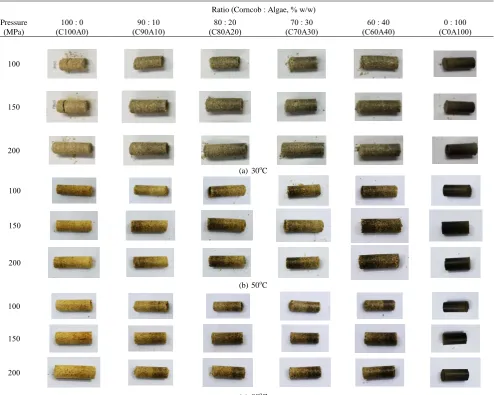
Fig. 2 shows appearances of the pellets after storage for one week. It can be seen that sole corncob pellets (C100A0) showed bits and pieces falling off and did not form a tight pellet at room temperature compression, even with a binder. They would need to be processed at higher temperatures to form very tight pellets. For corncobs, they appeared to be loosely tight at low pressure, and more tightened at high pressure. The closed solid particles appeared to be forced to adhere to each other, becoming stronger attraction between solid particles or interlocking bonds [4]. Pure algae pellets did not show similar behavior. This may be because of smaller particle size and difference in constituent, such as starch, protein, lignin, and fiber of algae.
Ratio (Corncob : Algae, % w/w) Pressure
(MPa)
100 : 0 (C100A0)
90 : 10 (C90A10)
80 : 20 (C80A20)
70 : 30 (C70A30)
60 : 40 (C60A40)
0 : 100 (C0A100)
100
150
200
(a)30oC
100
150
200
(b)50oC
100
150
200
[image:2.595.90.243.55.264.2](c)80oC
[image:2.595.53.548.345.740.2](a) at 30oC
(b) at 50oC
[image:3.595.84.512.72.647.2](c) at 80oC
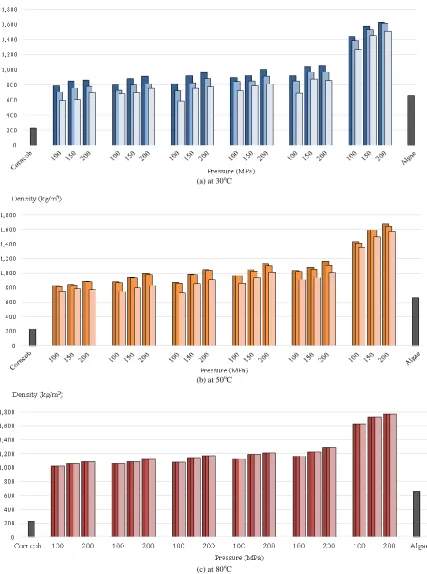
Fig. 3. Variation in pellet densities with applied pressure, mixture ratio and die temperature.
B. Compact and Relaxed Densities
Pellet densities are shown in Fig. 3 as a function of die temperature, applied pressure and mixture ratio which was varied from no algae to increasing amount of algae (0, 10, 20, 30, 40 and 100%). There are three columns for each condition, corresponding to compact density, relaxed density after storage for 1 week, and relaxed density after storage for 5 months. Compact density was always higher than relaxed
(a) at 30oC
(b) at 50oC
[image:4.595.82.514.90.656.2](d)at 80oC
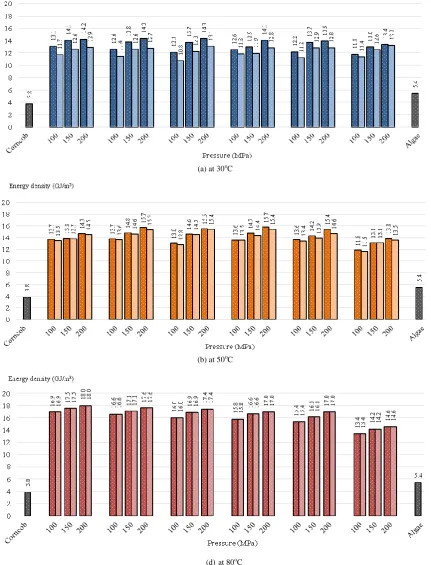
Fig. 4. Variation in pellet energetic density with applied pressure, mixture ratio and die temperature.
C. Energy Density
Fig. 4 (a) to (c) show variation of pellet energetic density as a function of die temperature, applied pressure and mixture ratio. The energy density (J/m3) used in this work was defined as the product between heating value (J/kg) and density (kg/m3). Mixture ratio was varied from no algae to increasing amount of algae (0, 10, 20, 30, 40 and 100%).
energy density varied from 11.7-12.9 GJ/m3 when compressed at 30oC to 16.9-18.0 GJ/m3 when compressed at 80oC, respectively. These values were much higher than those of corncobs and algae before compaction.
D. Compressive Strength
Durability of the pellets is an important property for solid fuels. It may be evaluated indirectly from compressive strength of the pellets. High values of compressive strength mean high durability of the pellets. In this work, compressive strengths of the pellets from various compaction conditions are shown in Fig. 5. In each row, mixture ratio was varied from no algae at the front to increasing amount of algae (0, 10, 20, 30, 40 and 100%) towards the back. It can be seen that generally compressive strength increased with applied pressure and heating temperature. For a given temperature and pressure condition, compressive strength was also found to increase with increasing portion of algae. Moreover, long storage time appeared to improve the strength, but it is not yet conclusive. Further tests should be carried out.
IV. CONCLUSION
In this work, co-pelletization between corncobs and algae was investigated. Die temperature, compression pressure and corncobs to algae mixture ratio were considered as important process parameters for biomass densification. As anticipated, relatively high temperatures and applied pressures (80oC, 150-200 MPa) were required to enhance the densities, energetic content, and strength of corn residues. With algae as binder (10% w/w), moderate temperatures and applied pressures (30-50oC, 100-150 MPa)
proved to be effective in improving the physical characteristics of the pellets. This technique may be employed in physically upgrading corn and other agricultural residues.
ACKNOWLEDGMENT
N. T. and P. P. would like to thank Maejo University for technical support.
REFERENCES
[1] Office of Agricultural Economics, “Agricultural statistics of Thailand,” Ministry of Agriculture and Cooperatives, 2014. [2] Sittisun P., Tippayawong N., and Wattanasiriwech D., “Thermal
degradation characteristics and kinetics of oxy combustion of corn residues,” Advances in Materials Science & Engineering, vol. 2015, 8 pages, 2015.
[3] Kaliyan N., and Morey R.V., “Densification characteristics of corn cobs,” Fuel Processing Technology, vol. 91, pp. 559-565, 2010. [4] Kaliyan N., and Morey R.V., “Densification characteristics of corn
stover and switchgrass,” Transaction of American Society of Agricultural & Biological Engineers, vol. 52, pp. 907-920, 2009. [5] Kaliyan N., and Morey R.V., “Factors affecting strength and
durability of densified biomass products,” Biomass & Bioenergy, vol. 33, pp. 337-359, 2009.
[6] Jiang L., Liang J., Yuan X., Li H., Li C., and Xiao Z., “Co-pelletization of sewage sludge and biomass: The density and hardness of pellet,” Bioresource Technology, vol. 166, pp. 435-443, 2014. [7] Thapa S., Johnson D.B., Liu P.P., and Canam T., “Algal biomass as a
binding agent for the densification of Miscanthus,” Waste & Biomass Valorization, vol. 6, pp. 91-95, 2014.
[8] Wongsiriamnuay T., and Tippayawong N., “Effect of densification parameters on the properties of maize residue pellets,” Biosystems Engineering, vol. 139, pp. 111-120, 2015.
[9] Mani S., Tabil L.G., and Sokhansanj S., “Effects of compressive force, particle size and moisture content on mechanical properties of biomass pellets from grasses,” Biomass & Bioenergy, vol. 30, pp. 648-654, 2006.