Abstract —GMF Power Services is a Strategic Business Unit (SBU) of PT GMF AeroAsia which has main service to repair the turbine engines. As the time passed, The project completion time is often delayed. It can be seen through the Planning Data Sheet (Sheet PD) which is the process control tool of Maintenance, Repair, and Overhaul (MRO) in SBU GMF Power Services. This paper concerns about the delay factors in GMF Power Services. A survey using a questionnaire was conducted in some departments to analyze the problem and to improve the management system. The Ranking Factor Analysis of the survey data leads into an insight of the possible causes of this phenomenon. Based on the 30 samples had been taken, it was known that the root cause of the delay is the lack of the working system. In addition, the lack of awareness of every individual is also a problem within GMF Power Services. The integrated system analysis of each department as well as the improvement of existing Standard Operating Procedure (SOP) in GMF Power Services was proposed as improvement of the current system.
Index Terms—Delay factors, delayed project, project
management, integrated system, standard operating procedure
I. INTRODUCTION
MF Power Services is a business unit in GMF AeroAsia that serve non aviation sector as a member of Indonesia Flag Carrier Garuda Indonesia Holding Company. GMF Power Services was established to provide comprehensive repair and overhaul industrial gas turbine engine [1]. GMF Power Services (“GPS”) is a business unit which serves non aviation sector, i.e.: providing services in overhaul maintenance of industrial gas turbine engines. GPS business includes repair, modification and overhaul, industrial gas turbine and Aero-derivatives, repair and renovation of gas turbine components, services of Power Generation in the main generator, repair and Overhaul Transformer & Motor Rewinding Base, control and
Manuscript received December 23, 2015; revised January 25, 2016. Violita E. Puteri is with Logistic and Business System Laboratory, Industrial Engineering Department, Faculty of Engineering, Sebelas Maret University, Surakarta, INDONESIA (corresponding author to provide phone: +6285642000426; e-mail: [email protected]).
Wahyudi Sutopo is with Industrial Engineering Department, Faculty of Engineering, Sebelas Maret University, Surakarta, INDONESIA (e-mail: [email protected]).
Muh. Hisjam is with Department of Industrial Engineering, Faculty of Engineering, Sebelas Maret University, Surakarta, INDONESIA (e-mail: [email protected]).
Ria Asyrofa is with Production and Planning Control of SBU GMF Power Services, GMF AeroAsia, Jakarta, INDONESIA (email: [email protected]).
Protection of Engines, Generators, and Motors, and analysis of performance and engineering services of Rotary Electrical Engine and Power Plant [1]
During the repair process of turbine engines in GMF Power Services, the section of Production Planning Control (PPC) collected the data on every part that is repaired. The collection of the data is done by making Preliminary Inspection Report (PIR). The PIR will be the basis for making of Planning Data Sheet (PD Sheet). PD Sheet is used to take control of any part progress activity following the completion of the project planning. However, based on PD Sheet can be seen that there are many projects that the completion does not match with the existing schedule. This causes delays in delivery of parts to consumers. To know the delay factors in GMF Power Services, this paper conducted a survey using a questionnaire. The distribution of the questionnaires was conducted in some departments of the GMF Power Services which relate directly to the MRO process.
In this case study, the definition of the delay is an execution time that not used according to the plan of activities that cause one or more activities follow to be delayed or not completed on schedule as planned [2] [3]. If a job has been targeted to be completed in a predetermined time, but for some reason cannot be met then it has been delayed [4]. Article 120 of Presidential Decree No. 54/2010 Jo. Presidential Decree No. 35/2011 Jo. Presidential Decree No. 70/2012 says that the Goods / Services that are late completing the work within the time periods specified in the Contract because of an error Goods / Services, delay fines imposed by 1/1000 (one per one thousand) of the value of the Contract or part of the Contract value for each day of delay [5]. Based on the regulation, the company suffered in that project fines due to delay for 14 days.
As a reference in the search for the factors causing delays in the GMF Power Services, there are several causes of delay that occurs according to the "Lewis and Atherley" which is [6]:
1. Late payment by the client owner.
2. The implementation of a bad phase of work by the contractor.
3. Mismanagement of materials by the contractor. 4. Shortage of labor by contractors.
5. Heavy rain / job sites flooded.
6. Different land condition than expected. 7. Additional work requested by the client owner. 8. Changes in plumbing, structural, electrical.
Standard Operating Procedure (SOP) to
Improve Quality Management System
(Case Study: SBU GMF Power Services)
Violita E. Puteri, Wahyudi Sutopo, Muh. Hisjam, and Ria Asyrofa
9. Errors in the planning and specification. 10. Ambiguity of planning and specification. 11. The changes in the planning and specification. 12. Errors in interpreting drawings or specifications. 13. Changes in methods of work by the contractor. 14. Change the order of client owner.
15. Planning schedule work less well by the contractor. 16. Less than optimal productivity from the contractor. 17. Changes in the scope of work consultants.
18. The strike conducted by contractors. 19. Repairing work that has been completed. 20. Repairing the damage of a job due to strike
II. METHODOLOGY
In this study, data collection was conducted in PT GMF on GMF unit Power Services. The data is retrieved from one of the projects where the project has been delayed for 14 days. The data used in this study are primary data and secondary data. The primary data obtained through interviews and observation using a pre-prepared list of questions / questionnaire, while the secondary data obtained from company documents and other publications containing information that supports this research based on these factors can be known root cause of delays in the project so that it can be improved to avoid delays in future.
Fig 1. Flowchart of Research Methods
III. RESULT AND DISCUSSION
[image:2.595.307.548.329.523.2]Based on the data obtained from the PD Sheet, we can know that there is a delay in the project. It can be seen from the graph that connects the planning and actual progress in the field. In example, the project is scheduled for completion on July 24, 2015 but in fact was completed on August 7, 2015. The project has been delayed for 14 days or as long as 2 weeks. The chart can be seen below.
Fig 2. Comparison Chart Planning and Actual Project Progress
In this research questionnaires be done in most parts of the SBU GMF Power Services. These fields consist of adviser, manager, engineering, ppc, and mechanics that exist in the production floor so that the expected results of this
research is more actual. Samples were taken using non-probability sampling, which is accidental methods. Number of samples that used is 30 samples due to the limited time available.
A.Survey Results
The survey has been conducted on 30 respondents include most parts of the SBU GMF Power Services especially that directly related to the production. Respondents consisted of several groups of parts at a certain percentage.
The question in the questionnaire is divided into two parts, which is personal data and rating factor. Questions in the rating factor divided by 11 factors cited in Langford, 1996, regarding the factors of project delays.
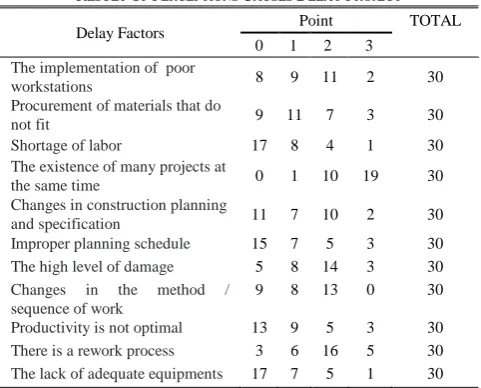
The answers to these questions are divided into four types of ranges that have no effect, rather influential, influential and highly influential. The number 0 indicates that the factor had no effect, number 1 shows that factors are rather influential, number 2 shows that the factors are influential, and number 3 shows that the factors are a very influential. Based on questionnaire data obtained the following results
TABLE I
RESULT OF PERCEPTIONS CAUSES DELAY PROJECT
Delay Factors Point TOTAL
0 1 2 3
The implementation of poor
workstations 8 9 11 2 30
Procurement of materials that do
not fit 9 11 7 3 30
Shortage of labor 17 8 4 1 30
The existence of many projects at
the same time 0 1 10 19 30
Changes in construction planning
and specification 11 7 10 2 30
Improper planning schedule 15 7 5 3 30
The high level of damage 5 8 14 3 30
Changes in the method / sequence of work
9 8 13 0 30
Productivity is not optimal 13 9 5 3 30
There is a rework process 3 6 16 5 30
The lack of adequate equipments 17 7 5 1 30
B.Ranking Factor Analysis
In this study, it can be seen what are the factors that influence delays in the project as well as the ranking of each factor. The calculation can be known through the index of interest is the average of all respondents. The formula for calculating the index of interest is as follows [3].
Where :
I = Index interests
xi = The frequency response of each perception
ai = value on a given perception (0,1,2,3)
N = number of data
From the calculation using the formulas above, known the index of the interests of each factor. Based on the interest index, known the rank ordering of factors that affecting this project delays. Here are the results of the ranking factors that cause delays in this project.
Target
Actual
[image:2.595.49.290.572.706.2]TABLEII
RANKING FACTORS THAT CAUSING DELAYS PROJECTS
No Delay Factors Mean Ranking
1 The implementation of poor workstations 1,23 4 2 Procurement of materials that do not fit 1,13 5
3 Shortage of labor 0,63 11
4 The existence of many projects at the
same time 2,60 1
5 Changes in construction planning and
specification 1,10 7
6 Improper planning schedule 0,87 9
7 The high level of damage 1,50 3
8 Changes in the method / sequence of work 1,13 6
9 Productivity is not optimal 0,93 8
10 There is a rework process 1,77 2
11 The lack of adequate equipments 0,67 10
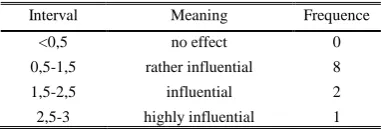
Based on the results of the calculation of the mean in TABLE II, we know that the factors that causing delays in project in sequence are (1) The existence of many projects at the same time, (2) There is a rework process, (3) The high level of damage, (4) The implementation of poor workstations, (5) Procurement of materials that do not fit, (6) Changes in the method / sequence of work, (7) Changes in construction planning and specification, (8) Productivity is not optimal, (9) Improper planning schedule, (10) The lack of adequate equipments, (11) Shortage of labor. These factors can be classified into several types based on the mean calculated to obtain the following data [7].
TABLEIII
EXPLANATION INTERVAL MEAN VALUE
Interval Meaning Frequence
<0,5 no effect 0
0,5-1,5 rather influential 8 1,5-2,5 influential 2 2,5-3 highly influential 1
1stRankThe existence of many projects at the same time
The existence of many projects at the same time is a factor that affects the project delays. By the time the project is coming there are also many projects that must be completed by GMF Power Services. However this is not the main cause of delays in the project. The main cause is the lack of good internal systems so that the delays in the project.
2ndRank. There is a rework process
The existence of rework or rework parts that have been completed classified as factors that affect the delay of the project. In the project there is a rework on the Transition Piece and Combustier Basket parts. This can happen due to a lack of precision mechanics and lack of supervision of the leader in the execution part.
3rdRank The high level of damage
The high damage to the parts is also an influential factor in the delay of projects When damage to the high part takes a longer time in the execution of the part.
4thRank The implementation of poor workstations
A poor implementation of each workstation is a factor that somewhat influential in project delays. Lack of awareness of
each mechanic to do the maximum is one reason for the occurrence of these factors. The lack of professional labor force is also the reason workmanship maximum.
5thRank Procurement of materials that do not fit
Procurement of materials that are not appropriate is a factor that somewhat influence the project delays. Current lack of availability of materials to be used in the production process is an obstacle course of the production process itself. The lack of a clear recording of the material causing less uncontrolled spending inventory of existing material.
6thRank Changes in the method / sequence of work
The change of the method and sequence of construction to be a factor that somewhat influence to delay the project. The workmanship has been found in the part Sheet PD activity will be done on the part. Changes in the sequence and the current working methods in the field waiting for each other to make the mechanics between the one and the other.
7thRank Changes in construction planning and specification
The change of plan execution is a factor that somewhat influence to delay the project. This often happens when there is a reduction in activity and additional activities undertaken for the part. This factor is almost the same as the previous factor where there is a lack of communication from mechanic to engineer or otherwise.
8thRank Productivity is not optimal
Not optimal productivity is a factor that somewhat influence to delay the project. The presence of some workers who are not serious during the working hours is the cause of these factors occur. Lack of awareness of the mechanics of the cause is not optimal productivity jobs.
9thRank Improper planning schedule
Improper planning schedule is a factor that somewhat influence to delay the project. Actually planning progress that has been made by the PPC section are in accordance with the target. However, implementation of the production floor that can not compensate for these targets. This is due to the lack of information about the mechanical part of the delivery deadline.
10thRank The lack of adequate equipments
The lack of adequate equipments is a factor that somewhat influence to delay the project. The tools used in the process is already adequate. However, in some welding work station as there are some damaged equipment. Besides the number of the existing tools are not comparable with each other, causing many workers to borrow equipment and hamper the process.
11thRank Shortage of labor
A shortage of labor is a factor that somewhat influence to delay the project. The amount of labor that exist in GMF Power Services is already very inadequate. Labor shortages in question is the lack of skilled manpower thus slowing the process.
C.Cause-Effect Diagram
[image:3.595.73.264.412.477.2]Delay Project Machine
Material
Man
Process
Existence of many project at the same time
Rework process
High level of damage Implementation of poor workstations
Procurement of materials that do not fit
Changes in construction planning Changes in method/
sequences of work Productivity is
not optimal
Improper planning schedule
Lack of adequate equipments
Shortage of labor
Lack of usage information of materials
The lack of good recording of material usage
A lack of control from the leader
Differences leadership of each leader
Differences perception of engineering and production
Lack of communication of each department
Weak management
The lack of a good working system A lack of control from the leader Differences leadership
of each leader Not considering the damage of each part
Fixed on the 100-day standard of workmanship
The lack of good human resources Lack of training
The amount of buildup jobs
Lack of awareness of the mechanics Lack of some equipments
[image:4.595.47.547.54.330.2]Lack of control on tools needed
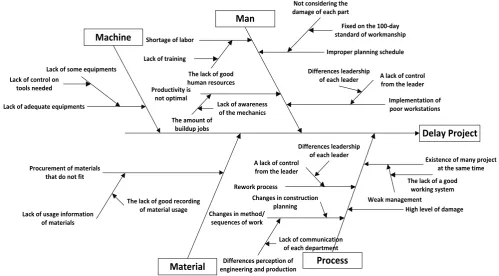
Fig 3. Cause-Effect Diagram for delay project
Based on man factor, the cause of a poor workstation implementation is the lack of supervision of a leader because of differences in leadership of each leader. Causes of improper planning schedule is not considering the damage of each part as fixated on the standard of workmanship of 100 days. The cause of which is not optimal productivity is the amount of accumulation of work due to lack of awareness of the mechanics. The cause of the lack of manpower is the absence of good human resources due to lack of training or training. In the process factor, the cause of the many projects simultaneously is weak management in the absence of a good working system. Cause of rework is the lack of supervision of the leader because of differences in leadership of each leader. Causes changes in the method and sequence of work is the execution plan changes and differences in perception from the engineering and production due to lack of information of each section. In the material factors, causes the procurement of material that does not fit is the lack of information on the use of materials in the absence of registration of the use of good materials. In the machine factor, the cause of the absence of adequate equipments is at least part of the equipment for surveillance of the minimal tool needs. In essence, most of the root cause of the problem is due to project delays by the absence of a good working system, causing some problems. Besides the lack of awareness of each individual to do a job is a matter that also affects the delay of this project.
Working System Analysis
The system is basically a whole, not just the number of different components, but the interaction of the various components so as to form a totality. Integral system can also be represented as systems of input-outputsebagaimana schematically presented below.
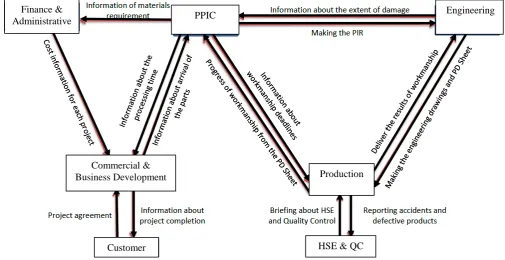
On the issue of project delays in the SBU GMF Power Services led to the weakness of the system in its own internal GMF Power Services. It is necessary for changes to the existing system so that the flow of information more clearly. The lack of clear information flow and understood by every employee is an inhibitor of system performance in GMF Power Services SBU. Improvement of existing systems involving all sections in the SBU GMF Power Services, among others PPIC, Engineering, Production, Quality & HSE, Commercial & Business Development, and Finance & Administration.
1.PPIC and Engineering
The flow of information going from PPIC to form the Preliminary Engineering Inspection (PIR) which is used as a reference for Engineering in making PD Sheet. The flow of information going from Engineering to PPIC contains information on the extent of damage and the estimated time of workmanship.
2.Engineering and Production
The flow of information going from Engineering to Production is an image processing technique that is used as a reference part and PD Sheet which is used as control the process. The flow of information going from Production Engineering to form part of the workmanship of each stage to avoid rework.
3.PPIC and Production
The flow of information from Production to PPIC such a project deadline so that it can be used as a reference in execution priority. The flow of information from Production to PPIC the form of a progress report in the form of PD Sheet workmanship.
4.Production and Quality & HSE
dangerous situations and reporting product defects. The flow of information from Quality & HSE to Production such briefed HSE and quality for mechanics.
5.PPIC and Commercial & Business Development
The flow of information from the PPIC to Commercial & Business Development such longer notices the project so that the Commercial & Business Development can provide information to consumers. The flow of information from the Commercial & Business Development to PPIC such part arrival information so it can be recorded and making the PIR.
6.PPIC and Finance & Administration
The flow of information from the PPIC to Finance & Administration such a list of material requirements required so that the Finance & Administration can order to avoid delays material.
7.Finance & Administration and Commercial & Business Development
The flow of information from the Finance & Administration to Commercial & Business Development contains information on the cost of each project to be communicated to consumers.
8.Commercial & Business Development and Customers The flow of information from the Commercial & Business Development to Customers such information
and its product completion costs. Instead Customers submit project agreement.
The flow of information is crucial thing within a firm. Uncertain path of information on the company causing confusion among workers. They do not know where the right information is coming from. This of course can cause chaos in companies such as delays in the project.
The flow of information made in this study is expected to facilitate the workers to know the origin of the information needed. The flow of information is made only based on business processes that occur in the GMF Power Services. This is due to a lack of understanding of workers, mostly from the production floor. This is certainly concern considering the wheel from the company come from the production floor and the poor flow of information becomes an obstacle to the passage of the production process.
[image:5.595.46.552.376.636.2]In addition to the flow of information that must be repaired, clarity of information regarding the person in charge of each process on the production floor also needed to be clarified. Lack understanding of each individual on the responsibility of the job is another one of the obstacles to a production process. Therefore carried the translation from the production process flowchart in the form of Standard Operating Procedure (SOP) facilitates workers about the details of the process that ongoing.
Fig 4. Flow of Information for Each Department Commercial & Business Development
Engineering PPIC
Finance & Administrative
Customer HSE & QC
TABLEIV
IMPROVEMENTS OF STANDARD OPERATING PROCEDURE (SOP)
No Procedure Information PIC Flowchart
PPIC
Implemented by : Production operator
Report to Engineering and PPIC
Packaging done in parts
Completing the documents that used for deliveries
If there are damaged item will be returned. 1 Data collection and checking
every part incoming
Data collection was performed using Preliminary Inspection according with the documents from
the customer
PPIC
5 Finalization parts that have been
completed MRO Engineering
3 Briefing to the production leader
Explanation of planning based PD Sheet timeline as well as an explanation of workmanship damages based Sketch of Defect, dimentional,
and Coating Thickness
Engineering and PPIC
4 Maintenance, Repair, and Overhaul (MRO) Process
MRO implementation process conducted according to the PD Sheet processing steps. Recording is done on the date of execution of
each activity.
Production Leader 2 Filling Preliminary Inspection Data collection was done by the suitability of
S/N code with each part and each part damage
Packaging and Finishing
Delivering Part
Finish Mechanical Cleaning Surface
(Stripping)
Visual Inspection
NDT Process
Repair Process
NDT Process
Mechanical Cleaning Surface
(Activating)
Coating Coordinate with Each Production
Leader Preleminary
Inspection
Incoming Inspection Start
Incoming Part
Incoming Check
IV. CONCLUSION
A survey using a questionnaire and the ranking factor analysis of the survey data can be used to determine the cause of the delay problems at GMF Power Services. The Standard Operating Procedure (SOP) was developed to guide the obligations of each department involved in the process of Maintenance, Repair, and Overhaul (MRO).
REFERENCES
[1] (Annual Report) GMF AeroAsia. (2014). Sustainable Growth Through Collaboration [Online]. Available : http://www.gmf-aeroasia.co.id/wp-content/uploads/2015/07/AR_GMF_2014.pdf [2] Wulfram, I. Ervianto. Construction Project Management. Transl.
Manajemen Proyek Konstruksi. Yogyakarta : Penerbit Andi, 2002.
[3] Suyatno, “Delay Factor Analysis Building Project (Application Model Regression),” Transl. Analisis Faktor Keterlambatan Proyek
Gedung (Aplikasi Model Regresi) [Online], Magister Thesis,
Diponegoro University Semarang, 2010. Available: http://core.ac.uk/download/pdf/11722919.pdf.
[4] Lewis, T.M. and Atherley, B.A. Analysis of construction delays.
Proceedings of International Symposium for the Organisation and
Management of Construction: Shaping Theory and Practices, Vol. 2,
pp. 60-71, 1996.
[5] Indonesia. Act of the Republic of Indonesia No. 70 On Procurement of Government Goods / Services. Transl. Undang-Undang Republik
Indonesia No. 70 Tentang Pengadaan Barang/Jasa Pemerintah.
Jakarta, 2012.
[6] Langford. The Organization and Management of Construction Shaping Theory and Practice. Great Britain: E&FN SPON, ASCE, 1996.
[7] Furqon.Applied Statistics for Research. Transl. Statistika Terapan
untuk Penelitian. Bandung : CV. Alfabeta, 1997.
[8] Kamaruzzaman. Study of Delay in the Completion of Construction Project. Transl. Studi Keterlambatan Penyelesaian Proyek
Konstruksi. Journal of Civil Engineering UNTAN , Vol. 12, No. 2,
2012.
[9] Abrar Husen. Project Management, Planning, Scheduling and Controlling Project. Transl. Manajemen Proyek, Perencanaan,
Penjadwalan & Pengendalian Proyek. Yogyakarta : Penerbit Andi,
2008.
[10]Soeharto. Project Management from Conceptual to Operational.
Transl. Manajemen Proyek dari Konseptual sampai Operasional.
Jakarta: Erlangga, 2001.
[11] Sudarsono, T.M., Christie, O., & Andi. (2014). Frequency Analysis, Impact, and Type of Delay in Construction Projects. Transl. Analisis Frekuensi, Dampak, dan Jenis Keterlambatan pada Proyek
Konstruksi [Online]. Available:
http://studentjournal.petra.ac.id/index.php/teknik-sipil/article/view/2623
[12] CIOB. (January, 2009). Managing the Risk of Delayed Completion in the 21st Century [Online]. Available: https://www.ciob.org/sites/default/files/CIOB%20research%20-%20Managing%20the%20Risk%20of%20Delayed%20Completion% 20in%20the%2021st%20century.pdf
[13] Ng, S.T., Skitmore, R.M., and Deng, M.Z.M. and Nadeem, A. (2004). Improving Existing Delay Analysis Techniques for the Establishment of Delay Liabilities. Construction Innovation
[Online]. 4(1). pp. 3-17. Available: http://eprints.qut.edu.au/archive/00004116
[14] Ren, Z, Atout, M and Jones, J (September, 2008) Root causes of construction project delays in Dubai [Online]. In: Dainty, A (Ed).
Procs 24th Annual ARCOM Conference, Cardiff, UK, Association of
Researchers in Construction Management. pp. 749-757. Available: http://citeseerx.ist.psu.edu/viewdoc/download?doi=10.1.1.454.7590& rep=rep1&type=pdf
[15] Priscyllia Surya Hadiwiyono and Togar W.S. Panjaitan.(July, 2013).
Designing Standard Operating Procedure (SOP) Department of Human Resources (HR) in PT. X. Transl. Perancangan Standard Operating Procedure (SOP) Departemen Human Resources (HR) Di
PT. X [Online]. Journal Titra, Vol. 1, No. 2, pp. 227-232. Available:
http://studentjournal.petra.ac.id/index.php/teknik-industri/article/view/1042
[16] Sitorus, J., Risk Factors that Influencing Against the Time Performance of EPC Gas Project in Indonesia. Transl.Faktor-Faktor Risiko yang Berpengaruh Terhadap Kinerja Waktu Proyek EPC Gas
di Indonesia [Online], Magister Thesis, University of Indonesia,