Linear Stability of Poiseuille Flow in a Vertical
Pipe Filled with Porous Medium
Ashok Kumar
Abstract—The present paper reports a numerical investiga-tion on the stability of of non-isothermal poiseuille flow in a vertical pipe filled with porous medium. The flow is induced by external pressure gradient and buoyancy force. The non-Darcy Brinkman-extended model has been considered. Here, it is assumed that the buoyancy force acting in the opposite direction of the forced flow. To study the instability mechanism of the poiseuille flow, the linear theory of stability analysis has been used for three different values 0.7, 7.0, and 70 of Prandtl number (Pr). To this end, coupled ordinary differential equations obtained from linear theory of stability analysis, have been solved numerically using Spectral collocation method. Four different values 10−1, 10−2, 10−3, and 10−4 of Darcy number (Da) have been considered to study the impact of permeability of the medium on the flow stability. The numerical experiments on the stability show that, the first azimuthal mode is always least stable mode. Second, effect of azimuthal numbers die out on decreasing permeability of the media. Third, the instability boundary curves in zero azimuthal mode for Da equal to 10−1 and 10−2 show anticipated results for air and water. Further, the influence of media permeability on base flow stability shows that the stability of the flow increases on decreasing of Da.
Index Terms—Porous media, mixed convection, linear stabil-ity, spectral methods.
I. INTRODUCTION
An instability mechanism of isothermal/non-isothermal is an attractive problem in the research area of fluid dynamics, especially transition of poiseuille flow is still a field of active and ongoing research. It is well known that the linear theory of stability analysis fails to capture the instability boundary of isothermal pipe, channel, and annulus. Recently, Kerstin Avila and his group [1] have used the linear theory of stability to capture the instability boundary points of poiseuille flow in isothermal pipe assuming that the surface of the pipe is not smooth. There are some other works experimental and theoretical related to the non-isothermal pipe for viscous fluid flow only. But, if the pipe is filled with porous media (isotropic/anisotropic) then how the physics of the stability characteristics of poiseuille flow will change still was not clear.
Many previously published results indicate that non-isothermal flow instability and transition differ substantially from those of an isothermal flow. The earliest work on the stability of non-isothermal pipe flow was conducted by, among others, Hanratty, Rosen and Kabel [2] and Scheele and Hanratty [3]. Based on fully-developed and laminar parallel flow approximations, Hanratty et al. [2] obtained analytical solutions for mixed convection flow in a vertical pipe and observed experimentally that the flow is stable in the entry region but highly unstable after the flow is fully
Ashok Kumar is with the Department of Mathematics, H N B Garhwal University (A Central university) Srinagar, 246174, Uttarakhand (India) E – mail: [email protected]
developed. Scheele and Hanratty ([2]-[4]) have reported that in the case of buoyancy assisted flow (heated upward flow), the development of points of inflection in velocity profiles is cause of the instability. The flow is super-critically stable and the transition to turbulence is gradual. For the case of buoy-ancy opposed flow (heated downward flow) the instability is associated with separation from the wall and the flow is sub-critically unstable. Transition is sudden and occurs shortly after the flow becomes unstable. They have also observed in their experiment that the flow stability depends primarily on the shape of the velocity profile, which is modified by heating, and the dependence on the Reynolds number is only secondary. In fluid environment, the theoretical work on the stability of poiseuille flow in a vertical pipe has been presented by Yao ( [5], [6]). Yao has investigated the linear stability analysis for an upward fully-developed flow in a heated vertical pipe (with the consideration that fluid is water i.e Pr=7.0) and found that the fully-developed non-isothermal flow is super-critically unstable. The flow can become unstable when Rayleigh number>75 and Reynolds number> 40 and the most unstable flow pattern is double spiral i.e. the most unstable azimuthal wave number is unity. Yao and his group also have reported important pioneering work on identifying linear thermal instability in vertical annulus ([7] - [11]) and a vertical pipe [12]. Instability in pipe flow also reported recently by Cotrell et. al. [13] and their results shows that the long-puzzling, unphysical result that linear stability analyzes lead to no transition in pipe flow, even at infinite Reynolds number, is ascribed to the use of stick boundary conditions, because they ignore the amplitude variations associated with the roughness of the wall. Once that length scale is introduced (here, crudely, through a corrugated pipe), linear stability analyzes lead to stable vortex formation at low Reynolds number above a finite amplitude of the corrugation and unsteady flow at a higher Reynolds number, where indications are that the vortex dislodges.
buoyancy force in the vertical pipe filled with porous medium ([15], [16]). From the above reviews, most works on mixed convection through vertical pipe is pertained in the purely fluid environment, whereas, in porous media, it introduces a new research area. It is essential to investigate the stability of buoyancy opposed poiseuille flow in vertical pipe filled with porous media under different controlling parameters.
A. Mathematical Formulation
We consider a fully developed mixed convection flow caused by an external pressure gradient and a buoyancy force in a vertical pipe filled with porous medium. The wall temperature is linearly varying with z asTw=T0+C1R0z∗,
where C1 is a constant and T0 is upstream reference wall
temperature and R0 is radius of the pipe. The gravitational
force is aligned in the negative z∗-direction. As shown
schematically in figure 1.
The thermo-physical properties of the fluid are assumed to be constant except for density dependency of the buoyancy term in the momentum equations. The porous medium is saturated with a fluid that is in local thermodynamic equilibrium with the solid matrix. The medium is assumed to be isotropic in permeability. In expressing the equations for the flow in the porous medium, it should be noted that the Darcy model presents a linear relationship between velocity of discharge and the pressure gradient. As the Darcy model does not hold when the flow velocity is not sufficiently small or when the permeability is high, extensions to this model known as Brinkman-extended or Forchheimer-extended models ex-ist. In short, the Brinkman term is found to be needed for satisfying a no-slip boundary condition at solid walls, whereas the Forchheimer term accounts for the form drag. Also in analogy with the Navier-Stokes equations, the Darcy model has been extended by including the material derivative. The necessity of the simultaneous inclusion of all or some of these extensions has been discussed in the literature [17]. Therefore, in order to cover extreme values of input parameters i.e., high permeability, high velocity and low thermal diffusivity; the governing equations for the flow and heat transfer in cylindrical polar coordinate system using following non-dimensional quantities:
r= r
∗
R0∗, u = u
∗
Wc∗
, v= v
∗
Wc∗
, w= w
∗
Wc∗
, z= z
∗
R0∗,
p= p
∗
ρfWc∗2 , t=t
∗W
c∗ R0∗ , θ
= Tw
∗−T∗
C1R0∗ReP r
are written as:
∂u ∂r + u r + 1 r ∂v ∂ψ+ ∂w
∂z = 0 (1)
1 ǫ ∂u ∂t + 1 ǫ2
Ju−v
2
r
=−∂p
∂r+ Λ Re
D2u− 2
r2 ∂v ∂ψ − u r2 − Λ
ReDau (2)
h1 ǫ ∂v ∂t + 1 ǫ2
Jv−uv
r i
=−1
r ∂p ∂ψ+ Λ Re
D2v− v
r2 + 2 r2 ∂u ∂ψ − Λ
ReDav (3) h1
ǫ ∂w
∂t + 1 ǫ2(Jw)
i =−∂p
∂z+ Λ Re
D2w
− Λ
ReDaw− Ra Reθ (4) h
σ∂θ ∂t+ (Jθ)
i
= 1
ReP rw+ 1 ReP r
D2θ (5)
where,
J=u∂
∂r+ v r
∂ ∂ψ+w
∂
∂z,and D
2= ∂2
∂r2+ 1 r ∂ ∂r+ 1 r2 ∂2 ∂ψ2+
∂2 ∂z2
In the above equations the dimensionless parameters are
the Rayleigh number,Ra=gβTC1
∗R
0∗ 4
˜
να , the Prandtl num-ber,P r= ν˜
α, andΛ = µf
˜ µ .
B. Disturbance Equations of Basic Flow
The basic flow is a fully developed and steady flow that depends onr only. Using these assumptions, the governing equations (1)–( 5) are reduced to
d2
W0
dr2 +
1 r
dW0
dr − Λ
DaW0−RaΘ0−Re dp
dz = 0 (6) d2
Θ0
dr2 +
1 r
dΘ0
dr =−W0. (7)
The corresponding boundary conditions are given by:
dW0
dr = dΘ0
dr = 0 at r= 0, (8)
W0= Θ0= 0 at r= 1, (9)
withW0 and Θ0 being the basic velocity and temperature,
respectively. The analytic as well as numerical solutions of basic flow are given by Ashok Kumar et. al. [15]. The temperature may be eliminated from the above equations (6)-(7) to give the following expression for the velocity field.
(∇2− 1 2Da)
2
+λ2
W0= 0 (10)
where,λ2=Ra− 1
4Da2 and∇
2
= d
2
dr2 +
1 r
d
dr. The axial pressure gradient can be determined by requirement of global mass conservation:
Z 1
0
rW0(r)dr=
1
2 (11)
The solution of Eq. (10), for the two different cases: (i)λ2
> 0, (ii) λ2
<0, is given by
W0(r) =a1J0(P1 1/2
r) +a2I0(P2 1/2
r) (12)
where,
a1=
h
0.25P1 1/2
P2 1/2
I0(P2 1/2
)i
h
P2 1/2
J1(P1 1/2
)I0(P2 1/2
)−P1 1/2
J0(P1 1/2
)I1(P2 1/2
)i ,
a2=−a1
J0(P1 1/2
) I0(P2
1/2
),
P1=
iqRa−41
Da2
−21
Da for λ
2
>0
q 1
4Da2 −Ra
−21
Da for λ
2
<0,
and
P2=
iqRa− 1
4Da2
+ 1
2Da for λ 2
>0
q 1
4Da2 −Ra
+ 1
2Da for λ 2
J0 and I0 are zeroth order first and second kind of Bessel
functions respectively. The corresponding temperature is given by
Θ0(r) =
a1
P1 h
J0(P1 1/2
r)−J0(P1 1/2
)i
− a2 P2 h
I0(P2 1/2
r)−I0(P2 1/2
)i (13)
In linear stability analysis, infinitesimal disturbances are imposed on the base flow. Thus the velocity, pressure and temperature fields can be written as
(u, v, w, θ, p) =u,˜ v, W˜ 0(r) + ˜w,Θ0(r) + ˜θ, P0(z) + ˜p
(14) where the tilde quantities denote the infinitesimal distur-bances to the corresponding term. The linear disturdistur-bances equations can be obtained by using the relation (14) in equations (1) -(5) and neglecting the small non-linear terms. They are
continuity:
∂u˜ ∂r + ˜ u r + 1 r
∂v˜ ∂ψ+
∂w˜
∂z = 0 (15)
r-momentum:
h1
ǫ ∂u˜ ∂t +
W0
ǫ2
∂u˜ ∂z i
(16)
=−∂p˜
∂r+ 1 Re
D2u˜− 2
r2
∂˜v ∂ψ−
˜ u r2
− u˜
ReDa (17)
ψ-momentum:
h1
ǫ ∂v˜ ∂t +
W0
ǫ2
∂v˜ ∂z i
(18)
=−1
r ∂p˜ ∂ψ+
1 Re
D2v˜− ˜v
r2 + 2 r
∂u˜ ∂ψ
− v˜
ReDa (19)
z-momentum:
h1
ǫ ∂w˜
∂t + 1 ǫ2
dW0
dr u˜+ ∂w˜ ∂z
i
(20)
=−∂p˜
∂z+ 1 Re
D2w˜− w˜
ReDa− Ra
Reθ˜ (21)
energy:
P rRe
σ∂θ˜ ∂t +
dΘ0
dr u˜+W0 ∂θ˜ ∂z
= ˜w+
D2θ˜ (22)
where
D2= d
2
dr2 +
d
dr (23)
Equations (15)-(22) can be reduced to a set of ordinary dif-ferential equations if the disturbance quantities are expressed in the normal-mode form such as
˜
u,v,˜ w,˜ θ,˜p˜= ˆu(r), vˆ(r), wˆ(r), θˆ(r), pˆ(r)
e[iα(z−ct)+nψ] (24) where, αis the wave number, n is integer azimuthal wave number and c =cˆr+icˆiis complex wave speed. The growth
and decay of the disturbances depend on cˆi. Depending on
whethercˆi <0,cˆi= 0 orcˆi>0, three different possibilities
stable, neutrally stable or unstable may be distinguished. The governing linear equations for the infinitesimal disturbances can be written as
duˆ dr +
ˆ u r +
inˆv
r +iαwˆ= 0 (25)
d2uˆ dr2 +
1 r
duˆ dr −
n2+ 1
r2
+α2+ 1
Da+iαRe W0
ǫ2 −
c ǫ
ˆ u
−2in
r2 vˆ−Re
dpˆ
dr = 0 (26)
d2ˆv dr2 +
1 r
dvˆ dr −
n2+ 1
r2
+α2+ 1
Da+iαRe W0
ǫ2 −
c ǫ
ˆ v
+2in r2 uˆ−
inRe
r pˆ= 0 (27)
d2wˆ dr2+
1 r
dwˆ dr−
n2 r2 +α
2+ 1
Da+iαRe W0
ǫ2 −
c ǫ
ˆ w+1
ǫ2
dW0
dr uˆ
−Raθˆ−iαRepˆ= 0 (28)
d2θˆ dr2 +
1 r
dθˆ dr−
n2 r2 +α
2+iαReP r(W 0−σc)
ˆ θ+ ˆw
−ReP rdΘ0
dr uˆ= 0 (29)
The required boundary conditions accompanying the above equations (25)-(29) are specified at the wall and center. At the wall all disturbances must vanish. This implies
ˆ
u= ˆv= ˆw= ˆθ=dˆp
dr = 0, at r= 1 (30) At the center of the pipe, the boundary conditions are as follows [18]:
ˆ
u= ˆv=dwˆ dr =
dθˆ dr =
dpˆ
dr = 0, r= 0, n= 0, ˆ
u+ivˆ= 2duˆ dr +
dvˆ
dr = ˆw= ˆθ= ˆp= 0, r= 0, n= 1, ˆ
u= ˆv= ˆw= ˆθ= ˆp= 0, r= 0, n≥2.
(31)
C. Method of Solution and Validation of Code
In order to solve the coupled differential equations (25)–(29) along with the boundary conditions (30) and (31), the Spectral collocation method has been used ([18], [19], [20]). Verification of the code is given in several ways. First, the independence of the solution is examined for variation of order of base polynomial (N). Secondly, it is checked whether or not the total rate of change of kinetic and thermal energy at critical points are zero. Finally, some comparisons are made with published results with our data for specific cases ([15], [16]).
II. RESULTS ANDDISCUSSION
TABLE I
CRITICALRAYLEIGH NUMBER(|Ra|)FOR OPPOSED FLOW ATRe=
500ANDn= 1.
Da Pr = 0.7 Pr = 7.0 Pr = 70
10−1 221.15286 221.58543 221.20206
10−2 1351.40322 1354.93697 928.41921
10−3 15204.40642 13212.27782 7601.62278
10−4 142972.18284 124748.38083 90369.59374
Isotropic Porous Media
Tw
=
T0
+
C1 R0
z*
Flow
R0
ψ
r* z*
[image:4.595.314.526.313.525.2]g
Fig. 1. Physical model and co-ordinate system.
200 400 600 800 1000 0
2 4 6 8 10
n = 0 n = 1
(a) Da = 10-1
Re |Ra|
x102
200 400 600 800 1000 14
16 18 20
n = 0 n = 1
(c) Da = 10-3
Re |Ra|
x103
200 400 600 800 1000 10
20 30 40 50 60
n = 0 n = 1
(b) Da = 10-2
Re |Ra|
x102
200 400 600 800 1000 13
13.5 14 14.5 15
n = 0 n = 1
(d) Da = 10-4
Re |Ra|
x104
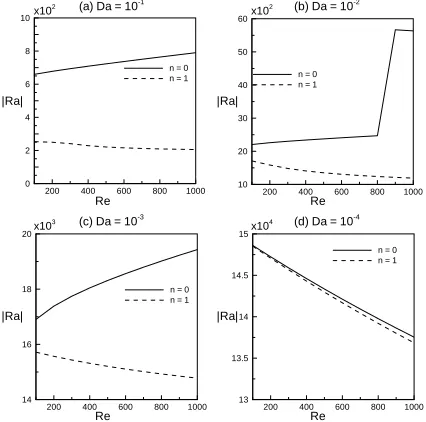
Fig. 2. The stability boundary for (a) Da = 10−1, (b) Da = 10−2, (c) Da
= 10−3and (d) Da = 10−4 at and Pr= 0.7.
of criticalRais made at Re equal to 500, Pr = 70. It can be seen from the table I that the results are as usual expected one. From the same table it can be also observed that for Da= 10−1critical value of Ra is almost independent of fluid i.e.P r, which is not usual.
200 400 600 800 1000 10
15 20 25 30 35
n = 0 n = 1
(b) Da = 10-2
Re |Ra|
x102
200 400 600 800 1000 10
11 12 13 14 15 16
n = 0 n = 1
(c) Da = 10-3
Re |Ra|
x103
200 400 600 800 1000 10
11 12 13 14 15
n = 0 n = 1
(d) Da = 10-4
Re |Ra|
x104
200 400 600 800 1000 0
2 4 6 8 10
n = 0 n = 1
(a) Da = 10-1
Re |Ra|
x102
Fig. 3. The stability boundary for (a) Da = 10−1, (b) Da = 10−2, (c) Da
= 10−3 and (d) Da = 10−4at and Pr=7.
200 400 600 800 1000 8
10 12 14 16 18
(b) Da = 10-2
Re |Ra|
x102
200 400 600 800 1000 6
9 12 15
n = 0 n = 1
(c) Da = 10-3
Re |Ra|
x103
200 400 600 800 1000 6
9 12 15
n = 0 n = 1
(d) Da = 10-4
Re |Ra|
x104
200 400 600 800 1000 2
3 4 5 6
n = 0 n = 1
(a) Da = 10-1
Re |Ra|
x102
Fig. 4. The stability boundary for (a) Da = 10−1, (b) Da = 10−2, (c) Da
= 10−3 and (d) Da = 10−4at and Pr=70.
A. Conclusion
We have attempted to gain an understanding of instability of pressure gradient driven buoyancy opposed poiseuille flow in a vertical pipe filled with fluid-saturated porous medium. To this end, we adopted Brinkman-Wooding-extended Darcy model. By means of linear theory, we were able to extract detailed information of transition of basic flow through a porous medium for different fluids. The Spectral Collocation Method is used to solve the set of linear ordinary differential equations. The main objective in this study was to investigate the effect of permeability as well as Prandtl number on the stability of base flow. The following conclusions can be drawn from this study.
• The first azimuthal mode is always least stable mode. • Increasing the the media permeability, reduces the stability of
the basic flow.
• The effect of azimuthal numbers die out on decreasing per-meability of the media.
[image:4.595.61.274.476.687.2]• The stability analysis indicates that for the same Reynolds number (Re), the fully developed base flow is highly unstable for fluid of high Prandtl number.
• In contrast to a pure viscous fluid, where the effect of Pr is not significant, in isotropic porous medium Prandtl number takes a significant role in characterizing the flow stability in buoyancy opposed case.
REFERENCES
[1] K. Avila, D. Moxy, A. D. Lozar, M. Avila, D. Barkler and B. Hof, ”The Onset of Turbulence in Pipe Flow,”Science 2011, vol. no. 333, pp. 192-195.
[2] T.J. Hanratty,E. M. Rosen, and R. L. Kabel, 1958, ”Effect of heat transfer on flow field at low Reynolds numbers in vertical tubes,”Indust. Eng. Chem. 1958, vol. no. 50, pp. 815-820.
[3] G. F Scheele, and T. J. Hanratty, ”Effect of natural convection on stability of flow in a vertical pipe,”J. Fluid Mechanics 1962vol. no. 14, pp. 244-256.
[4] G. F Scheele, and T. J. Hanratty, ”Effect of natural convection on transition to turbulence in vertical pipes,”Cand. J. Chem. Eng. 1960, vol. no. 38, pp. 67-73.
[5] L. S. Yao, ”Is a fully-developed and non-isothermal flow possible in a vertical pipe,” Int. J. Heat Mass Transfer 1987a, vol. no. 30, pp. 707-716.
[6] L. S. Yao, ”Linear stability analysis for opposed mixed convection in a vertical pipe,” Int. J. Heat Mass Transfer 1987b, vol. no. 30, pp. 810-811.
[7] L. S. Yao, and B. B. Rogers, ”The linear stability of mixed convection in a vertical annulus,”J. Fluid Mech. 1989a, vol. no. 201, pp. 279-298. [8] L. S. Yao, and B. B. Rogers, ”Mixed convection in a annulus of large aspect ratio,”ASME J. Heat Transfer 1989b, vol. no. 111, pp. 683-689. [9] L. S. Yao, and B. B. Rogers, ”Finite amplitude instability of non-isothermal flow in a vertical annulus,” Proc. R. Soc. Lond. A 1992, vol. no. 437, pp. 267-290.
[10] B. B. Rogers, and L. S. Yao, ”The importance of Prandtl number in a mixed-convection instability,”ASME J. Heat Transfer 1993b, vol. no. 115, pp. 482-486.
[11] B. B. Rogers, E. M. Moulic and L. S. Yao, ”Finite-amplitude instability of mixed-convection,”J. Fluid Mech. 1993a, vol. no. 254, pp. 229-250. [12] B. B. Rogers, and L. S. Yao, ”Finite-amplitude instability mixed-convection in a heated vertical pipe,”Int. J. Heat Mass Transfer 1993a, vol. no. 36, pp. 2305-2315.
[13] D.L. Cotrell, G. B. McFadden, and B. J. Alder, ”Instability in pipe flow,” PNAS 2008, vol. no. 105, pp. 428-430.
[14] Y. C. Su, and J. N. Chung, ”Linear stability analysis of mixed-convection flow in a vertical pipe,”J. Fluid Mech. 2000, vol. no. 422, pp. 141-166.
[15] A. Kumar, P. Bera, and J. Kumar, ”Non-Darcy mixed convection in a vertical pipe filled with porous medium,”International. J. Thermal Sciences 2011, vol. 50, pp. 725-735.
[16] P. Bera, and A. Kumar, “Analysis of least stable mode of Buoyancy assisted mixed convective flow in vertical pipe filled with porous medium,”Proceeding of World congress on Engineering 2011, 6-8 July, 2011, (Imperial College, London).
[17] P. Bera, and A. Khalili, ”Stability of mixed convection in an anisotropic porous channel,”Phys. Fluids 2002, vol. no. 14, pp. 1617-1630. [18] M. R. Khorrami, M. R. Malik, and R. L. Ash, ”Application of
Spectral Collocation Techniques to the Stability of Swirling Flows,”
J. Computational Physics 1989, vol. no. 81, pp. 206-229.
[19] S. S. Motsa, and P. Sibanda, ”On the Chebyshev spectral collocation method in channel and jet flows,”SAMSA Journal 2001, vol. no. 1, pp. 36-47.