A Thesis Submitted to The University of Dublin, Trinity College,
for the degree of Doctor in Philosophy
Colm Bhandal
Declaration
This thesis has not been submitted as an exercise for a degree at this or any other university. It is entirely the candidate’s own work. The candidate agrees that the Library may lend or copy the thesis upon request. This permission covers only single copies made for study purposes, subject to normal conditions of acknowledgement.
Colm Bhandal
Summary
The subject of this thesis pertains to coordination in systems of entities characterised by mobile, real-time behaviour and unreliable communication over a wireless network. Such systems are now being deployed both in academic trials and in real-world scenarios towards the achievement of various goals e.g. search and rescue, surveillance, object tracking, traffic management. Coordinating the behaviour of entities in these systems is a non-trivial task, due to real-time demands, sensor inaccuracies, wireless coverage unreliability and entity mobility, among other concerns.
A coordination model is a theoretical framework for the development of strategies by which systems of entities can operate safely towards the achievement of their goals. Comhord´u is a coordination model that facilitates the definition of scenarios consisting of a number of entities and a safety constraint. Furthermore, it provides a means of deriving behavioural constraints upon entities such that the safety constraint in a scenario is respected while entities pursue their goals. However, there is no formal proof that this is the case. Moreover, the presentation of Comhord´u is not formal and is somewhat fragmented, based mostly on a mixture of prose and UML diagrams. Hence there is a need for its formalisation.
There are several benefits to formalising a model. A formal specification avoids the ambiguities often implicit in a natural language description. Also, through the process of formalising a model, often necessary modifications or improvements to the original design become apparent. Furthermore, a formal specification can be subjected to rigorous mathematical analysis, often with the aid of a computer.
This work is the first to address the formalisation of Comhord´u. The goal is to produce a formal specification of Comhord´u along with a verification of its correctness with respect to maintaining safety. That is, for every scenario that can be developed with Comhord´u, are the coordination strategies sufficient to guarantee that safety for that scenario is maintained?
Preceding a formal specification of Comhord´u, critical analysis of the original model is provided. This analysis uncovers a number of ambiguities in the original model and argues that certain aspects of the original model would be difficult to formalise. Following this analysis, modifications are made to the original model yielding a revised model that is more amenable than the original to the process of formalisation. These modi-fications alone are significant contributions of this work. In light of the modimodi-fications made, it is necessary to validate this revised model against the original. That is, the revised model is analysed in how closely it matches the original model. In particular, this analysis focuses on elements from the original that are altered or even wholly absent in the revised model.
The revised model is formally specified using a novel formal specification language, developed specifically for the purpose of this work. This language incorporates a general behavioural model for systems of mobile, real-time entities with unreliable wireless communication. Within this language, a protocol is specified; this is based on the idea of behavioural constraints from the original presentation of Comhord´u. A proof is provided that this protocol is correct with respect to maintaining safety; roughly speaking the proof says that adherence to the protocol by all entities in a system implies safety in that system. The exact notion of safety is defined later in this thesis.
The aforementioned formal specification and proof are encoded using the proof assistant Coq. The language and protocol description are encoded in Gallina, the specification language of Coq. The proof of correctness is partially translated into Coq. That is, the main theorem pertaining to safety is proved in terms of a number of
lower level results, some of which are assumed without proof in the machine encoding. For those results left unproved in Coq, sketch proofs are provided by hand.
Acknowledgements
Firstly I’d like to extend a warm thank you to my supervisor Dr. Arthur Hughes. His positive feedback and encouragement often kept me going when things were really starting to look pear-shaped. I always got a lot out of our meetings, whether if was coffee, obscure mathematical knowledge, or vital feedback. I’m especially grateful for the work he put in towards the end scrutinising the endless walls of text I kept sending him.
To my (unofficial/co) supervisor Prof. Matthew Hennessy, I extend my gratitude for the time he dedicated to meeting me regularly over the past two years. It must have taken a good deal of patience and effort to listen my over-excited ramblings. I could not have finished this without the critical guidance he gave me towards getting my work on track.
I would like to thank Dr. M´elanie Bouroche, the creator of the original Comhord´u model, for taking the time to discuss various issues and providing key feedback.
Thanks to Dr. Andrew Butterfield for the domain specific advice. His feedback at important junctures along the way has been essential in steering this work.
I am grateful to the rest of the foundations and methods group here at Trinity College, for listening to my various talks over the years and providing me with feedback and new ideas.
I would like to thank my friends who kindly agreed to do some proof-reading for me: Michael Clear, Paul Laird, Carlo Spaccasassi, Giovanni Bernardi, Mithileash Mohan and Brendan Cody Kenny. Their fresh pairs of eyes spotted things I never would have considered myself.
I’d like to thank Dr. Sarah Loos and her supervisor Prof. Andr´e Platzer for their correspondence about the KeyMaera hybrid systems tool. Particularly thanks to Sarah, whose lengthy email conversation partially cured my ignorance of hybrid programs and was a great learning experience for me.
Thanks to Edsko de Vries for the “tcd-phd-thesis.cls” template.
I would like to acknowledge the Irish Research Council as the sponsor of this work.
While this is a formal statement of acknowledgements, it wouldn’t feel right if I didn’t acknowledge the people who helped me get through this thing on a more personal level. At this point though, there’s a slight cringe. These things always give the impression of an inflated sense of grandeur on the behalf of the author
“Oooooh look at me, I’m so important, all these people exist in the world for the sole purpose of supporting me through whatever mad endeavour I choose to undertake” etc. etc. Hopefully just saying that will neutralise the effect somewhat before I launch into a big list of thank yous that would make any oscar-winning speech look like a one-liner. All joking aside though, I do appreciate every person I’m about to mention here.
To my family, I’d like to extend a huge thanks. Mam and Dad, fair play for putting up with a 26 year old man still living with his parents and eating all their porridge. I appreciate all the subtle and overt support you’ve given me to complete this thing. Special thanks Dad for the printing and Mam for insisting on washing my bedsheets periodically every 9 days. And the rest of you lot, Liam, Louise, Edel and Rachel. How bloody lucky am I to have you 4 lunatics bydefault? I didn’t even have to fill in any forms for you guys. There was no postage-and-packaging fee. You just came free with life and that’s pretty cool.
To all my close friends I’ve met over the years: you guys are so much more than just the “antidote to thesis stress” but you’re that too. Cheers guys. Some of those sessions with ye in pubs/houses/apartments towards the end kept my sanity barely hanging on by a thread. And it always made the last-train-home-alone journey that little bit less depressing to see the wacky pictures, videos and comments you posted up on various social media outlets that I’m afraid to mention by name here lest I get sued for copyright infringement.
Thanks to the people in the Lloyd building, just for generally being good company but also probably for specific things that I can’t remember now. In particular, to the attendants Chris and Tina thanks for letting me into my office all those times I idiotically locked myself out, and just for all the chats in general. To Shane the hardware guy next door, thanks for fixing my computer that annoyingly decided to start crashing twice daily very close to the thesis deadline. To the various people who have been in and out of room 112 of the Lloyd building over the past five years, I’ve enjoyed your company and random discussions.
I’d like to acknowledge Trinity college Dublin for the institute of scholarship it provides. Material benefits aside, as a scholar, I’ve had the chance to meet some wonderful, interesting and eccentric people; usually all three in one. Commons for me has often been an oasis of social energy in an otherwise dull day; isolated in the depths of our singularly focused work, us PhD students probably don’t get to interact with people as much as we should.
To the people I met in spring/summer schools, it’s been a pleasure to keep the company of the likes of yourselves. The formal methods and theoretical computer science communities are scattered across the globe in little isolated fragments, so it’s great when we get together en masse and bring the theory to life. Not to mention all the nerdy jokes that would elude/bore 99.999999. . . % of the general population.
No doubt I’ve probably forgotten some person, institute, place, time, animal, theorem or concept that I should have acknowledged. To anyone who really does belong here, but who I’ve foolishly forgotten to mention, please accept my excuse of “thesis-related stress”, and give yourself the pat on the back you know you deserve.
This is a bit unorthodox, but I’d like to acknowledge my self. Yes that’s right, if you hadn’t inferred my inflated sense of self importance by now here’s the hard evidence. To my past self, I forgive you for being such a moron starting into this whole thing without a clue in the world, ignoring valuable advice and just generally mucking about. I also appreciate you eventually copping on, dragging your ass out of bed and just doing the work, day by day. Cheers mate, you got me here so far. To my future self, why are you reading this, was five years of your life at it not enough? Anyway, please don’t be too critical of the content.
Finally, I would like to acknowledge my old mug. I had so many cups of tea in that mug. It had the caption Stress is forbiddenwritten on it. One day, I left it on top of a soap dispenser and accidentally knocked into it with my elbow. That was the end of my old mug. The irony is, I was probably too stressed to notice it sitting there. The lesson? Heed thy mug. But don’t despair! There is a silver lining to this story. I have a new mug with sheep in different moods printed all over it. This new mug has stood by me during the final most hectic months of my PhD and we have become quite close even in this short space of time. Long may I sip tea out of this new mug.
Contents
1 Introduction 1
1.1 Coordination . . . 1
1.2 Formal Methods . . . 3
1.3 Publications Related to this Thesis . . . 7
1.4 Contributions . . . 8
1.5 Summary of Content . . . 9
2 Literature Review 10 2.1 Distributed Systems . . . 10
2.1.1 Distributed Systems: Discussion . . . 12
2.2 Future Cities and Vehicular Computing (FCVC) . . . 12
2.2.1 FCVC: Discussion . . . 14
2.3 Formal Specification Languages . . . 14
2.3.1 Process Algebra . . . 16
2.3.2 Two-tiered Network-based Languages . . . 17
2.3.3 Other Network-based Languages . . . 19
2.3.4 Hybrid Systems . . . 19
2.3.5 Formal Specification Languages: Discussion . . . 20
2.4 Real-Time Formalisms . . . 21
2.4.1 Temporal Logic . . . 23
2.4.2 Real-time Languages . . . 24
2.4.3 Other Real-time Literature . . . 25
2.4.4 Real Time: Discussion . . . 25
2.5 Tools . . . 25
2.5.1 Real-time Tools . . . 26
2.5.2 Hybrid Systems Tools . . . 27
2.5.3 Theorem Provers and Proof Assistants . . . 28
2.5.4 Symbolic and SAT/SMT Solvers . . . 29
2.5.5 Other Tool Papers . . . 29
2.5.6 Tools: Discussion . . . 30
2.6 Discussion of Literature . . . 31
3 Towards a Formal Coordination Model 34 3.1 Original Comhord´u Model . . . 34
3.1.1 Comhord´u Preliminaries . . . 35
3.1.2 Responsibility: an Alternative approach to Coordination . . . 36
3.1.3 Methodology of Comhord´u . . . 37
3.1.4 The ComhMod Tool . . . 37
3.2 Assessment of Comhord´u . . . 38
3.2.1 Disambiguation of Goal Statement . . . 39
3.2.2 Potential Problems with Formalising Comhord´u . . . 40
3.3 Revised Comhord´u Model . . . 41
3.3.1 A Modified Space-Elastic Model . . . 42
3.3.2 Behavioural Model . . . 42
3.3.3 Safety . . . 44
3.3.4 A Modified Contract . . . 45
3.4 Assessment of Revised Model . . . 46
3.4.1 General Discussion of Revised Model . . . 47
3.4.2 Omissions . . . 47
3.4.3 Modifications . . . 49
3.4.4 Assessment of Revisions: Summary . . . 51
3.5 An Abstract Formalisation of Comhord´u in UPPAAL . . . 51
3.5.1 Summary of Comhord´u in UPPAAL . . . 52
3.5.2 Discussion of Comhord´u in UPPAAL . . . 54
3.6 Methodology . . . 55
3.6.1 The Comhord´u Protocol: an Alternative to the Contract with Transfer . . . 56
4 Language 58 4.1 Software Language . . . 61
4.1.1 Naming Conventions . . . 61
4.1.2 Syntax of the Software Language . . . 63
4.1.3 Discrete Software Language Semantics . . . 64
4.1.4 Towards a Delay Semantics for Software Processes . . . 69
4.1.5 Software Language Timed Semantics . . . 71
4.1.6 Sanity Checks for the relationSort. . . 77
4.1.7 Software Language Properties . . . 79
4.1.8 Zeno Behaviours of Software Processes . . . 80
4.2 Interface Language . . . 81
4.2.1 Timed Lists . . . 85
4.2.2 Interface Semantics . . . 87
4.2.3 Timed List Examples . . . 88
4.3 Mode State Language . . . 90
4.4 Tying it all together: Entity Network Language . . . 93
4.4.1 Rules for Networks of Entities . . . 99
5 Protocol 102 5.1 Motivation . . . 102
5.2 Informal Protocol Description . . . 103
5.3 Formal Protocol Specification . . . 108
5.3.1 Broadcast Process . . . 109
5.3.2 Overlap Process . . . 112
5.3.3 Listener Process . . . 120
5.3.4 Behaviour of the Overall Process . . . 125
6 Safety Proof 130
6.1 Safety at a Glance . . . 130
6.2 Auxiliary Definitions . . . 131
6.2.1 Some Basic Definitions . . . 132
6.2.2 The History Relations . . . 134
6.3 Results . . . 137
6.3.1 Main Supporting Results . . . 142
6.3.2 Lower Level Results . . . 148
7 The Coq Model of Comhord ´u 155 7.1 Introduction to Coq . . . 155
7.2 Overall Structure . . . 159
7.3 Coding Challenges . . . 160
7.4 Content Highlights . . . 162
7.4.1 Some Underlying Axioms . . . 162
7.4.2 General Tactics . . . 163
7.4.3 Syntax and Semantics of the Software Fragment . . . 164
7.4.4 Protocol Component Definitions . . . 165
7.4.5 State Predicates . . . 167
7.4.6 Specialised Tactics . . . 170
7.5 Pending Work . . . 171
8 Conclusions, Related Work and Future Work 180 8.1 Summary of Contribution . . . 180
8.1.1 Language . . . 180
8.1.2 Protocol . . . 181
8.1.3 Proof . . . 182
8.1.4 Coq Encoding . . . 182
8.2 Discussion . . . 183
8.2.1 Justification for choice of Methodology . . . 183
8.2.2 Validation . . . 184
8.2.3 Size of Codebase . . . 185
8.2.4 Implications of Zeno Behaviours . . . 185
8.3 Shortfalls . . . 186
8.3.1 Incompleteness of Coq Proof . . . 186
8.3.2 Complexity of Language . . . 186
8.3.3 Applicability . . . 187
8.3.4 Other Limitations . . . 187
8.4 Related Work . . . 188
8.4.1 Mechanised Formalisms . . . 188
8.4.2 Formalised Systems . . . 189
8.4.3 Discussion of Related Work . . . 191
8.5 Future Work and Possible Extensions . . . 191
8.5.1 Formal Model of SEM Implementation . . . 192
8.5.2 Potential Applications of Comhord´u . . . 192
List of Figures
1.1 The consensus approach . . . 2
1.2 The transfer primitive . . . 3
2.1 Rough depiction of the research area . . . 11
3.1 Simplified Coverage . . . 50
3.2 The Entity Template. . . 53
4.1 Entity with channels . . . 60
4.2 The rule DEL-ADD. . . 73
4.3 The rule DEL-SUB. . . 73
4.4 Interface . . . 84
4.5 General timed list example. . . 89
4.6 Input list example. . . 90
4.7 Notification list example. . . 90
4.8 Entity Movement . . . 97
5.1 Safe, initial and reachable states . . . 104
5.2 A minimum sufficient coverage split into its constituent zones. . . 105
5.3 Case analysis oftrans≥adaptNoti f . . . 106
5.4 Protocol Components with Channels . . . 109
5.5 The broadcast process. . . 111
5.6 The overlap process. . . 112
5.7 The overlap process, with states classified into operational sections. . . 121
5.8 The listener process. . . 122
5.9 The listener process, divided into sections based on high level behaviour. . . 126
6.1 The proof map . . . 138
List of Tables
1.1 Semantics of the Toy Language. . . 5
2.1 Evaluation of formalisms based on various attributes. . . 33
3.1 Basic Underlying Components and Assumptions of the Revised Comhord´u Model. . . 43
4.1 Naming convention legend. . . 62
4.2 Syntax of the software language. . . 64
4.3 Discrete semantics of the software language. . . 66
4.4 Inductive rules for theSortrelation. . . 71
4.5 Timed semantics of the software language. . . 74
4.6 Syntax for lists of timestamped elements. . . 85
4.7 Semantics for timed lists. . . 85
4.8 Syntax for the interface language. . . 86
4.9 Additional rule for the input list semantics. . . 86
4.10 Additional semantics for the notification list. . . 87
4.11 Semantics for the interface. . . 88
4.12 Syntax of the MState language. . . 91
4.13 Semantics of the Mode State language. . . 93
4.14 Syntax of networks and entities. . . 93
4.15 Semantics of single entities. . . 99
4.16 Semantics of networks of entities. . . 100
4.17 Accept Relation . . . 101
7.1 Breakdown of Pending Work across Files. . . 179
they are not certain;
and as far as they are certain,
they do not refer to reality.
Chapter 1
Introduction
This thesis presents the formalisation of a coordination model called Comhord´u using a process algebra and proof assistant. The original model, initially developed in [Bouroche, 2007], is a framework for designing real-time systems of mobile entities that are in some sense safe. Formalisation of Comhord´u incorporates both a precise specification of its components and a verification that the systems it generates are indeed safe. The remainder of this chapter explains the concepts of formalisation and coordination, among other key concepts. It also provides some motivation for the formalisation of Comhord´u and summarises the content of the thesis.
This chapter is organised as follows. Section 1.1 motivates and introduces the concept of coordination in real-time systems of entities. Section 1.2 argues in favour of the use of formal methods, mentions some existing formal methods, and provides a simple example of a formal language, along with a specification and some behavioural simulations in that language. Section 1.3 outlines some previously published papers relating to this work. Section 1.4 briefly describes the contributions of this thesis. Section 1.5 outlines the structure of the subsequent chapters.
1.1
Coordination
This work is concerned with a concept called coordination as it applies to a certain class of systems. The systems of interest are those in which physical entities operate in real time, are capable of movement in space and can communicate with each other over a wireless network. These systems span disciplines such as robotics [Dunbabin and Marques, 2012, Mostofi, 2013], autonomous vehicles [Marinescu et al., 2010, Zhu et al., 2009] unmanned aerial vehicles [Peng et al., 2012, Kushleyev et al., 2013, Alvissalim et al., 2012], and any other areas in which autonomous physical agents operate concurrently. The increasing ubiquity of these systems necessitates research into design methods that allow them to operate in a safe and progressive manner. For example, a team of unmanned aerial vehicles might need to survey an area without colliding into each other.
The broad question that comes to mind in this context is, how can systems of entities becoordinated? Be-fore this question can be answered, it is necessary to give a rough intuition as to what is meant bycoordination. Coordination is defined elsewhere as: “the management of interactions both amongst entities, and between entities and their environment, towards the production of a result” [Bouroche, 2007]. Coordination models are theoretical frameworks for modelling distributed systems and developing coordination schemes for these systems. System designers can use these models as a blueprints towards building real systems.
Comhord´u is a coordination model developed in [Bouroche, 2007]. It applies to the class of systems previ-ously mentioned i.e. those in which there are physical mobile entities and a wireless network. In such systems, as argued in [Bouroche, 2007] and [Bouroche and Cahill, 2008], coordination becomes non-trivial due to the possibility of network coverage degradation. To address this difficulty, Comhord´u introduces a concept called responsibility. This is an alternative to the traditional approach of consensus. With consensus entities await acknowledgements from other entities before committing to a course of action. In contrast, the idea of
sibility is that certain entities in a system are elected “responsible”. These entities then independently guarantee coordination within the system, i.e. without necessarily any feedback from neighbours. Responsibility can be transferred to neighbouring entities if a potentially hazardous action is to be taken.
Figure 1.1 depicts consensus among five entities: a sender notifies the other four entities of some action it intends to perform and awaits acknowledgement messages from these entities before proceeding with this action. In the figure, it is assumed that the sender, depicted as a circle at the bottom of the diagram, first sends messages to all of the other four entities, also depicted as circles. These messages are shown as arrows. The replies from other entities, also shown as arrows, are assumed to follow receipt of the initial message. Once the entity receives replies from all entities, it can then safely take action.
Figure 1.2 portrays a transfer of responsibility: the sender warns neighbouring entities of its intention and then these become responsible to adapt accordingly. These transfer messages must be periodically sent as long as an entity remains acting in a hazardous way, because, due to the potential mobility of entities, the set of neighbouring entities is not fixed with respect to an entity.
[image:14.595.133.506.366.594.2]Coordination in Comhord´u is based around the notion of a safety constraint. This is a condition that should never be violated by a system. The coordination schemes proposed in Comhord´u are developed towards the aim of maintaining system safety while allowing entities to progress. In Comhord´u, a safety constraint language is defined allowing for the specification of scenario-specific safety constraints. These safety constraints are properties based on the state variables of the constituent entities of a scenario. For example, a safety constraint might say that one car should never be travelling towards another car whenever the two are within a certain distance of each other; this would conceivably prevent collisions between the two cars.
Figure 1.1: The consensus approach. A sender entity (bottom) asks its neighbours for permission to perform a planned action. It then awaits acknowledgement from each of the entities before it proceeds with the action. Entities in the diagram are shown as circles; messages are represented by arrows.
Figure 1.2: The transfer primitive. An entity notifies other entities within a certain region of an action it is performing. It is then the responsibility of the receiving entities to adapt their behaviour in order to maintain safety. Entities in the diagram are shown as circles. The message broadcast is shown as a large translucent circle.
1.2
Formal Methods
Formal methods are “mathematically based languages, techniques, and tools for specifying and verifying . . . systems” [Clarke and Wing, 1996]. Some key terminology that pertains to formal methods is now ex-plained; admittedly this is somewhat verbose but is included for sake of the non-formal-methods reader. The process of specifying and verifying a system is referred to as formalisation. The system in question is said to be formalised. A system that is specified using a formal language is said to be formally specified. The result is called a formal specification or just a specification. A formal specification can be augmented by proving properties about it, this is the process of formal verification or just verification. A specification that does not use formal methods is referred to as “informal” or sometimes “semi-formal” if a moderate amount of rigour is employed.
There are a plethora of existing languages for formal specification. Process algebras such as the classic Cal-culus of Communicating Systems (CCS) [Milner, 1982] are languages for modelling various forms of compu-tation. A “toy” process algebra is given in Example 1.1; following this Example 1.3 illustrates a simple process in that language along with its behaviour. Several recently developed process algebras are geared specifically towards the modelling of broadcast communication [Mezzetti and Sangiorgi, 2006, Godskesen, 2007, Merro et al., 2011, Prasad, 2006, Cerone et al., 2013]. Real-time logics e.g. [Alur and Henzinger, 1994, Chaochen et al., 1991, Cimatti et al., 2009] are languages chiefly intended for the specification of timing properties for systems.
There are a number of tools e.g. [Larsen et al., 1997, Platzer and Quesel, 2008, Huet et al., 2007] for machine based specification and (semi-)automatic verification of systems. Systems can be modelled with these tools and automatic algorithms can be run in order to check certain properties or behaviours of a system. The main advantage with such automation is that the processing power of a computer is exploited: computers can search through state spaces that would be intractable to explore by hand. Even still, tools suffer from a phenomenon known as state-space explosion: the state-space tends to grow exponentially relative to the size of the specification.
It is reasonable to ask what is the benefit of going to such lengths to formalise a model? The argument here is that the contributions of such a formalisation are manifold. As stated elsewhere, a motivation for using formal specification is “to add precision, to aid understanding, and to reason about properties of a design” [Woodcock and Davies, 1996]. An imprecise model or design of some system can be difficult to comprehend and may have many interpretations due to inherent ambiguities. This lack of understanding will most likely lead to the design being incorrectly implemented, perhaps even to the point of system failure. Systems whose safety is crucial are in particular need of precise specification: “Many real-time systems are safety-critical, and therefore deserve to be specified with mathematical precision” [Schobbens et al., 2002]. Formalisation also allows for the rigorous assertion of various system properties. Properties can be proved by hand or verified automatically using a software tool.
Example 1.1(A Simple Timed Process Algebra). A simple process algebra is presented here, to give the non-formal-methods reader an idea of what a process algebra entails. This is a minimal version of timed CCS with some features stripped away. The idea here is to convey the essence of a typical process algebra with real-time behaviour. There is an inductive definition of the language syntax and then a separate definition of the behaviour of the language via what is called a structural operational semantics. The inductive syntactic language definition consists of a number of constructors i.e. functions to build terms of the language. The structural operational semantics defines a relation over the language. It is comprised of rules for deducing when one process can transition to another one.
The syntax of this language consists of four constructors, explained in the following.
• The first constructor is0, which can be thought of as the “base case” for the induction in the definition. It is a term of the language that is supposed to represent a process that does nothing, i.e. a stopped or dead process.
• The next constructor is discrete action prefixing. It takes as arguments a discrete actionδ and a process P and returns a processδ qP. A discrete action represents something that happens without any time passing. Of course, in reality all actions will take some time to execute but for all intents and purposes some actions can be considered to be instantaneous e.g. the execution of a single command of a program. The meaning of a prefixed processδ qPis that it is waiting to do a discrete actionδ and then evolve to become the nested processP.
• A special type of prefix called a delay prefix guards a processPwith a timete.g. inε(t)qP. The variable tis drawn from some time domain, e.g. the real numbers. The meaning of this process is that no actions of the processPcan be done until the timethas elapsed. The choice constructor is denoted by the plus sign. It takes two processes and returns a process.
• A choice term is capable of “choosing” to perform a discrete action from either of its sub-components and then behaving like that sub-component.
Given below is the inductive language definition. The meta-variablesP andPi denote processes. The following definition can be interpreted as giving the rules for building a processP. That is, it formally defines the aforementioned constructors. In the definition, constructors are separated by vertical bars . Every term in
P::=0δqP ε(t)qP
P1+P2
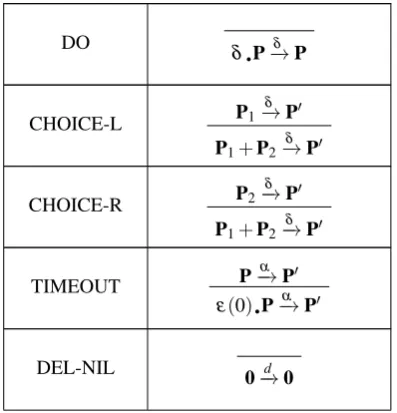
Table 1.1 gives a simple semantics corresponding to this language. That is, it furnishes the preceding syntactic terms with concrete behaviours that are rigorously defined via a set of rules. The rules are all of the form Premise
Conclusion . This can be read as “WheneverPremiseis true,Conclusioncan be derived”. Sometimes the premise of a rule is empty, meaning that the conclusion is unconditionally true. The conclusions to these rules are of the formP−→α P0, which can be interpreted as meaning thatPtransitions to the processP0and in the meantime performs the actionα. Actionsαcan be either discrete, in which case they are denoted using the meta-variableδ, or they can be timed, in which case they are denoted with a meta-variabled, for delay. It is assumed delays are strictly positive values in the time domain, in comparison to time valuest prefixing terms which may be 0.
The rule DO says that a processδ qPprefixed by a discrete actionδ is capable of doing that action and transitioning to the nested processP. The next two rules, CHOICE-L and CHOICE-R, characterise behaviours for choice terms. If two processesP1andP2are combined together via the choice construct, and either can perform a discrete transition, then the entire process can perform that transition with the same action and derivative process. Note that in the course of taking a discrete transition either the left or right sub-component of a choice construct is “chosen”, so to speak. That is, the process behaves as if the other sub-component didn’t exist at all. There is no discrete transition possible for the process0, characterising the fact that this process is incapable of performing any discrete action. The rule TIMEOUT says that if a process is guarded by a time of 0 then its actions are free to be performed. Note the use of the meta-variableα in this rule, denoting either a discrete or a timed action.
[image:17.595.220.419.554.761.2]The remaining rules pertain to delay actions. DEL-NIL and DEL-PFX allow the nil and action prefixed processes to delay by an arbitrary amount and remain unchanged after the delay. This can be thought of as the processes waiting. The rule DEL-SUB allows a delay-prefixed process to delay by a certain amountdand this amount to be subtracted from the delay guard in the resulting process. Notice in this rule the conditiond≤t which restricts the delays from occurring if they exceed the value of the guard. The rule DEL-CHOICE says that if two processes can delay by the same amount, then the sum of these processes can also delay by that amount. Notice that this does not force a choice to be made between the pair. That is, only discrete actions cause the choice construct to “collapse”, so to speak.
Table 1.1: Simple discrete semantics of a toy language.
DO
δqP−→δ P
CHOICE-L P1
δ − →P0 P1+P2
δ − →P0
CHOICE-R P2
δ − →P0 P1+P2
δ − →P0
TIMEOUT P
α −→P0 ε(0)qP−→α P0
DEL-NIL 0 d
− →0
Table 1.1 – Continued DEL-PFX
δ qP−→d δ qP
DEL-SUB d≤t
ε(t)qP−→d ε(t−d)qP
DEL-CHOICE P1 d −
→P01 P2−→d P02 P1+P2
d −
→P01+P02
That concludes this short example. In Example 1.3 the behaviour of a concrete term in this language is explored. For a more thorough introduction to process algebras, the reader is referred to the textbook on
reactive systems [Aceto, 2007]. N
Remark 1.2(Environment Delimiters). For the remainder of this thesis the following delimiters are used to mark the end of an environment. Remarks such as this one and examples such as Example 1.1 are ended with a black triangleN. Definitions are ended with a black square. The standard Q.E.D. symbolis used to mark
the end of a result such as a theorem or lemma. N
Example 1.3(A Simple Process). Recall the simple process algebra from Example 1.1. Below is an example of a simple process in that language. The purpose of this process is to repetitively perform the actionoutthree times. The actions are separated by a period of 1 time unit. That is, before each execution of the actionout, at least 1 unit of time must pass. Also, an actionstopcan happen before any of theoutactions occur. This might model, say, an external event causing the process to abort its execution prematurely. The process is modelled in a somewhat repetitive manner using an interleaving of delay prefixes and action prefixes.
ε(1)qoutqε(1)qoutqε(1)qoutq0+stopq0
The process operates as follows. Initially, the only possible actions are the passage of time and thestop action. If thestopaction is ever performed, then the process evolves to0i.e. it stops. Otherwise, up to 1 unit of time can pass; this may occur as a single delay action or as a sequence of delays. At any point between consecutive delays, the stop action may happen in which case the process transitions to0. Once 1 unit of time passes, the left hand term has timed out, and theoutaction is ready to be performed. From here, either more time can pass, astopaction can occur, or theoutaction can be taken. In the case of theoutaction being taken, the left hand term is “chosen” and the stop action is no longer available. From then on, only delays and more outactions are possible, until the process0is finally reached.
Sequences of transitions can be used to demonstrate the behaviour of this process. Each individual transition can be deduced using only the rules of the semantics given in Table 1.1. A transition always contains a source process, an action and a derivative process. Sequencing transitions, such that the derivative process of one transition is used as the source process of the subsequent transition, yields what is called a trace, and can be represented by a sequence of processes interleaved with the corresponding actions. Abstractly, a trace consists of processesPiand actionsαiand takes on the following form.
P1 α1 −→P2
α2 −→P3. . .
αn −→Pn+1
To begin with, let us imagine that the stop action never occurs and the left hand side process executes all of itsoutactions as soon as they are ready to be performed. In the following trace, a delay of 1 time unit occurs, followed by an execution of theoutaction. This happens again. The lastoutaction is then preceded by two delays adding up to 1 time unit, and the final term is0.
ε(1)qoutqε(1)qoutqε(1)qoutq0+stopq0−→1 ε(0)qoutqε(1)qoutqε(1)qoutq0+stopq0−→out ε(1)qoutqε(1)qoutq0−→1 ε(0)qoutqε(1)qoutq0−→out ε(1)qoutq0−→0.6 ε(0.4)qoutq0−→0.4 ε(0)qoutq0−→out 0
The availability of a discrete action does not imply that it must be performed immediately. This is facilitated by the rule DEL-PFX, which allows a prefixed process to delay indefinitely. The following trace illustrates this point. First a delay of 1 time unit happens, rendering the left hand process capable of performing theoutaction. However, it is supposed that another delay of 11 time units occurs, showing that actions do not need to happen as soon as they are ready. From here, it is possible that any number of further delays occur. In this short example though, let us say that thestopaction occurs next. This might indicate that some sort of an error has precluded the execution of the left hand side process.
ε(1)qoutqε(1)qoutqε(1)qoutq0+stopq0−→1
ε(0)qoutqε(1)qoutqε(1)qoutq0+stopq0−→11
ε(0)qoutqε(1)qoutqε(1)qoutq0+stopq0−−→stop 0
Intuitively, this process specification seems somewhat wasteful. Specifically, there is much repetition in the sequence of delays andoutactions. As a human programmer, it is natural to see such a specification and ask if there is some form of abbreviation possible to alleviate any of this repetition. For example, a C++ programming background would suggest the use of some variant of a “for loop” to achieve the repetition. Furthermore it is impossible in this toy language to specify a process that carries on repeating its actions indefinitely. This is because all process are in some sense finite i.e. they all eventually terminate in their behaviour.
Another potential point of contention arising in relation to this process is the fact that thestop action, representing some sort of program error, can only happen at the start of the process. That is, once the left hand term begins executing, thestopaction is no longer available. It would make more sense to have thestopaction available at all points in the execution of the program. However, to model such behaviour in this language requires a verbose specification, involving a series of nestedstopactions for everyout action. Later in this thesis, a more expressive language is presented which facilitates cleaner expression of such behaviours.
The reason behind the choice of this particular example is that it relates somewhat to the previously men-tioned notion of responsibility; specifically it models periodic broadcast in quite an abstract way. The message being broadcast is abstracted with the actionoutand the period of the broadcast is 1 time unit. Also, while the broadcast is periodic, only a finite number of broadcasts can be modelled in this language; in this case 3 broadcasts are modelled. Later in this thesis, a process with indefinite broadcasting capability is specified using a language of greater complexity to this one.
1.3
Publications Related to this Thesis
At the time of writing, there are two peer-reviewed publications in relation to this work. These are detailed below.
• An Abstract Model of a Coordination Protocol using the UPPAAL Model checker. In this paper [Bhandal et al., 2011a] the UPPAAL modelling tool is used to generate an abstract model of Comhord´u and some properties about the model are verified.
• A Process Algebraic Description of a Temporal Wireless Network Protocol. This paper [Bhandal et al., 2011b] presents a description of a protocol using a process algebra. The protocol characterises the concept of responsibility that is intrinsic to Comhord´u.
1.4
Contributions
Recall that the goal of this research is to formalise the Comhord´u coordination model and verify that it is correct. Initially it would seem then that a research question corresponding to this goal would be: “is Comhord´u correct?” However, attempting to answer this question reveals that it is not as simple as it appears. This is because the original presentation of Comhord´u is not formally defined. Rather, it consists mostly of a fragmented collection of English descriptions and UML diagrams. To answer this question definitively, then, it is necessary to first provide a rigorous formal definition of Comhord´u and of what is meant by “correct”.
However, this matter is complicated by the intractability of formally modelling certain aspects from the original model. The infeasibility of the inclusion of these aspects leads to the development of a number of modifications to the original model in order to render a revised model that is more amenable than the original to formalisation. These modifications raise the issue of validation: how well does the revised model adhere to the original?
Taking into account the above points, the research questions addressed by this thesis are as follows. • What revisions need to be made to Comhord´u prior to its formalisation?
• How does the revised model relate to the original formulation of Comhord´u? • Is the revised model correct, i.e. does the safety condition hold in the revised model? To answer these questions, this work provides the following contributions.
• Several modifications are made to the original Comhord´u model. The modified model is a contribution in itself. Overall, it consists of less components than the original model but it is more precise and so better adapted for formalisation.
• A formal modelling language is developed, embodying the behaviour of real-time systems of mobile entities. It consists of a number of sub-languages for modelling different aspects of this behaviour. The languages assume a process-algebraic style i.e. terms are defined using an inductively constructed syntax and behaviour is defined via an operational semantics.
• A protocol is devised and specified in a software fragment of the aforementioned language. This protocol is a novel feature of the formal model, though it is based on the notion of responsibility from the original Comhord´u model.
• A proof demonstrating the correctness of this protocol is provided. That is, the protocol is shown to guarantee safety, in a certain sense discussed later.
• The aforementioned language, protocol and proof are encoded into the proof assistant Coq.
1.5
Summary of Content
The remainder of this thesis is broken down as follows:
• Chapter 2 is a literature review of the areas of distributed systems and formal methods.
• Chapter 3 investigates the feasibility of formally modelling Comhord´u. In the process of this investiga-tion, revisions are made to the original model in order to render it more amenable to formalisation. • Chapter 4 introduces a formal specification language for real-time systems of mobile entities. • Chapter 5 defines a protocol in the aforementioned language and explores its behaviour. • Chapter 6 gives an overview of the main results comprising the safety proof.
• Chapter 7 describes the main features of the Coq development of this model, and outlines some pending work to be done in Coq. At the time of writing, the Coq model of Comhord´u can be found online at: https://www.scss.tcd.ie/ bhandalc/CoqDoc/toc.html.
Chapter 2
Literature Review
The goal of this thesis is to address the problem of formalising a coordination protocol called Comhord´u. The research area pertaining to this goal is cross-disciplinary: Comhord´u belongs to the distributed systems domain whereas formal methods constitute a field in their own right. Both areas need to be studied for different reasons. On the one hand, distributed systems provides a context and motivation for Comhord´u. On the other hand, formal methods allows for the exploration of solutions to the problem of formalising Comhord´u. It is also important to study the intersection of both fields i.e. the application of formal methods to distributed systems. The fields of distributed systems and formal methods are covered here. Related work in the application of formal methods to distributed systems is left for Section 8.4.
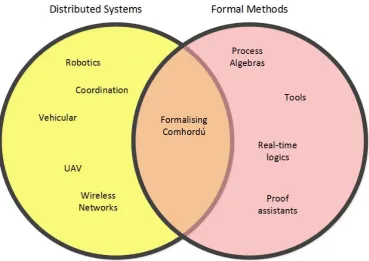
Figure 2.1 roughly depicts the research area in question. Arguably there are other disciplines involved and alternative ways of categorising the various sub-disciplines. For example, hybrid systems research can be considered a field in its own right, with formal methods forming a sub-discipline. However, from the perspective of this work, the diagram shown seems to capture best the relevant areas of research. The two broad fields are distributed systems and formal methods. Within each of these are shown sub-themes e.g. robotics in the distributed systems domain. The intersection of the two disciplines represents the field of applied formal methods to distributed systems. The formalisation of Comhord´u, which forms the subject of this thesis, can be said to lie in this intersection. Nonetheless, this thesis is approached primarily from a formal methods perspective, building upon existing work in the distributed systems domain. Accordingly then the remainder of this chapter focuses in some detail on formal methods whereas distributed systems is given more of an overview.
This chapter is broken into sections. At the end of each section is a discussion exploring the relevance of the literature presented in that section with respect to the current thesis. The first two sections give background to the Comhord´u model, while the final three contain formal methods theory that applies to the problem of formalising and verifying Comhord´u. Section 2.1 explores some research in distributed systems, providing a context and motivation for the Comhord´u model and protocol. Following this is a chapter solely dedicated to future cities and vehicular computing research, which is arguably a sub-discipline of distributed systems but warrants discussion in its own right because it is more directly related to Comhord´u. Following this in Section 2.3 is a presentation of formal methods theory, with a particular focus on process algebras for the specification of systems. Real-time formalisms, which seem more specifically related to this work, are given separate attention in Section 2.4. Finally, there is a discussion of formal methods tools in Section 2.5.
2.1
Distributed Systems
Broadly speaking, the Comhord´u model applies to what may be referred to as distributed systems. This is quite a general term, spanning a number of areas. This section gives a brief overview of distributed systems research related to Comhord´u. Subjects covered here include wireless sensor networks (WSN), transport, unmanned
Figure 2.1: Rough depiction of the research area. The subject of this thesis is formalising Comhord´u, which lies in the intersection between formal methods and distributed systems.
aerial vehicles (UAV), coordination, robotics, and multi-agent systems. Since there is an overlap between these subjects in the literature, they are not all considered individually in the discussion to follow. This area gives only a brief glimpse of distributed systems literature, as the primary focus of this work is formal methods. For a more comprehensive background of the work inspiring Comhord´u, the reader is referred to [Bouroche, 2007]. Unmanned aerial vehicles (UAV) constitute an emerging discipline in distributed systems. Much of the research in this field focuses on a specialised scenario in which the vehicles operate, usually towards the com-pletion of some task or the testing of some algorithm. In most cases, the focus is on the cooperation of multiple UAVs constituting what is known as a swarm. The need for coordination between multiple UAVs is expressed in [How et al., 2004]: “Future UAV teams will have to autonomously demonstrate cooperative behaviors in dy-namic and uncertain environments”. In [Vries and Subbarao, 2011] a steering technique for swarms of UAVs is proposed and tested using a simulator, with an emphasis on obstacle avoidance. A search and rescue team of UAVs and unmanned ground vehicles (UGV) is given in [Weaver et al., 2013]. In [Wei et al., 2013], a UAV team is proposed for the purpose of “enemy territory reconnaissance, remote area surveillance and haz-ardous environment monitoring.” A similar application of UAV teams is given in [Alvissalim et al., 2012], in which UAVs swarm and self-deploy to restore a telecommunication link that has gone down due to some disaster. Some work is focused more on the dynamics of the vehicles themselves, such as reducing the size of the quadrotors to improve agility [Kushleyev et al., 2013] or using air currents to boost altitude and extend flight duration [Cobano et al., 2013].
question are given the goal of target tracking and capturing.
Cyber-physical systems CPS, discussed in [Rajkumar, 2012], bridge the gap between computing and phys-ical machines. In this paper, massive advancements in human society are predicted due to the emergence of this area. Of interest here are the safety and timeliness requirements that the paper predicts will be essential to such systems: “Since a CPS interacts with the physical world, it must operate dependably, safely, securely, efficiently, and in real time”.
2.1.1
Distributed Systems: Discussion
The purpose of the preceding exposition of distributed systems research is to provide a context and motivation for the Comhord´u protocol. The context is characterised by a number of sub-fields the focus of which is the de-velopment of coordination methods in various different types of systems. The motivation for Comhord´u in this setting is the need for a general protocol for coordination that is robust with respect to fluctuations in network coverage. However, the overall goal of this thesis is not to motivate Comhord´u itself but rather argue towards a need for its formalisation and then provide such a formalisation. Thus this section is minimal, providing just enough detail for a reader grasp the basics of the background behind Comhord´u. For a more thorough argument motivating Comhord´u itself, as opposed to its formalisation, the reader is referred to [Bouroche, 2007].
2.2
Future Cities and Vehicular Computing (FCVC)
Future Cities and Vehicular Computing (FCVC) is concerned with the application of computer science to vehicle navigation and traffic management towards the ultimate goal of improving transportation infrastructure, particularly in cities. While this discipline may be considered to fall under the banner of distributed systems, it is considered here in its own right because the research herein is directly related to Comhord´u. The following list discusses research in this domain.
Comhord ´u and SEM Of primary relevance here is Comhord´u, the coordination model and protocol at the heart of this thesis. The model is presented in [Bouroche, 2007] as part of a PhD thesis. An abridged version can be found in [Bouroche and Cahill, 2008]. The basics of Comhord´u are as follows. A system of mobile “entities” is assumed: these could be cars, robots, unmanned aerial vehicles, more or less anything covered in 2.1. These entities are capable of communicating over a wireless network. It is assumed that the entities want to achieve some goals and in doing so must behave in potentially unsafe modes of operation relative to each other. In this context, the goal is coordination: to allow the entities to achieve their goals while maintaining overall system safety. The challenges of this goal are outlined in [Senart et al., 2006]. The Comhord´u protocol addresses these challenges in a novel way compared to pre-existing methods of coordination, which are primarily consensus-based, using a notion called responsibility. The claim made in [Bouroche, 2007] is that if all entities operate according to Comhord´u, then the system is guaranteed to be safe. However, this claim is not formally verified, nor can it be, unless the entire Comhord´u model is formalised. Hence, the work in [Bouroche, 2007] leaves open the need for formalisation, which is addressed in this thesis. For more detail on the Comhord´u protocol, see Section 5.2.
test scenario involving a pedestrian crossing in [Bouroche et al., 2006]. The details of this model are summarised in Section 3.1.
Intelligent Traffic Much of the work in the FCVC group is based around improving traffic in some way, referred to here as “intelligent traffic” research. When compared to Comhord´u, traffic is more restrictive and so in a certain sense easier to abstract. For example, cars can be assumed to stay in lanes and so position can be abstracted by the lane a car is in and a single number representing where that car is on the lane. The opportunity for abstraction afforded by the restrictions of traffic, e.g. lane adherence, facilitates more concise formal models, but their applicability under these abstractions becomes limited to a particular scenario.
In [Asplund et al., 2012], a similar protocol to Comhord´u called CwoRIS is verified using the Z3 theorem prover. The protocol allows cars to enter a road intersection without collisions i.e. it ensures mutual exclusion of cars from the intersection. Again in a similar vein to Comhord´u, responsibility is employed to ensure safe behaviour: “every entity is responsible for making sure that it does not enter an unsafe state with respect to any other entity”. The work is domain-specific to the case of the intersection, unlike Comhord´u, which is intended for wider application.
In [O’Hara et al., 2012], a simulation platform called MDDVsim is presented. It combines microscopic details, e.g. the speeds and positions of the individual vehicles, with macroscopic behaviour e.g. traffic flow density. This platform is tested on a scenario with two cars side by side on a two lane highway. It is argued here that simulation can save time and money by allowing certain vehicular behaviours to be tested without actually constructing them. This resonates somewhat with the advantages of using formal methods, although the latter is generally more time consuming and more rigorous.
A body of work addresses the problem of improving traffic flow on motorways. Some challenges as-sociated with this problem are mentioned in [Cahill et al., 2008]: “real-time hierarchical scheduling, local real-time coordination and real-time inter-vehicle communication.” Also in that work, the benefits of “vehicle scheduling” are given as the reduction of “air pollution, traffic congestion, stress and acci-dents”. The slot based approach [Marinescu et al., 2010] is one step in this direction, with the aim of optimising traffic with intelligent vehicles. The scheme proposed is that vehicles drive in virtual slots that move along the motorway with time thus reducing traffic congestion and giving drivers better time bounds on their journeys. The paper includes two algorithms: one for slot acquisition and another for lane merging. The core idea is that because vehicles drive (semi)-autonomously in slots that have a pre-determined behaviour (speed profile, trajectory), smaller gaps can be left between vehicles and a form of cooperation can be achieved, compared with the competitive form of driving seen on the roads these days. Extending this work is [Marinescu et al., 2012], in which the on-ramp traffic merging is added to augment the previous merging algorithm. Another method for traffic congestion reduction appears in [Arnaout and Bowling, 2011]. The method is tested using a microscopic agent-based simulation upon which quantitative statistical analysis is performed e.g. flow rate and average speed are measured. A location tracking system for a city, called HERO is proposed in [Zhu et al., 2009]. The system consists of a number of nodes that track the locations of vehicles as they move around the city. An overlay network matching the road infrastructure is augmented with a top-level hierarchical network to allow vehicle position information to be propagated across space. Such a network can facilitate applications such as traffic diversion. It is also conceivable that safety protocols similar to CwoRIS [Asplund et al., 2012] could be achieved using this network.
Overall, intelligent traffic research usually focuses on a specific scenario e.g. lane merging or junc-tion scheduling, allowing various abstracjunc-tions to be employed. Related work in this domain appears in Section 8.4, with the added theme of formal verification.
Wireless Networks The communication medium used by Comhord´u systems is a wireless network. While the Comhord´u model includes the network as a rather abstract component allowing broadcast messages to be sent, it is worth exploring at least some literature on networks, particularly in relation to FCVC research. In [Asplund and Nadjm-Tehrani, 2012] a new scheme is proposed for analysing the “routing latency” of messages in the network. Similarly in [Asplund, Mikael Nadjm-Tehrani, 2012] a number of theoretical results are given in relation to the worst-case latency of broadcast in a network. This is closely related to the notion of message latency in Comhord´u, as can be seen from the introduction: “an important aspect [of time critical applications] is to be able to guarantee message delivery within a certain amount of time”. A medium access control (MAC) protocol for “reliable and timely broadcast”, called the Real-time Reservation Protocol (RRP) is presented in [Zhang et al., 2013]. Here “periodic beaconing” i.e. the repetitive sending of broadcast messages is employed to achieve reliable broadcast. A notion called staleness is introduced as part of the protocol, which measures the time since receipt of the last beacon for a particular entity. All of this work on wireless networks is quite closely related to SEM, i.e. the communication protocol underlying Comhord´u. However, no further exposition of network-related research is needed here since it is beyond the scope of this work.
2.2.1
FCVC: Discussion
In one sense, Comhord´u “belongs” in the FCVC group. Its original motivation was to achieve coordination in systems of entities such as traffic on roads. However it is argued here that for a number of reasons Comhord´u is both more general and less applicable to traffic-based scenarios than the related work already discussed. This is not to say that Comhord´u isunsuitablein such applications, rather that the more tailored approaches seem better suited.
In support of this point, notice that Comhord´u is not restricted to any spatial paths. That is, while it is reasonable to assume that traffic always remains in a single lane on a road, Comhord´u allows for a most flexible general movement of its entities. This vastly increases the applicability of Comhord´u to domains outside of FCVC relative to any protocols that take single lane movement as a given. However it becomes questionable whether Comhord´u would be useful at all in a scenario where single lane movement is a reasonable assumption to make. That is, there seems to be no need to use Comhord´u when a more tailored approach can probably deliver better results.
There are also other application-specific abstractions other than single-lane movement exploited by the above work that cannot be factored into Comhord´u because of its generality. For example in [Asplund et al., 2012], a junction is represented as an abstract atomic component and safety can be reduced to mutual exclusion of entities from this shared resource. Such abstractions cannot be made in Comhord´u, which physically models only space itself and the constituent entities as points in that space.
Also much of the work found in this FCVC field is more low-level than Comhord´u in that network specifics are taken into account such as message loss and MAC layer protocols. While these considerations are useful for implementations of the underlying SEM model they are beneath the scope of the Comhord´u model itself.
2.3
Formal Specification Languages
This section is chiefly devoted to the consideration of formal languages for the purpose of specifying the Comhord´u model. Formal languages are well-defined mathematical entities that facilitate the exact specifica-tion of systems. Usually, a language of this kind has a formal syntax defined using mathematical notaspecifica-tion and a formal semantics interpreted over a mathematical structure e.g. a graph. They can be viewed as a subset of the more general field of formal methods, which are defined as “mathematically based languages, techniques, and tools for specifying and verifying . . . systems” [Clarke and Wing, 1996]. The application of formal meth-ods usually involves using some language to specify a system so that it can be rigorously verified as “correct” in some sense. The verification may be supported by a tool but most of the discussion on these is left to Section 2.5.
The merits of formalisation are manifold, and are discussed extensively in the literature. Here a cross-section of these pro-formal ideas taken from papers in a number of different fields are combined to give a thorough argument in favour of formalisation. We begin with a point made in the artificial intelligence literature outlining what is arguably the most immediate benefit of formally modelling a system: “[Formal specification] allows a precise and non-ambiguous description of the architecture” [Hilaire et al., 2010]. A similar point is made in relation to formal methods in robotics: “Formal specification necessitates to state requirements precisely. A beneficial side effect is that it focuses discussions and manifests design decisions” [Walter et al., 2010]. Yet again almost the same point is made in the hybrid systems literature: “Formal approaches may help with a deep analysis that takes care of the precise semantics of the requirements” [Cimatti et al., 2012]. In other words, simply the act of formalising a system alone is already advantageous in that it makes the specification of the system precise, and “forces our hand” in making design decisions that might otherwise be ignored.
Such ignorance at an early design stage can have negative consequences later on. As argued in [Florian et al., 2012]: “The correctness of such [real-time] systems is of significant importance because malfunctions can induce notable economic costs, and they can even cause the loss of human life.” The argument involving safety is also stressed in [Schobbens et al., 2002]: “Many real-time systems are safety-critical, and therefore deserve to be specified with mathematical precision.” Formal methods is also hailed in the field of hybrid systems: “rigorous reliability analysis requires formal modelling” [Henzinger, 2000]. Furthermore, “[f]ormal verification becomes more and more important as computerized control systems in safety-critical systems grow significantly in complexity” [Platzer and Quesel, 2008]. Put another way, many systems, particularly those with real-time involved, are safety critical i.e. the consequences of them malfunctioning are catastrophic, potentially even fatal. Thus, there is a strict need for these type of systems to operate correctly, and the rigour offered by formal methods can help achieve guaranteeing this correct operation, which is difficult to achieve otherwise given the ever increasing complexity of such systems.
Formal modelling usually entails some sort of verification, though as discussed already the specification of a system formally is contribution enough as it is. One of the advantages of formally verifying some property is rigour that is otherwise unachievable: “It is very easy to overlook some detail when carrying out by hand even an elementary derivation. Informal arguments for equivalence of processes are error prone, since exhaustive case analyses on possible transitions are elusive” [Honsell et al., 2001]. Not only are the state spaces too vast for human exploration, there are also some subtleties that tend to escape our intuition: “For a complicated language, it soon goes beyond human capabilities to keep track of the consequences of design-decisions in the semantics and one can often overlook possible counter-intuitive phenomena introduced there” [Mousavi and Reniers, 2006].
To start, there is the issue of validation: does the formal model indeed capture the system it intends to represent? It seems as though the answer to this question is never a resounding “yes” i.e. “absolute validation is Utopian” [Ciaffaglione and Honsell, 2003]. The reason for this is usually the loss of detail that cannot be avoided through the process of abstraction. For example, “[n]on-realistic vehicle dynamics, simplified communication models and idealistic localisation can all detract from the credibility of evaluations carried out” [O’Hara et al., 2012]. In general, it is hard to know how to abstract “correctly”, and indeed a “possible difficulty is in justifying the abstractions made during the modelling process” [Webster et al., 2011]. In fact, [Bertolino et al., 2012] claims that “the job of validating and verifying [systems is] extremely difficult”.
Another “important obstacle is generating faithful models from system description formalisms, in particular for mixed software/hardware systems” [Calude, 2009]. In other words, specifications should not deviate too much from the real-world behaviour of the system they intend to model. Still, “[v]ery often, theory makes assumptions oversimplifying reality” [Calude, 2009]. This is not just a formal methods issue, but applies to any theory whatsoever that hoes to model the real world.
The remainder of this section reviews a number of different formalisms in terms of their applicability in formalising and verifying the Comhord´u model and protocol. These formalisms span a wide range of themes in-cluding two-tiered or multi-tier languages, languages for networks, hybrid systems and process algebra, among others. These themes are not mutually exclusive, and so the following organisation is not to be taken strictly. What can be said is that the majority of the formalisms considered are geared towards the modelling of net-works. A large amount of these network-oriented formalisms, particularly the more recent ones, adopt what can be called a “two-tiered” approach, in that they separate the modelling of “nodes” and “processes”, in some sense representing the physical entities and the software components in the network respectively.
In the following, first process algebras in general are discussed in Section 2.3.1: these are formal languages that have an algebraic flavour and form the basis of most of the work appearing in this section. After this, the two-tiered languages already mentioned are presented in Section 2.3.2. Then Section 2.3.3 covers other network-based languages. Following this hybrid systems are discussed in Section 2.3.4; these are systems that combine continuous behaviour with discrete behaviour.
2.3.1
Process Algebra
Process algebras are mathematical constructs usually geared towards the modelling of software or hardware. They can be thought of as abstract or simplified programming languages, with certain implementation details omitted such as platform-specific commands or specialised libraries. The advantage of abstracting in this way is that the languages are simple enough to be subjected to analysis and verification techniques. For example, properties of programs written in such languages can be specified and proved. Many of the formalisms exam-ined in the following, particularly in Section 2.3.2 and Section 2.3.3 can be classified as process algebras. This section covers the “classical” process algebras, laying the groundwork for the more modern ones which are presented next.
A good introductory text for process algebras is [Aceto, 2007]. Introduced in this book is one of the oldest and best-known process algebras called the Calculus of Communicating Systems (CCS). Also included is the timed version of CCS called TCCS, a logic called Hennessy-Milner logic for specifying properties of processes and another formalism called Timed Automata (TA). This text is highly recommended for anyone interested in familiarising themselves with process algebra.
that it is the output process that determines the value sent, while the input process simply listens for this value, accepts it, and binds it to a variable that may occur in the process body.
Timed CCS [Yi, 1991] extends the original syntax with one feature, the delay prefix, and adds delay tran-sitions to the semantics. The delay prefix essentially models a process which has “gone to sleep”, to borrow a term from multi-threading in an imperative software programming. The prefixed process can do nothing but delay until the time in the delay prefix has elapsed. The delay transition relation, which is added in the timed semantics, models the passage of time in the behaviour of processes.
Another classical process calculus is Tony Hoare’s Communicating Sequential Processes (CSP). A good introduction to this language can be found in [Davies and Schneider, 1995]. Also found in this paper are extensions of this language to include time. The main deterrent to using CSP or one of its variants to model Comhord´u is the way communication is handled. The problem is that “CSP is based on a multiway [event] synchronisation mechanism, but it does not differentiate between input and output” [Ene and Muntean, 2001]. Now, at first sight event synchronisations seem promising for modelling broadcast, in that they allow multiparty participation in an event. For example, let us say one process wishes to send a message and all others wish to receive it. It might be possible to model both sending and receiving as participation in an event that symbolises the transmission of the message. However, this idea runs into trouble because of conflicts. For example, consider two processes trying to send the same message. If the transmission of this message is modelled as an event, and sending/receiving this message are both modelled as participation in this event, then two senders can send the same message at the same time. This violates our intuitive notion of broadcast, i.e. that of a single sender and multiple receivers.
The process algebras discussed up to now are “classical” languages, but they do not seem suitable for a natural description of Comhord´u. In particular, the features of broadcast and mobility are missing, and some “hack” would be needed in order for these to be included, which would no doubt complicate the model somewhat. The question then is, does there exist a process algebra suitable for modelling Comhord´u? Or indeed, can this be achieved by some other formalisms other than process algebra? To answer this a number of more modern process algebras are first considered in Section 2.3.2 and Section 2.3.3, then other formalisms are explored in the subsequent sections.
2.3.2
Two-tiered Network-based Languages
A plethora of process calculi have recently emerged to deal with the modelling of wireless networks. Many of these employ what is commonly referred to as a “two-tiered” approach, where the nodes of a network and the software components running within those nodes are given separate treatment. That is, the languages are split into two separate “sub-languages”, one for nodes and communications and the other for software and internal computations. In a certain sense, the nodes can be seen as the hardware components of a network and the processes running within them the software components. The advantage is a separation of concerns, making systems not only easier to understand but also more amenable to proofs: “a traditional process calculus must intermix the computation of neighborhood information with the protocol’s control behaviour. This tends to render such models unnatural and unnecessarily complex” [Singh et al., 2010].
To begin with, let us consider the Calculus of Wireless Systems (CWS) [Mezzetti and Sangiorgi, 2006]. This is a language for modelling systems at the data link layer- the lowest communication layer. Systems are modelled on two levels:
1. There is a fixed network of nodes i.e. nodes cannot be created or destroyed dynamically. Each node has a position in space and a fixed broadcasting radius. Position and broadcasting radius do not change over time for a given node. The nodes represent the physical transmitter/receiver apparatuses that handle data transfer.
A separate semantics is given for processes and networks of nodes. The process semantics is simple and similar to CCS. The main focus of the network semantics is on modelling message collisions. Although useful for modelling at the datalink layer, this calculus