Distributed and Multi-Type Resource Management
Luc Moreau
†[email protected]
Department of Electronics
and Computer Science
University of Southampton
Southampton SO17 1BJ UK
Christian Queinnec
[email protected]
LIP6
4, place Jussieu, 75252
Paris Cedex
France
May 15, 2002
Abstract
The authors have previously defined Quantum, a framework for managing resources, which can be used by both providers and consumers of resources to express and program resource-related operations. In this paper, we extend this framework to the distributed setting by introducing distribution-specific operations, and we generalise the framework to support multiple types of resources.
1
Introduction
Dynamic code loading has popularised the idea of Internet servers able to reconfigure them-selves and to extend their capabilities by uploading code dynamically — examples of such systems can be found in the mobile agent literature. The full power of this paradigm shift can be achieved if untrusted code can be run in a safe manner, and in particular if malicious code can be prevented from using too many resources. This raises the problem of resource management, both for the provider and the consumer of resources.
Another important trend is illustrated by multi-agent systems or services-based architec-ture (in particular in the Grid context), where complex applications are the result of dynamic composition, opportunistic reuse, and on-the-fly creation of multiple distributed computa-tions. Resource management is not only crucial, as illustrated by proposals for computational economies, but has now become a distributed problem.
In previous work [9, 10], the authors introduced Quantum, a framework generalising Ko-rnfeld and Hewitt’s group hierarchy [7] and providing a programmatic interface for managing resources in a distributed setting. Quantum is based on the notion of energy, an abstract notion
ECOOP’02 Workshop on Resource Management for Safe Languages, Malaga, Spain, June 2002.
denoting a quantity of resources, and on groups acting as tanks of energy. Groups are organ-ised along a hierarchical structure. Groups sponsor computations, which consume energy from the group they are directly sponsored by. Two forms of notification are supported: exhaustion of the energy contained in a group and termination of the computation sponsored by a group. Additionally, Quantum provides a mechanism for pausing and resuming a hierarchy of com-putations. Notifications are made available to the programmer and therefore can be arbitrary computations, whose resources must also be managed: Quantum specifies how such notifica-tions can be integrated in a single framework. Our previous work focused on its formalisation [9] and its implementation in a shared memory [10].
The distributed aspect of Quantum had not been investigated properly. We assumed that the shared memory could be extended to the distributed context, but this required complex and unpractical algorithms to maintain tank levels transparently. Since then, advances in mobile agent systems, and “Internet Programming” languages have shown that distribution has to be represented explicitly in the formalism.
While our model of resource management had always been intended to support multiple resources of different types (and not just processor resources), we had never shown how Quan-tum could be extended to accommodate different types of resources.
The contribution of this paper is twofold: (i) the introduction of two different primitives
related to distribution — migration and communications — and their semantics in terms of groups. (ii) the support for multiple types of resources. Each of these contributions is presented in turn, followed by a brief related work section and a conclusion.
2
An Overview of Quantum
In this section, we overview Quantum as described in previous publications [10, 9]. The ab-stract syntax of Quantum primitives is displayed in Figure 1.
primitives ::
Feϕeϕ t
! "
g ϕp
#$% &
ge
g ' Group
e ' Energy
F : Group( Energy) α
ϕeϕ
tϕp : Group( Energy) void
Figure 1: Abstract Syntax of Quantum Primitives
Our goal is to be able to allocate resources to computations, and to monitor and to control their use as evaluations proceed. We regard two events as essential to the lifetime of a compu-tation, which may trigger customisable actions. The termination of a computation marks the end of its life, and we would expect unconsumed resources to be transferred to a more suit-able computation. The exhaustion of the resources allocated to a computation may trigger a computation so that for instance more resources can be supplied.
In order to be notified of the termination or energy exhaustion of a computation, we in-troduce an entity that represents the computation. A group is an object that can be used to refer to a computation in a Quantum program. A group is associated with a computation com-posed of several threads proceeding in parallel; in turn, they can initiate subcomputations by creating subgroups. As a result, our computation model is hierarchical. A group is said to
sponsor [7, 11, 6] the computation it is associated with. Reciprocally, every computation has a
sponsoring group, and so does every thread.
t1
t3 g1: e1
t2:
Feϕeϕ
t
t1
t3 t2: F
g2 g1:
e1
e
Kg
g3: e3
g3: e3
[image:3.612.77.522.251.544.2]g2: e
Figure 2: Group Creation
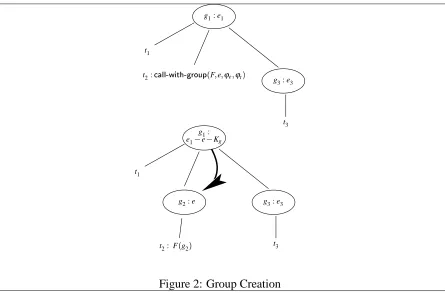
At creation time, a group is given an energy quota. More specifically, a computation that evaluates the expression
!"$#%'&(!*),+-,./10
F2e2 ϕe2ϕ t3
under the sponsorship of a group g1, creates a new first-class group g2 that is allocated an initial quota of energy e and whose parent is g1. Furthermore, it initiates a computation under the sponsorship of g2 by calling F with g2 and e as argument; hence, the user function F receives a handle on its sponsoring group. As Quantum keeps track of resource consumption, the energy e allocated to g2is deducted from the energy of g1. Figure 2 displays the behaviour of the primitive
(4
!5"6#%'&(!7),+8-,./ . We see a configuration where a group g
t t
g1: e g1: e
e1
Figure 3: Computation and Energy Consumption
t5:ϕt
g3e
3
g2: e2 g
3: 0
t1
t2 t3
Terminated
g1:e1
e3 Kt
g2: e2 g
3: e3
t1
t2 t3 t4
[image:4.612.72.523.89.349.2]g1: e1
Figure 4: Termination of a Group
(4
!5"6#%'&(!7),+8- ./
, a new subgroup g2 sponsoring the application of F on g2 and e is created; energy is transferred from g1to g2. This transition assumes that e1
e Kg.
Remark In Quantum, every action has an associated cost. Figure 2 shows that the
energy of g1is e1
e
Kgafter transition. The value
e is the amount of energy
transferred to the new group g2and
Kgrepresents the cost of the group creation
operation.
Quantum enforces the following principle: any computation consumes energy from its sponsoring group. Therefore, not only is a group perceived as a way of naming computations, but also it must be regarded as an energy tank for the computation. Figure 3 displays a thread t evolving to state t by performing an action, whose cost e
1is charged to the sponsoring group
g1.
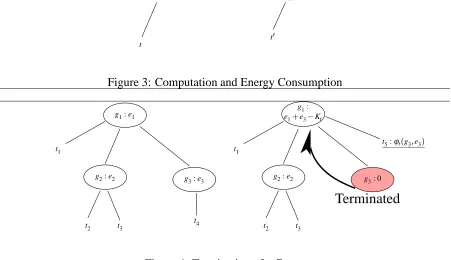
In addition, two events may be signalled during the lifetime of a group: group termination and energy exhaustion are asynchronously notified by applying the user functions (the notifiers) ϕt andϕe, respectively1. A group is said to be terminated, when it has no subgroup and it does
not sponsor any thread; i.e. no more activity can be performed in the group. In Figure 4, when the only thread t4of group g3is terminating, the functionϕt is asynchronously called with g3 as argument to notify its termination, and the energy surplus of g3 is transferred back to g1. Note that the execution of the notifierϕt is sponsored by g1, i.e. the parent of g3.
g1: e1
g2: e2 g
3: e3
t1
t2 t3 t4
g2: 0 g
3: e3
t1
t2 t3 t4
t5:ϕe
g2e
2 g1:
e1 e2
Ke
[image:5.612.68.528.55.220.2]Exhausted
Figure 5: Exhaustion of a Group
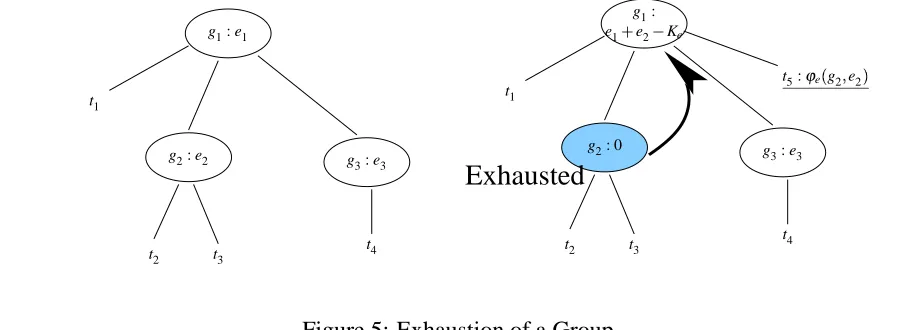
In Figure 5, a computation t2 sponsored by g2requires more energy than available in g2; the functionϕe is asynchronously called on g2 to notify its energy exhaustion, also under the
sponsorship of g1, with transfer of the remaining energy of g2to g1.
Remark An exhaustion notification, like every Quantum transition, has a cost. An
exhaustion occurs only once in a group (before the group gets refilled again), and therefore the cost of notification propagation can be included, i.e. “precharged”, in the cost of group create Kg.
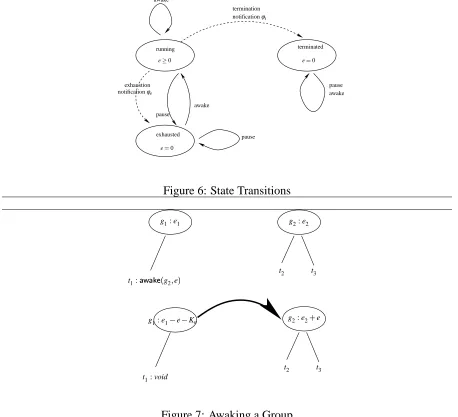
Figure 6 displays the state transition diagram for groups. At creation time, a group is in the +5. # ) state, which means that the threads that it sponsors can proceed as long as they do
not require more energy than available. Asynchronous notifications are represented by dotted lines. Once a computation requires more energy than available in its sponsoring group, the state of its group changes to
&
.%
, and at the same time an asynchronous notification ϕe is run. When all the subgroups and all the threads sponsored by a group terminate, its
state becomes %
+ # %
, while the asynchronous notifier ϕt is called. Let us observe that the % + # %
state is a dead end in the state diagram; this guarantees the stability of the termination property: once a computation terminates, it is not allowed to restart (as the resource that it did not consume may have been reallocated).
Energy may be caused to flow between groups, independently of the group hierarchy, un-der the control of the user program. Two primitives operate on groups: /
. and " .
Intuitively, the primitive /
.
forces a running group and its subgroups into the
&
. %
state, and all the energy that was available in this hierarchy is transferred to the group that sponsored the /
.
action. The construct
"
0
g2 e
3 transfers energy e to the group g, after
deducting it from the group sponsoring the
"
action. If the group g is in the
&
.%
state, its state is changed to +5. # ) ; if the group is in the%
+ # % state, "
acts as a null
operation. Figure 7 displays the behaviour of
"
, assuming that e
1
e Ka and g
2 is not terminated.
Let us observe the asymmetric behaviour of /
. and "
: the former operates
e 0 e 0
e 0
exhausted running
notificationϕt
pause awake
pause awake awake
pause
termination
terminated
notificationϕe
[image:6.612.70.528.57.474.2]exhaustion
Figure 6: State Transitions
g1: e1 g2: e2
t2 t3
t1:
g2e
g2: e2 e
t2 t3 t1: void
g1: e1
e
Ka
Figure 7: Awaking a Group
parallel search. In particular, we might wish to resume the search with the energy distribu-tion that existed when the hierarchy was paused. Unfortunately, such informadistribu-tion is no longer available because groups are memory-less. By this, we mean that a group does not remember the amount of energy it had before being paused. It is therefore the programmer’s responsibil-ity to leave some information at pausing-time about the way a hierarchy should be awakened. Not only does /
.
transfer energy, but it also posts a notification for each group in the tree.
Figure 8 displays the precise behaviour of /
.
. Evaluating
/
.
0
g12 ϕp
3 forces into the
!
&
. %
state each group g in the hierarchy rooted by g
1; moreover, for each g, an evaluation
that calls ϕp with g as argument is created under the sponsorship of the parent of g. Let us
g1: e1
g2: e2 g
3: e3
t1
t2 t3 t4
g0: 0
t7:ϕp
g2e
2
g2: 0 g3: 0 t1
t2 t3 t4
g0: e0
g1: 0 t6:ϕp
g1e
1
g :
t : void
t8:ϕp
g3e
3 g : e
t :
g1ϕp
e e1
e2 e3
[image:7.612.68.524.55.253.2]
Kp
Figure 8: Pausing a Group
This section concludes our overview of Quantum. We now investigate how it can be ex-tended to the distributed setting and how we can support multiple resources.
3
Distributed Resource Management
As far as distribution is concerned, we distinguish the transfer of data between hosts from the transfer of groups between hosts. The former can easily be expressed by send and receive primitives ‘`a la’π-calculus. The latter is reminiscent of remote procedure calls and migration of mobile agents. Indeed, groups act as sponsors of computations; if a group changes location, so does the sponsored computation.
In this work, we do not want to impose strong mobility to a programming language for the sake of resource management (nor do we require the power of first-class continuations). We introduce a primitive for migrating a group that is similar to the invocation of a remote procedure.
We introduce the primitive migrate0 h 2 f
3 , which requires two arguments: h a host name
and f a procedure without argument (a thunk). The effect of the migrate primitive is displayed in Figure 9.
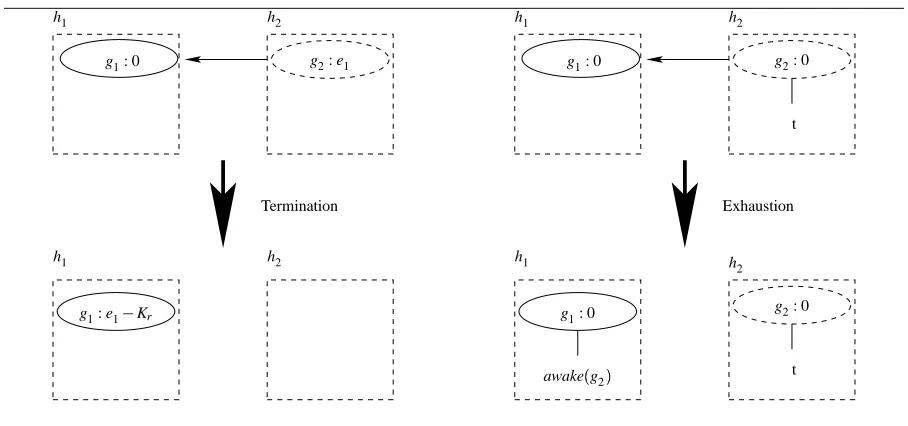
Before transition, on host h1, migrate is called with arguments h2 and f , with a current stack noted as an evaluation context E1[4], and with a sponsoring group g1containing e1units of energy. After transition, the group g1 contains no energy and sponsors no computation; it can be seen as a “zombie” [12] which acts as a handle to the remote computation. On host h2, a new group g2is created to sponsor the application of the thunk f ; group g2contains e1units of energy, minus the amount Km necessary for the migration operation. Let us note that after
transition, the execution thread on h1 has disappeared, and on h2we have not reactivated the execution context E1: this is in effect a weak migration. For migration to proceed, we require
migrate to be executed in a group that sponsors only one thread.
The parent of group g2is g1. In Figure 9, we represent g2as a dashed ellipse, because this group is not explicitly created by the user using the group-creation primitive
(4
!"6#%'&(!*) +8-,./
h2 h1
h1 h2
E1migrate h2 f
g1: e1
f
g2: e1
Km
g1: 0
[image:8.612.68.523.55.262.2]Migration
Figure 9: Migration
but it results from a migration. Such a group is referred to as a remote group. For a remote group, the handlers for termination and exhaustion are defined by the semantics so as to provide the behaviour described in Figure 10 (a) and (b).
h1 h2
h2 h1
g1: e1
Kr
g2: e1
g1: 0
Termination
h1
h1 h2
g2: 0
t
h2 g2: 0
t g1: 0
g1: 0
awake g2
Exhaustion
Figure 10: Return from Migration: (a) Termination — (b) Exhaustion
In Figure 10 (a), when a remote group g2 detects the termination of the computation it sponsors, its energy is transferred back to its parent g1, minus the amount
kkostreturn necessary for the return. After such a transition, termination can then be detected
in g1.
According to Figure 10 (b), exhaustion of g2triggers a propagation of an exhaustion noti-fication to host h1, under the sponsorship of g1. As such a computation attempts to run under
[image:8.612.70.524.356.569.2]of g1’s parent. If more energy is transferred to g1, it will then be transferred to g2, through the use of the awake primitive.
The reader may observe that, in Figure 10 (b), the activation of a notification under the sponsorship of g1 takes place without being accounted for. We note that a group exhaustion occurs only once (before the group gets refilled again), and therefore the cost of notification propagation can be included, i.e. “precharged”, in the cost of group migration Km.
Nothing prevents the thunk activated by a migration to call the migrate primitive again. Such successive migrations create a sequence of nested remote groups, reminiscent of for-warding pointers left by mobile agents. There is an opportunity to shortcut such sequences of remote groups using a mechanism similar to the collapsing of chains of pointers [8].
The rationale for requiring a single thread in a group g1 before allowing migration to pro-ceed is the following. After migration, g1acts as a handle for the remote group g2: exhaustion of g1 implies that g2 is exhausted; if more energy is transferred to g1, it is passed on to g2. Additionally, chains of such handles can be shortcut easily.
h2
h1
h2 h1
g1: e1
Kc
E1void
g2: e2
Kc
E2v g1: e1
E1send cv
g2: e2
E2receive c
[image:9.612.64.520.270.522.2]Communication
Figure 11: Synchronous Communications
Figure 11 displays the semantics of synchronous communications using primitives send and receive. No group is created or migrated here; instead, both sponsoring groups are charged with the cost of communication Kc.
4
Management of Multiple Resources
one used in Scheme engines [3]. In this Section, we step backward and study the primitives ma-nipulating energy. We then show that they may be extended to cope with various (and multiple as well) types of energies. Some design considerations are also addressed in this Section.
4.1
Operations on energy
From an energy system implementor’s viewpoint, there are only three primitive operations that deal with energy tanks. These operations target how energy is (i) merged when a subgroup
terminates and gives its energy back to its parent, (ii) consumed while a group performs some work, and (iii) split between the creating and created groups.
The following Java interface represents these operations. The receiver of these messages, an energy-tank, is side-effected by these operations.
interface EnergyTank {
void merge (Energy energy); boolean consume (Energy delta);
Energy split (SplitDescriptor d) throws EnergyExhaustion; }
The simplest operation is merge that occurs when a group terminates and returns its remain-ing energy to its parent. The two energies are then recombined and put back in the parent’s tank (the receiver of the merge method). A little less simpler is the consume operation that is repeatedly called to decrement the energy tank of the working group. The argument is a (request for) energy and the answer is a boolean telling whether the request is accepted. When the request is accepted, the energy tank is decremented, that is, consumption is pre-paid. To support concurrent behaviour, the request and the decrementation are performed atomically.
Creating a group is a more complex operation since the energy of the current group has to be split into two parts under the user’s control. The energy returned by split will fill the subgroup’s tank, this returned energy is removed from the energy tank of the working group (the receiver of the split method). The split operation takes an argument, a descriptor, specifying how the user wants to split energy. The descriptor is any type of data that users may safely create to carry their intention (a string, a percentage, etc.). It cannot be an energy since, for safety reasons, energy should never be handled directly by users since users may duplicate it, lose it, steal it, etc.
The split operation interprets the descriptor and returns some energy to fill the freshly created group with the appropriate part of the current energy. In terms of energy, if we merge back the split energy into the current tank, we should not create energy ex nihilo. Thus the following invariant, informally stated, holds:
e.merge(e.split(d)) e
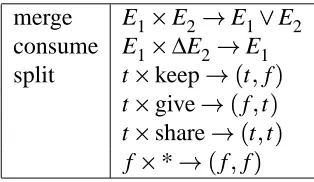
File Permissions The right to read a specific file may be represented as a boolean energy. We will consider that the consume operation does not exhaust this right2. The merge disjuncts the two booleans. The split operation receives one of three possible descriptor strings: “keep”, “give” or “share”. These descriptors allow the new group’s creator to keep, give or share their right. Table 1 presents an algebraic view of the operators. Without the permission to read a file, the split operation always return 0 f
2 f
3 for any split descriptor (denoted by in the last line of
Table 1).
merge E1
E2
E1
E2
consume E1
∆E2
E1
split t
keep 0t
2 f
3
t
give 0 f
2t
3
t
share 0t
2 t
3
f
*
0
f2 f
[image:11.612.218.375.166.257.2]3
Table 1: The boolean energy to read a file.
Migration Hops We may count the number of hosts a computation is allowed to migrate to in order to restrict the diameter of a distributed computation. The consume operation triggered by migration decrements the number of allowed hops. The merge operation ignores the number of hops any terminating subgroup may return to it and sticks to the initial number of hops it received when created. The split may restrict the number of hops it gives to the new group while preserving its own number of allowed hops. The restriction may be expressed with a natural number (p in Table 2). These definitions allow diameters of distributed computations to be properly nested.
merge E1
E2
E1
consume E1
∆E2
E1
1
split n
p
0
n2 min
0
02 n
p33
Table 2: The energy for hops.
4.2
Multiple energies
Though hidden from users, energy should be managed by implementors. The implementation of the interfaceEnergyTankrelies on some operations onEnergyso it is possible to add, subtract or split energies. Although Object-Oriented, the next interface has no side-effect (as was the case with a tank of energy), it deals with pure energy.
In the next interface, the quotient, plus and minus operations on energy support the split,
merge and consume tank operations.
2Alternatively, the write permission on a write-once device would consume the energy at the first successful
interface Energy {
Energy quotient (SplitDescriptor d); Energy plus (Energy e);
Energy minus (Energy e) throws EnergyExhaustion; }
We may now implement a simpleEnergyTankas:
class EnergyTankImpl implements EnergyTank { private Energy _e;
EnergyTankImpl (Energy e) { this._e = e;
}
Energy split (SplitDescriptor d) throws EnergyExhaustion { Energy gift = this._e.quotient(d);
this._e = this._e.minus(gift); return gift;
}
void merge (Energy e) {
this._e = this._e.plus(e); }
boolean consume (Energy de) { try {
this._e = this._e.minus(de); return true;
} catch (EnergyExhaustion ee) { return false;
} } }
The EnergyTank interface copes with one type of energy only. It is a simple step to
extend such an interface to multiple energies, say EnergiesTank. First, we suppose an
EnergiesTankto hold a set ofEnergyTanks. Second, we transfer sets of energies. Third, the split operation now takes a set of split descriptors and it is possible from any of them to determine which type of energy it splits.
interface EnergiesTank {
void merge (Energies energies); boolean consume (Energies delta);
The final step is to let the user devise new types of energy (and associated split descriptors) and have the underlying machinery manage it. It remains to let the user create an initial amount of the new energy and register it with the current group. Once registered, this new energy will be managed entirely by the group according to the user’s split descriptors.
5
Related Work
A number of existing systems support resources accounting. Telescript [15] featured “clicks” that are a unit of charge deducted from an agent’s account. JRes and JKernel [2] support accounting of memory, CPU and network usage. Nomads [13], through a modified JVM, supports strong migration of agents and resource accounting; in particular, a limit file is able to specify both quantity limits (such as disk space or memory) but also rate limits (such as disk usage rate and transfer rate). Java Seal2 [14] is an extension of Java Seal [1] which provides portable resource accounting. A notion of process is introduced in KaffeOS [5], a modified JVM, which allows resource control in a fine manner.
All these systems are complementary to Quantum: indeed, they implement the accounting of resource usage and they raise a notification when a resource quota is reached, while Quan-tum provides the mechanism to transfer (i.e. add or remove) resource dynamically between distributed computations. Quantum also provides a programming model to support the execu-tion of asynchronous notificaexecu-tions, under the control of the same resource management system. Notifications are therefore becoming a key programming technique that can be made available to the programmer. Additionally, our model also supports resources they do not necessarily have a physical reality, but can be defined in an application-specific setting.
Java Seal [1] is able to migrate nested seals. On the contrary, our proposed model only supports migration of leaf groups. Additionally, our model does not make any assumption on the programming language, and allows migration of a group only if it sponsors a single thread — the thread itself is not migrated, but it essentially initiates a remote method invocation, i.e. weak migration. On the other hand, our pause operation is recursive, and is able to pause recursively a whole hierarchy of groups.
6
Conclusion
In this paper, we have extended Quantum, our framework of resource management to the dis-tributed setting, by introducing explicit remote method invocation (or weak migration) and multiple types of resources. Quantum itself does not provide the accounting mechanism, but it sits on top of such a mechanism to provide a programmatic interface that can be used by re-source consumers and providers to program complex distributed applications and their hosting platforms.
References
[1] Cyaran Bryce and Jan Vitek. The JavaSeal Mobile Agent Kernel. Autonomous Agents
and Multi-Agent Systems, 4(359–384), 2001.
[2] Grzegorz Czajkowski and Thorsten von Eicken. JRes: A Resource Accounting Interface for Java. In Proceedings of ACM OOPSLA Conference, Vancouver, BC, October 1998.
[3] R. Kent Dybvig and Robert Hieb. Engines from Continuations. Computer Languages, 14(2):109–123, 1989.
[4] Matthias Felleisen and Robert Hieb. The Revised Report on the Syntactic Theories of Sequential Control and State. Theoretical Computer Science, 2(4):235–271, 1992. Tech-nical Report 100, Rice University, June 1989.
[5] Jay Lepreau Godmar Back, Wilson C. Hsieh. Processes in KaffeOS: Isolation, Resource Management, and Sharing in Java. In Proceedings of the 4th Symposium on Operating
Systems Design and Implementation, October 2000.
[6] Robert H. Halstead, Jr. New Ideas in Parallel Lisp : Language Design, Implementation. In T. Ito and Robert H. Halstead, editors, Parallel Lisp: Languages and Systems. US/Japan
Workshop on Parallel Lisp. Japan., number 441 in Lecture Notes in Computer Science,
pages 2–57. Springer-Verlag, 1990.
[7] William A. Kornfeld and Carl E. Hewitt. The Scientific Community Metaphor. IEEE
Trans. on Systems, Man, and Cybernetics, pages 24–33, January 1981.
[8] Luc Moreau. Distributed Directory Service and Message Router for Mobile Agents.
Sci-ence of Computer Programming, 39(2–3):249–272, 2001.
[9] Luc Moreau and Christian Queinnec. Design and Semantics of Quantum: a Language to Control Resource Consumption in Distributed Computing. In Usenix Conference on
Domain-Specific Languages (DSL’97), pages 183–197, Santa-Barbara, California,
Octo-ber 1997.
[10] Luc Moreau and Christian Queinnec. Distributed Computations Driven by Resource Con-sumption. In IEEE International Conference on Computer Languages (ICCL’98), pages 68–77, Chicago, Illinois, May 1998.
[11] Randy B. Osborne. Speculative Computation in Multilisp. An Overview. In Proceedings
of the 1990 ACM Conference on Lisp and Functional Programming, pages 198–208,
Nice, France, June 1990.
[13] Niranjan Suri, Jeffrey M. Bradshaw, Maggie R. Breedy, Paul T. Groth, Gregory A. Hill, Renia Jeffers, Timothy S. Mitrovich, Brian R. Pouliot, and David S. Smith. NOMADS: Toward a Strong and Safe Mobile Agent System. In Proceedings of the Fourth
Interna-tional Conference on Autonomous Agents, pages 163–164, Barcelona, Catalonia, Spain,
2000. ACM Press.
[14] A. Villaz´on and W. Binder. Portable resource reification in java-based mobile agent sys-tems. In The Fifth IEEE International Conference on Mobile Agents (MA’2001), Decem-ber 2001.
[15] James E. White. Telescript technology: Mobile agents. In Jeffrey Bradshaw, editor,