The progressive salinization of irrigated land with saline water can limit the future of agriculture in many areas of the world (Estañ et al. 2005). The irrigation water salinity in Iran is the major factor limiting plant growths. Soil salinity is a serious constrain to crop production in many areas of Iran where the poor quality of irrigation water is commonly associated with high temperature and reduced rainfall. Because salinity water is among the most limiting factors in agriculture, it is important to study the potential effects of this stress. Soil salinity induces osmotic stress by inducing both the accumulation of toxic levels of Na and Cl ions and the uptake prevention of es-sential nutrients such as K, Ca and NO3 (Munns 2002). Also osmotic stress led to the reduction of water uptake capability of roots and consequently inhibition of plant growth and a reduction in the
crop productivity (Netondo et al. 2004). Soil sa-linity inhibits plant growth, with considerable reductions in plant biomass (Rameeh et al. 2004).
Ozone is unstable in solution (Beltrán 2004). It has been effectively used to control growth of microorganism, food and drinking water treat-ment (Wang et al. 2006), treattreat-ment of fruits and vegetables to increase shelf-life of the products (Guzel-Seydim et al. 2004). Ozone has a potential for enhancing crop yield (Zheng et al. 2007). In a greenhouse experiment Chan et al. (2007) con-cluded that irrigation by ozonated water for one month increased the leaf area and fresh weight of Pak Choi and Chinese spinach. However, Graham et al. (2011) reported that single applications of aqueous ozone had no effect on leaf area and shoot dry weight. However, pathogen levels were sig-nificantly reduced in all treatments with aqueous
Interactive effects of salinity and ozonated water on yield
components of cucumber
E. Peykanpour
1, A.M. Ghehsareh
1, J. Fallahzade
2, M. Najarian
11
Department of Soil Science, Isfahan (Khorasgan) Branch, Islamic Azad University,
Isfahan, Iran
2
Young Researchers and Elite Club, Isfahan (Khorasgan) Branch, Islamic Azad
University, Isfahan, Iran
ABSTRACT
A greenhouse experiment was conducted to investigate the effects of salt stress and ozone on yield and yield components of cucumber. The treatments were defined by a two-factorial design of three irrigation water salinity levels (2, 4 and 6 dS/m) and three ozone concentrations (0, 0.5 and 1 ppm). After germination, cucumber seeds were grown in pots containing soil, coco peat and perlite and fed with Hoagland’s solution and were imposed with salt and ozone treatments. The results showed that salinity of irrigation water significantly reduced fruit yield of cucumber owing to a decrease both in fruit number and fruit weight. Also, statistical testing showed significant reductions in vitamin C, fresh and dry weight of shoot and root with increasing water salinity. Ozonated water improved fruit yield by increasing fruit number, but had no significant effect on fruit weight. Application of ozone caused significant increases in fresh and dry weight of shoot and leaf area but caused a significant decrease in the vitamin C. Generally, using ozonated water irrigation can induce positive effect on cucumber under salt stress. In conclusion, the saline water in combination with ozone could be recommended in strategic management to grow cucumber (without impaired effects on crop quantity).
ozone. Ohashi-Kaneko et al. (2009) suggested that ozonated water can be used to sterilize differ-ent water sources (e.g., drain water, river water, rain water and underground water), in order to control pathogens during the early growth stage of plants. The effects of salt stress (Huang et al. 2009) and ozonated water (Ohashi-Kaneko et al. 2009) on the growth and productivity of vegetables have been studied separately by many authors, but the combined effects of ozone and salt stress on cucumber are not available in the literature. Therefore, the present study aims at investigating combined ozone and salt stress effects on: fruit yield, biomass of shoot and root, leaf area and vitamin C of cucumber.
MATERIAL AND METHODS
In order to study salt stress and ozonated water effects on cucumber yield and yield components, a greenhouse experiment was conducted in the Khorasgan University in 2014. Average tempera-tures of day and night were 26°C and 18°C, respec-tively, in greenhouse. Cucumber seeds (storm) were sown in a box of coco-peat substrate and young plants at four leaf stages were transferred in 10 L pots filled with soil (80%) and leca + perlite (20%). One cucumber plant was cultivated per pot. Modified Hoagland’s solution was used for irriga-tion of the pots. Electrical conductivity of nutrient solution was 1.5 dS/m. pH of this solution was set at 5.6 with nitric acid. The treatments were defined by a two-factorial design of three irrigation water salinity levels (2, 4 and 6 dS/m) and three ozone concentrations (0, 0.5 and 1 ppm). The nine treat-ment combinations were replicated five times and arranged in a randomized complete block design. The salt solution was prepared by nutrient solu-tion and NaCl and the electrical conductivity of different salinity levels was adjusted by a direct reading conductivity meter. Ozonated water was generated with an electrolytically ozonated
wa-ter generator. The plants were exposed to ozone concentrations via irrigation with nutrient solu-tion. For preparation of 0.5 and 1 ppm O3, ozone was added to nutrient solution for 5 s and 10 s, respectively. Some fruit yield indexes including fruit weight, fruit length, fruit number and fruit yield were measured. Also, some growth indices including fresh and dry weight of shoot and root, leaf number, leaf area were determined at the end of growth period. The concentration of vitamin C was measured by applying the method described by Ruck (1963).
Statistical analysis. Two-way ANOVA was used to assess the effects of ozonated water and salts stress on all analysed plant properties. Means were compared by the Duncan’s test at P < 0.05. Statistical procedures were carried out using the software package SAS 9.1 for Windows (Cary, USA).
RESULTS
Soil analysis results are shown in Table 1. The soil belongs to the non-saline soil with a neutral reaction and the amount of lime which is rela-tively high.
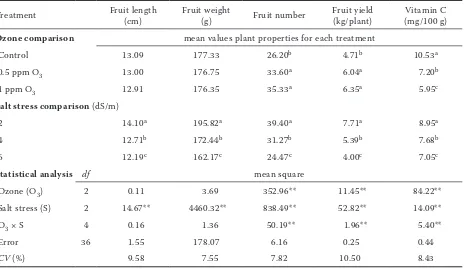
[image:2.595.66.539.687.741.2]The ozonated water and salts stress levels ef-fects on fruit traits. Significant mean squares of the ozonated water were determined for fruit num-ber, fruit yield and vitamin C indicating significant differences of these traits at three ozonated water levels (Table 2). However, the effects of ozonated water on fruit length and fruit weight were not significant (Table 2). Fruit number and fruit yield were increased at high ozonated water levels, but the concentration of vitamin C was decreased. Although, fruit number and fruit yield were in-creased by about 35% at 1 ppm O3 as compared with control, the concentration of vitamin C was decreased by 44%. According to Table 2, signifi-cant mean squares of the salts stress levels were determined for all fruit traits. A decrease in these traits was noted as the salinity of irrigation water
Table 1. Some chemical and physical properties of experimental soil
EC
(dS/m) pH (%)N
P K OC
(%) (cmolCEC +/kg) CaCO(%) 3 Texture (g/cmρb 3) Porosity (%)
(mg/kg)
1.42 8.22 0.08 28 153 1.7 19 42 Sandy loam 1.5 56
increased. Compared with 2 ds/m, fruit length, fruit weight, fruit number, fruit yield and vitamin C were 14, 17, 38, 48 and 21.2% lower at 6 ds/m of salinity level, respectively (Table 2). Although, the interaction of ozonated water × salts stress on fruit length and weight were not significant, there was
[image:3.595.69.533.113.382.2]a significant ozonated water × salts stress interac-tion on the fruit number, fruit yield and vitamin C (Table 2). The highest fruit number and yield was obtained at the third level of ozonated water (1 ppm) and 2 ds/m of salinity level (Table 3) and the treatment of control (without ozone) and 6 Table 2. ANOVA model and comparison of cucumber fruit traits for different treatments
Treatment Fruit length (cm) Fruit weight (g) Fruit number Fruit yield (kg/plant) (mg/100 g)Vitamin C
Ozone comparison mean values plant properties for each treatment
Control 13.09 177.33 26.20b 4.71b 10.53a
0.5 ppm O3 13.00 176.75 33.60a 6.04a 7.20b
1 ppm O3 12.91 176.35 35.33a 6.35a 5.95c
Salt stress comparison (dS/m)
2 14.10a 195.82a 39.40a 7.71a 8.95a
4 12.71b 172.44b 31.27b 5.39b 7.68b
6 12.19c 162.17c 24.47c 4.00c 7.05c
Statistical analysis df mean square
Ozone (O3) 2 0.11 3.69 352.96** 11.45** 84.22**
Salt stress (S) 2 14.67** 4460.32** 838.49** 52.82** 14.09**
O3 × S 4 0.16 1.36 50.19** 1.96** 5.40**
Error 36 1.55 178.07 6.16 0.25 0.44
CV (%) 9.58 7.55 7.82 10.50 8.43
Mean values plant properties for each treatment. In each column, different letters indicate that values are significantly different (P < 0.05), according to the Duncan’s test. *P < 0.05; **P < 0.01
Table 3. Effects of different treatment on some parameters of cucumber
Treatment Fruit length
(cm) Fruit weight (g/plant) Fruit number (per plant) Fruit yield (kg/plant) (mg/100 g)Vitamin C Ozone (O3) salt stress (dS/m)
Control
2 14.08 196.73 31.80c 6.25c 12.94a
4 12.82 172.58 25.60de 4.44d 9.86b
6 12.36 162.70 21.20f 3.44e 8.79c
0.5 ppm
2 14.12 195.58 39.80b 7.78b 7.50d
4 12.86 172.96 33.20c 5.74c 7.12de
6 12.00 161.70 27.80d 4.58d 6.97de
1.0 ppm
2 14.10 195.15 46.60a 9.10a 6.42ef
4 12.44 171.78 35.00c 6.00c 6.05fg
6 12.20 162.12 24.40e 3.96de 5.38g
[image:3.595.64.536.550.739.2]ds/m of salinity level had the lowest number and fruit yield. However, the highest concentration of vitamin C was observed at control (without ozone) and 2 ds/m of salinity level (Table 3).
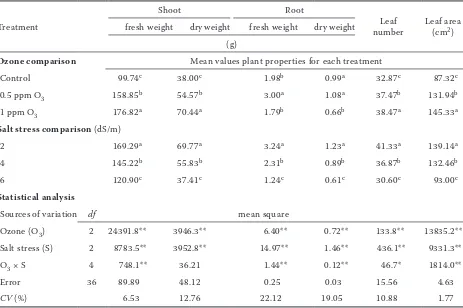
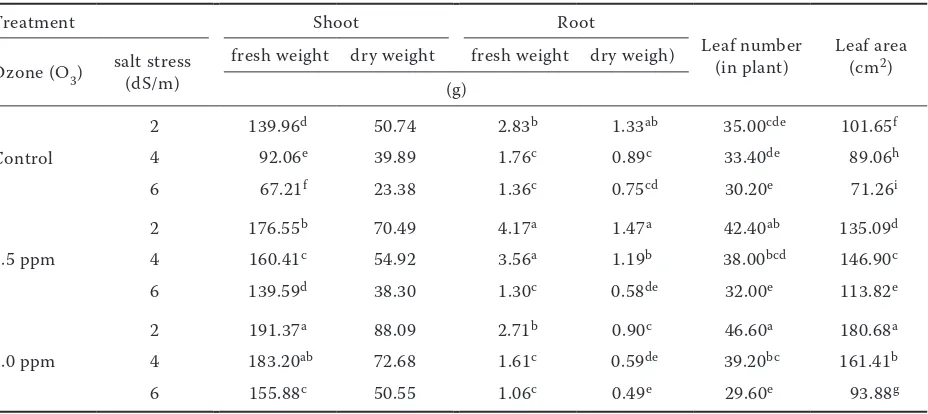
The ozonated water and salts stress levels effects on growth indices. According to Table 4, significant (P < 0.01) mean squares of the ozonated water were determined for all growth indices. A significant increase in fresh and dry weight of shoot, leaf number and leaf area was noted as the ozo-nated water levels increased (Table 3). Treatment with 1 ppm O3 increased fresh and dry weight of shoot, leaf number and leaf area by 77, 85, 17 and 66%, respectively, comparing to control. The salt stress resulted in a significant (P < 0.01) decrease in all growth indices. Statistical testing indicated that with higher levels of water salinity the fresh and dry weight of shoot, fresh and dry weight of root, leaf number and leaf area were significantly decreased (Table 4). Compared with 2 ds/m, fresh and dry weight of shoot and fresh and dry weight of root were 29, 46, 62 and 50% lower at 6 ds/m
of salinity level, respectively (Table 4). The treat-ment with 6 ds/m of salinity level decreased leaf number and leaf area by 26% and 33%, respec-tively, comparing to 2 ds/m. In most cases, there were a significant interaction between ozonated water and salts stress levels on the growth indices (Table 4). The highest fresh weight of shoot, leaf number and area was obtained at the third level of ozonated water (1 ppm) and 2 ds/m of salinity level and the lowest of these traits was obtained at control (without ozone) and 6 ds/m of salinity level (Table 5). However, fresh and dry weight of root was higher in 0.5 ppm ozonated water and 2 ds/m of salinity level than in the other treatments (Table 5), although in some cases, the differences were marginally significant.
DISCUSSION
[image:4.595.67.530.113.421.2]The present study demonstrated that the appli-cation of ozone concentration (especially 1 ppm) Table 4. ANOVA model and comparison of plant properties for different treatments
Treatment
Shoot Root
Leaf
number Leaf area (cm2)
fresh weight dry weight fresh weight dry weight (g)
Ozone comparison Mean values plant properties for each treatment
Control 99.74c 38.00c 1.98b 0.99a 32.87c 87.32c
0.5 ppm O3 158.85b 54.57b 3.00a 1.08a 37.47b 131.94b
1 ppm O3 176.82a 70.44a 1.79b 0.66b 38.47a 145.33a
Salt stresscomparison (dS/m)
2 169.29a 69.77a 3.24a 1.23a 41.33a 139.14a
4 145.22b 55.83b 2.31b 0.89b 36.87b 132.46b
6 120.90c 37.41c 1.24c 0.61c 30.60c 93.00c
Statistical analysis
Sources of variation df mean square
Ozone (O3) 2 24391.8** 3946.3** 6.40** 0.72** 133.8** 13835.2**
Salt stress (S) 2 8783.5** 3952.8** 14.97** 1.46** 436.1** 9331.3**
O3 × S 4 748.1** 36.21 1.44** 0.12** 46.7* 1814.0**
Error 36 89.89 48.12 0.25 0.03 15.56 4.63
CV (%) 6.53 12.76 22.12 19.05 10.88 1.77
increased the fruit number, fruit yield, leaf area and fresh, dry weight of shoot. Ohashi-Kaneko et al. (2009) found that flower bud number, flower number, shoot fresh weight, shoot and root dry weight were greater tomatoes treated with ozonated water (1 ppm concentration) than for control. The root respiration by ozonated water might be related to increased biomass productivity of cucumber plants. On the other hand, ozone in water irrigation is well known to autolysis and generates active oxygen species (H2O2, O2 and OH) (Tomiyasu et al. 1985). Therefore, the exposure of roots with high level of oxygen is probably associ-ated with the promotion of biomass productivity. According to the study on the tomato reported by Ohashi-Kaneko et al. (2009), ozonated water did not harm plants (tomato) but did promote their growth. Sterilization by ozonated water might have decreased root, consequently increasing water and mineral uptake by plant root (Ohashi-Kaneko et al. 2009). Chan et al. (2007) concluded that irriga-tion by ozonated water for one month increased the leaf area and fresh weight of Pak Choi and Chinese spinach. However, Graham et al. (2011) reported that single applications of aqueous ozone had no effect on leaf area and shoot dry weight. Bou Jaoudé et al. (2008) reported that a low level of ozone concentration reduced the number of leaves, flowers and pods, leaf area and dry matter of soybean crops. An EC of 1.8 dS/m can be usu-ally harmful to vegetable crops due to salt stress
(De Pascale and Barbieri 1995). Many works found that the yields components of vegetables decreased with increase in irrigation water salinity (Rameeh et al. 2004, Huang et al. 2009). The results showed that with higher levels of water salinity the fruit number, fruit yield, fresh and dry weight of shoot, fresh and dry weight of root, leaf number and leaf area were significantly decreased. These results agree with the findings of Huang et al. (2009) who showed that salinity significantly reduced fruit yield of cucumber owing to a decrease both in mean fruit weight and fruit number. However, salinity caused a reduction in the number of fruits (Beyenne and Hunter 2003, Trajkova et al. 2006).
In conclusion, it is proposed that ozonated wa-ter can be used for irrigation of cucumber plant. Moreover, ozonated water does not harm plants. Overall, the use of ozonated water could provide a useful tool to improve fruit yield of cucumber under salinity stress.
REFERENCES
Beltrán F.J. (2004): Ozone Reaction Kinetics for Water and Waste-water Systems. New York, Lewis Publishers.
Beyenne G.T., Hunter A. (2003): Physiological response of tomato from induced sodium chloride stress. ISHS Acta Horticulturae, 618: 291–298.
[image:5.595.68.532.112.319.2]Bou Jaoudé M., Katerji N., Mastrorilli M., Rana G. (2008): Analysis of the ozone effect on soybean in the Mediterranean region: II. Table 5. Effects of different treatment on some parameters of cucumber
Treatment Shoot Root
Leaf number
(in plant) Leaf area (cm2)
Ozone (O3) salt stress (dS/m) fresh weight dry weight fresh weight dry weigh) (g)
Control
2 139.96d 50.74 2.83b 1.33ab 35.00cde 101.65f
4 92.06e 39.89 1.76c 0.89c 33.40de 89.06h
6 67.21f 23.38 1.36c 0.75cd 30.20e 71.26i
0.5 ppm
2 176.55b 70.49 4.17a 1.47a 42.40ab 135.09d
4 160.41c 54.92 3.56a 1.19b 38.00bcd 146.90c
6 139.59d 38.30 1.30c 0.58de 32.00e 113.82e
1.0 ppm
2 191.37a 88.09 2.71b 0.90c 46.60a 180.68a
4 183.20ab 72.68 1.61c 0.59de 39.20bc 161.41b
6 155.88c 50.55 1.06c 0.49e 29.60e 93.88g
The consequences on growth, yield and water use efficiency. European Journal of Agronomy, 28: 519–525.
Chan G.Y.S., Li Y., Lam E.K.H., Chen C.Y., Lin L., Luan T., Lan C., Yeung P.H.W. (2007): Effects of ozonated water on antioxidants and phytomorores level of vegetables. In: Proceedings of the Sustainable Agri-Food Industry Use of Ozone and Relative Oxidants, October 29–31, Valencia.
De Pascale S., Barbieri G. (1995): Effects of soil salinity from long-term irrigation with saline-sodic water on yield and quality of winter vegetable crops. Scientia Horticulturae, 64: 145–157. Estañ M.T., Martinez-Rodriguez M.M., Perez-Alfocea F., Flowers
T.J., Bolarin M.C. (2005): Grafting raises the salt tolerance of tomato through limiting the transport of sodium and chloride to the shoot. Journal of Experimental Botany, 56: 703–712. Graham T., Zhang P., Dixon M. (2011): Aqueous ozone in the root
zone: Friend or foe? Journal of Horticulture and Forestry, 3: 58–62. Guzel-Seydim Z.B., Greene A.K., Seydim A.C. (2004): Use of
ozone in the food industry. LWT – Food Science and Technol-ogy, 37: 453–460.
Huang Y., Tang R., Cao Q.L., Bie Z.L. (2009): Improving the fruit yield and quality of cucumber by grafting onto the salt tolerant rootstock under NaCl stress. Scientia Horticulturae, 122: 26–31. Munns R. (2002): Comparative physiology of salt and water stress.
Plant, Cell and Environment, 25: 239–250.
Netondo G.W., Onyango J.C., Beck E. (2004): Sorghum and salin-ity: I. response of growth, water relations, and ion accumulation to NaCl salinity. Crop Science, 44: 797–805.
Ohashi-Kaneko K., Yoshii M., Isobe T., Park J.-S., Kurata K., Fujiwara K. (2009): Nutrient solution prepared with ozonated water does not damage early growth of hydroponically grown tomatoes. Ozone: Science and Engineering: The Journal of the International Ozone Association, 31: 21–27.
Rammeh V., Rezai A., Saeidi G. (2004): Study of salinity toler-ance in rapeseed. Communications in Soil Science and Plant Analysis, 35: 2849–2866.
Ruck J.A. (1963): Chemical Methods for Analysis of Fruit and vegetable Products. Summerland, Canada Department of Ag-riculture.
Tomiyasu H., Fukutomi H., Gordon G. (1985): Kinetics and mecha-nism of ozone decomposition in basic aqueous solution. Inor-ganic Chemistry, 24: 2962–2966.
Trajkova F., Papadantonakis N., Savvas D. (2006): Comparative effects of NaCl and CaCl2 salinity on cucumber grown in a closed hydroponic system. HortScience, 41: 437–441. Wang Y.-H., Lin Y.F., Li J., Lin L.C. (2006): Effect of ozone and
potassium sorbate in storage of Indian jujube fruit. Food Sci-ence and Technology, 7: 258–260.
Zheng Y.B., Wang L.P., Dixon M. (2007): An upper limit for el-evated root zone dissolved oxygen concentration for tomato. Scientia Horticulturae, 113: 162–165.
Received on March 4, 2016 Accepted on June 24, 2016
Corresponding author: