Supported by the University of Natural Resources and Life Sciences, Vienna, Open Access Publishing Fund.
Phosphorus (P) is a central element to life on Earth. Due to the scarcity of global P reserves on the one hand (in this context the term ‘peak phosphorus’ was introduced by Cordell et al. 2009) and eutrophication of water bodies caused by P in the runoff from agricultural fields on the other hand (Smil 2000, Liu et al. 2008), a judicious and efficient use of P fertilizers is critical. To secure plant-availability while reducing environmental risks, an accurate forecast of the plant-available P
status in agricultural soils is needed. Many soil P extraction methods exist, some of which – using weaker extracting agents – aim at assessing the P in soil solution (termed P intensity; cf. Beckett and White 1964), while others – often using stronger extracting agents – target the pool that buffers the soil solution P (termed P quantity; cf. Beckett and White 1964). Today, diverse P extraction meth-ods are being employed in routine soil testing to base fertilizer recommendations upon. While
Correlation of extractable soil phosphorus (P) with plant
P uptake: 14 extraction methods applied to 50 agricultural
soils from Central Europe
Franz ZEHETNER
1,*, Rosemarie WUENSCHER
1, Robert PETICZKA
2,
Hans UNTERFRAUNER
31Institute of Soil Research, University of Natural Resources and Life Sciences, Vienna, Austria 2Department of Geography and Regional Research, University of Vienna, Vienna, Austria 3Technical Office Unterfrauner, Vienna, Austria
*Corresponding author: [email protected]
ABSTRACT
Zehetner F., Wuenscher R., Peticzka R., Unterfrauner H. (2018): Correlation of extractable soil phosphorus (P) with plant P uptake: 14 extraction methods applied to 50 agricultural soils from Central Europe. Plant Soil Environ., 64: 192–201.
The aim of this study was to test different soil phosphorus (P) extraction methods in relation to plant P uptake. A greenhouse pot experiment was conducted with spring wheat. The soils were extracted with the following methods/ extractants: H2O, CaCl2, LiCl, iron oxide impregnated filter papers (Fe-oxide Pi), Olsen, calcium-acetate-lactate (CAL), cation and anion exchange membranes (CAEM), Mehlich 3, Bray and Kurtz II (Bray II), citrate-bicarbonate-dithionite, organic P, HCl, acid ammonium oxalate, total P. Plant P uptake was in the range of the P extracted by neutral salt solutions (CaCl2, LiCl). P extracted with H2O, CaCl2 and CAEM correlated best with plant P uptake over one growing season, while several established soil P test methods, including CAL, Mehlich 3 and Bray II, did not show significant correlations. When grouping the soils according to pH, the weaker extraction methods (H2O, CaCl2, LiCl) showed significant correlations with plant P uptake only for the low and intermediate pH groups (pH in 1 mol/L KCl ≤ 6.6), while some of the stronger extraction methods (CAL, Mehlich 3, Bray II, dithionite, oxalate, total P) showed significant correlations only for the high pH group (> 6.6) comprised of calcareous soils. It was concluded that weaker P extraction methods, especially neutral salt solutions best predict plant-available P in the short term. However, they do not perform well for calcareous (and clayey) soils and do not account for P that may become available beyond one growing season.
the calcium-acetate-lactate (CAL; Schüller 1969) extraction is used in routine soil testing in Austria and Germany, Mehlich 3 (Mehlich 1984) is used in the Czech Republic and in major parts of Canada and the United States of America. On the other hand, Brazil uses a more recently established ex-traction method on the basis of anion exchange membranes (resin P; Bissani et al. 2002).
In a previous paper, the results of 14 different soil P extraction methods applied to 50 agricultural soils from Central Europe were compared (Wuenscher et al. 2015). It was shown that the different methods extract distinct pools of soil P, and that the extract-ability of a given pool is influenced by different soil properties to different extents. Here, the P extractable by these 14 extraction methods is cor-related with P uptake by spring wheat grown on the 50 agricultural soils in a greenhouse pot experi-ment. The main aim was to identify the extraction methods that best reflect P uptake by plants.
MATERIAL AND METHODS
Soil sampling and basic soil characterization. Soils were sampled from the plough layer (0–30 cm depth) of 50 agricultural fields in Austria and Germany. The sites were chosen to cover a wide range of soil properties and P levels. Prior to sampling, the soils were managed according to the common farm practices, and no further measures were taken (e.g. specific P fertilization) to obtain different levels of P. Most sites were represented only once in this study; however, approximately one third of the sam-ples were part of different long-term experiments; in these cases, the soils were similar but amended with different levels of P over time.
After sampling, an aliquot of each soil was dried at 50°C, sieved to pass 2 mm, and stored at the
room temperature; this aliquot was used for the laboratory analyses. Basic soil properties were analysed according to standard methods, which are described in detail in Wuenscher et al. (2015). Table 1 summarizes selected soil properties and demonstrates the diversity of the soils used in this study; more details are presented in Wuenscher et al. (2015). The molar ratio Po/Feo indicates the degree of P saturation of the Fe oxides in the soil. In our study, this ratio ranged from very low P saturation (0.08) to very high P saturation (0.84) reflecting the diverse P status of our sample set.
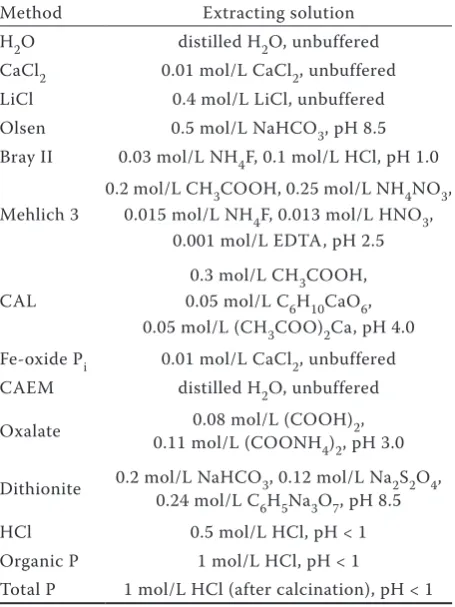
Soil P was extracted with 14 different extrac-tion methods that utilize various mechanisms of extraction and, hence, target different soil P pools; a brief summary of the 14 applied methods is given in Table 2, for more details see Wuenscher et al. (2015).
Greenhouse pot experiment. The pot
experi-ment with spring wheat (Triticum aestivum L. cv. Triso) was carried out in a greenhouse with automatic climate control through ventilation but no air conditioning for cooling. To homogenize the soil samples, the entire volume of one sample was mixed in a container, big stones were removed and large aggregates crushed. The pots were prepared from 12-L buckets (diameter: 26 cm), in which 10-mm drainage holes were drilled. A 2-cm layer of washed quartz gravel was placed as a drainage layer at the bottom, and a fibrous web was placed on top of the gravel layer. Approximately half of the final soil volume was filled into the bucket and re-compacted, then the second half, which was mixed with 0.8 g KCl fertilizer was added and re-compacted. The soil material for the top 3 cm was sieved (< 2 mm) for seedbed preparation. The total filled soil volume was 10.9 L. The filled pots were watered with deionized water before sowing. A master plate was used to standardize the
distri-Table 1. Summary of selected physicochemical soil properties (n = 50; for more details see Wuenscher et al. 2015)
pH (1 mol/L KCl)
OC lCaCO
3 lClay lSand CECpot (cmolc/kg)
Feo Fed
Feo/Fed Po/Feo (molar)
(%) (mg/kg)
Mean 6.0 1.72 5.6 22.8 36.5 13.0 4040 9770 0.42 0.31
Standard deviation 0.8 0.74 11.6 9.9 23.8 4.5 3320 6480 0.14 0.20
Minimum 4.3 0.93 0 4.2 1.5 6.2 930 1860 0.14 0.08
Maximum 7.1 4.03 56.2 53.1 86.2 29.1 21 950 42 990 0.82 0.84
[image:2.595.66.532.637.729.2]bution and distance of the seeds; 19 grains were sown in each bucket in a depth of approximately 2–3 cm. The pot experiment was run from May 2 to July 28, 2011, thus, lasting for 88 days.
During the growing phase, the pots were wa-tered (deionized water) according to plant needs. The soil water content was monitored with soil moisture probes (four Decagon ECH2O Dielectric Aquameter sensors and one Decagon 5TE, Pullman, USA) installed in five pots with strongly varying soil properties (representatives of the 50 pots included in the experiment). Soil water was kept near field capacity. On average, the pots were watered every 1.8 days with an average of approximately 340 mL each time. The mean soil temperature measured by the Decagon 5TE sensor was 24.9°C with a normal day to night fluctuation; the minimum was 18.8°C and the maximum was 36.6°C.
The pots were fertilized with a total of 1.17 g N and 0.42 g K, which corresponds to 220 kg N/ha and 80 kg K/ha. K was applied in one dose as potas-sium chloride (May 2); N was divided into 4 doses: 0.37 g N as calcium ammonium nitrate (May 9), 0.21 g N as ammonium nitrate (May 19), 0.53 g N as urea (June 14), 0.05 g N as urea foliar applica-tion (June 22). The plants were monitored daily. No deficiency symptoms of secondary nutrients or micronutrients were detected. Infesting pests (notably thrips and spider mites) were controlled with insecticide and predatory mites, respectively. Before harvest, the plants were not watered for a longer period in order to promote ripening. All plants were harvested on the same day, and straw was separated from the ears on-site. The plant material was dried at 50°C, and the grain was threshed and counted.
Plant analysis. Most of the plant parameters were determined at harvest or shortly after. The tillering was determined by the number of stalks (green and ripened). The thousand-seed weight, the number of ears and the number of grains per ear were recorded. The dry weight of straw and grain was measured. Both, straw and grain samples were ground to assure complete digestion; 0.2 g of ground plant material was digested with 5 mL HNO3 (65%) and 1 mL H2O2 (30%) using an automated digestion block (maxi-mum temperature of 155°C held for 190 min). The digests were diluted with 30 mL of distilled water and filtered with paper filters before photometric P determination. The P recovery from a certified reference material was 100 ± 10%.
Photometric P determination. The photometric
determination of P extracted from soils and after plant digestion was conducted with the molybde-num blue method according to Murphy and Riley (1962). This method was further modified to allow detection of low P concentrations (detection limit of 25 µg P/L) needed for some of the samples/ extracts; the modifications are described in detail in Wuenscher et al. (2015).
RESULTS AND DISCUSSION
[image:3.595.64.292.128.432.2]Plant yield and plant P uptake. Table 3 shows a summary of plant yield parameters collected after harvest as well as plant P contents and up-take. The mean dry matter grain and straw yields amounted to 157.4 and 219.5 g/m2, respectively.
Table 2. Overview of the studied soil phosphorus (P) extrac-tion methods (for more details see Wuenscher et al. 2015)
Method Extracting solution H2O distilled H2O, unbuffered CaCl2 0.01 mol/L CaCl2, unbuffered LiCl 0.4 mol/L LiCl, unbuffered Olsen 0.5 mol/L NaHCO3, pH 8.5 Bray II 0.03 mol/L NH4F, 0.1 mol/L HCl, pH 1.0
Mehlich 3
0.2 mol/L CH3COOH, 0.25 mol/L NH4NO3, 0.015 mol/L NH4F, 0.013 mol/L HNO3,
0.001 mol/L EDTA, pH 2.5
CAL
0.3 mol/L CH3COOH, 0.05 mol/L C6H10CaO6, 0.05 mol/L (CH3COO)2Ca, pH 4.0 Fe-oxide Pi 0.01 mol/L CaCl2, unbuffered CAEM distilled H2O, unbuffered
Oxalate 0.08 mol/L (COOH)2, 0.11 mol/L (COONH4)2, pH 3.0
Dithionite 0.2 mol/L NaHCO3, 0.12 mol/L Na2S2O4, 0.24 mol/L C6H5Na3O7, pH 8.5 HCl 0.5 mol/L HCl, pH < 1 Organic P 1 mol/L HCl, pH < 1
An average of 301 ears per m2 was recorded and the number of grains per ear varied between 9 and 21. An average thousand seed weight of 35.9 g was calculated. Clearly, these yield parameters were below the average of field-grown spring wheat. Diepenbrock et al. (1999) listed an average spring wheat grain yield of 643 g/m2 at harvest. Moreover, the thousand-seed weight of spring wheat is typi-cally higher (average: 39.5 g), stand density is usu-ally much higher under field conditions with an average of 526 ears per m2, and also the number of grains per ear is typically higher (average: 30.8) (Diepenbrock et al. 1999).
In our study, grain P contents ranged from 2950 to 5380 mg/kg, while straw P contents were be-tween 340 and 2820 mg/kg. These values were in the range of average values reported for wheat; an average range of 3020 to 5580 mg/kg is common for wheat grain and the range for wheat straw is 1050 to 1980 mg/kg (Diepenbrock et al. 1999). According to Blume et al. (2010), dry matter wheat grain contains approximately 4000 mg P/kg and straw contains approximately 1500 mg P/kg. On
average, the grain P contents in our experiment were 5 times higher than the straw P contents (Table 3). The total P uptake ranged from 460 to 1400 mg/m2, thus showing a 3-fold increase from the lowest to the highest value. The average contribution of seed P to total plant P uptake was estimated at approximately 5% (assuming that all seed P was translocated to the aboveground plant parts).
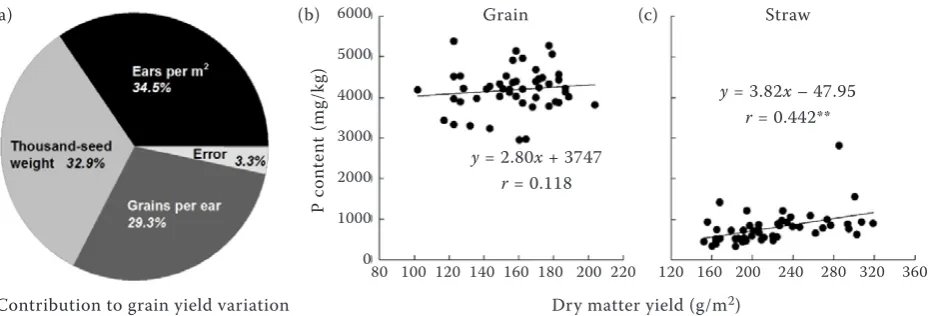
A multiple linear regression was performed and Figure 1a shows the contributing share of the three harvest parameters ears per m2, grains per ear and thousand-seed weight to grain yield variation. All three parameters explained a similar share of approximately 1/3 of the observed grain yield variation. Figures 1b,c show the relation between the P content of grain and straw, respectively, and their dry matter yield. While increasing straw yields corresponded to higher straw P contents, the grain yield results showed no such trend.
Soil P extracted by different methods in
rela-tion to plant P uptake. The magnitude of P
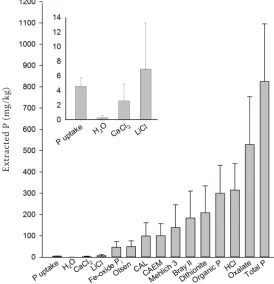
[image:4.595.64.532.114.213.2]ex-tracted by the 14 extraction methods is shown in Figure 2. Additionally, the plant P uptake (converted
Table 3. Plant yield parameters and plant phosphorus (P) contents and uptake (n = 50) Yield
Ears
per m2 per earGrains
Thousand seed weight (g)
P content Total P uptake (mg/m2)
DM grain DM straw grain straw
(g/m2) (mg/kg)
Mean 157.4 219.5 301 17 35.9 4190 790 842
Standard deviation 22.6 45.5 35 2 3.4 528 394 193
Minimum 101.9 152.4 264 9 28.4 2950 338 463
Maximum 203.8 318.9 433 21 45.1 5380 2820 1400
DM – dry matter
Figure 1. (a) The contribution of three harvest parameters to grain yield variation (multiple linear regression;
n = 50; R2 = 0.967); (b, c) Correlation of grain and straw dry matter yields with their respective phosphorus (P) contents (n = 50; **P < 0.01)
(a) (b) Grain (c) Straw
Dry matter yield (g/m2) Contribution to grain yield variation
P
co
nt
en
t (
m
g/
kg
)
y = 2.80x + 3747
r = 0.118
y = 3.82x – 47.95
r = 0.442**
80 100 120 140 160 180 200 220 120 160 200 240 280 320 360
6000
5000
4000
3000
2000
1000
[image:4.595.68.535.551.709.2]to mg P/kg soil) is given in the first column. This comparison illustrates that the weaker extraction methods (H2O, and especially the neutral salt so-lutions CaCl2 and LiCl), which may be regarded as measures of P intensity, were in the range of the plant P uptake, whereas the other extraction methods, most of which aim at assessing P quan-tity, extracted much higher P amounts.
Plants and other organisms mainly assimilate P dissolved in soil solution. Due to its low solubility, the concentration of P in soil solution is generally low (below 0.15 mg/L) (Condron and Tiessen 2005). Blume et al. (2010) reported a common range of soil solution P concentrations between 0.001 and 0.1 mg/L for unfertilized soils and between 0.1 and 5 mg/L for fertilized topsoils. This is a similar range as ex-tracted by the water saturation extraction in our study (0.04–3.37 mg/L). The soil solution P concentrations required for optimum plant yields lie between 0.3 and 0.8 mg/L (Blume et al. 2010). Emsley (2001) pointed out that, at any given time, the soil solution holds only about 1% of P essential to healthy plant growth. In our study, the average amount of P taken up by the wheat plants was 4.55 mg/kg, while the H2O extraction method extracted 0.26 mg/kg on average (Figure 2). Hence, the average P in soil solution was more than 5% of the average plant uptake.
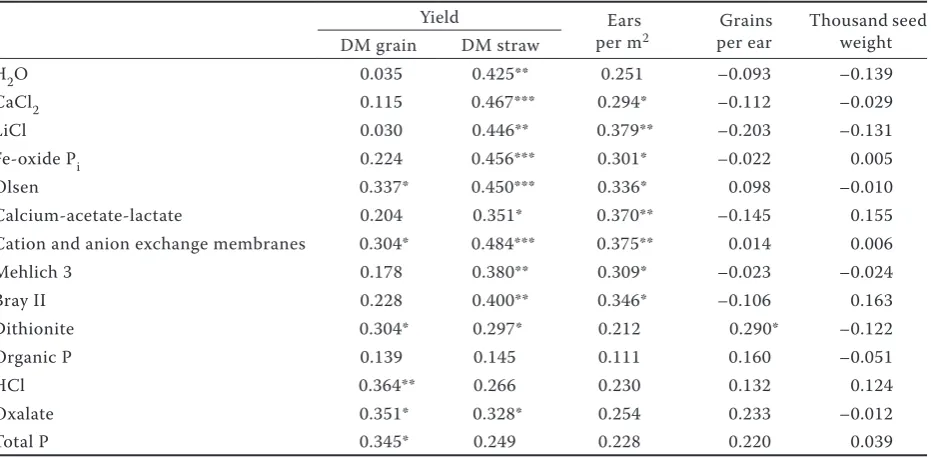
[image:5.595.74.349.469.754.2]Correlating extracted soil P with plant yield and plant P uptake. Correlation coefficients between P extracted by the different extraction methods and plant yield parameters were calculated (Table 4). The observed correlations were relatively low, which may be due to moderate to high P status of the soils in our study. For example, most of the studied soils were beyond the critical P concentrations deter-mined by Mehlich 3, Olsen and resin P (the latter is comparable to our cation and anion exchange membranes (CAEM)) for maize yield in a variety of soil types from Iowa, USA (Mallarino and Atia 2005) and also beyond the critical P concentrations based on CaCl2, Olsen and oxalate in a recent study including several long-term P-response field trials across Europe (Nawara et al. 2017). On the other hand, Mundus et al. (2017) reported relatively poor correlations between P extracted by different soil test methods including Olsen and dry matter yield of spring barley in a pot experiment with mainly P deficient soils of Scandinavia. They attributed this result to the limited pot volume in relation to shoot biomass in their study. In our pot experiment, the ratio of shoot biomass (straw + grain: 13.7 to 26.5 g per pot) to soil volume (10.9 L) was lower than in the study of Mundus et al. (2017), but still exceeded the threshold of 1 g dry matter per L soil, above
Figure 2. Phosphorus (P) extracted by different extraction methods compared to plant P uptake in the pot experiment (means and standard deviation; n = 50). Fe-oxide Pi – iron oxide impregnated filter paper; CAL – calcium-acetate-lactate; CAEM – cation and anion exchange membranes
Ex
tr
ac
te
d
P
(m
g/
kg
which pot size could limit plant growth (Poorter et al. 2012).
In our study, extracted soil P correlated more sig-nificantly with straw yield than with grain yield. This is in agreement with Bissani et al. (2002), who showed generally lower correlation coefficients with grain yield than with straw yield for Mehlich 1, anion exchange resin, anion exchange membrane and iron oxide impregnated filter papers (Fe-oxide Pi). This trend may be due to the fact that P is accumulated in grain seeds in order to provide enough P for ger-mination and the first growing phase when roots are not able yet to take up enough P. In the plant, P is relatively mobile; it is not stored in older plant parts (i.e. straw) but transported back to the roots and redistributed to plant parts with P demand (Schachtman et al. 1998). Hence, soil-induced P limitations may be more strongly reflected in the straw than in the grain.
It was interesting to note that grain yield cor-related significantly with the stronger extraction methods, whereas straw yield showed a tendency to correlate less with the strongest extraction methods. The highest correlation coefficient of an extraction method with dry matter grain yield was obtained for the HCl extraction (r = 0.364,
P < 0.01). Similar significance levels as for HCl were reached by Olsen, CAEM, dithionite, oxalate
and total P. For dry matter straw yield, the high-est correlation coefficient was obtained with the CAEM method (r = 0.484, P < 0.001). Equally well correlated were the methods CaCl2, Fe-oxide Pi and Olsen; less well but still significantly correlated were the methods H2O, LiCl, CAL, Mehlich 3, Bray II, dithionite and oxalate.
Several extraction methods correlated with the number of ears per m2, i.e. CaCl
2, LiCl, Fe-oxide Pi, Olsen, CAL, CAEM, Mehlich 3 and Bray II. This shows that the P availability in our samples may have affected the tillering of the spring wheat. The number of grains per ear was only correlated significantly with the dithionite extraction method, while the thousand-seed weight did not show a significant correlation with any of the tested soil extraction methods.
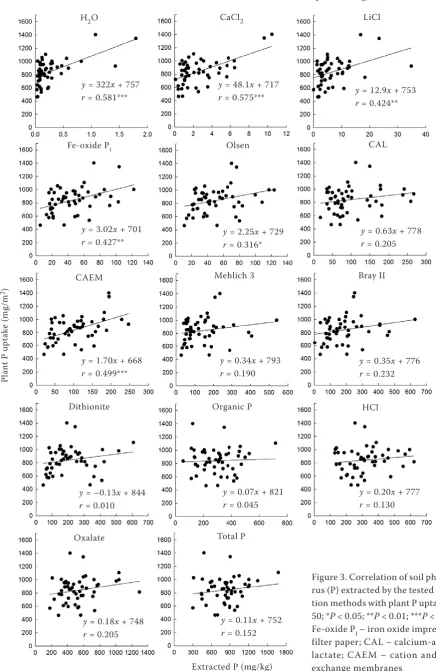
[image:6.595.67.533.126.355.2]Figure 3 shows the correlation of P extracted by the tested methods with total plant P uptake. Clearly, the weaker extraction methods achieved better correlations than the stronger methods. The best correlation was obtained by the H2O extrac-tion followed by CaCl2 and CAEM. The methods LiCl, Fe-oxide Pi and Olsen showed weaker, but still significant correlations with plant P uptake, but the rest of the methods did not show significant correlations. Similar results were obtained by Shirvani et al. (2005), who found that the P intensity index
Table 4. Pearson correlation coefficients between soil phosphorus (P) extracted by the tested methods and dif-ferent plant yield parameters (n = 50)
Yield lEars
per m2
lGrains per ear
lThousand seed weight DM grain DM straw
H2O 0.035 0.425** 0.251 –0.093 –0.139
CaCl2 0.115 0.467*** 0.294* –0.112 –0.029
LiCl 0.030 0.446** 0.379** –0.203 –0.131
Fe-oxide Pi 0.224 0.456*** 0.301* –0.022 0.005
Olsen 0.337* 0.450*** 0.336* 0.098 –0.010
Calcium-acetate-lactate 0.204 0.351* 0.370** –0.145 0.155
Cation and anion exchange membranes 0.304* 0.484*** 0.375** 0.014 0.006
Mehlich 3 0.178 0.380** 0.309* –0.023 –0.024
Bray II 0.228 0.400** 0.346* –0.106 0.163
Dithionite 0.304* 0.297* 0.212 0.290* –0.122
Organic P 0.139 0.145 0.111 0.160 –0.051
HCl 0.364** 0.266 0.230 0.132 0.124
Oxalate 0.351* 0.328* 0.254 0.233 –0.012
Total P 0.345* 0.249 0.228 0.220 0.039
CaCl2 was significantly correlated with wheat P up-take while among several tested P quantity indices only resin P (comparable to our CAEM) showed a significant correlation. Also similarly to our results, Kulhánek et al. (2009) found by far the best correla-tion with water extraccorrela-tion (R2 = 0.66); however, in their study, CaCl2 (R2 = 0.13) was correlated less than anion exchange membrane extraction (R2 = 0.20) and Mehlich 3 (R2 = 0.19). Those results were based on samples of homogeneous soil types (all loamy) with a pH close to 6.3. The authors suggested that the weak correlation of CaCl2 was a result of Ca-phosphates forming during extraction.
In another study, Fe-oxide Pi and CAEM were found to be well correlated with plant P uptake (Kuo 1996) and were expected to perform better than other extraction methods due to their supposed independency of soil properties. This is in agree-ment with the results shown by Saggar et al. (1999), who found that CAEM extracted higher amounts of soil (available) P than Olsen, and plant yield predic-tion was superior to the one by Olsen. Menon et al. (1988) claimed that Fe-oxide Pi was an accurate method to determine plant-available P and that it was very independent of soil properties and applied fertilizer. However, Zheng and Zhang (2012) noted that some inconsistent results were observed deriv-ing from the preparation of the impregnated filter paper. Depending on the type of filter papers, the Fe-oxides may distribute inhomogeneously resulting in irreproducible amounts of extracted P.
In general, our results showed lower correlation coefficients than the data presented in other papers (e.g. Zorn and Krause 1999, Kulhánek et al. 2009). This could be due to the inclusion of many differ-ent soils in our study showing a wide range of basic properties and variable P status rather than apply-ing the extraction methods to a limited number of similar soils with altered P levels (by fertilizer ap-plication). Experiments that are based on fewer soils often have much less variability in soil parameters; however, their results are very specific for limited soil types and provide a less general evaluation of soil P extraction methods and their regional applicability to agricultural soils.
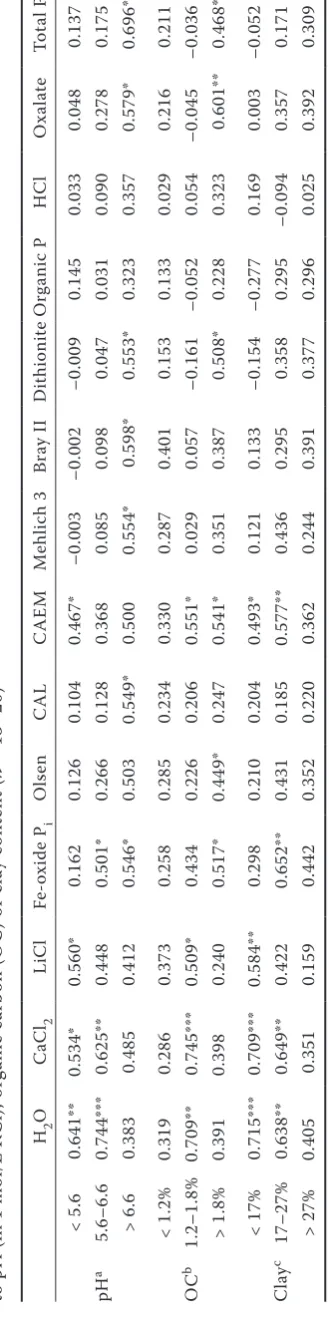
In an attempt to further investigate the performance of the tested extraction methods in dependence of major soil properties, the 50 soils were grouped ac-cording to their pH, organic carbon and clay content. The grouping system was chosen based on the clas-sifications by Blum et al. (1996) and slightly modified
in an effort to yield relatively equal group sizes. The grouping according to pH resulted in 3 groups of soils with pH (in 1 mol/L KCl) < 5.6, between 5.6 and 6.6 and > 6.6, respectively. The high pH group (above 6.6) was exclusively comprised of calcareous soils, with CaCO3 contents of between 1% and 56% (mean: 20.1%, standard deviation: 13.9%). The grouping ac-cording to organic carbon (OC) content subdivided the soils into the groups < 1.2%, between 1.2% and 1.8% and > 1.8% OC. The grouping according to clay content yielded the groups < 17%, between 17% and 27% and > 27%. For each group of soils, correlation coefficients were calculated between P extracted by the different extraction methods and plant P uptake (Table 5). In general, the weaker extraction methods (H2O, CaCl2, LiCl) and the methods employing a sink mechanism (Fe-oxide Pi and CAEM) correlated in more cases with plant P uptake than the stronger extraction methods. Mehlich 3 and Bray II yielded similar results in all groups; this is likely a conse-quence of the similarity of their extraction mechanism (cf. Wuenscher et al. 2015). Also, dithionite, oxalate and total P extraction yielded similar results.
Among the pH groups, the weaker extraction meth-ods (H2O, CaCl2, LiCl) were better correlated with the low and intermediate groups (below 5.6 and 5.6 to 6.6). In contrast, the Fe-oxide Pi correlated signifi-cantly with the intermediate and high pH groups. The stronger extraction methods correlated significantly only with the high pH group (above 6.6), i.e. only for calcareous soils. Our results indicate that the weaker extraction methods, being based on water-solubility and ion exchange, performed best in soils around pH 6, where P retention is relatively low, and in more acidic soils, where anion sorption becomes more important. However, they failed to relate to plant P uptake in calcareous soils, where P is precipitated as calcium phosphate. The mechanisms of water solubility and ion exchange do not seem to be of primary impor-tance in such soils; plants likely mobilize P (and other nutrients) through acidification of the rhizosphere (Hinsinger et al. 2003). This mechanism, in turn, is more closely simulated by (some of) the stronger extraction methods, which could explain their better performance in the high pH soils.
Figure 3. Correlation of soil phospho-rus (P) extracted by the tested extrac-tion methods with plant P uptake (n = 50; *P < 0.05; **P < 0.01; ***P < 0.001). Fe-oxide Pi – iron oxide impregnated filter paper; CAL – calcium-acetate-lactate; CAEM – cation and anion exchange membranes
Extracted P (mg/kg)
H2O CaCl2 LiCl
Fe-oxide Pi Olsen CAL
CAEM Mehlich 3 Bray II
Dithionite Organic P HCl
Oxalate Total P
y = 322x + 757
r = 0.581***
y = 48.1x + 717
r = 0.575*** yr = 0.424** = 12.9x + 753
y = 3.02x + 701
r = 0.427** yr = 0.316* = 2.25x + 729 yr = 0.63 = 0.205x + 778
y = 1.70x + 668
r = 0.499***
y = 0.34x + 793
r = 0.190
y = 0.35x + 776
r = 0.232
y = 0.20x + 777
r = 0.130
y = 0.07x + 821
r = 0.045
y = –0.13x + 844
r = 0.010
y = 0.18x + 748
r = 0.205
y = 0.11x + 752
r = 0.152
Pl
an
t P
u
pt
ak
e
(m
g/
m
and total P showed significant correlations in the high OC group. For the grouping by clay content, the least number of significant correlations was observed. Only the weaker extraction methods (H2O, CaCl2, LiCl) and the methods employing a sink mechanism (Fe-oxide Pi, CAEM) showed significant correlations with plant P uptake at low and intermediate clay contents but not for the group with higher clay contents (above 27%).
In conclusion, it was found that the P uptake by spring wheat over one growing season was in the range of the P extractable from soil by neutral salt solutions (CaCl2 and LiCl). The results further show that weak extracting agents, such as H2O and dilute CaCl2, correlated best with plant P uptake. This in-dicates that extraction methods assessing P intensity may be suitable indicators of plant-available P in the short term; however, potential re-supply of P by the soil is not assessed by these methods. Stronger extracting agents targeting P quantity are presumed to provide better information on the longer-term P supplying capacity of soils. Of the tested stronger soil P extraction methods, the sink-based approach using CAEM showed the best correlation with P uptake by spring wheat, while several established soil test methods, including CAL, Mehlich 3 and Bray II, did not show significant correlations.
When grouping the soils according to pH, organic carbon or clay content, weaker extraction meth-ods correlated better for soils with lower pH (and clay contents), while stronger extraction methods correlated better for soils with high pH (calcare-ous soils) and high organic carbon content. It is recommended to conduct longer-term studies to investigate several consecutive growing seasons and provide further information on the suitabil-ity of different soil P extraction methods for the prediction of plant-available and environmentally mobile P fractions over variable time scales.
ACKNOWLEDGEMENTS
The authors are grateful to all farmers who provided soil samples for this project. Special thanks go to Drs. Helmut Eißner, Bodo Hoffmann and Friedhelm Herbst (Experiment ‘Ewiger Roggen’), Division of Agriculture and Nutritional Sciences, Martin Luther University Halle-Wittenberg, Germany, to Michael Baumecker, Lecture and Research Station Thyrow, Humboldt-Universität zu Berlin, Germany, and to
Ta bl e 5 . P ea rs on c or re la tio n c oe ff ic ie nt s b et w ee n s oi l p ho sp ho ru s ( P) e xt ra ct ed b y t he te st ed m et ho ds a nd p la nt P u pt ak e i f s am pl es a re g rou pe d a cc or di ng to p H (i n 1 m ol /L K C l), o rg an ic c ar bo n (O C ) o r cl ay c on te nt ( n = 1 3– 20 ) lH 2 O
lCaC
l2
lLiC
l Fe -o xi de Pi
lOls
en C A L C A EM lM eh lic h 3 lBr ay II lDit hionit e
lOrg
an
ic
P
lHC
l
lOxa
[image:9.595.83.248.104.765.2]Dr. Heide Spiegel, Austrian Agency for Health and Food Safety (AGES), Vienna, Austria, for supplying soil samples from long-term field experiments. The authors also acknowledge the help and assistance from Markus Puschenreiter, Ewald Brauner, Astrid Hobel, Elisabeth Kopecky, Angelika Hromatka and Karin Hackl from the Institute of Soil Research, BOKU Vienna. This study was made possible through support granted by BoWaSan/Bodenkalk e. Gen., Graz, Austria, and Karner Düngerproduktion GmbH, Neulengbach, Austria.
REFERENCES
Beckett P.H.T., White R.E. (1964): Studies on the phosphate po-tentials of soils: Part III: The pool of labile inorganic phosphate. Plant and Soil, 21: 253–282.
Bissani C.A., Tedesco M.J., de O. Camargo F.A., Miola G.L., Gianello C. (2002): Anion-exchange resins and iron oxide-impregnated filter paper as plant available phosphorus in-dicators in soils. Communications in Soil Science and Plant Analysis, 33: 1119–1130.
Blum W.E.H., Spiegel H., Wenzel W.W. (1996): Bodenzustandsin-ventur – Konzeption, Durchführung und Bewertung. Empfeh-lung zur Vereinheitlichung der Vorgangsweise in Österreich.
2nd Edition. Vienna, Bundesministerium f. Land- und
Forst-wirtschaft.
Blume H.-P., Brümmer G.W., Horn R., Kandeler E., Kögel-Knabner I., Kretzschmar R., Stahr K., Wilke B.-M. (2010): Scheffer/
Schachtschabel Lehrbuch der Bodenkunde. 16th Edition.
Hei-delberg, Spektrum Akademischer Verlag.
Condron L.M., Tiessen H. (2005): Interactions of organic phos-phorus in terrestrial ecosystems. In: Turner B.L., Frossard E., Baldwin D.S. (eds.): Organic Phosphorus in the Environment. Wallington, CAB International, 295–307.
Cordell D., Drangert J.-O., White S. (2009): The story of phos-phorus: Global food security and food for thought. Global Environmental Change, 19: 292–305.
Diepenbrock W., Fischbeck G., Heyland K.-U., Knauer N. (1999):
Spezieller Pflanzenbau. 2nd Edition. Stuttgart, Eugen Ulmer
GmbH & Co.
Emsley J. (2001): Phosphor – Ein Element auf Leben und Tod. Weinheim, Wiley VCH.
Hinsinger P., Plassard C., Tang C.X., Jaillard B. (2003): Origins of root-mediated pH changes in the rhizosphere and their responses to environmental constraints: A review. Plant and Soil, 248: 43–59.
Kulhánek M., Balík J., Černý J., Kozlovský O., Nedvěd V. (2009): The content of available phosphorus in soils and P uptake by plants. Scientia Agriculturae Bohemica, 40: 105–109. Kuo S. (1996): Phosphorus. In: Bartels J.M., Bigham J.M. (eds):
Methods of Soil Analysis, 3. Chemical Methods. Madison, Soil Science Society of America, 869–919.
Liu Y., Villalba G., Ayres R.U., Schroder H. (2008): Global phos-phorus flows and environmental impacts from a consumption perspective. Journal of Industrial Ecology, 12: 229–247.
Mallarino A.P., Atia A.M. (2005): Correlation of a resin membrane soil phosphorus test with corn yield and routine soil tests. Soil Science Society of America Journal, 69: 266–272.
Mehlich A. (1984): Mehlich 3 soil test extractant: A modification of Mehlich 2 extractant. Communications in Soil Science and Plant Analysis, 15: 1409–1416.
Menon R.G., Hammond L.L., Sissingh H.A. (1988): Determina- tion of plant-available phosphorus by the iron
hydroxide-impregnated filter paper (Pi) soil test. Soil Science Society of
America Journal, 52: 110–115.
Mundus S., Carstensen A., Husted S. (2017): Predicting
phos-phorus availability to spring barley (Hordeum vulgare) in
agri-cultural soils of Scandinavia. Field Crops Research, 212: 1–10. Murphy J., Riley J.P. (1962): A modified single solution method
for the determination of phosphate in natural waters. Analytica Chimica Acta, 27: 31–36.
Nawara S., van Dael T., Merckx R., Amery F., Elsen A., Odeurs W., Vandendriessche H., McGrath S., Roisin C., Jouany C., Pellerin S., Denoroy P., Eichler-Löbermann B., Börjesson G., Goos P., Akkermans W., Smolders E. (2017): A comparison of soil tests for available phosphorus in long-term field experi-ments in Europe. European Journal of Soil Science, 68: 873–885. Poorter H., Bühler J., van Dusschoten D., Climent J., Postma
J.A. (2012): Pot size matters: A meta-analysis of the effects of rooting volume on plant growth. Functional Plant Biology, 39: 839–850.
Saggar S., Hedley M.J., White R.E., Perrott K.W., Gregg P.E.H., Cornforth I.S., Sinclair A.G. (1999): Development and evalua-tion of an improved soil test for phosphorus, 3: Field compari-son of Olsen, Colwell and Resin soil P tests for New Zealand pasture soils. Nutrient Cycling in Agroecosystems, 55: 35–50. Schachtman D.P., Reid R.J., Ayling S.M. (1998): Phosphorus uptake
by plants: From soil to cell. Plant Physiology, 116: 447–453. Schüller H. (1969): Die CAL-Methode, eine neue Methode zur
Bestimmung des pflanzenverfügbaren Phosphors im Boden. Zeitschrift für Pflanzenernährung und Bodenkunde, 123: 48–63. Shirvani M., Shariatmadari H., Kalbasi M. (2005): Phosphorus buffering capacity indices as related to soil properties and plant uptake. Journal of Plant Nutrition, 28: 537–550.
Smil V. (2000): Phosphorus in the environment: Natural flows and human interferences. Annual Review of Energy and the Environment, 25: 53–88.
Wuenscher R., Unterfrauner H., Peticzka R., Zehetner F. (2015): A comparison of 14 soil phosphorus extraction methods ap-plied to 50 agricultural soils from Central Europe. Plant, Soil and Environment, 61: 86–96.
Zheng Z.M., Zhang T.Q. (2012): Soil phosphorus tests and trans-formation analysis to quantify plant availability: A review. In: Whalen J. (ed.): Soil Fertility Improvement and Integrated Nutrient Management – A Global Perspective. Rijeka, InTech, 19–36.
Zorn W., Krause O. (1999): Untersuchungen zur Charakterisierung des pflanzenverfügbaren Phosphats in Thüringer Carbonatbö-den. Journal of Plant Nutrition and Soil Science, 162: 463–469.