
Abstract—African Energization is long due; this problem has lingered for a long time without a comprehensive solution. Efforts to resolve this problem have met with both technical and political obstacles rendering them ineffective. Currently, only a few African countries pursue the renewable energy alternative for electricity generation, the most common alternative source is hydropower; however, bio-fuel, solar photovoltaic (PVs), geothermal and the wind are more efficient alternatives fit for use, in both the rural and the urban areas of African countries. This paper presents the range of economic and political issues that constitute major obstacles to the realization of sustainable Africa electrification. One major observation in this work is that with the renewable endowments of most African countries, the continent should be generating income from electricity while providing enough power for its citizenry. The work also provides some capacity building strategies and policies to help sustain the energy to be generated for electricity purposes.
Index Terms—Africa, Energization, Alternative Energy, Electricity, GNI
I. INTRODUCTION N
recent years, African electrification has topped the list of the continent’s needs. Most discussions on Africa, within and outside her coast, have stressed the need for her to energize herself to meet the targeted economic and social development expected of her. The reality of the poor use of the productive energy generation potential of Africa only reveals that an adequate solution is still missing. The solution to this problem will require identifying the root causes and efforts to tackle them. In mid-2015, Africa’s population was estimated to be 1.171 Billion people [1, 2], accounting for 15.96% of the World’s population. Meanwhile, the economic output of the Continent is only around 4.4% of the World’s total. Africa’s GNI (using purchasing power parities) is averaged $4,457 billion compared with the world GNI of $14,931 [1]. In landmass Africa’s land area covers just over 30.3 million km2 in 53
countries of diverse culture, colors, sizes, and languages. Africa as a continent consumes the least when it comes to World energy despite being the second largest continent in
Manuscript received March 19, 2016; revised April 10, 2016.
M. O. Agboola is with the Department of Finance, College of Business Administration, Dar Al-Uloom University, Riyadh, Saudi Arabia (Tel: +966114949167; e-mail: maryagboola@ dau.edu.sa).
P. O. Agboola is with the Department of Applied Mechanical Engineering, College of Engineering (Muzahimiyah Campus), King Saud University, Riyadh, Saudi Arabia (e-mail: [email protected])
[image:1.595.304.552.575.756.2]the world; this is particularly the case with fewer than 25 percent of Africans having access to electricity. In Uganda, only 5 percent of the population has access to electricity; in Kenya, 15 percent; in Congo, 6 percent. In the oil-rich Nigeria, less than 40% have access to electricity, 25 of the 44 sub-Saharan nations face crippling electricity shortages. Electricity failure (blackouts) and rationing are standard practice in most African countries to ensure that most urban areas have electricity at one time or the other. The poor power supply is more evident considering how big the market for standby generator set is, in most African countries, where individual and most firms (Public & Private) have to generate their electricity at a very high cost. In Nigeria, the Manufacturers Association of Nigeria (MAN) and the National Association of Small Scale Industrialists had estimated that the sum of N1.8 billion on the average goes into standby power generation weekly. The increase in standby generation by the individual house will increase Africa carbon emission contribution; which at the moment is the lowest in the world. Currently, only a few Africa countries pursue renewable energy alternative for electricity generation, the most frequent source is hydropower; however, solar photovoltaic (PVs), biofuel, geothermal and the wind are more efficient to use in both the rural and the urban areas of African countries. Most of these energy resources are yet to be fully utilized, which is a contributing factor in making the continent the lowest consumer of energy.
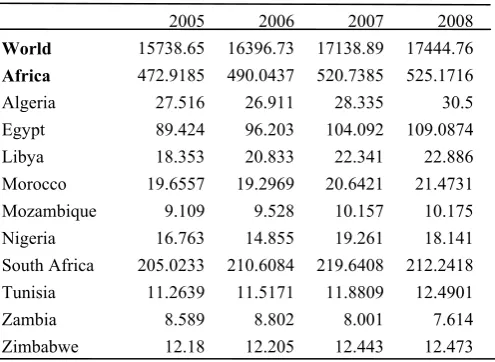
TABLE 1
TOTAL ELECTRICITY NET CONSUMPTION (BILLION KILOWATT HOURS) BETWEEN 2005- 2008 [4]
2005 2006 2007 2008
World 15738.65 16396.73 17138.89 17444.76 Africa 472.9185 490.0437 520.7385 525.1716
Algeria 27.516 26.911 28.335 30.5
Egypt 89.424 96.203 104.092 109.0874
Libya 18.353 20.833 22.341 22.886
Morocco 19.6557 19.2969 20.6421 21.4731 Mozambique 9.109 9.528 10.157 10.175 Nigeria 16.763 14.855 19.261 18.141 South Africa 205.0233 210.6084 219.6408 212.2418 Tunisia 11.2639 11.5171 11.8809 12.4901
Zambia 8.589 8.802 8.001 7.614
Zimbabwe 12.18 12.205 12.443 12.473
N.B.: Available data: After 2008, most countries in Africa do not have data on Total Electricity Net Consumption
Africa Energization: Alternative Energy
Capacity Building Strategies and Policies
Mary O. Agboola and Phillips O. Agboola, Member, IAENG
There is an urgent need for substantial increases in energy consumption in Africa as a whole if Africa is to be competitive with other developing regions of the world. The problems facing the development of energy in Africa appear to be overwhelming ranging from technical to political. A closer look at this issue in Africa will demonstrate that the energy sector in Africa provides enormous opportunities for formulating and implementing ambitious renewable energy programs that will bring an environmentally sound and secure energy future [3]. Table 1 shows total net electricity consumption in some selected African countries compared with the total net electricity in Africa and the World
II. AFRICA ENERGY CAPACITY:RENEWABLE AND NON -RENEWABLE
When it comes to natural endowments, Africa is a continent to be reckoned with due to her enormous natural resources. Oil reserves in Africa were estimated at 119.114 billion barrels, around 8.8% of the World’s total; three countries concentrated 78.64% and five countries concentrated 89.74 % of these reserves (Libya 37.17%, Nigeria 31.23%, Algeria 10.24%, Angola 8%, and Egypt 3.1%) [4,5]. The proven natural gas reserves were estimated at 495.25 trillion cubic feet, 7.5 % of the World's total; three countries concentrated 81.32%, and five countries concentrated 94.24% of these reserves, (the same as above: Nigeria 37.41%, Algeria 32.10%, Egypt 11.81%, Libya 10.98%, and Angola 1.94%) [5]. Africa’s coal reserves are estimated at 36 Gtoe, around 5.7% of the World’s total; 90% of these coal reserves are concentrated in South Africa, and over 97% of Africa’s coal is also produced in South Africa. In 2010, Oil & dry natural Gas productions were estimated respectively at 10.69 million b/d (barrels a day) and 202.30 billion cubic meters (around 12.66% and 6.71% of the World total, respectively). Moreover, recently, new oil and gas reserves are being discovered in several African countries and regions (Ghana, Mauritania, Uganda, Tanzania, Zambia, the Gulf of Guinea, etc.). The African natural energy resources are unevenly distributed rather they are more concentrated in a few countries (Nigeria, Algeria, South Africa, Angola, and Libya). There is no doubt that African countries have abundant fossil fuel though highly concentrated in some few countries, this fuel is non-renewable sources of energy for a limited period of exploitation. The renewable energy sources are equally available in Africa and more evenly distributed among the member countries than the fossil fuel. Hydropower potential in Africa can significantly contribute to its energization. Large hydropower potentials are present in the East, West and Central African countries with gross theoretical potentials of about 3892 TWh/year, technically exploitable potentials of about 1917 TWh/year and economic exploitable at 1096 TWh/year. This amount (1096 TWh/year) doubled the current electricity demand of the Africa continent. Nigeria produced more than 70% of its electricity generation from Hydropower systems. The continent can explore about 9000 Megawatt of geothermal potential and abundant biomass, solar and significant wind potential [6]. The potential in Nuclear energy is exploited by
South Africa, Egypt, and Nigeria.
Biomass offers an attractive opportunity in Africa electrification, the abundant of biomass as estimated by Deepchand (2001) indicated that a significant proportion of current electricity generation in 16 Eastern and Southern African countries could be met by bagasse-based cogeneration in the region’s sugar industry. About 20% of Mauritius electricity is generated from cogeneration [7]. There is enormous exploitable hydropower capacity in African countries, but just only 7% has been harnessed— one of the worlds lowest figures. Africa has an estimated proven geothermal potential of 9000MW, but only 45MW (in Kenya) is currently in use. Solar power is another advantage in Africa for electricity generation, the average solar radiation (insolation) is between 5–6 kWh/m2, solar
0 20000 40000 60000 80000 100000
North America
Middle East
Central & South America
Asia & Oceania
[image:3.595.314.551.42.468.2]2005 2006 2007 2008 2009
Figure 1: Crude Oil Distillation Capacity (Thousand Barrels Per Cal Day) [8]
[image:3.595.312.547.53.209.2]Figure 2: Crude Oil Proved Reserves (Billion Barrels) [8]
Figure 3: Coal Overview 2009 (Quadrillion Btu) [8]
Figure 4: Natural Gas Overview 2009 (Billion Cubic Feet) [8]
Figure 5: Total Electricity Net Consumption (Billion Kw) [8]
[image:3.595.57.286.59.385.2]Figure 6: Total Electricity Installed Capacity (Million Kw) [8]
Figure 7: Total Primary Energy Production (Quadrillion Btu) [8]
[image:3.595.54.284.415.694.2] [image:3.595.312.549.502.625.2]Figure 9: Total Primary Energy Consumption/Production in Africa between 2004-2008[8]
Figure 10: Population (Millions) [8]
Figure 11: Total Renewable Electricity Net Generation (Billion Kw) [8]
Figure 12: Total Renewable Electricity Net Consumption (Billion Kw) [8]
III. WHY THE POOR AFRICA ENERGIZATION
[image:4.595.53.286.299.741.2]comparison between Africa, North America, Central and South America, Europe, Eurasia, Asia and Oceania and the world in Total Primary Energy Consumption and Total Electricity Net Generation. Africa produces more primary energy but consumes less of it, a trend we saw earlier too. This shows that the problem of Africa energization is not of resources but more politically and technical. Figure 9 show the wide gap between Africa primary energy production and consumption. If Africa will be energized herself, there is a need to reduce the gap between its primary energy consumption and production. The revenue generated from exporting primary energy to other continents has not transcended into cutting technology to hardness its resources. Figure 11&12 shows Total Renewable Electricity Net Generation and Total Renewable Electricity Net Consumption; few countries are taking the advantage of the renewable energy for electricity generation. Africa has landmass for biomass that can make her the leading producer of biomass. The current fear on Africa biomass is the issue of food insecurity.
IV. RENEWABLE ENERGY CAPACITY BUILDING STRATEGIES The challenges facing the development of a viable energy sector in Africa need to be adequately addressed. Most African countries depend on traditional biomass to meet their basic energy needs due to the corruption that resulted in high level of poverty and uneven wealth distribution. There is the need for a massive development of energy infrastructure to improve the current per capital energy consumption in Africa. Sustainable energy in Africa will equally address the challenges of poor economic and social development and will ensure access to secure, affordable and reliable energy. Capacity building strategies in the following areas will enhance the development of reliable energy in Africa.
A mandatory renewable energy sources development across Africa through the auspices of Africa Union (AU)
Development of Agricultural, Engineering and entrepreneurship projects that can reduce the migration of youth to Europe and North America.
Private-led financing mechanisms that can support the integration of renewable energy into the existing convectional energy sources.
Incentives to attract Independent power producer to utilize renewable energy sources
Creating atmosphere that reduces investments risks, e.g., solving ethic wars
Allowing the Africa Development Bank to play more in financing trans- countries energy projects
Collaborating with the developed countries to increase the Hydropower utilization
Solving the gas flaring in Africa
Establishing Africa energy policies that will involve all the Africa countries
Creating an Africa energy information center that will help to manage data and information on Africa energy
V. POLICY, REGULATORY, AND DEVELOPMENTAL FRAMEWORKS
Finances for most energy projects in Africa comes from oversea donors and investors, massive government mismanagement coupled with corruption have left most of the reserve of Africa countries empty. A high Priority should be given to sustainable financing programs for renewable energy technologies projects. Nigeria, for instance, can use her Petroleum Trust Fund (PTF) for the integration of renewable energy into the national electricity grid. In Ghana, a national energy fund has been successfully utilized to finance renewable energy projects and energy efficiency activities on a sustainable basis. According to Africa Development Bank, an estimate of US$ 547 billion will be required to power African countries by 2030, this on yearly average will need over US$ 27 billion per year from Sub- Sahara region but total funding to the energy sector in Sub-Saharan African is just about US$ 2 billion every year. This difficulty in financing the energy sector in Africa will require external investments from the developed economy interested in the energy market in Africa. The new financing options should include mobilizing local and foreign financing, aid and grants; foreign direct investments; carbon financing. The private led local participation investment in Africa can only meet the financial demand of small-scale renewable energy systems, as can be seen, is some Africa countries like Nigeria and South Africa but the bulk finances needed to energize Africa will require massive investment from international financing organizations that will need guaranty from a beneficiary government. Foreign investor participation will be attracted if ADB can create a section that operates as an insurance and broker body for the foreign investors interested in Africa market.
projects that will put to use their skills. The Africa continents are blessed with great minds that can do well in Science, Engineering and Medicines as can be seen from their contribution in the developed world. The brain drain systems like the skilled immigrant to the developed countries need to be tackled by providing an environment that supports healthy thinking and innovation. This will also promote and strengthen the domestic knowledge base, stimulate learning and innovation, and create the support structures to sustain energizing the Africa continent. Although most African countries do have operating skills and some modification skills, they will need both productive and innovative skills to scale up. If Africa countries step up energy market, they will need to enlarge there research base and thread the path of cutting-edge R&D as seen in Europe and America. Also, the continent will need to consider technological maturity, reliability, and financial feasibility to develop into the world technology hub. Africa will be better off committing itself to developing renewable energy technology like the Hydropower, Solar and Wind energy that will have immediate effects on its energy situation.
VII. CONCLUSION
There are significant renewable and non-renewable energy sources in Africa which if fully exploited can energize the continent. Exploiting these resources face some challenges in most Africa countries, the most important being its ability to optimize the use of these resources in providing for its use. The Africa continent needs to improve its economic and social development to compete favorably with other continents. The current advance in the use of renewable energy in generating electricity presents the continent with a unique opportunity to develop effective and contextualized strategies that would promote the dissemination of renewable energy technologies so as to address existing energy needs. This work recommended capacity building strategies in finance mobilization and policies to scale up renewable energy technologies in African energization. However, these capacity building strategies will not effectively assist in increasing the energy consumption in Africa if the business as usual scenario continues. The need for policy makers to adopt modest policies that will integrate renewable energy into the continent's energy mix and invite all development partners to assist the continent should be encouraged.
REFERENCES
[1] Population Reference Bureau. 2015 World Population Data Sheet with the special focus on women's empowerment. www.prb.org [Retrieved March 2016]
[2] World Population Prospects: 2006 Revision" United Nations (Department of Economic and Social Affairs, Population Division).
www.esa.un.org/unpd/wpp [Retrieved March 2016]
[3] Abeeku Brew-Hammond. Energy access in Africa: Challenges ahead. Energy Policy 38 (2010) 2291–2301
[4] U.S Energy information Administration. Independent Statistical and Analysis. www.eia.doe.gov [Retrieved March 2016]
[5] International Energy Agency, IEA – “Energy Balances for Non-OECD Countries”, 2006 Edition, IEA, Paris, 2006.
[6] Karekezi, S., and Ranja, T. 1997. Renewable Energy Technologies in Africa. ZED Books and AFREPREN. Oxford U.K
[7] World Population Prospects: The 2006 Revision" United Nations (Department of Economic and Social Affairs, Population Division) [8] www.iea.org/statistics, Licence: www.iea.org/t&c; as modified by [O.
Phillips Agboola], 2008.
![Figure 3: Coal Overview 2009 (Quadrillion Btu) [8]](https://thumb-us.123doks.com/thumbv2/123dok_us/432621.540986/3.595.54.284.415.694/figure-coal-overview-quadrillion-btu.webp)
![Figure 10: Population (Millions) [8]](https://thumb-us.123doks.com/thumbv2/123dok_us/432621.540986/4.595.53.286.299.741/figure-population-millions.webp)