y. Exp. Biol. (1965), 43, 193-210 With 12 text-figures
^rinUd in Great Britain
NERVE IMPULSE PATTERNS AND REFLEX CONTROL
IN THE MOTOR SYSTEM OF THE CRAYFISH CLAW
BY D. M. WILSON AND W. J. DAVIS
Department of Zoology, University of California, Berkeley
(Received 4 December 1964)
INTRODUCTION
With the excellent description of anatomy and neuromuscular physiology which is available for crayfish claws and legs they seem appropriate objects for detailed analysis of the nervous control mechanisms which operate them. We wish to report on two aspects of this control which seem especially significant, namely, the production of a specially patterned motor output to which the muscles are sensitive, and a role for the peripheral neuromuscular inhibition.
It has been shown (Wiersma & Adams, 1950) that the tension developed by certain crustacean muscles is influenced not only by the average frequency of electrically induced excitatory nerve impulses, but also by the spacing, or pattern, of the impulses. For example, when the excitatory axon to the opener muscle of the crayfish claw was stimulated 12 times in a second, more tension resulted when the impulses were delivered in pairs than when all the intervals between impulses were equal. Within limits the tension increased as the size of the smaller intervals (between paired impulses) decreased. Such preparations have been cited as examples of pattern-sensitivity at a myoneural junction. It has not been shown previously that the animals which possess this synaptic property can utilize it by generating suitably patterned excitatory impulses, since recordings of the normally generated motor activity have not been analysed until now.
Reflex and motor control of crab and crayfish legs have been studied especially by Bush (1962a, b, 1963), Eckert (1959), and Atwood (personal communication). A striking finding has been that often the excitatory and inhibitory motor neurons to the same muscle are active concurrently rather than showing a temporal alternation as expected for antagonists. We have regularly found this synergism between inhibitor and excitor. By studying the effects of several input pathways and using additional techniques of analysis it is possible to relate this phenomenon to adaptively organized proprioceptive reflexes and exteroceptive reflexes.
MATERIAL AND METHODS
The observations were made upon commercially supplied Procambarus clarkii. The animals tended toward lethargy, especially after a long period in the storage aquaria or after some handling or dissection. Some of the results are possibly influenced by this perhaps unnatural state (see later).
conditions attainable, fine insulated wires were inserted through tiny holes in the skeleton of the propodite, into the claw muscles, and fixed by wax. The animals were left free to move and were observed both during spontaneous activity and during various kinds of mechanical stimulation. Usually they became quiescent rather soon and only the most vigorous stimulation elicited strong activity. Records were made from both the opener and closer muscle of the dactyl, but those from the latter were mostly impossible to interpret. This appears to be because of temporal interaction of the three innervating neurons. Sometimes the 'fast' muscle action potentials anti-facilitate and the 'slow' anti-facilitate to nearly the same size, so that they are indistinguish-able, and both are affected by superimposed inhibition. Potentials of the claw opener muscle, with only one exciting and one inhibiting axon (Van Harreveld & Wiersma, 1937), were not ambiguous, and it was usually possible to recognize the temporal sequence of excitor motor neuron impulses from the muscle action potential record. Since this is of crucial importance a later paragraph will be devoted to impulse identification.
For nerve recordings and stimulation the animal was tied to a wax block and a few square millimetres of skeleton was removed to expose the nerve. This was done either in the abdominal, oesophageal, or claw region (inner surface of the propodite). Van Harreveld's solution was used to keep the tissues moist. In some cases the gills were perfused with water. The nerves were lifted into air or oil on bare silver wires.
Electrical records were either filmed or stored on magnetic tape to be filmed later. For some of the statistical analysis the films were processed by punching time of occurrence of impulses on IBM cards. The data was then processed automatically by
programs developed by Wyman (1964).
RESULTS
Identification of the nervous units
The detailed results in this paper will deal only with the neurons which innervate the opener muscle of the dactyl of the cheliped of crayfish. It is well known that this muscle is doubly innervated by an excitor axon (with properties intermediate between fast and slow) and an inhibitor axon (van Harreveld & Wiersma, 1937). It has also been observed that in extracellular nerve recording the inhibitor axon has the spike of larger amplitude (Bush, 1962).
Since the conclusions of this paper rest heavily upon the unambiguous identification of these nervous units in the electrical records we will review the criteria we have used, even though on the basis of the work of the above investigators this would seem superfluous.
Motor system of the crayfish claw 195
bear any temporal relationship to each other, including simultaneity (the record sums); hence, they represent two different axons. Spikes of the same amplitude never occur separated by less than about 4 msec.; hence, they do not represent activity in in-dependent units. Even electrical stimulation cannot synchronke spikes of a single amplitude; therefore, only a single axon is implicated. The smaller of these nerve spikes is always associated with a muscle action potential in the opener muscle. The muscle action potentials are not of constant amplitude. In the absence of nerve spikes of the larger kind the amplitude of the muscle potential shows a regular dependence on previous activity (Marmont & Wiersma, 1938). During long trains of small nerve impulses the muscle potentials grow or facilitate gradually; the extent of the facilitation is dependent both on length of the train and on frequency. A closely spaced pair of impulses results in a conspicuous augmentation. At low frequencies of the small
H I
0-1 sec
Fig. 1. Records of efferent nerve (below) and muscle action potential (above) during electrical stimulation of the circumoesophageal connective. The smaller nerve potential is associated with excitatory muscle action potentials which show facilitation upon repetition. The larger nerve potentials cause a reduction in the muscle potentials when they occur a few milliseconds before the excitatory impulse. The nerve potentials often occur in pairs following a single stimulus. The inhibitor has the greater latency. Therefore it often depresses only the second of a pair of muscle potentials, giving the illusion of antifacilitation.
impulse only, the muscle action potentials can be very small and there may be no detectable motion of the dactyl. Most often, however, the dactyl opens due to con-traction of the opener muscle and it can therefore be concluded that the small efferent nerve impulses are those of an excitatory motor axon.
It is usually impossible to record muscle action potentials when only the large nerve impulses occur. Occasionally, very small potentials are recorded by the extracellular wire leads. Unlike the larger excitatory potentials these may be of either polarity and when they occur in a train superimposed on a shifting baseline, their amplitude and polarity vary with baseline shifts. Although extracellular a.c. (but long time-constant) recording was used these potentials seemed to exhibit the reversal phenomenon characteristic of inhibitory postsynaptic potentials.
When the large nerve spikes occur a few milliseconds before the small ones the muscle action potentials are diminished relative to those due to small spike innervation only (Marmont & Wiersma, 1938; Wiersma & Ellis, 1942). The amount of diminution is dependent upon the temporal relationship between the two nerve spikes. Unless the two are very closely spaced the muscle potentials are uninfluenced by the larger nerve spike. The inhibitory impulse has greater effect upon the excitatory muscle potential
if it precedes the excitatory nerve impulse by about 5 msec. This near concurrence is not necessary in order to inhibit contraction. Since the large efferent nerve impulses never cause contraction of the muscle, but do diminish the excitatory muscle action potentials, it can be concluded that they are the recordable activity of the inhibitory axon. No other nerve activity has been found to influence the muscle activity. Therefore, even when the electrical record from the muscle is quite complex, it is possible to interpret it as a sequence of activations by a single excitatory unit with the resulting muscle action potentials having amplitudes which depend upon the state of facilitation and presence or absence of nearly simultaneous inhibition. Since it is difficult to record from the nerves of moving animals we have made such an interpretation of the muscle records to obtain information on the normal patterns of use of a single excitatory motor neuron. In the stationary preparations, we have recorded the nerve potentials themselves, thus eliminating the need for one part of the argument.
Temporal pattern of motor discharge Muscle potentials from freely moving animals
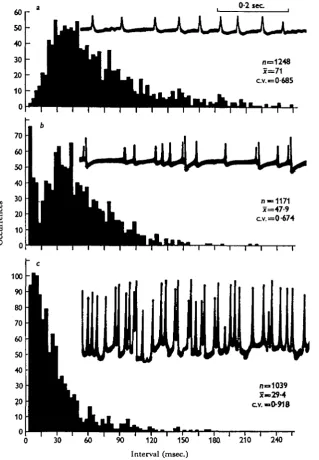
By the time the attachment of electrodes was complete the reactivity of the animals was already low. It was nearly impossible to induce a hard claw pinch, but some walking and defensive reactions occurred. The defence reaction, which involves raising and opening the claws, was associated with strong electrical activity in the opener muscle. In the absence of known stimuli usually no activity occurred, but sometimes relatively low frequency 'spontaneous' muscle potentials were observed and recorded. Medium and high levels of activity could be elicited by touching, pinching or scratching various parts of the body. The film records were studied for evidence of a patterned motor output by entering the values for the time intervals between the muscle potentials into interval histograms. Separate histograms, corres-ponding to different overall levels of activity, were constructed. The histograms in Fig. 2a-c represent low, medium and high levels of activity, respectively. Sample records appear with the proper histograms. As noted above, variation in the amplitude of the single-unit opener muscle action potentials can be attributed to neuromuscular facilitation and to the occurrence of inhibitory activity during motor excitation.
Motor system of the crayfish claw 197
of the shorter interval class is near to the value most effective in increasing muscle tension (Ripley & Wiersma, 1953). Many of the records which are tabulated in histogram c, including the one illustrated, indicate that patterning of the impulses, expecially into pairs, occurs at the highest average frequencies also, but since the average interval size is small here, two modes did not separate in the histogram.
0-2 see
240
[image:5.451.71.391.137.597.2]Interval (msec.)
It seems highly unlikely that some input to the animal had the same temporal distribution as the output shown in Fig. zb and it is therefore probable that the closely spaced impulses are generated by ganglionic mechanisms independent of input pattern. However, this conclusion is not rigorous without the controlled experiments described in the next section.
Motor neuron and muscle potentials due to preganglionic electrical stimulation
Electrical stimulation of the circumoesophageal connectives or abdominal nerve cord elicits activity in the claw opener muscle. The muscle potentials may follow the input shocks 1:1 with a latency that varies around a value of 25 msec^ Usually many
' f ' 1 ' 1 ' i ' r1 ' f f f ' ~
—4-4, M l 1 , ^ 1.0. Mt L-UJL '. * L.
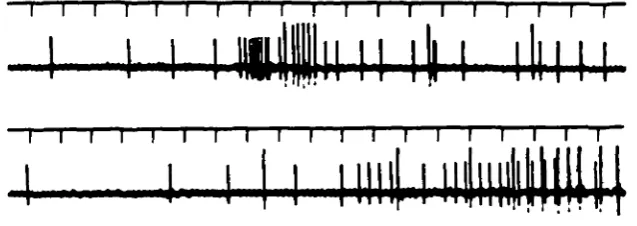
Fig. 3. Muscle action potentials during electrical stimulation of the circumoesophageal connective. Upper lines, 10 marks/sec.; middle lines, stimulus marker; lower lines, muscle recording, (a) Single-to-triple responses; (6) several cases of apparent antifacilitation due to inhibition during the second excitatory potential; (c) some activity which has escaped dependence upon the stimulus timing. This activity continues as an after-discharge.
cycles of input are needed before the output begins. During the steady response which finally develops the output may consist of multiple discharges due to a single input shock. These doublets and triplets resemble in temporal characteristics those recorded from the intact animal, the separating interval being about 4-12 msec. They are clearly not due to a similar temporal micro-structure in the input. Fig. 3 gives an illustration of this effect. The irregularities in amplitude of the muscle potential are rationalized by comparison with the records of Fig. 1 in which the nerve and muscle recordings are presented. In Fig. 1 it can be seen also that a single input shock often gives rise to two small efferent nerve impulses which are correlated with a muscle action-potential doublet, and that there is often another rather later impulse. In Fig. 3 c, which is taken after a long period of stimulation, extra excitatory muscle potentials occur which are not correlated closely with the stimulus, and these continue as an after-discharge.
Multiple discharges of the large (inhibitory) spike can also be caused by single preganglionic shocks.
Motor system of the crayfish claw 199
motor neurons fire only as the result of a complex integrative activity which includes both spatial and temporal summation as well as local pattern production.
Reflexes and central control of the opener muscle General body stimulation
Mechanical stimulation nearly anywhere on the body surface can elicit activity in both the excitor and the inhibitor axons of the claw opener. This is true also of electrical stimulation of the nerve cord either ahead of or behind the thorax. The two units may
4—4
Fig. 4. Various excitor—inhibitor relationships, (a) A single unit (the excitor) is active; (6) excitor dominates inhibitor; (c) inhibitor dominates excitor; (d) excitor and inhibitor exhibit all phase relationships; (e) inhibitor shows some naturally induced two- or three-spike bursts during low background activity. Both units increase in frequency from left to right. Time marker, io/sec.
not respond equally and they may have different background (pre-stimulation) levels of activity. Nevertheless, for most stimulation sites their responses are positively correlated. Fig. 4 shows some various relationships between excitor and inhibitor activity, and Fig. 5 shows the effect of mechanical stimulation of the body surface. In Fig. 5 it is seen that both axons are activated together, but that the larger (inhibitor) is later, and that either may produce a doublet following a single stimulus. During a long series of mechanical stimuli stimulus-independent discharge begins, as it does during electrical stimulation.
seen that, as in most nerve spike trains, low-frequency runs are associated with more scatter. However, if the degree of scatter (the standard deviation) is compared to the mean interval it is found that this relative measure of variation (the coefficient of variation, S.D.-=-£) increases with frequency, not with interval (Fig. 7). This is not necessarily to be expected. Werner & Mountcastle (1963) found the coefficient of variation of some sensory projection neurons to be independent of frequency. The increased variability at high frequency may not represent simply increased random-ness but may reflect the addition of the new class of shorter intervals due to the doublets and triplets of spikes. At any rate the increased variability should lead to an enhancement of muscle tension in the absence of other influences such as neuro-muscular inhibition.
1 1 _ l I
Fig. 5. Response to mechanical stimulation of body. Prodding of ventral abdominal surface about 4-5 times/sec, produces bursts (1-3) of excitatory impulses often followed by one or two inhibitory impulses. After a prolonged series of stimuli the excitor shows additional activity which has escaped fixed latency dependence (c and d). Time marker, io/sec.
Spontaneous behaviour
N=36O x=130 s.o.= 30 50 100 200 Interval (msec.) 300 Excitor
-- — ..jtHibii
N=245 x=192 S.D
l
.=.48 200 •100 Interval (msec.) (A) 0-8 0-7 0 6 0-5 0-4 0-3 0-2 0-1 0 -0-1- 0 - 2
• .Excitor N=245 x—« Inhibitor
N=360
2 3 4 5 6 7 8 9
Order of serial correlation
(c)
0-8
0 7
-10 0-2 0-4 0-6 0-8
Phase (excitor in inhibitor interval)
oo
co•a
Excitor Inhibitor
1 2 3 etc.
Fig. 6. Analysis of results of a long run of' spontaneous' output, (a), (4) Interval histograms for the inhibitory and excitatory trains respectively, (c) Auto-correlograms consisting of ten orders of serial correlation coefficient for each train, (d) Phase histogram comparing per-centage time of occurrence of spikes of one train in intervals of the other, (e) Cross-correlo-grama consisting of eleven orders of interval correlation chosen as illustrated. Intervals of one train (a single interval is shaded) are correlated to the preceding, but overlapping, interval of the other train for the zeroth-order correlation. Comparison is made to the succeeding, but overlapping, interval for the first-order correlation, and with successive intervals for higher serial orders. Different correlation values are found, especially for the first two orders, depending upon whether the cross-correlation is made from the excitor to the inhibitor ( • • ) or vice versa ( x x ).
1-0
09
0-8
c P 0-7
•a 06 -.5 0 :en t u Co e 0-5 0-4 03
0-2
01 -• 245 i • 360 1248 l *169 • 1171 i i 1039
10 20 30
Average frequency (impulses/sec.)
Fig. 7. Plot of the coefficient of variation (standard deviation divided by mean) for several runs of activity of the excitor motor neuron. The numbers near the points give sample size. Although the standard deviation of interval length decreases with increase in frequency, this measure, relative to the mean, increases with increase in frequency.
The interval distribution for the inhibitory impulses during the same period shows a higher average frequency, but a lower tendency to smooth change in frequency as judged from the autocorrelogram (Fig. 6 c). This is contrary to the behaviour of at least some other related neuron pairs (Wilson & Wyman, 1964). Relatively more of the variation in interval lengths may be attributed to uncorrelated cycle-to-cycle changes than in the case of lower-frequency behaviour.
If the excitatory spike intervals are compared serially with the inhibitory ones a cross-correlogram may be constructed (Fig. 6e). It can be seen directly that the two are positively correlated in frequency, that is, trend together both over short and longer periods. It should also be noted that if excitatory intervals are compared to
preceding inhibitory ones the correlation is not significant, but that only when
excita-tory ones are compared to succeeding inhibiexcita-tory ones is the correlation high. The opposite is true if inhibitory intervals are compared to excitatory ones. This means that frequency changes generally begin to occur in the excitatory line before they do in the inhibitory one, even though they usually occur in both at about the same time.
Motor system of the crayfish claw
203Stimulation of the claw
Passive opening of the claw or mechanical stimulation of the hair beds along the inner edge of the propodite (facing the dactyl) may also cause increased firing of both excitor and inhibitor axons, but these stimuli cause much more pronounced increases in the inhibitor. Passive opening of the dactyl presumably stimulates the joint receptor organ. This proprioceptive reflex is a dependable way of eliciting inhibitor activity. The background activity may be dominated by either the excitor or inhibitor, but the result is the same; both increase in frequency (see Fig. 8), but the inhibitor activity is probably sufficient to prevent tension development since inhibitor/excitor ratios of less than one can be sufficient to block contraction (Ripley & Wiersma, 1953).
jOpen
1 1 1 1 1 1 1 1 1
1
1
1
1 1 1 1
I Open
I I 1 T I I I I I I I I I I I I
(Open lOpen
1 r 1 i 1 r 1 T
Fig. 8. Effect of passive claw opening. The movement lasted only a few tenths of a second.
(a) The inhibitor was already active and both units increased. (6) The excitor was already
active and both units increased, (c) There was no background activity. The inhibitor fires first. The concurrence of activity in the two units during this reflex is not due to spontaneity or stimulation from another cause. Time marker, io/sec. Amplitude changes are associated with movement of the preparation.
Electrical stimulation of the claw nerve where it contains both sensory neurons and the motor axons to the opener muscle produces the effects illustrated in Fig. 9. The stimulus is followed by a compound nerve potential which varies more or less smoothly with stimulus voltage. At least at higher stimulus strengths this wave of activity should include the proprioceptive and hair-bed fibre spikes as well as antidromic motor axon spikes. Many milliseconds later than this compound wave there may be an efferent discharge in the motor axons. It is characteristic that this discharge will be in the inhibitory axon only, or in both inhibitor and excitor. In the latter case the inhibitory spikes are earlier and usually greater in number. In contrast to other sources of input, for this afferent pathway the inhibitor seems to have the lower threshold (and shorter latency).
Ratio of inhibitor to excitor activity
2 0 4
50 msec.
Fig. 9. Effect of electrical stimulation of the mixed nerve peripheral to the branching to the opener muscle. The stimulus artifact is followed by a compound wave of activity which presumably carries both sensory and motor axon spikes centrally. There is a later rebound of individual spikes which can be identified as both efferent and motor. The first is the larger inhibitor. With greater input or a longer period of facilitation, later, smaller excitor axon spikes occur.
35
1
S 15
C
15 20 25 30 35 40
Excitor (impulses/sec.)
45
Motor system of the crayfish claw 205
iRipley & Wiersma (1953) have demonstrated that the frequency ratio is a useful index for determining some aspects of muscle activity. For example, they find that I/E ratios above about 0-4-0-8 result in no tension in their crayfish-claw preparations. If we plot the naturally occurring inhibitory and excitatory frequencies for a number of data samples we find that the points fall into two groups (Fig. 10). One group includes results of passive claw opening and the other includes results of general body stimula-tion (without claw movement). The slope of the former group is steep, showing that the effect of passive claw opening is to cause inhibitory dominance. The result will be total inhibition during vigorous passive opening. The group of data points arising from other kinds of stimulation have a slope of less than one. I/E ratios appear to decrease with increased excitation and the latter should dominate. Because the dominance changes depending upon whether the input is from the claw (primarily proprioceptive) or from the rest of the body (primarily exteroceptive) the system can work adaptively even though the apparently antagonistic units show a general synergism.
I 1 I I I I I I I I I l 1 1 1
[image:13.451.68.387.263.376.2]I I I I
Fig. 11. Two examples of the sequence of motor neuron events associated with active opening of the claw.
Natural claw opening
In all of the above reflex studies the dactyl was either moved passively, held still, or did not move because inhibition dominated excitation. In these circumstances the proprioceptive reflex does not operate as a feedback loop; the loop is open. If the claw is left free to move, the loop does operate and the sequence of events due to a transient input is the following (Fig. 11). If the animal is stimulated in any of a large variety of ways there is first a noticeable rise in frequency of the excitor motor axon to the opener muscle. The inhibitor may also increase in frequency due to the primary input, but inhibitor activity does not become pronounced until later when the dactyl is moving. The effect is that an exteroceptively or centrally driven movement is stopped or limited by proprioceptive feedback. The effects are mostly phasic; the claw may stay open, but the rate processes decline.
DISCUSSION
The lethargic preparations
input. However, there was often no claw movement because of the effect of peripheral motor inhibition. The extent of this inhibitory background and response varied from animal to animal and over long periods in a single preparation. We have no systematic results on this long-term variation, but it may be possible to correlate it to the animal's behavioural state. One important function of the muscle inhibition may be to control this behavioural state. For the crayfish it may be appropriate to speak not of a ' central excitatory state', but rather of a peripheral excitatory (or even inhibitory) state. Not only can one say that' a crayfish thinks with his claws' but also it may be possible that a significant part of this general tendency to behavioural response is regulated at the neuromuscular level in addition to efferent sensory control or central facilitating mechanisms.
The motor output pattern
Not only is the neuromuscular junction sensitive to changes in pattern of temporal sequence of impinging impulses (shown by earlier workers), but it also receives, under natural circumstances, trains of impulses containing similar pattern character-istics. Under the natural circumstances the pattern does not consist of neatly spaced pairs of impulses but rather of an irregular train containing an unusual number of closely spaced doublets and triplets. From the results of earlier workers we can con-clude that any deviation from a smoothly rhythmic sequence will enhance tension development, and that the naturally occurring sequence will produce a greater rate of tension increase than a rhythmic one of the same average frequency. The fact that the relative variance increases with impulse frequency may be adaptively related to the need for rapid adjustment of tension. The use of two sequence parameters, average frequency and variance, narrows the frequency spectrum needed for a given range and sensitivity of control. It is possible, of course, that other parameters are significant as well. For example, different patterns with the same frequency and variance have not been investigated.
A possible weakness in the argument that the pattern-sensitive junction receives an appropriate pattern, and that therefore the whole arrangement has behavioural signifi-cance, lies in the possibility of a negating action by simultaneous inhibition. Simul-taneous action was seen to be common in our records of activity driven by electrical input when there was more or less fixed latency-dependence between stimulus and response. However, the finding that the excitor and inhibitor impulses bear no special phase relationship one to the other shows that under some natural circumstances the inhibitor only subtracts excitation with some average effect, and not an effect specially related to the relative timing of the potentials, even if such a special effect were characteristic of nerve-muscle preparation.
Motor system of the crayfish claw 207
'The shorter intervals between paired impulses are probably caused by a relaxation oscillation due to some recovery process in the motor neuron. Either relative re-fractoriness or depression of excitatory membrane potential following impulse initiation could give the observed effect. The same sort of mechanism would explain the results obtained with the crayfish, but if this is the case then the fundamental (input) rhythm is subject to more variation, since the bimodal histogram is continuous rather than disjoint. The duration of the small intervals is consistent with expected times for refractory recovery of arthropod motor neurons. By this multiple discharge process, which occurs primarily during periods of high levels of excitation, it is possible for the relative variance to increase with frequency not by a real increase in noisiness but by the addition of a new aspect of temporal patterning. Thus these neurons do not really violate the more usual finding that rhythmicity increases with frequency if one considers that at higher levels of activity there is some frequency multiplication following the fundamental oscillation and that the brief burst represents a single excitatory cycle in the driving mechanism.
A model of the reflex organization
The excitor and inhibitor neurons seem to form (part of) a single motor neuron pool. For all kinds of inputs their outputs are positively correlated in frequency (unless one chooses very short or highly irregular samples). For most inputs, and during spon-taneous activity, the apparently smaller excitor neuron has the lower threshold and shorter stimulus-to-response latency. (By spontaneous we mean that there is no known input to the animal which is correlated with the output. The motor neurons probably received input from other parts of the C.N.s.) In this respect the neuron pool is probably of the general type. For special inputs from the claw the larger inhibitor neuron responds more readily. However, from the point of view of the central connexions it is not necessary to postulate antagonistic interactions between these two neurons. They may be synergistically driven neurons supplying the same muscle but their inputs are differentially weighted, depending upon source. All of our observa-tions lead to this conclusion. It should be remembered that we are talking about a single pair of neurons to one muscle. The extent to which other muscles and other animals use the same arrangement of excitor-inhibitor innervation remains to be seen. For a contrary example see Kennedy & Takeda (1965), who find reciprocal be-haviour between the inhibitor and excitors of the slow flexor muscles of the crayfish abdomen.
Fig. 12 shows how this common but differentially weighted input can be put to use. The proprioceptive loop has the characteristic of a negative feedback system not in the well-known ways of inhibiting the excitor neurons of the muscles which would supplement the on-going movement, or of exciting the excitor neurons of the ant-agonistic muscles, but instead the negativity is achieved by exciting the inhibitor of the muscle producing synergistic movement. Here is a second adaptive role for peripheral neuromuscular inhibition. It replaces the central inhibition which is miss-ing in this case. In addition to this effect of the proprioceptive feedback there is also excitation of the excitor neurons of the closer muscle and the two effects are supplemental.
discussion. First it should be pointed out that it is not clear what sort of stability it provides. Several factors will make an analysis tedious. First of all, the muscles develop tension rather slowly in response to a change of input frequency. This means that during short bursts or trends it is rate of change of tension and not steady-state tension which is affected by the motor output. Secondly, it is true that in the absence of antagonism or skeletal blocks or elasticity a steady tension proportional to some innervation frequency should produce continual movement until muscle shortening is impossible, but since the other things are not absent it is difficult to predict how position or rate of movement will be related to motor frequency. Thirdly, the reflex
Opener muscle
Joint receptor
Input Excitor
Inhibitor
Fig. 12. Model summarizing possible organization of the reflex system controlling the opener muscle. Interneurona could intervene in the chain and provide the fundamental oscillatory drive with multiplet production by the motor neurons themselves.
efficacy adapts fairly rapidly. The equilibrium value for the loop may therefore change as a derivative function of its state. Our intuitive guess is that by reason of sensory and central adaptation the reflex has phasic characteristics which tend simply to oppose movement and to bring the claw to rest wherever it is, and that only to the extent that there are non-adapting tonic elements will the feedback loop tend to maintain a given position. It seems probable that tonic effects are more prominent in the extremes of the range of claw positions.
A behavioural interpretation
Motor system of the crayfish claw 209
tanaximum time with less than a maximum expenditure of energy and each effort by the captive object to open the claw is countered by more holding force. This is only a single example of how the reflex mechanisms may be integrated into a whole sequence, but its overt aspects are probably sufficiently well known to all who handle crayfishes that the example is well taken.
SUMMARY
1. The opener muscle of the crayfish claw receives, under nearly natural conditions, a train of excitatory nerve impulses which may show a temporal patterning to which the muscle is specially sensitive. Especially at high frequencies the impulse train contains doublets which form a separate class in the interval distribution. Their appearance at high frequencies gives rise to an increase in the coefficient of variation of interval lengths.
2. Excitatory and inhibitory motor neurons to the same opener muscle seem to be part of the same commonly excited motor neuron pool. Frequency changes in the two axons generally show positive correlations. For most inputs and for 'spontaneous' central drive the excitor has the lowest threshold and shortest latency, and it gives the earliest indication of changes of excitatory state.
3. Proprioceptive input from the claw may excite both motor neurons, but generally the inhibitory one gives the earlier, bigger response. The peripheral inhibition com-pletes a negative feedback loop.
4. Inhibitory frequencies plotted against concurrent excitatory frequencies give points falling into two groups with different slopes dependent upon input source. For general body inputs the slope is less than one and for proprioceptive claw input it is much more than one. This divergence leads to greater effectiveness of either excitation or inhibition as overall level of output increases, with a good separation of antagonistic functions in spite of the apparent lack of reciprocal interaction.
We wish to thank R. J. Wyman for help with the data processing, E. Reid for preparing several illustrations, and D. Kennedy for criticizing a draft of the manu-script. Financial support came from NSF grant number GB2116 and NIH grant number NB03927.
REFERENCES
BUSH, B. M. H. (1962a). Peripheral reflex inhibition in the claw of the crab, Carcmus maenat (L.).
J. Exp. Biol. 39, 71-88.
BUSH, B. M. H. (19626). Proprioceptive reflexes in the legs of Carcmus maenas (L.). J. Exp. Biol. 39, 89-ios.
BUSH, B. M. H. (1963). A comparative study of certain limb reflexes in decapod crustaceans. Comp.
Biochem. Pkytiol. 10, 273—90.
ECKERT, B. (1959). Ober das Zusammenwirken des erregenden und des hemmenden Neurons des M. abductor der Krebsschere beim Ablauf von Reflexen des myotatischen Typus. Z. vergl. Pkysiol. 41, 400-526.
KENNEDY, D. & TAKEDA, K. (1965). Reflex control of abdominal flexor muscles in the crayfish. II. The tonic system. (In manuscript)
MARMONT, G. & WLERSMA, C. A. G. (1938). On the mechanism of inhibition and excitation of crayfish muscle, jf. Pkysiol. 93, 173-93.
RIPLEY, S. H. & WIERSMA, C. A. G. (1953). The effect of spaced stimulation of excitatory and in-hibitory axons of the crayfish. Pkysiol. Comp. 3, 1—17.
SIEGEL, S. (1956). Non-parametric Statistics. New York: McGraw-Hill.
VAN HARREVELD, A. & WIERSMA, C. A. G. (1937). The triple innervarion of crayfish muscle and its-function in contraction and inhibition. J. Exp. Biol. 14, 448-61.
WERNER, G. & MOUNTCASTLE, V. B. (1963). The variability of central neural activity in a sensory system, and its implications for the central reflection of sensory events. J. Nettropkynol. 26, 958. WIERSMA, C. A. G. (1961). Reflexes and the central nervous system. In The Physiology of the
Crus-tacea, T. H. Waterman (ed.). New York. Academic Press.
WIERSMA, C. A. G. & ADAMS, R. T. (1950). The influence of nerve impulse sequence on the contractions of different crustacean muscles. Pkysiol. Comp. a, 20-33.
WIERSMA, C. A. G. & Ellis, C. M. (194a). A comparative study of peripheral inhibition in decapod crustaceans. J. Exp. Biol. 18, 323-36.
WILSON, D. M. (1964). Relative refractoriness and patterned discharge of locust flight motor neurons.
J. Exp. Biol. 41, 191-205.
WILSON, D. M. & WYMAN, R. J. (1964). Motor output patterns during random and rhythmic stimula-tion of locust thoracic ganglia. Biophyi.J. 5, 131-43.
WYMAN, R. J. (1964). Probabalistic characterization of simultaneous nerve impulse sequences.