THE ROLE OF MESSAGE
FRAMING IN PROMOTING
ACTIVE WORK
COMMUTING BY
ELECTRICALLY ASSISTED
BICYCLE
Ilona Valster
S1114085
COMMUNICATION STUDIES BEHAVIORAL SCIENCES
EXAMINATION COMMITTEE prof.dr. A.T.H. Pruyn dr. O. Peters
DOCUMENT NUMBER FINAL VERSION -
The primary objective of this study was to examine the effect of tailored messages to
individual differences in motivational orientation on attitudes and intentions towards active
work commuting by electrically assisted bicycles (EAB). The underlying objective was to
develop an approach for enhancing message persuasiveness in health communication. Based
on regulatory focus theory, it was predicted that a fit between the strategically used framing
method and people’s chronic regulatory focus would result in higher intentions and more
positive thoughts and feelings about active work commuting by EAB. Moreover, it was
expected that people who experienced a regulatory fit had a more positive attitude and a
higher buying intention of an EAB. The tailored messages were presented among four
different risk-reduction conditions and the psychological risk reduction condition appeared to
be the most effective. The expected regulatory fit effect was only found in the financial risk
reduction. However, the interaction showed a contrasting relation in which a regulatory
non-fit resulted in a higher advertisement evaluation, more positive feelings about active work
commuting by EAB, a more positive attitude towards EAB and a higher buying intention of
an EAB. The results show that regulatory fit is probably not always or solely the moderator
of message framing effects. Involvement and motivational to process information are possible
important factors that moderate regulatory (non)fit effects.
2 Abstract (in Dutch)
Het primaire doel van deze studie was om te onderzoeken of boodschapformulering gericht
op individuele verschillen in motivationele oriëntatie invloed heeft op de attitudes en intenties
met betrekking tot forenzen per elektrische fiets. Het onderliggende doel was om een
methode te ontwikkelen die de overtuigingskracht van gezondheidscommunicatie vergroot.
Op basis van regulatory focus theory werd verwacht dat een match tussen de strategisch
gekozen boodschapformulering en de wijze waarop mensen doelen nastreven (regulatory
focus) zou resulteren in hogere intenties en meer positieve gedachtes en gevoelens over
forenzen per elektrische fiets. Daarnaast werd verwacht dat mensen die een ‘regulatory fit’
ervoeren, een meer positieve houding en een hogere aankoopintentie met betrekking tot een
elektrische fiets hadden. De gemanipuleerde boodschappen werden toegepast op vier
verschillende risico verminderende condities, waarbij de slogan die de nadruk legde op het
verminderen van het psychologische risico het meest succesvol bleek. Het verwachte
‘fit-effect’ werd alleen in de conditie met de financiële risico verminderende slogan gevonden,
waarbij de interactie overigens tegenovergesteld bleek te zijn. Concreet betekent dit dat
slogans die incongruent waren aan de motivationele oriëntatie van mensen, leidden tot meer
positieve gevoelens over forenzen per elektrische fiets, een betere houding ten opzichte van
elektrische fietsen en een hogere aankoopintentie van een elektrische fiets. De resultaten
impliceren dat regulatory fit waarschijnlijk niet de enige modererende factor is op
boodschapformulering. Betrokkenheid en motivatie om informatie te verwerken zijn
mogelijke belangrijke factoren die regulatory (non)fit effecten modereren.
3 Executive summary
By support of Royal Dutch Gazelle, the current study examined the effect of tailored
messages to individual differences in motivational orientation on attitudes and intentions
towards active work commuting by electrically assisted bicycles (EAB). The underlying
objective from a practical point of view was to develop a method for effective (health)
communication in advertisements.
Based on regulatory focus theory, it was predicted that a fit between the strategically
used message framing method and people’s chronic regulatory focus would result in higher
intentions and more positive thoughts and feelings about active work commuting by EAB.
Moreover, it was expected that people who experienced a regulatory fit had a more positive
attitude and a higher buying intention of an EAB.
Three hundred and thirty-seven (N= 337) filled in the online questionnaire. All
participants were randomly allocated to the advertisement in one of the four risk reduction
conditions (i.e., financial-, physical-, time- or psychological risk reduction condition) which
contained a visual, logo and gain- or loss- framed slogan encouraging participants to
participate in active work commuting by EAB. The expected regulatory fit effect was only
found in the financial risk reduction, but the interaction showed a contrasting relation in
which a regulatory non-fit resulted in a higher advertisement evaluation, more positive
feelings about active work commuting by EAB, a more positive attitude towards EAB and a
higher buying intention of an EAB. In fact, this means that when the objective is to
communicate about financial issues related to active work commuting, it is important to know
the predominantly regulatory focus of the target group. Promotion oriented people are more
persuaded by a loss-framed slogan and prevention oriented people by a gain-framed slogan.
Between all four risk reduction conditions, the psychological risk reduction condition
4 persuading people to commute by bicycle is to use slogans that focus on psychological
feelings and benefits. Furthermore, the gain-framed slogans were more persuasive with
respect to advertisement evaluation. Therefore, it is recommended to formulate slogans in
advertisements in terms of gains when the objective is to create a more believable,
informative and interesting advertisement. Finally, a relevant effect regarding gender was
found on attitude towards EABs. Women appear to have a more positive attitude towards
EABs than men. Since most of the EABs currently are also sold to women, is it
recommended to focus in advertisements on the most potential target group: men.
It should be noted that the importance of future research in exploring motivations in
active work commuting behavior is essential, considering the health- and environmental
consequences of commuting by motorized transportation modes. Future research should aim
to extend the knowledge of regulatory non-fit effects and the underlying factors that moderate
these effects on persuasion. This can be realized by for example generalizing and extending
the current study. The use of a different participant sample, improved framing manipulation,
induced regulatory focus (i.e., compared to measuring chronic regulatory focus), involvement
and motivation to process information as moderating factors are examples of relevant
5 An important way to enhance public health is by increasing physical activity. The
relationship between physical activities in different domains and health indicators such as
body mass index has been positively confirmed by several studies over the years (Morrison,
Petticrew & Thomson, 2002; Abu-Omar & Rütten, 2008; Vuori, 1998; Haskell, Lee, Pate,
Powell, Blair, Franklin, Macera, Heath, Thompson & Bauman, 2007). However, the amount
of people with overweight or even obesity is still rising (Schokker, Visscher, Nooyens, van
Baak & Seidell, 2006) and research shows that adults are still not active enough (Haskell et
al., 2007). Specifically in the Netherlands, it turns out that less than half of the adult
population meets the recommendations for adequate physical activity (Kemper, Ooijendijk &
Stiggelbout, 2000). In combination with unhealthy lifestyles physical inactivity remains an
urgent public health issue (Haskell et al., 2007; Simons, van Es & Hendriksen, 2009).
The potential of improving public health by physical activity has been called
substantial (Vuori, 1998) and is also known as health-enhancing physical activity (HEPA).
HEPA is defined by Oja, Vuori and Paronen (1998, p.87) as “accumulation of 30 minutes or
more of moderate-intensity exercise on most, or preferably all days, of the week”. There are
several domains in which HEPA can take place, such as leisure time, occupational time,
domestic time and during commuting (Abu-Omar & Rütten, 2008). Oja et al. (1998) state that
incorporating physical activity into people’s daily life routine is the best way to realize
substantial public health-enhancement. The combination of daily life routine and the potential
to make two daily activity bouts makes the domain of active work commuting (e.g., walking,
cycling) an important and interesting domain to increase public health.
Since cycling is performed at a higher relative intensity, it became more effective in
improving health compared to walking (Oja et al., 1998). Moreover, cycling enables people
6 Union member countries are shorter than five kilometers (Titze, Stronegger, Janschitz & Oja,
2008) and thus having a great potential to be travelled by bicycle. Despite a bicycle-friendly
infrastructure and a positive image of cycling, even in the Netherlands exists a large group
who decides not to cycle in these situations (Heinen, van Wee & Maat, 2010). A relatively
new device that can help people to meet the guidelines for sufficient physical activity is the
electric bicycle (Simons et al., 2009).
Electric bicycles can be described as “electric motor powered bicycles, including as
well fully as partially motor powered bicycles” (Muetze & Tan, 2005, p.2865). The partially
motor powered bicycles are also called electrically assisted bicycles (EABs) (Simons et al.,
2009) and have a lot of potential in the Netherlands to grow as an alternative way of
commuting since this type of electric bicycle is most common in the Netherlands and requires
also human physical activity (Muetze & Tan, 2005). Opposed to regular bicycling, electric
bicycling by EAB enables long distance biking in a shorter time frame without an intense
effort and without resulting in uncomfortable unhygienic situations (e.g., sweat). This makes
the EAB an interesting mode of transport in the domain of active work commuting. Related
to the common goal to improve public health, supporting evidence is found in the study of
Simons et al. (2009). Their results showed that the physical intensity during cycling on an
EAB is sufficiently high enough to meet the physical activity guidelines for adults according
to HEPA standards.
In order to achieve enhancement in public health, people need to be persuaded to
change their (commuting) behavior. Morrison et al. (2003) state that health promotion
campaigns or programs focused on physical activity are the most effective transport
interventions to improve health and change behavior. However, message impact still needs
further development to improve the effectiveness of future health promoting campaigns. The
7 motivational orientation on attitudes and intentions towards active work commuting by
electrically assisted bicycles. The underlying objective is to develop an approach for
enhancing message persuasiveness in health communication.
Message framing as a behavior change strategy
There are many approaches that focus on health behavior modification. One major
form that uses theoretical frameworks to inform and persuade both individuals and
communities about health-enhancement activities is health communication (Myers, 2010).
Noar (2006) states that a targeted and well-executed health mass media campaign can
contribute to improve knowledge of (health) issues and to change attitudes and beliefs
towards a certain behavior. Moreover, it will support behavioral change. Although there are
many factors of importance by conducting a mass media campaign, one of the most important
elements of the communication campaign is the way a message is tailored (Noar, 2006).
Message tailoring is a “health communication strategy that involves the customization of
information and intervention to best fit the characteristics and needs of specific target
populations or individuals” (Kreuter & Wray, 2003, as cited in Myers, 2010, p. 501). Prior
findings show that tailored health messages have more persuasive power and are more
effective in behavioral change promotion, compared to general health messages that are not
tailored to individual differences (Kreuter & Wray, 2003; Latimer, Katulak, Mowad &
Salovey, 2005).
Message framing is a message tailoring strategy whereby information is manipulated
and framed in order to influence (individual or public) behavioral decisions. This concept of
framing holds that the way a message is characterized (e.g., in a communication campaign)
8 2007). In this way it is assumed that someone’s attitude, decision, intention and even
behavior can change when presenting a similar message in different frames or formats. The
major goal of a framing strategy is generally to promote a certain behavior (Rothman &
Salovey, 1997), which can be achieved via different message framing forms. Levin,
Schneider and Gaeth (1998) describe three different message framing types that all have
distinctive underlying mechanisms and effects. One of these manipulations is introduced by
Tversky and Kahneman (1981) and is called ‘risky choice framing’. In this type of framing,
the choice between a risky and a riskless outcome depends on the way they are framed. The
next framing method is called ‘attribute framing’. The focus point in the framing
manipulation of attribute framing is on characteristics of an object or event. Finally, goal
framing is associated with the framing of a certain goal of an action or behavior (Levin et al.,
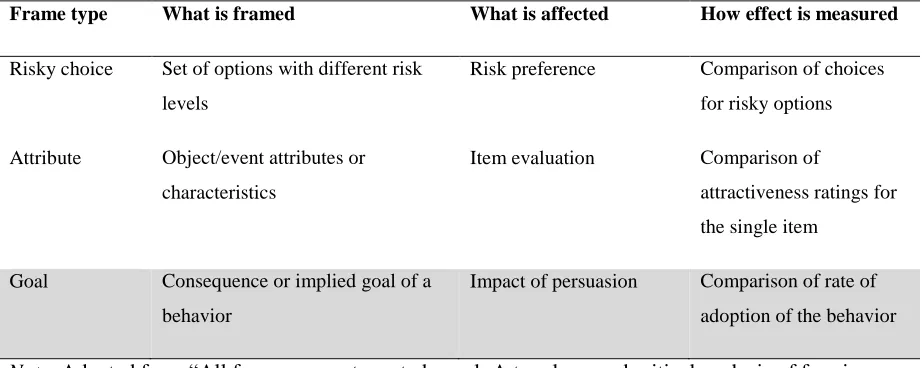
1998). Table 1 is adopted from Levin et al. (1998) and shows the methodological differences
[image:9.595.68.529.502.686.2]between risky choice-, attribute- and goal framing.
Table 1
Summary of Methodological Differences in Risky Choice, Attribute and Goal Framing
Frame type What is framed What is affected How effect is measured
Risky choice Set of options with different risk
levels
Risk preference Comparison of choices
for risky options
Attribute Object/event attributes or
characteristics
Item evaluation Comparison of
attractiveness ratings for
the single item
Goal Consequence or implied goal of a
behavior
Impact of persuasion Comparison of rate of
adoption of the behavior
9 Goal framing. The most applied way of framing to promote physical activity is goal
framing. Goal framing is mostly applied to studies that focus on persuasive communication.
Research shows that the persuasiveness of a message may depend on whether the message
focuses either on the positive consequences (or gains) of performing a certain behavior or on
the negative consequences (or losses) of not performing that particular behavior (Levin et al.,
1998). An important and distinctive feature of goal framing manipulation is that both the
gain-framed condition and the loss-framed condition aim at achieving the same desired
end-state or behavior and thus representing equivalent information (Block & Keller, 1995; Levin
et al., 1998). The key question in goal framing is whether the gain- or loss-framed condition
has more persuasive power in convincing people to perform a certain behavior.
Due to inconsistent findings, several meta-analytic reviews were conducted in the
previous years to collect, analyze and report message framing effects on health behavior in
order to see whether a gain-framed or loss-framed message is more effective. Levin et al.
(1998) collected the results of 28 studies with respect to goal framing and found that in
general the loss-framed messages had more effect on responses compared to the gain-framed
messages. An example is the well-known study from Meyerowitz and Chaiken (1987). Their
study aimed to convince women to engage in breast self-examination (BSE). The results
showed that women who were exposed to a loss-framed message that emphasized the
negative consequences of not engaging in BSE were more likely to participate in BSE,
compared to women who were exposed to information that focused on the positive
consequences of BSE (i.e., gain-framed message). Support for this conclusion was also found
in the study of Block and Keller (1995). They found that for low efficacy or detection
behavior, the loss-framed message had more influence on attitudes and intentions than the
gain-framed message. However, a more recently conducted meta-analytic review of O’Keefe
10 did not find evidence that a loss-framed message was significantly more persuasive than a
gain-framed message, or the other way around. This is in line with the results of the extended
study of O’Keefe and Jensen (2007) which focused specifically on disease prevention
behaviors (e.g., diet/ nutrition behaviors, inoculation and exercise behaviors). They found
significant advantage for gain-framed messages over loss-framed messages, but this effect
was very small and applicable to only one specific form of prevention behavior (i.e., dental
hygiene). Therefore, it can be concluded that it is unclear which frame, gain or loss, is more
persuasive than the other (Levin et al., 1998; Myers, 2010; O´Keefe & Jensen, 2006; 2007;
Rothman & Salovey, 1997).
In addition, Yan, Dillard and Shen (2010) state that if framing effects exist, they can
only be understood by determining the underlying variables that moderate these effects.
Theoretical models should provide more insight in the underlying processes that leads to
different results in message framing. In fact, it means that the common use of only one
theoretical framework is not sufficient. In order to understand why multi-theoretical
frameworks should be used to explain message framing effects, the relevant theories and
conceptual models regarding message framing will be discussed.
Motivational orientation
The basic principle of message framing can be found in the prospect theory.
Kahneman and Tversky (1979) introduced this theory which describes how people manage
risk and uncertainty in decision making. More specifically, they state that when behavioral
choices involve risk or uncertainty, decision making depends on whether the choices are
framed in terms of potential losses or in terms of potential gains. In this way, people tend to
be more willing to seek and take risks as long the potential disadvantages or losses of a
11 gains, people generally tend to be risk averse and to choose the decision that avoids these
risks (Kahneman & Tversky, 1979; Levin et al., 1998; Myers, 2010). Tversky and Kahneman
(1981) applied this theory to the concept of framing and found in their study that when the
losses were certain, most of the participants chose the risk reeking option. On the contrary, if
a gain was certain, people chose the risks averse option. However, prospect theory does not
adequately describe the underlying mechanisms and conditions of message framing that
influence people’s attitudes, beliefs and behaviors (Rothman & Salovey, 1997). For that
reason, it is not possible to explain message framing effects on health-related behavior purely
based on prospect theory (Levin et al., 1998; Rothman & Salovey, 1997). Multi-theoretical
frameworks are necessary in order to understand the moderating factors and complexity
regarding message framing effects.
Higgins (2000) states that characteristics of individuals provides most insight in the
effectiveness of message framing. Related to the concept of goal framing, Higgins (2005)
argues that “when people pursue a goal, they begin with some motivational orientation, some
concerns or interests that directs to the goal or pursuit” (Higgins, 2005, p.1). For that reason
he argues that motivation theories can be integrated with prospect theory in order to
understand the underlying processes in message framing. There are several theories of
motivation who state that individual behavior is regulated by two different systems: the
approach system and the avoidance system (Carver, Sutton & Scheier, 2000). These systems
represent people’s chronic predominantly motivation style. The approach system regulates
“desired” behavior towards potential good outcomes (Gray, 1981) whereas the avoidance
system leads “aversive” behavior away from possible threats or bad outcomes (Gray, 1981;
Carver et al., 2000). Sherman, Mann and Updegraff (2006) state that message framing
interacts with the so-called predominantly motivational style that someone has. More
12 messages which are in line with motivational style are the most effective way to promote
health behaviors.
Higgins (1997) examined also the approach-avoidance principle and introduced a
theory of self-regulatory focus, called regulatory focus theory (RFT). RFT underlies the
hedonic principle (i.e., “people are motivated to approach pleasure and avoid pain”, Higgins,
1997, p.1280) but differs radically in its motivational consequences. The theory starts with
arguing that the hedonic self-regulatory principle should be applied differently when it comes
to different needs (Higgins, 1997). The two different regulatory focus mechanisms are
defined as promotion focus and prevention focus. According to RFT is regulatory focus the
dominant motivation system which explains why people make certain decisions or show a
certain behavior. The underlying thought of RFT is that self-regulation in regarding strong
ideals versus strong oughts differs in regulatory focus. Ideal self-regulation concerns a focus
on promotion, whereas ought self-regulation concerns a focus on prevention.
The self-regulatory orientations work separately and independently of each other and
form the motive of someone’s attitudes and behaviors. Every person has a predominantly
prevention- or promotion focus. According to Higgins (1997), for both information
processing and motivation, people with a predominantly prevention focus respond different to
a message than people with a predominantly promotion focus. For example, people with a
predominantly prevention oriented focus are driven by safety, responsibility and security
needs. Those people view goals as oughts and they are motivated from a strategically point of
view to approach non-losses (i.e., the absence of negatives) and to stay away from bad
outcomes (i.e., losses: the presence of negatives). People with the opposite dominant
regulatory focus (i.e., promotion focused) are mainly motivated by hopes, accomplishments
and advancement needs. For those people, goals are seen as ideals and they are strategically
13 outcomes (i.e., gains: the presence of positives). It should be noted that both people with a
promotion focus and people with a prevention focus want to achieve the desired end state and
to avoid the opposite (Cesario, Higgins & Scholer, 2008). In fact, it means that as well
promotion focused people as prevention focused people aim to approach success and to avoid
failure. Only the way in which they represent these states is different for promotion versus
prevention focused people. Finally, it is also important to note that regulatory focus is a state
and for that reason, it cannot only differ between individuals (i.e., predominantly chronic
regulatory focus), but can also differ between situations, which is called momentary
regulatory focus. Predominantly (chronic) regulatory focus can be measured by the
regulatory focus questionnaire (Higgins, Friedman, Harlow, Idson, Ayduk & Taylor, 2001).
Momentary regulatory focus can be primed or induced, for example before message
exposure.
Regulatory fit theory. After the well known article of Higgins (1997) about RFT, as
well Higgins as other researchers conducted new studies to examine and extend the theory
about regulatory focus. An important extension of RFT which has impact on the concept of
message framing is regulatory fit. Regulatory fit theory is also a goal-pursuit theory but one
that focuses on the relation between people’s chronic regulatory focus and the strategic
framing method of a message (i.e., promotion or prevention focused) (Higgins, 2000; 2005;
Cesario et al., 2004). People experience a regulatory fit when both the person and the
situational demands are either promotion- or prevention focused (Higgins, 2000). In this way
people’s focus regarding a goal can be uninterrupted (i.e., regulatory fit) or intermittent (i.e.,
regulatory non-fit) because of the communication strategy someone has used.
Higgins (2000) state that regulatory fit creates a feeling of rightness regarding the goal
pursuit. Moreover, he suggest that regulatory fit increases task engagement (Higgins, 2000,
14 such as feeling right about someone’s positive response after exposure to a message
(Cesario, Grant & Higgins, 2004). Additionally, in high regulatory fit situations, people tend
to be more strongly motivated and alert during decision making. Even after decision making,
people evaluate it more positively compared to people that experienced a regulatory non-fit
(Higgins, 2000). Finally, regulatory fit increases the value of people’s behavior (Higgins,
2000). In that way, regulatory fit intensifies responses, such as the persuasiveness of framed
message arguments (Cesario, Higgins & Scholer, 2008).
The theory is applicable to the following situation: The topic of a message focuses on
a desired end state or goal for the message recipient. Accordingly, the message is framed in
terms of a promotion- (i.e., aiming at avoiding non-gains or approaching gains) or prevention
orientation (i.e., aiming at approaching non-losses or avoiding losses). Consequently, the
framed message will sustain or disrupt the recipient’s chronic motivational orientation, and
will result in a regulatory fit or non-fit. Researchers used this theory to test fit predictions and
found that promotion-framed arguments (focused on hopes, accomplishments or
advancement needs) had a greater persuasive impact on people with a matching chronic
regulatory focus (i.e., predominantly promotion focused orientation), compared to people
with a predominantly prevention focused orientation. The reverse was true for
prevention-framed arguments (Cesario, Higgins & Scholer, 2008).
Regulatory fit and physical health. A recent and relevant study related to regulatory
fit and the enhancement of physical health is the study of Latimer, Rivers, Rench, Katulak,
Hicks, Hodorowski, Higgins and Salovey (2008). They investigated to what degree messages
tailored to people’s promotion- or prevention-goal orientation resulted in more positive
thoughts and feelings about physical activity participation. Moreover, they investigated
15 Latimer et al. (2008) measured (the by Higgins [2005] indicated) five domains that derive
value from regulatory fit, which included:
“(a) increased preference for or inclination toward the behavior (Higgins, Roney,
Crowe, & Hymes, 1994), (b) increased motivation to engage in behavior (Cesario,
Grant, & Higgins, 2004; Shah, Higgins, & Friedman, 1998), (c) imagining feeling
good about engaging in the behavior (i.e., positive prospective feelings; Higgins,
2000), (d) feeling good after engaging in the behavior (i.e., positive retrospective
feelings; Freitas & Higgins, 2002), and (e) assigning a greater value to the behavior
(e.g., perceiving the behavior as more enjoyable, more worthwhile, or worth more
money; Higgins, Idson, Freitas,Spiegel, & Molden, 2003)” (Latimer et al., 2008, p.
827).
Latimer et al. (2008) used these five domains (i.e., inclination, motivation, positive
prospective feelings, positive retrospective feelings and value) as indirect indicators of
regulatory fit. Compared to former studies that extend their findings from laboratory-based
experiments, this study was a field-based investigation within the domain of health. The
findings showed that participants were more likely to participate in physical activities and
had more positive feelings towards this health behavior when exposed to messages that fit
their chronic regulatory focus, compared to incongruent messages that did not fit their
chronic regulatory focus. This effect was particularly found in the promotion-focused
condition. Moreover, the results showed that the fit-effects were mediated by positive
retrospective feelings about physical activity.
From this research, it seems clear that tailored messages that fit peoples regulatory
focus have a positive influence on the participation in physical activity. However, it is less
16 similar between people with different levels of physical activity. Moreover, it remains unclear
if the results can be generalized to other communication designs. While Latimer et al. (2008)
conducted a telephone interview where participants listened to a randomly assigned
promotion-focused or prevention-focused message, the current research will focus on the
development and testing of computer tailored messages. The primary goal of the current
study is to generalize prior evidence of message framing and regulatory fit. More specifically,
the persuasiveness of messages tailored to individual differences in regulatory focus are
examined in a more specific domain of HEPA: active work commuting. Regulatory fit theory
is used to predict the persuasiveness of slogans in computer tailored advertisements.
Followed by the results of Latimer et al. (2008) it is expected that:
H1 a: When exposed to a gain-framed message, promoters have higher intentions and
more positive thoughts and feelings about active work commuting by EAB than
preventers.
b: When exposed to a loss-framed message, preventers have higher intentions and
more positive thoughts and feelings about active work commuting by EAB than
promoters.
Since the process of changing commuting behavior by electrically assisted bicycles
does not only involve intrinsic motivation, but also the adoption and purchase of a product
(i.e., an EAB), the influence of tailored messages on the consideration towards EABs is also
taken into account:
H2: a: When exposed to a gain-framed message, promoters have a more positive attitude
17 b: When exposed to a loss-framed message, preventers have a more positive attitude
and a higher buying intention of an EAB than promoters.
Latimer et al. (2008) used the IPAQ to screen people on physical activity and included
only inactive people in their research. However, to provide a deeper understanding in
different levels of physical activity among people, it is necessary to include all these levels in
the current study. In general it is expected that highly active people will intent more strongly
in active work commuting, but prefer to ride on a regular bicycle. Since the EAB enables
people to cycle longer distances (Muetze & Tan, 2005) in shorter time frame and without
resulting in uncomfortable unhygienic situations, commuting by EAB can also be of interest
for active people, specifically for longer distances. Since the EAB also requires physical
effort, inactive people are expected to intend only shorter trips with an EAB. For that reason
the current study will also investigate if interaction effects of regulatory fit on intentions,
thoughts and feelings about active work commuting by EAB can be explained (are mediated)
by levels of physical activity (as defined by IPAQ).
H3: Interaction effects between regulatory focus and message framing on intentions,
thoughts and feelings towards active work commuting by EAB are mediated by
participants’ level of physical activity.
The adoption of a new product
Since EABs and their purpose for active work commuting are relatively new, some
barriers of adoption need to be taken into account. Ostlund (1974) describes the importance
of the ‘perceived risk’ of an innovation. The consumers’ perceived risks of innovations can
be classified into six key dimensions of perceived risk: financial-, performance-, physical-,
time-, social- and psychological risks (Stone & Gronhaug, 1993). For example, financial risk
18 influence of communicating the risks of a new product. Herzenstein, Posava and Brakus
(2005) tested the adoption of a new product in relation to regulatory focus and perceived risk.
Their results showed that in conditions where the perceived risks of a really new product was
not made clear to consumers, promotion oriented people tend to have a higher purchase
intention than prevention oriented consumers. However, in case the risks were made more
noticeable, both promotion- and prevention oriented participants were similarly unwilling to
buy the product.
In contrast to this ‘perceived risk’ perspective, messages can also be framed to
emphasize the risks of not adopting the product (i.e., risk reduction strategy), which may
result in a higher intention to adopt a product. This would be in line with findings from Van
Bekkum, Williams and Morris (2011) about communicating barriers associated with a
specific behavior, such as cycling. They state that decreasing the perceptions of barriers
assists in changing individuals’ attitudes, beliefs and intentions towards carrying out that
behavior change.
Heinen et al. (2010) divided the barriers to cycle into different groups: built
environment (e.g., poor infrastructure, perceived insecurity), natural environment (e.g.,
hilliness, bad weather), socio-economic variables (e.g., personal- and household
characteristics), psychological factors (e.g., attitudes, social norms, habits) and aspects related
to costs, time, physical effort and safety. (Heinen et al., 2010; Oja et al., 1998; Pucher &
Dijkstra, 2003). Several barriers or dimensions not to cycle are related to the perceived risk
dimensions of adopting a new product. For example, the expense of buying a bike is a barrier
to cycle (Van Bekkum, Williams & Morris, 2011), but also a perceived risk dimension in
adopting a new product (Stone & Gronhaug, 1993). Other perceived risk dimensions of
19
effort), time risk (related to time barrier) and psychological risk (related to psychological barriers).
Based on existing literature it is suggested to use risk reduction slogans aligned with
barriers to cycle, because this will assist in changing individuals’ attitudes, beliefs and
intentions towards active work commuting by EAB. In the current research, therefore, the
gain- and loss-framed slogans will be applied to four different risk reduction dimensions.
This is particularly interesting since most prior studies related to the enhancement of public
health focus on physical costs/benefits in the messages that they examine. For example, it
may be possible that people are more triggered and persuaded to participate in active work
commuting when reading a message related to financial costs/benefits instead of a message
related to physical costs/benefits. In that case the same goal (enhancing public health by
active work commuting) will be achieved by only communicating in the most persuasive
dimension, which may be other than the physical health dimension. The results of this part of
the study will indicate whether communicating a financial-, physical-, time- or psychological
risk reduction slogan is more persuasive in both participation intentions of active work
commuting and purchase intentions of an electric bicycle.
Research design. In conclusion, it is expected that high levels of fit lead to
enhancement of message persuasiveness and product adoption. In order to achieve the
objectives of the current study, risk reduction condition, message framing, regulatory focus,
and level of physical activity were included as independent variables in the design. A 4 (risk
reduction slogan: financial vs. physical vs. time vs. psychological) x 2 (frame of slogan: gain
vs. loss) x 2 (regulatory focus: promotion vs. prevention) between-subjects design was used.
A regulatory focus x frame interaction would provide further support that regulatory focus
moderates framing effects (H1+2). The four different risk reduction dimensions would
20 Furthermore, a separate analysis with level of physical activity (low vs. moderate vs. high)
may provide support that level of physical activity moderates the framing effects in active
work commuting behavior (H3).
Method
Participant characteristics
All participants were recruited by Royal Dutch Gazelle, a bicycle manufacturer and
market leader in the Dutch bicycle industry. Gazelle produces per year around 250.000
bicycles, of which approximately 30.000 EABs (GfK, 2011). An e-mail with the invitation to
participate in an online survey was sent to a sample of 9.971 potential participants, who were
randomly selected from the customer database of Gazelle. The database included a wide
range of different stakeholders of Gazelle, among others customers who bought a bicycle,
people who requested a brochure and people who signed up for the newsletter of Gazelle.
Similar to the study of Werth & Förster (2007), participants were informed that the goal of
the study was to learn something about consumers and to obtain product evaluations.
Furthermore, participants were told that the survey was related to commuting behavior and
that this information was necessary for Gazelle in order to meet the needs of customers. As a
reward for their participation, they had a chance to win a bicycle. Participants were able to fill
in the questionnaire on every location, as long as there was internet connection.
In total, 1.485 people were willing to participate in the survey (response rate = 15%).
However, only eligible participants filled in the questionnaire for this study. Selection criteria
included whether or not the participant was a commuter (only commuters passed through)
and what their main mode of transportation was. Commuters by either a bicycle or electric
bicycle were excluded from this study since it was the aim to convince people who are
21 eligible for this study continued with another (satisfaction) questionnaire of Gazelle, which is
not covered by this study. Accordingly, participants were randomly assigned to one of the
four risk reduction conditions, with either a gain- or loss-framed slogan. Figure 1 shows the
[image:22.595.76.524.287.688.2]sampling and flow of participants through the survey.
Figure 1
Sampling and Flow of Participants Through the Survey
Finally, three hundred and thirty-seven (N = 337) participants (187 male, 150 female)
filled in the questionnaire for this study. Most of them had a fulltime job (60%) and were E-ma il sent to sa mple (n = 9.971)
Delivery fa ilure (n = 41)
E-ma ils deliverd (n = 9.930)
E-ma ils opened (n = 3.535)
Willing to pa rticipa te (n = 1.485)
Ineligible: continued with other questionna ire (n = 1.148)
Physica l risk reduction condition (n = 85)
Fina ncia l risk reduction condition (n = 86)
Time risk reduction condition (n = 98)
Psychologica l risk reduction condition (n = 68) Eligible to current study (n = 337)
Ga in- fra med sloga n (n = 42)
Loss- fra med sloga n (n = 43)
Ga in- fra med sloga n (n = 43)
Loss- fra med sloga n (n = 43)
Ga in- fra med sloga n (n = 45)
Loss- fra med sloga n (n = 53)
Ga in- fra med sloga n (n = 38)
Loss- fra med sloga n (n = 30)
22 predominantly highly educated (i.e., HBO or university; 57%), which is above the Dutch
average (i.e., 34% of the labor force, Centraal Bureau voor de Statistiek, 2012). The average
age of the sample was 43.83 years (SD = 10.48), varying between 22 and 71. Almost all
participants had a moderate (43%) or high (50%) level of physical activity. As a consequence
of that, no reliable outcomes can be reported for people low in physical activity. Regarding
the different risk reduction conditions and different message framing conditions, there were
no significant differences in demographic characteristics and baseline physical activity. Table
[image:23.595.75.524.369.720.2]2 shows an overview of all participant characteristics.
Table 2
Participant Characteristics
n % n %
Gender Occupation
Male 187 56 Fulltime job 201 60
Female 150 45 Parttime job 101 30
Age Enterpreneur 12 4
15-25 11 3 Housewife/-man 1 0.3
26-44 165 49 Unemployed 4 1
45-64 152 45 Retired 10 3
65+ 9 3 Student 5 2
Household structure Others 4 1
Live alone 40 12 Level of Physical Activity
Live together with parents/carers 8 2 Low 24 7
Live together with partner 91 27 Moderate 144 43
Live together with partner and children 185 55 High 169 50
Live together with children 11 3 Mode of transport
Live together with other people 1 0.3 Car 247 73
Others 1 0.3 Motorcycle, -bike or scooter 9 3
Educational level ᵃ Public transport (e.g., train, bus) 58 17
Primary school 1 0.3 Others (i.e., combination) 23 7
VMBO/MAVO/LBO 32 10 Possession bicycle
MBO 91 27 Yes 327 97
HAVO/VWO 22 7 No 10 3
HBO 136 40
University 55 16 Total 337 100
23 Experimental manipulations
Similar to the study of Latimer et al., (2008) a pilot study was conducted to review
and test the gain- and loss-framed manipulation of the framed slogans in the advertisements.
In total, twenty-three respondents (N= 23; 56% female; 44% male; Mage = 29.70; SD = 9.30 years) were randomly assigned to one of the two experimental conditions (i.e., gain- or
loss-framed advertorial). The two advertisements had the same visual and included the same
neutral information (i.e., product specifications), which was based on Werth & Förster
(2007). The only difference was the framing method of the slogan, which was either
gain-framed or loss-gain-framed. 12 Respondents evaluated the gain-gain-framed message and 11
respondents evaluated the loss-framed message. As expected, the gain-framed message was
evaluated significantly higher in emphasizing the benefits of commuting by EAB on physical
health (Mgain = 4.33) as opposed to the loss-framed condition (Mloss = 3.27, t (21) = 2.84, p <
.05). The mean scores showed on the other hand that the loss-framed messages were
evaluated significantly higher in emphasizing the risks of not commuting by EAB (Mloss =
3.18), compared to the gain-framed condition (Mgain = 2.00, t (21) = -2,29, p < .05).
Respondents were also asked to report what according to them, the key message of the
advertorial was. It turns out that the neutral information distracted too much from the main
message. For that reason, the neutral information in the advertisement was excluded in the
main study to make sure the focus was only on the key message.
In doing so, the advertisements in the actual experiment were also created by
presenting the same message in different formats. Core information was consistent across
conditions, along with the same visual and logo. Differences appeared only in the way the
message was framed (i.e., gain- or loss- framed) and in risk reduction dimensions (i.e.,
physical-, financial-, time- or psychological dimension). Gain- and loss-framed messages
24 textual slogans (Schneider, Salovey, Pallonen, Mundorf, Smith & Steward, 2001). These
slogans were formulated with assistance of communication professionals from the marketing
& communication department of Gazelle. Table 3 shows all (translated) gain- and
loss-framed slogans (see Appendix C for the original advertisements with Dutch slogans) for each
of the risk reduction condition and Figure 2 shows two of these original advertisements.
Immediately after exposure to the manipulated advertisement, participants filled in two
questions to check the manipulation of gain and loss framing. Similar to the pilot test, the
results confirmed the intended manipulation. The gain-framed messages were evaluated
significantly higher in emphasizing the benefits of commuting by EAB (Mgain = 4.15) as
opposed to the loss-framed conditions (Mloss = 3.26, t (335) = -7.017, p < .01). On the
opposite, the loss-framed messages were evaluated significantly higher in emphasizing the
risks of not commuting by EAB (Mloss = 3.14) compared to the gain-framed condition (Mgain
[image:25.595.74.525.507.673.2]= 2.26, t (335) = 4.579, p < .01).
Table 3
Translated Gain- and Loss-framed Slogans of Manipulated Advertisements
Risk reduction condition Gain-framed slogans Loss-framed slogans
Not commuting by electrically assisted bicycle decreases your physical fitness and thus lowers your health
Not commuting by electrically assisted bicycle will cost you a lot of money
Not commuting by electrically assisted bicycle will cost you more time in urban area´s with traffic congestion
Not commuting by electrically assisted bicycle worsens your feeling about the start of your day!
Physical
Financial
Time
Psychological
Commuting by electrically assisted bicycle increases your physical fitness and thus makes you healthier
You will gain a lot of money by commuting with electrically assisted bicycle
You will gain time when you commute by electrically assisted bicycle in urban area´s with traffic congestion
25 Figure 2
Original Gain- and Loss-framed Advertisements in Physical Risk Reduction Condition
Procedure
The online survey was conducted by means of a professional online survey program
(MWM2). This program made sure every question was filled in before answering the next
question, so no missing values appeared. Moreover, it was not possible to return to the
previous page. The first part of the survey was a short screening, based on current commuting
behavior. Eligible participants (commuters, who currently not commute by bicycle or EAB)
continued with the second part of the survey, which included the other independent variables
(i.e., RFQ & IPAQ). Accordingly, they were randomly allocated to one of the four
advertisements (financial, physical, time or psychological) with either a gain- or loss-framed
slogan encouraging to participate in active work commuting by EAB. Similar to the study of
Lee and Aaker (2004), participants were told to view the advertisement as they were viewing
it on a website or in a magazine. They were exposed to the advertorial as long as they needed
for reading and understanding the message. After exposure, the depending variables (i.e.,
26 Measures
Most of the independent and dependent variables were adopted from prior studies.
The article of Titze et al. (2008) formed the basis for the demographic characteristics
measured in this study.
Independent variables. Regulatory focus was assessed using the 11-item Regulatory
Focus Questionnaire (RFQ; Higgins et al., 2001). A translated version of the original RFQ
was adopted from Zomerdijk (2012). Participants rated their subjective histories of promotion
and prevention success on a 5-point scale (1 = never; 5 = very often). Examples of the
questions that the scale included were: “How often did you obey rules and regulations that
were established by your parents?” and “I feel like I have made progress toward being
successful in my life”. Six questions were related to promotion focus (α = .67) and five items
were related to prevention focus (α = .75). According to Higgins et al. (2001), as well the
subscale for promotion focus as the subscale for prevention focus have adequate test-retest
reliability and appropriate validity. For that reason, the scale remained similar to the original.
Identical to Higgins et al. (2001), the difference between the scores on the promotion
subscale and the scores on the prevention subscale served as indicator of predominant
regulatory focus.
Physical activity was assessed using the self-reported short form of the International
Physical Activity Questionnaire (IPAQ questionnaire, 2012) Using the short-form was easier
to administer and relatively undemanding for participants. This was of major importance
regarding the overall length of the entire questionnaire. The scale assesses the frequency and
duration of walking and moderate- and vigorous-intensity physical activities over the last 7
days. The output of the questionnaire is information on so called metabolic equivalents
(Abu-27 Omar & Rütten, 2008). The total weekly physical activity was calculated by weighting the
scores (i.e. number of minutes per week) within each category using the category-specific
metabolic equivalents. Based on the IPAQ protocol (IPAQ guidelines, 2012), participants
were categorized in three levels of physical activity: high level of physical activity, moderate
level of physical activity and low level of physical activity.
Dependent variables. The first measured outcome variables is persuasion, as assessed
among four categories: advertisement evaluation, motivation to participate in active work
commuting, positive prospective feelings about commuting by EAB and perceived goal
value. The second outcome variable is adoption, which was measured by attitude towards
EABs and buying intentions of an EAB.
Advertisement evaluation was measured by the extent to which participants found the
physical activity message believable, informative and interesting (Latimer et al., 2008) by
using a 1 (not at all) to 5 (extremely) scale (α = .85). Motivation was measured by asking
participants to what extent they agreed with the statement: “I will try (I intent) to participate
in active work commuting by bicycle for at least three times per week”. Rating scores were
from 1 (strongly disagree) to 5 (strongly agree) (Latimer et al., 2008). Prospective feelings
and perceived goal value were analyzed collectively since the results of the factor analysis of
all value from fit variables showed one factor for all these items. Feelings associated with
engaging in active work commuting by EAB were assessed using four bipolar pairs, rated on
a 5-point-scale (unpleasant-pleasant, not enjoyable-enjoyable, stressful-relaxing, extremely
worthless-extremely valuable), α = .88 (Latimer et al., 2008).
Attitude towards EABs was measured by five items based on the study of Werth and
Förster (2007) (α = .831). First of all, participants rated on a scale of 1 (not at all) to 5
28 Secondly, participants evaluated the expected quality and satisfaction with the product in
everyday life, also on 5point scales (very poor qualityvery good quality, not satisfied at all
-very satisfied).
Buying intention EAB was measured using two items in the form, “During the next 12
[24] months, what do you think the chances are that you or someone in the household will
buy an electrically assisted bicycle?” (Juster, 1966), r = .89. Chances were measured on a
scale from 1 (no change/almost no change) to 7 (certain/practically certain). See Appendix A
and B for both the original (Dutch) questionnaire and the English questionnaire.
Results
Main effects
First of all, separate analyses were conducted to test main effects on advertisement
evaluation, motivation to participate in active work commuting, prospective feelings of active
work commuting by EAB, attitude towards EABs and buying intention of an EAB.
Framing. For slogan (i.e., gain- or loss-framed), no main effects were expected.
However, the results of the ANOVA analyses showed that the gain-framed slogans resulted
in significantly higher advertisement evaluations (F (1,335) = 35.88, p < .01). This effect was
significant in all of the four risk reduction conditions, which means that all advertisements
with a gain-framed slogan were evaluated as more believable, informative and interesting.
Regulatory Focus. A Pearson correlation analysis was conducted to test whether
chronic regulatory focus had an effect on the outcome variables. Since predominant
regulatory focus was calculated as the difference between the promotion scale and the
prevention scale, scores below zero indicate a predominant prevention focus and scores
above zero indicate a predominant promotion score. In this way, the correlation analysis
29 outcomes on advertisement evaluation, motivation, prospective feelings, attitude of EABs or
buying intention of an EAB. The correlation was significant for prospective feelings (r =
-.154, n = 337, p < .01). Since the relation is negative, it means that people with lower scores
on regulatory focus (i.e., prevention focus) had higher scores on prospective feelings with
respect to active work commuting by EAB. Concretely, it means that people who are more
prevention oriented have more positive feelings about engaging in active work commuting by
EAB than people who are more promotion oriented.
Level of physical activity. Followed by the guidelines of the IPAQ protocol (IPAQ
guidelines, 2012), people’s level of physical activity was calculated. Based on that score,
people were assigned to either a low, moderate or high level of physical activity. ANOVA
analyses shows that differences in level of physical activity had an influence on motivation to
participate in active work commuting (F (2,334) = 5.60, p < .01) and prospective feelings
about active work commuting by EAB (F (2,334) = 4.80, p < .01). A post-hoc Bonferroni test
shows that the effect for motivation is both significant between people low in physical
activity and people high in physical activity (F (2,334) = 4.80, p < .05) and between people
with a moderately level of physical activity and people with a high level of physical activity
(F (2,334) = 4.80, p < .05). Regarding prospective feelings, the Bonferroni test shows that the
mean difference is significant between people low in physical activity and people high in
physical activity (F (2,334) = 4.80, p < .05). In other words, the results indicate that the
higher the level of physical activity, the stronger the motivation is to participate in active
work commuting and the more positive prospective feelings they have about commuting by
EAB.
Age and gender. In order to test to what degree demographics characteristics might
influence the outcome variables, age and gender were also tested in an ANOVA analysis. For
30 positive attitude towards EABs than men (F (1,335) = 6.09, p < .05), especially in the
psychological risk reduction condition. With respect to advertisement evaluation, a
marginally significant age effect was found. As the age of participants rises, the
advertisement was seen as more believable, informative and interesting (F (3,332) = 2.50, p <
.10).
Risk reduction condition. ANOVA analyses were conducted to test the mean scores
between the different risk reduction conditions (i.e., physical- financial-, time- and
psychological risk reduction). The results showed that overall, the psychological condition
resulted in higher means scores (see Table 4). However, the differences between the
[image:31.595.75.516.427.520.2]conditions were only significant for buying intentions (F (3,333) = 5.99, p < .01).
Table 4
Mean Scores between all Risk Reduction Conditions
Physical Financial Time Psychological
Evaluation of ad M = 3.19, SD = .89 M = 2.96, SD = .87 M = 3.06, SD = .89 M = 3.14, SD = 1.03
Motivation M = 2.62, SD = 1.46 M = 2.65, SD = 1.54 M = 2.58, SD = 1.53 M = 2.96, SD = 1.47
Prospective feelings M = 3.90, SD = .94 M = 3.88, SD = .91 M = 3.80, SD = .76 M = 4.00, SD = 1.03
Attitude EAB M = 3.71, SD = .82 M = 3.74, SD = .74 M = 3.75, SD = .76 M = 3.94, SD = .81
Buying intention EAB M = 2.43, SD = 1.59 M = 2.13, SD = 1.42 M = 2.46, SD = 1.66 M = 3.24, SD = 1.99
Hypothesis testing
In order to test the first two hypotheses regarding interaction effects of regulatory fit
between regulatory focus and framing method, separate hierarchical regression analyses were
conducted according to the procedure of Fitzsimons (2008). Fitzsimons (2008) argues that,
when measuring an independent variable such as self-control (or in the current study
regulatory focus), it is not appropriate anymore to dichotomize this variable. As example for
31 dataset and a new variable is created and called “promotion oriented” by scores on the RFQ
that are above the median. On the other hand are scores below the medium of the RFQ coded
as “prevention oriented”. The next step would then be a two-by-two between-subjects
ANOVA analysis. The main problem with this method is the fact that it could lead to
misinterpretations of the hypothesized relationships. Fitzsimons (2008) states that the correct
approach would be to “regress the dependent variable on the continuous independent
variable, the manipulated independent variable and their interaction” (Fitzsimons, 2008, p.6).
In the current study, the independent variables were regulatory focus, message framing and
the interaction between those variables. Accordingly, the statistical test is the slope of
regulatory focus on the ‘framing’ level of the manipulated independent variable (Fitzsimons,
2008).
In this way, regulatory focus was prior to conducting the analyses, zero-centered and
experimental condition was dummy-coded (loss message = -1, gain message = 1). To
interpret the Message Framing x Regulatory Focus interaction, two restructured regression
equations were calculated. The relationship between regulatory focus and the outcome
variable was statistically examined by conducting a so-called spotlight analysis at one
standard deviation below the mean of the regulatory focus score (i.e., predominantly
prevention focused people) and one standard deviation above the mean of the regulatory
focus score (i.e., predominantly promotion oriented people) (Fitzsimons, 2008; Latimer et al.,
2008). According to Fitzsimons (2008, p.7) is the statistical test for differences across gain-
and loss-framed conditions is given by the parameter and significance of the dummy variable
in the regression equation. In this way, the results indicated whether a gain- or loss-framed
slogan influenced the dependent scores for promotion or prevention oriented people and to
32 Finally, the interaction effect was visualized by plotting a graph using the unstandardized
beta weights (i.e., prevention oriented versus promotion oriented variables).
Overall effects. First of all, interaction effects were measured regardless of the
experimental risk reduction conditions (i.e., all four risk reduction conditions). For each of
the outcome variables (i.e., advertisement evaluation, motivation, prospective feelings,
attitude EAB and buying intention) separate regression models were conducted with
independent variable regulatory focus, the dummy variable for gain- or loss-framed condition
and their interaction. However, in contrast with the formulated hypothesis, neither for
advertisement evaluation, motivation, attitude towards EAB or buying intention of an EAB
the regression model was significant and no interaction effects were found.
Only for prospective feelings about active work commuting, the regression model was
significant (R²adjusted = .03, F (3,333) = 4.48, p < .01). The results showed a significant
two-way interaction between message framing and regulatory focus (β = -.153, t = -2.125, p <
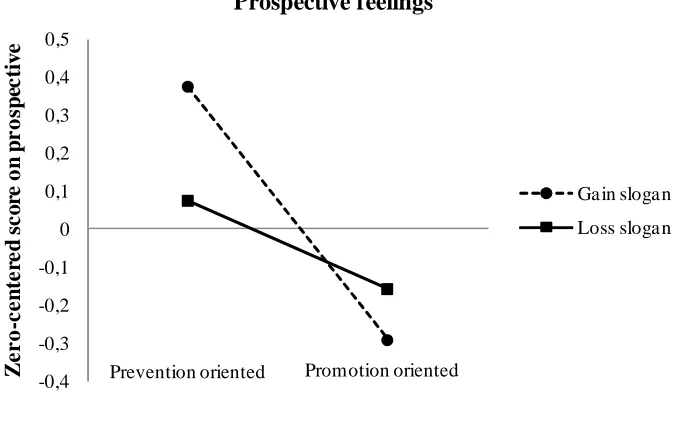
.05). In order to explore the interaction, the slopes of regulatory focus were examined. As
Figure 3 shows were the slopes for both the gain-framed message and the loss-framed
message decreasing, which means that prevention-oriented people had as well in the
gain-framed condition as well as in the loss-gain-framed condition more positive feelings about active
work commuting by EAB, compared to promotion oriented people. However, in contrast with
the hypothesis, the regression coefficients indicated a non-fit effect for the regulatory focus x
framing method interaction, which implies that for prevention oriented people, a gain-framed
slogan was the most effective and for promotion oriented people, a loss-framed slogan was
the most effective (Figure 3). Indeed, for prevention oriented people, a spotlight analysis at
one standard deviation below the mean of regulatory focus showed a significant difference
33 when exposed to the gain-framed slogan (β = .150, t = 2.106, p < .05). A similar spotlight
analysis at one standard deviation above the mean of regulatory focus showed no significant
difference (β = -.067, t = -.932, p > .10), which means that for promotion oriented people, it
[image:34.595.131.476.280.498.2]made no significant difference whether the slogan was framed in terms of gains or losses.
Figure 3
Zero-Centered Scores on Prospective Feelings, Regardless of Risk Reduction Condition
Risk reduction conditions. Subsequently to the overall analysis, separate regression
analysis were conducted to each of the four risk reduction conditions (i.e., physical-,
financial-, psychological- and time risk reduction) to see if different interaction effects appear
by exposure to different risk reduction conditions. The results showed that the expected
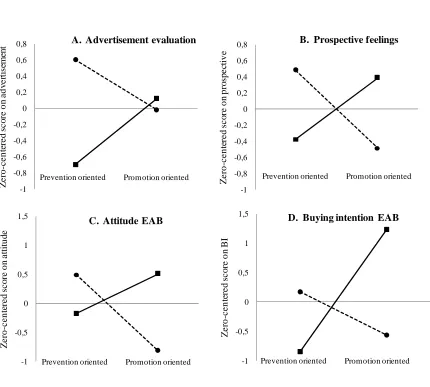
interaction effect was only found in the financial condition. Specifically, the regression
models were significant for prospective feelings (R²adjusted = .14, F (3,82) = 5.64 p < .01) and
marginally significant for attitude towards EABs (R²adjusted = .05, F (3,82) = 2.58 p < .10).
Regarding prospective feelings, the interaction effect was found to be statistically
significant (β = -.482, t = -3.591, p < .01). The slope of the gain-framed message was found -0,4 -0,3 -0,2 -0,1 0 0,1 0,2 0,3 0,4 0,5 Z e r o -c e n te re d s c o re o n p r o sp ec ti v e Prospective feelings Gain slogan Loss slogan
34 to be negative, while the slope of the loss-framed message was positive. The spotlight
analysis showed a significant difference at one standard deviation below the mean of
regulatory focus (β = .352 , t = 2.558, p < .05), which means that prevention oriented people
had more positive feelings about active work commuting by EAB when exposed to the
gain-framed message, compared to the loss-gain-framed message. Conversely, the spotlight analysis at
one standard deviation above the mean showed also a significant difference such that
promotion oriented people had more positive feelings about active work commuting by EAB
when exposed to the loss-framed message (β = -.334, t = -2.624, p < .05). In this way, the
regression coefficients indicated again the opposite direction (i.e., non-fit results in higher
scores). This means that feelings about active work commuting by EAB became more
positive when people were exposed to a slogan that was incongruent with their predominantly
regulatory focus.
Also regarding attitude towards EABs, there was a significant interaction effect found
(β = -.291, t = -2.536, p < .05). Similar to the effect on prospective feelings, the slope was
negative when exposed to the gain-framed message and positive when exposed to the
loss-framed message. However, the spotlight analysis showed not significant effects on both sides
of regulatory focus. For predominantly prevention oriented people, the attitude towards EABs
was significantly more positive when exposed to the gain-framed slogan (β = .250 , t = 2.125,
p < .05). For predominantly promotion oriented people, the attitude towards EABs did not
significantly became more positive, but however, became more positive when exposed to the
loss-framed slogan (β = -.164, t = -1.507, p > .10).
Hypotheses 1a+b and H2 a+b aimed to find evidence for regulatory fit theory. Since
the findings only show interaction effects in the financial risk reduction condition,
specifically for prospective feelings and attitude towards EABs, these hypotheses are not