J. exp.Biol. (198a), IOI, 187-an ^^th 9 figures
in Great Britain
LIMB MECHANICS AS A FUNCTION OF SPEED AND GAIT:
A STUDY OF FUNCTIONAL STRAINS IN THE RADIUS AND TIBIA OF HORSE AND DOG
BY CLINTON T. RUBIN* AND LANCE E. LANYONf •School of Veterinary Medicine, Tufts University,
North Graf ton, Massachusetts 01536 U.S.A. and f School of Veterinary Science, University of Bristol,
Park Row, Bristol BSi 5LS, U.K.
(Received 1 March 1982 - Accepted 25 June 1982)
SUMMARY
Rosette strain gauges were attached to the midshaft of the radius and tibia of two horses and two dogs, which ran on a treadmill through their entire range of speed and gait. The relative magnitudes of the principal strains on the opposite cortices of each bone remained constant through the stance phase of the stride, and their orientation varied by a maximum of only 140 through the entire speed range. The maximum strain rate increased linearly with speed, but the peak strain magnitude was also dependent upon the gait used, increasing incrementally by up to 59% at the transition from walk to trot, and dropping by 42 % from a trot to a canter. Force transducers attached to the shoes of one horse indicated similar changes in ground load.
The peak strains induced during vigorous activity are remarkably uniform in a wide range of animals. This suggests that the skeleton is scaled to provide constant safety margins between peak functional strains and those at which yield and ultimate failure occur.
INTRODUCTION
The primary role of the appendicular skeleton of terrestrial vertebrates is to provide rigid structures to withstand and transmit the loads involved in locomotion. The immediate consequence of these loads is to induce strains within the bone tissue. Since these strains can be recorded with strain gauges, suitably instrumented bones can be used as internal force transducers sensitive to the manner a*nd magnitude of limb loading. However, since bone is a tissue which adjusts its architecture in relation to its functional strain environment, these strains also represent the structural objective of this adaptive process. This objective is assumed to be an appropriate compromise between the form, mass, strength, and need for tissue economy, within the appendicular skeleton.
running on a treadmill. These data are considered in relation to the mechanics locomotion, and the functional significance of bone form.
Bone strain, locomotor mechanics and gait change
Cursorial quadrupeds increase their speed by using different gaits in which the movements of the trunk, and the relative timing of the support and swing phases of the limbs, are altered. Although the sequence of movements involved in these gaits has been described in detail (Muybridge, 1957; Gambaryan, 1974; Hildebrand, 1959, 1965, 1976; Gray, 1968), the specific mechanical and metabolic benefits of each gait remain controversial. Many previous studies have centred on measuring total oxygen consumption (Taylor, Schmidt-Nielsen & Raab, 1970; Taylor & Rowntree, 1973; Fedak & Seeherman, 1979; Hoyt & Taylor, 1981), which gives little indication of the distribution of muscle activity within the body, on qualitative EMG recording (Tokuriki, 19730, 1973 b, 1974; Taylor, 1978; Goslow et al. 1981), which provides information relevant to the electrical activity of the muscle but not the amount of tension it develops; on cinematographic analysis of the moments and forces acting about joints (Alexander, Langman & Jayes, 1977; Alexander, Jayes &~Ker, 1980; Alexander & Goldspink, 1977), which relies heavily on theoretical assumptions; and on force plate analyses (Pratt, 1976; Heglund, 1979; Cavagna, Heglund & Taylor, 1977; Alexander & Jayes, 1978), which are confined to whole animal or single limb contact forces. Data revealed by each of these methods alone is limited and can disguise or misrepresent the mechanical and metabolic benefits of gait change. To investigate these benefits directly it is necessary to know at all times each muscle's energy consumption, or its tension and length, either of which would be difficult to achieve. However, one consequence of tension is that it loads the bones to which the muscles are anchored. The normal pattern of limb bone deformation therefore results from (and can be used as a measure of changes in) the internal forces caused by the muscles as they react with the externally imposed forces originating from the animal's contact with the ground. Any alterations in the absolute or relative magnitude of these forces should be detectable in terms of the size and pattern of strains engendered within the limb bones.
In the experiments reported here, the bone strain data, which were obtained from the radius and tibia of horses and dogs over these animals' complete speed range on a treadmill, are examined in relation to the load distributions which occur in the limbs during each gait, and at each gait transition.
Bone strain and the functional significance of bone form
Limb mechanics as a function of speed and gait 189
H h e overall shape and anatomical relationship of the bone are genetically determinedand will develop in the absence of functional stimuli (Lanyon, 1980). However, its final form, mass, and detailed architecture are influenced by mechanical activity and are therefore a unique achievement for each animal. The features most greatly influenced by mechanical function are those with obvious structural significance, i.e. the presence and size of crests and tuberosities, the thickness of cortices, the amount and orientation of cancellous tissue, and the degree of curvature of long bone shafts.
Although the nature of the functional influences responsible for the production and maintenance of normal bone structure are not understood, the evidence suggests that they are derived from some aspect of the mechanical circumstances which the bone encounters (Wolff, 1870; Roux, 1895; Koch, 1917; Goodship, Lanyon & MacFie, 1979; Rubin & Lanyon, 1981; Hayes & Snyder, 1981; Lanyon et al. 1982). For the bones of cursorial quadrupeds, the predominant functional stimulus will almost certainly be provided by locomotion, and the structural objective of bone architecture in the limbs will therefore be related to the mechanical demands which this activity imposes. The strain data obtained from the experiments described here will be considered in relation to this structure-function relationship.
MATERIALS AND METHODS
Limb terminology during gaits
At any gait, each individual limb performs essentially the same action, slowing or increasing its relative motion according to the requirements of speed (Tokuriki, 1973 a, 19736, 1974)- The difference between gaits depends primarily on the sequence in which the limbs are placed on the ground. During the walk the principal support phases occur between either diagonally opposite, or ipsilateral, fore and hind limbs. Between these two main support phases, there are transient phases when three, or even four, legs may be touching the ground, but at no time are there less than two feet with ground contact. As speed at the walk increases, the limbs move faster until the animal changes from a walk to a trot. This gait consists of alternating support by diagonally opposite fore and hind limbs moving in phase with one another. Each diagonal support phase is separated by an aerial (floating) phase.
During the canter, the footfall pattern is changed so that the legs of one diagonally opposite pair move out of phase with each other while those of the other pair remain 'in-phase'. A single stride of the canter begins with the lead ('out-of-phase') forelimb, which throws the animal into the aerial phase. The animal lands on the diagonally opposite (out-of-phase) hind limb. The contralateral hind limb and its diagonally opposite (in-phase) forelimb make ground contact simultaneously in the same way that they did in the trot. As the stance phase of these diagonally opposite in-phase limbs ends, the out-of-phase lead forelimb is placed to the ground and provides the animal's sole support before it is propelled into the aerial phase of the next stride.
in-phase hind leg makes contact before the previously in-phase foreleg. A total four independent limb contacts are thus made with the ground, and in some animals the relationship of the previously synchronous (in-phase) pair of limbs becomes so extended that there is a second aerial phase between them. Although other animals use a variety of other gaits (e.g. rotary gallop, pace, bound, etc.), the four footfall patterns described above were the gaits normally exhibited by the animals used in these experiments.
Principles of strain measurement
When a structure is deformed, even in a very simple manner, the strain produced within it is complex. If a solid cube of isotropic material is compressed between two opposing faces, it will compress in that plane and stretch in the plane perpendicular to it. The ratio of the change in any dimension to the original dimension is the strain. At any point on the structure's surface there will be a principal compressive strain and, at right angles to it, a principal tensile strain. In these principal strain directions there is no shear strain. In any direction other than the principal directions there is a component of shear which varies in magnitude, but is maximum at 45 ° to the direc-tions of the principal tensile and compressive strains. If the loading pattern of the structure is complex, and the material is anisotropic, the relative magnitude of the principal strains will be affected as will be their orientation with respect to the direc-tion of loading. Despite this, the direcdirec-tion of the principal tensile and compressive strains will always remain at right angles to each other.
By attaching strain gauges to a structure's surface, the changes in dimension of that surface can be measured. The type of strain gauge used in this and previous in vivo studies on bone (Lanyon, 1973) is composed of an electrical conductor made of metal foil arranged as a grid mounted on a thin supporting epoxy-resin base. The base is glued to the bone surface so that the gauge element deforms with the structure's surface. The resulting change in the conductor's dimensions alters its electrical resistance and this change can be recorded. A single strain-sensitive element can only respond to changes in strain from the surface of the structure to which it is attached, and it is maximally sensitive to strains in the directions in which its grid is aligned. This severe limitation of single element gauges makes it necessary to use rosette strain gauges which are composed of three completely independent strain-sensitive grids. These grids are stacked over the same area and are aligned at zero, 45 and 900 relative to one another. Using the independent values of strain from these three directions, the changes in the size and direction of the principal strains can be com-puted using standard formulae (Dally & Riley, 1978). The alignment of the rosette gauge relative to the bone's princpal strain directions (or the bone's geometry) is unnecessary since the principal directions are calculated and corrected to the bone's long axis using radiographs or the isolated bone post-mortem.
Calculation of bone loads
Limb mechanics as a function of speed and gait 191
P981 b). The three components of load axial force, bending moment, and torsion -can be calculated from the strains by using the natural and sectional properties of the bone. In this study, the primary loading conditions of the bone were assumed to consist of axial force and bending moment. To determine the magnitude of these loads, the principal strains were first converted through a coordinated transformation matrix into strains in the longitudinal and transverse directions. From the relation-ships of these, the proportion of the total strain due to bending or axial compression can be calculated. Through a reduced stress matrix, the isolated longitudinal stresses necessary to produce these strains can also be determined (Carter, 1978).
The cross-sectional shape, area, and second moment of area of the horse bones were assessed from anteroposterior and lateral radiographs of the limbs. The dogs were killed after the experiment, and the bone dimensions were measured directly. With this bone geometry, bending moments in one plane and loads due to axial force can be calculated (Crandall, Dahl & Lardner, 1977). The axial force can be trans-formed to the weight-referenced gravitational force, and stresses due to axial force or bending moment can also be determined. A value of 18-2 GPa is used for the longitu-dinal elastic modulus, 12-2 GPa for the transverse modulus, and 0*46 for the Poisson's ratio of longitudinal stress/transverse strain (Lanyon, Magee & Baggot, 1979; Schryver, 1978; Carter, 1978).
Experimental procedure
Bone strain was recorded from rosette strain gauges, attached to the cranial and caudal surfaces of the right radial and tibial midshafts of two adult dogs (29 and 32 kg) and two adult ponies (147 and 138 kg), during locomotion on a treadmill. The gauges were attached under general halothane anaesthesia using a single medial incision over the bone's diaphysis and reflexion of limb musculature, exposing the cranial and caudal gauge sites without any muscle disruption. The bone surface was prepared by removing a small (10 mm2) area of the bone's periosteum, drying the exposed surface, swabbing it with methyl-ethyl-ketone, and then gluing the gauge to the surface with isobutyl 2-cyanoacrylate monomer. The lead wires from the gauge passed through a small epoxy resin flange which was anchored to the bone's surface some 30 mm from the gauges by a 1-5 mm diam. stainless steel screw inserted into a tapped hole in the cortex. The leads were passed subcutaneously and emerged through the skin at a remote incision. The wound was closed, and the lead ends then connected to a series of strain gauge bridge amplifiers via a standard six pin plug connector. The orientation and position of the gauges were determined from cranio-caudal and lateral radiographs. All the animals used were in good physical condition and had previously been trained to perform on the treadmill over their complete range of speed. Post-operative soreness had subsided sufficiently by 2 days after gauge implantation such that the animals were willing to run on the treadmill up to their previously determined maximum speeds without discernible lameness. While the dog radius and tibia were instrumented in separate operations, the ponies' tibias and radii were instrumented on the same occasion, allowing data from all 12 gauge elements to be recorded onto magnetic tape simultaneously. On at least one occasion, each animal's strain recordings were •tnchronized to cine film taken at 200 f.p.s.
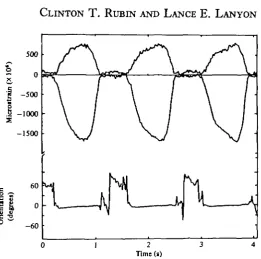
Fig. i. Peak principal tensile (upper trace) and compressive (lower trace) strain on the caudal surface of the radius of dog B, together with the orientation of the principal compressive strain in relation to the long axis of the bone, taken while the animal walked at 4-2 kph. While both the tensile and compressive strain magnitudes change quickly during the stance phase of the limb, the orientation of the principal strains remains remarkably constant.
Analysis of bone strain data
Calculations of the magnitude and orientation of principal strains were made from the 'raw' (3-element) strain data of at least six consecutive strides. The analogue strain gauge data from the F.M. tape was digitized through an A-D convertor and entered into a microprocessor. From these data, principal strain calculations were made at each speed at 5 ms intervals, and the magnitudes of principal tensile strain (%), compressive strain (ee), and their respective directions relative to the long axis of the bone (6et and 6ec) were fJlotted. The location of zero strain from each channel
of the changing strain gauge signal was adjusted to be zero volts by applying a suitable d.c. voltage off-set to the tape recorder output signal. Positions of zero strain from the gauge traces were taken to be the strain levels during the swing phase of the limb when the three gauges of the rosette showed little or no change in strain. These zero strain levels are identical to those occurring when the leg is lifted from the ground, or when the animals were anaesthetized and lying on their sides.
RESULTS
Changes in strain and strain orientation during a stride
Limb mechanics as a function of speed and gait
193 [image:7.451.107.336.45.297.2]0 1 2 Time (s)
Fig. 3. Similar data to that shown in Fig. 1, from the caudal radius of horse A taken while trotting at 8-6 kph. The constancy of strain orientation is again maintained throughout the stance phase of the limb, and is similar to that at different gaits.
change in raw strain in any element of the gauges, and this flat portion in the gauge traces is taken to represent zero strain (Fig. 1). As the limb is placed to the ground and the bone is loaded, there is a sharp increase in both the principal tensile (et) and
principal compressive (ec) strains, which reach a peak approximately midway through the stance phase. Both components of principal strain then quickly return to zero as the leg again enters the swing phase. The orientation of the larger principal strain (6ec) relative to the long axis of the bone is also shown. The direction of the smaller
principal strain (6et) is always 900 removed.
In all the bones instrumented, the principal compressive strain was the larger principal strain on the caudal surface and was closely aligned to the bone's longitudinal axis. On the cranial surface the principal tensile strain was larger in magnitude and oriented more closely to the bones' longitudinal axis than the transverse compressive strain. In all cases, the peak principal compressive strain (Pec) on the caudal surface
was larger than the peak principal tensile strain (Pet) on the cranial surface. This strain
situation is consistent with the predominant loading mode of these bones, i.e. axial compression with superimposed cranio-caudal bending.
In contrast to the abrupt changes in strain magnitude which occurred throughout the stance phase of the stride, the strain direction remained constant. The change in strain orientation during the loading period was always less than 4° from its orientation at the instant when peak principal strain was developed (Figs. 1, 2).
Changes in strain orientation as a function of speed and gait
| - 1 7 5 0
S. - 1 2 5 0 o o
- 7 5 0
o
S
10
10
1250
750
• •
Caudal A AA A A t • m 9
T TT • • J
• • •
Cranial
• • •
10 15 Speed (kph)
20 25
Fig. 3. Speed-related changes in the peak principal compressive strain on the caudal surface, and peak principal tensile strain on the cranial surface, of the tibia of dog A, together with their orientation to the bone's long axis. The peak strain magnitude increases 49 % from a w a l k ( 4 ) t o a trot ( A ) at 5 7 kph, but drops 33 % from a trot to a canter ( • ) at 121 kph, when the instrumented hind limb is out-of-phase with its contralateral forelimb. The data points from the three fastest speeds were obtained with the animal galloping ( © ) , and it appears that the peak strain magnitude plateaus at these higher speeds. The strain orientation on both cortices shifts by 13° at the walk:trot transition, but remains aligned with the bone's long axis throughout the rest of the speed range.
of the strain direction throughout the stride. The largest change in strain orientation throughout the animal's speed range was that recorded from the caudal surface of the tibia of dog A, which changed by 160 (Fig. 3). In this animal, the strain orientation shifted from io-8± (standard deviation) 170 proximal lateral to the bone's long axis at a slow walk (2 kph), to 16-3 ± 0-9° at the fastest walk (6 kph). At the same speed, transition to a trot reduced the longitudinal divergence to 37±o-6° and steadily shifted toward the bone's long axis as speed increased, until, at the fastest gallop (25 kph), reaching an orientation actually aligned with the bone's longitudinal axis (0-9 ±o-8°).
Limb mechanics as a function of speed and gait
195
8
Canter 23 kph
Fig. 4. Tracing from a cranio-caudal radiograph of the tibia of horse B. The size and orien-tation of the principal tension (<—•) and compression (» <) strains at the gauge site on the caudal aspect are indicated. The increase in size, but relative constancy in orientation of these strains is evident.
The loading orientation of the other experimental bones diverged very little through-out the range of speed, and remained closely aligned with the longitudinal axis. The standard deviation of the variance in orientation produced at any given speed was no greater than ± 2-3° for any animal (Fig. 4).
Changes in strain magnitude as a function of speed and gait
Dog tibia
The peak principal strains of dog A's caudal tibia were compressive and increased from - 702 ± S.D. 35 to - 1059 + 49 microstrain (jie) during walking at speeds ranging from 2-5-57 kph (Fig. 3). At the walk:trot transition, strain magnitude increased 49% to i58o±37/te and increased with increasing speed to -2006 ± 6 3 / ^ at the fastest trotting speed of 12*1 kph. This speed had been noted pre-operatively as the natural gait transition speed. At this speed, while cantering, the dog used a left leg lead, so that the instrumented right tibia was the ' out-of-phase' hindlimb. At the trot:canter transition, the peak principal strain dropped 33% to - 1348 ± 7 9 / ^ , and then increased linearly with speed to - 2016 ±<y) fie at 22-5 kph, at which time the dog was galloping. At the animal's maximum speed (247 kph) the strain had dropped
slightly to -i998±50/i€. The peak principal longitudinal strain on the cranial
surface of the tibia was tensile, but showed similar changes in magnitude with speed and gait.
Dog radius
The peak principal strain on the caudal surface of dog B's radius increased 19% at the transition from a walk to a trot (-1503 ± 63 to - 1800± 22 fie at 4-2 kph) and reached -2384 ± 4 9 / ^ when trotting at the trot:canter transition speed of 11-4 kph. Following transition to a canter at this speed, there was a 13 % drop in peak principal strain (to — 2087 ± 22 fie) when this leg was the non-lead leg. During the canter, peak principal strain on this in-phase forelimb increased with speed to — 2248 ± 41 fie at the fastest speed of 14-5 kph.
Horse tibia
The peak principal compressive strains on the caudal surface of horse A's tibia ranged from — 939 + 36 fie at a slow walk (4a kph) to — 3146 ± 65 fie at a fast canter (in-phase hind limb). During the walk, the peak principal strains increased with speed in a linear fashion to —1295 ±47 fie at 5-3 kph, the predetermined normal walk:trot transition point (Fig. 5). During trotting at this speed, peak strains were increased by 50% to —1943 ± So fie, and subsequently rose only slightly through the trotting speed range, reaching — 2395 ± 93 fie at 18-5 kph, which was the fastest trot attained.
Limb mechanics as a function of speed and gait
197
-3000
-2000 •
-1000 •
10 15 Speed (kph)
Fig. 5. Peak principal compressive strain from the caudal tibia of horse A (closed symbols) and horse B (open symbols). At 5-3 kph, both animals show a large increase in peak strains with the transition from a walk ( • ) to a trot (A). Strain levels remain fairly constant through-out the trot, despite an increase in speed from 5 to abthrough-out so kph. Horse A was capable of exten-ding each gait both above and below the normal gait transition speed. The data from this animal shows that at, or below, the normal transition speed (17 kph), there was no incremental change in peak strain when the animal changed from a trot to an in-phase canter (•) (the instrumented leg remaining in-phase with its opposite forelimb). However, above this transition speed there was a 10-15 % increase in peak strain when the animal changed from the extended trot to the canter. Horse B showed a similar incremental increase at the canter: extended trot transition. In both animals, peak strain levels appeared to plateau at high speeds. Horse A was trained to change lead legs as well as extend gaits. The lead change during the canter, such that the instrumented hind limb was out-of-phase with the lead forelimb, ( 9 ) , caused a large decrease in peak strain, identical to that measured in the tibia of dog A (Fig. 3).
speed during the canter when the tibia was in phase, and reached -3146±65/teat 25-1 kph, which was the highest strain recorded for horse A. The peak principal tensile strain on the cranial surface of the tibia rose in a similar fashion to +2350 +
- 2 7 0 0
h
X
1 -2000
i
- 1 3 0 0
* Trot
. • Walk
-T ^
•
*
1
-Lag-leg canter
Lead-leg canter
• * .
-1 -1 10 15
Speed (kph)
20 25
Fig. 6. Peak principal compressive strain (±s.R.) on the caudal radius of horse A (which would extend gaits and change lead). A 34 % increase occurred at the transition from a walk to a trot at the same-speed, while there was practically no change over a 15 kph increase in speed at the trot. Transition from a trot to a canter involved a reduction of 26 % when the instrumented forelimb was the non-leading leg, and 42 % when it was the lead leg (see also force-shoe traces, Fig. 7). At this point, strains during the canter were actually 16 % lowerthan those which occurred at the slowest walk. Peak strains at higher speeds appeared to plateau.
Horse radius
As in the tibia, the larger principal strains on the caudal surface of the radius were compressive and almost longitudinal. At the slowest walk (4-1 kph), the mean peak principal strain on the caudal surface was — 1777 ± 105 fie rising to — 1965 ± 58 fie at the walk:trot transition speed (5-5 kph) (Fig. 6). When trotting at this transition speed, the peak strains increased to 34% above the highest walking value ( — 26261 73 /ie). Strains fluctuated around — 2700 fie throughout the speed range at the trot, the largest strains for the radius of horse A being recorded midway through that trotting range ( — 2865 + 173 fie at 8-5 kph). At the fastest trotting speeds recorded (i8-6kph), the peak strains were —26711182/16. After transition to a canter at 13-7 kph, when the instrumented radius was the non-lead forelimb (in-phase), the peak strains dropped 26% from —2567114210 — 1911 + 12^ fie, rising to —23161 J7 fie at 19 kph. When the gait transition was such that the instrumented leg was the lead forelimb (out-of-phase), the drop in peak strains between a trot and a canter (at 13-1 kph) was 42%, to — 14941129 fie; i.e. 16% lower than the strains recorded for the slowest walk. The peak strain values for the lead leg levelled at — 2041199 fie (at 21-3 kph), dropping slightly while galloping to - 2 0 0 7 ! 139 fie at 25-2 kph.
Limb mechanics as a function of speed and gait
199500
-1000
..K.k.KA.K.KA. A K
-2000
8 <2
[image:13.451.36.415.46.242.2]Time ($)
Fig. 7. The upper pair of traces are the principal strains of the caudal aspect of the radius of horse A, analysed as she changed from a trot to a canter at a constant treadmill speed. The lower trace is from the load-sensitive force-shoe attached to the same forefoot one year after completion of the strain gauge experiments. The animal's trot: canter transition for these two separate events is shown at the same speed, 16 kph. The 4a % decrease in compressive strain at the transition is reflected by a similar decrease in peak force recorded from the shoe. peak strain value seen in horse A (which would not go faster) and reached — 2649
± 105 fie at the animal's maximum speed of 27-1 kph (Fig. 6).
Change in bone load with speed and gait
The principal strain data from the two rosettes on each bone were used to approxi-mate axial force and bending moment within the bone (DeLaura, Rubin & Lanyon, 1982). At the transition from a walk to a trot (at 5 kph) there was a 66% increase in the normalized axial force in the radius of horse A, while at the transition from a trot to a lead leg canter (15 kph) there was a 64% decrease. The comparable figures for the tibia of dog A were a 57% increase at the walk: trot transition, and a 57% decrease at the transition from a trot to an out-of-phase canter.
Estimation of ground forces with force shoes
Although there are several experimental advantages to treadmill locomotion, it has the disadvantage that ground force data is difficult to obtain from any floor mounted device. With horses, however, it is possible to incorporate load cells into modified shoes which can be nailed to the animal's foot in the normal manner (Pratt, 1980). A set of such shoes was constructed for the left forefoot of Horse A. These shoes had an epoxy-resin base attached to the ground surface into which 6 mm holes were drilled parallel to the ground at the metal/epoxy-resin interface. A split, hollow, stainless-steel cylinder with a strain gauge attached to its inner surface could be inserted into the hole, where it would be deformed proportionately to the loads applied to the ground.
Fig. 8. Trace of the principal tension and compression strains from the caudal surface of the radius of horse A taken during one stride at the trot. This data was recorded at 15 in/s and analysed at 1 ms intervals to ensure no transient response was being missed. The strain reversal which occurs during the period of increasing strain is commonly referred to as the ' impact spike'. These spikes did not appear on the dog traces.
of the force shoe signal was primarily, although not uniquely, dependent upon the size of the vertical force between foot and ground surface. When running on the treadmill, the size of these recordings followed exactly the same pattern as those of the surface bone gauges. The 42% decrease in surface strain on the radius at the trot:canter transition was mirrored by a 42% drop in deflexion of the horse shoes (Fig. 7). At the walk:trot transition, the bone gauges showed an increase of 34% where the force shoes demonstrated an increase of 32%.
Impact spikes
At the trot and the canter, a transient strain 'spike' appeared immediately following impact on the traces from gauges attached to the horses' radius and tibia. The peak magnitude of the spike was approximately 75 % of that of the actual peak principal strain (Fig. 8). While the 'spike' appeared on the analogue raw strain data, it was eliminated or attenuated on the processed principal data, which were taken at 5 ms intervals. Some high speed data from all animals and bones were taped at 15 ips and analysed at 1 ms intervals to ensure that no other transient response was attenuated on the FM tape. The 'impact spike' did not occur on the dog bones.
Loading and unloading strain rates as a function of speed
Limb mechanics as a function of speed and gait
2 0 1y = 2745 J C - 3 0 6 7 r = 0-95 0-08
0 0 6
| 0 0 4
0-02
[image:15.451.76.349.44.294.2]15 Speed (kph)
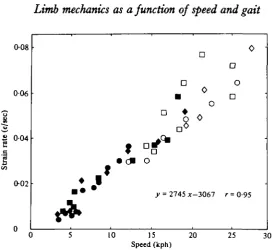
Fig. 9. The peak maximum strain rates (determined over 15 ms intervals) from the caudal surface of horse A's tibia ( • ) , horse B's radius ( • ) and dog A's tibia ( # ) . The rates deter-mined from cantering and galloping are shown as open symbols. These strain rates appear remarkably similar considering the different bones and the 5 x difference in animal mass. Despite the discrepancies in peak strains which occur at the gait transitions, the increase in maximum strain rate appears to be linear. The equation determining the line is given.
of the stance phase. Peak unloading rate was the sharpest decrease in principal strain, and occurred as the foot was removed from the ground. The highest strain rates were consistently on the caudal surface of either radius or tibia, on all animals. The strain rates on the cranial surface were less, in proportion to the smaller strain magnitude on these cortices. At the change from a trot to a canter, there was no consistent change in strain rate similar to that measured in strain magnitude. Indeed, the loading and unloading strain rates appeared to increase in a linear fashion relative to speed. A linear regression was therefore calculated and, with only one exception (horse A's radius), these lines represented the data with a confidence limit of P < o-ooi.
Fig. 9 demonstrates a typical relationship of strain rate vs. speed. For dog A's tibia the peak loading strain rate increased from 4479 fit. s"1 (microstrain per second) at the slowest walk, to 7721 /je.s"1 at the fastest walking speed. Transition to a trot at this speed increased strain rate 125 % to 17435 /ie.s"1. After this incremental increase, strain rate increased linearly with no incremental change at the trot: canter transition to 64060 fie.s-1 at the fastest galloping speed (25 k.h"1). The slope for this increase was determined by least squares fit to be:
y = 2649*— 2886, r = 0-97.
(This slope represents all the rate points, including those from the walk. It is possible that because of the comparatively few speeds recorded for walking that there is rela-tively little effect from the transition discrepancy. This is true for all the bones.)
radius. Again, a large discrepancy exists at the walk:trot transition (191 %), but thd correlation of the sloped linear fit over the complete speed range remains high. The equation of the line is similar to that for the dog tibia:
y — 2671X-2873, r = 098.
Considering the different masses of the animals (5*), and the different bones, the combined data for both animals give a remarkably high correlation coefficient:
y = 2665*-2938, r = 0-96.
A very poor correlation of strain rate to speed existed for horse A's radius (loading P < 0025; unloading P < o-i), and is perhaps a result of the extended gaits. However, horse A's tibia correlates very well with the strain rates measured from the other animals. The representative equation as determined by these points is:
y = 2894*-3450, r = 0-91.
The regression equation for data from the three animals combined is: y = 2746*-3067, r = 0-95.
Duty factor and stride frequency
There are various ways in which the decrease in peak strain and ground force seen at the trot:canter transition could be achieved without change in speed. During the canter, if each individual limb were to be in contact with the ground for a longer period relative to the entire stride cycle, this would allow more time for the necessary propul-sive force to be applied, and thus the peak ground force would decrease proportion-ately. However, measurements of ground contact time from the treadmill cine records in these experiments are in agreement with previous reports by other investigators, who have shown that, although duty factor changes significantly from a walk to a trot, there is no such discrepancy from a trot to a canter (Jayes & Alexander, 1978) (e.g. time of ground contact at the gait transition for dog A's tibia: trot = canter = 0-175 8 )-It has also been suggested that the change in gait is made to increase the average number of feet on the ground per stride (Pennycuick, 1975), which would also allow the required propulsive force to be applied over a longer period of time. However, in this experiment at least, there was no change in the average number of feet on the ground at the trot: canter transition (e.g. dog A, average number of feet on ground: trot = 1-47; canter = 1-50).
An increase in stride frequency following the transition to a canter would also allow a decrease in load, since ground contact per second would be increased. However, our data confirm that although stride frequency changes significantly from a walk to a trot, no change occurs from trot to canter (Heglund, Taylor & McMahon, 1974).
7)-Limb mechanics as a function of speed and gait 203
It appears therefore that the decrease in peak vertical force which we observed at the trot:canter transition was most likely associated with a decrease in the vertical dis-placement of the animal's centre of mass which occurred while the feet were still in contact with the ground (Cavagna, Heglund & Taylor, 1977).
DISCUSSION
Bone Strain and the Functional Significance of Bone Architecture
The strategies available for achieving the best compromise between tissue economy and mechanical competence in the skeleton are: (1) to regulate the manner and magnitude of skeletal loading; (2) to adjust the material properties of the tissue; (3) to adjust the mass and alignment of tissue present.
(1) Regulation of the manner and magnitude of applied loading
In the limb bones which we have investigated, the orientation of the principal strains and the ratio of their magnitudes on opposing cortices were maintained constant during the limb's stance phase, indicating a consistent mode of loading throughout the limb's period of ground contact. This mode of loading was also maintained through-out the animal's complete range of speed, regardless of change in gait.
Although the orientation and manner of loading were uniform throughout the animal's range of speed and gait, the peak load magnitude, and thus the peak strains achieved, were dependent upon the gait used. Large increases in peak strains occurred at the walk: trot transition, while decreases occurred at the transition from a trot to a canter. Thus, while coordination of muscle activity and external forces confines the orientation of loading within the skeleton, the sequencing of limbs and redistribution of muscular activity that accompany gait change permit increases in ground speed with regulation of the loading magnitude.
(2) Adjustment of tissue properties
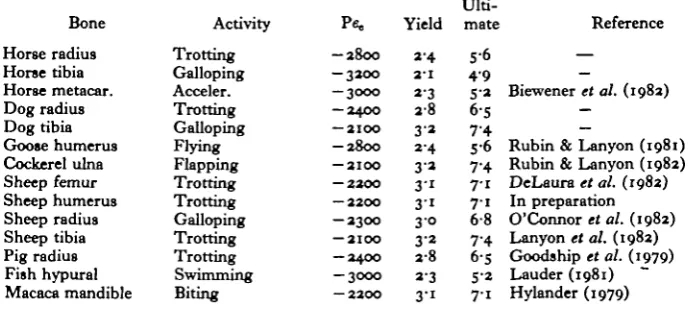
Table i. Peak functional strains measured from bone-bonded strain gauges in a range of animals, during their customary activity which elicited the highest
recorded strains
(The safety factors to yield and ultimate failure were calculated using values of 6800 and 15700 microstrain for yield and ultimate tensile strain, respectively (Carter et al. 1981 a, b, c.))
Bone Horse radius Horse tibia Horse metacar. Dog radius Dog tibia Goose humerus Cockerel ulna Sheep femur Sheep humerus Sheep radius Sheep tibia Pig radius Fish hypural Macaca mandible Activity Trotting Galloping Acceler. Trotting Galloping Flying Flapping Trotting Trotting Galloping Trotting Trotting Swimming Biting
- 2 8 0 0 — 3 2 0 0 — 3 0 0 0 — 2 4 0 0 — 2 1 0 0 - 2 8 0 0 — 2 1 0 0 — 2 2 0 0 — 2 2 0 0 — 2 3 0 0 — 2 1 0 0 — 2 4 0 0 — 3 0 0 0 — 2 2 0 0
Yield
2 4
2 - 1
a-3
2 8
3'*
2-4
3 »
3 ' i 3 1 3 0 3 2 2 8 a-3 3-1 Ulti-mate 5-6 4 9 5-a 6-5 7 4 5 6 7-4 7-1 7 1 6-8 7-4 6-S 5-2 7-1 Reference —
Biewener et al. (1982)
— —
Rubin & Lanyon (1981) Rubin & Lanyon (1982) DeLaura et al. (1982) In preparation O'Connor et al. (1982) Lanyon et al. (1982) Goodship et al. (1979) Lauder (1981) Hylander (1979)
one to eight (Alexander, 1981). However, peak functional strains recorded directly from a variety of animals indicate that these strains are remarkably similar throughout a wide variety of animals, and that the range of safety margins to failure is narrower than that previously predicted (2-1-3-1 safety margin to yield) (Table 1).
During normal activity, the skeleton is not only at risk from failure during single loading incidents, but also from fatigue damage following repetitive loading. The latest estimates of Carter et al. (1981a, b), made after repetitively loading machined samples of bovine and human cortical bone over a strain range in excess of 5000 microstrain, suggest that the fatigue resistance of bone is poor and predict that a strain range of 3000 microstrain would elicit a fatigue life of approximately 100 000 cycles. If Carter's suggestion is true, and the linear extrapolation of in vitro fatigue life into the physiological strain range is correct, then bone has no fatigue endurance limit, and the strain levels engendered during normal activity would cause sufficient damage to necessitate not only constant, but also substantial, intracortical and tra-becular remodelling in order to prevent complete fatigue failure. Although it seems probable that these fatigue predictions are too pessimistic, studies of peak functional strains and bone remodelling activity of migratory species, such as the gnu and gazelle which travel many thousands of miles in a few weeks, or swifts and geese which fly tens of thousands of miles every year, would be illuminating in this respect.
(3) Adjustment of mass and alignment of bone tissue
Limb mechanics as a function of speed and gait 205
Table 2. The percentage of total strain due to bending and the axial force/body weight (Gf) during locomotion in the tibia of animals of a widely varying size range (Data from the horse and dog are those presented here, those from the buffalo and elephant are extrapolated from Alexander (19796). In each case the strains due to the bending moment account for the largest proportion of the total strains. It appears likely therefore that bone architecture (girth, cortical thickness and curvature) is adjusted in relation to bone length, limb orientation, and style of locomotion in order to ensure similar strain magnitudet and proportions in a variety of animals (see Tables 1 and 3.))
% due to Bm Gf
Dog 84-4 + 3-5 3-6 Horse 83-5 + 25 a-8 Buffalo 81 3-0 Elephant 89 o-8
has the amount of bending during steady state locomotion been small enough for all cortical surfaces to be under greater or lesser degrees of compression (Biewener et al. 1982). The more common situation is that seen in the radius and tibia where the bones' neutral strain axes pass through the narrow cavity, thus placing the entire thickness of at least one cortex into longitudinal tension, and the other cortex into longitudinal compression. The percentage of total strain due to bending for the tibia of four animals (Table 2) shows that as much as 89 % of the total strain in this bone is due to bending.
Although external bending moments cannot be avoided, they could be minimized if the longitudinal curvatures which many bones characteristically develop were arranged so as to produce moments within the structure of an opposite sign to those externally imposed. Even if complete flexural neutralization could not be achieved by this means, any cancellation of bending moments should provide a definite struc-tural benefit. However, despite the apparent desirability of flexural neutralization by this means, the curvatures which many long bones have developed are not always directed towards neutralizing bending, but in some cases actually appear to increase it (Lanyon, 1980). In the horse radius at the time of peak strain, the bending moments induced at the midshaft by the bone's curvature are in fact greater than those produced by its eccentric loading and its angulation to the ground (Biewener et al. 1982). The structural advantages to such longitudinal curvatures would be hard to determine if the functional strains which bending creates were the purely deleterious phenomena which they would be in an inanimate material. It is possible, however, that in living bone intermittent strains may produce some physiological benefit, either to the metabolism of the bone's cellular population, or to the maintenance of their matrix on which the structural competence of the bone depends. Under these circumstances, a certain level of intermittent strain might be desirable, and strain regulation could be achieved by increasing or decreasing the bone's curvature according to its external loading situation. The idea that any feature of bone morphology might be specifi-cally designed to increase tissue strain is contrary to conventional ideas which have concentrated on the advantages of tissue economy and structural safety. It appears, however, that widely dissimilar weight-referenced axial loads, combined with different •oss-sectional geometries, thickness of cortices, and degree of longitudinal curvature,
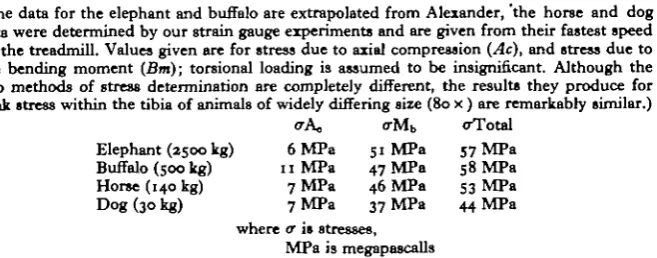
Table 3. Stresses calculated for the tibial midshaft of four quadrupeds during fast running
(The data for the elephant and buffalo are extrapolated from Alexander, 'the horse and dog data were determined by our strain gauge experiments and are given from their fastest speed on the treadmill. Values given are for stress due to axial compression (Ac), and stress due to the bending moment (Bm); torsional loading is assumed to be insignificant. Although the two methods of stress determination are completely different, the results they produce for peak stress within the tibia of animals of widely differing size (80 x ) are remarkably similar.)
(TA. ffMb <rTotal
Elephant (2500 kg) 6 MPa 51 MPa 57 MPa Buffalo (500 kg) 11 MPa 47 MPa 58 MPa Horse (140 kg) 7 MPa 46 MPa 53 MPa Dog (30 kg) 7 MPa 37 MPa 44 MPa
where <x is stresses, MPa is megapascalls
In both the dog and the horse, maximum strains in the radius occur at a trot, and in the tibia, the peak strain levels measured during trotting are achieved again only at the animal's fastest gallop. The maximum strains for any speed within the dog and horse tibia were used to determine the maximum stresses due to bending and axial compression. These stress values were then compared with those which Alexander et al. (1979 A,) calculated for large, fast running quadrupeds, using cinematography and limb dissection (Table 3).
The similarity in these data suggests that peak functional stresses within bone are more likely to be dictated by the requirements of the tissue than by any parameter of animal size or locomotory function. It further suggests that the skeletons of vertebrates are scaled to regulate peak functional stresses (a result of evolutionary pressure to maintain similar safety factors to failure), rather than preserving geometric (length/ diameter) proportionality (Alexander et al. 1979 a) or elastic similarity (McMahon,
1973.
1975)-Although relating bone architecture to peak functional strains appears the most relevant (and convenient) measure in relation to a bone's structural competence, it has been shown (O'Connor, Lanyon & MacFie, 1982) that the parameter of a strain regime which has the greatest influence in regulating bone mass is the rate at which the strain changes rather than the peak strains that are achieved. Thus, although the maximum danger to the bone arises from peak strains, the predominant factor which influences bone mass is the rate at which the strain changes. The association which naturally exists between high peak strains and high strain rates will therefore result in bone architecture being preferentially influenced by the strains encountered during periods of vigorous, rather than more sedentary, activity.
Bone strain, locomotor mechanics, and gait change
Limb mechanics as a function of speed and gait 207
consumption if some method of energy conservation or redeployment were involved.
For locomotion at any speed, oxygen is necessary to enable muscles to develop tension. However, the relationship between the amount of oxygen used, the work done, and the tension developed, is not a simple one. Tension may be developed within a muscle while it is shortening and doing positive work, while it remains the same length, or while it is being stretched and doing negative work. Since positive work is metabolically far more costly than negative work, it becomes advantageous for any particular muscle to maximize the relative amount of negative work which it has to do (Abbot, Bigland & Ritchie, 1952). The energetic cost of developing any level of peak tension will then be less, and the number of active muscle fibres necessary to achieve this can be reduced. In addition to the benefits of obtaining high tension levels cheaply, negative work provides the advantage that the energy stored within the muscle and tendon during stretching can be recovered elastically and contribute to movement at no additional metabolic cost. The extent to which this particular energy conservation strategy is used varies according to the location of the muscle and the gait which the animal employs.
When an animal is walking, there is little or no useful recovery of energy stored elastically within stretched tendons and muscles. Instead, metabolic energy expendi-ture is reduced because of the smooth exchange between potential and kinetic energy as the animal's centre of mass rises and falls, accelerating and decelerating, at each step. The saving which results from this transition can account for as much as 70 % of the propulsive energy required for forward movement during the walk (Cavagna, Thys & Zamboni, 1976; Cavagna et al. 1977).
At a trot in a quadruped or a run in a biped, there is an aerial period between each support phase. Maximum potential and kinetic energy are in phase at these gaits, thus eliminating the possibility of energy conservation by phasic interchange. However, on landing from the aerial phase, much of the animal's kinetic energy is converted to strain energy by stretching the tendons, ligaments and muscles within the limb. This strain energy is recovered elastically and contributes towards the propulsion into the next airborne phase. Presumably, it is the substitution of this form of mechanical energy conservation for that used in the walk which allows the transition to a trot to be accomplished without any incremental cost in oxygen consumption. This occurs even though the amount of work done increases due to an increase in the vertical dis-placement of the animal's centre of mass (Cavagna et al. 1977), which is clearly indicated by the substantial increase in skeletal strain at this transition.
during the trot. The lack of any discrepancy in bone strain rate over the trot: canted transition, despite a 40% decrease in peak axial load, suggests that the muscle loading rate, and thus also the fibre type population which is active, remains constant at that time, but that the active fibre number is reduced. This supposition is supported by glycogen depletion experiments, which demonstrate that some muscles in the limbs actually do less work during the canter than the trot (Armstrong et al. 1977).
The reduced limb bone loading, which we have shown to occur at the trot: canter transition in these experiments, reflects a coordinated reduction in both ground force and tension within the limb muscles. This drop could be predicted from appropriate substitution in the canine power output formulae published by Cavagna et al. (1977), and is consistent with their observation of a decrease in external work between cantering and trotting at the same speed. These bone strain and force shoe measure-ments are further supported by ground-mounted force plate recordings near the transitions, which also show a decrease in peak vertical force at the canter (Biewener et al. 1981). For the ground force to decrease at the transition while the animal con-tinues at the same speed implies a reduction in vertical movement of the animal's centre of mass during the period of ground contact.
CONCLUSIONS
Limb bone loading is the result of forces engendered within the muscles and forces originating from the ground. During treadmill locomotion these act together with the following results:
(1) A constant loading orientation of the bone is maintained during the stance phase of each limb and throughout the animals' complete range of speed and gait. This restricted mechanical environment provides a unique requirement (and should permit an economical solution) to the structural demands of steady-state locomotion.
(2) Peak bone loads increase incrementally at the walk: trot transition and decrease substantially at the transition from a trot to a canter. This decrease is most marked in the lead forelimb and the diagonally opposite hind limb. The decrease in limb bone loading is accompanied by a decrease in ground force. Since the manner of loading remains constant, this implies that fewer muscle fibres are active within the limbs at a slow canter than at a fast trot. Although probably not the sole purpose of the gait change, the decreased limb loading which occurs at this transition permits increased speed without progressive erosion of the bone's safety factors to failure.
(3) The bone's rate of loading and unloading increases linearly with speed. The slope and magnitude of maximum bone strain rate as a function of speed is similar in dogs and horses, for both radius and tibia. Since the osteogenic potential of a strain regime is determined primarily by this rate of change of strain rather than the peak strains achieved, the architecture of the appendicular skeleton will be primarily related to the loading situation during the animal's most vigorous activity.
Limb mechanics as a function of speed and gait 209 tones this regulation of peak functional strains is primarily achieved by adjustment of the bones' girth, cortical thickness, and longitudinal curvature in relation to their overall length. Scaling within the appendicular skeleton appears therefore to be related to peak functional strain levels within the bone rather than any criteria related directly to animal size, weight, or locomotory function.
The experiments described were performed at the Concord Field Station, Museum of Comparative Zoology, Harvard University. They would not have been possible without the help and support of C. Richard Taylor, its director, and his colleagues, particularly D. Hoyt, W. Brown, and A. Biewener. We also wish to thank M. Fedak, N. Heglund, G. Goldspink, R. McN. Alexander, and T. McMahon for valuable criticism of the manuscript at various stages.
REFERENCES
ABBOT, B. C , BIOLAND, B. & RITCHIE, J. M. (195a)- The physiological cost of negative work. J. Pkytiol, Lond. 117, 380—390.
ALEXANDER, R. M C N . , LANGMAN, V. A., & JAYBS, A. S. (1977). Fast locomotion of some African ungulates. J. Zool., Lond. 183, 291-300.
ALEXANDER, R. M C N . & GOLDSPINK, G. (1977). Mechanics and Energetics of Animal Locomotion. London: Chapman & Hall.
ALEXANDER, R. M C N . & JAYES, A. S. (1978). Vertical movements in walking and running. J. Zool., Lond. 185, 27-40.
ALEXANDER, R. M C N . , MALOIY, G. M. O., HUNTER, B., JAYES, A. S. & NTURIBI, J. (1979a). Mechanical
stresses in fast locomotion in buffalo and elephant. J. Zool., Lond. 189, 135-144.
ALEXANDER, R. M C N . , JAYES, A. S., MALOIY, G. M. O. & WATHUTA, E. M. (19796). Allometry of the
limb bones of mammals from shrews to elephant. J. Zool., Lond. 189, 305—314.
ALEXANDER, R. M C N . , JAYES, A. S., & KER, R. F. (1980). Estimates of energy cost for quadrupedal running gaits. J. Zool., Lond. 190, 155-192.
ALEXANDER, R. M C N . (1981). Factors of safety in the structure of animals. Sci. Prog., Oxf. 67, 109-130.
ARMSTRONG, R. B., MARUM, P., SAUBERT, C. W., SEEHERMAN, H. S., & TAYLOR, C. R. (1977). Muscle
fiber activity as a function of speed and gait. J. appl. Phyt. 43, 672-677.
BIEWENER, A., ALEXANDER, R. M C N . , & HEGLUND, N. C. (1981). The role of elastic storage in kangaroo rats during locomotion. J. Zool., Lond. 195, 369-383.
BIEWENBR, A., THOMASON, J., GooDSHiP, A. & LANYON, L. E. (1982). The stresses in the horse forelimb: a comparison of two experimental techniques. J. Biomech. (in the press).
CARTER, D. R. (1978). Anisotropic analysis of strain rosette information from cortical bone. J. Biomech. xx, 199-202.
CARTER, D. R., CALER, W. E., SPENGLER, D. M. & FRANKEL, V. H. (1981a). Cortical bone fatigue: the effect of strain range, stress range, and elastic modulus. Tram. Orth. Res. Soc. 27, 44.
CARTER, D. R., HARRIS, W. H., VASU, R. & CALBR, W. E. (19816). The mechanical and biological
response of cortical bone to in vivo strain histories. In Mechanical Properties of Bone. ASME Publ. AMD 45, 81-92.
CARTER, D. R., CALER, W. E., SPENGLER, D. M. & FRANKEL, V. H. (1981c). Fatigue behavior of adult cortical bone: the influence of mean strain and strain range. Acta. orthop. scand. 5a, 481-490. CAVAGNA, G. A., THYS, H., & ZAMBONI, A. (1976). The sources of external work in level walking and
running. J. Phytiol., Lond. 363, 639-657.
CAVAGNA, G. A., HEGLUND, N. C. & TAYLOR, C. R. (1977). Mechanical work in terrestrial locomotion: two basic mechanisms for minimizing energy expenditure. Am. J. Physiol. 333, 243-261.
CRANDALL, S. A., DAHL, N. G., & LARDNER, T. J. (1977). Introduction to the Mechanics of Solids, 2nd ed. New York: McGraw-Hill.
CURREY, J. D. (1979). Mechanical properties of bone tissue with greatly differing functions. J. Biomech. 13,313-319.
FEDAK, M. A. & SEBHERMAN, H. J. (1979). Reappraisal of energetics of locomotion show identical in bipeds and quadrupeds. Nature, Land. 28a, 713-716.
GAMBARYAN, P. P. (1974). How Mammals Run. New York: Halstead Press, Wiley.
GOODSHIP, A. E., LANYON, L. E. & MCFIE, H. (1979). Functional adaptation of bone to increased stress. 7- Bonejt Surg. 61A, 530-546.
GOSLOW, G. E., SKEHKRMAN, H. J., TAYLOR, C. R., MCCUTCHIN, M. N. & HECLUND, N. C. (1981).
Electrical activity and relative length changes of dog limb muscles as a function of speed and gait. J. exp. Biol. 94, 15-42.
GRAY, SIR J. (1968). Animal Locomotion. London: Weidenfeld and Nicolson.
HAYES, W. C. & SNYDBR, B. (1981). Toward a quantitative formulation of Wolff's law in trabecular bone. In Mechanical Properties of Bone. ASME publ. AMD 45:
43-°9-HEOLUND, N. C. (1979). Size and scaling in animal locomotion. Thesis, Harvard University. HEGLUND, N. C , TAYLOR, C. R. & MCMAHON, T. (1974). Scaling stride frequency and gait to animal
size: mice to horses. Science, N.Y. 186, 1112-1113.
HILDKBRAND, M. (1959). Motions of the running cheetah and horse. J. Mammal. 40, 481-495. HILDEBRAND, M. (1965). Symmetrical gaits of horses. Science, N.Y. 150, 701-798.
HILDEBRAND, M. (1976). Analysis of tetrapod gaits: general considerations in symmetrical gaits. In Neural Control of Locomotion (ed. R. M. Herman, S. Grillner, P. S. Stein & D. G. Stuart), pp. 203-236. New York. Plenum Press.
HOYT, D. F. & TAYLOR, C. R. (1981). Gait and the energetics of locomotion in horses. Nature, Lond. 292, 239-240.
HYLANDER, W. L. (1979). Mandibular function in Galago crassicaudatus and Macaco fascicularis: an in vivo approach to stress analysis of the mandible. J. Morph. 159, 253-296.
JAYES, A. S. & ALEXANDER, R. M C N . (1978). Mechanics of locomotion of dog8 and sheep. J. Zool., Lond. 185, 289-308.
KOCH, J. C. (1917). The laws of bone architecture. Am. J. Anat. 21, 177-298.
LANYON, L. E. (1973). Analysis of surface bone strain in the calcaneus of sheep during normal loco-motion. J. Biomech. 6, 41-49.
LANYON, L. E. (1976). Measurement of bone strain in vivo. Acta orthop. belg. 42, 98-108.
LANYON, L. E., MAGEE, P. T. & BAGGOTT, D. G. (1979). The relationship of functional stress and strain to the processes of bone remodelling. J. Biomech. ia, 593-600.
LANYON, L. E. (1980). The influence of function on the development of bone curvature. J. Zool., Lond. 193. 457-466.
LANYON, L. E., PAUL, I. L., RUBIN, C. T., THRASHER, E.L., DELAURA, R. A., ROSE, R. M. & RADIN,
E. L. (1981 b). In vivo strain measurements from bone and prosthesis following total hip replacement. J. Bonejt Surg. A63, 920-944.
LANYON, L. E., GOODSHIP, A. E.,PYE, C . , & M C F I E , H. (1982). Mechanically adaptive bone remodelling. A quantitative study on functional adaptation in the radius following ulna osteotomy in sheep. J. Biomech. 15, 141-154.
LAUDER, G. W. (1981). Structure and function in the tail of the pumpkin seed sunfish. J. exp. Biol. (submitted).
MCMAHON, T. (1973). Sixe and shape in biology. Science, N.Y. 179, 1201-1204.
MCMAHON, T. (1975). Using body size to understand the structural design of animals. J. appl. Phyt. 39, 619-627.
MUYBRIDCE, E. (1957). Animals in Motion, 2nd ed. New York: Dover.
O'CONNOR, J. A., LANYON, L. E. & MACFIE, H. (1982). Influence of strain rate on adaptive bone remodelling. J. Biomech. (submitted).
PENNYCUICK, C. J. (1975). On the running of the gnu and other animals. J. exp. Biol. 63, 775-799. PRATT, G. W. (1976). Force plate studies of equine biomechanics. Am. J. vet. Res. 37, 1251-1255. PRATT, G. W. (1980). Analyzing track characteristics. Thoroughbred Record a n , 771-776.
REILLY, D. T. & BuRSTEiN, A. H. (1974). The mechanical properties of cortical bone. J. Bonejt Surg. 56A, 1001-1022.
Roux, W. (1985). Ges Abhandlugen Ober Entunckiungtmechanik der Orgamsmen Bd. I. Funktionclle Anpasstmg. Leipzig.
RUBIN, C. T. & LANYON, L. E. (1981). Bone remodelling in response to applied dynamic loads. J. Bone Jt Surg. Orth. Trans. 5, 237-238.
RUBIN, C. T. & LANYON, L. E. (1982). Peak functional strain and fatigue properties in bone. Trans. Orth. Res. Soc. 7, 83.
SCHRYVER, H. F. (1978). Bending properties of cortical bone in the horse. Am. J. vet. Res. 39, 25-28. TAYLOR, C. R., SCHMIDT-NIELSEN, K. & RAAB, J. L. (1970). Scaling of energetic cost of running to
body size in mammals. Am. J. Physiol. 219, 1104—1107.
Limb mechanics as a function of speed and gait 211
AYLOR, C. R. (1978). Why change gaits? Recruitment of muscles and muscle fibres as a function of speed and gait. Am. Zool. 18, 153-161.
TOKUHIKI, M. (1973 a). Electromyographic and joint mechanical studies in quadrupedal locomotion. I. Walk. Jap. J. vet. Set. 35, 433-446.
TOKURIKI, M. (19736). Electromyographic and joint mechanical studies in quadrupedallcoomotion. II. Trot. Jap. J. vet. Set. 35,
5*5-533-TOKUHIKI, M. (1974). Electromyographic and joint mechanical studies in quadrupedal locomotion. III. Gallop, jap. J. vet. Set. 36, 121-133.
WOLFF, J. (1870). Die Innere Architekture der Knochen. Arch. Anat. Physiol. V. 50.
Woo, S. L-Y., KEUI, S. C , AMIEL, D., GOMEZ, M. A., HAYES, W. C , WHITE, F. C , & AKESON, W. H.