programming language
Steven te Brinke
January, 2011
A dissertation submitted to the University of Twente
for the degree of Master of Science
Department of Computer Science
Chair Software Engineering
Supervisors
Dr. ing. Christoph Bockisch
Dr. ir. Lodewijk Bergmans
1. Introduction 1
1.1. Goals and motivation . . . 1
1.2. Approach . . . 3
1.3. Results . . . 5
1.4. Outline . . . 5
2. Problem elaboration 7 2.1. Approach to evaluation . . . 7
3. Co-op language 13 3.1. Sending messages . . . 13
3.2. Structure . . . 15
3.3. Typing . . . 16
3.4. Classes . . . 17
3.5. Methods . . . 17
3.6. Dispatch . . . 19
3.7. Condition language . . . 24
3.8. Message rewrite language . . . 31
3.9. Constraints . . . 32
4. Composition operator construction 41 4.1. Static . . . 41
4.2. Event notification . . . 43
4.3. Multiple inheritance . . . 44
4.4. Other kinds of inheritance . . . 49
5. Co-op prototype 53 5.1. Limitations . . . 55
5.2. Performance . . . 56
6. Related work 59 7. Possible improvements 63 7.1. Method signature . . . 63
7.2. Annotation processor . . . 65
7.3. Binding scope . . . 66
7.4. Java integration . . . 66
7.5. Constraint fields instead of methods . . . 67
7.6. Message send success . . . 68
8. Conclusion 69 A. Differences with Java 73 B. Composition operators 77 B.1. Static method calls . . . 77
B.2. Dispatch optional . . . 78
B.3. Method inheritance . . . 79
B.4. Field Inheritance . . . 81
Glossary 83
1.1. Goals and motivation
Separation of concerns is an important concept in software development. Every soft-ware application consists of multiple concerns, examples are: what is to be computed, how the results are displayed, who is authorized to view the results, which data is logged, etc. Separation of these concerns allows a programmer to focus on a single concern, without having to consider everything at once [10]. During the software life cycle, concerns often evolve separately. Therefore, evolution scenarios are better supported when concerns are separated.
To separate concerns, software is typically decomposed in separate parts, called modules [6]. These modules are integrated in a coherent program by using com-position operators. Comcom-position operators are the language mechanisms which let programmers compose behaviour and/or data, defined as separate entities. Examples of composition operators are: function application, inheritance, delegation, pointcut-advice mechanisms, composition filters, etc. Function application allows the invo-cation of functionality defined separately—as a function definition—by using a call statement. Inheritance and delegation allow addressing fields and methods defined separately—as part of a super class or delegatee.
Depending on the situation, different composition operators are needed, but no
language provides all possible relevant operators. When a language does not provide a composition operator with the desired compositional behaviour, workarounds have to be used by the programmer. That is, introducing new operators by writing glue code, for example as macros, libraries, frameworks or language extensions. Often, these newly introduced operators are only partially integrated with the language. Therefore, its use might require additional glue code to be written, of which an example is
given in the next paragraph. Typically, such glue code solutions suffer from a lack of
maintainability.
As shown in [16], delegation is a composition operator that requires additional glue code when explicit language support is lacking. In object-oriented languages that do not support explicit delegation [25], similar functionality can be simulated by
forwarding calls from one object to another. However, when forwarding a call in this
way, theself orthisobject context changes from the object the call was originally sent
to—the interface object—to the object to which the call is delegated. In contrast, in
languages that support explicit delegation, theself context does not change when
dele-gating an operation. This difference leads to the so-calledself problemin languages that
do not support explicit delegation [25]. That is,self-calls within the object to which a
call is delegated, will always be handled by that object, rather than the interface object to which the call was originally sent (before being delegated). Although it is possible to work around this by passing the original interface object as an extra call parameter, this is an unsatisfactory solution. For example, this workaround necessitates changes
to the interface of affected methods, which also impacts other clients of the delegatee
(even if they do not use delegation but regular method invocation).
In addition, one of the motivations for using object-based languages is their built-in
support for object-based encapsulation, such as theself object reference. If the use of
self is restricted this limits the benefits of using a language that supports this primitive
in the first place. Thus, using workarounds might not allow the expressiveness of the language to be used to its full potential.
Following the problem that every composition operator supports only a limited set of evolution scenarios, our goal is to provide a composition infrastructure for defining such operators. Because defining a new composition operator might be a non-trivial task, we would not like to put this burden on every application programmer. Therefore, it is important that composition operators can be distributed as libraries, which can be used by many applications.
Composition operators are very important in the definition of an application, they are used at many places throughout the code. This means that their execution time can have a significant influence on the execution of the application as a whole. Therefore, not only the ease of defining new operators, also the possibility for applying optimiza-tions is important. Both concerns can be addressed by a declarative specification. The optimizations themselves are outside the scope of this thesis.
The composition infrastructure should:
• model composition operators as first-class entities
• provide a declarative way for defining composition operators
• allow composition operators to be composed again
• allow multiple composition operators to be used within the same program
• reuse the technology for defining application programs in composition operator definition
• allow composition operators to be distributed as libraries
1.2. Approach
To support the composition infrastructure described in the previous section, we have designed a programming language, Co-op. Its core object language and basic syntax are inspired by the Java programming language [14]. In Co-op, method calls and field lookups are modelled as message sends [30]. These message sends can be handled using several primitive elements, from which composition operators can be constructed. This is similar to the message handling presented in [16].
The primitive elements used by Co-op are bindings and constraints. A binding selects certain messages using a selector and then rewrites these to messages which— directly or indirectly—invoke the desired behaviour. Constraints are used to express dependencies and ordering among bindings.
To allow the flexibility to deploy new composition operators at runtime, Co-op is typed dynamically. This is because composition operators, which are applied dynami-cally, can change the structure of a class. For example, a composition operator might change the available methods on an object. Thus, at compile time it is unknown which methods will be available during runtime, making static type checking impractical; either it cannot guarantee safety, or it will be too restrictive by disallowing uncertain cases that are actually correct.
A first Co-op prototype, partly realizing our goals, was presented by Havinga [16]. The main concepts of his work are: expressive, first class composition operators which can be composed again. Building upon his work, our main contributions are:
More declarative selector language By introducing specific selector expressions,
selector expressions can invoke any method written in the turing-complete base code.
Improved definition of constraints Havinga [16] reused the constraints specified by
Nagy [26]. We introduce slightly modified versions of these constraints, increas-ing the expressivity of the constraints. For example, we decoupled orderincreas-ing and control constraints, which means that control constraints do not imply an order, but allow the programmer to specify the desired order.
Unifying method invocation and field lookup The mechanisms for method
invoca-tion and field lookup are unified by modelling field lookup as message sends, which is how method calls were modelled already. Allowing field lookup to reuse the functionality provided for method calls improves the expressiveness of defining composition operators.
Access to dynamic message properties Message rewrite can access the result
re-turned by executed bindings. Whenever a message send is dispatched to multiple methods, these methods can use the result returned by the previously called method.
Recursion avoidance in message selectors Because we allow using message sends
in selectors, it is easy to cause infinite recursion accidentally. In the most common case, Co-op can detect and avoid this unwanted recursion.
Most important about Co-op are its concepts, i.e. the denotational semantics of the language. We consider the concrete syntax to be of lesser importance. Even though quite a bit of thought went into designing the concrete syntax, the syntax for the core object model and basic expressions are borrowed from Java [14]. We believe that many concepts of Co-op can be written using a syntax based on any object oriented
language. An example of such a language, having a different concrete syntax, would
be Smalltalk [12].
1.3. Results
To show that our language supports modelling a variety of composition operators, we implemented several. As a test case, we used inheritance, because it is a diverse and well classified composition operator. From the 16 properties of inheritance presented in [28], we have implemented 10. Besides these, we also implemented singletons and static method calls, showing that not only inheritance is supported. All composition operators are implemented in separate classes, allowing reuse in any program. The implementations have been tested using the prototype.
1.4. Outline
The outline of the rest of this thesis is as follows.
Chapter 2 elaborates the problem, describing the goals of Co-op in more detail.
In chapter 3 we explain the Co-op language. After discussing the structure, the
different kinds of expressions are explained. The basic expressions are similar to the
ones in Java, so we only discuss the differences with Java. Our main contribution is
the dispatch. Therefore, we discuss dispatch in more detail, including the language features related to dispatch.
In chapter 4 we give several examples of composition operators implemented in the described prototype.
Chapter 5 discusses the implemented Co-op prototype, describing its features and limitations.
In chapter 6 our work is compared with related work.
Chapter 7 lists several features that did not make it into our language and discusses their pros and cons.
2.1. Approach to evaluation
In order to demonstrate the expressiveness of Co-op, we would like to show that many composition operators can be modelled in Co-op. Because every programming language has its own set of composition operators, having its own semantics, the number of available composition operators is too large to present a full overview. Inheritance is a subset of these operators, which is more clearly defined and still quite diverse [28]. Therefore, we use inheritance to test how much of it can be covered by Co-op. To show that Co-op is not limited to inheritance only, some other well-known composition operators will be shown too.
2.1.1. Inheritance
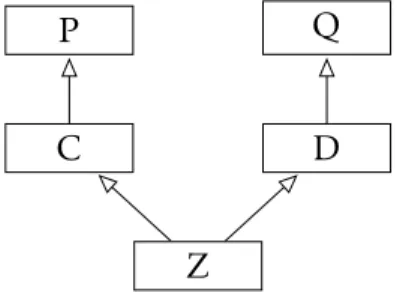
A detailed description of inheritance is presented by Taivalsaari [28]. In general, an inheritance hierarchy is a directed acyclic graph (DAG). A simple example of an inheri-tance DAG is shown in figure 2.1. Which DAGs represent valid inheriinheri-tance hierarchies depends on the kind of inheritance. According to Taivalsaari [28], inheritance has
eight main characteristics. This section will give a short description of these different
characteristics of inheritance.
Inheritance type Most object oriented systems are built aroundclasses, which are blueprints from which instances can be created. Another possibility are prototype
based systems. These systems have no classes, but are built aroundobjects. These
Z C
P
D Q
Figure 2.1.:Basic inheritance DAG
Turtle
heading forward
Pen
x y draw()
delegation self
(a) Delegation
Turtle
x y draw()
heading forward
Pen
x y draw()
self
(b) Concatenation
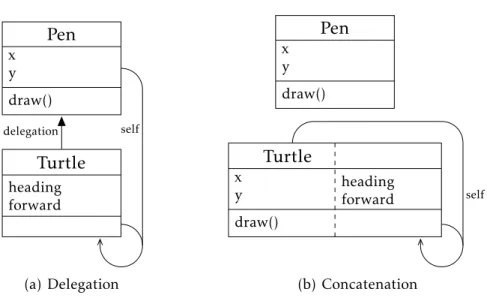
Figure 2.2.:Different sharing types
objects are prototypes providing default behaviour. Instances are created by cloning already existing prototypes. Inheritance can be achieved by modifying an individual instance, which then becomes a new prototype that can be cloned.
Sharing type In order to share common behaviour between objects, the relation between these objects must be expressed. Within computer memory, there are only two ways to express direct relationships: references and contiguity. This results in two
elementary strategies for inheritance: delegation, which uses references, and
concatena-tion, which uses contiguity. Often, common behaviour is shared by using delegation:
when an object receives a message it does not understand, it will delegate this message to those objects that have been designated as its “parents”. It is also possible to capture the essence of inheritance by using concatenation instead of delegation. Concatenation can be done by utilizing cloning together with the ability to add new properties to
objects dynamically. Figure 2.2 illustrates the storage difference between these sharing
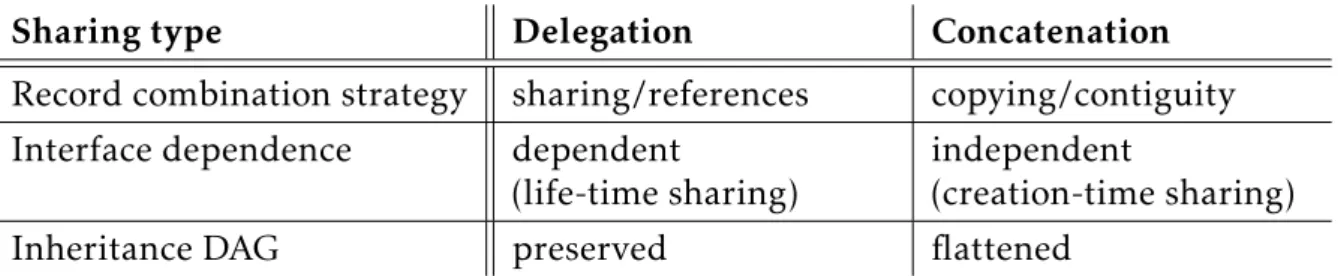
types for a Turtle extending a Pen. An overview of the differences between the two
sharing types is given in table 2.1.
Vertical combination In most main-stream object oriented languages, lookup pro-ceeds from the most recently defined (descendant) parts of the object to the least
recently defined parts (parents). This lookup order is called descendant-driven
Sharing type Delegation Concatenation
Record combination strategy sharing/references copying/contiguity
Interface dependence dependent
(life-time sharing)
independent
(creation-time sharing)
Inheritance DAG preserved flattened
Table 2.1.:Delegation versus concatenation
C P
start of lookup
delegation self
(a) Descendant-driven
C P
start of lookup
delegation self
(b) Parent-driven
Figure 2.3.: Different directions of lookup
traverses the inheritance DAG in the opposite direction. An illustration of these lookup directions is given in figure 2.3. As can be seen, in both situations is the inheritance direction the same—P extends C. However, the start and direction of lookup and also the direction of the self reference are opposite.
Besides the difference in direction, vertical combination can also differ in the
completion of method lookup. When the same method is defined as part of multiple classes in the inheritance DAG, calling the method can be handled in multiple ways.
Simplest is disallowing this situation, which disallows any overriding, calledstrict. The
most frequently adopted approach isasymmetric: terminating the lookup immediately
after encountering the first matching method. It is also possible to execute every
matching method. Thiscomposingcompletion is, for example, used by Beta.
When combining the different types of direction and completion, we have five
variations of vertical combination, which are shown in table 2.2. The inheritance
hierarchy for the columnx∈C∧x∈P is shown in figure 2.4. In this case,x is defined
as a member ofC andP, causing vertical overlap becauseP is an ancestor ofC. The
other two columns represent the situations without vertical overlap; herexonly is a
Z C
x
P
x
D Q
Figure 2.4.: Vertical overlapping
Z C
y
P
D
y
Q
Figure 2.5.: Horizontal overlapping
CextendsP x∈C∧x<P x∈C∧x∈P x<C∧x∈P
strict C.x error P .x
asymmetric descendant-driven C.x C.x P .x
asymmetric parent-driven C.x P .x P .x
composing descendant-driven C.x C.x◦P .x P .x
composing parent-driven C.x P .x◦C.x P .x
Table 2.2.:Variations of vertical lookup combination
Horizontal combination When the inheritance DAG contains overlapping
proper-ties along different paths, these properties are horizontal overlapping. An example
of such a hierarchy is shown in figure 2.5. By usingorderedhorizontal combination,
an order is defined among the different paths. This allows the execution of the first
matching property. When no such order is defined, i.e. the horizontal combination is
unordered, the presence of horizontal name collision is an error.
Multiple inheritance Single inheritance, for example provided by Java, only allows extending a single class. Multiple inheritance, for example provided by C++, also allows extending multiple classes. Thus, single inheritance limits the inheritance hierarchy to trees, whereas multiple inheritance allows the hierarchy to be any DAG.
Selective inheritance Not passing all information from the parent to the child is called selective inheritance. Two cases of selective inheritance can be distinguished:
selective attribute inheritanceandselective value inheritance [33]. Selective attribute
inheritance allows inheriting only a subset of the members of the parent object. Selective value inheritance provides the ability to inherit a subset of the values of the parent object. Thus, selective value inheritance is a kind of attribute inheritance where some values are the same for the parent and child object, whereas others—the
ones not using value inheritance—might differ.
Mixin inheritance Mixin inheritance provides the ability to write special mixin classes. These mixin classes are syntactically equivalent to normal classes, but have
a different intention. A mixin class is defined solely for adding properties to other
classes. Mixins are never instantiated and have no superclasses. By combining a mixin with a base class using multiple inheritance, the functionality of the mixin is added to the base class.
It is possible to combine every value for one characteristic with all other character-istics. However, some combinations might not be useful. For example, when using single inheritance, horizontal combination is not important, because only one parent is available. Which combination of characteristics is provided depends on the pro-gramming language. A few examples are: Smalltalk provides class-based, delegation based, asymmetric descendant-driven inheritance. Beta provides class-based, concate-nation based, composing parent-driven single inheritance. Java provides class-based, delegation based, asymmetric descendant-driven single inheritance.
2.1.2. Other composition operators
The semantics and syntax of the Co-op language will be elaborated in this chapter. The core object language and basic syntax are inspired by the Java programming language. However, we believe that many concepts of Co-op can be written using a syntax based on any object oriented language. Thus, we consider the concrete syntax of lesser importance than the semantics. Therefore, we will not elaborate all syntactic details and focus on the parts that are important for understanding the semantics.
3.1. Sending messages
In Co-op, every method call and field access is dispatched using message sends. This section will present the basic idea of message sends using a metaphor. The details of dispatch will be explained later in section 3.6.
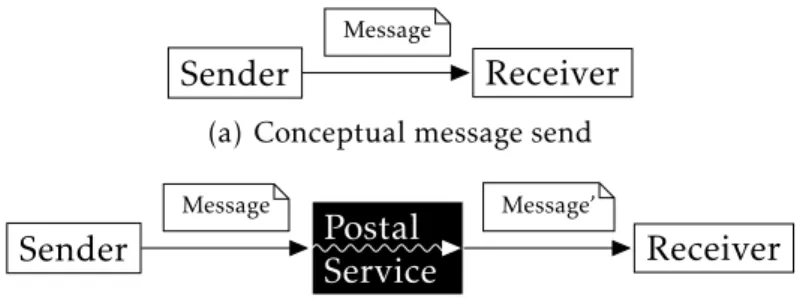
Sending a message to a friend can be as easy as writing his address on a postcard and putting it in the postbox. Then, we assume it will be delivered to the intended receiver as shown in figure 3.1(a). In general, we do not think about the intermediate steps of the message delivery. As figure 3.1(b) shows, the message will be handled by a postal service, which is a black box to us. The postal service can influence the delivery in several ways, of which we will give a few examples:
• When the intended receiver is on holiday, the postal service might reroute the message to his holiday address.
Sender Receiver
Message
(a) Conceptual message send
Sender Postal
Service Receiver
Message Message’
(b) Actual message send
Figure 3.1.:Sending a message
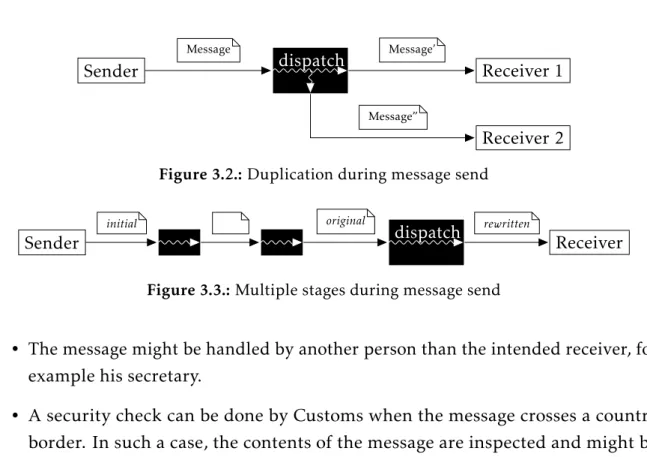
Sender dispatch Receiver 1
Receiver 2
Message Message’
Message”
Figure 3.2.:Duplication during message send
Sender dispatch Receiver
initial original rewritten
Figure 3.3.:Multiple stages during message send
• The message might be handled by another person than the intended receiver, for example his secretary.
• A security check can be done by Customs when the message crosses a country border. In such a case, the contents of the message are inspected and might be altered.
In any of these situations, there is a stakeholder that benefits from the ability to influence the message delivery process. In general, a consumer can easily subscribe to
and unsubscribe from the services offered to consumers, like the rerouting to a holiday
address, without thinking of the influence these subscriptions have on the process of the postal service.
In Co-op, message sends are handled similar to the process described above. The
message delivery process—postal service—is called dispatchand can be influenced
by programmers. A single influence—consumer service—is acomposition operator. A
composition operator can be activated and deactivated by an application programmer— which is similar to subscription by consumers. Ideally, an application programmer does not have to think about the dispatch once he has activated the right composition operators, in the same way we do not think about the process of the postal service.
Co-op does not have a clear distinction between the address and contents of a message—a message is more like a postcard than an enveloped letter. Any composition operator has access to the full content of the message. Thus, dispatch can influence the full message, like Customs can influence your full package.
we look at a specific dispatch, we say that the incoming message is theoriginal message
and the outgoing message is therewritten message. Theinitial messageis the message
originally sent. Further details of dispatch will be explained in section 3.6.
3.2. Structure
The structure of a Co-op class is similar to that of a Java class. Besides variables and methods, which are well-known members in object-oriented languages, Co-op also provides a declarative syntax to specify dispatch. Dispatch declarations never specify the full dispatch process, rather are always partial—like consumer services never influence the full process of a postal service.
An example Co-op class shown in listing 3.1. This class specifies a simple string prefixer. The class can be used as follows:
1 varprefixer = Prefixer.new();
2 prefixer.setPrefix("[mesg]");
3 System.println(prefixer.prefix("HelloWorld!"));
Executing this example will result in the following output:
[mesg] Hello World!
Examples of more advanced classes utilizing dispatch are shown in the next chapter.
A Co-op class can contain the following members:
• Variables: define the existence of fields like in Java.
• Methods: define methods like in Java.
• Conditions: define boolean conditions over messages.
• Bindings: define which message is bound to which dispatch.
• Constraints: define constraints between bindings.
Variable A variable declaration defines the existence of a certain field inside the
Listing 3.1:Simple Co-op class defining a string prefixer
1 classPrefixer {
2 varprefix;
3
4 methodsetPrefix(prefix) {
5 this.prefix = prefix;
6 }
7
8 methodprefix(str) { 9 returnthis.prefix + str;
10 }
11 }
Method A method definition defines a method signature and its body. Two methods with a single argument are specified in listing 3.1 (on line 4 and 8).
Binding A binding is structured as follows:
1 BindingName = (MessageSelector)
2 {
3 // Message rewrite
4 };
The BindingName is the name of the defined binding. The MessageSelector selects
which messages are influenced by this binding—for example only messages to a certain person. The message rewrite is used to change values of the message—for example rewriting the address to the holiday address of the selected person.
Constraint Constraints are used to express ordering and dependencies between bindings.
3.3. Typing
change the available methods on an object. Thus, at compile time it is not always known which methods will be available during runtime, making static type checking impractical; either it cannot guarantee safety, or it will be too restrictive by disallowing uncertain cases that are actually correct.
3.4. Classes
Co-op is a class-based language [32]. Thus, Co-op does not provide built-in inheritance, a concept used by object-oriented languages. Inheritance can be achieved by providing the desired dispatch, as will be explained later.
Co-op classes do not have a special constructor, but every class object has a method
which returns a new instance of its type. An instance ofSomeClasscan be created as
follows:
SomeClass.new();
Classes are loaded lazily in Co-op, like it is done in Java. When a class is loaded,
the method initializeClass() will be called. This method fulfils the role of a static
initializer.
In Co-op, everything is an object. Thus, Co-op does not provide separate primitive
types. The keywordnullreferences a single instance of the classcoop.lang.Null.
3.5. Methods
Co-op methods are identified by their name and number of explicit parameters. Besides these properties, every method utilizes a—possibly empty—set of implicit parameters. Implicit parameters are parameters which are implicitly passed to a method. A method definition must define all used implicit parameters explicitly.
Every message property is passed to the called method implicitly, if the method declares the use of this parameter. By default, every method has the implicit parameter
this. Which implicit parameters are used by a method can be defined by using the
annotation@ImplicitParametersas follows:
2 // Method body
3 }
Here, the method someMethod has two implicit parameters: this and thisJoinPoint.
These two parameters can be used in the same way and have the same scope as explicit parameters. At the call side, these parameters are not given to the method, shown in the following call:
someObject.someMethod();
From the perspective of the method body, the following method definition is equal to
the previous one, even though the signatures differ:
1 method@ImplicitParameters([]) someMethod(this, thisJoinPoint) {
2 // Method body
3 }
At the call side, this method differs from the previous one, because we have to pass
the parameters explicitly now:
SomeClass.someMethod(someObject, someJoinPoint);
Thus, we see that implicit parameters are implicit only in the way they are passed to a method. A method definition must define all used implicit parameters explicitly. The execution of a method is only possible if all implicit parameters are available, as will be explained in more detail in section 3.6.
Side note
In general, the use of implicit and explicit parameters differs. However, when we look closely at the semantics, we see that the differences are small. At the call side, we often assume that the arguments become explicit parameters, and the other properties implicit ones. However, this distinction is not very clear, because a binding can easily change this behaviour.
Further, we see in the examples above that implicit parameters can be passed to a method as explicit ones. This would only require a trivial change to the message rewrite:
parameters = [this, thisJoinPoint]
We can also change the method to receive the explicit parameters as implicit ones, in the following way:
2 varthis = parameters[0];
3 varthisJoinPoint = parameters[1];
4 // Method body
5 }
Thus, we see that the distinction between implicit and explicit parameters mainly is syntactic sugar. However, we think that the distinction is important to allow writing software applications easily.
The body of a method consists of the same expressions allowed by Java. The only
semantic difference is that field accesses and method calls are message sends. Besides
annotating elements which allow annotations in Java, it is also possible to annotate message sends. Details about these message sends are explained in the next section.
3.6. Dispatch
In Co-op, both method calls and field accesses are modelled as message sends. The dot is the message send operator, so message sends can be written in the following way:
this.someOtherField =
1
z }| {
this.someField
| {z }
2
;
this.someFunction()
| {z }
3
;
This code contains three message sends, namely:
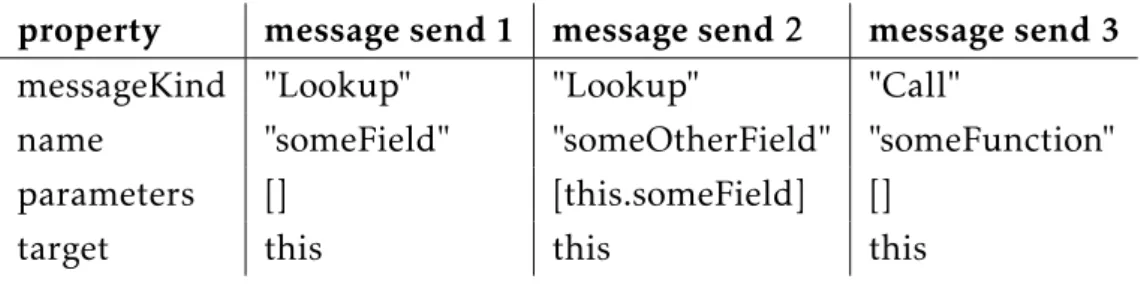
1. A message of the kind “Lookup” with name “someField” and no parameters,
which commonly results in a field read ofsomeField.
2. A message of the kind “Lookup” with name “someOtherField” and a single parameter, namely the value returned by message send 1, which commonly
results in storing this value in fieldsomeOtherField.
3. A message of the kind “Call” with name “someFunction” and no parameters,
which commonly results in the execution of the methodsomeFunction.
property message send 1 message send 2 message send 3
messageKind "Lookup" "Lookup" "Call"
name "someField" "someOtherField" "someFunction"
parameters [] [this.someField] []
target this this this
Table 3.1.:Example message properties
all three cases the target of the message isthis. Also, there is a sender property which
is initialized tothis. The common properties of a message are listed in table 3.2. The
default properties are initialized by any message send, the other properties might be undefined, depending on the context. For example, when a message is sent from a
static context—a context without athisreference—, the sender of the message will be
undefined.
An interesting message property is the set of call annotations. Annotations provide the ability to add additional information to a message send. These annotations can be added to every message send at the call side. Annotations can be added to a call as follows:
this.@SomeAnnotation @OtherAnnotation("SomeValue") someFunction();
Besides the listed properties, a message can have any property, because the avail-ability of properties can be influenced by message rewrites, which will be explained later. The default dispatch, explained in the next paragraph, uses certain properties of
the message, as shown by theusecolumn.
Side note
We have seen that message rewrites receive the original message and produce a rewritten message. Therefore, we have thought about providing the original message as a—possibly immutable—property of the rewritten message. In presence of recursive rewrites, bindings could access the original messages recursively, or only the initial message could be provided. However, in any case the relation between the original message and the rewritten message is defined by another rewrite, i.e. another composition operator. Thus, allowing access to the original message creates awareness of other composition operators which have been applied already.
name def. type use meaning (of initial value)
sender no any originating context (null iffstatic)
senderType yes Class type of originator
target no any F intended receiver (null if static)
targetType yes Class M type for method lookup
name yes String MF name of method to be invoked
parameters yes list ofany MF explicit parameters to be passed to the
method
messageKind yes {"Call",
"Lookup"}
MF whether the message should result in a
method call or a field access
annotations set of
Annotation
annotations of the call
this no any the original target (not used for selection,
but used as implicit parameter by many methods)
thisType yes Class the class of the original target (not used for
selection, but used as implicit parameter by methods)
result no any return value of last invoked method
error no any error thrown by last invoked method
Table 3.2.:Common message properties
composability. Therefore, we have decided not to provide access to the original message.
Default dispatch In order to achieve the common behaviour of message sends de-scribed at the beginning of this section, Co-op provides a default binding which achieves this behaviour. The default binding is always present, but only succeeds if the message addresses a declared method or field.
A message addresses a method if and only if (i) themessageKindis “Call” and (ii) the
targetTypehas a method namedname(iii) which has the same amount of parameters
as the length ofparametersand (iv) for this method all implicit parameters are defined.
method when defined as message properties. For example, most methods use the
implicit parameterthis, but it is possible to require any number of implicit parameters.
A message addresses a field if and only if (i) themessageKindis “Lookup”, (ii) the
targetTypehas a field namednameand (iii) the length ofparametersis (a) zero—field
get—or (b) one—field set. In the former case, the current value of the field will be returned. In the latter case, the value of the given parameter will be stored in the field and this value will be returned.
An overview of the properties used for addressing methods and fields in shown in
table 3.2. Theusecolumn shows what the default dispatch uses this property for. This
is for locating a method implementation (M) or a field instance (F).
We defined the default binding to be always present, but only sometimes successful. This is similar to saying a method call succeeds if and only if the called method is implemented. It is simple to imagine the default binding conforming to this definition:
1 bindingdefaultBinding = (true)
2 {
3 // The actual dispatch is performed: executing the method or accessing the field
4 // Only successful if the dispatch succeeds (i.e. method or field is defined)
5 };
Side note
Another possibility to look at method calls is by saying: a method call is only possible when the called method is declared and in that case, it is always success-ful. Using this view on method calls, the default binding would be defined to be always successful, but only present whenever an implementation exists. Using this definition, we would have an instance of the default binding for every method. An example for the methodSystem.printlnis shown below.
1 bindingdefaultBinding = (targetType == System & messageKind == "Call" &
name == "println" & arguments.length == 0)
2 {
3 // The actual dispatch is performed: executing the method or accessing the field
4 // Always successful
5 };
introducing other concepts of the language, like constraints, we will maintain this similarity between binding success and presence.
We saw that the first definition can be written as one generic instance, whereas the second one uses multiple parameterised instances. Because of the simplicity of understanding a single instance, we will use the first definition throughout this thesis.
Bindings Every binding consists of a condition, the message selector, and an assign-ment block, the message rewrite. The message selector specifies for which messages the binding is applicable. The message rewrite creates a modified copy of the message, which is then resent. This rewritten message will be processed by all applicable bindings, exactly like the original message send. A binding is successful if and only if the message send of the rewritten message is successful.
For multi-level dispatch in general and single inheritance in particular, we can easily see that this recursive definition of success is desired. When modelling single inheritance, messages are resent to the super class recursively, as long as no implemen-tation is present. Once an implemenimplemen-tation has been found, the call succeeds. Thus, the call succeeds if and only if at least one super class implements the method. We
will see later that more difficult situations, like Beta inheritance, can be modelled
using this recursive success as well.
Every bindingbis a special type of member of a classCand can access any property
pof classC. This general structure is shown in the listing below. Any instancecofC
has also an instancec.bof bindingC.b.
1 classC {
2 varp;
3 bindingb = (this.p) { . . . };
4 }
5
6 varc = C.new();
We see here that we can distinguish between a binding class, C.b, and a binding
instance,c.b. We talk about bindings when the distinction between binding instances
and binding classes is not important.
operator. For example, inheritance is modelled by several binding classes. So for every inheritance relation, instances of these binding classes are created.
Binding activation In order to use a binding, it must be activated first. The
activa-tion of a binding c.bcan be done by callingc.b().activate(). When the binding is no
longer needed, it can be deactivated by callingc.b().deactivate().
Message sends A message send succeeds if and only if at least one binding processes the message successfully. Whereas message resends are not required to succeed, in principle message sends written by a programmer are. In general, whenever a programmer writes a method call, he expects something to happen. Thus, the call should at least be dispatched to some implementation. If all bindings fail, the call cannot be dispatched to anywhere, so an exception is thrown.
However, if the programmer would like to signal an event which does not have to be handled, he can do so by adding an annotation to the call. For example, the built-in
annotation@ImplementationOptionalallows message sends which are not handled by
anyone. The working of this annotation is defined in Co-op itself, it is not part of the language itself, and will be explained in section 4.
3.7. Condition language
A condition is essentially a boolean expression over properties of the message. It can also execute message sends, for example to read fields of the object it is part of. Because in theory all message selectors, which are conditions, will be evaluated on every message send, it is important to allow optimization of these conditions.
Therefore, conditions should be free of side effects. When all conditions are side effect
free, the runtime environment can—without influencing the result of the program— omit evaluation of any condition if it has already identified whether this condition matches. Because message sends are allowed in conditions, Co-op can not guarantee
that conditions are side-effect free. This is the responsibility of the programmer. Co-op
does guarantee correct behaviour only if all conditions are side effect free.
the cheap comparisons first. However, in conditions it is quite difficult to identify which operators are cheapest, because every condition only specifies a small part of the dispatch. The programmer is unaware of the total dispatch. Therefore, the programmer should not try to optimize the total dispatch, the execution environment should perform these optimizations. An example of such an optimization could be utilizing a binary decision diagram of all activated selectors, which allows evaluating as few conditions as possible.
In order to optimize, the execution environment should be able to re-order the evaluation of primitive expressions which are part of conditions. Therefore, the programmer should not make assumptions about the evaluation order based on the order in which expressions are defined. To distinguish between the semantics of Java, which guarantees an evaluation order, and unordered behaviour, we use a
different syntax for the booleanand(&) andor(|) operators. These operators do not
guarantee the order of evaluation, or that the evaluation is performed lazily. Because
all operands are side-effect free, laziness does not influence the result, so it is an
optional optimization strategy.
When unordered evaluation is used, it is desired that expressions posses the Church–Rosser property [8, 31]:
If an expression can be evaluated at all, it can be evaluated by consistently using
normal-order evaluation. If an expression can be evaluated in several different
orders, then all of these evaluation orders yield the same result.
Boolean logic is not sufficient to guarantee this property for unordered evaluation,
because dispatch can fail and we do not require that all expressions are evaluated. Thus, some evaluation orders might fail, whereas others succeed, of which an example is given in the next paragraph. To ensure that all evaluation orders yield the same result, Co-op uses ternary logic [23] for evaluating conditions. This means that we
introduce an additional truth value:unknown. We can think ofunknownas a sealed
box containing either unambiguously true or unambiguously false. Some logical
operators can yield an unambiguous result, even if they involve anunknownoperand,
as shown in table 3.3.
An example of a condition requiring ternary logic when evaluation is unordered, is the following:
a b a∧b a∨b
true true true true
true false false true
true unknown unknown true
false true false true
false false false false
false unknown false unknown
unknown true unknown true
unknown false false unknown
unknown unknown unknown unknown
Table 3.3.: Example of ternary operators
When aequals null, it is clear that the condition should evaluate to false and that
dispatchinga.lengthwould fail. Using left to right short-circuit evaluation will result
inf alse∧. . .=f alse. However, we do not require left to right evaluation, so the given
condition is equal to:
a.length == 10 & a !=null
When evaluated in this order,a.lengthwill be evaluated first, which fails. Thus, without
the use of ternary logic, unordered short-circuit evaluation can yield different results
for different permissible execution orders. Therefore, we define the return value of a
failing dispatch to beunknown. Now, evaluation will result in:
unknown≡10 ∧ a.null
= unknown ∧ a.null
= unknown ∧ f alse
= f alse.
When looking at the unorderedoroperator, we see that the result of both orders is
also the same:
a ==null| a.length == 10
Using left to right short-circuit evaluation whenaequalsnullresults intrue∨. . .=true.
matching type operators lhs rhs
lazy &,| object object
normal ==, !=,<,>,<=,>= object object
annotation presence @==, @!= message annotation matching
expression
Table 3.4.:Binary selector operators
a.length == 10 | a ==null
Evaluation of this order will result in:
unknown≡10 ∨ a≡null
= unknown ∨ a≡null
= unknown ∨ true
= true.
Besides the operators explained above, a message selector can use normal binary operators and a special annotation operator. The possible operations are listed in table 3.4. The annotation operator is provided because annotations are an important property of messages, adding annotations is the way for programmers to add addi-tional information to a message send. In order to check for presence or absence of some annotation, use:
1 message @== @SomeAnnotation
2 message @!= @SomeAnnotation
Checking that the annotation has certain parameter values is also possible:
1 message @== @SomeAnnotation(name == "SomeName")
2 message @== @SomeAnnotation(priority > 4)
3.7.1. Recursion avoidance
messageKind == "Lookup" & target == this.child
This condition, used for defining inheritance, will generate a message send for reading
the fieldchild. In order to process that message, all message selectors, including the
one just given, should be evaluated. This will result in the same message send again, causing infinite recursion.
As said in the previous paragraph, message selectors are side effect free. Thus,
the evaluation of a message selectors does not change the state of the system. The behaviour of a message send is only influenced by the state of the system and the message itself. When message selectors generate messages recursively, the state remains the same. Thus, if the message being processed is generated again recursively, it will always result in infinite recursion, which is never desired.
To avoid this infinite recursion, we define that whenever during the evaluation of a message selector, a new message is generated which is exactly the same as any of the
messages causing the evaluation of this selector, the result of this selector isunknown.
This avoids the most common infinite recursion.
In the example given at the beginning of this paragraph, we see that now the
given selector will be cancelled for the message send for reading the field child, so
the field read can happen normally. This example is also shown in figure 3.4. The pieces of paper (rectangles with a folded top right corner) represent message sends. All bindings, drawn as rectangles, are matched against each message send. For all bindings, except the default binding, the applicability is defined by a selector. These selectors are shown as expression trees, where rounded rectangles depict the expressions. All constraints are shown as dashed arrows. In this figure, we have also shaded the recursion avoidance part part. The unshaded part is the desired message send, without recursion.
We see that recursion is detected when the second message is sent again. This detection—represented by the dotted arrow—cancels the message send. Therefore, the
result of the message send isunknown. As we can see, this causes the virtualBinding
to be unapplicable, allowing the defaultBinding to succeed, which is the desired behaviour.
The situation becomes more difficult when two instances,α andβ, of the
messageKind = "Lookup" target = . . .
virtualBinding
&
==
true
messageKind "Lookup"
==
target this.child
messageKind = "Lookup" target =α
name = "child"
succeeds
virtualBinding
unapplicable
&
unknown
==
true
messageKind "Lookup"
==
unknown
target this.child
unknown
messageKind = "Lookup" target =α
name = "child"
cancelled
defaultBinding
applicable
defaultBinding skip
skip
infi nit
ere curs
io
n
original message send
match all bindings
message selector evaluation
recursively generated message send
match all bindings
message selector evaluation
recursively generated message send
desired
handling
of
messag
e
send
recursion
av
oidance
Figure 3.4.:Recursion avoidance example forvirtualBinding =
messageKind = "Lookup" target = . . .
virtualBindingα & == true messageKind "Lookup" == target this.child
messageKind = "Lookup" target =α
name = "child"
succeeds virtualBindingα unapplicable & unknown == true messageKind "Lookup" == unknown target this.child unknown
messageKind = "Lookup" target =α
name = "child"
cancelled virtualBindingβ & == true messageKind "Lookup" == target this.child
messageKind = "Lookup" target =β
name = "child"
succeeds virtualBindingα unapplicable & unknown == true messageKind "Lookup" == unknown target this.child unknown
messageKind = "Lookup" target =α
name = "child"
cancelled virtualBindingβ unapplicable & unknown == true messageKind "Lookup" == unknown target this.child unknown
messageKind = "Lookup" target =β
name = "child"
cancelled
defaultBinding
applicable
defaultBinding
virtualBindingβ defaultBinding
skip skip skip skip skip skip infinite recursion infinite recursion infinite recursion
Figure 3.5.:Recursion avoidance example for two instances ofvirtualBinding
recursion. This mutual recursion can be detected and cancelled too, as shown in figure 3.5.
Side note
but is restrictive in the kinds of infinitive recursion which can be detected. This is caused by the requirement thatexactlythe same message should be generated recursively. Adding message properties for debugging or tracing might break this requirement. For example, adding a counter that counts the stage of the dispatch will cause all subsequent messages to have a different stage count. Therefore, recursion avoidance will never be triggered.
In fact, only the properties which are used in conditions are important for recursion avoidance. Thus, we could define recursion avoidance to only consider these properties for message equality. Because message selectors are declarative, it is possible to generate the set of properties used in conditions and use only these properties. However, using a system wide set is not desired. This is still restrictive, because most likely many other composition operators are loaded. These operators might use other properties than the operator to which the recursion avoidance applies. Another major problem is that recursion avoidance is now influenced by which composition operators are loaded. Thus, recursion avoidance might work fine when a composition operator is tested in isolation, but might fail when used in combination with other operators. This influence between composition operators violates the desired separation of concerns.
Another possibility allowing debugging and tracing could be to allow the pro-grammer to annotate certain properties as being unimportant for message equality. This way, it would be possible to create specific properties for debugging and tracing. Whether such a solution is desired is open for further research.
3.8. Message rewrite language
A message rewrite creates a copy of the original message, modifies it and resends this modified message. The modification of the copy can be done using assignments:
mySelector = message.name;
The left hand side of the assignment references a property of the new message which should be set. The right hand side is an expression, in this case a message send for
reading the fieldnameof the original message.
For annotations, special operators are provided, which can be used as follows:
message @+= @MyAnnotation;
The left hand side is alwaysmessage, as we are changing the annotations of the copy of
oper action
@+= Adds the given annotation to the annotations of the message.
@-= Removes the given annotation from the annotations of the message.
Table 3.5.:Annotation operators in action selectors
Side note
We also thought about providing the operation @=, which replaces all annotations of the message with the given one. However, we have not seen any use case of this operator and think that its use reduces the composability of composition operators. A composition operator should only influence the annotations which are important to this operator itself. If a composition operator removes all annotations, it cannot be composed with any other operator that requires any annotation.
Besides assigning values to properties, it is also possible to remove a property from the message:
removemySelector;
None of these operations influence the original message. Thus, even after removing a property from the rewritten message, it will still be available on the original message.
Side note
Whereas it is theoretically possible to resend a message without any modification, this will never be done in practice. Resending a message unmodified will always cause infinite recursion. Therefore, we can assume that every message rewrite modifies at least one message property.
3.9. Constraints
Multiple composition operators can apply at the same time. In order to express relations among these operators, we use constraints. Co-op models composition operators as binding classes. Therefore, constraints are expressed over binding classes.
A constraint specifies a relation between two binding classes. For example,pre(A, B)
specifies a precedence relation between binding A and binding B. The meaning of the
different constraints will be explained in this section.
constraints influence the execution order only, they do not influence what will be executed. Control constraints do the complement: they express what will be executed, without influencing the execution order. Nagy does not make this distinction, his control constraints can influence the execution order and vice versa. We explicitly decoupled these two concerns, because we think it is better to address them separately.
Binding presence and success are closely related, as shown in section 3.6. Therefore, we have chosen the constraints to have the same outcome on binding absence and failure. To achieve this, we use, from the constraints presented by Nagy, as ordering
constraint the softpreand as control constraints the hardcond and hard skip. This
results in the following constraints:
• p_pre(A, B) only allows the execution ofBwhenAhas been executed already or
will not be executed at all
• cond(A, B) only allows the execution ofBwhenAis applicable
• p_skip(A, B) only allows the execution ofBwhenAis not applicable
Transitivity Some constraints are not transitive. For example,p_skipis not
transi-tive:p_skip(A, B)∧p_skip(B, C) does allow the execution ofAandC or the execution
ofB(or any subset thereof). This might not be the desired behaviour, of which we
present an examples in the next few paragraphs.
Aprofessoris astaff memberat the university. Therefore, the university models a
professor as a subclass of staffmember, as shown in figure 3.6(a). Every staffmember
has the ability to make appointments, but in this example the professor has his own procedure for making appointments. In order to ensure that appointments are made using one procedure only, we use the following constraint:
constraintinheritanceConstraint = skip(defaultBinding, virtualBinding);
This ensures that whenever a professor has his own procedure for making an appointment—
the defaultBinding—, the procedure of a staffmember—the virtualBinding—will not
be used—it is skipped.
The university has assigned asecretaryto everyprofessor, as shown in figure 3.6(b).
StaffMember
makeAppointment()
Professor
makeAppointment() (a) Inheritance
Professor
makeAppointment()
Secretary
makeAppointment()
delegation
(b) Delegation
StaffMember
makeAppointment()
Professor
makeAppointment()
Secretary
makeAppointment()
delegation
(c) Combination of inheritance and delegation
Figure 3.6.:Combination of concerns that would benefit from transitive constraints
constraintdelegationConstraint = skip(delegationBinding, defaultBinding);
Whenever there is a secretary to which making an appointment can be delegated—the delegationBinding—, the professor will not try to make an appointment himself—the defaultBinding is skipped.
Both examples presented above represent a concern about professors. These con-cerns are described separately, but what happens when we combine them? This could, for example, result in the situations shown in figure 3.6(c), together with the constraints:
1 constraintinheritanceConstraint = skip(defaultBinding, virtualBinding); 2 constraintdelegationConstraint = skip(delegationBinding, defaultBinding);
When we try to make an appointment with a professor in this situation, andskipis
not transitive, the following happens:
1. The secretary will make an appointment for the professor.
2. Because the default binding fails, the virtual binding is not restricted by any
constraints, so the procedure defined for a staffmember is executed.
This means that the appointment is made twice, which is undesired. We can avoid this problem by adding the following constraint:
constrainttransitivityConstraint = skip(delegationBinding, virtualBinding);
With the addition of this constraint, the behaviour would be as follows:
1. The secretary will make an appointment for the professor.
• The delegation constraint causes the default binding to fail.
• The transitivity constraint causes the virtual binding to fail.
Now, the appointment is made only once, which is the desired behaviour. However, we had to add a constraint between two concerns: inheritance and delegation. Because we try to separate concerns, we would like to avoid the need to specify this constraint. This constraint is exactly the constraint that transitivity would give us. Thus, using a
transitiveskipconstraint can avoid the need to specify constraints between different
concerns. Therefore, we think transitive constraints are desired.
Because we consider transitivity a desired property, we call the non transitive
constraintsprimitive. This is denoted by using the prefixp_ before the names of these
constraints. The transitivity of the different constraints is explained below.
Cond The transitivity ofcond follows from its definition. Assume that we have
de-finedcond(A, B) andcond(B, C), then transitivity requires thatcond(A, C) holds. Only
whenAis not applicable andC is applicable,cond(A, C) would not be satisfied.
There-fore, we consider only situations whereAis not applicable. WhenAis not applicable,
Bcannot be applicable, because ofcond(A, B). Similar, C cannot be applicable, due
tocond(B, C). All these possible situation are listed in table 3.6. Thus, whenAis not
applicable,C is not applicable either. This means thatcond(A, C) holds, so we can
conclude:
A B C cond(A,C)
unapplicable unapplicable unapplicable holds
unapplicable unapplicable absent holds
unapplicable absent unapplicable holds
unapplicable absent absent holds
absent unapplicable unapplicable holds
absent unapplicable absent holds
absent absent unapplicable holds
absent absent absent holds
Table 3.6.:Possible situation whencond(A, B) andcond(B, C) are defined
Pre Forpre, this is different. By itself,p_pre is not transitive. For example, when
we definep_pre(A, B) andp_pre(B, C) andBis absent,p_pre(A, C) might not hold. A
possible execution order would be: hC, Ai. This execution order satisfies both defined
constraints, but not the constraint implied by transitivity.
However, we have definedpre to be transitive. This transitivity can be ensured by
calculating the transitive closure over allpreconstraints. When this is done, there is
no need to add any additional kind of constraint; everypreconstraint can be handled
as a primitive one. The result is:
• preis transitive: pre(A, B)∧pre(B, C)⇒pre(A, C)
Skip As we saw earlier,p_skipis not transitive, which might result in undesired
behaviour. Therefore, we also provide a transitive version of skip.
• skipis transitive: skip(A, B)∧skip(B, C)⇒skip(A, C)
In total, we have defined five constraints, all listed in table 3.7. However, we have
only three basic kinds of constraints, because the transitivepreandskipcan be defined
in terms of the primitive version of these constraints.
When there are conflicts between constraints, it can be impossible to identify which
bindings should be executed in what order. An example is whenpre(A, B) andpre(B, A)
Constraint Meaning
p_pre(A,B) Prioritizes execution of binding A over execution of binding B.
pre(A,B) Idem, but transitive.
cond(A,B) Allows execution of bindingBonly if bindingAis applicable.
p_skip(A,B) Skips execution of bindingBif bindingAis applicable.
skip(A,B) Idem, but transitive.
Table 3.7.:Constraints
defaultBinding virtualBinding
α β
skip
Figure 3.7.:Example of theskip(defaultBinding,virtualBinding) constraint in figure 3.5
3.9.1. Constraints handle binding instances
We have now seen the intention of the different constraints. However, because
con-straints are expressed between binding classes, they have to handle a set of binding instances at runtime. Thus, in order to define the semantics of constraints more precisely, we have to take into consideration that they work over sets.
An example of such a set can be derived from figure 3.5. In this situation, there are
two instances of the virtual binding,α andβ, and a single default binding. Between
the two binding classes, the following constraint is defined:
skip(defaultBinding, virtualBinding);
In figure 3.5, we see this constraint and the binding instances every time all bindings are matched, which is three times. The first occurrence, directly after the first message send, is most clear. What we cannot see easily from this figure is that there are only two binding classes and is a single constraint. This is shown more clearly in figure 3.7.
Using this notion of a set of binding instances, we define the precise semantics of constraints as follows:
• pre(A, B) only allows the execution ofβ∈Bwhen∀α∈Aα is applicable⇒α has
pre
pre
pre
Figure 3.8.:Working of pre constraint
cond
Figure 3.9.:Working of cond constraint
skip
Figure 3.10.:Working of skip constraint
• cond(A, B) only allows the execution ofβ∈Bwhen∃α∈Aα is applicable
• skip(A, B) does not allow the execution ofβ∈Bwhen∃α∈Aα is applicable
The semantics ofpre(A, B) are also shown in figure 3.8. It shows that all elements
from A, the left set, should have been executed before any element of B, the right
set, can be executed. Forcond(A, B) andskip(A, B) we see in figures 3.9 and 3.10 that
the applicability of any element fromAis enough to respectively allow or cancel the
execution of all elements ofB.
Thecondandskipconstraint both use existential quantification—∃α∈Aαis applicable—
rather than universal quantification—∀α∈Aα is applicable. This is motivated by the
similarity between binding presence and success. If we consider the shaded circle in figure 3.11 an unsuccessful bindings, both sets are similar. Therefore, we would like the constraints to have the same result on both sets. However, we see that only for the existential qualifier, the outcome is true regardless the used set. The universal qualifier will yield false for the left and true for the right set. Therefore, the existential qualifier is used for the definition of these constraints.
≈
3.9.2. Constraint activation
Only activated constraints are used by the runtime. Constraint activation is the same as binding activation. An example is the following the constraint:
constraintinheritanceConstraint = skip(defaultBinding, virtualBinding);
This constraint can be activate by calling:
inheritanceConstraint().activate();
Deactivation works similar:
inheritanceConstraint().deactivate();
It is possible to define many different composition operators in Co-op. In this chap-ter, we will explain three of these composition operators, to show how composition operators can be created.
4.1. Static
Static method calls are not a built-in concept of Co-op. However, it is easy to write
a static method call, because Co-op will load the class Static listed in section B.1
before executing any program. This class defines the composition operator for static method calls, which will be explained in this section. Some relevant code snippets from section B.1 are also listed in this section. When we do so, we use the line numbers from the full listing, so it is easy to locate the same code in the appendix.
Consider that we have the following class, defining a single method,someMethod,
which behaves like a static method:
1 classSomeClass {
2 method@ImplicitParameters([]) someMethod() {
3 // Some method body
4 }
5 }
Now we can executesomeMethodin the following way:
SomeClass.someMethod();
This call will result in the message send shown in figure 4.1 (irrelevant message
properties are omitted). The different steps in the dispatch are explained below.
The original call has targetSomeClass, which is an instance ofcoop.lang.Class
repre-sentingSomeClass. Therefore, the default binding will try to locate an implementation
of the methodsomeMethodincoop.lang.Class, which fails. Thus, the default binding
fails.
The classStaticdefines a single binding: