RESILIENCE OF ADOLESCENTS AS A RESOURCE OF ADAPTATION TO THE SOCIAL ENVIRONMENT
Elena V. Kuftyak
Nekrasov Kostroma State University, 1 May st. 14, Kostroma, Russian Federation
Abstract
Resilience of an individual is an indicator of his ability to develop, adapt and preserve the stability/balance in difficult situations. The first studies on resilience originate in child psychology and psychiatry. Contemporary authors define resilience as a dynamic process involving positive adaptation in the context of adverse living conditions. Resilience, vitality, self-regulation, coping behavior and psychological defense mechanisms influence the processes of human adaptation.
Senior high school students (the average age of 16 years) took part in our empirical study on teenagers’ resilience and social adaptation. A variety of methods for empirical data collecting were used: observation, expert interviews and test methods. We hypothesized that the resilience of adolescents is associated with indicators of social adaptation. The results of our study have confirmed an existence of relationship between resilience, social adaptation and social disadaptation.
First, we have found that the main causes of adolescents’ social disadaptation are: manifestation of anxiety and hostility to adults, impulsivity and failure to comply with social norms.
Secondly, the low level of the risk group’s resilience is determined by the lack of control over events and determination on choice making in difficult situations, including traumatic ones.
Therefore, resilience is an important resource for the adolescents’ development and social adaptation to environmental conditions.
Key words: Resilience, adolescent, social adaptation, resource
1. INTRODUCTION
Human ability to remain adaptive and successful in difficult circumstances is a guarantee of person’s wellbeing and health irrespectively of age. Human adaptation system’s functioning is impossible without such psychological phenomenon as resilience providing potential development and effective functioning of a person in adverse conditions as well.
In modern foreign psychology the shift of priorities from pathogenesis (aimed at detecting the origin and development of the disease) to salutogenesis (the system of concepts and positions focused on health and managing stress in adverse circumstances) allows research scientists and practicing psychologists to concentrate on identifying the factors which help a person or a group of people (a family) to reach positive adaptation and wellbeing (Nikol'skaja, Granovskaja, 2000; Kuftyak 2012). The resilience relation to psychology of health, humanistic and positive psychology makes its’ studying one of the top-priority psychology directions. In this context the considerable interest is represented by the issue of resilience as a process or the general ability or result (state) of successful adaptation, restoration and functioning in conditions of various stresses (daily, extreme and chronic). The issue of resilience is actualized be the fact that young growing generation being the social capital of society and answering modern changes of a macroenvironment and microenvironment appears to be the most vulnerable in present conditions (Rean 2006). It’s health and wellbeing in the future depend on resilience development and creation of the certain providing sustainability conditions. Thus the significance of this issue has both the theoretical and practical bases.
2. THE CONCEPT OF THE VIABILITY IN PSYCHOLOGY
The viability researches originate in the child's psychology and psychiatry. Back in the 70s of the last century scholars and practitioners drawn phenomenon of resistance in children at risk of psychopathology and developmental disorders due to adverse genetic or environmental influences. The attention of psychologists focused on identifying evidence that the same problems may have different consequences. Thus, M. Rutter notes, more than a half of children exposed to painful events, irrespective of their strength, not experienced the negative effects, in particular, they have not mentioned the development of mental disorders (Rutter 1999). Research in this area have turned many negative perceptions, as well as deficit-centered model of the development of the child living in disadvantaged circumstances. Initially, the ability to withstand stress was seen as an innate quality, like a miracle, like the ability, unique characteristic of children as psychological armor "invulnerable child", who was thought like a "steel doll" and impervious to stress (Anthony, Cohler 1987). Gradually came to the fore the question of the functioning of the human adaptive systems, which, in the case of normal operation, provide the conditions for the development process, in spite of the tragedy and trauma. The modern view on the viability gives us insight not only return to their previous state after the difficulties (the crisis), but the ability to develop into an uncertain future (Maddi, Harvey).
Investigation of the viability (resilience) in foreign psychology has a recent but rich history as recorded in the first longitudinal study of stability in children E. Werner and R. Smith (Werner 1993). The study was initiated by the authors in 1955 on the island of Kauai (Hawaii), and lasted for more than fifty years.
Emmy Werner, exploring the resistance to stress observed the fate of about 700 children from poor families of the multinational plantation workers on the island of Kauai Hawaiian archipelago. Two-thirds of children by the age of 18 had serious problems (poverty, mental disorders were observed, experienced early pregnancy, had problems in school and with the law), and a third of them were "competent, confident and caring adults", despite a number of negative circumstances of the physical nature and environmental influences. Psyche of the children identified as flexible. The term mental elasticity means that these children are adverse circumstances of life do not have any significant impact. Such children can be likened to "roly-poly doll," despite living in appalling conditions in troubled families, grew perfectly normal. In adult life, people with a flexible mentality became successful professionals, lived in a stable marriage and didn’t have any disorders.
In her work, the researcher identified four factors influencing to the differences between children at risk, who managed to successfully adapt and those that were not able to adapt: active problem solving; ability to perceive the traumatic circumstances constructively; the ability to stimulate a positive interaction with the other; the ability to accept and see the importance of events by faith.
Results of the study sustainability uncovered the influence on the destiny of man close relationships with friends and mentors (coaches, teachers) who supported their beginnings, believe in their potential and encourage them in an effort to achieve in life as much as possible. Thus, the lack of success of parents (parental alcoholism, mental illness, family disturbances) did not give opportunities for children to use the potential of the family, which could be to identify and develop, even in the case where the physical condition of the parents did not allow them to take an active part in the fate of the children.
This study served as a starting point for changing the view in the aspect of the influence on the family members and understanding of the characteristics of the family, which is experiencing a stressful event. Thus, the influence of the family on its members ceases to be perceived as threatening, each family member has the potential and power to restore and develop independently of the stressful situation.
F. Horowitz proposed a generalized model describing the interaction between the qualities of the child and the environment. This model assumes that the vulnerability or resistance of each child, on the one hand, and the presence or absence of "assist" the environment, on the other hand, are the main ingredients. Thus, stable child in a poor environment can be quite successful as a child is able to
benefit from all the available opportunities and impacts. Similarly, a vulnerable child can be successful in a stimulating environment. According to this model, only the collision of two extremes - a vulnerable child in a poor environment - leads to a really bad result (Bi 2004).
Currently, a systematic approach makes it possible to go beyond the system "parent - child" and to consider the influence of relatives, including siblings and distant relatives. This approach changes the view of the family, experiencing a stressful event: now the family is not perceived as destroyed and irreparably to recovery, and as a family that has faced with difficulties in life, but all the members have the potential for recovery and development.
Modern research suggests that social and biological components of sustainability are closely related. Psychologically viability refers to the physical ability to regulate hormones and other stress responses, quickly return to its original level when risk factors (stressful events) subside (Ozbay, Johnson at al. 2007). Other aspects of "sustainability" are: the ability to solve problems, the regulation of emotions, a sense of ownership of the situation and adequate skills.
Almost all studies of personality show that the profile of people demonstrating viability, has high rates for the five factors "Big Five - Big Five» (extraversion, emotional stability / sustainability, intellectual and cultural openness to experience, tendency to agree / friendliness, honesty / awareness) (Howard at al. 1996). A special interest is the emotional stability, social competence, analyticity, creativity, the ability to solve problems.
According to F. Ozbay, social isolation and low levels of social support show the negative impact on mental and physical health, in strength correlates with obesity or smoking (Ozbay, Johnson at al. 2007). On the contrary, the presence of social support is related to the reduction of emissions of stress hormones, which reduces susceptibility to negative influences.
In modern psychological works understanding of sustainability can neither be reduced to a universal nor a stable phenomenon. Individuals and families can be sustained in some areas and situations, and can not to show it in others, besides their ability to recover can vary over time (MacDermid, Samper at al 2008). Even showing absolute stability, individuals and families can not be completely immune to stress, they may suffer feelings and stress due to crisis situations.
3. STUDYING OF RESILIENCE IN RUSSIAN PSYCHOLOGY
In Russian psychology the term of “resilience” was introduced for the first time by B. G. Ananyev in the 50th years of the last century. According to B. G Ananyev, resilience is an initial component of the general working capacity which influences its manifestations, activity of intelligence and stability of orientation on realization of a goal. Along with working capacity, abilities and talents resilience belongs to the certain class of human development potentials. According to B. G Ananyev, all these potential properties "prove in the most different directions depending on the real process of person’s interaction with vital conditions of the outside world and upon the personality structure” (Ananyev 2001). The researches of this problem were concentrated generally on identifying the indicators of active longevity. The connection between talents and resilience was found in a number of studies.In classical works resilience is considered as the main potential of human development, the general acting human ability of effective functioning corresponding to the high level of vital functions.
In modern Russian science the concept of resilience in view of insufficient psychological commonality is used as an interdisciplinary concept (Kuftyak 2011). In a number of studies resilience is considered to be: a type of human resource (B. G. Ananyev); a system-wide mental property (E.A. Rylskaya); an integrated personality characteristic (A.I. Laktionova, A.V. Makhnach); vital principle (M.P. Guryanov); the characteristic reflecting quality of some functions answering for successful adaptive behavior (V.D. Shadrikov); the activity of the subject operating in the conditions of objective social determination within the set circumstances (K.A. Abulkhanov-Slavskaya).
The analysis of modern Russian literature allowed allocating a number of approaches to resilience research in psychology.
One of them is the approach considering resilience as a personality potential (Maddi, Harvey 2005). D. A. Leontyev entered the concept of "personal potential" which can be seen as a psychological analog of a the person’s vital core which reflects the measure of person’s overcoming the set circumstances, himself, and also the measure of ongoing efforts for work on himself and over life circumstances. According to D. A. Leontyev one of specific forms of personal potential manifestation is overcoming the adverse conditions of the self-development. These adverse conditions can be set by genetic features, somatic diseases as well as by external adverse conditions. The obviously adverse conditions for formation of the personality exist and they can negatively influence development of the person, but their influence can be negotiated, mediated, the direct connection can be broken due to introduction of additional measurements factors into this system, first of all the self-determination based upon the personal potential. One more theoretical approach to studying of resilience is based upon understanding of resilience as the special modality of consciousness (S. L. Rubenstein, K.A. Abulkhanov-Slavskaya) connected with its functional role in human life and characterizing its vital ability. Thus the consciousness which remains steady reflects social reality and can adapt the personality for it. It also as much as possible strengthens personality position, promotes its self-expression and self-realization. Due to static character of consciousness the protection function of the personality is carried out and its internal balance in difficult life situations remains stable.
The third is a cross-cultural approach, the most widespread in European and American psychology. It is based upon studies of scientists from different countries studying resilience and the ways of response to difficulties taking into account culture, sex, age, the region of residence, material level and a state of health. One of great international projects carried on by scientists from Canada, the USA, Russia, China, Israel, Tanzania Gambia and Colombia is the project "Methodological and contextual problems in research of the nursery and teenage resilience: the international cooperation in research of phenomenology of mental health of the children and teenagers in the group of risk".
The range of personal stability problems drew attention of many researchers. M. Tishkova studied psychological stability at younger school students and teenagers in difficult life situations of different types (Tishkova 1987). V. E. Chudnovskiy studied the moral stability of personality (Chudnovskiy 1981). N. N. Telepova developed the psychological model of personality resistance to addictive factors including set of spiritual values, norms and vital principles that establish the personal view of the world, and also the necessary knowledge and skills actualizing in situations of the addictive factors influence (Telepova 2012). L.V. Parfentyeva investigated stability of motivational states and the personality behavior on the sample of pedagogical discipline students in higher educational institutions.
A.I. Laktionova in her comparative study of resilience features and social adaptation in groups of adaptive and maladaptive teenagers has found that the personal properties connected with resilience and social adaptation of teenagers are: emotional regulation and motivation, the level of subjective control, self-assessment properties, coping and protective mechanisms, communicative features (domination/dependence in relations, acceptance/rejection of others). Among the reasons of teenagers’ social disadaptation A.I. Laktionova has distinguished: insufficient degree of expressiveness of the personal and behavioral characteristics which are positively connected with resilience and social adaptation and excessive expressiveness of characteristics, related with them negatively; lack of effective social support; low efficiency level of the environment resources use.
Developing the general-psychological concept of human resilience E.A. Rylskaya revealed the empirical criteria of resilience – "satisfaction with life" and "helplessness" as having the most constant dispersion in samples of examinees of different age regardless of ontogenesis stages specifics (lytic or critical). According to E.A. Rylskaya, "the self-actualizational potential" and "the spiritual involvement” act as integrative factors of human resilience (Rylskaya 2011). The first is interpreted in the context of openness of the personality resilience system which can be realized in the measure what the rigidness allows as a function of closing the system from external interactions. The second factor ("the spiritual involvement”) is viewed as a symptom complex of the person’s intrinsic properties that allow him to realize the resilience in the human way (unlike an animal). E.A. Rylskaya notes that the general indicator of resilience in age limits from 34 to 45 years remains as a rather constant measure. It
is possibly connected with the fact that formation of actual human resilience finishes by the conditional beginning of mature ontogenesis. And its subsequent development is connected not with further maturing of resilience, but with quantitative and high-quality transformations of its components in complete structure.
There is a number of studies on family resilience in Russian science as well: (table 1).
Table 1. The directions of resilience studying at the individual and group levels
Individual resilience Family resilience (group)
Development of the general-psychological concept of human resilience (E.A. Rylskaya)
The description of the family resilience factors at different stages of life cycle (E.G. Eydemiller, V. V. Yustitskis)
Identifying of stability of motivational states and the personality behavior on the sample of pedagogical discipline students in higher educational institutions (Parfentyeva, 2011)
Identifying of forms and factors of the young people premarital activity defining stability or instability of their family (D. V. Baranov)
Studying of interrelation between internal (personal, behavioral) and external (environmental) factors of teenagers resilience
(A.I. Laktionova, A.V. Makhnach)
The study on connection between characteristics of individual resilience and the indicators characterizing stability of a family (E.V. Kuftyak, M. A. Sizova)
The analysis of psychological stability at younger school students and teenagers in difficult life situations of different types (M. Tyshkov)
Studying of influence of number of children on stability of a family (N. V. Bogachyova)
Description of the psychological model of personality resistance to addictive factors (N. N. Telepova)
4. METHODOLOGY Participants of the study
The empirical study on resilience and social adaptation of adolescents involved students of 8-9 classes of secondary schools in Russia. Total sample size was 25 teenagers, the average age – 16 years. The used methodology
The disadaptation symptoms intensity were assessed by Stott’s programmable monitoring procedure. The Personality Anxiety Scale (PAS) (Prihozhan, 1983) was used to identify the level of social competence of adolescents, as well as the level of social competence in accordance with chronological age. Questionnaire “The Personal Views Survey” (Maddi 2003; adaptation Leontiev 2006) and Resilience Factors Scale (RFS).
5. RESULTS AND DISCUSSION
The participants were divided into two groups according to Stott’s monitoring procedure results. The first group consisted of "adaptive teenagers» (n = 14) and the second group of “maladaptive teenagers» (n = 11). To divide the participants into the groups we used the level of symptom-complex severity indicators. The group of maladaptive teenagers showed the following symptom-complexes: lack of trust in new people, things and situations; depression; emotional stress; anxiety towards the adults; restlessness. These data have proved that these children have to put a lot of effort in the
performance of any act or achieving success; they are characterized by low mood, lack of energy, low concentration and restlessness.
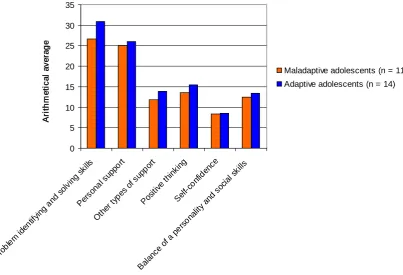
There were found statistically significant differences in indicators of the social competence severity in the groups. Such indicators as the development of randomness and social interests have much smaller quantitative intensity in "maladaptive teens" comparing with "adaptive teenagers." The "maladaptive teens" have a low level of social development that mismatches chronological age of the participants. Comparing the average values of indicators using the Resilience Factors Scale (RFS) procedure the following data were identified (Fig. 1): the skills of problem identifying-solving were less expressed in “maladaptive teens” group (U=11,000, at p=0,000), as well as positive thinking (U = 36,000, at p = 0,025), the balance of personality and social skills (U = 34,000, at p = 0.018), the appeal for different types of support (U = 20,000, at p = 0,001). Our study showed that “adaptive teenagers” get over the mental and emotional stress by the means of efficient coping such as "problem solving", "positive thinking" and "appeal to support".
0 5 10 15 20 25 30 35 Prob lem iden tifyi
ng a nd s olvi ng s kills Per sona
l suppo rt
Other types
of s upp ort Pos itive think ing Sel f-conf idenc e Bal anc e of a pe rsonal ity and s
ocial ski lls A ri th m et ic al av er ag e
Maladaptive adolescents (n = 11)
Adaptive adolescents (n = 14)
Figure 1. The average values of resilience components in groups of adolescents
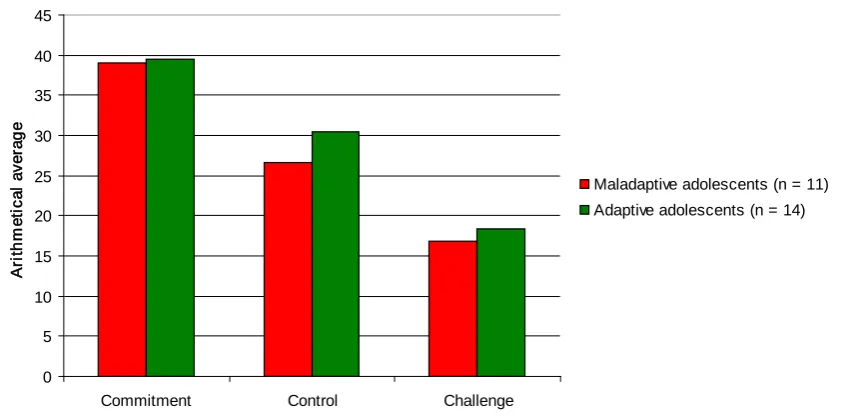
Using Mann-Whitney’s test we found significant differences in indicators of "control" in the studied groups of teenagers (U = 26,0, p = 0,004). The indicator of “control” was significantly higher in the adapted adolescents’ group (Fig. 2). It was also found that the level of hardiness manifestation in groups of adolescents tended to be different. The level of hardiness in maladjusted adolescents was significantly lower than that of the adapted group (U = 44,0, p = 0,061).
0 5 10 15 20 25 30 35 40 45
Commitment Control Challenge
A
ri
th
m
et
ic
al
av
er
ag
e
Maladaptive adolescents (n = 11) Adaptive adolescents (n = 14)
Figure 2. The average values of hardiness components in groups of adolescents
These data do not contradict the views of S. Muddy on the development of hardiness. Age-related changes in the hardiness manifestations are primarily associated with social factors such as the impact of resilient adults’ positive examples and learning how to keep emotions and behavior under control. According to our research the adapted teenagers are harder than the maladapted. Teens with behavioral disorders have a low social level comparing to well-to-do adolescents, they tend to feel a low level of social support and they are characterized by high tension in behavior and learning activities. These data allow predicting the lower mental health level of maladapted adolescents and it can be confirmed by a low level of their hardiness intensity.
To investigate the relationship between resilience, hardiness, social adaptation and social disadaptation we conducted a correlation analysis. The data obtained by Spearman's rank correlation confirmed the presence of the relationship between all indicators.
The study has found:
1. Presence of interconnection between resilience, social adaptation and social disadaptation. The higher the level of resilience, the lower the social disadaptation level and the higher the social adaptation level.
2. Resilience indicators are negatively connected with such disadaptation symptom-complexes as withdrawal and anxiety towards peers on the total sample of adolescents. These individually exhibited traits and behavior characteristics are caused by excessive anxiety, fearfulness, propensity for obsessive fears and self-isolation which do not help adolescents actively and independently resolve their stressful situations.
3. Considering the results of the study on interconnection between hardiness and disadaptation symptom-complexes the following data were revealed: the negative control bonds due to withdrawal, anxiety towards peers, anxiety towards adults’ acceptance, negative interrelations between hardiness and emotional immaturity of adolescents. We can confirm that hardiness in its manifestations is based upon the weaknesses and vulnerabilities demonstrated by maladaptive adolescents.
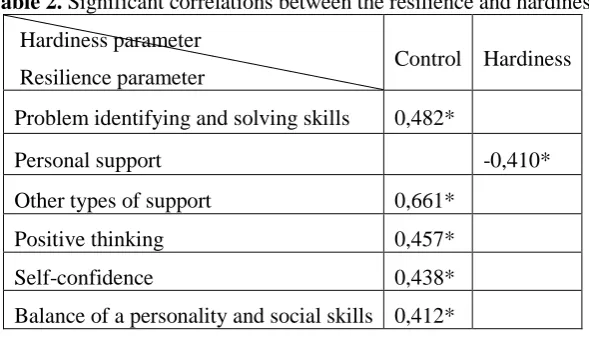
4. Resilience indicators associated with the control in adolescents and their hardiness include (Table 2): the skills of identifying and solving problems, support of an adolescent, positive thinking, self-confidence and social skills.
Table 2. Significant correlations between the resilience and hardiness Hardiness parameter
Resilience parameter Control Hardiness
Problem identifying and solving skills 0,482*
Personal support -0,410*
Other types of support 0,661*
Positive thinking 0,457*
Self-confidence 0,438*
Balance of a personality and social skills 0,412*
In our view, the person’s conviction that it is possible to influence the outcome of an event, regardless of the essential situation outcome, determines the human behavior’s productivity, his total energy potential and success in difficult situations.
6. CONCLUSIONS
In modern social, economic, demographic and environmental conditions an important factor of human adaptation to reality as well as personal self-fulfillment is resilience which characterizes person's ability to implement his resource potential and can predict his success in various fields of life.
Firstly, we have found that adolescents’ manifestation of anxiety and hostility to adults, impulsiveness and failure to comply with social norms can be the causes of their social disadaptation.
Secondly, disadaptation symptom-complexes negatively associated with indicators of resilience and hardiness are mostly expressed in adolescents at risk comparing to their adapted peers.
Thirdly, the low level of the risk group’s resilience is determined by the lack of control over events and determination on choice making in difficult situations, including traumatic ones.
Therefore, the low social adaptation level of maladaptive adolescents is defined by their low resilience, and, as a consequence - the lack of resources for social adaptation. Thus resilience is an important resource for the adolescents’ development and social adaptation to environmental conditions.
The study was supported by the Russian Foundation for Humanities, project 15-06-10198a
REFERENCES
Anan'ev, B. G. 2001, Man as a subject of knowledge, Piter, St. Petersburg.
Anthony, E. J., Cohler B. J. (Eds.) 1987, The invulnerable child, Guilford Press, New York. Bi, H. 2004, Child Development, Piter, St. Petersburg.
Chudnovskiy, V. 1981, Moral stability of personality, Pedagogy, Moscow.
Howard, P. J., Medina, P. L., Howard, J. M. 1996, The Big Five locator: A quick assessment tool for consultants and trainers, The 1996 Annual, Vol. 1., Preiffer & Company, San Diego.
Kuftyak, E.V. 2012, Factors of development of coping behavior in children and adolescents, Psikhologicheskie Issledovaniya, Vol. 2(22), p. 3, http://psystudy.ru (in Russian, abstr. in English).
Kuftyak, E.V. 2011, Psychology of family: regulation and defense, Nekrasov Kostroma State University, Kostroma.
MacDermid, S.M., Samper, R., Schwarz, R., Nishida, J., Nyaronga, D. 2008, Understanding and promoting resilience in military families, Military Family Research Institute, West Lafayette.
Maddi, S.R., Harvey, R.H. 2005, Hardiness condidered across cultures, Handbook of multicultural perspectives on stress and coping, Springer, New York, pp. 403–420.
Nikol'skaja, I.M., Granovskaja, R.M. 2000, Psychological defense of children, Book publisher “Speech”, Saint-Petersburg.
Ozbay, F., Johnson, D.C., Dimoulas, E., Morgan, C.A., Charney, D., Southwick, S. 2007, Social support and resilience to stress: Fromneurobiology to clinical practice, Psychiatry, Vol. 4, pp. 35–40. Rean, A.A. 2006, Psychology of personality adaptation. Analysis. Theory. Practice, Book publisher “Prime EVROZNAK”, Saint-Petersburg.
Rutter, M. 1999, Resilience concepts and findings: Implications for family therapy, Journ. of family therapy, Vol. 21, pp. 119–144.
Rylskaya, E. 2011, On the Issue of Human Psychological Vitality: a Conceptual Model and Empirical Results // Psychology. Journal of the Higher School of Economics, no. 3, pp.9–39.
Telepova, N. 2012, Psycho-pedagogical concept of the formation of psychological stability of personality to addictive factors, Avtoref. diss. … dokt. psihol. Nauk, [Abstract of Doctor’s thesis on Psychology], Nizhny Novgorod.
Tishkova, M. 1987, Investigation of the stability of the personality of children and adolescents in difficult situations, Voprosy Psychologii, no. 1, pp. 27–34.
Werner, E. E. 1993, Risk, resilience, and recovery: Perspectives from the Kauai Longitudinal Study, Development and Psychopathology, Vol. 5, pp. 503–515.