Page 178
THE DIMENSION OF SOCIAL PARTICIPANTS IN UNIVERSITY EDUCATION QUALITY Marija Stonkiene
Faculty of Communication, Vilnius University, Lithuania
Abstract
The paper discusses changes in higher education that made a great impact on external stakeholders growing interests in quality of research activities outcomes in universities higher education. These changes can be characterized by one significant dimension that is constantly growing - practicability of universities research activities outcomes. The need of adaptability of research outcomes in universities’ higher education industry is constantly growing, as well as the needs to meet interests of external stakeholders - social participants in higher education system. These two factors accelerate universities to develop and maintain the third mission - to develop its services to public society. All this along with the traditional universities missions - to ensure education and research benefits for states/societies as well as for markets/industries. These trends show that universities are aware of interests of social participants in higher education system. Therefore, universities strategic goals, activities and KPIs are developed closely related with interests of social stakeholders.
The research covers analysis of strategic plans of the best Lithuanian universities in order to point out universities activities that could have practical benefits in the market or for society. Universities strategic research activities which outcomes KPIs can be closely related with interests of social participants are also noted and considered as the dimension of social participants in university education quality.
Keywords: university, university mission, higher education outcomes, quality, external stakeholders, Lithuania
1. INTRODUCTION
Due to ongoing changes in higher education the quality of higher education is becoming more relevant to a wider range of entities - not only for academic community itself but also for the higher education stakeholders. The role of stakeholders in higher education is growing, but still there is a lack of attention to their interests.
The traditional higher education in Europe always used to be a part of state’s social policy with guaranteed state funding, while in United States of America was on the contrary (Demeulemeester, 2011). As industries started to contribute in higher education financing, diversification in higher education financing system rapidly increased. Respectively higher education starts to pay close attention to the interests of industries and markets. Society as well has legitimate expectation to the use of state’s financial resources. According to A. Lyytinen and others, all these changes led higher education institutions to accountability to stakeholders. And as stakeholders’ interests and priorities differentiate, it shapes interests and priorities of higher education institutions as well. Therefore, institutions must be up-to-date with the situation in industries and markets as well as with European Union and State policies that seek to constantly improve higher education quality and to assure close relations between higher education institutions, society and industries (Lyytinen et al., 2017).
Page 179
perceptions of quality affect approaches been applied to assure quality, and also different stakeholders think about quality in different ways (Elassy, 2015; Udam and Heidmets, 2013). As Burrows and Harvey marked the important role of stakeholders in higher education, they also noted that every stakeholder has a different opinion about the quality and plays under by his or her own interest in higher education (Burrows, Harvey, 1992). While Razavi et al. declares that customer or stakeholder satisfaction is the ultimate goal to achieve quality in higher education, the definition of higher education quality becomes strongly related with needs and expectations of stakeholders (Razavi et al., 2012). This type of definition lets researches conclude that higher education quality goes hand in hand with interests and expectation of stakeholders (Harvey, L. and Green, D., 1993). A huge amount of research work emphasizes a great variety of stakeholders needs or expectations on higher education quality (Pham and Starkey, 2016). And that lets to the fact that quality of higher education has many aspects, not one - that stakeholders’ interests and expectations are the only real one dimension in higher education quality. Therefore, it can be stated that in universities higher education quality outcomes can be developed by many subjects - local and external stakeholders. The stakeholder satisfaction from the conceptual framework in quality management is the leading criterion for determining the quality of the product/service offered (Ganguli, Roy, 2011; Pizam et al., 2016). This means that stakeholders not only play an active role in definition of higher education quality, but also become so-called judges for higher education research outcomes. Researches note that stakeholders play different roles in higher education system, therefore it can be summoned that opinions about higher education and its quality differs as well (Leišytė and Westerheijden, 2015).
Usually researches about external stakeholders role in higher education quality speaks about stakeholders role in processes of quality management, assurement and control (Rosa and Texeira, 2014; Westerheijden, 2014). In this study analysis of interests of external stakeholders’ roles was not taken.
The research focus on practicality of results of external stakeholders’ interests and its impact on evaluating higher education quality in universities. When relations between markets and higher education emerged and keep developing, it is natural to say that external stakeholders take more important roles in research outcomes quality in higher education quality definitions. Therefore, this study aim is to identify the dimension of special external stakeholder group (in abstract, in this study they are called social participants of higher education, here and after - social stakeholders) in university education quality. To abstract a group of social participants is excluded from overall external stakeholders in order to evaluate its given different value in markets relations. How this group of social stakeholders plays and impact quality outcomes of traditional universities missions and how they change the third universities mission. The dimension of social participants in university education quality is analyzed on the background of stakeholder-focused in higher education quality theory, according to which external stakeholders are integral multi-customers group in higher education system that define quality of the system itself. This theory is chosen due to the fact that customer-oriented aspects are very strong in markets relations. The idea of customer-customer-oriented aspects got a lot of attention and approval between researchers in discussions about higher education quality (i.e. Boksberger and Melsen, 2011; Gallarza et al., 2011; Sánchez-Fernández and Iniesta-Bonillo, MA, 2007 et al).
Page 180
enhancement. Universities in Lithuania are encouraged to cooperate with interested parties, and as a result stakeholders’ interests on higher education quality become more relevant.
In the first part of the study outcomes of higher education system in universities are discussed. Major changes that were caused by relations with markets which led to distinguish specific group of stakeholders - state/society and market/industries - are also concerned. Interests of these external stakeholders become more and more relevant and therefore it should be highly concerned in the context of outcomes quality of higher education institutions. In the second part of the study analysis of how universities mission activities KPIs are responding to the state/society and market/industries interests is held. Universities mission activities are taken from up-to-date universities strategic plans. Results of analysis are discussed and summarized in conclusions.
2. MATERIALS AND METHODS
This research is a descriptive analysis to determine and analyze outcomes of interests of external stakeholders of higher education – higher education social participants - in universities strategic documents, and indicators of these stakeholders for higher education quality. In the research to analyze and interpret data qualitative methods were used. Data was collected by analysis of the content of relevant strategic documents of selected universities.
For the analysis of strategic document, the best Lithuanian universities were selected. During this Lithuanian higher education reform consolidation of resources is proceeding - universities are going to be merged. Therefore universities selection for the analysis was done in two steps: in the first step, universities that have submitted data to European higher education system U-Multirank were chosen, and in the second step - universities that after reform will not change their status (if after the reform university is going to keep its status, or if the university is going to be absorbed by other university, or be merged with other(s) university(ies) into one). For the final analysis only, universities that will keep their independence status are chosen.
U-Multirank system was chosen as the first tool after considering the fact of Lithuanian universities aim to be featured on European level. This U-Multirank system is not considered as universities ranking system, it is more information system. In this system there is information that covers various aspects of higher education outcomes. It can be related to universities’ missions: studies (teaching and learning), research activities / scientific research (in this, external research income indicator is distinguished, and it relates with the practicality), and the third mission, which relates with practical usage of research knowledge. It covers knowledge transfer (indicators: co-publications with industrial partners, income from private sources, patents awarded (size normalized), publications cited in patents) and regional engagement (bachelor graduates working in the region, regional joint publications, income from regional sources). That leads to the conclusion that if universities submit data onto U-Multirank portal they can be called as one of those which execute their missions. Therefore, it is objective to analyze in what practical way interests of social participants in higher education are reflected in universities’ strategic plans. There are 18 Lithuanian higher education institutions (out of 43) that have submitted their data onto U-Multirank portal (https://www.umultirank.org); 10 of which are universities (out of 21). In Lithuanian there are two types of higher education institutions: universities and colleges.
Page 181
for 2014-2020, Vytautas Magnus University strategic plan for 2012-2020 and Vilnius University strategic plan for 2018-2020. Strategic plans are one of the most important documents for universities. Local and external stakeholders follow those strategic plans, discuss and evaluate them. Strategic plans are publicly communicated. Universities’ core strategic goals are declared in these documents, as well as activities fields and tools that help to achieve those goals, and of course KPIs to measure achievements.
In analysis it was presumed that if university's strategic activities are related with the practical use of those activities outcomes, it can be determined that interests of higher education social participants are important to university. Therefore, in the research only those strategic activities are evaluated which correlates with universities’ missions - studies, research and the third one - services for public, society. Outcomes of these strategic activities are also analyzed. Identification of KPI’s shows not only perception of the importance of institution’s activities development, but also express the outcome quality of those strategic activities. In the research it was presumed that if activity’s field (as well as outcomes quality KPI’s) is connected with its practical use, the activity is considered as the one which is responsive to the interest of higher education social participants. And also, outcomes of these activities give enough information about university’s level of the dimension of social participants in university education quality.
Social participants of higher education (hereinafter - social participants) in this research are called external higher education stakeholders, whose have their own interests for the quality outcomes of traditional and the third universities missions - state/society and market/industry. Interests of these stakeholders are related with the quality requirements for universities higher education activities outcomes that emphasize practical use of these activities outcomes. In the article stakeholders are considered as “any group or individual who can affect or is affected by the achievement of the organization’s objectives” (Freeman, 1984, p. 25). While the term social participants is chosen to emphasize the role of one part of external higher education stakeholders (state/society and market/industry). The role is related with stakeholder’s own interests (needs and expectations) in quality of higher education in universities as well as stakeholders’ social involvement into the higher education system. On one hand it is observed and recognized that involvement of social participants is rising (e.g. business representatives are being invited to become lectures in universities, preparing scientific articles together with business representatives, guidance of research activities for region, society’s or individual communities problems solving and others). It is important to note that opportunities for social participants to make influence to higher education institutions are very different, which can be caused by interests of those social participants.
Page 182
defining the quality of university higher education, due to their coordination with other stakeholders, may not necessary meet the expectations and priorities of stakeholders in assessing university higher education activities outcomes. In the research the purpose is not to investigate social participants' attitudes towards university strategy documents, strategic objectives, implementation of their activities or their expressions (indicating performance outcomes), which could have changed during the process of reconciliation of interests of all stakeholders, are limited to the interests of the individual activities (and their outcomes) of the social participant, recognizing the behavior of the activities (and their outcomes) for practical needs, their application purpose.
3. HIGHER EDUCATION AND THE INTEREST OF EXTERNAL STAKEHOLDERS: THE
THIRD MISSION OF UNIVERSITIES
First of all, focus on the quality of higher education is related to the growth of the higher education masses, which has stimulated the growth of demand for higher education and led to increased competition between higher education institutions (Ashwin et al., 2015). On the other hand, changes in labor markets linked to the development of new technologies, the introduction of new business models have also led to an increase of demand for higher education. The mass of higher education not only ensures the competitiveness of graduates of higher education institutions, but also changes the expectations of employers - the academic degree becomes a standard requirement. In this way, not only the needs of the labor market have an impact on higher education, but also changes in the system of higher education also change the labor market. Researchers note that higher education policies are also gear towards increasing student numbers. In most cases, government policies respond in this way to the need for skilled specialists associated with the needs of employers (Srikanthan and Dalrymple, 2003). Obviously, higher education becomes increasingly dependent on market needs, competition, and the same time market relations find their place in higher education. It is also important to assess the development of market relations in higher education and to overcome changed functions of financing in the higher education system with public resources. It also promotes the growth of the number of students. On the other hand, inadequate funding promotes higher education change and research activities, especially since research is increasingly funded through competitive, contractual and global trends (OECD, 2014). Another important trend in research is the growing research and business cooperation, which encourages the introduction of market relations in higher education research (e.g., this explains the finding of research results commercialization structures at universities). It is also noticed that the used to be growing trend of patents in recent years has declined, but it only indicates that the higher education system has strategically assessed the available innovative potential and strategically shapes the intellectual capital portfolio (OECD, 2016, 151 p.). Research in the higher education system also affects other trends that change research (e.g., public involvement/engagement in research) (OECD, 2016). The analysis of the situation has shown that the higher education system observes the development of market relations, driven by the changing sources of funding for higher education, the mass of studies, the applicability of research results, and the globalization of higher education. Scientists say that in most countries quasi-market in higher education is based on the so-called new management model in higher education (Agasisti and, Catalano, 2006). This model is characterized by the introduction of similar market relations (quasi-market relations) into the public sector. The new public management is characterized by operational efficiency, reducing the power of centralization, and applying service access. By analyzing the input of market relations into higher education system in universities, attention is drawn to the abundance of attitudes to higher education outcomes. B. Jongbloed observes that this situation allows the term "multitude of markets" to be recognized in the higher education sector (Jongbloed, 2003). To assess the quality of university higher education activities outcomes, it is first and foremost important to define results, which can be linked to the so-called university missions. Traditionally, there are two university missions: training / learning (education or studies, further - education) and research.
Page 183
Page 184
university higher education research outcomes ₋industry-higher education or government-higher education society (Etzkowitz and Zhou, 2006). Researchers say that the Triple Helix knowledge creation model, i.e. the outcomes of university research activities to apply for practical application, the involvement of universities in solving societal problems indicates the emergence of new missions of universities - the so-called third university mission (Ahola and Honkanen, 2004). The third mission of higher education institutions is called all activities related to the creation, use, dissemination in non-academic environment, i.e., the interaction between higher education institutions and society, the impact of higher education institutions on the socio-economic environment (Molas-Gallart, et al., 2002). F. Pucciarelli, A. Kaplan claims there are three basic missions: teaching, research, and public service. (Pucciarelli and Kaplan, 2016). The analysis of universities missions revealed that both the outcomes of university higher education and the evaluation of their results change, these changes depend on the conditions of operation of the university higher education institutions, as well as changes in the activities that determine the development of the circle of stakeholders in the system, their involvement in the definition of the quality of higher education outcomes. It is clear that the idea of a third university mission is based on both the change in the quality of higher education services, which is related both to market needs and to the needs of society (manifested both in the growth of the mass of higher education and in the knowledge and skills relevant for the market, the importance of access to higher education services, increasing the applicability, increasing the applicability of research results, and opening up the public) and higher education research activities aimed at increasing the practical applicability of research outcomes, benefits for the state/society, the market/industry. Researchers note that the higher education system is legally obliged to take external views into account and thus the system of higher education outcomes becomes a distinct stakeholder-oriented structure (Maassen, 2000, Magalhaes and Amaral, 2000). This means that changes in the performance of the higher education system also lead to changes in the quality of higher education activities, such as teaching, research, and public service outcomes. It can also be argued that university higher education focuses on value creation for stakeholders, and although this implies that the concept of university higher education quality should be constructed by evaluating and matching the interests of all university stakeholders in the field of higher education, abstracted from external stakeholders - state/society and market/industry needs should have a clear expression in the quality of the outcomes of the higher education system.
The discussion of the university higher education outcomes assessment has shown an increasing expectation of applicability of practical outcomes (both in education and in research). The importance of the practical application of university higher education outcomes is highlighted by scientists as the so-called third university mission associated with services to the state/society, market/industry. This allows assuming that the importance of interests of some stakeholders - society/state, market/industry - grows in the system for defining and ensuring the quality of the results of higher education in higher education. This means that university higher education system or separate institutions’ strategic documents, that outline the institution's operational goals and requirements for the quality of the outcomes of the institution, must be reflected in the needs and expectations of these social stakeholders. It is likely that the needs and expectations of social participants in strategic university documents are detailed when discussing the missions of traditional universities - studies and research activities (and performance indicators), but if there is a clear and distinct third university mission related to the practical applicability of the outcomes, the strategic documents may separate this distinction between activities implementing the mission (indicators of activities).
4. THE DIMENSION OF SOCIAL PARTICIPANTS IN UNIVERSITY EDUCATION QUALITY: THE RESULTS OF THE RESEARCH
Page 185
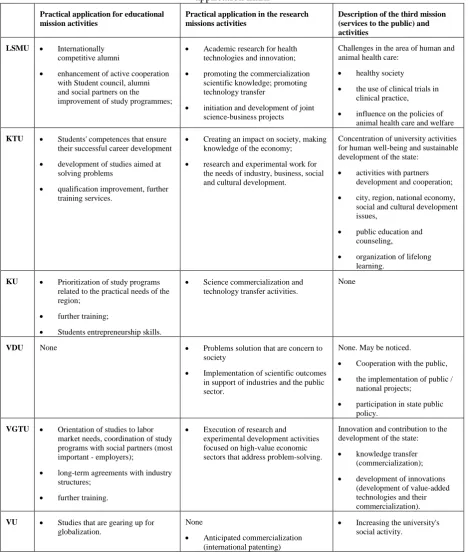
planned work under a trilateral university mission logic, i.e. while distinguishing the strategic directions of education, research and services for the public. While in other universities (VDU, VU) strategic documents activities of services to the society are found in other strategic plan fields or in the fields of detailed activities indicators. One regional university (KU) does not plan third university missions’ activities, but services to the public discussed in the context of traditional university missions (education and research) (see Table 1). The third strategic mission of the universities - the service to the public - is clearly not aligned in the strategic documents of the classical universities.
Table 1. Strategic documents highlight the activities of university missions that have a practical application mark
Practical application for educational mission activities
Practical application in the research missions activities
Description of the third mission (services to the public) and activities
LSMU Internationally competitive alumni
enhancement of active cooperation
with Student council, alumni and social partners on the improvement of study programmes;
Academic research for health
technologies and innovation;
promoting the commercialization
scientific knowledge; promoting technology transfer
initiation and development of joint
science-business projects
Challenges in the area of human and animal health care:
healthy society
the use of clinical trials in
clinical practice,
influence on the policies of
animal health care and welfare
KTU Students' competences that ensure
their successful career development
development of studies aimed at
solving problems
qualification improvement, further
training services.
Creating an impact on society, making
knowledge of the economy;
research and experimental work for
the needs of industry, business, social and cultural development.
Concentration of university activities for human well-being and sustainable development of the state:
activities with partners
development and cooperation;
city, region, national economy,
social and cultural development issues,
public education and
counseling,
organization of lifelong
learning.
KU Prioritization of study programs
related to the practical needs of the region;
further training;
Students entrepreneurship skills.
Science commercialization and
technology transfer activities.
None
VDU None Problems solution that are concern to
society
Implementation of scientific outcomes
in support of industries and the public sector.
None. May be noticed.
Cooperation with the public,
the implementation of public /
national projects;
participation in state public
policy.
VGTU Orientation of studies to labor market needs, coordination of study programs with social partners (most important - employers);
long-term agreements with industry
structures;
further training.
Execution of research and
experimental development activities focused on high-value economic sectors that address problem-solving.
Innovation and contribution to the development of the state:
knowledge transfer
(commercialization);
development of innovations
(development of value-added technologies and their commercialization).
VU Studies that are gearing up for
globalization.
None
Anticipated commercialization
(international patenting)
Increasing the university's
Page 186
Analyzing the activities of universities' educational mission, which are characterized by practical application, exclusive qualification upgrading, refinement activities - universities (KTU, VGTU, KU) distinguish such strategic activities. Universities in the education mission also influence the applicability of study program outcomes - international competitiveness (LSMU) and ability to operate in a globalized environment (VU). Classical university based on artes liberales principles (VDU) emphasizes the orientation towards the person's self-education and the activities of the mark of relevance to the field of study. It is also observed cooperation with stakeholders - assessment of interests of market/industry in the preparation of study programs (LSMU, VGTU), program orientation for regional issues (KU) - indicates other social participants - assessment of state/public interest in the activities of the study mission.
The activities of the university's research mission are marked by activities with practical application: transfer of science knowledge, technology transfer (LSMU, KU), one university (VGTU) assigns these activities to activities of the third university mission - services to the public. Universities in the activities of this mission highlight the peculiarities of the advisability of knowledge creation - "influencing society, creating knowledge for the economy", referring research and experimental activities to the needs of industry, business, social and cultural development" (KTU), knowledge is created through research and experimental development work, which are relevant for economic, social and cultural development", the" research aimed at solving specific problems <...> aimed at the high value added economic sector" (VGTU) also indicates the strategic goal of a joint business with initiation and enforcement of joint science and business projects" (LSMU) - this demonstrates the perceived need to focus on the interests of social participants. It also emphasizes the applicability of the results of research activities - the introduction of science into business and the public sector, solving problems that are concern of society (VDU). If research activities with a practical application mark are not distinguished, the analysis of the indicators presented in the strategic document has shown that such activities are being carried out (as evidenced by the indicator - commercialization of scientific knowledge (patents) (VU).
The naming of the third university mission - service activities in society is very diverse in strategic university plans, including the direction of cooperation with the stakeholders: developing activities and cooperation with partners (KTU, VDU), increasing university activity in the society (VU), participation in public policy (VDU, LSMU), the implementation of projects of state importance (VDU), regional, national economy problems (KU), public education, counseling (according to the competence) (LSMU, KTU), organization of lifelong learning (KTU). The strategic documents state that the mission is to address the state/public interests. Universities addressing business/industry interests in this mission include knowledge transfer and transfer innovation activities (VGTU).
Page 187
Table 2. Strategic documents indicate the quality indicators of the outcomes of the activities of the practical adaptability
Indicators of the quality of the outcomes of the activities of educational missions of practical application
Performance indicators for practical applications of research missions outcomes
Output indicators of the third mission (services to the public)
LSMU Alumni employment,
employer satisfaction.
None Participation in national
programmes of cancer prevention,
number of services in the
area of animal health and welfare,
patients’ feedback on the
quality of services,
animal keepers’ feedback
on the quality of veterinary treatment services.
KTU None Number of spin-offs
companies,
the share of MTEP
works and services in the university budget ,%.
None
KU Number of graduates, retraining, graduate students,
created business promotion centers, developed by
career development modules.
Preparation of common
MTEP with business partners.
Created open access
centers.
VDU None None None
VGTU None None None
VU The number of study areas corresponding to the study
level according to the number of study fields
corresponding to the minimum indicator (80%) after 12 months after completion of graduation from the employment contract in Lithuania,
The place of the university in the world by the indicator
of the reputation among employers (QS WUR, Employer reputation)
Number of international
patent applications.
Number of visitors
organized by the University with events related to heritage.
Page 188 5. DISCUSSION
The study confirmed the researchers' insights on the multiple colleges of higher education in the multitude of markets (Jongbloed, 2003). In the scope of the study, the outcomes of universities of higher education in Lithuania are oriented towards students, employers and social participants - the state/society and the market/industry. The obvious interest of stakeholders is observed in the activities of the universities' educational missions, since articulating the quality of the outcomes of educational activities, both the expectations of the learners expressed in terms of employment after the end of the school, the indicators, and the interests of the university higher education community, are expressed as indicators of the quality of study programs associated with the numbers of unemployed graduates, both the interests of external stakeholders, expressed by the satisfaction indicators of employers (whether it would be a state or market/industry). It not only confirms the idea of a university higher education stakeholder idea but also points to the importance of the interests of those stakeholders in the definition of the quality of university higher education outcomes, the emphasis in research (Schindler et al., 2015), which highlights the different aspects of the same performance outcomes observed by L. Harvey and D., Green (Harvey and Green 1993).
An analysis of the research activities of the universities identified by the strategic documents highlighted by the research papers (Etzkowitz and Leydesdorff, 2000, Carayannis et al., 2012) allow to determine the knowledge creation model used by these universities. The study revealed the dominant scene of the universities surveyed towards the knowledge creation Mode3 model, which is characterized by the coexistence of knowledge and innovation. This is evident to apply the knowledge generated by practical research in science, which is expressed in the development of innovation, knowledge trading activities. This goal encourages universities to respond to the needs of stakeholders and validates the importance of both public and market/industry interests in the quality of university higher education outcomes. The observation of the Triple Helix model of knowledge creation (Etzkowitz and Leydesdorff, 2000), but fragmented, inseparable from the traditional universe mission outcomes, makes it impossible to distinguish the research activities of university higher education subjects from scrutinizing the research activities towards this knowledge-generating model. Although some of the Lithuanian universities selected for the survey have unequivocally applied this knowledge creation model (LSMU).
In some analyzed universities strategic documents, it was discussed the third mission of university, but the activities of the third university mission are not clearly distinguishable from others - the activities of traditional university missions that have clear outcomes. Universities that identify the third mission in strategic documents are one of the activities that implement this mission, which refers to the interaction between the university and stakeholders (KTU), the impact of universities on the socio-economic environment (LSMU, KTU, VGTU), which is consistent with the researchers' articulation of the definition of the third university mission (Molas-Gallart et al., 2002). However, in the examined strategic documents, only a few universities clearly define and arrange services for the public (VU, LSMU). One can assume that such a situation is determined by the stage of awareness, purification (implementation and application of scientific knowledge development models) of the activities of the third university mission.
Page 189
social participant in research activities in the quality of research outcomes is indicated by quantitative indicators that demonstrate the efficiency of the transfer of knowledge or technology transfer (e.g., the number of patent applications, the number of start-up companies, etc.) and the indicator is the share of MTEP services in the university budget, applied university level of education but also ability to work with industries. The qualitative indications of the outcomes of these social participant university activities and form the dimension of social participants in university education quality (see Figure 1).
Figure 1. Dimension of social participants in university education quality
It is noted that the dominant market discourse does not undermine the public interest. The public interest - or the common interests of the state/society as a distinct social participant - is also constructing the dimension of social participants in university education quality - focusing on university activities in addressing issues that are relevant to society, strengthening community collaboration, community service, the use of university resources in public interests (such as Open Access Center Services (KU), Public Education Services (LSMU, etc.).
6. CONCLUSIONS
Page 190 REFERENCES
1. Demeulemeester, JL 2011, ‘Reforming higher education systems in Europe since the 80s: between utilitarianism and justice’, CEB Working Paper No 11/058 2011, viewed 18 February 2018, <https://dipot.ulb.ac.be/dspace/bitstream/2013/105062/1/wp11058.pdf>.
2. Lyytinen, A, Kohtamäki, V, Kivistö, J, Pekkola, E & Hölttä, S 2017, ‘Scenarios of quality assurance of stakeholder relationships in Finnish higher education institutions’, Quality in Higher Education, 23(1), pp.35-49.
3. Schindler, L, Puls-Elvidge, S, Welzant, H & Crawford, L 2015, ‘Definitions of quality in higher education: A synthesis of the literature’, Higher Learning Research Communications, 5(3), pp.1-13.
4. Elassy, N 2015, ‘The concepts of quality, quality assurance and quality enhancement’, Quality Assurance in Education, 23(3), pp.250-261.
5. Udam, M & Heidmets, M 2013, ‘Conflicting views on quality: interpretations of ‘a good university’ by representatives of the state, the market and academia’, Quality in Higher Education, 19(2), pp.210-224.
6. Burrows, A & Harvey, L 1992, ‘Defining quality in Higher Education: the stakeholder approach’, AETT Conference on quality in education, University of York, pp.6-8.
7. Chong, S 2014, ‘Academic quality management in teacher education: a Singapore perspective’, Quality Assurance in Education, Vol. 22 No. 1, pp.53-64.
8. Razavi, SM, Safari, H, & Shafie, H 2012, ‘Relationships among Service Quality, Customer Satisfaction and Customer Perceived Value: Evidence from Iran's Software Industry’, Journal of Management and Strategy, Vol. 3 No.3, pp. 28. viewed 20 February 2018, <http://sciedu.ca/journal/index.php/jms/article/view/1417>.
9. Harvey, L & Green, D 1993, ‘Defining quality’, Assessment and Evaluation in Higher Education, Vol. 18 No. 1, pp.9-34.
10. Pham, HT & Starkey, L 2016, ‘Perceptions of higher education quality at three universities in Vietnam’, Quality Assurance in Education, 24(3), pp.369-393.
11. Ganguli, S. & Roy, SK 2011, ‘Generic technology-based service quality dimensions in banking’, International Journal of Bank Marketing, vol. 29, no. 2, pp.168-189.
12. Pizam, A, Shapoval, V & Ellis, T 2016, ‘Customer satisfaction and its measurement in hospitality enterprises: a revisit and update’, International Journal of Contemporary Hospitality Management, 28(1), pp.2-35.
13. Leišytė, L & Westerheijden, DF 2015, ‘Students as stakeholders in quality assurance in eight European countries’, The Quality of Higher Education, (10), pp.12-27.
14. Rosa, M & Texeira, P 2014, ‘Policy reforms Trojan horses, and imaginary friends: the role of external stakeholders in internal quality assurance systems’, Higher Education Policy, 27, pp.219-37.
15. Westerheijden, D 2014, ‘Involvement of stakeholders in internal quality assurance across Europe. East-west contrasts in a seven-country study’, Hungarian Educational Research Journal, 4(1), pp.1-13.
16. Boksberger, PE & Melsen, L 2011, ‘Perceived value: a critical examination of definitions, concepts and measures for the service industry’, Journal of Services Marketing, 25(3), pp.229-240. 17. Gallarza, MG, Gil‐Saura, I & Holbrook, MB 2011, ‘The value of value: Further excursions on the
Page 191
18. Sánchez-Fernández, R & Iniesta-Bonillo, MA 2007, ‘The concept of perceived value: a systematic review of the research’, Marketing theory, 7(4), pp.427-451.
19. Freeman, R E 1984, Strategic management: A stakeholder approach. Boston: Pitman.
20. Mitchel RK, Agle BR & Wood DJ 1997, ‘Toward a theory of stakeholder identification and salience: defining the principle of who and what really counts’, Academy of Management Review, 27 (2), pp.853-866.
21. Ashwin, P, Abbas, A & McLean NM 2015, ‘Representations of a high-quality system of undergraduate education in English higher education policy documents’, Studies in Higher Education, Vol. 40 No. 4, pp. 610-623.
22. Srikanthan, G & Dalrymple, J 2003, ‘Developing alternative perspectives for quality in higher education’‘, International Journal of Educational Management, 17(3), pp.126-136.
23. OECD Science, Technology and Industry Outlook 2010. OECD Pub., viewed 2 March 2018, <https://www.oecd-ilibrary.org/science-and-technology/oecd-science-technology-and-industry-outlook-2014_sti_outlook-2014-en>.
24. OECD Science, Technology and Innovation Outlook 2016 The future of science systems OECD Pub., viewed 2 March 2018, <https://www.oecd-ilibrary.org/science-and-technology/oecd-science-technology-and-innovation-outlook-2016_sti_in_outlook-2016-en>.
25. Agasisti, T & Catalano, G 2006, ‘Governance models of university systems ₋ towards quasi‐ markets? Tendencies and perspectives: A European comparison’, Journal of Higher Education Policy and Management, 28(3), pp.245-262.
26. Jongbloed, B 2003, ‘Marketisation in higher education, Clark's triangle and the essential ingredients of markets’, Higher education quarterly, 57(2), pp.110-135.
27. Enders, J & Jongbloed, B 2007, ‘The public, the private and the good in higher education and research: An introduction’, Public-private dynamics in higher education: Expectations, developments and outcomes, pp.9-36.
28. Barr, N 2012, ‘The Higher Education White Paper: The good, the bad, the unspeakable–and the next White Paper’, Social Policy & Administration, 46(5), pp.483-508.
29. Schoenenberger, AM 2005, ‘Are higher education and academic research a public good or a public responsibility? A review of the economic literature’, viewed 12 March 2018, <http://citeseerx.ist.psu.edu/viewdoc/download;jsessionid=39217C2CDEDF428734CDBF9C9D0 3576D?doi=10.1.1.131.4134&rep=rep1&type=pdf>.
30. Jongbloed, B 2004. Regulation and competition in higher education, in Markets in Higher Education Springer, Dordrecht. pp.87-111.
31. Mazzarol, T 1998, ‘Critical success factors for international education marketing’, International Journal of Educational Management, 12(4), pp.163-175.
32. Kusumawati, A, Yanamandram, VK & Perera, N 2010, ‘Exploring student choice criteria for selecting an Indonesian public university: A preliminary finding’, viewed 14 March 2018, <ro.uow.edu.au/chsd/35/>.
33. Emery, C, Kramer, T & Tian, R 2001, ‘Customers vs. products: adopting an effective approach to business students’, Quality Assurance in Education, 9(2), pp.110-115.
34. Eagle, L & Brennan, R 2007, ‘Are students customers? TQM and marketing perspectives’, Quality assurance in education, 15(1), pp.44-60.
35. Nicolescu, L 2009, ‘Applying marketing to higher education: Scope and limits’, Management &
Marketing, 4(2), viewed 14 March 2018,
Page 192
36. Cave, M, Kogan, M & Hanney, S 1990, ‘The scope and effects of performance measurement in British higher education’, in Management Information and Performance; Indicators in Higher Education. Van Gorcum and Comp, BV, Assen/Maastricht, pp.48-49.
37. Blackmore, J 2000, ‘Academic pedagogies, quality logics and performative universities: evaluating teaching and what students wan’, Studies in Higher Education, 34, pp.857-872.
38. Blackmur, D 2007, ‘The public regulation of higher education qualities: rationale, processes and outcomes’, in Quality assurance in higher education: trends in regulation, translation and transformation, ed. D. Westerheijden, B. Stensaker and M. Rosa, Dordrecht, Springer, pp.15-45. 39. Brown, R 2010 Higher Education and the Market, London: Routledge.
40. Morley, L. 2003. Quality and power in higher education, McGraw-Hill Education.
41. Carayannis, EG & Campbell, DF 2012, Mode 3 knowledge production in quadruple helix innovation systems: 21st century democracy, innovation and entrepreneurship for development. New York, Springer.
42. Gibbons, M, Limoges, C, Nowotny, H, Schwartzman, S, Scott, P & Trow, M 1994, The new production of knowledge: The dynamics of science and research in contemporary societies. London, Thousand Oaks, New Delhi, Sage.
43. Carayannis, EG & Campbell, DF 2012, ‘Mode3 knowledge production in quadruple helix innovation systems’, in Mode 3 Knowledge Production in Quadruple Helix Innovation Systems Springer, New York, NY, pp. 1-63.
44. Etzkowitz, H & Leydesdorff, L, 2000, ‘The dynamics of innovation: from National Systems and “Mode2” to a Triple Helix of university–industry–government relations’, Research policy, 29(2), pp.109-123.
45. Etzkowitz, H & Zhou, C 2006, ‘Triple Helix twins: innovation and sustainability’, Science and public policy, 33(1), pp.77-83.
46. Ahola, S & Honkanen, V 2004, ‘Entrepreneurship education in finnish polytechnics’, viewed 20 March 2018, <http://ruse.utu.fi/pdfrepo/CHER2004paper.pdf>.
47. Molas-Gallart, J, Salter, A, Patel, P, Scott, A & Duran, X 2002, ‘Measuring third stream activities’, Final report to the Russell Group of Universities. Brighto, SPRU, University of Sussex.
viewed 20 March 2018,
<https://s3.amazonaws.com/academia.edu.documents/3460866/russell_report_thirdStream.pdf?A WSAccessKeyId=AKIAIWOWYYGZ2Y53UL3A&Expires=1524326861&Signature=leeEpNbEg
XcJzogKqdaoWSHhXW0%3D&response-content-disposition=inline%3B%20filename%3DMeasuring_third_stream_activities.pdf>.
48. Pucciarelli, F & Kaplan, A 2016, ‘Competition and strategy in higher education: Managing complexity and uncertaint’, Business Horizons, 59(3), pp.311-320.
49. Maassen, P 2000, ‘The changing role of stakeholders in Dutch university governance’, European Journal of Education, 35(4), pp. 449-464.
50. Magalhaes A& Amaral A 2000, ‘Portuguese higher education and the imaginary friend: The stakeholders’ role in institutional governance’, European Journal of Education, 35(4), pp.439-448. 51. Jongbloed, B., 2004, ‘Regulation and competition in higher education’, in Markets in Higher
Education Springer, Dordrecht. pp. 87-111.
52. Vilnius Gediminas Technical University development plan for 2014-2020, viewed 12 March 2018, <www.vgtu.lt/uploads/files/dir8/18_0.php>
Page 193
54. Kaunas University of Technologies strategic plan for 2017-2019, viewed 10 March 2018, <https://ktu.edu/wp-content/uploads/2018/01/KTUstrateginis-VP-2017-2019.pdf>
55. Klaipėda University strategic development plan for 2012-2020, viewed 10 March 2018, <https://www.ku.lt/wp-content/uploads/2016/03/KU-Pletros-strateginis-planas-2012.pdf>
56. Vytautas Magnus University strategic plan for 2012-2020, viewed 10 March 2018, <www.vdu.lt/wp-content/uploads/2012/07/35129.pdf>
57. Guidelines for the Strategic Development 2017-2021 of Lithuanian University of Health Sciences
viewed 10 March 2018,