Nonlinear Processes
in Geophysics
c
European Geophysical Society 2001
An example of resonances, coherent structures and topological
phase transitions – the origin of the low frequency broadband
spectrum in the auroral zone
T. Chang
Center for Space Research, Massachusetts Institute of Technology Cambridge, MA 02139, USA Received: 29 June 2000 – Accepted: 29 August 2000
Abstract. We consider the phenomena of intermittent
tur-bulence in magnetized space plasmas from the point of view of topological phase transitions involving the merging and interactions of anisotropic coherent structures. The stochas-tic behavior of these coherent plasma structures can undergo complex changes as the dynamic system evolves, similar to those commonly observed in (first and second order) equilib-rium phase transitions. When conditions are favorable, such topological entities can evolve into a state of forced and/or self-organized criticality (FSOC). As an example, we apply these ideas to the understanding of the origin of the com-monly observed broadband power-law low frequency electric field spectral densities and the characteristic filamentary cur-rent structures in the auroral zone. The broadband turbulence can provide efficient resonant energization of the ionospheric oxygen ions.
1 Introduction
Most of the observed turbulent space plasma processes are intrinsically intermittent with at least two distinctly differ-ent time scales, one time scale associated with the intermit-tency, which is very short, and an evolutionary time scale, which is much longer in duration. This has led Chang (1992) to suggest that the behavior for intermittent turbulent mag-netized plasma processes is related to the phenomenon of forced and/or self-organized criticality (FSOC), based on the concepts of path integrals and the dynamical renormaliza-tion-group. Subsequently, Chang (1998, 1999) constructed physically meaningful topological models to describe the ba-sic interactions for such processes in the context of the for-mation and evolution of the coherent structures generated near plasma resonances, and the fast interactions and relax-ation diffusion among these structures. From first principles, analogies were established between the concepts involving topological phase transitions for dynamical systems far from Correspondence to: T. Chang ([email protected])
equilibrium and those in equilibrium phase transitions. As an example, we apply these ideas and techniques to arrive at a basic understanding of the origin of the commonly observed broadband low frequency broken-power-law spectra involv-ing the intermittent turbulent electric field fluctuations in the auroral zone.
2 The concepts of coherent structures in space plasmas
Most field theoretical discussions begin with the concept of the propagation of waves. For example, in the MHD formu-lation, one can combine the basic equations and obtain the following convective expressions:
ρdV
dt =(B·∇)B+. . . (1)
dB
dt =(B·∇)V +. . . (2)
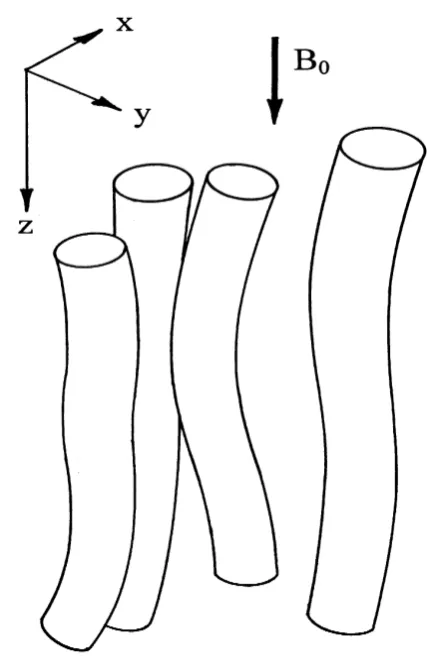
where the ellipsis represent the effects of the anisotropic pres-sure tensor, the compressible and dissipative effects, and all notations are standard. Equations (1,2) allow the propagation of Alfv´en waves. For such waves to propagate, the propa-gation vectorkmust contain a field-aligned component, i.e. B ·∇ → ik ·B 6= 0. However, at sites where the par-allel component of the propagation vector vanishes (i.e. at the resonance sites), the fluctuations are localized. Around these resonance sites (usually in the form of curves in phys-ical space), it may be shown that the fluctuations are held back by the background magnetic field, forming anisotropic coherent structures in the form of flux tubes (Chang, 1998, 1999) (see Fig. 1).
Fig. 1. Wiggling and meandering field-aligned current filaments.
In a turbulent MHD plasma, it has been suggested by Tay-lor (1974) that in a relaxed state, such a structure would be approximately force-free (i.e.j×B=0 ) due to the approx-imate conservation of the coarse-grained helicity, defined as K=RA·BdV integrated over the coherent structure, where j andB are the current density vector and magnetic field, andAis the vector potential. (We note that if a coherent structure is not simply connected and/or that theKintegral is not confined by a closed flux surface, the above discussions on helicity will need to be more carefully stated to ensure gauge invariance.)
We now consider the example of low frequency auroral turbulence. For the auroral geometry and low beta plasma, the force free condition is approximately satisfied by the sca-lar condition,B·∇j =0, whereBis approximately in the direction of the geomagnetic field andj is approximately the intensity of the field-aligned current. It can be shown that, with the inclusion of the kinetic effects through the anisotro-pic pressure terms and the generalized Ohm’s law, the above results are still approximately valid. We have, then, approxi-mately,
B0
∂jz
∂z = −
δBx
∂ ∂x +δBy
∂ ∂y
jz+. . . , (3)
the other modifying effects. Writing(−∂ψ/∂x, ∂ψ/∂y) = (δBy, δBx)for the fluctuating components of the magnetic
field components in the(x, y)directions to satisfy∇·B=0, jzandψare determined by Eq. (3) and the Ampere’s law. A
simple example would be the class of circularly cylindrical solutions ofψ (r)andjz(r). Generally, the solutions would
be much more complicated due to of the variabilities of the local conditions of the plasma and the three-dimensional ge-ometry. Thus, we envision the existence of bundles of spo-radically generated and nearly field-aligned localized cur-rent filaments (Fig. 1). These filaments (carrying upward or downward currents) wiggle and meander within the auroral zone. In the acceleration region, the total current carried by the filaments would be upward; the reverse is true in the re-turn current and/or black auroral region.
When filamentary current structures of the same polarity migrate toward each other, strong current sheets are gener-ated. In the ionosphere, these could be the origins of the observed small auroral arcs. When they move very close to each other, the current sheets can become very intense (Fig. 2). (An example of a two-dimensional analog has been sim-ulated by Wu and Chang, 2000). At this point, a number of possible follow-up scenarios may result. Firstly, the thin-ness of the intense current sheets enhances the electron iner-tia effect in the generalized Ohm’s law. This would provide the possibility of collisionless tearing instabilities (Seyler, 1990). On the other hand, if the sizes of the current filaments are of the order of the electron skin depth, then the thick-ness of the intense current sheets of the interaction regions among the current filaments can be even smaller and may approach that of the order of the local ion gyroradius. The ions would then become effectively unmagnetized and the electrons remain magnetized; thus, enhancing the electron Hall currents. As the electrons travel across the magnetic field lines, they would excite whistler fluctuations. In anal-ogy to the Alfv´en resonances, singularities ofkk=k·B=0 generally can develop, at which whistler fluctuations cannot propagate. These “whistler resonances” can provide the nu-clear sites for the emergence of coherent whistler structures, which is the analog of the coherent Alfv´enic structures, but with much smaller scales. The intermittent turbulence re-sulting from the intermixing and interactions of the coher-ent whistler structures in the intense currcoher-ent sheet region can then provide the coarse-grain averaged dissipation that al-lows the filamentary current structures to merge, interact, or breakup. In addition to the above scenarios, other plasma instabilities may set in when conditions are favorable.
3 Forced and/or self-organized criticality (FSOC)
Fig. 2. Cross sectional view of two merging current filaments of the same polarity. Contours areψ =const and arrows indicate di-rections of perturbed magnetic field in the(x, y)-plane. Blackened area is an intense current.
resonances in the neutral sheet region of the magnetotail may evolve into a forced and/or self-organized critical state (FSOC). We suggest that a similar scenario may be applied to our example in the auroral zone. Here, the coherent fil-amentary current structures that emerge from the Alfv´enic resonances can merge and/or become unstable (because of the whistler turbulence induced within the intense current sheets, finite electron inertia and other possibilities discussed above), intermix and produce new resonance sites and new filamentary structures. When they evolve into a forced and/or self-organized critical state, power-law frequency (ω) and mode number (k) spectra will result (including those for the associated velocity and electric field fluctuations). The demonstration of such possibilities was based on the con-cepts of the modern theory of critical phenomena and has been studied by Chang (1992, 1998, 1999) for the magne-totail scenario via the formalisms of path integrals and the dynamic renormalization-group (Chang et al., 1978; Chang et al., 1992) (see Sec. 4.). This would then provide a pos-sible explanation for the observed ubiquitously broadband power-law spectral densities of the electric field fluctuations. The power-law index is expected to change across the vari-ous characteristic frequencies or length scales of the plasma medium (such as the ion gyrofrequencies or ion gyroradii; see, e.g. Fig. 8 of Chang, 1999). Although the origin of the field-aligned current structures is assumed to arise from the consideration of plasma resonances and magnetic fluc-tuations, the resulting plasma dynamics in the auroral zone will generally be encompassed in the electric field structures. Because of the coherent and non-propagating nature of the
Fig. 3. Typical electric field spectral density in the diffuse auroral region at a geocentric altitude of 2 RE. The oxygen gyrofrequency is around 6 Hz. Mellot and Gurnett (private communication).
current structures, the associated electric field generally can carry a significant electrostatic component. Moreover, the perpendicular components of the electric field fluctuations would generally dominate over the field-aligned component, even with the effect of the electron inertia.
At the same time, the whistler coherent structures, which may have provided the dissipation required for the merg-ing and breakups of the filamentary current structures, may evolve into another FSOC state (however, generally with a different power-law index, for the electric field spectral den-sity). They may contribute to a fraction of the observed VLF emissions with the characteristic lower hybrid cutoffs. Because of the power-law nature of the combined Alfv´enic and whistler spectra (with negative indices) for forced and/or self-organized critical states, the intensities of the electric field spectral density may be expected to become smaller and smaller at higher and higher frequencies. At higher frequen-cies, such as the range of the lower hybrid frequency, other plasma instabilities may set in and provide spectral humps in the otherwise broadband spectrum (Fig. 3). Note, we are now discussing frequencies below, above and in the range of the ion gyrofrequencies.
diffu-m2
whereξ is the electric field spectral density andF is the res-onance function which accommodates the required Doppler shifts for resonance interaction and stochastic broadening of interactions among the ions and fluctuations.
4 Symmetry breaking and topological phase transitions
For nonlinear stochastic systems near criticality, the correla-tions among the fluctuacorrela-tions of the random dynamical fields are extremely long-ranged and there exist many correlation scales. The dynamics of such systems are notoriously dif-ficult to handle, either analytically or numerically. On the other hand, since the correlations are extremely long-ranged, it is reasonable to expect that the system will exhibit some sort of invariance under scale transformations. A powerful technique that utilizes this invariance property is the tech-nique of the dynamic renormalization-group (Chang et al., 1978, 1992, and references contained therein). As it is de-scribed in these references, based on the path integral for-malism, the behavior of a nonlinear stochastic system far from equilibrium may be described in terms of a “stochas-tic LagrangianL”. Then, the renormalization-group (coarse-graining) transformation may be formally expressed as:
∂L
∂` =RL (5)
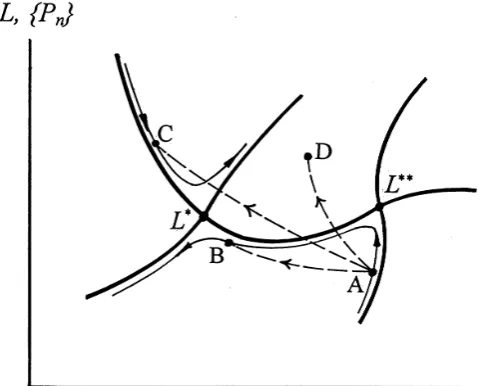
where R is the renormalization-group (coarse-graining) transformation operator and`is the coarse-graining param-eter for the continuous group of transformation. It will be convenient to consider the state of the stochastic Lagrangian in terms of its parameters{Pn}. Equation (5), then, specifies
how the Lagrangian,L, flows (changes) with`in the affine space spanned by{Pn}(Fig. 4).
Generally, there exists a number of fixed points (singu-lar points) in the flow field, where∂L/∂` = 0. At a fixed point (L∗orL∗∗in Fig. 4), the correlation length should not be changing. However, the renormalization-group transfor-mation requires that all length scales must change under the coarse-graining procedure. Therefore, to satisfy both require-ments, the correlation length must be either infinite or zero. When it is at infinity, the system is, by definition, at critical-ity. The alternative trivial case of zero correlation length will not be considered here.
To study the stochastic behavior of a nonlinear dynamical system near a particular criticality (e.g. the one characterized by the fixed pointL∗), we can linearize the renormalization-group operatorRaboutL∗. The mathematical consequence of this approximation is that, close to criticality, certain linear combinations of the parameters that characterize the stochas-tic LagrangianLwill correlate with each other in the form of power laws. This includes, in particular, the(k, ω), i.e. mode number and frequency, spectra of the correlations of the var-ious fluctuations of the dynamic field variables. In addition,
Fig. 4. Phase space (affine space) for the stochastic Lagrangian L({Pn}). Heavy solid lines are separactrices passing through the fixed pointsL∗, L∗∗under the renormalization-group (coarse grain-ing) transformation. Light solid lines are renormalization-group tar-jectories and thin solid arrows indicate the direction of increasing`. Broken lines and flaring arrows indicate paths and directions of the dynamic evolution of the stochastic system.
it can be demonstrated from such a linearized analysis that generally, only a small number of (relevant) parameters are needed to characterize the stochastic state of the system near criticality (i.e. low-dimensional behavior; see Chang, 1992). As the dynamical system evolves in time, a number of transitional scenarios are possible. For example, the system may evolve from a critical stateA(characterized byL∗∗) to another critical state B (characterized byL∗), as shown in Fig. 4. In this case, the system may evolve continuously from one critical state to another. Such type of symmetry breaking can lead to the continuously varying scaling indices and multifractal characteristics.
On the other hand, the evolution from the critical stateA to critical stateC, as shown in Fig. 4, would probably in-volve a dynamical instability characterized by a first- order-like topological phase transition because the dynamical path of evolution of the stochastic system would have to cross over a couple of renormalization-group separatrices (shown as heavy solid lines). Alternatively, a dynamical system may evolve from a critical stateAto a stateD(as shown in Fig. 4), which may not be situated in a regime dominated by any of the fixed points; in such a case, the final state of the system will no longer exhibit any of the characteristic properties that are associated with criticality.
5 Summary
plas-mas. The theory is based on the concepts of resonances and coherent structures. When conditions are favorable, the co-herent structures may merge, interact and evolve into forced and/or self-organized critical states (FSOC). An example is given to provide a possible explanation of the development of broadband power-law electric field spectral densities in the auroral zone. Such low frequency intermittent turbulence in the auroral zone can efficiently accelerate the ionospheric oxygen ions (Chang et al., 1986; Andr´e et al., 1988.) Acknowledgement. The author thanks M. Andr´e, G. Consolini, G. Ganguli, P. Kintner, C. Seyler, S. W. Y. Tam and C. C. Wu for useful discussions. Research is supported by grants from AFOSR, NSF and NASA.
References
Andr´e, M., Koskinen, H., Matson, L., and Erlandson, R., Local transverse ion energization in and near the polar cusp, Geophys. Res. Lett., 15, 107–110, 1988.
Chang, T., Low-dimensional behavior and symmetry breaking of stochastic systems near criticality – can these effects be observed in space and in the laboratory?, IEEE Trans. On Plasma Science, 20, 691–694, 1992.
Chang, T., Sporadic localized reconnections and multiscale inter-mittent turbulence in the magnetotail, in Geospace Mass and En-ergy Flow, Geophysical Monograph, No. 104, edited by J. L.
Horwitz, D. I. Gallagher, and W. K. Peterson, (American Geo-physical Union, Washington, DC), pp. 193–199, 1998.
Chang, T., Self-organized criticality, multi-fractal spectra, sporadic localized reconnections and intermittent turbulence in the mag-netotail, Phys. Plasmas, 6, 4137–4145, 1999.
Chang, T., Crew, G. B., Hershkowitz, N., Jasperse, J. R., Retterer, J. M., and Winningham, J. D., Transverse acceleration of oxy-gen ions by electromagnetic ion cyclotron resonance with broad-band left-hand polarized waves, Geophys. Res. Lett., 13, 636– 639, 1986.
Chang, T., Nicoll, J. F., and Young, J. E., A closed-form differen-tial renormalization-group generator for critical dynamics, Phys. Lett., 67A, 287–290, 1978.
Chang, T., Vvedensky, D. D., and Nicoll, J. F., Differential renormalization- group generators for static and dynamic criti-cal phenomena, Phys. Reports, 217, 279–362, 1992.
Consolini, G. and Chang, T., Magnetic field topology and criticality in geotail dynamics: relevance to substorm phenomena, Space Science Rev., in press, 2000.
Seyler, C. E., A mathematical model of the structure and evolu-tion of discrete auroral arcs, J. Geophys. Res., 95, 17199–17215, 1990.
Taylor, J., Relaxation of toroidal plasma and generation of reverse magnetic fields, Phys. Rev. Lett., 33, 1139–1141, 1974. Wu, C. C. and Chang, T., 2D MHD simulation of the emergence and