Nonlinear Processes
in Geophysics
c
European Geophysical Society 2002
Acoustic-gravity nonlinear structures
D. Jovanovi´c1, L. Stenflo2, and P. K. Shukla3
1Institute of Physics, P.O. Box 57, Yu-11001 Belgrade, Yugoslavia
2Department of Plasma Physics, Ume˚a University, S-90187 Ume˚a, Sweden
3Institut f¨ur Theoretische Physik IV, Ruhr-Universit¨at Bochum, D-44780 Bochum, Germany
Received: 14 September 2001 – Accepted: 7 December 2001
Abstract. A catalogue of nonlinear vortex structures associ-ated with acoustic-gravity perturbations in the Earth’s atmo-sphere is presented. Besides the previously known Kelvin-Stewart cat’s eyes, dipolar and tripolar structures, new solu-tions having the form of a row of counter-rotating vortices, and several weakly two-dimensional vortex chains are given. The existence conditions for these nonlinear structures are discussed with respect to the presence of inhomogeneities of the shear flows. The mode-coupling mechanism for the non-linear generation of shear flows in the presence of non-linearly unstable acoustic-gravity waves, possibly also leading to in-termittency and chaos, is presented.
1 Introduction
In recent years there has been a growing interest in the nonlinear effects associated with large amplitude acoustic-gravity perturbations in the Earth’s atmosphere. These ef-forts were motivated by the need to obtain more accurate predictions of the dynamics of the atmosphere under various meteorological conditions, including different profiles of the pressure and density, as well as the presence of shear flows.
The most commonly used model equations for the two-dimensional, ∂/∂y = 0, large amplitude acoustic-gravity phenomena have the form
∂
∂t − ey× ∇ψ
· ∇
∇2ψ− 1 4H2
∂ψ ∂t
= − ey× ∇q0· ∇χ , (1)
and ∂
∂t − ey× ∇ψ · ∇
χ =0, (2)
Correspondence to: D. Jovanovi´c ([email protected])
where the notations are
ψ= 9
ρ0
, χ =p
1/γ 0 ρ
1 p10/γ
dp0 dz
!
z=zcr ,
1 4H2 =ρ
1/2
0
d2ρ0−1/2
dz2 and q0=
p10−1/γ
(d/dz) p10−1/γz=z cr
. (3) Here, 9 is the stream function, defined by v = −ey × ∇9/ρ0, wherev is the fluid velocity. As usual, p andρ
are the pressure and density, andγ (γ ≈1.4) is the adiabatic constant. The subscript “0” denotes the unperturbed quan-tities, andz = zcr is the critical vertical position that will be defined later. Equations (1) and (2) were derived (Sten-flo, 1990; Stenflo and Stepanyants, 1995) for low frequency disturbances in an almost incompressible fluid, δp/p0 δρ/ρ0 1, usually referred to as the anelastic regime.
Al-though the derivation (Stenflo, 1990) was restricted to ex-ponential density profiles and perturbations with relatively short wavelengths and small (but finite) amplitudes, the sys-tem above was used as a simple model to study certain large amplitude phenomena, such as self-organization into coher-ent structures. A more rigorous analysis (Jovanovi´c et al., 2001) shows that the same equations are also valid in the strongly nonlinear regime, in the vicinity of the extremum z = zcr of the background density, where the condition (∇2ρ0/ρ0)1/2 |∇ρ0/ρ0|is fulfilled.
In the nonlinear regime, the dynamics of the acoustic-gravity phenomena, as described by Eqs. (1) and (2), is dom-inated by nonlinear convection, and as a consequence, var-ious coherent localized vortex structures may arise. The form of the vortices is determined by the spatial profiles of the background density ρ0(z) and pressure p0(z), and by
atmosphere, based on the modulational instability of acoustic-gravity waves. In the strongly nonlinear phase, the latter provides the energy source for the vortex chain cre-ation. The numerical studies also indicate the possibility of a transition to chaos.
2 Stationary solutions
We look for a solution of Eqs. (1) and (2) that is station-ary in the reference frame travelling with a constant ve-locity u along the x axis, i.e. which is dependent only on the vertical coordinatezand the coordinatex−ut. Using ∂/∂t = −u(∂/∂x)and the properties of the vector product, Eqs. (1) and (2) are readily integrated to
∇2ψ+u Z dz
4H2+q0
dF(ψ+uz)
d (ψ+uz) =G(ψ+uz) , (4) and
χ=F(ψ+uz) , (5)
whereFandGare arbitrary functions of the nonlinear char-acteristicψ+uz. We are particularly interested in nonlinear solutions that are localized, i.e. which vanish for(x, z) → ±∞. For the localized solutions, substituting the unper-turbed valuesρ0(z),p0(z)andψ0(z)into Eqs. (4) and (5) we
can readily evaluate the asymptotic forms of the functionsF
andG. Since they are continuous functions, their asymptotic forms are applicable along all the nonlinear characteristics ψ (x, z)+uz=const.that extend to infinity in thex, zplane. There may exist finite regions, usually referred to as vortex cores, in which the characteristics are closed lines, whereF
andGmay take completely different forms, provided that the physical boundary conditions across the vortex core edge are satisfied. Obviously, the full nonlinear problem is impossi-ble to solve in the general case, since that would involve the inversion of the unknown functionsF andGalong sepatri-ces between the regions of open and closed characteristics, whose actual shape is also not known in advance. Further-more, such a complex problem often does not have a unique solution. The eventual stationary state (if any!) to which the system saturates in the evolution, as described by the full Eqs. (1) and (2), depends very sensitively on the initial con-ditions and fine details, many of which are not included in our Eqs. (4) and (5). Metaphorically, it is often said that the state of the atmosphere is determined by the flapping of a butterfly’s wing at some distant past.
Naturally, analytical solutions are available only if the functionsFandGhave sufficiently simple forms, which are, in turn, permitted only for some specific profiles of the un-perturbed quantitiesρ0(z),p0(z)andψ0(z).
3 Solitary vortices
Solitary vortices can be constructed analytically when the functionsFandGare adopted as linear, i.e.
F(ξ )=F0+F1·ξ, G(ξ )=G0+G1·ξ, (6)
but permitting the constantsF0,1 andG0,1to take different
values inside and outside of the vortex core. The core is cho-sen to be a circle with radiusr0. Although such a choice
seems to be very restrictive, it represents a paradigm for vor-tices which are characterized by a single region of closed isolines. Due to their topological constraints, all solitary vor-tices (including those with more complicated expressions for
F andG) share many common features, resulting from the fact that they are produced by the nonlinearities acting within the core, leading to a linear (or weakly nonlinear) evanescent response in the outer region.
3.1 Dipoles
The acoustic-gravity solitary vortices that propagate relative to the surrounding fluid have the form of dipoles. They were described previously (Stenflo, 1987; Stenflo and Stepa-nyants, 1995). From the asymptotic considerations, it is ob-vious that for a non-zero vortex velocity u, the simple ex-pression (6) can be satisfied in the outer region only when the unperturbed quantitiesχ0(z)andq0(z)are linear functions,
whileH is constant and limz→±∞ψ0(z) = 0. Such
atmo-spheric conditions may be realized only approximately for small vortices (i.e. the vortices that are much smaller than the characteristic length of the density and pressure inhomogen-ities).
For the linear functionsFandG, Eqs. (4) and (5) are read-ily integrated asχ=χ0(z)−(wg2/u) ψand
ψ= −ur0cosθ
K1(µr) K1(µr0)
, r > r0
µ2+κ2
κ2 r
r0
−µ
2
κ2
J1(κr)
J1(κr0)
, r≤r0 ,(7)
wherer =(x002+z2)1/2,θ = arctan(x00/z),x00 =x−ut, andµ2 = 1/(4H2)−ω2g/u2, and where the characteristic wave numberκ is calculated from the nonlinear dispersion relation that is due to the appropriate boundary conditions at r=r0
J2(κr0) κJ1(κr0)
+ K2(µr0) µK1(µr0)
=0. (8)
Here, the constantω2g = −(1/u)(d/dz) χ0(z)is the squared
Brunt-V¨ais¨al¨a frequency, andJi andKi are the Bessel and modified Bessel functions of the order ofi, respectively. For typical atmospheric conditions, the vortex core radiusr0is
of the order of 10–1000 m in the equatorial atmosphere. The vortex velocityuis close to the sound speed, except for tem-perature gradients corresponding to the instability threshold, ωg ≈ 0, when the vortex speed may be much lower. For details, we refer the reader to a previous paper (Stenflo and Stepanyants, 1995).
3.2 Tripoles
the Earth’s atmosphere (Pingree and Le Cann, 1992) and produced in the rotating tank experiments (van Heijst and Kloosterziel, 1989). Their theoretical explanation was pre-sented first in the context of plasma physics (Jovanovi´c et al., 1998), and recently, they were also constructed for the acoustic-gravity mode (Jovanovi´c et al., 2001).
Tripoles can also be analytically constructed using the simple expressions (6), but in contrast to the dipoles, they do not propagate relative to the surrounding fluid, i.e. they are carried by a zero-order flow. The solution of the basic Eqs. (4), (5), and (6), in the form of a tripole, can be obtained only in the presence of a sheared flow with a linear velocity dependence, linearly inhomogeneous inverse square length 1/H2, and parabolicz-dependence of the quantitiesχ0 and q0, i.e.
χ=δχ−ωg,20z+χz2
, (9)
ψ=δψ+wz+ψz2
, (10)
q0=z+qz2, (11)
and 1 4H2 =
1 4H02(1
+2Hz) , (12)
where the perturbationsδχ andδψ are vanishing forz → ±∞, and whereωg,0,w,H0,χ, ψ,q, andH are con-stants, satisfying
u
w =
ψ χ
−1, (13)
and
ψ χ
−1 ψ χ
−H χ
=4H02ω 2
g,0 w2
1−q
χ
. (14)
Under these conditions, the outer solution is readily ex-pressed in terms of the modified Bessel functionsK0,K2,
of the zeroth and second order, as
δψ(out )=β0K0(µr)+β2K2(µr)cos 2θ. (15)
Likewise, from the requirement that the terms which are lin-ear inzmust cancel out, we obtainF1(in) =F1(out ), and the solution is, therefore,
δψ(in)=α0J0(κr)+α2J2(κr)cos 2θ
− 1 κ2
h wψ
µ2+κ2 z002−z02+G(out )0 −G(in)0 i
+ 2 κ4wψ
µ2+κ2, (16)
whereG(out )0 =2wψ, the e-folding numberµis determined by
µ2=G(out )1 = 1 wψ
uH
4H02 −
ωg,20χq wψ
!
(17)
and we have used the notationsκ2 = −G(in)1 ,z0 = (w+ u)/(2wψ), z00 = z+z0, r = (x002 +z002)1/2 and θ =
arctan(x00/z00). Our solutions (15) and (16) must satisfy the standard physical boundary conditions across the edge of the vortex core. We require that the functionGis continuous and that its argumentψ+uzis constant atr =r0. As a
conse-quence, the stream functionψis also continuous across the core edge, providing the finiteness of the flow velocity. In addition, we require that the flow velocity, and consequently, the radial derivative(∂/∂r)δψ, is also continuous. Eliminat-ing the amplitudesαi,βi, (i =0,2) from the corresponding continuity relations, we obtain the nonlinear dispersion rela-tion
2 r0
µ2
κ2 +1
! = µ
2
κ2
(∂/∂r0)J2(κr0)
J2(κr0)
+ (∂/∂r0)K2(µr0) K2(µr0)
. (18)
It is worth noting that this dispersion relation is related only to the second harmonic.
4 Vortex chains
Vortex chains, with various forms, may arise in ordinary flu-ids and plasmas in the presence of sheared flows, as a result of the nonlinear saturation of the Kelvin-Helmholtz instabil-ity. They typically appear in more complicated geometries, in which the asymptotic form of the functionGin Eq. (4) is nonlinear.
Several analytical and semi-analytical vortex chain solu-tions have been constructed so far from a simplified version of Eq. (4) in the form of the Liouville equation
∇2ψ=G(ψ+uz) . (19)
Obviously, Eq. (19) is applicable to acoustic-gravity phe-nomena only if the quantitiesHandq0are related through u
Z dz
4H2+q0
dF(ψ+uz)
d (ψ+uz) =0. (20)
This condition may be imposed in advance (i.e. indepen-dently of the solution for ψ, which is still unknown) only ifFis a linear function on the entirex, zplane. The slope of such a linear function is readily obtained from the asymptotic version of Eq. (5). Thus,
F1≡
dF(ψ+uz)
d (ψ+uz) =p
−1/γ
0 (zcr)
dp0(zcr) dzcr
· lim z→±∞
1 ψ0+uz
"
p10/γ(zcr) ρ0(zcr)
−p
1/γ
0 (z0) ρ0(z0)
#
=const., (21)
whereψ0(z)is the unperturbed stream function, andz0is
de-fined byψ0(z0)+uz0=0. Noting that in the zero-amplitude
relation betweenψ0 and the asymptotic form of the
corre-sponding functionG
z=
Z ψ0−uz
dζ
2 Z ζ
dξG(ξ ) −1/2
. (22)
4.1 Kelvin-Stewart cat’s eyes
For the acoustic-gravity problem, the Kelvin-Stewart cat’s eyes solution of the Liouville Eq. (19) was found previously (Stenflo, 1994; Shukla and Shaikh, 1998). It has the form ψ= −uz+Aln
coshkz+
1−β−2 1/2
coskx00
, (23) where A,k and β are arbitrary constants. Introducing the above expression into Eq. (19), one readily obtains the cor-responding expression
G(ξ )= Ak
2
β2 exp
−2ξ
A
. (24)
The cat’s eyes may be visualized as a row of identical vor-tices, with the typical spatial scale 2π/ k, which are driven by an anti-parallel shear flow. From Eqs. (20), (21), and (23) one can see that such a solution is possible only when the un-perturbed quantitiesp0,ρ0andv0(v0= −dψ0/dz)
asymp-totically, for large|z|, behave as
v0−u∼ z |z|,
p10/γ
|z|ρ0 ∼const., and
ρ01/2 d2/dz2ρ0−1/2 (d/dz) p10−1/γ
∼const. (25)
4.2 Row of counter-rotating vortices
The solution in the form of a row of counter-rotating vortices ψ= −uz+Aarctanh κzcoskxx
kxcoshκzz
, (26)
is obtained from Eq. (19) whenGis adopted as
G(ξ )= A
4
κz2−kx2
sinh4ξ
A, (27)
which is possible only under the following asymptotic con-ditions for|z| → ∞
v0=u, p01/γ
ρ0
∼const., (28)
and
ρ01/2 d2/dz2 ρ0−1/2 (d/dz) p10−1/γ
∼const. (29)
Although the nonlinear structure in the form (26) is known in the literature for the ordinary fluids and plasmas (see, e.g. Mallier and Maslowe, 1993), until now it has not been pro-posed in the acoustic-gravity context.
5 Weakly two-dimensional vortex chains
The exact analytical vortex chain solutions (23) and (24) have been obtained only for the very specific density, pressure and shear flow profiles described in Sect. 4. Naturally, nonlinear structures with similar topologies are expected to exist in a much broader variety of atmospheric configurations. As an example, in this Section, we will construct several weakly 2-D (two-dimensional) chains, with∂ψ/∂z∂ψ/∂x. How-ever, the overall picture of the generation of vortex chains is still not clear, and additional extensive studies are necessary. In the presence of a shear flow in the unperturbed state, whose stream functionψ0satisfies the Liouville equation
ψ0+uz=G0(ψ0+uz) , (30)
and for the density and pressure profiles that satisfy the con-dition
u Z dz
4H2+q0
dF(ψ+uz)
d (ψ+uz) =a· (ψ0+uz) , (31) we may rewrite our basic Eq. (4) as
∇2−a(ψ−ψ0)=G1(ψ+uz)−G0(ψ0+uz) , (32)
whereG1(ξ ) = G(ξ )−aξ, anda is an arbitrary constant.
Obviously, a localized solutionψ→ψ0for|z| → ∞is
ob-tained if the functionG1behaves asymptotically as limψ→ψ0
G1(ψ+uz)=G0(ψ0+uz).
Two different solutions of Eq. (32), found numerically in the context of plasma physics, can be applied here to the acoustic-gravity problem.
5.1 Tearing and bending modes
First, we assume that in the unperturbed state there exists a shear flow in thexdirection, whose velocityexv0(z)is given
by
v0(z)=u−A κz tanhκzz, (33)
which corresponds to
ψ0= −uz+Aln coshκzz, (34)
and
G0(ξ )=A κz2exp
−2ξ A
. (35)
We proceed by adoptingG1=G0in Eq. (32), and look for a
weakly 2-D solution in the form
δψ≡ψ−ψ0=δψ0(z)+δψ1(z)coskxx, (36) withδψ0δψ1. This permits us to rewrite Eq. (32) as two
coupled equations forδψ0andδψ1 d2
dz2 −a
! δψ0
− A κ
2
z cosh2κzz
exp
− 2δψ0
A
−1
and "
d2 dz2 −k
2
x−a
+ 2κ
2
z cosh2κzz
exp
−2δψ0 A
#
δψ1=0. (38)
Equations (32)–(35) and (37), (38) have been extensively studied (Vranjeˇs and Jovanovi´c, 1996, 1997). In the linear limit, Eq. (32) has a stable solution forkx < (κz2−1)1/2. Conversely, a localized nonlinear solution was found from Eqs. (37) and (38) if 0≤κz ≤1, i.e. in the parameter range in which the linear solution is unstable. It consists of two nonlinear modes, which correspond to the even and odd so-lutions forδψ1. Physically, these two modes emerge due to
the tearing/reconnection, and the bending of the stream lines, respectively. The wavelength of the bending mode is almost an order of magnitude larger.
We note that the asymptotic dependence of the zero-order shear flow (33) is the same as in the case of the Kelvin-Stewart cat’s eyes. The density and pressure profiles that admit this type of vortex chain are determined from Eqs. (5) and (31), with the additional requirement thatF is a linear function which asymptotically, forz→ ±∞, yields
p01/γ |z|ρ0
∼const., (39)
and
ρ01/2 d 2
dz2ρ
−1/2
0 +
F1 u
(d/dz) p01−1/γ(z) (d/dzcr) p1
−1/γ
0 (zcr)
∼ z
|z|. (40) From (40) one may conclude that the symmetric (i.e. the tear-ing/reconnection) vortex chain, (37) and (38), has the same physical nature as the Kelvin-Stewart cat’s eyes, which are adjusted here to a nonsymmetric atmospheric configuration, i.e. to different values of the parameters 1/4H2anddq0/dz
at low (z→ −∞) and high (z→ +∞) altitudes. 5.2 Double vortex chain
A chain of a different type is obtained when we adoptψ0=
G0(uz)=0, and
G1(ξ )= α
2 coshξ. (41)
For a weakly 2-D solution (36), using (41), the basic Eq. (32) breaks down to the following two equations
d2
dz2 −a
! δψ0−
α 2 cosh
−1(δψ
0+uz)=0, (42)
and "
d2 dz2 −k
2
x−a− α 2
sinh(δψ0+uz)
cosh2(δψ0+uz)
#
δψ1=0. (43)
The above system of equations was studied in Vranjeˇs and Jovanovi´c (1997), where a numerical solution was found in the form of two parallel vortex chains, shifted by a half-wavelength relative to each other. The asymptotic behaviour of the unperturbed quantities, forz→ ±∞, are determined from Eqs. (21) and (31) as
p10/γ zρ0
∼const., (44)
and ρ01/2 d
2
dz2ρ
−1/2
0 +
F1 u
(d/dz) p01−1/γ(z) (d/dzcr) p
1−1/γ
0 (zcr)
∼const. (45) Noting that the one-dimensional component of the fluid velocity (Vranjeˇs and Jovanovi´c, 1997), δv0 = −(d/dz)δψ0(z), which takes here the role of
the background shear flow, features three counter-streaming flows atz = 0 and z = ±a/α; this double vortex chain may be interpreted physically as a combination of two Kelvin-Stewart cat’s eyes chains with opposite orientation, brought close to each other.
6 Nonlinear generation of shear flows
In Sects. 4 and 5, we demonstrated the existence of station-ary vortex chains in atmospheric configurations, character-ized by the existence of counter-streaming flows, at low and high altitudes. A plausible explanation is that such structures result from the nonlinear saturation of the Kelvin-Helmholtz instability.
It should be noted that a linear instability of acoustic-gravity waves also arises in the absence of shear flows, if the temperature gradient is much larger than the density gra-dient, i.e. forω2g <0 (see, e.g. Stenflo, 1990). The nonlin-ear three-wave interaction of such large amplitude acoustic-gravity waves was studied by Axelsson et al. (1996), within the framework of the weak-turbulence approximation.
In this Section, we shall study the modulation instability of short-wavelength acoustic-gravity waves, and show that it leads to the generation of large-scale horizontal shear flows. Furthermore, on the short spatial scale, we find the evidence of a transition to chaos.
We study the acoustic-gravity phenomena described by Eqs. (4) and (5) in the absence of shear flows, ψ0 = 0,
considering a constant characteristic lengthH, and parabolic profiles of the quantitiesq0(z)andχ0(z), i.e.
q0(z)=q0(0)+Qz2, (46)
χ=δχ+χ0(0)+z2, (47)
where Qandare constants, and for simplicity, we have chosen the critical altitude to be zero (zcr=0). We look for a stationary solution. From Eqs. (46) and (47) the asymptotic forms ofFandGare then readily found as
F(ξ )=
u2ξ
2 and G(ξ )= 1
4H2ξ +2 Q
u4 ξ
0 20 40 -15
0 15
3k
x0z
0 20 40
-15 0 15
2kx0
0 20 40
-15 0 15
k
x00 20 40
0 15
ψ kx= 0
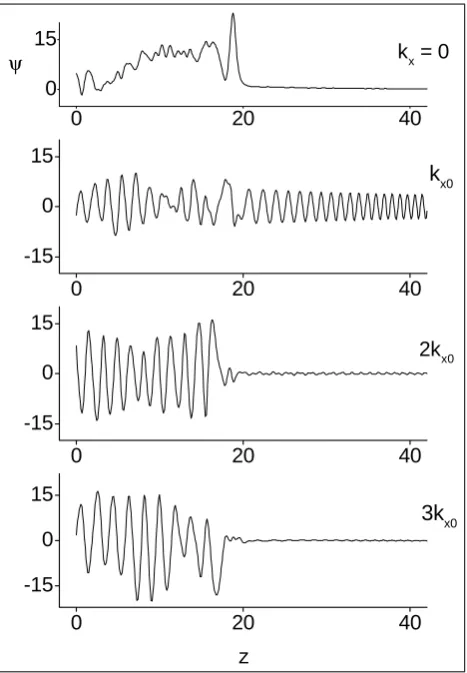
Fig. 1. The horizontal dependence of the first fourkxFourier com-ponents of the stream function. The top curve is thekx =0 mode, i.e. the stream function of the zonal flow.
We use these asymptotic expressions in the entire x, z plane, also those nonlinear characteristics that do not extend to infinity. Such a procedure, in the small but finite ampli-tude limit yields results that are equivalent to the standard coupled-mode theory. As a result, from Eq. (5), we obtain the nonlinear Schr¨odinger-like equation
∇⊥2 − 1 4H2
ψ
−2Q
u4 (ψ+uz)
h
(ψ+uz)2−u2z2i=0. (49) Here, Eq. (49) is numerically solved, and the results are displayed in Figs. 1 and 2 for the nonlinear solutions that asymptotically (atz → ∞) coincide with a linear acoustic-gravity wave emitted from the critical surfacez = 0 in the horizontal direction (i.e. with kx 6= 0 and kz = 0). The presence of the inhomogeneities (46) and (47) introduces a weakz-dependence of the effective wave numberkz of the linear mode. With our choice of parameters, the entire at-mosphere is transparent to the fundamental mode, with the turning point of the second harmonic located atztp ≈ 20, while those of the higherkxharmonics are located at propor-tionally larger distances fromz=0.
0
10
20
30
0
5
x
z
Fig. 2. The surface plot of the stream function.
Figure 1 shows that the nonlinearly generated zonal flow is spatially restricted to the critical region in which the sec-ond harmonic linear mode is evanescent, i.e. 0 < z < ztp. This result indicates that the modulation instability, which is responsible for the excitation of the zonal flow in the time domain, must also involve higher-order nonlinear processes, such as the coupling with the second harmonic. We also find that the nonlinear interactions comprising evanescent Fourier modes with higherkxproduce short-scale, nonlinear oscilla-tions in the direction of thezaxis, also restricted to the re-gion 0 < z < ztp, as can be seen in Figs. 1 and 2. While the basic configuration of the zonal flow appears to be robust (see Fig. 1), the distribution of these short-scale (both inx andz) quasi-modes is very sensitive to the small changes in the phase of the fundamental wave, and cannot be effectively controlled by the asymptotic boundary condition. Since they are also rather slowly converging with large kx, their be-haviour indicates the possibility of intermittency and chaos (Stenflo, 1996).
7 Conclusions
while their actual form is determined by the unperturbed den-sity, temperature and velocity profiles. Besides the classi-cal Kelvin-Stewart cat’s eyes chain, which can be realized under very restrictive conditions, a family of tearing- and bending-type vortex chains has been shown to exist under a broader class of atmospheric conditions. The mode-coupling mechanism for the nonlinear generation of shear flows in the presence of linearly unstable acoustic-gravity waves, possi-bly also leading to intermittency and chaos, is presented.
8 Acknowledgement
This work was done while one of the authors (D. J.) was visiting the Physics Department of the Ruhr University in Bochum, Germany. He is grateful for the hospitality of this institution. The work was supported in part (D. J.) by the Deutscher Akademischer Austauschdienst Grant A0119214.
References
Axelsson, P., Larsson, J., and Stenflo, L.: Nonlinear interaction be-tween acoustic gravity waves in a rotating atmosphere, Nonlin. Proc. Geophys., 3, 216–220, 1996.
Jovanovi´c, D., Pegoraro, F., and Rasmussen, J. J.: Tripolar shear-Alfv´en vortex structures, J. Plasma Phys., 60, 383–391, 1998.
Jovanovi´c, D., Stenflo, L., and Shukla, P. K.: Acoustic gravity tripo-lar vortices, Phys. Lett., A 279, 70–74, 2001.
Mallier, R. and Maslowe, S. A.: A row of counter-rotating vortices, Phys. Fluids, A 5, 1074–1075, 1993.
Pingree, R. D. and Le Cann, B.: Anticyclonic eddy X91 in the southern Bay of Biscay, May 1991 to February 1992, J. Geo-phys. Res., 97, 14 353–14 367, 1992.
Shukla, P. K. and Shaikh, A. A.: Dust-acoustic gravity vortices in a nonuniform dusty atmosphere, Phys. Scripta, T 75, 247–248, 1998.
Stenflo, L.: Acoustic solitary vortices, Phys. Fluids, 30, 3297–3299, 1987.
Stenflo, L.: Acoustic gravity vortices, Phys. Scripta, 41, 641–642, 1990.
Stenflo, L.: Acoustic gravity vortex chains, Phys. Lett., A 186, 133– 134, 1994.
Stenflo, L.: Nonlinear equations for acoustic gravity waves, Phys. Lett., A 222, 378–380, 1996.
Stenflo, L. and Stepanyants, Yu. A.: Acoustic-gravity modons in the atmosphere, Ann. Geophysicae, 13, 973–975, 1995.
van Heijst, G. J. F. and Kloosterziel, R. C.: Tripolar vortices in a rotating fluid, Nature, 338, 569–571, 1989.
Vranjeˇs, J.: Coherent structures in sheared flow of magnetized plasma, Phys. Scripta, 59, 230–234, 1999.
Vranjeˇs, J. and Jovanovi´c, D.: Nonlinear magnetic chains associ-ated with plasma flow, Phys. Plasmas, 3, 2275–2279, 1996. Vranjeˇs, J. and Jovanovi´c, D.: Electrostatic chains driven by