R E S E A R C H A R T I C L E
Open Access
Serum zinc-
α
2-glycoprotein levels are
elevated and correlated with thyroid
hormone in newly diagnosed
hyperthyroidism
Xin-Hua Xiao
†, Xiao-Yan Qi
†, Jiao-Yang Li, Yi-Bing Wang, Ya-Di Wang, Zhe-Zhen Liao, Jing Yang, Li Ran,
Ge-Bo Wen and Jiang-Hua Liu
*Abstract
Background:Zinc-α2-glycoprotein (ZAG) is a recently novel lipolytic adipokine implicated in regulation of glucose and lipid metabolism in many metabolic disorders. In vitro and animal studies suggest that thyroid hormones (TH) up-regulates ZAG production in hepatocytes. However, there is no data evaluating the possible relationship between ZAG and TH in a human model of hyperthyroidism. The objective of the present study is to assess the association of serum ZAG levels with TH and lipid profile in patients with hyperthyroidism before and after methimazole treatment.
Methods: A total of 120 newly diagnosed overt hyperthyroidism and 122 healthy control subjects were recruited. Of them, 39 hyperthyroidism patients were assigned to receive methimazole treatment as follow-up study for 2 months. Results:The clinical consequence showed that serum ZAG levels were elevated in patients with hyperthyroidism (P< 0.01). Adjust for age, gender and BMI, serum ZAG levels were positively related with serum free T3 (FT3), free T4 (FT4) levels and negatively correlated with serum total cholesterol (TC), low density lipoprotein cholesterol (LDLC) levels in hyperthyroidism subjects (allP< 0.01). After methimazole treatment, serum ZAG levels were decreased and the decline was associated with decreased FT3, FT4 and increased TC levels (allP< 0.001).
Conclusion:We conclude that ZAG may be involved in the pathogenesis of lipid metabolism disorder in patients with hyperthyroidism.
Trial registration:ChiCTR-ROC-17012943. Registered 11 October 2017, retrospectively registered.
Keywords:Hyperthyroidism, Zinc-α2-glycoprotein, Adipokine, Thyroid hormone
Introduction
Hyperthyroidism is a clinical situation where there is excess TH in the circulation due to increased synthesis of hormone from a hyperactive thyroid gland [1]. In addition to typical clinical symptoms like resting energy expenditure and weight loss directly related to excess TH, the patients with hyperthyroidism are likely to accompanied by changes in lipid metabolism [2,3]. However, the underlying mecha-nisms are not fully elucidated.
Adipose tissue secretes a variety of active biological sub-stances called adipokines that act in an autocrine, paracrine and endocrine manner [4]. Several lines of evidence have shown that adipokines, such as adiponectin, leptin, resistin and fibroblast growth factor 21, etc., play an important role in regulating energy expenditure and metabolism of lipids [5–8]. Recently, researchers demonstrate that apart from abnormal circulating levels of TH and thyroid-stimulating hormone (TSH), changes in profile of adipokines (like adiponectin, leptin and resistin, etc.) also have been found in patients with hyperthyroidism [9–11]. Moreover, adipo-cytes express high levels of TH and TSH receptors which function similar to those in thyroid, suggesting TH may
* Correspondence:[email protected]
†Xin-Hua Xiao and Xiao-Yan Qi contributed equally to this work.
Department of Metabolism and Endocrinology, The First Affiliated Hospital of University of South China, Hengyang 421001, China
participates in the regulation of adipocyte functions [12]. Thereby, thyroid dysfunction may influence secretion of adipokines, which contributes to lipids metabolic disorders. Zinc-alpha-2-glycoprotein (ZAG) is a recently character-ized adipokine synthescharacter-ized and secreted mainly by adipose tissues and liver [13]. It is a 43-kDa soluble glycoprotein first isolated from human plasma and proposed as a tumour-derived cancer cachexia [14]. It is found in various bodily fluids such as plasma, semen, sweat, milk and cere-brospinal fluid [15]. The plasma concentration of ZAG is affected by several factors, including body weight and health status. ZAG has been found to have a wide range of biological activities, but the recent interest in ZAG function comes from its specific lipolytic action and its potential role in body weight regulation. Very recently, we further explained the functions of ZAG, it can protect against obesity-associated fatty liver by ameliorating hepatic steato-sis, insulin resistance and inflammation, as well as promote browning in adipocytes, once again indicating its novel role in lipid metabolism [16–18].
Given that both TH and ZAG are involved in regu-lating energy expenditure and metabolism of lipids, moreover, in vitro and animal studies suggest that TH up-regulates ZAG production in hepatocytes [19], we suspect that overt hyperthyroidism might alter the production of ZAG. However, so far, there are limited human studies of ZAG expression and little is known of ZAG’s role in hyperthyroidism. In this study, we investigated the association of serum ZAG levels with TH and lipid profile in patients with hyperthyroidism before and after methimazole treatment.
Materials and methods
Subjects
A total of 120 consecutive newly diagnosed overt hyperthyroidism (37 men and 83 women) were enrolled from the First Affiliated Hospital of University of South China (Hengyang, China), from October 2015 to Au-gust 2016. All of the subjects were diagnosed with overt hyperthyroidism by typical symptom, elevated serum TH, reduced thyroid-stimulating hormone (TSH), and TSH receptor antibody (TRAb) levels in these patients might increase or normal. Additionally, 122 healthy individuals who had undergone a routine physical examination were recruited as the control group. All of the hyperthyroidism patients were drug-naive before recruitment. Thirty-nine hyperthyroid patients received methimazole treatment for two months. No dietary rec-ommendations were given. Exclusion criteria for both groups included age < 18 years, BMI > 35 kg/m2, known cardiovascular disease, neoplasms, smoking, diabetes, hypertension, and renal impairment (serum creatinine 120μmol/L).
Ethics statement
The study protocol was approved by the Ethics Committee of the First Affiliated Hospital of University of South China (Number: 2015-05-01), and written informed consent was obtained from all participants before their inclusion in the study. The items of the consent form include aim, inclusion and exclusion criteria, procedures, harm and benefit, med-ical care, privacy and right, and withdrawal. All procedures were in accordance with the Helsinki Declaration.
Biochemical measurements
A standard questionnaire was used to collect the informa-tion about health status and medicainforma-tions. Blood samples were collected from 8 to 9 am after a 12-h overnight fast, and serum was separated and stored at −20 °C for assay. Fasting plasma glucose (FPG), FT3, FT4 and TSH were measured electrochemiluminescence immunoassay (Roche Diagnostics). Total cholesterol (TC), triglyceride (TG), low density lipoprotein cholesterol (LDLC), and high-density lipoprotein cholesterol (HDLC), alanine aminotransferase (ALT), aspartate aminotransferase (AST), total bilirubin (TBIL) and conjugated bilirubin (DBIL) levels were mea-sured by colorimetric enzymatic assays with an autoanaly-zer. The serum concentrations of ZAG were determined using ELISA according to the manufacturer’s protocols (Biovendor, Modrice, Czech Republic).
Statistical analysis
All analyses were performed with Statistical Package for Social Sciences version 17.0 (SPSS, Chicago, IL, USA). Normal distributed data were expressed as mean ± SD. Data that were not normally distributed, as determined using Kolmogorox-Smirnov test, were logarithmically transformed before analysis and expressed as median with interquartile range (IQR). χ2 and one-way ANOVA tests were used for comparison of categorical and continuous variables, respectively. The Student’s pairedttest was used for comparison of the data before and after anti-thyroid treatment. The Pearson correlation coefficient was used for analyses of correlations. Multiple stepwise regression was performed to determine variables that had independent as-sociations with serum ZAG. P-values < 0.05 (two-sided) were considered statistically significant.
Results
Subject characteristics
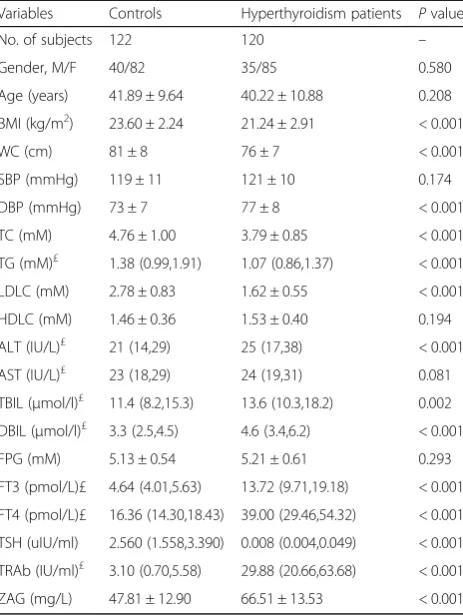
(P< 0.01). However, no significant difference was found in SBP, FPG, HDLC and AST levels between two groups.
Correlations of serum ZAG levels with thyroid hormone and other clinical parameters
We also investigated the associations between ZAG and the other parameters in hyperthyroidism subjects. ZAG was negatively correlated with BMI, TC, LDLC and TSH (all P< 0.05), positively correlated with AST, FT3, FT4 (allP< 0.05). After adjustment for age, gender and BMI, serum ZAG levels were positively related with serum FT3, FT4 levels, the correlation coefficient was 0.324 (P< 0.001) and 0.341 (P< 0.001), respectively (Fig. 1 a-b). In addition, serum ZAG levels were negatively correlated with serum TC and LDLC levels (correlation coefficient =−0.275 and−0.263, all P< 0.01, Fig.1 c-d). However, there was no significant cor-relation between serum ZAG and SBP or DBP, TG, HDLC, ALT, TBIL, DBIL, TSH, TRAb. To determine which parameters were independently associated with serum ZAG, multiple stepwise regression analysis was performed. Age, gender, BMI, TC, LDLC, ALT, AST, FT3, FT4, and TSH were analyzed. FT3 was found to be independently associated with serum ZAG (β= 1.230,P< 0.001).
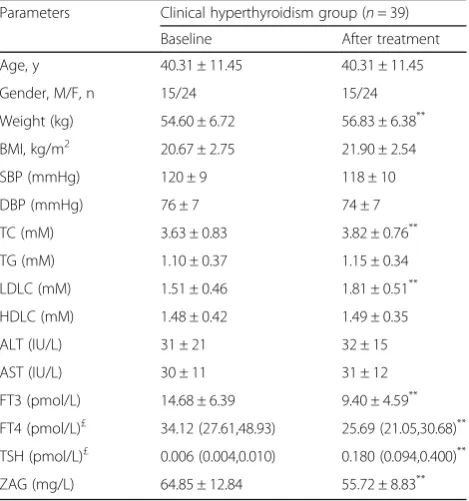
Influences of methimazole treatment on metabolic parameters and serum ZAG levels
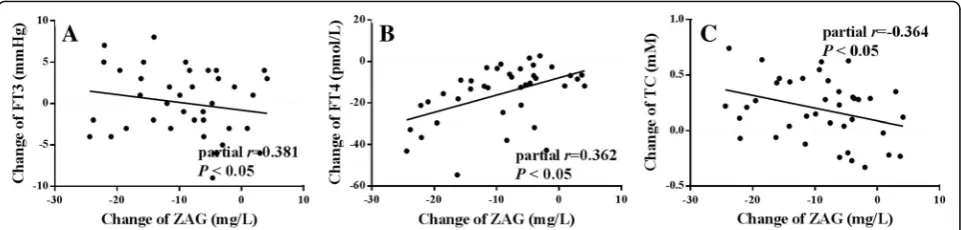
No serious adverse events were recorded during the follow-up observation study. The levels of FT3 and FT4 were significantly decreased (P< 0.01) from baseline while the levels of Weight, TC and LDLC were dramatically in-creased (P< 0.01) in patients with overt hyperthyroidism (Table2). Serum ZAG levels was decreased from 64.85 ± 12.84 mg/l to 55.72 ± 8.83 mg/l after methimazole treat-ment (P< 0.001) (Table 2). Interestingly, the decreased ZAG levels were significantly correlated with the decreased FT3, FT4 and increased TC levels, even after adjustment for the independent variables of age, gender and BMI (FT3: partial r= 0.381; FT4: partialr= 0.362, TC: partial
r=−0.364, allP< 0.05) (Fig.2).
Discussion
In this study, we found that serum ZAG levels were in-creased in patients with newly diagnosed hyperthyroidism and declined after methimazole treatment. Serum ZAG levels were positively related with serum FT3, FT4 levels and negatively correlated with serum TC and LDLC levels in hyperthyroidism subjects after adjustment for age, gender and BMI. Moreover, the decline of ZAG levels was significantly correlated with the decrease of FT3, FT4 and increased TC levels. These findings present for the first time the clinical relevance between TH and serum ZAG levels in hyperthyroidism subjects.
Epidemiological studies have shown that hyperthyroidism results in a hyper-metabolic state associated with increased energy expenditure causing weight loss [20]. Significantly, the patients with hyperthyroidism are likely to accompan-ied by changes in lipid metabolism [2]. Our study was con-sistent with the notion and showed that hyperthyroid patients had decreased levels of blood lipids and displayed an ectomorphic type as measured by BMI and WC. Numerous putative underlying mechanisms have been proposed to explain this changes in lipid metabolism: i) TH can directly trigger a series of pathway mainly involved in lipid metabolism and energy homeostasis, such as PI3K/ Akt, MAPK/ERK, SIRT1, peroxisome proliferator activated receptors (PPARs), etc. [21, 22]. ii) More importantly, TH participates in the regulation of adipocyte functions includ-ing secretinclud-ing adipokines [10, 23, 24]. As refered before, there is striking evidence that TH excess lead to prominent changes in classical adipokines (like adiponectin, leptin and resistin, etc.), we wonder serum ZAG, a novel lipid-mobil-izing adipokine, whether changed in hyperthyroidism patients.
To the best of our knowledge, there is only one study investigating serum ZAG concentration in hyperthyroid patients [19]. It concluded that serum ZAG levels were increased in patients with hyperthyroidism and declined after methimazole treatment. However, they did not have
Table 1Clinical and biochemical features in study subjects
Variables Controls Hyperthyroidism patients Pvalue
No. of subjects 122 120 –
Gender, M/F 40/82 35/85 0.580
Age (years) 41.89 ± 9.64 40.22 ± 10.88 0.208
BMI (kg/m2) 23.60 ± 2.24 21.24 ± 2.91 < 0.001
WC (cm) 81 ± 8 76 ± 7 < 0.001
SBP (mmHg) 119 ± 11 121 ± 10 0.174
DBP (mmHg) 73 ± 7 77 ± 8 < 0.001
TC (mM) 4.76 ± 1.00 3.79 ± 0.85 < 0.001
TG (mM)£ 1.38 (0.99,1.91) 1.07 (0.86,1.37) < 0.001
LDLC (mM) 2.78 ± 0.83 1.62 ± 0.55 < 0.001
HDLC (mM) 1.46 ± 0.36 1.53 ± 0.40 0.194
ALT (IU/L)£
21 (14,29) 25 (17,38) < 0.001
AST (IU/L)£ 23 (18,29) 24 (19,31) 0.081
TBIL (μmol/l)£ 11.4 (8.2,15.3) 13.6 (10.3,18.2) 0.002
DBIL (μmol/l)£ 3.3 (2.5,4.5) 4.6 (3.4,6.2) < 0.001
FPG (mM) 5.13 ± 0.54 5.21 ± 0.61 0.293
FT3 (pmol/L)£ 4.64 (4.01,5.63) 13.72 (9.71,19.18) < 0.001
FT4 (pmol/L)£ 16.36 (14.30,18.43) 39.00 (29.46,54.32) < 0.001
TSH (uIU/ml) 2.560 (1.558,3.390) 0.008 (0.004,0.049) < 0.001
TRAb (IU/ml)£ 3.10 (0.70,5.58) 29.88 (20.66,63.68) < 0.001
data demonstrating the association of serum ZAG levels with TH and lipid profile in patients with hyperthyroidism before and after treatment. Here, we detected consistent changes in serum ZAG levels in patients with newly diag-nosed hyperthyroidism. Furthermore, association analyses
showed that serum ZAG levels were positively related with serum FT3, FT4 levels after adjusting for age, gender and BMI in patients with newly diagnosed hyperthyroidism both before and after treatment with methimazole. Re-markably, multiple regression confirmed the FT3 was inde-pendently related to serum ZAG. Combined with a previous in vivo study which suggested TH could increase ZAG production [19], we therefore concluded that the in-creased circulating ZAG levels in hyperthyroidism patients may partly due to TH excess.
Many works documented the alteration in serum con-centrations of ZAG was closely linked with dyslipidemia in various endocrine metabolic disorders, such as type 2 dia-betes mellitus, polycystic ovary syndrome, growth hormone deficiency, Cushing’s syndrome, obesity, non-alcoholic fatty liver disease and metabolic syndrome [25–31]. In addition, Studies performed by Olofsson et al. showed that serum levels of ZAG were significantly correlated with serum TC and TG levels, and a polymorphism in the ZAG gene was also associated with circulating TC levels in healthy and obese Swedish population, suggesting that ZAG is involved in lipid metabolism [32]. In good agreement, we observed in the present study that the serum levels of ZAG were negatively associated with TC, LDLC levels after adjusting for age, gender and BMI in patients with newly diagnosed hyperthyroidism both before and after treatment with methimazole. Hence, these lines of clinical evidences sug-gest a potential role of ZAG in pathogenesis of metabolic syndrome.
Fig. 1Correlations of serum levels of ZAG with (a) FT3 (log transformed), (b) FT4 (log transformed), (c) TC and (d) LDLC in 120 hyperthyroidism subjects. Therwas assessed by partial correlation analysis with adjusted age, gender and BMI
Table 2Comparison of clinical parameters after methimazole treatment in patients with overt hyperthyroidism
Parameters Clinical hyperthyroidism group (n= 39)
Baseline After treatment
Age, y 40.31 ± 11.45 40.31 ± 11.45
Gender, M/F, n 15/24 15/24
Weight (kg) 54.60 ± 6.72 56.83 ± 6.38**
BMI, kg/m2 20.67 ± 2.75 21.90 ± 2.54
SBP (mmHg) 120 ± 9 118 ± 10
DBP (mmHg) 76 ± 7 74 ± 7
TC (mM) 3.63 ± 0.83 3.82 ± 0.76**
TG (mM) 1.10 ± 0.37 1.15 ± 0.34
LDLC (mM) 1.51 ± 0.46 1.81 ± 0.51**
HDLC (mM) 1.48 ± 0.42 1.49 ± 0.35
ALT (IU/L) 31 ± 21 32 ± 15
AST (IU/L) 30 ± 11 31 ± 12
FT3 (pmol/L) 14.68 ± 6.39 9.40 ± 4.59**
FT4 (pmol/L)£ 34.12 (27.61,48.93) 25.69 (21.05,30.68)**
TSH (pmol/L)£ 0.006 (0.004,0.010) 0.180 (0.094,0.400)**
There are several limitations in our current study. First, the study was a non-randomized controlled trial, which may cause some bias. Second, the sample size was relatively small and consisted entirely of Chinese people, which may have hampered the generalization of our findings. Despite there are some limitations, it seems likely that ZAG may have a pathophysiological role in lipid metabolism in patients with hyperthyroidism. Further detailed studies are still needed to better elucidate the underlying molecular mechanisms.
Conclusion
Our study demonstrates that serum ZAG levels are ele-vated in patients with hyperthyroidism and decreased after methimazole treatment. The decline of ZAG was associated with FT3, FT4 and TC levels. Our findings provide clinical evidence that ZAG may be involved in the pathogenesis of lipid metabolism disorder in patients with hyperthyroidism (Additional file1).
Additional file
Additional file 1:Baseline and follow-up data of study subjects. Baseline data included anthropometric parameters and biochemical parameters in 122 control subjects and 120 patients with newly diagnosed hyperthyroid-ism. Follow-up data contained anthropometric parameters and biochemical parameters of 39 cases overt hypothyroid patients before and after methi-mazole treatment. (XLS 64 kb)
Abbreviations
ALT:Alanine aminotransferase AST: Aspartate aminotransferase; BMI: Body mass index DBP: Diastolic blood pressure; DBIL: Conjugated bilirubin FPG: Fasting plasma glucose; FT3: Free T3 FT4: Free T4 HDLC: High-density lipo-protein cholesterol; LDLC: Low-density lipolipo-protein cholesterol SBP:Systolic blood pressure; TBIL: Tobal bilibrubin TC: Total cholesterol TG: Triglyceride; TH: Thyroid hormone TRAb: TSH receptor antibody; TSH: Thyroid-stimulating hormone WC: Waist circumference; ZAG: Zinc-α2-glycoprotein
Acknowledgments Not applicable.
Funding
This work was supported by research grants from the National Natural Science Foundation of China (81870595) and Major special projects of Hunan provincial health and family planning commission(A2017011).
Availability of data and materials
The datasets used and/or analyzed during the current study are available from the corresponding author on reasonable request.
Authors’contributions
JL and XX initiated and designed the study. XQ, and YW were responsible for data collection. JL analysed the data. XQ and JL interpreted the results. XX, XQ and JL wrote the article and the other authors revised it critically for important intellectual content. XX acquired the funding for financing this study. All authors reviewed and approved the final manuscript.
Ethics approval and consent to participate
The study protocol was approved by the Ethics Committee of the First Affiliated Hospital of University of South China, and written informed consent was obtained from all participants before their inclusion in the study.
Consent for publication Not applicable.
Competing interests
The authors declare that they have no competing interests.
Publisher’s Note
Springer Nature remains neutral with regard to jurisdictional claims in published maps and institutional affiliations.
Received: 6 February 2018 Accepted: 9 January 2019
References
1. Maji D. Hyperthyroidism. J Indian Med Assoc. 2006;104(10):563–4 566-7. 2. Song Y, Yao X, Ying H. Thyroid hormone action in metabolic regulation.
Protein Cell. 2011;2:358–68.
3. Mashita K, Tarui S. Thyroid gland dysfunction and metabolic abnormalities, with special reference to abnormal lipid and glucose metabolism. Nihon Rinsho. 1980;38(3):1656–65.
4. Kokkinos S, Papazoglou D, Zisimopoulos A, Papanas N, Tiaka E, Antonoglou C, Maltezos E. Retinol binding Protein-4 and adiponectin levels in thyroid overt and subclinical dysfunction. Exp Clin Endocrinol Diabetes. 2016;124(2):87–92. 5. Ghadge AA, Khaire AA, Kuvalekar AA. Adiponectin: a potential therapeutic target for metabolic syndrome. Cytokine Growth Factor Rev. 2018;39:151–8. 6. Rodríguez AJ, Neeman T, Giles AG, Mastronardi CA, Paz Filho G. Leptin
replacement therapy for the treatment of non-HAART associated lipodystrophy syndromes: a meta-analysis into the effects of leptin on metabolic and hepatic endpoints. Arq Bras Endocrinol Metabol. 2014;58(8):783–97.
7. Adeghate E. An update on the biology and physiology of resistin. Cell Mol Life Sci. 2004;61(19–20):2485–96.
8. Luo Y, Ye S, Chen X, Gong F, Lu W, Li X. Rush to the fire: FGF21
extinguishes metabolic stress, metaflammation and tissue damage. Cytokine Growth Factor Rev. 2017;38:59–65.
9. Bossowski A, Sawicka B, Szalecki M, Koput A, Wysocka J, Zelazowska-Rutkowska B. Analysis of serum adiponectin, resistin and leptin levels in children and adolescents with autoimmune thyroid disorders. J Pediatr Endocrinol Metab. 2010;23:369–77.
10. Chen Y, Wu X, Wu R, Sun X, Yang B, Wang Y, Xu Y. Changes in profile of lipids and adipokines in patients with newly diagnosed hypothyroidism and hyperthyroidism. Sci Rep. 2016;19:6–26174.
11. Wang G, Liu J, Yang N, Hu Y, Zhang H, Miao L, Yao Z, Xu Y. Levothyroxine treatment restored the decreased circulating fibroblast growth factor 21 levels in patients with hypothyroidism. Eur J Intern Med. 2016;31:94–8. 12. Nannipieri M1, Cecchetti F, Anselmino M, Camastra S, Niccolini P, Lamacchia
M, Rossi M, Iervasi G, Ferrannini E. Expression of thyrotropin and thyroid hormone receptors in adipose tissue of patients with morbid obesity and/ or type 2 diabetes: effects of weight loss. Int J Obes 2009; 33: 1001–1006. 13. Cabassi A, Tedeschi S. Zinc-α2-glycoprotein as a marker of fat catabolism in
humans. Curr Opin Clin Nutr Metab Care. 2013;16(3):267–71.
14. BURGI W, SCHMID K. Preparation and properties of Zn-alpha 2-glycoprotein of normal human plasma. J Biol Chem. 1961;236:1066–74.
15. Hassan MI, Bilgrami S, Kumar V, Singh N, Yadav S, Kaur P, Singh TP. Crystal structure of the novel complex formed between zinc alpha2-glycoprotein (ZAG) and prolactin-inducible protein (PIP) from human seminal plasma. J Mol Biol. 2008;384(3):663–72.
16. Xiao X, Li H, Qi X, Wang Y, Xu C, Liu G, Wen G, Liu J. Zinc alpha2 glycoprotein alleviates palmitic acid-induced intracellular lipid accumulation in hepatocytes. Mol Cell Endocrinol. 2017;439:155–64.
17. Xiao XH, Qi XY, Wang YD, Ran L, Yang J, Zhang HL, Xu CX, Wen GB, Liu JH. Zinc alpha2 glycoprotein promotes browning in adipocytes. Biochem Biophys Res Commun. 2018;496(2):287–93.
18. Xiao XH, Wang YD, Qi XY, Wang YY, Li JY, Li H, et al. Zinc alpha2 glycoprotein protects against obesity-induced hepatic steatosis. Int J Obes. 2018.https://doi.org/10.1038/s41366-018-0151-9.
19. Simo R, Hernandez C, Saez-Lopez C, Soldevila B, Puig-Domingo M, Selva DM. Thyroid hormone upregulates zinc-alpha2-glycoprotein production in the liver but not in adipose tissue. PLoS One. 2014;9:e85753.
20. Li H, Yuan X, Liu L, Zhou J, Li C, Yang P, Bu L, Zhang M, Qu S. Clinical evaluation of various thyroid hormones on thyroid function. Int J Endocrinol 2014; 2014: 618572. 21. Senese R, Lasala P, Leanza C, de Lange P. New avenues for regulation of lipid
metabolism by thyroid hormones and analogs. Front Physiol 2014; 5:475. 22. Sinha RA, Singh BK, Yen PM. Direct effects of thyroid hormones on hepatic
lipid metabolism. Nat Rev Endocrinol. 2018;14(5):259–69.
23. Seifi S, Tabandeh MR, Nazifi S, Saeb M, Shirian S, Sarkoohi P. Regulation of adiponectin gene expression in adipose tissue by thyroid hormones. J Physiol Biochem. 2012;68(2):193–203.
24. Md O, de Síbio MT, Olimpio RM, Moretto FC, Luvizotto Rde A, Nogueira CR. Triiodothyronine modulates the expression of leptin and adiponectin in 3T3-L1 adipocytes. Einstein (Sao Paulo). 2015;13(1):72–8.
25. Tian M, Liang Z, Liu R, Li K, Tan X, Luo Y, Yang M, Gu HF, Liu H, Li L, Yang G. Effects of sitagliptin on circulating zinc-alpha2-glycoprotein levels in newly diagnosed type 2 diabetes patients: a randomized trial. Eur J Endocrinol. 2016;174:147–55.
26. Lai Y, Chen J, Li L, Yin J, He J, Yang M, Jia Y, Liu D, Liu H, Liao Y, Yang G. Circulating zinc-alpha2-glycoprotein levels and insulin resistance in polycystic ovary syndrome. Sci Rep. 2016;6:25934.
27. BalažM, Ukropcova B, Kurdiova T, Vlcek M, Surova M, Krumpolec P, Vanuga P, Gašperíková D, KlimešI, Payer J, Wolfrum C, Ukropec J. Improved adipose tissue metabolism after 5-year growth hormone replacement therapy in growth hormone deficient adults: the role of zinc-α2-glycoprotein. Adipocyte. 2014;4(2):113–22.
28. Escoté X, Aranda GB, Mora M, Casals G, Enseñat J, Vidal O, Esteban Y, Halperin I, Hanzu FA. Zinc alpha-2 glycoprotein is overproduced in Cushing's syndrome. Endocrinol Diabetes Nutr. 2017;64(1):26–33. 29. Ge S, Ryan AS. Zinc-α2-glycoprotein expression in adipose tissue of obese
postmenopausal women before and after weight loss and exercise + weight loss. Metabolism. 2014;63(8):995–9.
30. Yilmaz Y, Yonal O, Eren F, Kurt R, Celikel CA, Ozdogan O, Imeryuz N, Kalayci C, Avsar E. Serum zinc-α2-glycoprotein concentrations in patients with non-alcoholic fatty liver disease. Clin Chem Lab Med. 2011;49(1):93–7. 31. Lei L, Li K, Li L, Fang X, Zhou T, Zhang C, Luo Y, Liu H, Li X, Zheng H, Zhang
L, Yang G, Gao L. Circulating zinc-α2-glycoprotein levels are low in newly diagnosed patients with metabolic syndrome and correlate with adiponectin. Nutr Metab (Lond). 2017;14:53.