R E S E A R C H A R T I C L E
Open Access
Evaluation of self-educational training
methods to learn laparoscopic skills - a
randomized controlled trial
Steffen Axt
1, Pirmin Storz
1, Carolin Ehrenberg
1, Claudius Falch
1, Marc Immenroth
2, Andreas Kirschniak
1*and Sven Muller
1Abstract
Background:Evaluation of two different self-educational methods (video assisted learning versus video assisted learning plus a nodal point operation primer) on learning laparoscopic suturing and intracorporal knotting. Methods:Randomized controlled trial at the laparoscopic surgical training center, University of Tubingen with 45 surgical novices first year medical students being pretested for dexterity. After self-educational training for 90 min with either method (Group A: video assisted learning, Group B: video assisted learning plus a nodal point operation primer) participants had to perform five laparoscopic intracorporal knots. Assessed were number of knots completed (maximum of five knots counted, knot integrity, technical proficiency and knotting time per knot. Primary outcome measure is a composed knot score combining knot integrity, technical proficiency and knotting time.
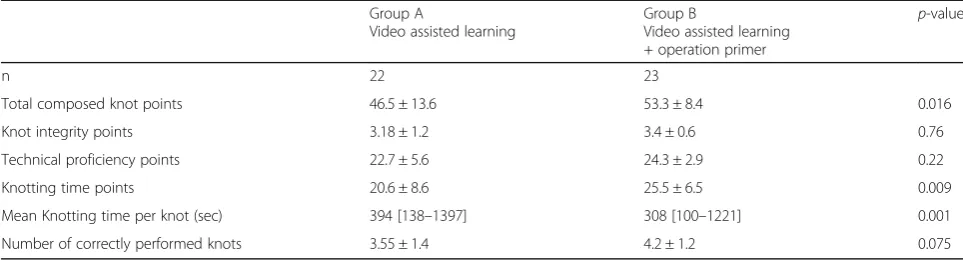
Results:Group B (n= 23) achieved a significantly higher composed knot score than Group A (n= 22) (53.3 ± 8.4 versus 46.5 ± 13.6 points respectively,p= 0.016). Median knotting time per completed knot was significantly different between Group B and Group A (308 s [100–1221] versus 394 s [138–1397] respectively,p= 0.001). Concerning number of completed knots there was a trend towards more knots achieved in Group B (4.2 ± 1.2 versus 3.55 ± 1.4 respectively,p= 0.075) .
Conclusions:The use of a nodal point operation primer highlighting essential key steps of a procedure augment the success of learning laparoscopic skills as suturing and intracorporal knotting. (UIN researchregistry3866, March 22, 2018).
Keywords:Laparoscopic suturing and intracorporal knotting, Operation primer, Self-educational, Video-assisted learning
Background
Learning laparoscopic surgical skills is a major challenge for interns and of paramount importance in any educa-tional surgical residency program. Especially in the light of limited training opportunities in the operation room due to restricted working hours and operation costs at its limit, optimized resident teaching strategies are warranted [1]. Simulation based training methods have been pub-lished that support training success and transferability into the operation room [2]. However the instructional
implementation strategies of simulation based resident training are less well investigated. Self-educational learn-ing by video tutorlearn-ing and followlearn-ing hands on trainlearn-ing by the resident himself is one possible option [3]. An additional available teaching approach is “step-by-step” -instructions based on the philosophy of the“mental train-ing”, repeatingly internalizing the essential key points of a procedure. Though, the actual mental training requires in the optimum case a “one-to-one” personal coaching and its practicability is therefor limited in everyday use.
The nodal point concept breaking down a procedure in a limited number of essential key steps significantly improves the learning and internalization of laparoscopic skills. This concept highlights crucial steps of a proced-ure and helps to repeatedly imagine the procedproced-ure [4].
* Correspondence:[email protected]; [email protected]
1Working Group for Surgical Technique and Training, Clinic for Visceral, General and Transplant Surgery, Tuebingen University Hospital, 72072 Tübingen, Germany
Full list of author information is available at the end of the article
The aim of this randomized controlled trial was to as-sess the value of an additional“nodal point operation pri-mer”without the actual mental training in the process of video assisted self-educational learning of laparoscopic su-turing and intracorporal knotting.
Methods
Setting and participants
This study was conducted by the Surgical Training Center at the University Tubingen. Because of the educational na-ture of the study, evaluation of the study protocol by the local ethics committee was not necessary. The participants were all first year medical students without pre-existing experiences in surgical techniques and especially no previ-ous laparoscopic skills.
Baseline assessment and pretests
In preparation all study participants received an instruc-tional video to teach elementary basics of laparoscopy and laparoscopic suturing and intracorporal knotting. Afterwards, participants had to reply a standardized questionnaire about basic laparoscopy before study in-clusion. Exclusion from the study was done if less than 60% of questions were correctly answered. After study inclusion two preliminary simulation based laparoscopic exercises and a laparoscopic intracorporal knot were performed in a black box trainer to assess baseline man-ual dexterity and the ability of three-dimensional orien-tation. For the first preliminary simulation based laparoscopic exercise participants had to touch 20 con-tact points of a 3-D model, in which every concon-tact point had a diameter of 3 mm surrounded by a ring which could be illuminated by LEDs. Contacting the surround-ing of the point was electronically detected as an error. For the second preliminary simulation based laparo-scopic exercise the participants had to pass a needle horizontally through five openings in a wall with two grasping instruments. Touching the wall with the needle or the instruments was electronically detected as an error. In both exercises, the number of errors and the necessary performing time in seconds were determined. Finally the participants had to perform a pretest laparo-scopic intracorporal knot in a maximum time span of seven minutes according to the below mentioned criteria after watching an uncommented video demonstrating laparoscopic suturing and intracorporal knotting.
Randomization
After study inclusion and successful pretesting partici-pants were randomly allocated to either group A (video assisted learning) or group B (video assisted learning plus operation primer) in a 1:1 ratio.
Study performance
Participants of both groups received a standardized intro-duction to the laparoscopic workstation for 10 min. From now on Group A and B were separated for the learning phase and final testing.
Group a–Video assisted learning
Participants of Group A watched a commented video of the performance of laparoscopic suturing and intracor-poral knotting. Afterwards the video was shown during a training period of 90 min in a continuous loop so that a presentation of the performance was available for the participants all the time.
Group B - video assisted learning plus a key point operation primer
Additionally to the video, the participants of Group B received an operation primer booklet highlighting the 10 key points of laparoscopic suturing and intracor-poral knotting in text form and with example pictures (see Additional File 1). The concept of an operation pri-mer is based on highlighting crucial steps of a procedure by key points and helps to repeatedly imagine the proced-ure. According to Immenroth et al. the definition of a key point is that it represents necessary structural motor com-ponents that must be performed in sequence and are marked by a reduction in the degrees of freedom of action (e.g correct alignement of the needle with the needle holder is a mandatory steps for a correct puncture of the wound edge in the following step) [4].
The correct use of the operation primer was shown in a standardized video presentation. Subsequently the par-ticipants had 90 min to train laparoscopic suturing and knots according to the video and the operation primer.
Finally after a 20 min break, each participant was instructed to perform five laparoscopic intracorporal knots in a maximum time span of 35 min without fur-ther help. The performance was video-taped for furfur-ther evaluation.
Outcome measure
The analysis of the videotapes and the knot specimen was performed independently by two blinded investiga-tors (both board certified general surgeons). Assessed were the number of knots completed (maximum of five knots counted), knot integrity, technical proficiency and knotting time per knot.
well as sufficient length of the rest of the suture (5 mm). A maximum of 6 points (one for each fulfilled evaluation criterion) could be reached for knot integrity.
Technical proficiency was defined as correctly per-forming the 10 key steps shown in the video and highlighted in the operation primer in the correct order. For reaching a step one could get two points. In addition, an extra-point was awarded for the right per-formance of the essential part of a step of the knotting technique. Thus, a maximum score of 30 points could be reached for technical proficiency.
Knotting time per knot was defined as time needed for the performance of one complete knot (knotting time) and was recorded in seconds. The knotting time was then transferred by means of a conversion table in a point value. The maximum achievable points given were 30 for a time needed of < 209 s for one knot. For each additional 35 s time needed a point was deducted.
As a maximum result a score of 66 points was pos-sible. Only completely performed knots were evaluated for knot integrity, technical proficiency, knotting time and number of correctly performed knots.
The mentioned composed knot score used at the Sur-gical Training Center at the University Tubingen to compare the before/after results of laparoscopic knotting in the residency training program is similar to the knot score proposed by Aggarwal et al. [5].
Materials
As suture material a 3–0 polyfilament suture with a 26 mm in diameter SH-needle (Ethicon Endo Surgery; Johnson and Johnson, New Brunswick; New Jersey, USA) was used. The length of the suture was standardized to 120 mm. The knots were performed on sponges with marks of 5 cm width and 1 cm height, which defined the area in which the knots had to be performed and in which a 8 cm long incision was placed in the center. The laparo-scopic tower was equipped by Karl Storz endoscopes (Karl Storz Endoscopes GmbH and Co. KG, Tuttlingen, Germany). The equipment consisted of high density cam-eras (Karl Storz H3 Z Full-HD, Karl Storz SCB Image 1 HD Hub 222,010 20), 30°-optics (Karl Storz Hopkins®-II 30°-optics) and cold light sources (Karl Storz SCB xenon 300 20,133,120). The recordings were done by an inte-grated reception system (AIDA, Karl Storz Endoscopes GmbH and Co. KG, Tuttlingen, Germany). During the performance of the study knots, the optics were fixed in an angle of 45° by a Karl Storz Martins arm (Karl Storz Endoscopes GmbH and Co. KG, Tuttlingen, Germany). The used laparoscopic instruments were a needle holder (Karl Storz, needle holder to Koh Marco; straight grip), a laparoscopic atraumatic grasping forceps (Karl Storz; click-Line Dissecting and Grasping Forceps according to
Kelly, pistol grip) and a laparoscopic scissors (Karl Storz, click shear line; pistol grip).
Statistical evaluation
Sample size calculation was done assuming a difference for the primary end point between group A and group B of greater than 20% to be relevant. This difference could be detected with a two-sided significance level α= 0.05 and a power of 1−β= 0.9, with a group size of 22 partic-ipants randomized to each group. The statistical evalu-ation was performed with SPSS 21 (SPSS Inc., Chicago, IL, USA). First the arithmetic means and their standard deviations or medians and their interquartile ranges were determined. In the analytical statistics first the de-termination of the normal distribution was done. Subse-quently, the test of homogeneity of variance followed. Significance was tested by the student t-test for pendent samples or the Mann-Whitney-U-test for inde-pendent samples. The study was registered at www. researchregistry.com(UIN researchregistry3866).
Results
Flow of participants through the study is displayed in Fig.1. Participant characteristics and pretest results were well distributed and are shown in Table1. None of the partici-pants achieved to perform a complete pretest knot. Outcome measures are summarized in Table 2. For the primary outcome measure composed knot score group B (n= 23) achieved significantly more total points than group A (n= 22) (53.3 ± 8.4 versus 46.5 ± 13.6 points re-spectively, p= 0.016). Especially median knotting time per completed knot was significant different between Group B and Group A (308 s [100–1221] versus 394 s [138–1397] respectively,p= 0.001). Concerning number of completed knots there was a trend towards more knots achieved in Group B (4.2 ± 1.2 versus 3.55 ± 1.4 respectively, p= 0.075). Concerning the inter-rater reli-ability of the two blinded reviewers for the outcome measures, there was discordance in only one case judg-ing tears in the sponge.
Discussion
laparoscopic skills and their comparability and known effectiveness is limited [9]. A randomized controlled trial by Prabhu et al. showed that elevated stress level in the operating room resulted in an incomplete transfer of simulator acquired laparoscopic skills in daily practice [10]. Therefor it remains important to evaluate different training methods for their learning curves and effectiveness when implementing a laparoscopic training curriculum. Studies on autodidactic learning methods in laparoscopic
simulator based training rarely exist. Xeroulis et al. com-pared in a randomized controlled trial computer based video instructions as a self educational method with expert feed back hands on training for laparoscopic knotting, showing no difference in learning success and learning curves for either method [11]. An additional available teaching approach is “step-by-step”- instructions based on the philosophy of the“mental training”[12]. Immenroth et al. described a significant difference in learning the
Fig. 1Study flow chart
Table 1Participant characteristics and pretest results
Group A
Video assisted learning
Group B
Video assisted learning plus operation primer
p-value
N= 22 23
Female Gender 10 16 0.11
Median age (years, [range]) 21 [20–28] 21 [20–26] 0.71
Previous experience with video games (n=) 20 22 0.52
Right handed (n=) 19 18 0.48
Pretest manual dexterity [s] 100 [28–580] 107 [58–215] 0,42
Pretest three-dimensional orientation [s] 178 [62–404] 179 [83–475] 0,51
Pretest knot integrity points 1.17 ± 1.3 1.27 ± 1.1 0.78
laparoscopic cholecystectomy between practical and mental training [4]. Though, mental training requires in the optimum case a “one-to-one” personal coaching and its practicability is therefor limited in everyday use. Based on this principal of “step-by-step”- instructional mental train-ing the concept of a nodal point operation primer divides and highlights a procedure in a limited number of essential key steps without the time and human resource consuming relaxation and repetition exercises. The aim of such a nodal point operation primer is a deeper and more structured internalization of the procedure by breaking it down to its essential 10 key points and therefore a higher and more sustainable chance of reproduction during a stressful situ-ation [13]. Our results underline that for medical novices the acquisition of laparoscopic skills such as intracorporal suturing and knot tying is improved using an additional operation primer. Especially the time needed to perform a laparoscopic knot was significantly shorter and there was a trend towards more correctly performed knots in a prede-fined time period in the operation primer group.
A potential bias of this study is that during the practice period no data about the amount of time spent on the task of laparoscopic knotting and on the actual usage of the video and/or the operation primer are available. However this study was primarily designed to evaluate two self-educational methods of learning laparoscopic knotting accepting that the amount of resource used by each single participant might be different among the two groups.
Simulation based training irrespective of the method itself has been shown to have a positive effect on all aspects of laparoscopic learning and its transferability of the acquired skills to the operation room [14]. Akl et al. reported that by just showing an instructional and structured video to the participants before training a significant reduction of lap-aroscopic knotting time was achieved [15]. Further, limited evidence exists on the influence of different teaching methods used in simulator based laparoscopic training on long term skill retention. While repetitive hands-on training is shown to be more proficient, the amount of instructor feedback seems to have no impact long term laparoscopic skill retention [14,16]. The effect of a nodal point operation
timer on long-term skill retention has to be issue of further evaluation.
Conclusion
Altogether, the use of a nodal point operation primer highlighting essential key steps of a procedure augments the success of performing laparoscopic skills as suturing and intracorporal knotting. It should therefor be imple-mented in self-educational simulation based laparo-scopic teaching programs as it is a valuable tool in taking up a procedure.
Additional file
Additional file 1:Institutional education booklet on laparoscopic suturing and knotting. An institutional education booklet explaining ten key steps of laparoscopic suturing and knotting. We have permission for publication of this institutional booklet from the University hospital Tuebingen, Germany. (PDF 1595 kb)
Acknowledgements
The authors wish to extend their thanks to all participants in the study and the support staff of the Surgical Training Center Tuebingen for their invaluable assistance.
Funding
There was no funding for the study.
Availability of data and materials
All the data on which the conclusions of this manuscript rely are available without restrictions by contacting the corresponding author.
Authors’contributions
SA contributed by designing and planning the study, collecting data, performing the statistical analyses and interpretation, writing and revising the manuscript, and final approval of the submitted manuscript. PS, CE, CF & MI contributed by planning the study, interpretation of statistical analysis and final approval of the submitted manuscript. SM & AK contributed by designing, facilitating and planning the study, collecting data, performing the statistical analyses and interpretation, writing and revising the manuscript, and final approval of the submitted manuscript. All authors read and approved the final manuscript.
Ethics approval and consent to participate
All participants verbally consented to participating in the study, which was approved by the local Ethics Committee University Tuebingen. No additional approval from the local Ethics Committee University Tuebingen was necessary. Table 2Participant outcome measures
Group A
Video assisted learning
Group B
Video assisted learning + operation primer
p-value
n 22 23
Total composed knot points 46.5 ± 13.6 53.3 ± 8.4 0.016
Knot integrity points 3.18 ± 1.2 3.4 ± 0.6 0.76
Technical proficiency points 22.7 ± 5.6 24.3 ± 2.9 0.22
Knotting time points 20.6 ± 8.6 25.5 ± 6.5 0.009
Mean Knotting time per knot (sec) 394 [138–1397] 308 [100–1221] 0.001
Competing interests
The authors declare that they have no competing interests.
Publisher’s Note
Springer Nature remains neutral with regard to jurisdictional claims in published maps and institutional affiliations.
Author details
1Working Group for Surgical Technique and Training, Clinic for Visceral, General and Transplant Surgery, Tuebingen University Hospital, 72072 Tübingen, Germany.2Ethicon, Endo-Surgery Europe, Norderstedt, Germany.
Received: 27 July 2016 Accepted: 18 April 2018
References
1. Babineau TJ, Becker J, Gibbons G, Sentovich S, Hess D, Robertson S, et al. The "cost" of operative training for surgical residents. Arch Surg. 2004;139(4): 366–9; discussion 9–70.
2. Stefanidis D, Scerbo MW, Montero PN, Acker CE, Smith WD. Simulator training to automaticity leads to improved skill transfer compared with traditional proficiency-based training: a randomized controlled trial. Ann Surg. 2012;255(1):30–7.
3. Singh P, Aggarwal R, Tahir M, Pucher PH, Darzi A. A randomized controlled study to evaluate the role of video-based coaching in training laparoscopic skills. Ann Surg. 2015;261(5):862–9.
4. Immenroth M, Burger T, Brenner J, Nagelschmidt M, Eberspacher H, Troidl H. Mental training in surgical education: a randomized controlled trial. Ann Surg. 2007;245(3):385–91.
5. Aggarwal R, Hance J, Undre S, Ratnasothy J, Moorthy K, Chang A, et al. Training junior operative residents in laparoscopic suturing skills is feasible and efficacious. Surgery. 2006;139(6):729–34.
6. McGaghie WC, Issenberg SB, Cohen ER, Barsuk JH, Wayne DB. Does simulation-based medical education with deliberate practice yield better results than traditional clinical education? A meta-analytic comparative review of the evidence. Acad Med. 2011;86(6):706–11.
7. Sturm LP, Windsor JA, Cosman PH, Cregan P, Hewett PJ, Maddern GJA. Systematic review of skills transfer after surgical simulation training. Ann Surg. 2008;248(2):166–79.
8. Scott DJ, Bergen PC, Rege RV, Laycock R, Tesfay ST, Valentine RJ, et al. Laparoscopic training on bench models: better and more cost effective than operating room experience. J Am Coll Surg. 2000;191(3):272–83. 9. Willis RE, Richa J, Oppeltz R, Nguyen P, Wagner K, Van Sickle KR, et al.
Comparing three pedagogical approaches to psychomotor skills acquisition. Am J Surg. 2012;203(1):8–13.
10. Prabhu A, Smith W, Yurko Y, Acker C, Stefanidis D. Increased stress levels may explain the incomplete transfer of simulator-acquired skill to the operating room. Surgery. 2010;147(5):640–5.
11. Xeroulis GJ, Park J, Moulton CA, Reznick RK, Leblanc V, Dubrowski A. Teaching suturing and knot-tying skills to medical students: a randomized controlled study comparing computer-based video instruction and (concurrent and summary) expert feedback. Surgery. 2007;141(4):442–9. 12. Hall JC. Imagery practice and the development of surgical skills. Am J Surg.
2002;184(5):465–70.
13. Niwa UC, Axt S, Falch C, Muller S, Kreuzer JA, Nedela P, et al. Laparoscopic cholecystectomy as standardised teaching operation to treat symptomatic cholecystolithiasis. Zentralbl Chir. 2013;138(2):141–2.
14. Zendejas B, Brydges R, Hamstra SJ, Cook DA. State of the evidence on simulation-based training for laparoscopic surgery: a systematic review. Ann Surg. 2013;257(4):586–93.
15. Akl MN, Giles DL, Long JB, Magrina JF, Kho RM. The efficacy of viewing an educational video as a method for the acquisition of basic laparoscopic suturing skills. J Minim Invasive Gynecol. 2008;15(4):410–3.