S T U D Y P R O T O C O L
Open Access
Vitamin D supplementation to prevent
depression and poor physical function in
older adults: Study protocol of the D-Vitaal
study, a randomized placebo-controlled
clinical trial
Elisa J. de Koning
1,2, Natasja M. van Schoor
1,2*, Brenda W.J.H. Penninx
1,3, Petra J.M. Elders
1,4, Annemieke C. Heijboer
5,
Jan. H. Smit
1,3, Pierre M. Bet
6, Maurits W. van Tulder
1,7, Martin den Heijer
8, Harm W.J. van Marwijk
1,4,9and Paul Lips
1,8Abstract
Background:Depressive symptoms and decreased physical functioning are interrelated conditions and common in older persons, causing significant individual and societal burden. Evidence suggests that vitamin D supplementation may be beneficial for both mental and physical functioning. However, previous randomized controlled trials have yielded inconsistent results and often had suboptimal designs. This study examines the effect of vitamin D supplementation on both depressive symptoms and physical functioning in a high-risk population of older persons with low vitamin D status.
Methods/design:The D-Vitaal study is a randomized, double-blind, placebo-controlled trial investigating the effects of
a daily dose of 1200 IU vitamin D3versus placebo for one year on depressive symptoms and physical functioning
(primary outcomes) in older adults. Participants (N= 155, age 60–80 years) were recruited from the general population. Eligibility criteria included the presence of depressive symptoms,≥1 functional limitation and serum 25-hydroxyvitamin D levels between 15 and 50/70 nmol/L (depending on season). Secondary outcomes include incidence of major depressive disorder, anxiety symptoms, health-related quality of life, cognitive function and cost-effectiveness of the intervention.
Discussion:With this study, we aim to elucidate the effects of vitamin D supplementation on depressive symptoms and physical functioning in older persons who are at high risk of developing more substantial mental and physical problems. If effective, vitamin D supplementation can be a preventive intervention strategy that is easy to implement in the primary care setting.
Trial registration:Netherlands Trial Register NTR3845. Registered 6 February 2013.
Keywords:Vitamin D, Depressive symptoms, Physical functioning, Functional limitations, Physical performance, Older adults, Randomized clinical trial, Prevention, Supplementation
* Correspondence:[email protected] 1
EMGO Institute for Health and Care Research, VU University Medical Center, P.O. Box 7057, 1007 MB Amsterdam, The Netherlands
2
Department of Epidemiology and Biostatistics, VU University Medical Center, P.O. Box 7057, 1007 MB Amsterdam, The Netherlands
Full list of author information is available at the end of the article
© 2015 de Koning et al.Open AccessThis article is distributed under the terms of the Creative Commons Attribution 4.0 International License (http://creativecommons.org/licenses/by/4.0/), which permits unrestricted use, distribution, and reproduction in any medium, provided you give appropriate credit to the original author(s) and the source, provide a link to the Creative Commons license, and indicate if changes were made. The Creative Commons Public Domain Dedication waiver (http://creativecommons.org/publicdomain/zero/1.0/) applies to the data made available in this article, unless otherwise stated.
de Koninget al. BMC Geriatrics (2015) 15:151
Background
Depressive symptoms are common in older adults, occur-ring in 8-16 % of persons over 55 years of age [1]. These symptoms are associated with various adverse health out-comes, such as a higher risk of cardiovascular diseases [2], hospitalization and mortality [3] and reduced quality of life [1]. Treatment of depression in older persons is often suboptimal, for example due to societal stigma, side-effects of anti-depressant medication, or interactions of antidepressants with other medications [2, 4]. Hence, development of a simple and safe prevention strategy is pivotal.
Ageing is also commonly accompanied by a decline of physical functioning. Studies show that functional limita-tions and poor physical performance are highly interre-lated with depressive symptoms, both cross-sectionally and longitudinally [2, 5–9], which can easily result in a downward spiral.
Previous research suggests that vitamin D supplemen-tation may improve both mental and physical health, although evidence is inconsistent [10–12]. Vitamin D inadequacy - defined as serum 25-hydroxyvitamin D (25(OH)D) levels of <50 nmol/L [13] - occurs in about 50 % of elderly persons from Western countries [14]. Vitamin D is synthesized in the skin under the influence of sunlight. In addition, some vitamin D is retrieved from food, especially from fatty fish [15]. Causes of vitamin D deficiency in older persons include declining efficiency of the skin to synthesize vitamin D, a lower amount of sun exposure and reduced nutritional intake [16].
Several biological mechanisms that can explain the re-lationship of vitamin D deficiency with depressive symp-toms and poor physical functioning have been suggested (see also Fig. 1). The active metabolite of vitamin D -1,25 dihydroxyvitamin D (-1,25(OH)2D) - is synthesized in the brain by the enzyme 1α-hydroxylase [17], enabling local activation of vitamin D. Moreover, the vitamin D
receptor (VDR) is present in several brain areas import-ant for depression and emotional behaviour, including the hippocampus and hypothalamus [18]. Furthermore, 1,25(OH)2D promotes the synthesis of depression-related monoamine neurotransmitters such as serotonin [17, 19, 20] and has a general protective effect on brain functioning through immunomodulation, anti-inflammatory action and promotion of neuroplasticity [17, 19, 21]. Regarding physical functioning, the VDR has been observed in the cerebellum [18], which is an important brain area for mobility, gait and balance [22]. In addition, the presence of 1,25(OH)2D and the VDR in muscle tissue facili-tates muscle contraction speed, muscle power and cell growth [19].
Prospective cohort studies suggest that vitamin D defi-ciency is associated with depressive symptoms, poor physical performance and functional limitations [23–26]. In the InChianti study, vitamin D deficiency at baseline almost doubled the risk of depressive symptoms after three and six years and was also associated with lower physical performance [27].
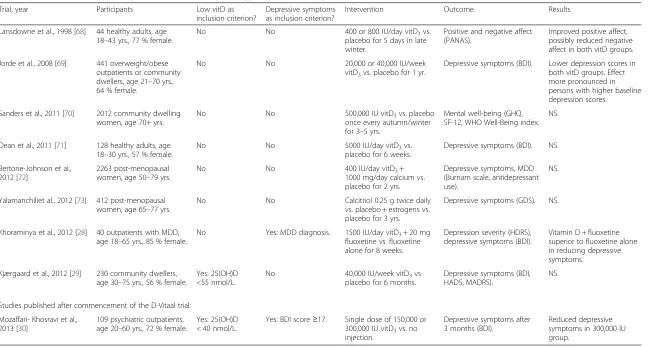
Evidence from randomized controlled trials (RCTs) is diffuse and inconclusive. Tables 1 and 2 provide an over-view of previous RCTs examining the effects of vitamin D supplementation on depressive symptoms and physical functioning. Only RCTs that included adults and had a sample size of ≥40 were selected (search strategy avail-able from the author). From these tavail-ables, it can be con-cluded that previous RCTs have been heterogeneous with respect to sample size, age range of the partici-pants, dosage of the supplementation, duration of the intervention and outcome measures. Moreover, only a very limited amount of studies included high-risk par-ticipants, i.e. persons with low serum 25(OH)D and mental/physical symptoms at baseline. It can be ex-pected that supplementation is more effective and rele-vant in persons with low baseline 25(OH)D levels and
Fig. 1Pathophysiological effects of low vitamin D status on mental and physical functioning
Table 1Overview of RCTs that examined the effect of vitamin D supplementation on depression
Trial, year Participants Low vitD as
inclusion criterion?
Depressive symptoms as inclusion criterion?
Intervention Outcome Results
Lansdowne et al., 1998 [68] 44 healthy adults, age 18–43 yrs., 77 % female.
No No 400 or 800 IU/day vitD3vs.
placebo for 5 days in late winter.
Positive and negative affect (PANAS).
Improved positive affect, possibly reduced negative affect in both vitD groups.
Jorde et al., 2008 [69] 441 overweight/obese outpatients or community dwellers, age 21–70 yrs., 64 % female.
No No 20,000 or 40,000 IU/week
vitD3vs. placebo for 1 yr.
Depressive symptoms (BDI). Lower depression scores in both vitD groups. Effect more pronounced in persons with higher baseline depression scores.
Sanders et al., 2011 [70] 2012 community dwelling women, age 70+ yrs.
No No 500,000 IU vitD3vs. placebo
once every autumn/winter for 3–5 yrs.
Mental well-being (GHQ, SF-12, WHO Well-Being index.
NS.
Dean et al., 2011 [71] 128 healthy adults, age 18–30 yrs., 57 % female.
No No 5000 IU/day vitD3vs.
placebo for 6 weeks.
Depressive symptoms (BDI). NS.
Bertone-Johnson et al., 2012 [72]
2263 post-menopausal women, age 50–79 yrs.
No No 400 IU/day vitD3+
1000 mg/day calcium vs. placebo for 2 yrs.
Depressive symptoms, MDD (Burnam scale, antidepressant use).
NS.
Yalamanchiliet al., 2012 [73] 412 post-menopausal women, age 65–77 yrs.
No No Calcitriol 0.25 g twice daily
vs. placebo + estrogens vs. placebo for 3 yrs.
Depressive symptoms (GDS). NS.
Khoraminya et al., 2012 [28] 40 outpatients with MDD, age 18–65 yrs., 85 % female.
No Yes: MDD diagnosis. 1500 IU/day vitD3+ 20 mg fluoxetine vs. fluoxetine alone for 8 weeks.
Depression severity (HDRS), depressive symptoms (BDI).
Vitamin D + fluoxetine superior to fluoxetine alone in reducing depressive symptoms.
Kjærgaard et al., 2012 [29] 230 community dwellers, age 30–75 yrs., 56 % female.
Yes: 25(OH)D <55 nmol/L.
No 40,000 IU/week vitD3vs placebo for 6 months.
Depressive symptoms (BDI, HADS, MADRS).
NS.
Studies published after commencement of the D-Vitaal trial:
Mozaffari- Khosravi et al., 2013 [30]
109 psychiatric outpatients, age 20–60 yrs., 72 % female.
Yes: 25(OH)D < 40 nmol/L.
Yes: BDI score≥17. Single dose of 150,000 or 300,000 IU vitD3vs. no injection.
Depressive symptoms after 3 months (BDI).
Reduced depressive symptoms in 300,000 IU group.
Systematic review of RCTs (inception - July 2015). Search strategy available from author. NS: not significant
PANAS: Positive And Negative Affect Schedule; BDI: Beck Depression Inventory; GHQ: General Health Questionnaire; SF-12: Short Form health survey–12 item version; MDD: major depressive disorder; GDS: Geriatric Depression Scale; HDRS: Hamilton Depression Rating Scale; HADS: Hospital Anxiety and Depression Scale; MADRS: Montgomery-Åsberg Depression Rating Scale
de
Koning
et
al.
BMC
Geriatrics
(2015) 15:151
Page
3
of
Table 2Overview of RCTs that examined the effect of vitamin D supplementation on physical functioning
Trial, year Participants Low vitD as inclusion criterion?
Poor physical function as inclusion criterion?
Intervention Outcome Results
Grady et al., 1991 [74]a
98 community dwellers, age 70+ yrs., 54 % female.
No No 0.25μg 1,25(OH)2D3twice daily vs. placebo for 6 months.
Muscle strength (quadriceps). NS.
Pfeifer et al., 2000 [75]
148 community dwelling females, age 70+ yrs.
Yes: 25(OH)D <50 nmol/L.
No 800 IU/day vitD3+ 1200 mg/day calcium vs. calcium alone for 8 weeks.
Body sway. Reduced sway in vitD group.
Bischoff et al., 2003 [76]
122 geriatric inpatient females, age 63–99 yrs.
No No 800 IU/day vitD3+ 1200 mg/day
calcium vs. calcium alone for 12 weeks.
Musculoskeletal function (knee muscle strength, grip strength, TUG).
Improved musculoskeletal function in vitD group.
Kenny et al., 2003 [77]
60 community dwelling males, age 65–87 yrs.
No No 1000 IU/day vitD3+ 500 mg/day
calcium vs. calcium alone for 6 months.
Muscle strength and power (leg, handgrip), physical performance (SPPB, TUG, supine-to-stand test).
NS.
Latham et al., 2003 [78]
243 geriatric in- and outpatients, age 65+ yrs., 53 % female.
No Yes: frailty. Single dose of 300,000 IU vitD2 vs. placebo + exercise training vs. social visits for 10 weeks.
Physical performance (knee strength, balance, TUG, gait speed) after 3 and 6 months.
NS.
Dhesi et al., 2004 [31]
139 outpatients, age 65+ yrs., 78 % female.
Yes: 25(OH)D <30 nmol/L.
Yes: history of falls. Single intramuscular injection of 600,000 IU vitD2vs. placebo.
Postural sway, physical performance (gait speed, chair stands, stair climbing), quadriceps strength after 6 months.
Improved physical performance and sway in vitD group.
Gallagher, 2004 [79] 289 postmenopausal females, mean age 72 yrs.
No No 0.5μg/day calcitriol vs. placebo
+ estrogen / progesterone treatment vs. placebo for 3 yrs.
Physical performance (grip strength, gait speed, chair stands).
Improved chair stands and gait speed in vitD group (p< .1).
Sato et al., 2005 [80] 96 females with post-stroke hemiplegia, mean age 74 yrs.
No No 1000 IU/day vitD2vs. placebo
for 2 yrs.
Muscle strength (of the intact hip).
Improved muscle strength in vitD group.
Bischoff-Ferrari et al., 2006 [81]
64 institutionalized older females, age 65–97 yrs.
No No 800 IU vitD3+ 1200 mg/day
calcium vs. calcium alone for 3 months.
Postural and dynamic balance.
NS.
Bunout et al., 2006 [82]
92 community dwellers, age 70+ yrs., 88 % female.
Yes: 25(OH)D <40 nmol/L.
No 400 IU/day vitD3+ 800 mg/day calcium vs. calcium alone + exercise training vs. control for 9 months.
Muscle strength (quadriceps, hand grip), gait speed, physical performance (SPPB, TUG), postural sway.
Improved gait speed and sway in vitD group.
Smedshaug et al., 2007 [83]
60 institutionalized persons, mean age 82 yrs., 65 % female.
No No 400 IU/day vitD3vs. placebo
for 1 yr.
Grip strength. NS.
Brunner et al., 2008 [84]
2364 postmenopausal females, age 50–79 yrs.
No No 400 IU/day vitD3+ 1000 mg/day
calcium vs. placebo for 5 yrs.
Grip strength, chair stands, gait speed.
NS.
Moreira-Pfrimer et al., 2009 [85]
46 institutionalized geriatric patients, age 62–94 yrs., 79 % female.
No No 150,000 IU/month vitD3for
2 months, followed by 90,000 IU/month vs. placebo for 4 months + . 1000 mg/day calcium.
Lower limb muscle strength (hip, knee).
Table 2Overview of RCTs that examined the effect of vitamin D supplementation on physical functioning(Continued)
Pfeifer et al., 2009 [86]
242 community dwellers, age 70–94 yrs., 75 % female.
Yes: 25(OH)D <78 nmol/L.
No 800 IU/day vitD3+ 1000 mg/day calcium vs calcium alone for 12 months.
Muscle strength (quadriceps), body sway, TUG.
Improved quadriceps strength, sway and TUG performance in vitD group.
Songpatanasilp et al., 2009 [87]a
42 postmenopausal females, age 65+ yrs.
Yes: hypovitaminosis D (range NR)
No 0.5 mg/day alfacalcidol + 1500 mg/day calcium vs. calcium alone for 12 weeks.
Muscle strength (quadriceps). Improved quadriceps muscle strength in vitD group.
Janssen et al., 2010 [88]a
70 female geriatric outpatients, age 65+ yrs.
Yes: 25(OH)D 20–50 nmol/L.
No 400 IU/day vitD3+ 500 mg/day calcium vs. calcium alone for 6 months.
Muscle strength (knee, leg, hand grip), mobility (TUG), gait speed.
NS.
Lips et al., 2010 [89] 226 community dwellers, age 70+ yrs., % female NR.
Yes: 25(OH)D 15–50 nmol/L.
No 8400 IU/week vitD3vs. placebo for 16 weeks.
Postural sway, SPPB. Reduced sway in vitD group, only in persons with higher baseline sway.
Witham et al., 2010 [90]
105 patients with systolic heart failure, age 70+ yrs., 34 % female.
Yes: 25(OH)D <50 nmol/L.
No 100,000 IU vitD2vs. placebo at baseline and after 10 weeks.
Gait speed, mobility (TUG), functional limitations.
NS.
Zhu et al., 2010 [91] 261 community dwelling females, age 70–90 yrs.
Yes: 25(OH)D <60 nmol/L.
No VitD21000 IU/day + 1000 mg/day calcium vs. calcium alone for 1 yr.
Lower limb muscle strength (ankle, knee, hip), mobility (TUG).
Improved hip muscle strength and mobility in vitD group, only in persons with lowest baseline function scores.
Glendenning et al., 2012 [92]
686 postmenopausal females, age 70+ yrs.
No No 150,000 IU vitD3vs. placebo at
baseline and after 3 and 6 months.
Grip strength, mobility (TUG). NS.
Hornikx et al., 2012 [93]
49 COPD patients, age 50+ yrs., 24 % female.
No No 100,000 IU vitD3/month vs.
placebo for 3 months.
Muscle strength (inspiratory, quadriceps), gait speed, maximal exercise capacity (cycle ergometer test)
Improved inspiratory muscle strength in vitD group.
Kampman et al., 2012 [94]
68 multiple sclerosis patients, age 21–50 yrs., 71 % female.
No No 20,000 IU vitD3/week vs.
placebo for 2 yrs.
Grip strength. NS.
Studies published after commencement of the D-Vitaal trial:
Hara et al., 2013 [95] 94 postmenopausal females with osteoporosis, age 55–75 yrs.
No No 1μg/day alfacalcidol + 200
mg/day calcium + 35 mg/week alendronate vs. calcium and alendronate alone for 4 months.
Muscle strength (back extensor).
Improved back extensor strength in younger vitD subgroup.
McAlindon et al., 2013 [96]
146 adults with knee osteoarthritis (OA), age 45+ yrs., 61 % female.
No Yes: presence of
symptomatic knee osteoarthritis.
2000 IU/day vitD3with dose escalation to obtain serum levels of >90 nmol/L vs. placebo for 2 yrs.
Gait speed, chair stands. NS.
Sanghi et al., 2013 [97]
103 adults with knee osteoarthritis, age 40–74 yrs., 64 % female.
No Yes: presence of
symptomatic knee osteoarthritis.
60,000 IU/day vitD3for 10 days followed by 60,000 IU/month vs. placebo for 12 months.
Functional limitations (WOMAC).
Small improvement of physical function in vitD group.
Table 2Overview of RCTs that examined the effect of vitamin D supplementation on physical functioning(Continued)
Knutsen et al., 2014 [98]
215 non-western immigrants, age 18–50 yrs., 73 % female.
No No 1000 or 400 IU vitD3/day vs.
placebo for 16 weeks.
Grip strength, chair stands, muscle strength and power.
NS.
Wood et al., 2014 [99]
293 postmenopausal females, age 60–70 yrs.
No No 400 or 1000 IU/day vitD3vs.
placebo for 12 months.
Grip strength. NS.
Rolighed et al., 2015 [100]
46 patients with primary hyperparathyroidism, age 29–77 yrs., 76 % female.
Yes, 25(OH)D <80 nmol/L.
No 2800 IU/day vitD3vs. placebo for 12 months.
Muscle strength (knee, elbow, hand grip), chair stands, mobility (TUG), postural sway.
NS.
Systematic review of RCTs (inception - July 2015). Search strategy available from author. NS: not significant. NR: not reported.
TUG: Timed Up-and-Go test; SPPB: Short Physical Performance Battery; WOMAC: Western Ontario and McMaster Universities Arthritis Index. a
only abstract available
de
Koning
et
al.
BMC
Geriatrics
(2015) 15:151
Page
6
of
in persons with clinically relevant depressive symptoms or reduced physical functioning.
Four out of nine RCTs on depression (44 %) observed a significant positive effect of vitamin D supplementation on depressive symptoms (see Table 1). However, only two studies included persons with either low 25(OH)D or de-pression at baseline [28, 29], and only one study included persons with both characteristics [30]. The latter study and the study that included persons with a diagnosis of major depressive disorder (MDD) [28] observed signifi-cant improvements after the supplementation.
Table 2 shows that in 14 out of 28 RCTs (50 %), vitamin D supplementation improved physical functioning. Twelve studies included participants with either low 25(OH)D or poor physical function at baseline, and physical function improved in seven (58 %) of these studies. Only one study included persons with both low 25(OH)D and poor phys-ical function [31] and this trial observed a significant im-provement of physical performance.
In conclusion, the effect of vitamin D supplementation seems more pronounced in persons with low 25(OH)D levels, depressive symptoms and poor physical function at baseline. However, RCTs that specifically included par-ticipants with these characteristics are scarce. Furthermore, to the best of our knowledge, no studies have examined the effect of vitamin D supplementation on the combin-ation of mental and physical functioning, despite the fact that these are interrelated concepts.
The current RCT aims to fill this knowledge gap by investigating whether older adults at high risk for poor mental and physical health can benefit from supplementa-tion with vitamin D. Primarily, the D-Vitaal trial examines whether vitamin D supplementation improves depressive symptoms, functional limitations and physical performance in persons with low 25(OH)D levels, clinically relevant depressive symptoms and functional limitations. Other, secondary health outcomes are assessed as well, such as incident MDD [32], anxiety [33], health-related quality of life [34, 35] and cognitive functioning [36]. In addition, it will be investigated whether vitamin D supplementation is a cost-effective strategy for the above-mentioned aims. If proven effective, vitamin D supplementation can easily be implemented in the primary care setting as a simple and safe strategy to prevent both mental and physical dis-orders in the elderly population.
Methods/design
Design of the study
The D-Vitaal study is a randomized, double-blind, placebo-controlled clinical trial that is carried out in the Netherlands. This study examines the effect of a daily dose of 1200 IU vitamin D3versus placebo on depressive symptoms, functional limitations and physical perform-ance. We included 155 participants aged 60–80 years. The
duration of the intervention is one year. The D-Vitaal trial was approved by the Medical Ethics Committee of the VU University Medical Centre Amsterdam and is registered with the Netherlands Trial Register under NTR3845. The D-Vitaal study adheres to the CONSORT guidelines for randomized controlled trials.
Participants
Potential participants were screened for presence of clin-ically relevant depressive symptoms, functional limitations and low serum 25(OH)D levels (≤50 or ≤70 nmol/L in winter (October-March) and summer (April-September), respectively). In this way, we recruited a vulnerable population at high risk of subsequent mental and physical function decline. As severe 25(OH)D deficiency can be as-sociated with bone disease [37], persons with 25(OH)D levels of <15 nmol/L were excluded and referred to their GP for treatment. In addition, persons with a current MDD diagnosis were excluded, as the aim of this study is to prevent depression. Furthermore, persons who use anti-depressant medication were excluded at screening because of possible interference of antidepressants with the effect of vitamin D on depressive symptoms. Persons with suffi-cient concentrations of 25(OH)D (>50 or >70 nmol/L in winter and summer, respectively) were also excluded, as it was expected that the effect of supplementation in these persons would be negligible. The summer/winter cut-off difference of 20 nmol/L was based on the observation by Van Schoor et al. that the seasonal variation of vitamin D levels in two cohorts of Dutch older persons was 14– 24 nmol/L [38]. The Health Council of the Netherlands advises a supplement of 800 IU/day vitamin D for insti-tutionalized persons [39]. Therefore, only community dwelling persons were included in the trial. Table 3 lists the inclusion and exclusion criteria of the D-Vitaal study. All participants provided written informed consent prior to the start of the intervention.
Recruitment and setting
The D-Vitaal study is carried out in Amsterdam and sur-rounding municipalities in the Netherlands. Both urban and rural areas were included. The majority of the partici-pants was recruited through municipality registries. Munici-palities in the surroundings of Amsterdam provided the addresses of inhabitants in the age range of 60–80 years. These persons received an information brochure about the study by mail. In addition, advertisement posters and infor-mation leaflets were distributed in community centres. About 20 % of participants was recruited through general practitioners (GPs) in Amsterdam. Using a standardized search in their electronic medical records, the GPs selected eligible patients between 60–80 years. These patients re-ceived a letter from their GP to draw their attention to the study. Finally, excluded participants of a previous clinical
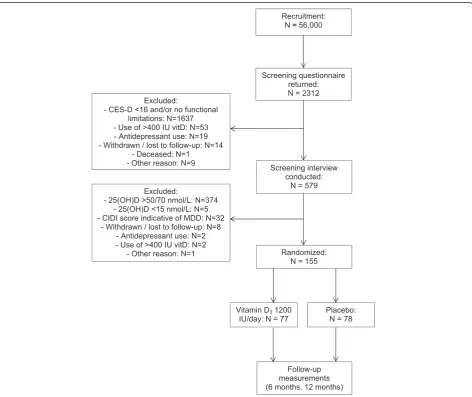
trial [40] who had indicated to be interested in contribut-ing to future research, were invited to participate in the D-Vitaal study. Recruitment commenced in June 2013 and the inclusion was finalized in April 2015. Figure 2 shows a flow chart of the recruitment, selection and randomization in the D-Vitaal study.
Screening phase
The screening phase of the D-Vitaal study included two steps: a mailed questionnaire and a short interview includ-ing a blood sample. The screeninclud-ing questionnaire assessed presence of depressive symptoms (Centre of Epidemio-logical Studies - Depression scale (CES-D) score of ≥16
Fig. 2Recruitment, selection and randomization in the D-Vitaal study Table 3Inclusion and exclusion criteria of the D-Vitaal study
Inclusion criteria: Exclusion criteria:
- Men and women of≥60 and≤80 years - Presence of major depressive disorder at screening - Presence of depressive symptoms (CES-D≥16) - Use of antidepressant medication at screening - Presence of≥1 functional limitation - Presence of major life-threatening illness
- Serum 25(OH)D levels≤50 (winter) or≤70 (summer) nmol/L. - Vitamin D (>400 IU/day) or calcium (>1000mg/day) supplementation - Ability to comply with the study protocol - Serum 25(OH)D levels <15 nmol/L.
- Living in an institution
CES-D: Centre of Epidemiological Studies Depression scale
[41]) and functional limitations and was also used to ex-clude persons who use antidepressant medication, vitamin D >400 IU/day and/or calcium supplements >1000 mg/day. For the first 12 participants, we used only the Functional Limitations questionnaire of the Longitudinal Aging Study Amsterdam (LASA-FL) [42] for the assessment of func-tional limitations. A LASA-FL score of ≥1 indicates the presence of functional limitations. However, this instrument proved not sensitive enough for this study population, cre-ating a large ceiling effect. Especially younger-old partici-pants (e.g. persons in their early sixties) reported few or no problems on this scale, as their level of general functioning was still moderate to high. Therefore, we added the Physical Functioning subscale of the Short Form-36 Health Survey [43] (SF-36-PF) to the screening phase. The SF-36-PF contains 10 items on physical functioning and assesses a broader range of functional limitations. Having diffi-culty with at least one of the items of the SF-36-PF was regarded as presence of functional limitations. Persons who were eligible according to the screening questionnaire (presence of both depressive symptoms and functional lim-itations) were invited for a screening visit where presence of MDD was examined and a blood sample was drawn to determine serum 25(OH)D levels.
Intervention and randomisation
Participants were randomly allocated with a 1:1 ratio to one of two treatment groups: vitamin D3(cholecalciferol) 1200 IU/day or placebo. Participants were stratified by sex and women were stratified by age (60–70 years/71–80 years). An independent pharmacist prepared three ran-domisation lists with computer-generated numbers using block sizes of four.
The intervention group takes three tablets of 400 IU vitamin D3 daily for a duration of 12 months. Based on earlier research, the daily dose of 1200 IU will lead to stable mean 25(OH)D levels of >80 nmol/L in the inter-vention group, with 90 % of individual 25(OH)D levels above 60 nmol/L within a few months [44, 45]. The pla-cebo group receives identical tablets without vitamin D and it is expected that this group maintains a mean serum 25(OH)D level of about 45 nmol/L. Both the vitamin D and placebo tablets were purchased from Vemedia Manufacturing B.V., The Netherlands. The tablets are supplied in vials of 100 tablets for 6 months, 600 tablets at a time. Participants are allowed to take a (multi)vitamin D supplement with a maximum of 400 IU/ day in addition to the study tablets.
Co-intervention
Calcium positively influences the bioavailability of vitamin D [46]. In addition, some effects of vitamin D may be caused by increased calcium absorption. Therefore, all participants were advised to use at least three dairy
consumptions daily to ensure adequate calcium intake of about 1000 mg/day. Calcium intake was assessed with a structured questionnaire during the screening phase. If calcium intake was low (less than 2 dairy consumptions per day), calcium tablets of 500 mg/day were prescribed to these participants.
Study procedures
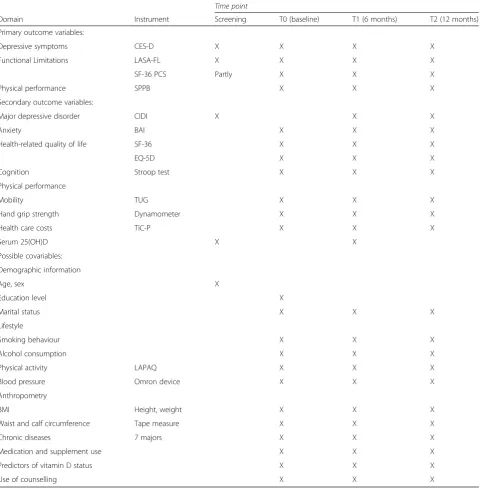
Face-to-face interviews take place at screening, baseline, six and 12 months. The baseline visit was timed closely after the screening phase. Shortly prior to the interviews, participants are asked to complete a mailed questionnaire to reduce interview time. Short telephone interviews are conducted after two weeks, three and nine months to check compliance and adverse events. Table 4 lists all measurements and their time points of the D-Vitaal study. Interviews and blood sampling are carried out by trained researchers or research nurses and take place at the participant’s home, at the VU University Medical Center, or at local community medical centres. The Endo-crine Laboratory of the VU University Medical Center conducts the 25(OH)D determinations. Participants who discontinue taking the study tablets for any reason are asked to participate in the remaining follow-up measurements. Any (serious) adverse events are carefully monitored.
Compliance
Compliance is checked by tablet count. To stimulate compliance, participants are contacted by telephone (after two weeks, three and nine months) and reminded at follow-up visits. The ultimate compliance check is the measurement of serum 25(OH)D after 6 months.
Outcomes Primary outcomes
Depressive symptoms The CES-D [41] is used to meas-ure differences in mean change of depressive symptoms after 12 months between the two treatment groups. The CES-D contains 20 items with a score range of 0–60. Higher scores indicate more depressive symptoms. A score of≥16 is indicative of clinically relevant depressive symptoms. The CES-D is a widely used instrument that displays good psychometric properties in various elderly populations [47].
Functional limitations The LASA-FL questionnaire [42] includes six items assessing common daily activities: climbing stairs, cutting toenails, walking 5 minutes out-doors without resting, rising from a chair, dressing/ undressing oneself and using own or public transport. Par-ticipants indicate whether they are able to perform these activities without difficulty, with some difficulty, with much difficulty, only with help, or not at all. The instrument can be scored in two ways: by determining the amount of
functional limitations (score range 0–6, with higher scores indicating presence of more functional limitations) and the degree of functional limitations (score range 0–24, with higher scores indicating more severe functional limitations). The LASA-FL is used to measure differences in mean change of the amount and degree of functional limitations after 12 months between the two treatment groups.
Physical performance A modified version of the Short Physical Performance Battery (SPPB) [26, 48] is used to determine differences in mean change of objective phys-ical performance between the treatment groups after 12 months. The SPPB includes a walking test (walking 3 meters, turning 180° and walking 3 meters back as fast as possible), a chair stands test (standing up from a chair without using hands five times as fast as possible) and a Table 4Assessed domains, instruments and their time points in the D-Vitaal study
Time point
Domain Instrument Screening T0 (baseline) T1 (6 months) T2 (12 months)
Primary outcome variables:
Depressive symptoms CES-D X X X X
Functional Limitations LASA-FL X X X X
SF-36 PCS Partly X X X
Physical performance SPPB X X X
Secondary outcome variables:
Major depressive disorder CIDI X X X
Anxiety BAI X X X
Health-related quality of life SF-36 X X X
EQ-5D X X X
Cognition Stroop test X X X
Physical performance
Mobility TUG X X X
Hand grip strength Dynamometer X X X
Health care costs TiC-P X X X
Serum 25(OH)D X X
Possible covariables: Demographic information
Age, sex X
Education level X
Marital status X X X
Lifestyle
Smoking behaviour X X X
Alcohol consumption X X X
Physical activity LAPAQ X X X
Blood pressure Omron device X X X
Anthropometry
BMI Height, weight X X X
Waist and calf circumference Tape measure X X X
Chronic diseases 7 majors X X X
Medication and supplement use X X X
Predictors of vitamin D status X X X
Use of counselling X X X
CES-D: Centre of Epidemiological Studies Depression scale; LASA-FL: Longitudinal Aging Study Amsterdam Functional Limitations questionnaire; SF-36 PCS: Short Form 36 Health Survey - Physical Component Summary score; SPPB: Short Physical Performance Battery; CIDI: Composite International Diagnostic Interview; BAI: Beck Anxiety Inventory; EQ-5D: EuroQol 5 Dimensions; TUG: Timed Up-and-Go test; TiC-P: Trimbos and iMTA questionnaire on Costs associated with Psychiatric illness; LAPAQ: Longitudinal Aging Study Amsterdam Physical Activity Questionnaire
balance test (standing with feet in tandem stand (i.e. standing with one foot in front of the other, with the heel of one foot touching the toes of the other foot) for up to 30 seconds). Participants can score 0–4 points for each test, adding up to a maximum of 12 points, with higher scores indicating better performance. Reliability and validity of the SPPB are good [49].
Secondary outcomes
Incidence of MDD The depression-section of the DSM IV-based Composite International Diagnostic Interview (CIDI, version 2.1) [50] is used to assess presence of MDD. At six and 12 months, the CIDI is administered if a participant scores≥16 on the CES-D.
Anxiety The Beck Anxiety Index (BAI) [51, 52] is a well-validated questionnaire that contains 21 items measuring anxiety symptoms that are relatively distinguishable from depression symptoms.
Cognition Cognitive function is assessed with indicators of information processing speed and executive function-ing obtained from the Stroop-Colour Word Test [53].
Health-related quality of life Health-related quality of life is measured with the EuroQol - 5 Dimensions (EQ-5D) [54] and the SF-36 [43]. The EQ-5D is a utility instrument that enables the calculation of Quality Adjusted Life Years (QALY’s). The SF-36 Mental Component Summary score (MCS) and Physical Component Summary score (PCS) are used as a measure of mental and physical health-related quality of life, respectively [43]. Both instruments are widely used and well-validated in older populations [43, 55].
Timed Up-and-Go test With the Timed Up-And-Go Test (TUG), functional mobility is assessed by asking the participant to stand up from a standard chair, walk a 3 meter distance, turn, walk back to the chair and sit down again [56].
Hand grip strength Hand grip strength is measured in kilograms with a strain-gauged dynamometer (Takei TKK 5401, Takei Scientific Instruments Co. Ltd., Japan). Participants are asked to apply maximum force on the device while in a standing position. Grip strength is measured twice for each hand, consecutively alternating between both hands. The hand grip strength score is de-rived by taking the mean of the highest score for each hand.
Economic evaluation To evaluate whether vitamin D is a cost-effective intervention for the prevention of depression and poor physical function in older persons, an economic evaluation will be performed. Dutch costing guidelines will
be used [57]. All relevant costs will be measured and valued, including the costs of the vitamin D intervention. Health care utilization is measured with the Trimbos and iMTA questionnaire on Costs associated with Psychiatric illness (TiC-P) [58]. Health care costs include costs of GP and psychiatric care, ambulatory and outpatient hospital care, physical therapists and home care. Costs of production loss are not included, as the majority of the participants does not have a paid job.
Possible covariables
Several variables are measured during the trial to check for possible (chance-based) differences between the treat-ment groups. Height and weight are measured with a cali-brated stadiometer and scale, respectively. Body mass index (BMI) is calculated by dividing weight (in kilograms) by height2 (in meters). Waist and calf circumference is assessed with a tape-measure. Blood pressure and pulse are assessed twice with a three-minute interval using the Omron M1 Plus device (Omron Healthcare Europe). The date of the baseline interview is used to measure seasonal variation of serum 25(OH)D levels [38]. Structured ques-tionnaires assess age, gender, education level, marital status, smoking behaviour, alcohol use, current medication and supplement use, use of corticosteroids in the past three months, chronic diseases, physical activity (walking, cycling, gardening, household activities and sports [59], vitamin D predictors (exposure to sunlight, skin pig-mentation, consumption of fatty fish) [60] and use of counselling.
Blood sampling and assessment of serum 25(OH)D
Blood samples are obtained in the morning by a trained research nurse at screening and 6 months for measure-ment of serum 25(OH)D. Participants are in a fasted state with regard to dairy products. Serum 25(OH)D is deter-mined using liquid chromatography followed by tandem mass spectrometry [61]. At screening, 25(OH)D was deter-mined immediately after blood sampling. The 25(OH)D determinations of the 6-month blood samples will be car-ried out at the end of the study, to ensure randomization concealment. Serum, EDTA plasma and whole blood sam-ples are stored frozen (−80 ° C) until determination and for potential future biomarker and DNA research.
Power calculation
The primary outcomes of the D-Vitaal study are change in depressive symptoms (CES-D score) and change in physical functioning (functional limitations and physical performance) after 12 months. In an RCT with a com-parable population (older persons from the community with depressive symptoms but no MDD), the mean CES-D score was 26 (SD: 5.1) [62]. To detect a change of 0.5 SD (i.e. 2.5 points change of CES-D score), a total
of 40 subjects per group is needed, assuming a power of 80 %, a two-sided alpha of .05 and an intraclass correlation coefficient (ICC) of .70 between baseline and follow-up measurements.
The SPPB score ranges from 0 to 12. A change of one point (SD: 1.5) is regarded as a meaningful change [63]. Assuming the same power, alpha and ICC as the CES-D calculation, 22 participants per group are needed.
The LASA-FL questionnaire is scored in two ways: by determining the amount (score range 0–6) and the degree (score range 0–24) of functional limitations. A change of one point in the amount of functional limitations can be regarded as a meaningful change [64]. The SD was set on 1.7, based on analyses in the Longitudinal Aging Study Amsterdam (LASA), a large prospective cohort study of older persons. Assuming again the same power, alpha and ICC as the previous calculations, at least 28 persons per group should be included. For the degree of functional limitations, no meaningful change data or RCTs could be identified in the literature. Based on analyses in LASA, a mean difference of 2 points can be expected, with an SD of 4.5. For this outcome, 48 persons per group are needed, using the same assumptions as indicated above. Consid-ering an expected dropout of 25 % and uncertainty of the 25(OH)D assay, we aimed to include at least 70 partici-pants per group, altogether at least 140 participartici-pants.
Data analysis
Baseline characteristics between treatment groups will be compared using Pearson Chi-square tests, independent-samples t-tests, one-way ANOVAs, or non-parametric tests. Persons who drop out will be compared to persons who complete the study. Skewed data will be transformed. Data will be analysed according to the intention-to-treat principle with longitudinal data analysis techniques (gen-eralized estimating equation (GEE) analysis or mixed model analysis) using SPSS (SPSS Inc. Chicago, IL, USA). A double-sidedp-value of .05 will be regarded as statisti-cally significant. If needed, models will be adjusted for relevant confounding variables. To investigate the inter-relatedness of depressive symptoms and physical function-ing, these variables will be added to each other’s effect analysis in separate models. Effect modification will be in-vestigated for age, gender and baseline serum 25(OH)D levels.
Per-protocol analyses will be performed as a secondary analysis with participants who were compliant with the study protocol (≥80 % tablet intake). As a compliance check, the improvement of vitamin D status - i.e. the number of participants with serum 25(OH)D levels over 50, 60 and 75 nmol/L - will also be analysed in secondary analyses. Finally, as a sensitivity analysis, it will be investi-gated whether change in serum 25(OH)D is associated with change in depressive symptoms, functional limitations
and physical performance over time in the total study sam-ple (irrespective of treatment group).
The economic evaluation will be performed from a so-cietal perspective with a time horizon of 12 months. The analysis will be done according to the intention-to-treat principle. Missing cost and effect data will be imputed using multiple imputation according to the MICE algo-rithm [65]. Bias-corrected and accelerated bootstrapping with 5000 replications will be used to calculate 95 % confidence intervals around the mean difference in total costs between the two groups. Incremental cost-effectiveness ratios (ICERs) will be calculated by divid-ing the difference in mean total costs by the difference in mean effects on the primary outcomes (depressive symp-toms, functional limitations and physical performance) be-tween the treatment groups. A cost-utility analysis will be performed estimating the incremental costs per QALY gained. Bootstrapping will be used to estimate the uncer-tainty surrounding the ICERs, which will be graphically presented on cost-effectiveness planes. Cost-effectiveness acceptability curves and net monetary benefits will also be calculated. Sensitivity analyses will be performed on the most important and uncertain cost parameters.
Discussion
As depressive symptoms and poor physical functioning are prevalent among older persons and cause significant individual and societal burden [66], effective low-cost prevention strategies are urgently needed. The D-Vitaal study aims to examine whether vitamin D supplementa-tion decreases depressive symptoms and funcsupplementa-tional limita-tions and improves physical performance in older adults. The majority of RCTs that examined vitamin D supple-mentation included participants with adequate serum 25(OH)D levels and good mental and physical health, which may explain the absence of effects of some previous clinical trials in the field [12].
The D-Vitaal trial is innovative in several ways: it in-cludes persons who may benefit most from the supple-mentation: older persons with low serum 25(OH)D levels and at high risk for developing poor mental and physical health. Furthermore, the tight interrelationship between depressive symptoms and physical functioning is taken into account by targeting both concepts in one RCT. Physical functioning is measured comprehensively with both self-reported questionnaires and objective tests. Fi-nally, MDD diagnosis is included as a secondary outcome measure. This enables us to explore the effect of the vita-min D supplementation on the development of MDD. To our knowledge, this outcome has not been investigated previously in an RCT [12].
It is more urgent to study the effects of vitamin D sup-plementation in persons with inadequate vitamin D levels than to examine whether there are any additional effects
of supplementation above normal ranges [67]. The amount of supplementation (1200 IU/ day) used in the D-Vitaal study is a moderate dose, but sufficient to cor-rect for deficiency and obtain an adequate vitamin D status [44, 45].
If the results of the D-Vitaal trial indicate that vitamin D supplementation is effective in reducing depressive symptoms and improving physical functioning in older adults, vitamin D can be an efficient intervention that targets two prevalent adverse health conditions simul-taneously. The economic evaluation will provide evidence on the cost-effectiveness of the intervention. As vitamin D supplementation is inexpensive and displays minimal side effects, opportunities for implementation in the pri-mary care setting seem promising. The first results of the D-Vitaal study are expected in 2016.
Abbreviations
1,25(OH)2D:1,25 dihydroxyvitamin D; 25(OH)D: 25 hydroxyvitamin D; ANOVA: analysis of variance; BAI: Beck Anxiety Inventory; BMI: body mass index; CES-D: Centre of Epidemiological Studies - Depression scale; CIDI: Composite International Diagnostic Interview; DSM: Diagnostic and Statistical Manual of Mental Disorders; 5D: EuroQol-5 Dimensions; EQ-VAS: EuroQol Visual Analog Scale; GEE: generalized estimating equations; GP: general practitioner; ICC: intraclass correlation coefficient;
ICER: incremental cost-effectiveness ratios; LASA-FL: Longitudinal Aging Study Amsterdam Functional Limitations questionnaire; MCS: Mental Component Summary (SF-36); MDD: major depressive disorder; PCS: Physical Component Summary score (SF-36); QALY: quality-adjusted life year; RCT: randomized controlled trial; SF-36: Short Form-36 Health Survey; SPPB: Short Physical Performance Battery; TiC-P: Trimbos and iMTA questionnaire on Costs associated with Psychiatric illness; TUG test: Timed Up-and-Go test; VDR: vitamin D receptor.
Competing interests
The authors declare that they have no competing interests.
Authors’contributions
NMvS and PL primarily designed the D-Vitaal study, all other authors contributed to the design; PL is the principal investigator; NMvS is the trial coordinator; EJdK, NMvS, HWJvM, BWJHP, PJME and PL conduct the research, ACH coordinates the serum 25(OH)D determinations from blood samples; PMB coordinates the issuing of the study tablets; MWvT designed the economic evaluation study; MdH and JHS assist with the statistical analyses, EJdK collects the data (together with the research assistants) and drafted the manuscript; all authors provided critical revision of the manuscript and approved the final version.
Acknowledgements
We are very grateful to all participants of the D-Vitaal study for their valued contributions. We would like to thank all general practitioners and municipalities that helped us with the recruitment of participants. Furthermore, we thank our research assistants Ans Nicolaas and Nicolette Pliester for their dedicated work and all students and colleagues involved in the D-Vitaal study for their most-appreciated assistance.
The D-Vitaal study is funded by The Netherlands Organization for Health Research and Development (ZonMw), the Hague, the Netherlands (grant number 200210022). ZonMw had no role in the design of the study, the collection, analysis and interpretation of the data, or in the preparation, review, or approval of the manuscript.
Author details
1EMGO Institute for Health and Care Research, VU University Medical Center, P.O. Box 7057, 1007 MB Amsterdam, The Netherlands.2Department of Epidemiology and Biostatistics, VU University Medical Center, P.O. Box 7057, 1007 MB Amsterdam, The Netherlands.3Department of Psychiatry, VU University Medical Center/GGZ inGeest, A.J. Ernststraat 1187, P.O. Box 1081
HL, Amsterdam, The Netherlands.4Department of General Practice and Elderly Care Medicine, VU University Medical Center, P.O. Box 7057, 1007 MB Amsterdam, The Netherlands.5Department of Clinical Chemistry, Endocrine Laboratory, VU University Medical Center, P.O. Box 7057, 1007 MB Amsterdam, The Netherlands.6Department of Clinical Pharmacology and Pharmacy, VU University Medical Center, P.O. Box 7057, 1007 MB Amsterdam, The Netherlands.7Department of Health Sciences, VU University, P.O. Box 7057, 1007 MB Amsterdam, The Netherlands.8Department of Internal Medicine, Endocrine section, VU University Medical Center, P.O. Box 7057, 1007 MB Amsterdam, The Netherlands.9Primary Care Research Centre, Institute of Population Health, University of Manchester, Oxford Road, Manchester M13 9PL, United Kingdom.
Received: 31 July 2015 Accepted: 13 November 2015
References
1. Blazer DG. Depression in late life: review and commentary. J Gerontol A Biol Sci Med Sci. 2003;58:249–65.
2. Hall CA, Reynolds-Iii CF. Late-life depression in the primary care setting: challenges, collaborative care, and prevention. Maturitas. 2014;79:147–52.
3. Prina AM, Deeg D, Brayne C, Beekman A, Huisman M. The association between depressive symptoms and non-psychiatric hospitalisation in older adults. PLoS One. 2012;7, e34821.
4. Prins MA, Verhaak PFM, Hilbink-Smolders M, Spreeuwenberg P, Laurant MGH, van der Meer K, et al. Outcomes for depression and anxiety in primary care and details of treatment: a naturalistic longitudinal study. BMC Psychiatry. 2011;11:180.
5. Braam AW, Prince MJ, Beekman ATF, Delespaul P, Dewey ME, Geerlings SW, et al. Physical health and depressive symptoms in older Europeans. Results from EURODEP. Br J Psychiatry. 2005;187:35–42.
6. Bromberger JT, di Scalea TL. Longitudinal associations between depression and functioning in midlife women. Maturitas. 2009;64:145–59.
7. Penninx BW, Deeg DJ, van Eijk JT, Beekman AT, Guralnik JM. Changes in depression and physical decline in older adults: a longitudinal perspective. J Affect Disord. 2000;61:1–12.
8. Vink D, Aartsen MJ, Schoevers RA. Risk factors for anxiety and depression in the elderly: a review. J Affect Disord. 2008;106:29–44.
9. Nyunt MSZ, Lim ML, Yap KB, Ng TP. Changes in depressive symptoms and functional disability among community-dwelling depressive older adults. Int Psychogeriatr. 2012;24:1633–41.
10. Beaudart C, Buckinx F, Rabenda V, Gillain S, Cavalier E, Slomian J, et al. The effects of vitamin D on skeletal muscle strength, muscle mass, and muscle power: a systematic review and meta-analysis of randomized controlled trials. J Clin Endocrinol Metab. 2014;99:4336–45.
11. Gowda U, Mutowo MP, Smith BJ, Wluka AE, Renzaho AMN. Vitamin D supplementation to reduce depression in adults: meta-analysis of randomized controlled trials. Nutrition. 2015;31:421–9.
12. Shaffer JA, Edmondson D, Wasson LT, Falzon L, Homma K, Ezeokoli N, et al. Vitamin D supplementation for depressive symptoms: a systematic review and meta-analysis of randomized controlled trials. Psychosom Med. 2014;76:190–6.
13. IOM (Institute of Medicine). Dietary reference intakes for calcium and vitamin D. Washington DC: The National Academies Press; 2011. 14. Kuchuk NO, Pluijm SMF, van Schoor NM, Looman CWN, Smit JH, Lips P.
Relationships of serum 25-hydroxyvitamin D to bone mineral density and serum parathyroid hormone and markers of bone turnover in older persons. J Clin Endocrinol Metab. 2009;94:1244–50.
15. Lips P, van Schoor NM, de Jongh RT. Diet, sun, and lifestyle as determinants of vitamin D status. Ann N Y Acad Sci. 2014;1317:92–8.
16. Lips P. Vitamin D, deficiency and secondary hyperparathyroidism in the elderly: consequences for bone loss and fractures and therapeutic implications. Endocr Rev. 2001;22:477–501.
17. de Abreu DA F, Eyles D, Feron F. Vitamin D, a neuro-immunomodulator: implications for neurodegenerative and autoimmune diseases. Psychoneuroendocrinology. 2009;34(1):S265–77.
18. Eyles DW, Smith S, Kinobe R, Hewison M, McGrath JJ. Distribution of the vitamin D receptor and 1 alpha-hydroxylase in human brain. J Chem Neuroanat. 2005;29:21–30.
19. Annweiler C, Montero-Odasso M, Schott AM, Berrut G, Fantino B, Beauchet O. Fall prevention and vitamin D in the elderly: an overview of the key role of the non-bone effects. J Neuroeng Rehabil. 2010;7:50.
20. Kesby JP, Eyles DW, Burne THJ, McGrath JJ. The effects of vitamin D on brain development and adult brain function. Mol Cell Endocrinol. 2011;347:121–7.
21. Eyles DW, Burne THJ, McGrath JJ. Vitamin D, effects on brain development, adult brain function and the links between low levels of vitamin D and neuropsychiatric disease. Front Neuroendocrinol. 2013;34:47–64. 22. Holtzer R, Epstein N, Mahoney JR, Izzetoglu M, Blumen HM. Neuroimaging
of mobility in aging: a targeted review. J Gerontol A Biol Sci Med Sci. 2014;69:1375–88.
23. Hoogendijk WJG, Lips P, Dik MG, Deeg DJH, Beekman ATF, Penninx BWJH. Depression is associated with decreased 25-hydroxyvitamin D and increased parathyroid hormone levels in older adults. Arch Gen Psychiatry. 2008;65:508–12.
24. Milaneschi Y, Hoogendijk W, Lips P, Heijboer AC, Schoevers R, van Hemert AM, et al. The association between low vitamin D and depressive disorders. Mol Psychiatry. 2014;19:444–51.
25. Sohl E, de Jongh RT, Heijboer AC, Swart KMA, Brouwer-Brolsma EM, Enneman AW, et al. Vitamin D status is associated with physical performance: the results of three independent cohorts. Osteoporos Int. 2013;24:187–96.
26. Wicherts IS, van Schoor NM, Boeke AJ, Visser M, Deeg DJH, Smit J, et al. Vitamin D status predicts physical performance and its decline in older persons. J Clin Endocrinol Metab. 2007;92:2058–65.
27. Milaneschi Y, Shardell M, Corsi AM, Vazzana R, Bandinelli S, Guralnik JM, et al. Serum 25-hydroxyvitamin D and depressive symptoms in older women and men. J Clin Endocrinol Metab. 2010;95:3225–33. 28. Khoraminya N, Tehrani-Doost M, Jazayeri S, Hosseini A, Djazayery A.
Therapeutic effects of vitamin D as adjunctive therapy to fluoxetine in patients with major depressive disorder. Aust N Z J Psychiatry. 2013;47:271–5. 29. Kjaergaard M, Waterloo K, Wang CEA, Almas B, Figenschau Y, Hutchinson
MS, et al. Effect of vitamin D supplement on depression scores in people with low levels of serum 25-hydroxyvitamin D: nested case–control study and randomised clinical trial. Br J Psychiatry. 2012;201:360–8.
30. Mozaffari-Khosravi H, Nabizade L, Yassini-Ardakani SM, Hadinedoushan H, Barzegar K. The effect of 2 different single injections of high dose of vitamin D on improving the depression in depressed patients with vitamin D deficiency: a randomized clinical trial. J Clin
Psychopharmacol. 2013;33:378–85.
31. Dhesi JK, Jackson SHD, Bearne LM, Moniz C, Hurley MV, Swift CG, et al. Vitamin D supplementation improves neuromuscular function in older people who fall. Age Ageing. 2004;33:589–95.
32. Williams JA, Sink KM, Tooze JA, Atkinson HH, Cauley JA, Yaffe K, et al. Low 25-hydroxyvitamin D concentrations predict incident depression in well-functioning older adults: the health, aging, and body composition study. J Gerontol A Biol Sci Med Sci. 2015;70:757–63.
33. Armstrong DJ, Meenagh GK, Bickle I, Lee ASH, Curran ES, Finch MB. Vitamin D deficiency is associated with anxiety and depression in fibromyalgia. Clin Rheumatol. 2007;26:551–4.
34. Motsinger S, Lazovich D, MacLehose RF, Torkelson CJ, Robien K. Vitamin D intake and mental health-related quality of life in older women: the Iowa Women's Health Study. Maturitas. 2012;71:267–73.
35. Sakalli H, Arslan D, Yucel AE. The effect of oral and parenteral vitamin D supplementation in the elderly: a prospective, double-blinded, randomized, placebo-controlled study. Rheumatol Int. 2012;32:2279–83.
36. Schlogl M, Holick MF. Vitamin D and neurocognitive function. Clin Interv Aging. 2014;9:559–68.
37. Need AG, O'Loughlin PD, Morris HA, Coates PS, Horowitz M, Nordin BEC. Vitamin D metabolites and calcium absorption in severe vitamin D deficiency. J Bone Miner Res. 2008;23:1859–63.
38. van Schoor NM, Knol DL, Deeg DJH, Peters FPAM, Heijboer AC, Lips P. Longitudinal changes and seasonal variations in serum 25-hydroxyvitamin D levels in different age groups: results of the Longitudinal Aging Study Amsterdam. Osteoporos Int. 2014;25:1483–91.
39. Gezondheidsraad (Health Council of the Netherlands). Evaluatie van de voedingsnormen voor vitamine D (Evaluation of the dieatary reference values for vitamin D). http://www.gezondheidsraad.nl/nl/taak-werkwijze/ werkterrein/gezonde-voeding/evaluatie-van-devoedingsnormen-voor-vitamine-d. (2008). Accessed 9 Nov, 2012.
40. van Wijngaarden JP, Swart KMA, Enneman AW, Dhonukshe-Rutten RAM, van Dijk SC, Ham AC, et al. Effect of daily vitamin B-12 and folic acid
supplementation on fracture incidence in elderly individuals with an elevated plasma homocysteine concentration: B-PROOF, a randomized controlled trial. Am J Clin Nutr. 2014;100:1578–86.
41. Radloff LS. The CES-D scale: a self-report depression scale for research in the general population. Appl Psychol Meas. 1977;1:385–401.
42. Bisschop MI, Kriegsman DMW, van Tilburg TG, Penninx BWJH, van Eijk JT, Deeg DJH. The influence of differing social ties on decline in physical functioning among older people with and without chronic diseases: the Longitudinal Aging Study Amsterdam. Aging Clin Exp Res. 2003;15:164–73. 43. Ware JEJ, Sherbourne CD. The MOS 36-item short-form health survey (SF-36). I.
Conceptual framework and item selection. Med Care. 1992;30:473–83. 44. Chel V, Wijnhoven HAH, Smit JH, Ooms M, Lips P. Efficacy of different doses
and time intervals of oral vitamin D supplementation with or without calcium in elderly nursing home residents. Osteoporos Int. 2008;19:663–71. 45. Lips P, Wiersinga A, van Ginkel FC, Jongen MJ, Netelenbos JC, Hackeng WH,
et al. The effect of vitamin D supplementation on vitamin D status and parathyroid function in elderly subjects. J Clin Endocrinol Metab. 1988;67:644–50.
46. Lips P. Interaction between vitamin D and calcium. Scand J Clin Lab Invest Suppl. 2012;243:60–4.
47. van de Rest O, van der Zwaluw N, Beekman ATF, de Groot LCPG, Geleijnse JM. The reliability of three depression rating scales in a general population of Dutch older persons. Int J Geriatr Psychiatry. 2010;25:998–1005. 48. Guralnik JM, Simonsick EM, Ferrucci L, Glynn RJ, Berkman LF, Blazer DG,
et al. A short physical performance battery assessing lower extremity function: association with self-reported disability and prediction of mortality and nursing home admission. J Gerontol. 1994;49:M85–94.
49. Freire AN, Guerra RO, Alvarado B, Guralnik JM, Zunzunegui MV. Validity and reliability of the short physical performance battery in two diverse older adult populations in Quebec and Brazil. J Aging Health. 2012;24:863–78. 50. Andrews G, Peters L. The psychometric properties of the Composite International Diagnostic Interview. Soc Psychiatry Psychiatr Epidemiol. 1998;33:80–8.
51. Beck AT, Epstein N, Brown G, Steer RA. An inventory for measuring clinical anxiety: psychometric properties. J Consult Clin Psychol. 1988;56:893–7. 52. Julian LJ. Measures of anxiety: State-Trait Anxiety Inventory (STAI), Beck
Anxiety Inventory (BAI), and Hospital Anxiety and Depression Scale-Anxiety (HADS-A). Arthritis Care Res (Hoboken ). 2011;63 Suppl 11:S467–72. 53. Klein M, Ponds RW, Houx PJ, Jolles J. Effect of test duration on age-related
differences in Stroop interference. J Clin Exp Neuropsychol. 1997;19:77–82. 54. Brooks R, Rabin R, de Charro F, editors. The measurement and valuation of
health status using EQ-5D: a European perspective. Dordrecht: Kluwer Academic publishers; 2003.
55. Kind P, Dolan P, Gudex C, Williams A. Variations in population health status: results from a United Kingdom national questionnaire survey. BMJ. 1998; 316:736–41.
56. Lin MR, Hwang HF, Hu MH, Wu HDI, Wang YW, Huang FC. Psychometric comparisons of the timed up and go, one-leg stand, functional reach, and Tinetti balance measures in community-dwelling older people. J Am Geriatr Soc. 2004;52:1343–8.
57. Oostenbrink JB, Koopmanschap MA, Rutten FFH. Standardisation of costs: the Dutch Manual for Costing in economic evaluations.
Pharmacoeconomics. 2002;20:443–54.
58. Bouwmans C, De Jong K, Timman R, Zijlstra-Vlasveld M, Van der Feltz-Cornelis C, Tan Swan S, et al. Feasibility, reliability and validity of a questionnaire on healthcare consumption and productivity loss in patients with a psychiatric disorder (TiC-P). BMC Health Serv Res. 2013;13:217.
59. Stel VS, Smit JH, Pluijm SMF, Visser M, Deeg DJH, Lips P. Comparison of the LASA Physical Activity Questionnaire with a 7-day diary and pedometer. J Clin Epidemiol. 2004;57:252–8.
60. van Schoor NM, Lips P. Worldwide vitamin D status. Best Pract Res Clin Endocrinol Metab. 2011;25:671–80.
61. Heijboer AC, Blankenstein MA, Kema IP, Buijs MM. Accuracy of 6 routine 25-hydroxyvitamin D assays: influence of vitamin D binding protein concentration. Clin Chem. 2012;58:543–8.
62. Veer-Tazelaar PJ, van Marwijk HWJ, van Oppen P, van Hout HPJ, van der Horst HE, Cuijpers P, et al. Stepped-care prevention of anxiety and depression in late life: a randomized controlled trial. Arch Gen Psychiatry. 2009;66:297–304.
63. Perera S, Mody SH, Woodman RC, Studenski SA. Meaningful change and responsiveness in common physical performance measures in older adults. J Am Geriatr Soc. 2006;54:743–9.
64. Hoogendijk E, van Groenou MB, van Tilburg T, Deeg D. Educational differences in functional limitations: comparisons of 55-65-year-olds in the Netherlands in 1992 and 2002. Int J Public Health. 2008;53:281–9. 65. van Buuren S, Oudshoorn C. Multivariate imputation by chained equations.
Leiden: TNO Prevention and Health, Public Health; 2000.
66. World Health Organization: The global burden of disease 2004 update. http://www.who.int/healthinfo/global_burden_disease/2004_report_update/ en/. (2008). Accessed 20 July 2015.
67. Spedding S. Vitamin D, and depression: a systematic review and meta-analysis comparing studies with and without biological flaws. Nutrients. 2014;6:1501–18.
68. Lansdowne AT, Provost SC. Vitamin D3 enhances mood in healthy subjects during winter. Psychopharmacology (Berl). 1998;135:319–23.
69. Jorde R, Sneve M, Figenschau Y, Svartberg J, Waterloo K. Effects of vitamin D supplementation on symptoms of depression in overweight and obese subjects: randomized double blind trial. J Intern Med. 2008;264:599–609. 70. Sanders KM, Stuart AL, Williamson EJ, Jacka FN, Dodd S, Nicholson G, et al.
Annual high-dose vitamin D3 and mental well-being: randomised controlled trial. Br J Psychiatry. 2011;198:357–64.
71. Dean AJ, Bellgrove MA, Hall T, Phan WMJ, Eyles DW, Kvaskoff D, et al. Effects of vitamin D supplementation on cognitive and emotional functioning in young adults–a randomised controlled trial. PLoS One. 2011;6, e25966. 72. Bertone-Johnson ER, Powers SI, Spangler L, Larson J, Michael YL, Millen AE,
et al. Vitamin D supplementation and depression in the women's health initiative calcium and vitamin D trial. Am J Epidemiol. 2012;176:1–13. 73. Yalamanchili V, Gallagher JC. Treatment with hormone therapy and calcitriol
did not affect depression in older postmenopausal women: no interaction with estrogen and vitamin D receptor genotype polymorphisms. Menopause. 2012;19:697–703.
74. Grady D, Halloran B, Cummings S, Leveille S, Wells L, Black D, et al. 1,25-Dihydroxyvitamin D3 and muscle strength in the elderly: a randomized controlled trial. J Clin Endocrinol Metab. 1991;73:1111–7. 75. Pfeifer M, Begerow B, Minne HW, Abrams C, Nachtigall D, Hansen C. Effects of a short-term vitamin D and calcium supplementation on body sway and secondary hyperparathyroidism in elderly women. J Bone Miner Res. 2000;15:1113–8.
76. Bischoff HA, Stahelin HB, Dick W, Akos R, Knecht M, Salis C, et al. Effects of vitamin D and calcium supplementation on falls: a randomized controlled trial. J Bone Miner Res. 2003;18:343–51.
77. Kenny AM, Biskup B, Robbins B, Marcella G, Burleson JA. Effects of vitamin D supplementation on strength, physical function, and health perception in older, community-dwelling men. J Am Geriatr Soc. 2003;51:1762–7. 78. Latham NK, Anderson CS, Lee A, Bennett DA, Moseley A, Cameron ID. A
randomized, controlled trial of quadriceps resistance exercise and vitamin D in frail older people: the Frailty Interventions Trial in Elderly Subjects (FITNESS). J Am Geriatr Soc. 2003;51:291–9.
79. Gallagher JC. The effects of calcitriol on falls and fractures and physical performance tests. J Steroid Biochem Mol Biol. 2004;89–90:497–501. 80. Sato Y, Iwamoto J, Kanoko T, Satoh K. Low-dose vitamin D prevents
muscular atrophy and reduces falls and hip fractures in women after stroke: a randomized controlled trial. Cerebrovasc Dis. 2005;20:187–92.
81. Bischoff-Ferrari HA, Conzelmann M, Stahelin HB, Dick W, Carpenter MG, Adkin AL, et al. Is fall prevention by vitamin D mediated by a change in postural or dynamic balance? Osteoporos Int. 2006;17:656–63. 82. Bunout D, Barrera G, Leiva L, Gattas V, de la Maza MP, Avendano M, et al.
Effects of vitamin D supplementation and exercise training on physical performance in Chilean vitamin D deficient elderly subjects. Exp Gerontol. 2006;41:746–52.
83. Smedshaug GB, Pedersen JI, Meyer HE. Can vitamin D supplementation improve grip strength in elderly nursing home residents? A double-blind controlled trial. Scand J Food Nutrition. 2007;51:74–8.
84. Brunner RL, Cochrane B, Jackson RD, Larson J, Lewis C, Limacher M, et al. Calcium, vitamin D supplementation, and physical function in the Women's Health Initiative. J Am Diet Assoc. 2008;108:1472–9.
85. Moreira-Pfrimer LDF, Pedrosa MAC, Teixeira L, Lazaretti-Castro M. Treatment of vitamin D deficiency increases lower limb muscle strength in institutionalized older people independently of regular physical activity: a randomized double-blind controlled trial. Ann Nutr Metab. 2009;54:291–300.
86. Pfeifer M, Begerow B, Minne HW, Suppan K, Fahrleitner-Pammer A, Dobnig H. Effects of a long-term vitamin D and calcium supplementation on falls and parameters of muscle function in community-dwelling older individuals. Osteoporos Int. 2009;20:315–22.
87. Songpatanasilp T, Chailurkit LO, Nichachotsalid A, Chantarasorn M. Combination of alfacalcidol with calcium can improve quadriceps muscle strength in elderly ambulatory Thai women who have hypovitaminosis D: a randomized controlled trial. J Med Assoc Thai. 2009;92(5):S30–41. 88. Janssen HCJP, Samson MM, Verhaar HJJ. Muscle strength and mobility in
vitamin D-insufficient female geriatric patients: a randomized controlled trial on vitamin D and calcium supplementation. Aging Clin Exp Res. 2010;22:78–84.
89. Lips P, Binkley N, Pfeifer M, Recker R, Samanta S, Cohn DA, et al. Once-weekly dose of 8400 IU vitamin D(3) compared with placebo: effects on neuromuscular function and tolerability in older adults with vitamin D insufficiency. Am J Clin Nutr. 2010;91:985–91.
90. Witham MD, Crighton LJ, Gillespie ND, Struthers AD, McMurdo MET. The effects of vitamin D supplementation on physical function and quality of life in older patients with heart failure: a randomized controlled trial. Circ Heart Fail. 2010;3:195–201.
91. Zhu K, Austin N, Devine A, Bruce D, Prince RL. A randomized controlled trial of the effects of vitamin D on muscle strength and mobility in older women with vitamin D insufficiency. J Am Geriatr Soc. 2010;58:2063–8. 92. Glendenning P, Zhu K, Inderjeeth C, Howat P, Lewis JR, Prince RL. Effects of
three-monthly oral 150,000 IU cholecalciferol supplementation on falls, mobility, and muscle strength in older postmenopausal women: a randomized controlled trial. J Bone Miner Res. 2012;27:170–6.
93. Hornikx M, Van Remoortel H, Lehouck A, Mathieu C, Maes K, Gayan-Ramirez G, et al. Vitamin D supplementation during rehabilitation in COPD: a secondary analysis of a randomized trial. Respir Res. 2012;13:84.
94. Kampman MT, Steffensen LH, Mellgren SI, Jorgensen L. Effect of vitamin D3 supplementation on relapses, disease progression, and measures of function in persons with multiple sclerosis: exploratory outcomes from a double-blind randomised controlled trial. Mult Scler. 2012;18:1144–51. 95. Hara S, Kishimoto KN, Okuno H, Tanaka M, Saito H, Oizumi A, et al. Effects of
alfacalcidol on back extensor strength gained through back extensor exercise in postmenopausal women with osteoporosis. Am J Phys Med Rehabil. 2013;92:101–10.
96. McAlindon T, LaValley M, Schneider E, Nuite M, Lee JY, Price LL, et al. Effect of vitamin D supplementation on progression of knee pain and cartilage volume loss in patients with symptomatic osteoarthritis: a randomized controlled trial. JAMA. 2013;309:155–62.
97. Sanghi D, Mishra A, Sharma AC, Singh A, Natu SM, Agarwal S, et al. Does vitamin D improve osteoarthritis of the knee: a randomized controlled pilot trial. Clin Orthop Relat Res. 2013;471:3556–62.
98. Knutsen KV, Madar AA, Lagerlov P, Brekke M, Raastad T, Stene LC, et al. Does vitamin D improve muscle strength in adults? A randomized, double-blind, placebo-controlled trial among ethnic minorities in Norway. J Clin Endocrinol Metab. 2014;99:194–202.
99. Wood AD, Secombes KR, Thies F, Aucott LS, Black AJ, Reid DM, et al. A parallel group double-blind RCT of vitamin D3 assessing physical function: is the biochemical response to treatment affected by overweight and obesity? Osteoporos Int. 2014;25:305–15.
100. Rolighed L, Rejnmark L, Sikjaer T, Heickendorff L, Vestergaard P, Mosekilde L, et al. No beneficial effects of vitamin D supplementation on muscle function or quality of life in primary hyperparathyroidism: results from a randomized controlled trial. Eur J Endocrinol. 2015;172:609–17.