R E S E A R C H A R T I C L E
Open Access
Primary care physicians
’
attitudes to the
adoption of electronic medical records: a
systematic review and evidence synthesis
using the clinical adoption framework
Amy O
’
Donnell
1*, Eileen Kaner
1, Caroline Shaw
1and Catherine Haighton
2Abstract
Background:Recent decades have seen rapid growth in the implementation of Electronic Medical Records (EMRs)
in healthcare settings in both developed regions as well as low and middle income countries. Yet despite substantial investment, the implementation of EMRs in some primary care systems has lagged behind other settings, with piecemeal adoption of EMR functionality by primary care physicians (PCPs) themselves. We aimed to review and synthesise international literature on the attitudes of PCPs to EMR adoption using the Clinical Adoption (CA) Framework.
Methods: MEDLINE, PsycINFO, and EMBASE were searched from 1st January 1996 to 1st August 2017 for studies
investigating PCP attitudes towards EMR adoption. Papers were screened by two independent reviewers, and eligible studies selected for further assessment. Findings were categorised against the CA Framework and the quality of studies assessed against one of three appropriate tools.
Results:Out of 2263 potential articles, 33 were included, based in North and South America, Europe, Middle East and Hong Kong. Concerns about the accessibility, reliability and EMR utility exerted an adverse influence on PCPs’attitudes to adoption. However many were positive about their potential to improve clinical productivity, patient safety and care quality. Younger, computer-literate PCPs, based in large/multi-group practices, were more likely to be positively inclined to EMR use than older physicians, less-skilled in technology use, based in solo practices. Adequate training, policies and procedures favourably impacted on PCPs’views on EMR implementation. Financial factors were common system level influencers shaping EMR adoption, from start-up costs to the resources required by ongoing use. Conclusions:By using the CA Framework to synthesise the evidence, we identified a linked series of factors influencing PCPs attitudes to EMR adoption. Findings underline the need to involve end-users in future implementation programmes from the outset, to avoid the development of an EMR which is neither feasible nor acceptable for use in practice. Trial registration:PROSPEROCRD42016038790.
Keywords:Electronic health records, Primary health care, General practitioners, Clinical adoption framework
* Correspondence:[email protected]
1Institute of Health & Society, Newcastle University, Baddiley-Clark Building, Richardson Road, Newcastle upon Tyne NE2 4AX, UK
Full list of author information is available at the end of the article
© The Author(s). 2018Open AccessThis article is distributed under the terms of the Creative Commons Attribution 4.0 International License (http://creativecommons.org/licenses/by/4.0/), which permits unrestricted use, distribution, and reproduction in any medium, provided you give appropriate credit to the original author(s) and the source, provide a link to the Creative Commons license, and indicate if changes were made. The Creative Commons Public Domain Dedication waiver
Background
Recent decades have seen rapid growth in the imple-mentation of Electronic Medical Records (EMRs) in
healthcare settings [1]. By supporting the systematic
col-lection and storage of patient data, the potential benefits of EMRs are manifold. They can help: increase
com-pleteness and minimise error in patient records [2];
im-prove the quality of healthcare, for example by
supporting enhanced adherence to clinical guidelines [3];
and promote increased efficiency in clinical workflows by facilitating structured data sharing across
organisa-tional and geographic boundaries [4, 5]. Whilst
trad-itionally their main function has been to support day-to-day clinical practice, EMR data offer a range of potential secondary uses, from supporting
commission-ing and healthcare planncommission-ing [4, 6,7], to helping patients
have more control over their records [8,9].
Effective implementation of EMRs in primary health-care provides a unique opportunity to collect a wide-range of ecologically valid patient data to support under-standing of disease burden and health trajectories over
the life-course [10]. From the mid-1990s, there has been
substantial investment in the information technology capabilities of primary care systems, particularly in de-veloped regions such as Western Europe, North America
and Australia [11,12]. However examples of EMR
initia-tives are found increasingly in low and middle income
countries (LMIC), such as Kenya and Brazil [13]. Indeed
it has been suggested that by making more efficient use of resources, EMRs could help counter relative scarcity
in the LMIC clinical workforce [14].
However, there are significant challenges associated with the introduction of EMRs: they are costly initiatives to implement, requiring time to tailor systems to suit
local contexts, and to train end users [15]. This can
prove a particular barrier for resource-poor settings, who may lack the qualified and experienced workforce
to support their effective adoption [14]. Moreover, some
of the benefits of EMRs have been disputed, particularly whether they have resulted in tangible improvements in
the quality or efficiency of care [16–19]. Lack of
inter-operability between proprietary systems has limited the potential for efficient data-sharing, and patients and pro-viders alike have expressed concerns about the security
of personal health information stored in EMRs [20].
Such challenges may explain why, despite substantial in-vestment, the implementation of EMRs in some primary
care systems has lagged behind other settings [5, 12],
with piecemeal adoption of EMR functionality by
pri-mary care physicians (PCPs) [21], especially those in
small or solo practices [22].
To date, consideration of the structural factors shaping EMR implementation has limited the attention given to
so-cial and psychological influencers [20, 23]. However, as
frontline users of EMRs, PCP attitudes have a significant
impact on successful adoption [23,24]. We aimed to review
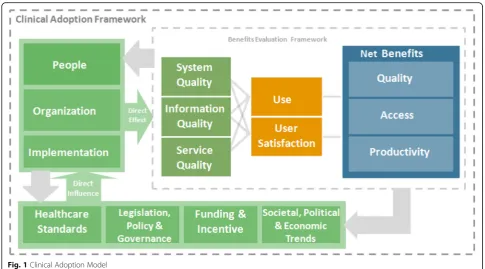
international literature on the attitudes of PCPs to EMR adoption in routine practice, using the Clinical Adoption (CA) Framework to guide categorisation and assessment of the evidence (Registration: PROSPERO CRD42016038790). The CA Framework consists of micro, meso and macro di-mensions encompassing: the quality, accessibility and func-tionality of the EMR system; the people, organisation and process involved in EMR implementation; and the societal,
political and legislative context [25,26]. Figure1provides a
conceptualisation of the framework in diagrammatic form, with further narrative describing the micro, meso and
macro dimensions of the CAF outlined in Table1.
Methods
Data sources and search strategy
We searched MEDLINE, PsycINFO and EMBASE on 1st August 2017 for papers published from 1st January 1996 to search date. Search terms encompassed four concepts: (1) PCPs; (2) primary care; (3) attitudes; (4) EMRs. Terms were coupled with relevant MeSH/thesaurus terms, truncated as appropriate, and variant spellings used. Bibliographies of re-lated reviews, outputs of key journals and reference lists held by reviewers were hand-searched. Only published peer-reviewed articles were retrieved for further review.
Inclusion criteria
EMRs were defined as computerised medical information systems that collect, store and display patient information
[27]. The main user of the EMR had to be a medically
qualified physician who provided primary healthcare, in-cluding general practitioners, family doctors, family physi-cians and family practitioners. Primary healthcare was defined as general healthcare covering a broad range of pre-senting problems, which can be accessed by a wide range of patients on demand, and not as the result of a referral for
specialist care [28]. Studies needed to investigate attitudes
towards the adoption of EMRs. We defined ‘attitude’as a
psychological disposition that is expressed by evaluating a
particular entity favourably or unfavourably [29].
Outcome measures of interest were: (1) any reported
measure of PCPs’knowledge, attitudes or satisfaction with
EMRs; (2) any objective or blind measure of EMR use (by standardised patient, other trained observer or video/ audio recording). Papers not reporting either of these out-comes of interest were excluded, as were studies based on secondary data. Due to the rapid expansion of digital tech-nology in healthcare from the mid-1990s, we restricted eligibility to studies published from 1996.
Data selection and extraction
relevant references were screened independently by two researchers (AOD, CS), who also reviewed full-texts of eli-gible papers. Disagreements were resolved by discussion with a third team member. A structured form guided data extraction of key study characteristics, including setting, participants, aim and methodology. Findings were mapped
and categorised against the CA Framework (see Fig.1).
Quality assessment
Quantitative studies were quality assessed using the
appro-priate Center for Evidence-Based Management’s Critical
Appraisal Checklist [30, 31]. Qualitative studies were
assessed using the Critical Appraisal Skills Programme
(CASP) Research Checklist [32]. Mixed-methods studies
were assessed using a combination of these tools.
Results
Characteristics of the included studies
We identified 33 articles (see Fig. 2): 15 based in the
USA [33–47]; 11 Europe [48–58]; two Canada [59,60]; and
one each in Saudi Arabia [61], Brazil [62], Hong Kong [63]
and Israel [64]. The literature was methodologically diverse,
including 11 qualitative studies [35,36,41, 44, 47, 49,54,
59, 63–65], 17 cross-sectional surveys [33, 34, 37, 39, 42, 43, 45, 46,50–52, 55–58, 60,62], one longitudinal survey
[53] and four mixed methods studies [38,40,48,61].
Publi-cation years ranged from 2001 to 2016. Of the 15 papers based on qualitative studies (including mixed methods studies with a qualitative component): one was deemed of
low [61]; nine moderate [33,35,36,41,48,49,54,64,65];
and five high quality [44, 47, 59, 63]. Of the 20 papers
based on cross-sectional studies (or a cross-sectional
component): 14 were moderate [37, 38, 40, 42, 43, 45,
46, 48,55–58, 60, 61] and six high quality [34,39, 50–
52, 62]. The final study employing cohort methods was
categorised as moderate quality [53]. Full study details
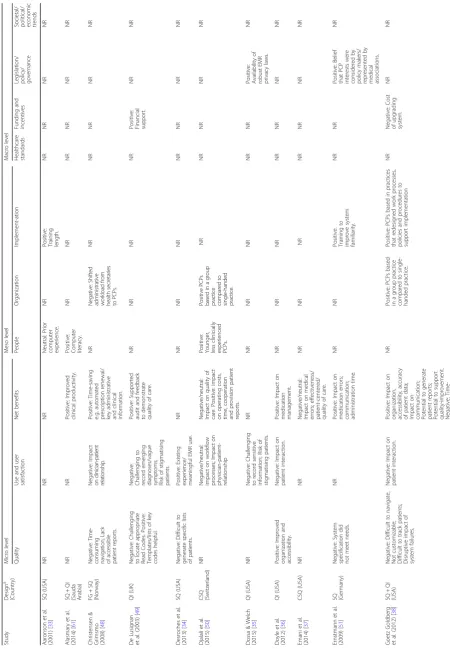
are available in Table2.
Micro level
Quality of information, system and service
Over half of the papers discussed the impact that the qual-ity of the EMR itself exerted on PCPs attitudes to adop-tion. Common factors ranged from the ease of access, efficiency and functionality of the system, to its technical
reliability once in use [34,36,38,41,42,44,46–49,51,52,
59,60,62–65].
Three papers identified the user interface design, includ-ing ease of log-in, as an important factor influencinclud-ing adoption: even if an EMR had advanced features, if the ini-tial interface was challenging, PCPs were likely to reject it
[47,59,63]. Several articles focussed on dissatisfaction
with the speed of the EMR, sometimes relative to the perceived superior performance of paper-based records
[38,42,47,62]. Navigating the EMR to locate key patient
information was sometimes viewed as time-consuming
[41, 48]. System complexity [59], such as long lists from
which to choose the appropriate code [49], was
highlighted as problematic, alongside criticism of the nu-merous steps needed to complete a clinical transaction
[38, 47]. However, templates were welcomed as a
structured means of entering data, and memory joggers, such as lists of key codes, were also considered helpful
[47,49].
A perceived mismatch between EMR functionality and the needs of PCPs in practice was a common theme. EMRs were often viewed as lacking an easily accessible overview of key patient data, particularly family histories
[34, 41, 44, 48, 62]. Problem lists were seen as overly
long, containing redundant or irrelevant information
[65]. One study highlighted the problems caused by the
limited amount of available screen real estate (browser window size), which meant that immediate information needs could not always be accommodated within a
sin-gle screen [41]. However one paper found PCPs were
satisfied with EMRs in terms of data-related
comprehen-siveness, organization, and readability [64], and another
suggested mostly positive impacts on the organisation
and accessibility of patient data [36].
PCPs found it challenging to track patients through the health system via EMRs, either over time or
across care boundaries [34, 38]. Lack of
interoperabil-ity of primary care EMRs with secondary care IT sys-tems, alongside an inability to transfer electronic records between practices, were also highlighted as
bar-riers to adoption [52, 60]. It was challenging to convert
third-party diagnostic results into searchable structured data, with practices usually reliant on scanning paper
doc-uments into the EMR as PDF files [65]. Several papers
fo-cussed on system reliability as a barrier to adoption [38,
59,60,62], emphasising the major disruption to office
op-erations and patient care caused by even occasional EMR
system or server crashes [38,62], often exacerbated by the
lack of technical support available to practices [38,59,60].
Thus post-implementation technical support was
import-ant to support effective EMR adoption over time [63].
Use and user satisfaction
PCPs’ satisfaction with EMRs in routine practice was
the most frequently reported influencing factor,
men-tioned by 22 papers [34–36, 38, 40–42, 44, 46–50, 52,
55, 56, 58–60, 63–65]. Two reported on incompatibil-ities between rigid EMRs and the complex, dynamic,
medical decision-making process [41, 65]. Concerns
were raised in nine about the potential negative influ-ence of computers on the doctor-patient relationship [36, 46–48, 50, 56, 59, 60, 64], some highlighting the intrusive nature of having the computer screen in the
consulting room [52], alongside the pressure of data
entry, which could distract attention from the patient
[36, 38, 40, 42, 48, 55, 63]. However, two papers
sug-gested that PCP IT skills, especially blind typing and the use of keyboard shortcuts and templates, could
help mitigate these issues [63, 64]. Moreover, if used
to involve patients in their care, by screen-sharing or using elements as a visual learning tool, two papers identified the potential for EMRs to boost
engage-ment [44, 47].
Several papers highlighted the difficulties experi-enced when using EMRs to record certain types of
patient data [35, 49, 57]. One study reported that
PCPs found it challenging to record emerging diagno-ses and/or vague symptoms, particularly when a
diag-nosis was potentially sensitive or stigmatising [49]. It
was suggested that certain information was sometimes excluded from the EMR out of respect for the
pa-tient’s wishes or because of the potential
conse-quences for the patient if external agencies accessed
the information [35]. Another study emphasised how
recording behaviour was shaped by PCPs’ perception
of the value of information recorded [54]. For
ex-ample, smoking was most frequently recorded and updated because it was used to help calculate an
Table 1Micro, meso and macro level dimensions and
categories of the Clinical Adoption Framework Dimension Category
Micro level Health Information System (HIS) quality, which refers to the accuracy, completeness and availability of the clinical information content; features, performance and security of the system; and responsiveness of the support services.
Usage quality which refers to HIS usage intention/ pattern and user satisfaction in terms of usefulness, ease of use and competency.
Net benefits, which refer to the change in care quality, access and productivity as a result of HIS adoption by clinicians. Care quality includes patient safety, appropriateness/ effectiveness, and health outcomes. Access refers to provider/patient participation and availability/access to services. Productivity covers care coordination, efficiency and net cost.
Meso level People meaning the individuals/groups involved, their personal characteristics and expectations, and their roles and responsibilities with the HIS.
Organization which refers to how the HIS fits with the organization’s strategy, culture, structure/ processes, info−/infrastructure, and return on value.
Implementation which involves the HIS adoption stages, project management approaches and the extent of the HIS’s fit for the practice.
Macro level Healthcare standards in terms of the types of HISs organizational performance and professional practice standards in place.
Funding and incentives which refer to the added values, remunerations and incentive programs.
Legislation/policy and governance in terms of the influence of legislative acts, regulations/policies and governance bodies, such as professional associations/ colleges and advocacy groups, and their attitudes toward HIS.
individual’s cardiovascular risk score. The recording of alcohol consumption, physical activity and eating
habits was far less routine [54].
Four papers discussed the positive influence of long
term EMR use on adoption attitudes [34, 39, 44, 58].
Users were more likely than non-users to believe that
current EMRs were helpful [39, 58]. PCPs working in
practices with even a relatively basic system were signifi-cantly more likely than those without to hold positive
opinions about increased EMR use [34]. Positive user
Table 2 Summary of micro, meso and macro level factors influencing PCP attitudes to EMR adoption Study Design a (Country) Micro level Meso level Macro level Quality Use and user satisfaction Net be nefits People Organization Implement-ation Healthcar e standard s Funding and incentives
Legislation/ policy/ governance
Soc
ietal/
political/ economic trend
s Aaronson et al. (2001) [ 33 ] SQ (USA) NR NR NR Neutral: Prior computer experienc e. NR Po si ti ve : Tr ai ni ng le n g th . NR NR NR NR Alasmary et al. (2014) [ 61 ] SQ + QI (Sauda Arabia) NR NR Positive: Improved clinical productivity. Positive: Comp uter literacy. NR NR NR NR NR NR Christensen & Grimsmo (2008) [ 48 ] FG + SQ (Norway) Neg at ive: Tim e-co nsu m in g na vig at io n ;L ack o f ac ce ss ibl e pa ti ent repor ts . Negative: Impact o n cl in ic ia n -p at ien t relations hip. Positive: Time-saving e.g. automated prescription renewal/ key administrative and clinical information. N R Neg ativ e :S hi fted ad mi ni st ra ti ve wo rkl o ad fr o m h e al th secret aries to P C Ps . NR NR NR NR NR De Lusigna n et al. (2003) [ 49 ] QI (UK) Negative: Challenging to locate appropriate Read Codes. Positive: Templates/lists of key codes helpful . Negative: Challenging to record emerging
diagnoses/vague symptoms; Risk
of stigmatisin g patients. Positive: Supported audit and feedback to demonstrate quality of care. NR NR NR NR
Positive: Financial support.
NR NR Desroches et al. (2013) [ 34 ] SQ (USA) Negative: Difficult to generate specific lists of patients. Positive: Existing experience/ meaningful EMR use. NR NR NR NR NR NR NR NR Djalali et al. (2015) [ 50 ] CSQ (Switzerland) NR Negative/neutral: impact on workflow processes; Impact on physician-patient- relationship Negative/neutral: Impact on quality of care. Positive: impact on operating costs, time, cooperation and provision patient reports.
Positive: Younger, less
Table 2 Summary of micro, meso and macro level factors influencing PCP att itudes to EMR adoption (Continued) Study Design a (Country) Micro level Meso level Macro level Quality Use and user sati sfaction Net benefits People Organization Implement-ation Healthcare standards Funding and incentives
Legislation/ policy/ governance Societal/ political/ economic trends
Greiv er et al. (2011) [ 59 ] FG (Canada) Negativ e: Comp lex/ inflexible system; Software interfac e issues and immaturity; Adverse impact s of IT structural failures inc. lack of technical support. Negativ e: Impact on patient interaction . Negative: Redu ced efficiency e.g. additional data entry time. Positive: Improved efficiency e.g. automated prescrip tion renewals/ consultatio n letters; Quality/accessibility of patient records. Negative: Lack of basic IT/ keyboard skills; Limited benefits for older PCPs. NR Negative: Lack of ongoing training post-implementation; Lack of technical support. Positiv e: Having designated champion to support/ problem solve. NR Negativ e:Cost of system installation NR NR Holan da et al. (2012) [ 62 ] CSQ (Brazil) Negativ e: Speed; Technical failures; Lack of functiona lity e.g. checking lab results. Negative/ neutral: Accessibility of previous notes; Ability to review medication list. NR Negative: Speed in comparison to paper records. Neutral: Length of clinical experience ; .Positive: Basic computer literacy; Being female; Younger PCPs. Positive: Seeing less than 16 patients per half-day. NR NR NR NR NR Keddie & Jones (2005) [ 52 ] CSQ (UK) Negativ e: Incomp atibility with secon dary care systems; Inability to transfer records between practices. Negativ e: Intrusion of PC in consulting room; Lack of fit wit h current work practic es. Negative: Time-consuming . NR NR Negative: Lack of training; lack of technical support. NR Negativ e: Cost of system installation . Negative: Concerns about the med ico-legal im plications; Llack of policy-maker support for implementation. NR Loomis et al. (2002) [ 39 ] CSQ (USA) NR NR Positive: More secure and confidential than paper records. Negative: Being a non-EMR user. NR NR NR NR NR NR Mead e et al. (2009) [ 53 ] SQ (Ireland) NR NR Negative: Time-consuming . Negative: Lack of basic computer skills. NR Negative: Poor training. NR Negativ e: Cost of introducing system . NR NR O ’ Malley et al. (2010) [ 65 ] QI (USA) Negativ e: Lack of system intero perability; Lengthy / irreleva nt problem lists. Negativ e: Mismatch wit h work practices; Lack of usefulness for complex patients/ situa tions. Po sit ive: C om pr ehe n sive / consiste nt/ accessible
documentation; Automated
Table 2 Summary of mi cro, meso and macro level factors influencing PCP attitudes to EMR adoption (Continued) Study De sign a (Country) Micro level Meso level Macro level Quality Use and user satisfaction Net benefits People Organization Implement-ation Healthcar e standards Funding and incentives
Legislation/ policy/ governance Societal/ political/ economic trends
Rose et al. (2005) [ 41 ] FG (USA) Negative: Difficult to navigate and acc ess patient notes; Lack of available screen real estate/ cluttered screen. Positive: Use of screen contrast/ colour; Ability to customize. Negative: Mismatch with existing workflow patterns. NR NR NR NR NR NR NR NR Rosemann et al. (2010) [ 56 ] SQ (Swit zerland) NR Negative: Impact on patient interaction; Impact on docto r-patient relationship. Negative: Cost-benefit ratio. Positive: Younger PCPs Positive: PCPs based in group practices. NR NR NR Negative: Concerns re data security law. NR Sequist et al. (2007) [ 42 ] SQ (USA) Negative: Technical limitations eg slow response time. Negative: Impact on patient interaction. Negative: Clinical productivity loss; Patient privacy/safety. Positive: Quality of care. Positive: More clinical experienc e Negative: Lack of basic computer skills. NR Negative: Lack of technical support; Lack of training. NR NR NR NR Shachak et al. (2009) [ 64 ] QI (Israel) Positive: Data-related comprehensiveness, organization, and readability. Positive: Reduced cognitive load ; Simple to use. Negative: Impact on patient interaction. Positive: Automated review of patients ’ medical histories/ test results; Provided clinical decision aids; Enhanced patient safety. Negative: Introduced new types of med ical errors e.g. typos.
Positive: Advanced computer/ communication skills.
NR NR NR NR NR NR Steininger & Stiglbauer (2015) [ 57 ] SQ (Austria) NR NR Negative: Impact on patient privacy. NR NR NR NR NR NR NR Stream (2009) [ 43 ] SQ (USA) NR NR Negative: Productivity loss. NR Positive: Presen ce of students and residents in practice; Attitude of individual practices; Being based in group rather than solo practices. NR NR Negative: Start-up financial costs, ongoing financial costs and training costs; Pay-for-performance and interes t free loans. Positive: Grants and increas ed reimbursement. NR NR Vill al ba-Mora et al .( 20 15 ) [ 58 ] SQ (Spain) NR Positive: Availability of ePrescription/ patient management services e.g. appointments and referrals. NR Positive: Being female; Having basic computer skills; Use of internet outside the workplace. NR NR NR NR NR NR Williams et al. (2011) [ 44 ] QI (USA) Negative: Accessing/ navigating family history information. Positive: Helping to directing patient care; Building relationship/ rapport. Positive: Increase in practice efficiency. NR NR NR NR NR NR NR Wright & Marvel (2012) [ 45 ] SQ (USA) NR NR NR Positive: Younger PCPs. NR NR NR NR NR NR Yan et al. (2012) [ 46 ] SQ (USA) Negative: Technical limitations. Negative: Adverse impact on -patient interaction. Negative: Substantial productivity loss against limit ed direct benefits. Negative: Older PCPs; Lack of EMR experience; Lack of computer skills. Neutral: Practice size. Negative: Training needs. NR
Negative: Substantial financial
Table
2
Summary
of
micro,
me
so
and
macro
level
factors
influencing
PCP
attitudes
to
EMR
adoption
(Continued)
Study
Desig
n
a
(Country)
Micro
level
Meso
level
Macro
level
Quality
Use
and
user
satisfaction
Net
benefits
People
Organization
Imple
ment-ation
Healthcare standards
Funding
and
incentives
Legislation/ policy/ governance Societal/ political/ economic trends
Zhang
et
al.
(2016)
[
47
]
QI
(USA)
Positive:
Use
of
templates.
Negative:
Time
consuming
functions
e.g.
clinical
reminders;
Techni
cal
limitations
e.g.
slow
user
interface,
lack
of
shortcuts;
limited
flexibility
Positive:
Promoted
p
ati
en
t
eng
ag
em
ent
as
viewi
n
g
tool
.
Negati
ve
:A
dverse
im
pact
on
-p
ati
en
t
int
eract
ion.
Negative:
Productivity
loss
NR
NR
NR
NR
NR
NR
NR
aDesign:
CSQ
-cross-sectional
surve
y
questionnaire;
FG
-focus
groups;
QI
-qualitative
interview
s;
SQ
-survey
helping to direct patient care based on family histories
or for building rapport [44].
Net benefits in terms of care quality, productivity and access
Twenty five papers discussed PCPs’perceived (dis)benefits
of EMR adoption across a range of areas [34, 36, 38–40,
42–44, 46–54, 56, 57, 59–65]. A number of studies fo-cussed on their potential to improve clinical productivity [36,38–40,44,48,50–54,59–65], for example by reducing
the coding mistakes commonly encountered in
paper-based records [61]. Anticipated gains also resulted
from the automation of key clinical functions, such as
pre-scription renewals and issuing referral letters [48, 59, 65].
Increased efficiency due to the improved accessibility of
pa-tient data was a common theme [36, 38, 40, 54, 59, 64],
with PCPs in two studies thinking that EMRs would elimin-ate the problems caused by poor organization of paper
charts and illegible handwriting [36,64].
The positive impact of EMRs on practice
communica-tion was reported in five papers [38, 40, 50, 51, 65].
Some PCPs highlighted use of the patient problem list, task assignment functions, and to-do lists as communi-cation tools between clinicians, administrators, and
pa-tients [38]. For others, EMRs enabled improved
coordination within the practice by making patient notes
more legible, organized and retrievable [65]. Users were
also more likely than non-users to view systems as im-proving the security and confidentiality of patient
re-cords [39].
Patient safety and care quality were two further areas
perceived as benefiting from EMR introduction [38–40,
49,65], particularly by more experienced users [39]. The
potential of EMRs to support audit and feedback was an
important motivating factor for adoption [49,54], as was
the ability to generate reports for quality-improvement
purposes [38]. PCPs in a number of studies anticipated
that the adoption of EMRs would result in improved
medication management [36, 51, 63–65]. By enabling
more accurate, comprehensive, and automated
docu-mentation of medications [63, 65], EMRs could help to:
identify and flag drug interactions [64]; identify patients
affected by a drug recall; and manage prescriptions for
controlled drugs more effectively [36].
Focussing on perceived disbenefits of EMR adoption,
the time [38,53,59,63] and cost [43, 46, 52, 56,60,63]
associated with installing a new electronic system were flagged. Three studies drew attention to the additional
time required to enter patient data in EMRs [38,47,59],
which reduced PCPs’ time for patient care. The initial
capital outlay required for EMR implementation was highlighted as a barrier by several papers; most sug-gested that PCPs felt unlikely to benefit directly from
such investment due to the increased workload
associated with using the system [46, 56, 60, 63].
Start-up costs emerged as the main barrier, but the on-going financial commitment of maintaining EMRs, in-cluding training practice staff, was also an obstacle
highlighted by PCPs [43,52,63].
Contradictions emerged with regards to the perceived benefits of EMRs reported above. PCPs in three studies were either neutral or negative about their impacts on
care quality [37,42,50], and a small number of
respon-dents in one study raised concerns about patient privacy
and safety [37]. Less than half of PCPs’ believed that
EMRs would reduce errors in medical records in one
paper [37]. Another raised concerns that EMR use could
actually introduce new types of medical errors, including
typos, adding information to the wrong patient’s chart,
and unintentionally selecting an erroneous item
(diagno-sis or medication) from scroll-down lists [64].
Meso level
People
Fifteen papers described PCP characteristics potentially
associated with attitudes to EMR adoption [33, 39, 41,
42,45,46, 50,53,58–64]. Three highlighted gender as a significant influencer, although in one, male PCPs
dem-onstrated higher levels of EMR adoption [50], whereas
the opposite was true for the remainder [58, 62]. Age
was a commonly occurring factor. Four papers suggested that younger PCPs were more likely to adopt EMRs than
older PCPs [46, 50, 56, 62], and another highlighted a
perception that such increased adoption rates were be-cause the benefits of EMRS were greater for younger
PCPs [59]. One study found that older PCPs were more
likely to express satisfaction with EMR use [62], but this
contrasted with findings elsewhere [45].
Several papers highlighted PCPs’lack of basic
comput-ing and keyboard skills as a substantial barrier to the level
[42, 53,59,60] and quality [64] of EMR adoption. Three
suggested that PCPs with prior computing experience were more likely to demonstrate positive attitudes towards
adoption and regular use [58, 61, 62], with non-users
much less positive [39]. However two further studies
found computing and/or EMR experience to be a
rela-tively neutral [33] or infrequently mentioned influencing
factor [46]. In terms of broader clinical experience, one
study found that PCPs with fewer years in medical
prac-tice appeared more positively inclined to EMR use [50],
al-though another [62] found this relationship weak, and a
further study suggested that more clinically experienced
PCPs were actually higher adopters [42].
Organization
Practice characteristics also influenced adoption
atti-tudes [38,43,46,48,50,56,62,65], particularly size [38,
practices [40,43,56]. Advanced EMR use (i.e. using data for monitoring and evaluation purposes) was more often seen in practices owned by large, healthcare organisa-tions, in part due to availability of technical and
admin-istrative support [38]. PCPs working in single-handed
practices were more likely not to have any computer or to have computers for reception purposes only, which impacted negatively on their attitudes towards EMR
adoption [43,46,50]. Only one study found that practice
size was not associated with PCPs’ barriers to EMR
adoption [46]. However findings from another suggested
that individual practices had more impact on EMR
adoption than larger practice networks [43].
Additional organisational factors shaping adoption concerned the alignment of EMRs within existing work-ing practices, roles and responsibilities, and patient
throughput; although here evidence was conflicting [46,
62]. A final study highlighted a perception that EMR
introduction led to a shift in administrative workload
from health secretaries to PCPs [48].
Implementation
The EMR implementation process influenced PCP views
in ten studies [33, 38, 42, 46, 51–53, 59, 60, 63], with
training the most frequently mentioned factor. Lengthier
training provision impacted positively on both PCPs’
views on implementation and their ongoing use of the
system [33]. Three papers reported that inadequate
training was an important barrier to EMR use [42, 46,
53]; another highlighted the need for ongoing training
post-implementation [59]. Lack of expertise, time and
knowledge to manage the implementation process was
also a barrier to adoption [60]. Practices that
experi-enced smoother transitions to EMR use had redesigned work processes and developed policies and procedures
to support implementation [38]. Finally, having a
desig-nated EMR champion could facilitate improved EMR
adoption [59].
Macro level influencers
Funding and incentives
Financial factors shaped PCP’s adoption attitudes in ten
studies [38, 39,43,46, 49, 52–54, 59,63,65]. The costs
associated with purchasing the technology [38, 53, 59]
alongside additional human resource demands, were
highlighted as key barriers to adoption [59]. Lack of
fi-nancial incentives resulted in more limited, less
inte-grated use of EMRs [65]; one paper suggested this was
construed as a lack of priority for both the work in-volved in implementing EMRs and the data collected
[54]. Several suggested that provision of grants and
re-imbursement schemes for EMRs would result in more
effective implementation [43, 63]. However, sustained
use over time increased PCPs willingness to invest in
EMRs [39].
Legislation, policy and governance
Six studies flagged policy and legislative influences [35,
46, 51,52, 54, 56]. Concerns around data security were
highlighted [52, 56], although one paper suggested that
availability of robust privacy laws could facilitate more
comprehensive EMR use [35]. Evidence was inconsistent
regarding the extent to which PCPs felt supported by policy makers in either the design or implementation of
EMRs [51,52].
No papers explicitly identified healthcare standards or societal, political and economic trends as macro level factors influencing adoption.
Discussion
This systematic review found that multiple and
interre-lated influencers shape PCPs’attitudes towards EMR
im-plementation in routine practice, although several common themes emerged across the literature. As
highlighted in previous reviews [18,23,24,66–68],
con-cerns about the accessibility, reliability and overall utility of the EMR appear to exert a sizeable adverse influence
on PCPs’attitudes to adoption. Like Boonstra and
Broe-khuis [23], we found that PCPs perceived a mismatch
between the rigid functionality of the EMR and their more complex, dynamic needs as family physicians, which negatively affected productivity. Lack of EMR
interoperability, limiting physicians’ ability to exchange
electronic information between other general practices or with secondary care IT systems, was also highlighted as a barrier; again a strong theme emerging in other
evi-dence syntheses [23,24,27,68,69]. At the same time, as
Audet et al. found [22], many PCPs were positive about
EMRs’ potential to improve clinical productivity, and
valued the automation of key clinical functions, like
pre-scription renewals. Echoing Nguyen et al’s evaluation
[68], there was also a perception that patient safety and
care quality could benefit from EMR introduction, by supporting the audit-and-feedback process, alongside improved medication management. However other re-views have found less conclusive evidence for this point
[66,70].
Certain PCP characteristics themselves appeared to be associated with views on EMR adoption. Younger PCPs, with an appropriate level of computing skills, and based in larger or multi-group practices, were more likely to be positively inclined towards using EMRs than older, physicians, less-skilled in technology use, and working in solo practices [see also 22, 66 on this point]. Like
Cas-tillo et al. amongst others [20,23,24,27], we found that
up-to-date policies and procedures, and the presence of a designated EMR champion, had a favourable impact
on both PCPs’ views on EMR adoption, and their
on-going use of the system.
Financial factors were the most common system level
dimension shaping PCP’s adoption of EMRs, from the
initial costs of purchasing the technology, to the add-itional demands required by their ongoing use: an issue
emphasised in numerous existing reviews [23,27,65,66,
68,69]. A lack of financial incentives or reimbursements
to support installation resulted in more limited, less in-tegrated EMR use by PCPs. However this was not a uni-form finding, with other studies finding ambiguous evidence for the effectiveness of financial incentives on
EMR adoption [71]. There was mixed evidence on the
extent to which PCPs felt supported and represented by policy decisions linked to the design and implementation of EMR systems. Ross et al. stress the adverse impact that absent or inadequate policy and legislation can have
on the adoption of e-health systems in general [69].
Finally, whilst concerns around data security were
men-tioned, in contrast to other studies [23, 66], this was a
relatively minor theme overall in our review.
Our findings serve to highlight that EMR programmes are complex interventions which must be implemented
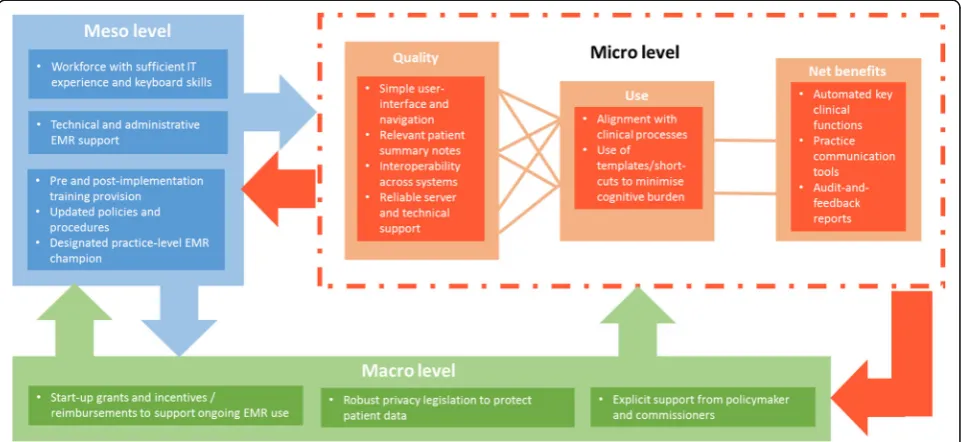
in dynamic socio-technical health systems [72]. Figure3
illustrates the key features a successful plan to boost EMR adoption should include based on our results .
However, as Lau et al. stress [73], whilst these features
may be conceptualised at either the micro, meso or mi-cro level, in reality, they operate interdependently. Thus an effective EMR programme needs to take into account not just these features in static isolation, but also
consider how they interact and evolve over time [74].
Further, with accelerating adoption of electronic records
across health and social care settings [68], and
increas-ingly complex population health needs [75], there is a
real need to improve interoperability across systems, to ensure that patients receive coordinated care of
consist-ent quality [76]. Various obstacles exist to realizing this
aim, from how we can allay patient and practitioners’
valid concerns around the ethics of personal data shar-ing, to the challenge of overcoming more technical and semantic hurdles. Whilst progress is being made towards building data systems that permit functional
interoper-ability [77], sharing and using data effectively will also
require the adoption of common standards, ontologies and terminologies across multiple sectors and
institu-tions [78].
Ultimately, however, EMR adoption is determined by the attitudes and behaviours of the individual clinician
themselves [24]. Decades of research emphasises the
positive effects of early user involvement in design and development on the eventual success of implementing
new technology [19]. Yet a dominant theme in this
re-view was a perceived lack of fit between proprietary EMR systems, and the values, priorities and work
prac-tices of PCPs themselves [79–81]. For example, the
ad-verse impact of EMR adoption on the doctor-patient
relationship was an enduring concern that was
highlighted across the period covered by the included
lit-erature [36, 38,40,42, 44, 46,48–50, 52,55,56, 59, 60,
63–65]. Future implementation programmes must pro-vide a forum for end-users to play an active role in the design process from the outset, and consider the
socio-technical “connectives” between clinician, system
and patient [82]. This would help to boost a sense of
psychological ownership of new systems [83], resulting
in greater support for technological change [84], as well
as harnessing their expertise and experience, thereby avoiding the development of an EMR which is neither
feasible nor acceptable for use [85,86].
Limitations
The systematic review methodology, a moderately sized and geographically varied evidence-base of 33 studies, were strengths of this study. However, our review was re-stricted to peer-reviewed papers, which could introduce
publication bias [87]. Additionally, as highlighted in
previ-ous reviews [23, 66], the literature in this field can be
poorly referenced within bibliographic databases, due to nonstandard use of terminology and lack of consensus on
a taxonomy relating to e-health technologies [88].
We were also limited by the shortcomings of the lit-erature based on methodological rigor, with the majority of included studies deemed of only moderate quality. Around half of the studies (17 out of 33) were structured surveys, using closed-ended questions to capture data,
which inevitably limited respondents’ opportunities to
highlight any issues not already prescribed in the ques-tionnaire. Greenhalgh has written extensively about the need to move beyond positivist methodologies when
evaluating eHealth programs [89]. Her framework for
the evaluation of the introduction of shared electronic summary records in England incorporates social,
tech-nical, ethical and political dimensions [90]. However,
there was limited data on macro or system level influen-cers, including policy and legislation, despite the fact that implementation science emphasises the importance of contextual factors in shaping adoption of new
inter-ventions and technologies [91].
The use of an alternative framework may have altered data synthesis and thus influenced findings. There are a number of potential theories, models and frameworks available to help understand EMR adoption, from
broader implementation theories such as Roger’s classic
Diffusion of Innovations [92], or the Consolidated
Framework for Implementation Research [69], to more
specific models like the Technology Acceptance Model
(TAM) [67, 93–96], and new taxonomies developed by
Boonstra and Broekhuis [23] or Castillo et al. [24]. In
contrast to previous approaches however, the CA Frame-work provides a conceptual model to help describe the factors shaping EMR adoption which has been specific-ally contextualised to the healthcare setting, which also allows us to capture influencing factors operating at the
organisational level and beyond [73,97].
Evidence exploring the patient perspective on EMR use was outside the scope of this review, including the accept-ability of patient-held medical records. Yet previous
research emphasises that adoption of these two systems
are inextricably linked [98]. Whilst our focus on PCPs was
deliberate, it may limit the generalizability of our findings
beyond primary healthcare [20,99], as effective
implemen-tation of a comprehensive, system-wide EMR, would need to take account of the norms, values, and work practices
of the full socio-technical network involved [90].
Conclusions
By using the CA Framework to synthesise the evidence base, we have identified a linked series of factors influen-cing PCPs attitudes to the adoption of EMRs, which could usefully inform future implementation initiatives. Policymakers and system architects designing such ini-tiatives need to recognise that EMR programmes are complex interventions, which must be implemented in dynamic social-technical systems, but that adoption is ultimately determined by the attitudes and preferences of the individual clinician.
Abbreviations
CA Framework :Clinical Adoption Framework; CASP: Critical Appraisal Skills Programme; EMR: Electronic Medical Record; LMIC: Low and middle income country; PCP: Primary care physician
Acknowledgments
We gratefully acknowledge the assistance of our Information Scientist, Fiona Beyer, in designing the search strategy.
Funding
The original study was supported by Fuse, the Centre for Translational Research in Public Health, a UKCRC Public Health Research Centre of Excellence (ES/G007470/1). AOD was a fully funded Fuse doctoral student, CH was a partially funded Fuse staff member and EK is a Fuse Senior Investigator. Funding for Fuse from the British Heart Foundation, Cancer Research UK, Economic and Social Research Council, Medical Research Council, the National Institute for Health Research, is gratefully acknowledged.
Availability of data and materials
All data generated or analysed during this study are available in this published article.
Authors’contributions
AOD, CH & EK contributed to development and design of the protocol. AOD conducted the electronic database searches; AOD & CS screened titles, abstracts and full text papers; AOD & CS extracted relevant data; CS & CH quality assessed eligible papers; and AOD conducted thematic synthesis of the included papers against the CA Framework. AOD, CH, CS & EK critically reviewed the manuscript for important intellectual content. All authors read and approved the final manuscript.
Ethics approval and consent to participate
Not applicable.
Consent for publication
Not applicable.
Competing interests
The authors declare that they have no competing interests.
Publisher’s Note
Author details
1Institute of Health & Society, Newcastle University, Baddiley-Clark Building, Richardson Road, Newcastle upon Tyne NE2 4AX, UK.2Department of Social Work, Education and Community Wellbeing, Faculty of Health and Life Sciences, Northumbria University, Newcastle upon Tyne NE7 7XA, UK.
Received: 30 November 2017 Accepted: 25 September 2018
References
1. Nguyen L, Bellucci E, Nguyen LT. Electronic health records implementation: an evaluation of information system impact and contingency factors. Int J Med Inform. 2014;83:779–96.
2. Columbus M. The Evaluation and Effectiveness of an Interdisciplinary Course in Electronic Health Record (EHR) Technology for Health and Rehabilitation Professionals. Pittsburgh: University of Pittsburgh; 2006.
3. Chaudhry B, Wang J, Wu S, Maglione M, Mojica W, Roth E, et al. Systematic review: impact of health information technology on quality, efficiency, and costs of medical care. Ann Inter Med. 2006;144:742–57.
4. Powell A, Davies H, Thomson R. Using routine comparative data to assess the quality of health care: understanding and avoiding common pitfalls. Qual Saf Health Care. 2003;12:122–8.
5. Fontaine P, Ross SE, Zink T, Schilling LM. Systematic Review of Health Information Exchange in Primary Care Practices. J Am Board Fam Med. 2010;23:655–70.
6. McKee M. Routine data: a resource for clinical audit? Qual Health Care. 1993; 2:104–11.
7. Hrisos S, Eccles M, Francis J, Dickinson H, Kaner E, Beyer F, Johnston M. Are there valid proxy measures of clinical behaviour? A systematic review. Implement Sci. 2009;4:37.
8. Department of Health. Royal College of General Practitioners, British Medical Association: The Good Practice Guidelines for GP electronic patient records v4. London: Department of Health; 2011.
9. NHS. Clinical use of the Summary Care Record. London: National Health Service; 2011.
10. Gnani S, Majeed A. A user’s guide to data collected in primary care in England. London: Eastern Region Public Health Observatory on behalf of the Association of Public Health Observatories; 2006.
11. Blumenthal D, Tavenner M. The“Meaningful Use”Regulation for Electronic Health Records. N Engl J Med. 2010;363:501–4.
12. Schoen C, Osborn R, Squires D, Doty M, Rasmussen P, Pierson R, Applebaum S. A Survey Of Primary Care Doctors In Ten Countries Shows Progress In Use Of Health Information Technology, Less In Other Areas. Health Affairs. 2012; 31:2805–16.
13. Fraser H, Biondich P, Moodley D, Choi S, Mamlin B, Szolovits P.
Implementing electronic medical record systems in developing countries. J Innov Health Inform. 2005;13:83–95.
14. Fritz F, Tilahun B, Dugas M. Success criteria for electronic medical record implementations in low-resource settings: a systematic review. J Am Med Inform Assoc. 2015;22:479–88.
15. Sheikh A, Cornford T, Barber N, Avery A, Takian A, Lichtner V, Petrakaki D, Crowe S, Marsden K, Robertson A, et al. Implementation and adoption of nationwide electronic health records in secondary care in England: final qualitative results from prospective national evaluation in“early adopter” hospitals. BMJ. 2011;343:d6054.
16. Crampton NH, Reis S, Shachak A. Computers in the clinical encounter: a scoping review and thematic analysis. J Am Med Inform Assoc. 2016;23: 654–65.
17. Cresswell KM, Bates DW, Sheikh A. Ten key considerations for the successful implementation and adoption of large-scale health information technology. J Am Med Inform Assoc. 2013;20:e9–e13.
18. Babbott S, Manwell LB, Brown R, Montague E, Williams E, Schwartz M, Hess E, Linzer M. Electronic medical records and physician stress in primary care: results from the MEMO Study. J Am Med Inform Assoc. 2013;21:e100–6. 19. Black AD, Car J, Pagliari C, Anandan C, Cresswell K, Bokun T, McKinstry B,
Procter R, Majeed A, Sheikh A. The Impact of eHealth on the Quality and Safety of Health Care: A Systematic Overview. PLOS Med. 2011;8:e1000387. 20. McGinn CA, Grenier S, Duplantie J, Shaw N, Sicotte C, Mathieu L, Leduc Y,
Légaré F, Gagnon M-P. Comparison of user groups’perspectives of barriers and facilitators to implementing electronic health records: a systematic review. BMC Med. 2011;9:46.
21. Simon SR, Kaushal R, Cleary PD, Jenter CA, Volk LA, Poon EG, Orav EJ, Lo HG, Williams DH, Bates DW. Correlates of Electronic Health Record Adoption in Office Practices: A Statewide Survey. J Am Med Inform Assoc. 2007;14:110–7. 22. Audet A-M, Squires D, Doty MM. Where Are We on the Diffusion Curve?
Trends and Drivers of Primary Care Physicians’Use of Health Information Technology. Health Serv Res. 2014;49:347–60.
23. Boonstra A, Broekhuis M. Barriers to the acceptance of electronic medical records by physicians from systematic review to taxonomy and interventions. BMC Health Serv Res. 2010;10:231.
24. Castillo VH, Martínez-García AI, Pulido JRG. A knowledge-based taxonomy of critical factors for adopting electronic health record systems by physicians: a systematic literature review. BMC Med Inform Decis Mak. 2010;10:60.
25. Lau F, Price M, Boyd J, Partridge C, Bell H, Raworth R. Impact of electronic medical record on physician practice in office settings: a systematic review. BMC Med Inform Decis Mak. 2012;12:10.
26. Lau F, Price M. In: Lau F, Kuziemsky C, editors. Chapter 3: Clinical Adoption Framework. In: , editors. . In Handbook of eHealth Evaluation: An Evidence-based Approach [Internet]. Victoria (BC): University of Victoria, Available from:https://www.ncbi.nlm.nih.gov/books/NBK481588/; 2017. 27. Ajami S, Bagheri-Tadi T. Barriers for Adopting Electronic Health Records
(EHRs) by Physicians. Acta Informatica Medica. 2013;21:129–34.
28. Vanselow NA, Donaldson MS, Yordy KD. A new definition of primary care. J Am Med Assoc. 1995;273:192.
29. Eagly AH, Chaiken S. The Advantages of an Inclusive Definition of Attitude. Soc Cogn. 2007;25:582–602.
30. Critical Appraisal Checklist for Cross-Sectional Study. 31. Critical Appraisal Checklist for for a Cohort or Panel Study. 32. CASP (Systematic Review) Checklist.
33. Aaronson JW, Murphy-Cullen CL, Chop WM, Frey RD. Electronic medical records: the family practice resident perspective. Fam Med. 2001;33:128–32. 34. Desroches CM, Audet AM, Painter M, Donelan K. Meeting meaningful use
criteria and managing patient populations: A national survey of practicing physicians. Ann Intern Med. 2013;158:791–9.
35. Dossa A, Welch LC. GPs’approaches to documenting stigmatising information: A qualitative study. Br J Gen Pract. 2015;65:e372–8.
36. Doyle RJ, Wang N, Anthony D, Borkan J, Shield RR, Goldman RE. Computers in the examination room and the electronic health record: Physicians; perceived impact on clinical encounters before and after full installation and implementation. Fam Pract. 2012;29:601–8.
37. Emani S, Ting DY, Healey M, Lipsitz SR, Karson AS, Einbinder JS, Leinen L, Suric V, Bates DW. Physician beliefs about the impact of meaningful use of the EHR: a cross-sectional study. Appl Clin Inform. 2014;5:789–801. 38. Goetz Goldberg D, Kuzel AJ, Feng LB, DeShazo JP, Love LE. EHRs in primary
care practices: benefits, challenges, and successful strategies. Am J Manag Care. 2012;18:e48–54.
39. Loomis GA, Ries SJ, Saywell RM Jr, Thakker NR. If electronic medical records are so great, why aren't family physicians using them? J Fam Pract. 2002;51: 636–41.
40. Pizziferri L, Kittler AF, Volk LA, Honour MM, Gupta S, Wang S, Wang T, Lippincott M, Li Q, Bates DW. Primary care physician time utilization before and after implementation of an electronic health record: A time-motion study. J Biomed Inform. 2005;38:176–88.
41. Rose AF, Schnipper JL, Park ER, Poon EG, Li Q, Middleton B. Using qualitative studies to improve the usability of an EMR. J Biomed Inform. 2005;38:51–60.
42. Sequist TD, Cullen T, Hays H, Taualii MM, Simon SR, Bates DW.
Implementation and Use of an Electronic Health Record within the Indian Health Service. J Am Med Inform Assoc. 2007;14:191–7.
43. Stream GR. Trends in adoption of electronic health records by family physicians in Washington State. Inform Prim Care. 2009;17:145–52. 44. Williams JL, Collingridge DS, Williams MS. Primary care physicians’
experience with family history: an exploratory qualitative study. Gen Med. 2011;13:21–5.
45. Wright E, Marvel J. Electronic health records: postadoption physician satisfaction and continued use. Health Care Manag. 2012;31:259–67. 46. Yan H, Gardner R, Baier R. Beyond the focus group: understanding
physicians’barriers to electronic medical records. Jt Comm J Qual Patient Saf/ Joint Commission Resources. 2012;38:184–91.
exam rooms: a qualitative study on primary care providers. J Am Med Inform Assoc. 2016;23:137–43.
48. Christensen T, Grimsmo A. Instant availability of patient records, but diminished availability of patient information: a multi-method study of GP's use of electronic patient records. BMC Med Inform Decis Mak. 2008;8:12. 49. de Lusignan S, Wells SE, Hague NJ, Thiru K. Managers see the problems
associated with coding clinical data as a technical issue whilst clinicians also see cultural barriers. Methods Inf Med. 2003;42:416–22.
50. Djalali S, Ursprung N, Rosemann T, Senn O, Tandjung R. Undirected health IT implementation in ambulatory care favors paper-based workarounds and limits health data exchange. Int J Med Inf. 2015;84:920–32.
51. Ernstmann N, Ommen O, Neumann M, Hammer A, Voltz R, Pfaff H. Primary care physician's attitude towards the German e-health card project-determinants and implications. J Med Sys. 2009;33:181–8. 52. Keddie Z, Jones R. Information communications technology in general
practice: cross-sectional survey in London. Inform Prim Care. 2005;13:113–23. 53. Meade B, Buckley D, Boland M. What factors affect the use of electronic
patient records by Irish GPs? Int J Med Inform. 2009;78:551–8. 54. Pocetta G, Votino A, Biribanti A, Rossi A. Recording Non Communicable
Chronic Diseases at Risk Behaviours in General Practice. A qualitative study using the PRECEDE-PROCEED Model. Ann ig : medicina preventiva e di comunita. 2015;27:554–61.
55. Prazeres F. How do GPs versus GP trainees adapt to electronic health records? A Portuguese pilot study. Inform Prim Care. 2014;21:139–41. 56. Rosemann T, Marty F, Bhend H, Wagner J, Brunner L, Zoller M. Utilisation of
information technologies in ambulatory care in Switzerland. Swiss Med Wkly : official journal of the Swiss Society of Infectious Diseases, the Swiss Society of Internal Medicine, the Swiss Society of Pneumology. 2010;140:w13088. 57. Steininger K, Stiglbauer B. EHR acceptance among Austrian resident doctors.
Health Policy Technol. 2015;4:121–30.
58. Villalba-Mora E, Casas I, Lupianez-Villanueva F, Maghiros I. Adoption of health information technologies by physicians for clinical practice: The Andalusian case. Int J Med Inform. 2015;84:477–85.
59. Greiver M, Barnsley J, Glazier RH, Moineddin R, Harvey BJ. Implementation of electronic medical records: Theory-informed qualitative study. Can Fam Physician. 2011;57:e390–7.
60. Pare G, Raymond L, de Guinea AO, Poba-Nzaou P, Trudel MC, Marsan J, Micheneau T. Barriers to organizational adoption of EMR systems in family physician practices: a mixed-methods study in Canada. Int J Med Infor. 2014;83:548–58.
61. Alasmary M, El Metwally A, Househ M. The association between computer literacy and training on clinical productivity and user satisfaction in using the electronic medical record in Saudi Arabia. J Med Sys. 2014;38:69. 62. Holanda AA, do Carmo ESHL, Vieira AP, Catrib AM. Use and satisfaction with
electronic health record by primary care physicians in a health district in Brazil. J Med Sys. 2012;36:3141–9.
63. Or C, Wong K, Tong E, Sek A. Private primary care physicians’perspectives on factors affecting the adoption of electronic medical records: A qualitative pre-implementation study. Work: Journal of Prevention, Assessment & Rehabilitation. 2014;48:529–38.
64. Shachak A, Hadas-Dayagi M, Ziv A, Reis S. Primary care physicians’use of an electronic medical record system: a cognitive task analysis. J Gen Intern Med. 2009;24:341–8.
65. O'Malley AS, Grossman JM, Cohen GR, Kemper NM, Pham HH. Are electronic medical records helpful for care coordination? Experiences of physician practices. J Gen Intern Med. 2010;25:177–85.
66. Ludwick DA, Doucette J. Adopting electronic medical records in primary care: Lessons learned from health information systems implementation experience in seven countries. Int J Med Inform. 2009;78:22–31. 67. Gagnon M-P, Ghandour EK, Talla PK, Simonyan D, Godin G, Labrecque
M, Ouimet M, Rousseau M. Electronic health record acceptance by physicians: Testing an integrated theoretical model. J Biomed Inform. 2014;48:17–27.
68. Greenhalgh T, Wherton J, Papoutsi C, et al. Beyond adoption: a new framework for theorizing and evaluating nonadoption, abandonment, and challenges to the scale-up, spread, and sustainability of health and care technologies. J Med Internet Res. 2017;19(11):e367.https://doi.org/10.2196/jmir.8775.
69. Ross J, Stevenson F, Lau R, Murray E. Factors that influence the implementation of e-health: a systematic review of systematic reviews (an update). Implemen Sci. 2016;11:146.
70. Graber M, Byrne C, Johnston D. The impact of electronic health records on diagnosis, in Diagnosis. 2017. p. 211.
71. Mennemeyer ST, Menachemi N, Rahurkar S, Ford EW. Impact of the HITECH Act on physicians’adoption of electronic health records. J Am Med Inform Assoc. 2016;23:375–9.
72. Cresswell K, Sheikh A. Organizational issues in the implementation and adoption of health information technology innovations: An interpretative review. Int J Med Inf. 2013;82:e73–86.
73. Lau F, Price M, Keshavjee K. From benefits evaluation to clinical adoption: making sense of health information system success in Canada. Healthc Q. 2011;14:39–45.
74. Price M, Lau F. The clinical adoption meta-model: a temporal meta-model describing the clinical adoption of health information systems. BMC Med Inform Decis Mak. 2014;14:43.
75. Afshar S, Roderick PJ, Kowal P, Dimitrov BD, Hill AG. In: Hoque MN, Pecotte B, MA MG, editors. Global Patterns of Multimorbidity: A Comparison of 28 Countries Using the World Health Surveys. In Applied Demography and Public Health in the 21st Century. Cham: Springer International Publishing; 2017. p. 381–402.
76. Madden JM, Lakoma MD, Rusinak D, Lu CY, Soumerai SB. Missing clinical and behavioral health data in a large electronic health record (EHR) system. J Am Med Inform Assoc. 2016;23:1143–9.
77. Ethier J-F, McGilchrist M, Barton A, Cloutier A-M, Curcin V, Delaney BC, Burgun A. The TRANSFoRm project: Experience and lessons learned regarding functional and interoperability requirements to support primary care. Learning Health Syst. 2018;2:e10037.
78. Legaz-García MC. Martínez-Costa C, Menárguez-Tortosa M, Fernández-Breis JT: A semantic web based framework for the interoperability and exploitation of clinical models and EHR data. Knowledge-Based Syst. 2016; 105:175–89.
79. Makam AN, Lanham HJ, Batchelor K, Moran B, Howell-Stampley T, Kirk L, Cherukuri M, Samal L, Santini N, Leykum LK, Halm EA. The good, the bad and the early adopters: providers’attitudes about a common, commercial EHR. J Eval Clin Pract. 2014;20:36–42.
80. Walter Z, Lopez MS. Physician acceptance of information technologies: Role of perceived threat to professional autonomy. Decis Supp Syst. 2008;46:206–15.
81. Cifuentes M, Davis M, Fernald D, Gunn R, Dickinson P, Cohen DJ. Electronic Health Record Challenges, Workarounds, and Solutions Observed in Practices Integrating Behavioral Health and Primary Care. J Am Board Fam Med. 2015;28:S63–72.
82. Takian A, Petrakaki D, Cornford T, Sheikh A, Barber N. Building a house on shifting sand: methodological considerations when evaluating the implementation and adoption of national electronic health record systems. BMC Health Serv Res. 2012;12:105.
83. Paré G, Sicotte C, Jacques H. The Effects of Creating Psychological Ownership on Physicians’Acceptance of Clinical Information Systems. J Am Med Inform Assoc. 2006;13:197–205.
84. Hyclak TJ, Kolchin MG. Worker involvement in implementing new technology. Technovation. 1986;4:143–51.
85. Ives B, Olson MH. USER INVOLVEMENT AND MIS SUCCESS: A REVIEW OF RESEARCH. Manag Sci. 1984;30:586–603.
86. Trudel M-C, Marsan J, Paré G, Raymond L, Ortiz de Guinea A, Maillet É, Micheneau T. Ceiling effect in EMR system assimilation: a multiple case study in primary care family practices. BMC Med Inform Decis Mak. 2017;17:46. 87. Dickersin K. The existence of publication bias and risk factors for its
occurrence. JAMA. 1990;263:1385–9.
88. Dixon BE, Zafar A, McGowan JJ. Development of a taxonomy for health information technology. Stud Health Technol Inform. 2007;129:616–20. 89. Greenhalgh T, Russell J. Why Do Evaluations of eHealth Programs Fail? An
Alternative Set of Guiding Principles. PLOS Med. 2010;7:e1000360. 90. Greenhalgh T, Stramer K, Bratan T, Byrne E, Russell J, Potts HWW. Adoption
and non-adoption of a shared electronic summary record in England: a mixed-method case study. BMJ. 2010;340:c3111.
91. May CR, Johnson M, Finch T. Implementation, context and complexity. Implement Sci. 2016;11:141.
92. Rogers EM. Diffusion of Innovations. New York: Free Press; 1995.
93. Davis FD. Perceived Usefulness, Perceived Ease of Use, and User Acceptance of Information Technology. MIS Quarterly. 1989;13:319–40.
95. Gagnon M-P, Godin G, Gagné C, Fortin J-P, Lamothe L, Reinharz D, Cloutier A. An adaptation of the theory of interpersonal behaviour to the study of telemedicine adoption by physicians. Int J Med Inform. 2003;71:103–15. 96. Gagnon M-P, Sánchez E, Pons JMV. From recommendation to action:
psychosocial factors influencing physician intention to use Health Technology Assessment (HTA) recommendations. Implemen Sci. 2006;1:8. 97. Yarbrough A, Smith T. Technology Acceptance among Physicians. Med Care
Res Rev. 2007;64:650–72.
98. Archer N, Fevrier-Thomas U, Lokker C, McKibbon KA, Straus SE. Personal health records: a scoping review. J Am Med Inform Assoc. 2011;18:515–22. 99. CA MG, Gagnon M-P, Shaw N, Sicotte C, Mathieu L, Leduc Y, Grenier S,