R E S E A R C H A R T I C L E
Open Access
Exploring the relationship between patients
’
information preference style and knowledge
acquisition process in a computerized
patient decision aid randomized controlled
trial
Anna M. Sawka
1*, Sharon Straus
2,3, Gary Rodin
4,5, Richard W. Tsang
6, James D. Brierley
6, Lorne Rotstein
7,8,
Phillip Segal
9,10, Amiram Gafni
11, Shereen Ezzat
14and David P. Goldstein
12,13Abstract
Background:We have shown in a randomized controlled trial that a computerized patient decision aid (P-DA) improves medical knowledge and reduces decisional conflict, in early stage papillary thyroid cancer patients considering adjuvant radioactive iodine treatment. Our objectives were to examine the relationship between participants’baseline information preference style and the following: 1) quantity of detailed information obtained within the P-DA, and 2) medical knowledge.
Methods:We randomized participants to exposure to a one-time viewing of a computerized P-DA (with usual care) or usual care alone. In pre-planned secondary analyses, we examined the relationship between information preference style (Miller Behavioural Style Scale, including respective monitoring [information seeking preference] and blunting [information avoidance preference] subscale scores) and the following: 1) the quantity of detailed information obtained from the P-DA (number of supplemental information clicks), and 2) medical knowledge. Spearman correlation values were calculated to quantify relationships, in the entire study population and respective study arms.
Results:In the 37 P-DA users, high monitoring information preference was moderately positively correlated with higher frequency of detailed information acquisition in the P-DA (r= 0.414,p= 0.011). The monitoring subscale score weakly correlated with increased medical knowledge in the entire study population (r= 0.268,p= 0.021,N= 74), but not in the respective study arms. There were no significant associations with the blunting subscale score.
Conclusions:Individual variability in information preferences may affect the process of information acquisition from computerized P-DA’s. More research is needed to understand how individual information preferences may impact medical knowledge acquisition and decision-making.
Keywords:Cancer, Patient decision aid, Behaviour, Health information, Decision making, Consumer health information, Information seeking behaviors
* Correspondence:[email protected]
1
Division of Endocrinology, Toronto General Hospital, 200 Elizabeth Street, 12 EN-212, Toronto, ON M5G 2C4, Canada
Full list of author information is available at the end of the article
Background
Patient decision aids (P-DAs) inform patients about healthcare choices and they have been shown to improve patients’ knowledge of medical choices, accuracy of ex-pectations of risks and benefits of choices, and participa-tion in decision-making [1]. A large number of P-DAs, in such forms as computerized programs, brochures, de-cision boards, videotapes, and others, are available for use in cancer care. [2]. Furthermore, the use of cancer care P-DAs is associated with improved medical know-ledge and reduced decisional conflict [2].
The International Patient Decision Aid Standards Col-laboration has developed quality evaluation criteria for P-DAs, and such criteria encompass informational con-tent, development process, and effectiveness in ensuring that decision-making is informed and values-based [3]. Such quality criteria include standardization of informa-tional content, including presentation of numerical de-scriptions of event rates and probabilities of outcomes [3]. Internet-based P-DAs are a contemporary development in the field [4], and of particular interest to this study. An international, multidisciplinary panel of scientists recently reported on theoretical literature and empirical evidence the from a variety of disciplines supporting internet-based P-DAs, including the Health Belief Model, Social Cog-nitive Theory, Elaboration Likelihood Model, Theory of Goal Setting and Performance, and Stages of Change Theory [4]. This group of experts recommended more research be performed using internet-based P-DAs, examining issues such as interactivity of users [4].
In searching for health information on the internet, it is known that individuals’ personal information prefer-ences impact searching behavior [5]. Furthermore, there is some research suggesting that matching information messages to patients’ information preference increases positive health behaviour, such as screening mammog-raphy [6, 7]. A need for more research in matching the way information is presented to individual patient pref-erences (‘patient-match’) has been called for [8]. In the area of internet-based P-DAs, the relationship between users’information-seeking style and quantity of informa-tion obtained from P-DAs (i.e. interactivity of user traits with such programs) and resultant knowledge acquisi-tion, is not known. Such research is critical in develop-ing an understanddevelop-ing of whether personalization of internet-based P-DAs to the information preferences of the user, may be potentially beneficial.
We recently developed and tested a patient-directed computerized (internet-based) P-DA, explaining the choice of adjuvant radioactive iodine (RAI) or no RAI, for early stage papillary thyroid cancer [9–13]. In a ran-domized controlled trial comparing the use of this P-DA (with usual care) to usual care alone, we found that one time P-DA exposure was associated with a significant
improvement of medical knowledge and reduction in de-cisional conflict, compared to no P-DA exposure [13].
The level of informational detail desired by thyroid cancer patients in medical decision-making is highly variable, with some individuals preferring detailed (in-cluding numerical probability) information, and others strongly preferring to avoid such details (particularly
“the numbers”) [14]. Such variability may be due to dif-ferences in general information preference style in re-sponse to health threats. Miller [15–17] has designated two main information preference styles in potentially threatening circumstances: monitoring (seeking out and attending to threatening information), and blunting (avoiding threatening information and cognitively dis-tracting from it).
We have previously reported, in a qualitative study, that thyroid cancer survivors indicated a need for a P-DA, explaining the choice of accepting or rejecting adjuvant radioactive iodine treatment, and the medium of choice for such was a computerized (internet-based) P-DA, with the ability to print the informational content [14]. As we understood from our prior research [14], that the potential users of a thyroid cancer adjuvant radioactive iodine treat-ment P-DA, expressed strong, variable, individual prefer-ences for level of detail of relevant information, we developed a computerized P-DA that provides patients with the option of accessing textboxes containing supple-mental detailed (largely numerical) information, or, alter-natively, avoiding such details (by not clicking on the relevant textboxes). The rationale for this approach was to allow users’who preferred to view detailed, largely numer-ical, information to easily access it by clicking on a link; furthermore, we enabled users who preferred to avoid such information, the option of simply not clicking on the related detailed information links. In this way, we planned for our P-DA to respect users’autonomy, in deciding what level of detail each individual wanted to access, in the decision-making process.
Methods
Trial design
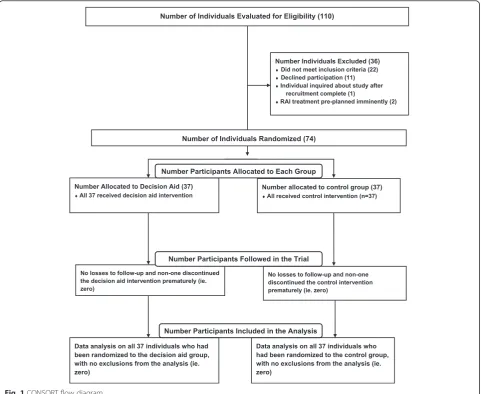
We conducted a single-center parallel design randomized controlled trial, and allocated 74 consenting adults with early stage PTC in 1:1 fashion, using central computerized randomization, to either a one-time exposure to a patient-directed computerized P-DA, or no P-DA [Clinical Trials.gov identifier NCT01083550 and (12;13)] (Fig. 1). CONSORT guidelines for trial reporting were followed [18] (see Additional file 1). Blinding of patients, their physicians, and study and study personnel after allocation was not possible. The statistical analyses were un-blinded for secondary outcomes reported in this manuscript. The computerized randomization sequence incorporated ran-dom block sizes of 2 and 4 and was developed by an off-site study statistician [13]. The randomization allocation was revealed to each participant using the DA program, by a research staff member, immediately prior to the interven-tion allocainterven-tion. The development of the P-DA included,
qualitative input from patient participants on relevant infor-mation needs [14], execution of multiple relevant system-atic reviews [19–23], and two phases of usability testing of respective prototypes of the P-DA (including feedback from patients, and physicians) [9–11]. This trial was approved by the University Health Network Research Ethics Board and all participants provided written, informed consent. As pre-viously reported [13], the inclusion criteria were: individuals aged≥18 years, who had a total thyroidectomy (completed in one or two stages) on or after September 1, 2009, and whose clinic-pathologic diagnosis was low risk papillary thyroid cancer (PTC) (i.e. primary tumor 1 to 4 cm in diameter, with no distant nor nodal metastases, no extra-thyroidal extension of the PTC, no vascular nor lymphatic invasion, and with no tall cell histologic features). Par-ticipants were required to be fluent in English (written and verbal, ascertained by self report), physically able to use a computer (by self-report), and provide in-formed consent [13]. We did not pre-test potential
participants on their literacy or numeracy level nor level of computer proficiency, prior to enrollment in the trial. Participants in the P-DA group self-navigated the P-DA website for up to 60 min at one sitting, on a PC desktop computer, located in a research office at University Health Network. A research assistant who was present in the room, directed each individual to re-view a set of general instructions at the beginning of the P-DA program (on the first webpage), explaining how to navigate the program, access supplemental in-formation, adjust font size, and print content. However, the research staff member did not assist the partici-pants with navigation of the P-DA, nor any other pro-cedures. P-DA users were required to visit the 16 web pages within the P-DA, but provided the option to ac-cess supplemental detailed information, presented within text boxes, labelled with an “i” and the title
“More Information.”There was no limit on the number of times that P-DA group participants could access supplemental detailed information during the study visit, but self-navigation time was limited to a max-imum of 60 min. No P-DA access was available outside the study. All participants received usual counselling and care from their treating physicians, but there was no standardization of the verbal consultations nor sup-plemental materials (eg. brochures) associated with usual care visits. All participants had been seen by at least one thyroid cancer specialist on at least one occa-sion, prior to viewing the P-DA. All participants were subsequently clinically followed by thyroid cancer specialists.
Outcomes
The results of the trial primary outcome analysis, com-paring medical knowledge between P-DA and no P-DA groups, has been previously reported [13]. The sample size justification of 74 participants has been previously described, for the primary outcome analysis [13], and was used as a convenience sample for all secondary ana-lyses. The post-randomization (study baseline) informa-tion preference style was measured by respective monitoring and blunting subscale scores of the Miller Behavioural Style Scale (MBSS) [15, 16], prior to any ex-posure to the P-DA (or no P-DA in the case of the con-trol group, i.e. at a concurrent time point in the study, relative to recruitment). The MBSS is a 32-item tool in which 4 hypothetical non-medical scenarios are pre-sented (including dental work, a terrorist hostage-taking, a potential imminent employment termination, and in-flight airplane problem), followed by choices that may be categorized as either monitoring (16 choices) or blunting (16 choices) style responses; the subscale scores for monitoring and blunting are respectively calculated by summing the number of positive responses in each
category (maximum score of 16 for each category) [15, 16]. The quantity of supplemental detailed medical information actively sought by P-DA users was mea-sured by the number of clicks on text boxes titled“More Information.” There were a total of 21 such text boxes located throughout the P-DA, and when a participant clicked on one of these text boxes or icons, an event was identified. Multiple clicks on the same text box at separ-ate discrete time points were individually counted to-ward the total number of clicks (for participants who returned to a textbox after closing it). The data on num-ber of clicks for more information was collected within the P-DA. Detailed numerical information was included in such text boxes, but not all of the detailed informa-tion was necessarily numerical. Medical knowledge was assessed using a previously validated 10-item true/false questionnaire, focused on early stage PTC and informa-tion relevant to the choice to accept or reject adjuvant radioactive iodine treatment (score represented by the total number of correct responses) [9, 10]. The medical knowledge questionnaire includes 10 questions (true or false) on the following topics: low PTC prognosis, radio-active iodine treatment procedure (including prepar-ation), potential radioactive treatment side effects, medical follow-up implications of radioactive iodine treatment, and the best available medical evidence on the impact of radioactive iodine treatment on long-term thyroid cancer outcomes [9, 10]. The knowledge ques-tionnaire was scored by the number of correct responses (maximum possible score of 10 out of 10) [9, 10]. Deci-sional conflict on the decision to accept or reject radio-active iodine treatment was measured using a previously validated questionnaire [24, 25]. All questionnaires were self-administered by the participants, using pen and paper, under the supervision of a research assistant.
Statistical methods
information preference style subscale measurements (using the Miller Monitor-Blunter Style Scale) and de-cisional conflict, as per recommendation of a reviewer. We also performed a post-hoc exploratory Spearman’s correlation analysis examining the relationship between the amount of supplemental detailed information ob-tained and medical knowledge. The rationale for this post-hoc analysis was to explore whether there was a relationship between the amount of informational con-tent obtained by participants and ultimate success in knowledge acquisition (i.e. to understand if obtaining more detailed information related to more knowledge). Quantitative statistical analyses were performed using PASW Statistics 18.0 (IBM, Chicago, IL).
Results
Participant characteristics
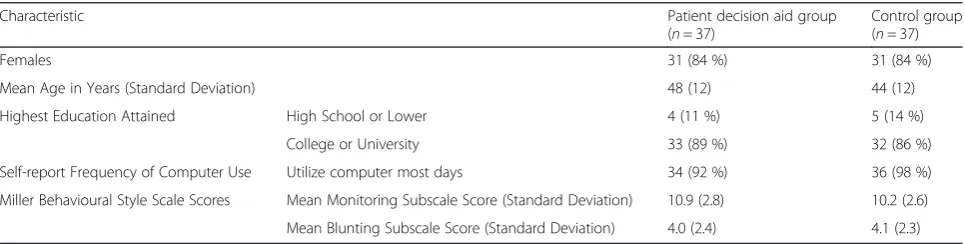
There were 74 study participants recruited, including 37 who were exposed to the P-DA, and 37 controls, who were not exposed to the P-DA. The details of the demographic and disease characteristics of the study population have been previously reported [13]. As reflected in Table 1, the respective P-DA and control groups were similar in terms of gender, age, level of education, and frequency of com-puter use. All 37 participants in the P-DA group were able to complete the viewing of the 16 web pages within the al-lotted time (maximum 60 min). As previously reported [13], the mean time spent viewing the P-DA was about 30 min, and ranged from 11 to 60 min, and none of the participants reported any major difficulties navigating the site. None of the participants in the control group viewed the DA at any time point before, during, or after the study. There was no harm reported to participants in this study.
The Miller Monitoring subscale result for the entire study population was a mean of 10.6 (out of a maximum of 16), standard deviation 2.7, minimum 3, maximum 16 (data from 74 individuals). The Miller Blunting subcale result for the entire study population was a mean score of 4.0 (out of a maximum of 16), standard deviation 2.3, minimum 0, maximum 10 (data from 74 individuals). For the entire study population of 74 individuals, the mean medical
knowledge score was 8.8 (out of a maximum of 10), stand-ard deviation 1.4, minimum of 4, and maximum of 10. For the entire study population (n= 74), the mean decisional conflict score (out of a maximum of 100) was 38.6, stand-ard deviation 22.5, minimum 2, maximum 98. As previ-ously reported [13], the mean medical knowledge score in the P-DA group was 9.7 out of 10 (standard deviation 0.6, from n= 37 participants), which was significantly higher than the mean score of 7.8 (standard deviation 1.3 from n= 37 participants) in the control group (p< 0.001 for the comparison). Furthermore, as previously reported [13], decisional conflict score was significantly lower in the P-DA group (mean score of 25.2, standard devi-ation 13.4 from n= 37 participants) compared to the control group (mean score of 52.1, standard deviation 21.9 from n= 37 participants) (p< 0.001 for the differ-ence). The Miller Monitor subscale results according to randomization status were as follows: P-DA group, mean score (out of a maximum of 16) was 10.9, stand-ard deviation 2.8, minimum 3, maximum 16, from 37 individuals, control group mean score 10.2, standard deviation 2.3, minimum 5, maximum 15, from 37 indi-viduals. The Miller Blunting subscale results according to randomization status were as follows: P-DA group, mean score (out of a maximum of 16) was 4.0, standard deviation 2.4, minimum 1, maximum 10, from 37 individ-uals, control group mean score 4.1, standard deviation 2.3, minimum 0, maximum 9, from 37 individuals. For the 37 individuals in the P-DA group, the mean number of clicks to obtain“More Information”was 11.1 (standard deviation 10.9, range from 0 to 41).
Information preference style and supplemental P-DA data obtained
Our first objective was to determine whether there was a relationship between participants’ information preference style and the quantity of supplemental information ob-tained in the P-DA program by clicking for “More Infor-mation”. We found a significant moderate positive correlation between the monitoring (higher information seeking preference) subscale score and the quantity of
Table 1Participant characteristics
Characteristic Patient decision aid group
(n= 37)
Control group (n= 37)
Females 31 (84 %) 31 (84 %)
Mean Age in Years (Standard Deviation) 48 (12) 44 (12)
Highest Education Attained High School or Lower 4 (11 %) 5 (14 %)
College or University 33 (89 %) 32 (86 %)
Self-report Frequency of Computer Use Utilize computer most days 34 (92 %) 36 (98 %)
Miller Behavioural Style Scale Scores Mean Monitoring Subscale Score (Standard Deviation) 10.9 (2.8) 10.2 (2.6)
Mean Blunting Subscale Score (Standard Deviation) 4.0 (2.4) 4.1 (2.3)
supplemental P-DA data obtained using “More Informa-tion” clicks (r= 0.414,p= 0.011). However, there was no significant relationship between the blunting (information avoidance preference) subscale score and the number of clicks for supplemental information (r= 0.117,p= 0.489) in the P-DA group (n= 37).
Information preference style and medical knowledge acquired
A second objective was to determine whether there was a relationship between the individual information preference style and medical knowledge, for the entire study popula-tion, as well as the intervention and control subgroups, respectively. For the entire study population of 74 indi-viduals, the monitoring subscale score was significantly, weakly positively correlated with the number of correct responses on a thyroid cancer medical knowledge ques-tionnaire (r= 0.268, p= 0.021); however, the blunting subscale score was not associated with the medical knowledge score (r=−0.124,p= 0.292). For the 37 indi-viduals in the P-DA group, there was no statistically significant association between monitoring subscale score and number of correct responses on the medical knowledge questionnaire (r= 0.277, p= 0.097), but the relatively small size of this subgroup likely limited statistical power of this analysis, given the observed trend. Further-more, the blunting subscale score was not associated with medical knowledge questionnaire score (r= 0.031, p= 0.855) in P-DA users. For the 37 individuals in the control group, medical knowledge was also not signifi-cantly associated with either the monitoring subscale score (r= 0.221, p= 0.189), nor the blunting subscale score (r=−0.246,p= 0.143).
Post-hoc exploratory analysis examining information preference style and decisional conflict
In a post-hoc exploratory statistical analysis suggested by a reviewer, we examined whether information preference style was associated with decisional conflict in the entire study population as well as in the respective subgroups (P-DA and control). Decisional conflict was measured post-P-DA intervention in the P-DA group. We found no statistically significant relationships between decisional conflict and the Miller Monitoring subscale score in the en-tire study population (r=−0.020, p= 0.866, n= 74), P-DA group (r=−0.029, p= 0.867, n= 37), nor in the control group (r= 0.127,p= 0.454,n= 37). Furthermore, we found no statistically significant relationships between decisional conflict and the Miller Blunting subscale score in the entire study population (r= 0.002,p= 0.987,n= 74), P-DA group (r= 0.278,p= 0.096,n= 37), nor control group (r=−0.227, p= 0.176,n= 37).
Post-hoc exploratory analysis examining quantity of supplemental information obtained and medical knowledge
In a post-hoc exploratory statistical analysis in the P-DA group, there was no relationship between the number of clicks for supplemental detailed information and the medical knowledge score (r=−0.154,p= 0.361) (n= 37). Although statistical power of this analysis was limited, the inverse relationship suggested that accessing supple-mental detailed information was unlikely to be a major contributor to medical knowledge.
Discussion and conclusions
We observed a high degree of variability among thyroid cancer patients, in the quantity of additional detailed in-formation sought within a computerized P-DA on RAI decision-making. We also observed that that high moni-toring information preference style was associated with increased frequency of obtaining such supplemental from the P-DA. These findings are consistent with re-sults of prior studies of oncology patients, indicating that high monitoring style is associated with general prefer-ence for more detailed medical information [26] and, in the case of oncologic healthcare consultations, increased number of questions posed by the patient [26, 27]. High monitoring subscale score on the Miller Behavioural Style questionnaire has also been associated with in-creased utilization of specialized sources of information by breast cancer patients, particularly relating to medical books or journals [28]. We did not observe a significant relationship between blunting style and information ob-tained from the P-DA. In previous studies, Ong et al. re-ported that a blunting style was not correlated with desired level of detail of cancer-related information [26], whereas Timmermans et al. reported that higher blunt-ing subscale scores were significantly associated with fewer questions posed by patients during palliative radiotherapy consultations, but not curative radiotherapy consultations [27]. Differences in the tools used to meas-ure blunting or differences in study populations, could potentially explain the variability in these findings. We did not find convincing evidence to suggest that in-creased rate of obtaining of detailed information im-proved medical knowledge scores. Our results also fail to support the assumed (or intuitive) model that a pref-erence to seek more information (high monitoring style) leads to significantly more medical knowledge in com-puterized P-DA users. More future research is needed, ideally in larger studies, to verify our findings and better understand the potential clinical impact.
process of information acquisition and ultimate know-ledge, the standardization to the procedure in which the P-DA was presented (i.e. in a research office, timed use, no exposure to the P-DA intervention before or after the session), complete data collection (i.e. no missing data), the automated recording of the number of clicks for supplemental information obtained within the P-DA by participants, and the utilization of a well-established, val-idated tool for measurement of information preference style. Some of the limitations include the following: this is a secondary analysis and the randomization was not stratified according to information preference (so the trial was not specifically designed to primarily address whether information preference impacts other outcomes and as such, results are hypothesis-generating), the sam-ple size was relatively small so the secondary analyses (including subgroup analyses) may have been statistically underpowered, potential selection bias (most partici-pants reported using computers on most days and most were well-educated, further all were fluent in written and spoken English), lack of standardization of the coun-seling (or any related materials) received by treating phy-sicians as part of usual care, and limited external generalizability to healthcare decisions or other comput-erized P-DAs where users do not have the option to choose to view additional information or not.
In conclusion, our study demonstrates the variability that exists among thyroid cancer patients, in terms of in-dividual information seeking preferences, and resultant quantity of detailed information retrieved from a com-puterized P-DA. Although hypothesis-generating, our re-sults also raise some questions about the incremental value of mandating presentation of detailed numerical data within P-DA’s, as some patients may prefer not to view such data, and it is not clear that those who view it, acquire more fundamental medical knowledge (as com-pared to a simpler explanation). An important implica-tion of our findings for developers of P-DAs and researchers, is the introduction of the concept of person-alizing knowledge translation to the information prefer-ences of users. Internet-based P-DAs may be particularly amenable to personalized modifications, allowing users to navigate links, based on information preferences. Yet, to some extent, tailoring informational detail in decision support tools by allowing some users to avoid detailed numerical probability information according to their preferences could be at odds with current P-DA quality standardization initiatives [3]. Future studies are needed, to explore whether personalization of format and the level of detail of content (particularly relating to numer-ical data) of P-DAs to users’ preferences may enable optimization of knowledge translation outcomes, or at least be non-inferior to current methods, but potentially preferred by some users. Such research is critical in
advancing our understanding of the evolving role of personalization of decision support tools in advancing patient autonomy regarding provision of information in medical decision-making.
Additional file
Additional file 1:CONSORT 2010 checklist of information to include when reporting a randomised trial*.
Competing interests
The authors declare that they have no competing interests.
Authors’contributions
AMS, DG, SS, AG, GR, and SE conceived of the study and contributed to its design. AMS and DG successfully applied for funding for the trial and supervised its execution. AMS, RWT, JDB, LR, PS, SE, and DG participated in participant recruitment. AMS performed statistical analyses and drafted the manuscript. All authors read and approved the final manuscript.
Acknowledgments
This study was supported by an operating grant from the Ontario Ministry of Health and Long-term Care (Alternate Funding Plan - Innovation Fund). Anna Sawka has been supported, in part, by a New Investigator Grant from the Canadian Institutes of Health Research (CNI-80701). Anna Sawka currently holds a Chair in Health Services Research from Cancer Care Ontario, funded by the Ontario Ministry of Health and Long-term Care. Sharon Straus holds a Tier 1 Canada Research Chair.
The authors would like to thank the research staff who worked on this project, including: Coreen Marino, Soumia Meiyappan, Dana David, Nofisat Ismaila, Heather Rilkoff, and Asima Naeem. We would also like to thank our study collaborators, including the following physicians (in alphabetical order): Dr. Jennifer Anderson, Dr. Sylvia Asa, Dr. Jeremy Freeman, Dr. Catherine Kelly, Dr. Philip Solomon, and Dr. Afshan Zahedi. We thank Mr. Kevin E. Thorpe for statistical advice and Mr. David Newton, for his computer technical support. We also thank Dr. Suzanne Miller for providing us with the Miller Behavioural Style Scale and providing us with permission for its use. Finally, we sincerely thank all our study participants in the study for their time and valued input.
Author details 1
Division of Endocrinology, Toronto General Hospital, 200 Elizabeth Street, 12 EN-212, Toronto, ON M5G 2C4, Canada.2Department of Medicine, St. Michael’s Hospital, 30 Bond Street, Shuter 2-026, Toronto, ON M5B 1W8, Canada.3Keenan Research Centre of the Li Ka Shing Knowledge Institute, University of Toronto, Toronto, ON M5B 1W8, Canada.4Department of Psychosocial Oncology, Princess Margaret Hospital, University Health Network, 16th Floor Room 724, 610 University Avenue, Toronto, ON M5G 2M9, Canada.5Department of Psychiatry and Palliative Care, Princess Margaret Hospital, University of Toronto, 16th Floor Room 724, 610 University Avenue, Toronto, ON M5G 2M9, Canada.6Department of Radiation Oncology, Princess Margaret Hospital, University Health Network, 5th Floor Room 963, 610 University Avenue, Toronto, ON M5G 2M9, Canada. 7
Department of Surgery, Toronto General Hospital, University Health Network, 200 Elizabeth Street, 10 EN-220, Toronto, ON M5G 2C4, Canada. 8
Toronto General Hospital, University of Toronto, 200 Elizabeth Street, 10 EN-220, Toronto, ON M5G 2C4, Canada.9Division of Endocrinology, Department of Medicine, Toronto General Hospital, University Health Network, 200 Elizabeth Street, 12 EN-216, Toronto, ON M5G 2C4, Canada. 10
Toronto General Hospital, University of Toronto, 200 Elizabeth Street, 12 EN-216, Toronto, ON M5G 2C4, Canada.11Department of Clinical Epidemiology and Biostatistics, McMaster University, 1280 Main Street West, CRL-208, Hamilton, ON L8S 4K1, Canada.12Department of Otolaryngology Head and Neck Surgery, Wharton Head and Neck Centre, University Health Network, 3-952, 610 University Avenue, Toronto, ON M5G 2M9, Canada. 13
Received: 21 July 2014 Accepted: 26 May 2015
References
1. Stacey D, Légaré F, Col NF, Bennett CL, Barry MJ, Eden KB, et al. Decision aids for people facing health treatment or screening decisions. Cochrane Database Syst Rev. 2014;1:CD001431.
2. O’Brien MA, Whelan TJ, Villasis-Keever M, Gafni A, Charles C, Roberts R, et al. Are cancer-related decision aids effective? A systematic review and meta-analysis. J Clin Oncol. 2009;27:974–85.
3. Elwyn G, O’Connor AM, Bennett C, Newcombe RG, Politi M, Durand MA, et al. Assessing the quality of decision support technologies using the International Patient Decision Aid Standards instrument (IPDASi). PLoS One. 2009;4(3):e4705. doi:10.1371/journal.pone.0004705.
4. Hoffman AS, Volk RJ, Saarimaki A, Stirling C, Li LC, Härter M, et al. Delivering patient decision aids on the Internet:definitions, theories, current evidence, and emerging research areas. BMC Med Inform Decis Mak. 2013;13 Suppl 2:S13. 5. Zhang Y. The effects of preference for information on consumers’online
health information search behavior. J Med Internet Res. 2013;15(11):e234. doi:10.2196/jmir.2783. PubMed PMID: 24284061.
6. Williams-Piehota P, Pizarro J, Schneider TR, Mowad L, Salovey P. Matching health messages to monitor-blunter coping styles to motivate screening mammography. Health Psychol. 2005;24(1):58–67. PubMed.
7. Lauver DR, Settersten L, Kane JH, Henriques JB. Tailored messages, external barriers, and women’s utilization of professional breast cancer screening over time. Cancer. 2003;97(11):2724–35. PubMed.
8. Kiesler DJ, Auerbach SM. Optimal matches of patient preferences for information, decision-making and interpersonal behavior: evidence, models and interventions. Patient Educ Couns. 2006;61(3):319–41.
9. Sawka AM, Straus S, Gafni A, Meiyappan S, O’Brien MA, Brierley JD, et al. A usability study of a computerized decision aid to help patients with early stage papillary thyroid carcinoma in decision making on adjuvant radioactive iodine treatment. Patient Educ Couns. 2011;84:e24–7. 10. Sawka AM, Straus S, Gafni A, Brierley JD, Tsang RW, Rotstein L, et al. How
can we meet the information needs of patients with early stage papillary thyroid cancer considering radioactive iodine remnant ablation? Clin Endocrinol (Oxf). 2011;74:419–23.
11. Sawka AM, Meiyappan S, David D, Straus S, Gafni A, Brierley JD, et al. A mixed methods evaluation of a computerized decision aid for patients considering radioactive iodine remnant ablation: Developing person-centered medicine for thyroid cancer. Int J Pers Cent Med. 2011;1:559–63.
12. Sawka AM, Straus S, Brierley JD, Tsang RW, Rotstein L, Rodin G, et al. Decision aid on radioactive iodine treatment for early stage papillary thyroid cancer–a randomized controlled trial. Trials. 2010;11:81.
13. Sawka AM, Straus S, Rotstein L, Brierley JD, Tsang RW, Asa S, et al. Randomized controlled trial of a computerized decision aid on adjuvant radioactive iodine treatment for patients with early-stage papillary thyroid cancer. J Clin Oncol. 2012;30:2906–11.
14. Sawka AM, Goldstein DP, Brierley JD, Tsang RW, Rotstein L, Ezzat S, et al. The impact of thyroid cancer and post-surgical radioactive iodine treatment on the lives of thyroid cancer survivors: a qualitative study. PLoS One. 2009;4:e4191.
15. Miller SM, Brody DS, Summerton J. Styles of coping with threat: Implications for health. J Pers Soc Psychol. 1988;54:142–8.
16. Miller SM. Monitoring and blunting: Validation of a questionnaire to assess styles of information seeking under threat. J Pers Soc Psychol. 1987;52:345–53. 17. Miller SM. Monitoring versus blunting styles of coping with cancer influence
the information patients want and need about their disease. Cancer. 1995;76:167–77.
18. Schulz KF, Altman DG, Moher D, for the CONSORT Group. CONSORT 2010 Statement: updated guidelines for reporting parallel group randomised trials. BMC Medicine. 2010;8:18.
19. Sawka AM, Brierley JD, Tsang RW, Thabane L, Rotstein L, Gafni A, et al. An updated systematic review and commentary examining the effectiveness of radioactive iodine remnant ablation in well-differentiated thyroid cancer. Endocrinol Metab Clin North Am. 2008;37(2):457–80.
20. Sawka AM, Thabane L, Parlea L, Ibrahim-Zada I, Tsang RW, Brierley JD, et al. Second primary malignancy risk after radioactive iodine treatment for thyroid cancer: a systematic review and meta-analysis. Thyroid. 2009;19(5):451–7. 21. Sawka AM, Lakra DC, Lea J, Alshehri B, Tsang RW, Brierley JD, et al.
A systematic review examining the effects of therapeutic radioactive iodine on ovarian function and future pregnancy in female thyroid cancer survivors. Clin Endocrinol (Oxf). 2008;69(3):479–90.
22. Sawka AM, Ibrahim-Zada I, Galacgac P, Tsang RW, Brierley JD, Ezzat S, et al. Dietary iodine restriction in preparation for radioactive iodine treatment or scanning in well-differentiated thyroid cancer: a systematic review. Thyroid. 2010;20(10):1129–38.
23. Sawka AM, Lea J, Alshehri B, Straus S, Tsang RW, Brierley JD, et al. A systematic review of the gonadal effects of therapeutic radioactive iodine in male thyroid cancer survivors. Clin Endocrinol (Oxf). 2008;68(4):610–7. 24. O’Connor AM. User Manual–Decisional Conflict Scale 1993, updated 2005.
http://www.ohri.ca/decisionaid
25. O’Connor AM. Validation of a decisional conflict scale. Med Dec Making. 1995;15:25–30.
26. Ong LM, Visser MR, van Zuuren FJ, Rietbroek RC, Lammes FB, de Haes JC. Cancer patients’coping styles and doctor-patient communication. Psycho-Oncol. 1999;8:155–66.
27. Timmermans LM, van Zuuren FJ, van der Maazen RW, Leer JW, Kraaimaat FW. Monitoring and blunting in palliative and curative radiotherapy consultations. Psycho-Oncol. 2007;16:1111–20.
28. Cowan C, Hoskins R. Information preferences of women receiving chemotherapy for breast cancer. Eur J Cancer Care (Engl). 2007;16:543–50.
Submit your next manuscript to BioMed Central and take full advantage of:
• Convenient online submission
• Thorough peer review
• No space constraints or color figure charges
• Immediate publication on acceptance
• Inclusion in PubMed, CAS, Scopus and Google Scholar
• Research which is freely available for redistribution