Honors Theses and Capstones Student Scholarship
Spring 2012
Arched Bridges
Lily Beyer
University of New Hampshire - Main Campus
Follow this and additional works at:https://scholars.unh.edu/honors
Part of theCivil and Environmental Engineering Commons
This Senior Honors Thesis is brought to you for free and open access by the Student Scholarship at University of New Hampshire Scholars' Repository. It has been accepted for inclusion in Honors Theses and Capstones by an authorized administrator of University of New Hampshire Scholars' Repository. For more information, please [email protected].
Recommended Citation
Beyer, Lily, "Arched Bridges" (2012).Honors Theses and Capstones. 33.
UNIVERSITY OF NEW HAMPSHIRE CIVIL ENGINEERING
Arched Bridges
History and Analysis
Lily Beyer
5/4/2012
i
Contents
Contents ... i
List of Figures ... ii
Introduction ... 1
Chapter I: History of Arched Bridges ... 3
What is an Arch ... 3
Arch Forms ... 7
Roman Arches ... 9
Middle Ages ... 11
Asian Bridges ... 14
Steel Arches ... 15
Reinforced Concrete ... 18
Chapter II: Design of an Arch ... 27
Shape of the Arch... 27
Arch Ribs ... 29
Behavior under load ... 34
Construction ... 37
Chapter III: Analysis of an Arch ... 42
Three-pinned Arch Analysis ... 43
Two-pinned Arch Analysis ... 50
Influence Line to Reaction ... 58
Chapter IV: Chesterfield Brattleboro Bridge Analysis ... 59
History of the Bridge ... 59
Analysis... 61
Dead Load ... 66
Live Load ... 71
Axial Force... 73
Conclusion ... 75
ii
List of Figures
Figure 1: Forces in an arch ... 3
Figure 2: Arched beam... 4
Figure 3: Corbelled Arch ... 4
Figure 4: Arch End Conditions ... 5
Figure 5: Steel hinge at the end of an arch at UNH’s Wittemore Center ... 6
Figure 6: Mike O'Callaghan - Pat Tillman Memorial Bridge ... 6
Figure 7: Typical Barrel Arch ... 7
Figure 8: Arched Bridge, Westford MA ... 7
Figure 9: Typical Arch-Deck Bridge ... 8
Figure 10: Robert Maillart's Bridge at Salginatobel ... 8
Figure 11: Typical Tied Arch Bridge... 9
Figure 12: Sydney Harbor Bridge ... 9
Figure 13: Pont du Gard Aqueduct ... 10
Figure 14: Ponte Rotto in Rome ... 11
Figure 15: Pont d'Avignon ... 12
Figure 16: Section of a Gothic Cathedral ... 13
Figure 17: Bridge at Neuilly by Perronet ... 13
Figure 18: Zhaozhuo Bridge ... 15
Figure 19: Ironbridge ... 16
Figure 20: Garabit Viaduct ... 17
Figure 21: Västerbron (West Bridge) in Stockholm ... 18
Figure 22: Hennebique system for reinforced concrete ... 19
Figure 23: Stauffacher Bridge by Maillart ... 20
Figure 24: Hollow Arch System by Maillart ... 21
Figure 25: Tavanasa Bridge by Maillart ... 22
Figure 26: Schwandbach Bridge ... 23
Figure 27: Tunkhannock Viaduct ... 24
Figure 28: Plougastel Bridge ... 25
Figure 29: Krk Island Bridges... 26
Figure 30: Hanging chain forming a catenary shape ... 28
Figure 31: Three types of arches, with varying rib thickness ... 30
Figure 32: Maillart's bridge at Vessy - note the variation in rib depth ... 31
Figure 33: Pinned Abutment Connection for Truss Bridge ... 32
Figure 34: Steel hinges in concrete arch ... 32
iii
Figure 36: Imperfectly fitted arches, resulting in pinned behavior ... 34
Figure 37: Arch bending under unbalanced load ... 35
Figure 38: Actions of a deck stiffened arch, unbalanced load ... 36
Figure 39: Arch Stress to Stiffness Ratio ... 37
Figure 40: Wood centering for a masonry bridge in Minneapolis ... 38
Figure 41: Harlan D. Miller Memorial Bridge, under construction ... 39
Figure 42: Sydney Harbor Bridge arch construction ... 40
Figure 43: Construction of the Hoover Dam Bypass ... 41
Figure 1: To the left, the arch form ... 42
Figure 2: Three-pinned arch... 43
Figure 3: Vertical Reaction Influence Lines for sample arch ... 44
Figure 4: Free body diagrams for calculating horizontal reaction H ... 45
Figure 5: Horizontal Reaction Influence Line for Sample Arch ... 45
Figure 6: Free body diagrams for P left of k and P right of k ... 46
Figure 7: Combined influence lines at k for sample arch ... 47
Figure 8: Negative moment transferred to the location it occurs ... 48
Figure 9: Moment envelope for three-pinned arch rib ... 48
Figure 10: Free body diagram for the axial load... 49
Figure 11: Influence line for axial force ... 50
Figure 12: Two-pinned Arch Analysis ... 51
Figure 13: Released structure with unit restraining force ... 51
Figure 57: Forces contributing to M’ and m at each location k ... 52
Figure 15: Horizontal reaction for single point load ... 53
Figure 16: Case 1 and 2 for calculating moments at location k ... 54
Figure 17: Combined influence lines for the sample arch ... 55
Figure 18: Moment envelope for two-pinned arch rib ... 56
Figure 19: Influence line for axial force along the arch ... 57
Figure 20: Influence line envelope for axial load ... 57
Figure 44: Suspension bridge in West Chesterfield ... 59
Figure 45: Old and New Chesterfield Brattleboro Bridge ... 60
Figure 46: Comparison of Hangers ... 61
Figure 47: Chesterfield Brattleboro Bridge Section ... 62
Figure 48: Arch Rib Section ... 63
Figure 49: Influence Line for Horizontal Reaction for Chesterfield Brattleboro ... 64
Figure 50: Combined influence lines for Moment at Location k ... 65
Figure 51: Chesterfield Brattleboro Bridge Influence Line Envelope for Moment ... 65
Figure 52: Influence line for axial force ... 66
Figure 53: Segment length in meters per meter in x ... 67
Figure 54: Weight of Chesterfield Brattleboro arch rib along the bridge ... 68
Figure 55: Bending moment at each location along the arch ... 68
iv
Figure 57: Stress in arch rib due to self-weight alone ... 69
Figure 58: Stress in the arch rib caused by the hanger loads ... 70
Figure 59: Stress from Dead Load due to Arch and Deck ... 71
Figure 60: Bending stress from truck and lane loads ... 72
Figure 61: Total bending stress from dead and live loads ... 73
1
Introduction
Humanity has been building bridges for all of history, but it has only been building arches
since the around the 6th century BC (Boyd, 1978). The arch first appeared in building
construction, brought to the Greeks from Mesopotamia around the 4th century BC. Arched
bridges, necessarily, came afterward, first appearing in Rhodes as a footbridge (Boyd, 1978). It
was not until the Romans that the arch became a common form for bridge construction. The
Roman road system tied the empire together, and those roads required many bridges. Some of
these bridges are still standing today, a tribute to the excellence of the engineers who built them
centuries ago.
Throughout the Middle Ages and into the Renaissance the primary building material for
arched bridges was masonry. There were bridges built of wood during this time, but stone is a
material much better suited to the stresses created by an arch. It was not until the industrial
revolution brought iron, and later steel, that the building materials began to change. Iron, steel
and reinforced concrete opened up the world of arched bridges to new variations on the form.
Stone is a heavy, brittle material, and it requires strong abutments to support it. Iron in its various
forms is much lighter and able to take tension. With metal, engineers began to experiment with
arched trusses, structures that are much lighter than a comparable stone bridge.
The problem of how best to build an arch is one that has plagued scientists and engineers
since the enlightenment, when early scientists began to approach problems mathematically
(Heyman, 1998). The question encompasses not just how the arch shall be curved, but also how
thick the arch rib needs to be to resist the stresses generated by using the bridge. Understanding
2
too much may not be unsafe, but it is unsettling to use. Understanding how the material and the
completed bridge will work together is an important part of engineering.
The analysis of arches depends largely on how the ends of the arch are fixed. Often arches
are more complicated than simple statics can determine, and elastic analysis must be employed.
It is also important to consider loads over portions of the bridge, as simply loading up the bridge
with the most weight is not always the most conservative approach. Applying the load from
vehicles at different locations across the span can create bending effects in the arch rib that
control the design. Arched bridges are more complicated to design, but depending on the location
the selection of an arch can be the best option, resulting in a beautiful bridge well integrated into
3
Chapter I: History of Arched Bridges
What is an Arch
The arch is a form where the forces from dead load are transferred as compression, and
tensile forces are eliminated. Depending on the shape of the arch this is more or less true – the
“perfect” arch will only carry compression, but there is only one perfect arch for any given set of
loads so heavy moving loads can often put parts of an arch into tension. Because the arch relies
on compression to carry load it is well suited to both masonry and concrete, materials that are
strong in compression but weak in tension.
Figure 1: Forces in an arch
The forces in an arch exert outward pressure on abutments and, as a result, they must be able
to resist this thrust. In many cases this means making the abutments quite massive – the stone
serving to spread out the thrust of the arch until pressures can be resisted by the natural
supporting soils and rock. In some construction, however, multiple arches in series can be used
to resist the thrust, the thrust of one arch opposing that of the next, thus transferring the all of the
4
forces at the foundation to resist the arch’s thrust. This outward thrust from the weight of the
arch is its defining characteristic.
Figure 2: Arched beam
An arch that is fixed against horizontal motion at only one end without a tie is not a true arch
(Figure 2). Because the roller at the right support cannot provide a horizontal reaction the arch is
actually a curved beam. A true arch must develop horizontal reactions at both supports.
Likewise, a corbelled arch is not a true arch. Corbelled arches were common in ancient
civilizations in the Americas, and develop an arch-like shape by cantilevering consecutive
5
courses of masonry outward until they meet in the middle (Figure 3). This type of arch does not
develop horizontal thrust at the base. Both of these examples of arch shapes can develop bending
stress, and are not structurally considered arches.
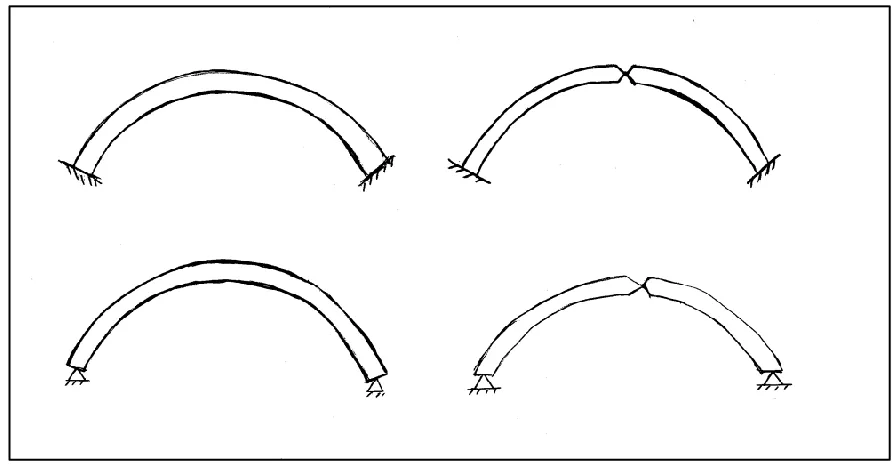
Arches can be supported at the abutments in two basic ways: either by a fixed connection or
by a pin. A fixed connection can transfer moment, while a pin is free to rotate. Traditional
masonry arches are of the fixed-fixed type, as the technology for creating deliberate pins had not
been developed. In the fixed-fixed position the angle between the abutments and the arch is held
Figure 4: Arch End Conditions: (from left) Fixed-Fixed, Single Pin, Two Pin, Three Pin
constant as the arch deflects under load. Adding pinned hinges to the structure allows it to deflect
more, but reduces the complexity of design, because the pin forces a location to have zero
moment. There are various ways of creating pinned connections in concrete structures, including
6
Figure 5: Steel hinge at the end of an arch at UNH’s Wittemore Center
The arch is particularly suited for bridge construction, especially where steep valley walls
provide natural confinement for abutments. The arch is necessary for masonry bridges, because it
develops mainly compressive stresses and, as a result, was the preferred form for thousands of
years. The arch is still used today, constructed of steel and concrete though not often of true
load-bearing masonry, because of its superior aesthetics and use of materials. One excellent
example of modern arch construction is the Hoover Dam Bypass project, shown in Figure 6,
7
which was completed in 2010. The arch is constructed of prestressed concrete, with a deck of
steel. Note how the canyon walls confine the arch, while the deck is separate, with supporting
columns or piers marching uninterrupted between approach and arch.
Arch Forms
There are several different ways that an arched bridge can be constructed. The traditional
method is a filled barrel arch; it was widely used up until modern construction in reinforced
concrete and steel. (Kassler, 1949) The general form is shown in Figure 7.The arch and side
walls were constructed of masonry and dirt and gravel fill was placed between them. The
roadway was then constructed on top. This method is has the advantage that the arch is
continuously braced by the fill, so that buckling of the arch is not an issue even if the shape is not
ideal. However, because of the heavy fill that is placed on the arch, there is an upper limit to the
size of the arch that can be created before it becomes too heavy. This form of arch also has a
very high ratio of dead load to live load in service, because the weight of the structure is much
higher than any load that it is likely to encounter. This makes collapse under live load extremely
unlikely.
8
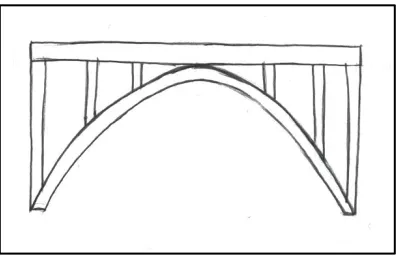
In the early 20th century a Swiss engineer named Robert Maillart developed an arch form
where the arch and the roadway are separated, with the roadway supported by columns or cross
walls. (Billington, 1979) The arch can extend above the road deck, creating a through arch,
where the road is supported by tension members instead of columns. These forms opened up the
possibilities of arches, and also drastically reduced the weight of the bridge. Because the arch no
longer had to support the weight of the fill underneath the road deck, it could become thinner and
use less material. This was more economical than the large masonry bridges that came before,
and easier to construct as well. However, the arch rib was no longer braced as it was in a filled
arch, and as a result live loads were more of an issue in design. It became necessary to consider
exactly how the arch transferred load, and what types of stresses it would experience under
moving traffic. In Maillart’s Salginatobel Bridge, the arch is thicker at the quarter points to better
resist the flexure that can result from the moving point loads of the traffic.
Figure 10: Robert Maillart's Bridge at Salginatobel
(http://www.worldofbuildings.com/bldg_profile.php?bldg_id=809)
The third arch bridge form puts the road deck underneath the arch, supported by tension
members, and the deck ties the two ends of the arch together, forming a tied arch. This is similar
to the through arch, where the roadway is below the arch rib but the abutments still take the
9
be built in areas where natural steepness of terrain does not exist, but it preserves the elegance of
the arch. Furthermore, with the tension tie taking the horizontal thrust, the foundations need only
to support the gravity loads on the bridge allowing arches to be used where there may not be
otherwise suitable subsoil conditions. The tied arch is particularly difficult to construct, because
the arch thrust is not resisted until the road deck is constructed, but the road deck is unsupported
until the arch is built.
Figure 12: Sydney Harbor Bridge (All About Australia)
Roman Arches
The Romans are remembered today as great engineers, building networks of roads to tie their
empire together. They were the first to adopt the arch form for widespread construction. The
Greeks before them used column and lintel construction for their temples, and did not develop
the arch (Steinman & Watson, 1957). The Greeks did build bridges, but they did not develop the
true arch until the mid-4th century BC (Boyd, 1978). The Greeks first used the arch in buildings,
and the only known example of a Greek arched bridge is a small foot bridge in Rhodes (Boyd,
1978). The Romans, on the other hand, made great use of the arch in bridge construction, and in
10
Figure 13: Pont du Gard Aqueduct,
(http://www.travlang.com/blog/pont-du-gard-bridge-an-amazing-man-made-aqueduct/)
The Romans relied primarily on masonry construction, though they did develop the first use
of concrete. They were experts in dressing stone, and some of their earlier construction did not
even have mortar – the stones were so smooth and fit so well together that it was not necessary.
Roman engineers were also experts in the transport of water, a requirement when cities outgrow
their own local water supply. One particular example is the Pont du Gard Aqueduct in southern
France. A three tiered aqueduct, it carried water for the city of Nîmes (see Figure 13). The
yellow limestone blocks were quarried about 600 meters away, and show evidence of numbering
to tell the masons where each block belonged (Site du Pont du Gard, 2011).
Roman arches were semicircular in shape, with large heavy piers in between. The great mass
of the piers, which could be up to a third of the span, supported both the weight of the arches and
their lateral thrust, making each arch independent of its neighbors (Kassler, 1949). Because each
arch span is supported individually, if one span is removed the rest of the bridge remains
standing. This can be seen today in the Ponte Rotto (“Broken Bridge”) in Rome, built in 142 BC
with six spans, only one remains today stranded in the middle of the river (see Figure 14)
11
very heavy, and the piers more disruptive to the flow of the river than later designs. They were
the first of their kind, however, and many are still standing today.
Figure 14: Ponte Rotto in Rome
(http://www.romaspqr.it/ROMA/Ponti/FOTO%20Ponti/ponte_rotto.htm)
Middle Ages
After the fall of the Roman Empire bridge building became much less of a priority across
Europe. Without armies which needed bridges and good roads to move troops and supplies, there
was no pressing reason to build new bridges, and many that were in existence were not
maintained. Much of the engineering knowledge required for bridge building was lost or
forgotten, and communities that might have built bridges did not have the economic resources
for such great undertakings.
It was not until the 1300s that bridge building became possible again. It was revived by
groups of monks called the Pontist Friars, who built bridges in an effort to aid travelers and
pilgrims (Kassler, 1949). One bridge built by the friars is the famous Pont d’Avignon (see Figure
12
appearance to the bridge. Medieval masons were much less skilled than their Roman
predecessors, and relied heavily on mortar (Heyman, 1966). The mortar both held the blocks of
stone together and compensated for the fact that the stones were not as well dressed and
smoothed as those of the Romans, mortar was required to ensure that the blocks fit together.
Medieval construction was also less durable: Roman bridges had no mortar to deteriorate and
wash away, and therefore did not lose strength over time. (Black, 1936)
Figure 15: Pont d'Avignon (http://en.wikipedia.org/wiki/File:Pont_d_avignon.jpg)
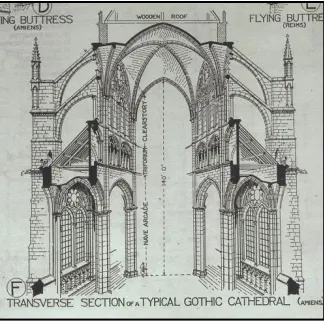
The primary contribution of medieval masons was not to the art of bridges – their greatest
achievements were in building the great Gothic cathedrals. Great technological innovations such
as flying buttresses, where builders understood that thrust could be transferred by half an arch
away from the source, resulted in the soaring lightness of the cathedrals. The majority of the
weight of the stone was carried by columns, with thin curtain walls of stone and glass in
between. The thrust of the arched vault was carried by flying buttresses away from the walls,
allowing much thinner interior supports that carried only the vertical loads. (Heyman, 1966)
These principles were not applied to bridges until much later, however, but they made as a great
13
Figure 16: Section of a Gothic Cathedral (www.columbia.edu/cu)
It was not until Jean Rodolphe Perronet, one of the first professional engineers, that the idea
of interdependent arches was developed (Kassler, 1949). Perronet took the principle of the flying
buttress, where the arched vault is supported vertically by columns, but restrained horizontally
by the buttress, and applied it to bridge building. The piers supported only the weight of the
arched spans; the horizontal thrust was transferred through the adjacent spans all the way to the
abutments. This meant that the piers could be much thinner, as they no longer had to restrain
each arch separately.
14
Perronet built several bridges using this principle, the first of which was the bridge at Neuilly
over the Seine (see Figure 17). The bridge, with five spans of 120 feet each, was constructed in
1772, but was destroyed in 1956 to make way for a wider bridge (Brown, 2001). Because of the
interdependent arch design all the arches had to be built at the same time; the piers were not
designed to support the lateral thrust without the next arch in place. By constructing the piers to
resist only the vertical forces, Perronet was able to reduce the span to pier ratio to 1:10, from the
1:5 common previously. For the bridge at Neuilly, King Louis XV wished to be present when the
arch support was removed, and Perronet arranged a ceremony where all the centering was struck
at once (Troyano, 2003).
Asian Bridges
In Asia bridges were also being built, but the development of engineering and design
progressed separately. Knowledge was not easily transferred across barriers both geological and
cultural. One particularly fine example of Chinese bridge building is the Zhaozhou Bridge in
Hebei Province. Built around 700 AD, it has a considerably shallower rise than its Roman
counterparts, and thus a much gentler rise in the roadway (Brown, 2001). It is the first example
of full depth arches in the haunches on each side of the bridge, which serve the dual purpose of
lightening the bridge weight and allowing heavy flood waters to pass through, lessening the
lateral force against the bridge from water (Wen, 2004). The bridge is decorated with carved
water dragons, and iron straps are visible clamping the stone blocks, achieving a harmony
unparalleled by the heavy construction of the Romans. The unknown Chinese engineers created a
15
Figure 18: Zhaozhuo Bridge (http://www.topchinatravel.com/china-attractions)
Steel Arches
Up until this point, bridges were built of stone or wood. It was not until the 19th century that a
new material became common: iron. (Kassler, 1949) Wrought iron, cast iron, and steel came into
common use and allowed for new and daring construction. Wrought iron is made by smelting, to
remove the impurities from iron ore, and then working the resulting mass. It contains between
.02% and .08% carbon, and is generally hard but malleable. Cast iron is created by melting iron
at a high temperature, so that the iron absorbs carbon easily. This iron is high in carbon, up to
4.5%, and is hard and brittle. Steel has a carbon content of .2% to 1.5%, harder than wrought iron
but not as brittle as cast iron. It can be created by several processes that drive out some of the
carbon from cast iron, leaving just enough for ductility. (Spoerl)
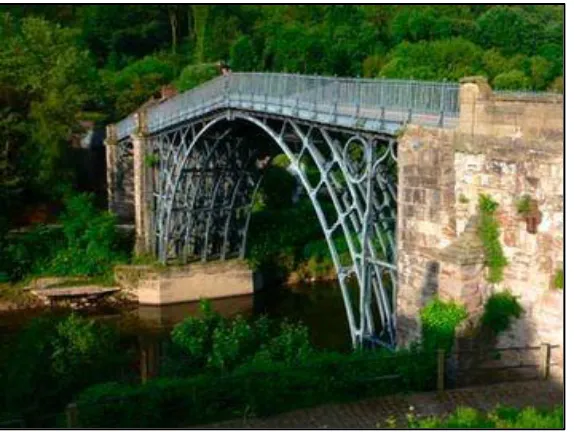
The first bridge built of iron is in Shropshire England. The Ironbridge was constructed in
1779 by Abraham Darby III. (UNESCO, 2012) The five ribs for the bridge were cast in two
pieces and joined together at the top – construction of the arch took only three months. The joints
16
as bolts. (Haan, 2011) Because cast iron is brittle using an arch makes a lot of sense. The
material, which does not handle tension well, is subjected only to compression. (Kassler, 1949)
The general shape is similar to earlier bridges in stone, but the appearance of the first iron bridge
is very different (see Figure 19). The new material allowed a greater lightness than the massive
character of masonry.
Figure 19: Ironbridge, (UNESCO, 2012)
The Garabit Viaduct, built by Gustave Eiffel (of the Eiffel tower), is one of the most
representative of early iron construction. As a truss, it makes use of the tensile capacity of steel.
Trusses are advantageous because they are lighter than a comparable solid member, and provide
less resistance to wind. This was particularly important for the Garabit Viaduct because of its
location in a steep valley, causing a natural wind tunnel. The Garabit Viaduct was constructed in
1881 to carry a rail line across the valley.
Eiffel fully understood the complexities of this new material, realizing that iron offered
incredible new possibilities for construction. He also performed tests to determine the modulus
17
benefit of other engineers. He was able to calculate the expected deflection of the Garabit
Viaduct, which was later verified by field measurements. (Barr, 1992) Eiffel also understood that
the wind loads encountered at high altitudes would be greater than those on the ground, and used
a truss to provide the least lateral load on the structure possible. (Ramaswamy, 2009)The Garabit
Viaduct shows that arches are not just suited to masonry, but can be beautiful and practical in
metal as well.
Figure 20: Garabit Viaduct (http://www.flickr.com/photos/daviddb/2140318177/)
Besides trusses, steel girders can also be formed into an arch. The general shape is generally
either the deck-arch form (Figure 10) or the tied arch (Figure 11). Because of the tensile
properties of steel, the deck is often suspended from the arch, hung from tension members or
cable, though the deck can also be supported above the arch by columns. The lightness of steel
generates less dead load thrust at the abutments, and less earthquake load, but construction is
often more difficult, requiring skilled labor. (Kassler, 1949) One particularly fine example of the
18
columns supporting the deck. The bracing between the two arches can also be seen in Figure 21,
below.
Figure 21: Västerbron (West Bridge) in Stockholm
(http://www.columbia.edu/cu/gsapp/BT/BSI/ARCH/arch1.html)
Reinforced Concrete
Soon after metal was developed as a viable bridge building material concrete reinforced with
iron, and later steel, also became popular. Unreinforced concrete has been understood since the
Romans, but it was not until the idea for reinforcing was understood that the material became
truly useful in bridge construction. In ancient Rome concrete was used for all kinds of structures,
from palaces to bridges to roads. Concrete is a material that is only strong in compression – it is
essentially artificial stone, created from volcanic ash, hydraulic lime, and aggregate. Because of
this, unreinforced concrete must be treated structurally like stone, and subjected to only
compressive stresses. The advent of reinforcing allowed concrete structures to carry tension - the
reinforcing material carries the tensile stresses, while the concrete carries the compressive. As a
19 Figure 22: Hennebique system for reinforced concrete
(http://www.arch.mcgill.ca/prof/sijpkes/abc-structures-2005/concrete/Hennebique-system.jpeg)
Reinforced concrete structures were first built by a gardener named Joseph Monier. He did
not fully realize the implications of reinforced concrete, and sold his idea and patent to the
engineer G. A. Wayss. Wayss, along with another engineer named François Hennebique, were
the first to develop methods for determining the stresses in reinforced concrete. (Brown, 2001)
Because concrete is relatively fluid when wet, it can be formed into almost any shape. Concrete
can be made to imitate stone, or have decorations added, or it can have stone blocks applied to
the faces (Kassler, 1949). Reinforced concrete is sometimes considered at its best when left
unadorned, allowed to show its true form. No one was better at this than Robert Maillart, the
20 Figure 23: Stauffacher Bridge by Maillart
(http://picasaweb.google.com/lh/photo/G75AY85AiLqz1Bsimmjnjw)
Maillart’s first reinforced concrete arch bridge was the Stauffacher Bridge over the Sihl
River in Zurich Switzerland, built in 1899. It is a three-hinged arch with an unreinforced
concrete arch rib, and reinforced vertical cross walls and deck. (Billington, 1979) This bridge is
faced in masonry that completely conceals the concrete structure. While this is Maillart’s first
large bridge, it was not until the Inn River Bridge at Zuoz that his design ideas began to take
shape. (Billington, 1979) Maillart used “the arched slab, the longitudinal walls, and the roadway
together [to] form the arch,” (Billington, 1979, p. 21) meaning that loads are not just transferred
from slab to cross wall to arch rib, but the entire system acts together. This hollow arch system
meant that the slab acts in both directions – carrying live loads to the longitudinal walls and to
21
Figure 24: Hollow Arch System by Maillart (Billington, 1979)
It was in 1905, however, that Maillart’s genius was fully realized with the Rhine Bridge at
Tavanasa (Brown, 2001). Here the spandrel walls (the longitudinal walls at the outside of the
deck) are reduced in height at the abutments, because of cracks that appeared in the earlier bridge
at Zuoz. The widening of the arch at the quarter spans, accomplished at Tavanasa by the
increasing height of the spandrel walls, was a form that Maillart used regularly at the beginning
of his career. A particularly fine example of this type is the bridge at Salginatobel, shown earlier
in this chapter (Figure 9). These bridges show Maillart’s dedication to design – he created
structures that were beautiful and practical. The arch rib of Maillart’s bridges was generally quite
thin, allowing the form work to be lighter and cheaper to construct than would be required for a
heavier arch. Once the arch had hardened the rest of the bridge could be cast, supported by the
22
Figure 25: Tavanasa Bridge by Maillart (http://www.nbq.ch/daniel/STS/STS.html)
Perhaps the most beautiful of Maillart’s bridges is the bridge at Schwandbach. Built in 1933,
the bridge is set high in a valley, arcing from one rock face to the other. The roadway curves
over the span of the bridge while the arch is perpendicular to the abutments. The inside of the
arch rib follows the inside curve of the roadway, whereas the outside edge is straight (Kassler,
1949). This irregular shape causes the arch to widen at the abutments, where it resists transverse
wind load, and narrows at the center, with cross walls that taper to meet the roadway. The arch
rib is less than 8 inches thick, the cross walls are 6.3 inches (Kassler, 1949), contributing to the
exceptional lightness of the bridge. The Schwandbach Bridge, which is still in use today, is an
23 Figure 26: Schwandbach Bridge
(http://www.ce.jhu.edu/perspectives/protected/ids/Buildings/Schwandbach%20Bridge/main.jpg)
Maillart was not the only influential designer in reinforced concrete. There were many
bridges built elsewhere in Europe and America that made beautiful use of the material. In
America, many reinforced concrete arch bridges were constructed along the Pacific coast. The
rugged terrain and many rivers required bridges, and many beautiful examples were built. One
particular designer, Conde McCullough, built an entire series of bridges for the Oregon Coast
Highway between 1932 and 1936 (Brown, 2001). There were also a number of reinforced
concrete arched bridges created in California, such as the Russian Gulf Bridge in 1940 and the
Bixby Creek Bridge in 1933 (Kassler, 1949). Perhaps the most impressive concrete arch bridge,
in sheer size alone, is the Tunkhannock Viaduct in Pennsylvania. Spanning across the entire
valley for almost half a mile, its massive semicircular arches march inexorably across, bringing
24
Figure 27: Tunkhannock Viaduct (http://stflyfisher.wordpress.com/tag/tunkhannock/)
Eugène Freyssinet, a contemporary of Maillart, built reinforced concrete bridges in France in
the early- to mid-1900s. He was especially influential because of his discovery of creep: the
phenomenon of concrete continuing to deform after it has hardened, even with constant load
(Brown, 2001). Freyssinet developed a system where he left a small amount of space at the
crown of the arch. After a year, when the concrete had deformed and the arches had begun to
sag, he came back and jacked apart the two sides of the arch and filled the space with new
concrete (Brown, 2001). Freyssinet’s most famous work is the Plougastel Bridge in Brittany.
Three enormous spans carry two decks, one road and one rail. All of the spans were built
successively over the same formwork, a giant wooden arch, tied together at the bottom, which
floated in concrete caissons. The Plougastel bridge was, at the time, the largest reinforced
25
Figure 28: Plougastel Bridge (http://www.simplonpc.co.uk/Brest.html)
Plain reinforced concrete is an incredible material that is still used today, but with the advent
of prestressing, concrete can be taken to a new level. Prestressing puts the steel in reinforced
concrete into tension, adding additional compression to the concrete. This cancels out the tension
stresses that would otherwise be present, putting the entire cross section into compression, and
ultimately creating a stronger material. (Brown, 2001) Prestressing maximizes the capacity of
concrete and, as a result, structures built of precast concrete can have greater spans and higher
loads than those built or regular reinforced concrete.
In 1979 in Croatia, the Krk Island bridges were constructed out of prestressed concrete. The
arch form was chosen because the exceptionally deep water that made piers impractical (Brown,
2001). The height of the bridge above the water does not disrupt boat traffic, an added benefit of
the arch. The extremely long span of 390 meters was only possible because of the process of
26
(Janberg, 2012). Even today the prestressed concrete arch is still used. One particular example of
a prestressed concrete arch is the Hoover Dam Bypass, which features twin arch ribs and a steel
deck (see Figure 6).
Figure 29: Krk Island Bridges
(http://www.davorkrtalic.com/Turizam/Krk/Krk_Baska_01/Krk_Baska_01_en.htm)
Arched bridges have been built for thousands of years. They work well in stone, concrete, or
steel. They are well suited to a variety of different locations, and by changing the location of the
deck with respect to the arch they can be constructed almost anywhere. Arches are not without
challenges, however. They are not easy to construct, and are not as straightforward to design as a
simple beam. The beauty possible in an arched bridge is unmatched, and they are more fluid than
the suspension or cable stayed options. The arch is a form that has existed for centuries, and we
27
Chapter II: Design of an Arch
Shape of the Arch
The perfect arch shape has two parts: the line of the center of the arch, which should
approximate the line of thrust of the arch under dead load alone, and the shape of the arched rib.
The line of the arch historically was not precisely calculated. The Romans built semicircular
arches, but the semicircle was the inside face of the arch, so the actual centerline was slightly
different (Brown, 2001). The fact that the “perfect” arch form was not known was not a problem
for the Romans, as the large weight of fill placed on top of the masonry arch served to brace it,
and counteracted any tension forces that might be caused by a variation in the line of thrust and
the centerline of the arch. Throughout the middle ages, bridge builders went with what worked.
They were able to take some of the lessons learned from cathedrals (for example, the fact that
steeper arches lead to less lateral thrust at the abutments) and apply them to bridges, but they did
not have any understanding of the scientific principles behind their work.
It was not until the late 1600s that the problem of the mathematically perfect arch form began
to be a matter for study (Heyman, 1998). At this time many scientists and mathematicians
formed societies for the advancement of knowledge, such as the Royal Society of London, and
met to consider the research and experiments of their fellows. Robert Hooke, who is known by
many engineers today because of “Hooke’s Law,” which describes the relationship between
stress and deformation, was one of these scientists. He was the “Curator of Experiments” for the
Royal Society, and was charged with bringing experimental demonstrations to the society
28
was the inverse of the form a weighted chain takes when hanging downward in tension would
provide the proper form of an arch in compression.
Figure 30: Hanging chain forming a catenary shape
(http://www.math.udel.edu/MECLAB/UndergraduateResearch/Chain/Main_Page.html)
Hooke published his “solution” to the problem of the perfect shape of a masonry arch around
1675 in an anagram “abcccddeeeeeefggiiiiiiiillmmmmnnnnnooprrsssttttttuuuuuuuux” (Linda
Hall Library, 2002), which unscrambles to “Ut pendet continuum flexile, sic stabit contiguum
rigidum inversum,” “as hangs the flexible line, so but inverted will stand the rigid arch”
(Heyman, 1998), which was later solved and published after his death. Hooke did not, however,
actually have a mathematical solution to the problem, though he later suggested a cubic parabola
(y=|ax3|) (Heyman, 1998). It is worth noting that the ends of a chain never hang vertically from
the support – there is always some horizontal component to the reactions. The arch would
necessarily also always have some skew with regard to the abutments to keep the line of thrust
along the centerline of the arch rib.
The approximation of the actual line of thrust is generally enough for a typical masonry arch.
29
section provided. The general rule developed by early studies of masonry is that keeping the line
of thrust within the middle third of the cross section is safe, but Heyman points out that what is
really required is keeping the line of thrust from passing outside the cross section (Heyman,
1966). For masonry construction, this is generally attainable, as can be seen by the wealth of
structures built before the theory of structural mechanics was understood. However, once
stronger material such as concrete and steel began to be used it became extremely important to
keep the center of the arch rib aligned with the line of thrust, because the sections were so much
smaller than previously (Billington, 1979). The careful analysis of the structure and the loads it
would be subjected to was necessary to ensure stability of the structure.
The general requirement to keep the applied stresses in a material below the allowable
stresses affects the design of the arch. The thickness generally varies from areas of high stress to
areas of low stress. This is particularly true for areas of high moment, because the dead load
stresses in an arch are fairly constant. Moment caused by live load, however, can cause a
significant increase in stress in a particular location, and to keep the stresses below the maximum
the cross section can be increased in compensation.
Arch Ribs
The perfect shape of the arch rib depends in large part on the type of end fixity encountered.
Because a pinned connection creates a location where zero moment can be transferred, the
section close to that location can become thinner. In contrast, areas around fixed supports (where
moment is high) must be thickened to accommodate the increase in stress. As can be seen below,
this results in a different shape of arch rib for each of the different arch conditions – fixed-fixed,
30
Figure 31: Three types of arches, with varying rib thickness
section, but it is an inefficient use of material, and results in a much less aesthetically appealing
bridge (Kassler, 1949). The dramatic narrowing of the fixed arch from abutment to mid span and
the sickle shape of the two-pinned arch are particularly elegant, and ignoring their possibilities
reduces the potential of the design.
One of the premier designers of arched bridges, Robert Maillart, grasped the difference
between simply engineering a structure and designing it as an art (Kassler, 1949). He understood
his materials, creating structures that were economical as well as beautiful. He did not try to get
his bridges to mimic anything else. His later bridges, in particular, proclaimed their concrete
structure proudly (Billington, 1979). Maillart was very particular is designing the ribs to resist
the necessary stresses with as little material as possible, an example of which can be seen in his
bridge at Vessy. Note how the arch ribs are thickest at the quarter spans, where the moment
31
Figure 32: Maillart's bridge at Vessy - note the variation in rib depth (Wikimedia Commons)
Hinges create locations in a member that are free to rotate. Because their resistance to
bending is zero, it also creates a location where the internal moment of the member is zero. In
steel construction, it is often easy to create a truly pinned connection. It can also be done by a
plate connection where the plate is thin and limited to the web of a member, and as a result is not
able to transfer moment across the connection. Pinned connections can also be created by an
actual hinge, with two sides and a dowel type connector in between (see Figure 33). For an arch
bridge, the base of the pinned connection would be angled, as shown previously in Chapter I,
32 Figure 33: Pinned Abutment Connection for Truss Bridge
(http://bridgehunter.com/wa/yakima/bh43055/)
In concrete bridges the method of creating hinges becomes slightly more complicated. It is
not possible to create hinges in plain concrete, because concrete cannot take the combined forces
that a hinge experiences. One early method was to cast steel hinges into the concrete at the crown
33
and abutments, allowing the bridge to move without cracking (see Figure 34). This type of the
connection is perfectly structurally sound, but it disrupts the unity of material. Maillart
developed a system where he created a hinge out of the reinforced concrete itself. Carefully
placed rebar carried the tension of the hinge, and the concrete on either side was allowed to move
(Billington, 1979).
Figure 35: Reinforced concrete hinge at springing of Salginatobel Bridge (Billington, 1979)
The issue of how to create a hinge is an important one, but the essential requirement is that
the location of the hinge needs to be significantly less resistant to moment than the rest of the
section, but still able to transmit axial load and shear. How we model the boundary conditions of
a structure is critically important, and it is equally important to ensure that the condition met with
in the field is appropriately constructed for the assumptions made in design. In arched bridges,
the relative fixity of the abutments is a crucial unknown. In masonry arches, it is often acceptable
34
movement in the abutment or imperfect fit between the abutment and arch will result in a three
pinned condition, the use of this model for analysis is warranted.
Figure 36: Imperfectly fitted arches, resulting in pinned behavior (Heyman, 1966)
Behavior under load
An arch is very stable under dead load alone, particularly if the arch centerline is close to the
line of thrust. It is more difficult, however, to control exactly what stress the structure
experiences under live loads. In a large masonry filled arch the live loads are relatively small
compared to the dead loads, and as a result the effects of the live load are limited. If the structure
is relatively light in relation to the live load it is expected to support then the effects of that live
load become more important. In particular, an unbalanced live load will create bending moment
in the arch rib. This creates an additional load that has to be designed for, or the arch could
collapse under heavy unbalanced load. As shown in Figure 37, the arch rib bends under the
unbalanced load, but deflects evenly under a balanced load. This extra bending from a heavy
35
Figure 37: Arch bending under unbalanced load (Billington, 1979)
There are various ways to deal with the bending caused by unbalanced loads. Robert Maillart
developed a system where he coupled a thin and flexible arch with a stiff deck. In his analysis he
assumed that the deck would carry all the bending moment created by unbalanced loads, and the
arch rib would only carry the axial load (Billington, 1979). This analysis relies on a stiff
connection between the deck and the arch: cross walls or columns rather than the flexible
hangers found on a through-arch bridge. When an unbalanced load occurs, the side of the bridge
under it deflects downward, and the opposite side deflects upwards. If the deck is relatively very
stiff, the deck resists this upward deflection, and provides a downward force through the cross
walls into the arch (Billington, 1979). This action distributes the partial live load across the entire
arch, and limits the deflection that the bridge experiences. In contrast, in an un-stiffened arch the
deck provides little resistance, and the entire bridge deflects upward on the side opposite to the
36
Figure 38: Actions of a deck stiffened arch, unbalanced load (Billington, 1979)
In contrast to this deck-stiffened approach, many bridges in the United States were built with
a relatively thick arch compared to the deck. This thin deck approach required fewer assumptions
than Maillart’s deck-stiffened arch, as the bending stresses calculated for the arch need not be
transferred to the deck. Maillart made a number of other assumptions in his approximate
analysis, including that the arch carried all dead, live and snow loads present; that the bending in
the arch rib is carried by the deck; and that the arch was hinged at the abutments, when in
practice he constructed the arch to be rigidly tied into the abutments (Billington, 1979).
In America, the practice was to use as exact an analysis method as possible, often creating an
elastic model to help with the analysis (Billington, 1979). This focus on analysis over design
caused American engineers to approach the problem of the arch-deck system differently from
European engineers such as Maillart. As can be seen in the graph of arch stress to stiffness ratio,
the ratio of the resistance to bending in the arch to the deck, (Figure 39) the equation does not
have a meaningful solution for the minimum stress in the arch. Either the arch becomes infinitely
thin, or infinitely thick, and neither end of the graph are of practical use. It is worth noting,
37
arch to deck stiffness reached (Billington, 1979). Maillart began from the deck-stiffened model,
looking for the thinnest arch possible, while the American approach called for a thicker and
stiffer arch.
Figure 39: Arch Stress to Stiffness Ratio (Billington, 1979)
Construction
The construction of arches is particularly difficult because an arch is not self-supporting until
it is completed. The thrust from each half of the arch requires the other half to balance it. For a
tied arch, where the deck resists the lateral thrust created by the weight of the arch itself, there is
nothing to resist the outward thrust until the deck is built, but nothing to support the deck without
the arch. The problem of construction can sometimes outweigh the advantages of the arched
form itself, but there are a number of creative solutions to the problem. These range from the
traditional centering forms, some tied to provide internal resistance to thrust, to intermediate
piers, to cable-stayed systems, to cantilevering the arch from its supports to meet the other side.
38
Formwork called centering is the most ancient system for supporting an arch. It involves
building a frame, generally of wood, to support the arch until it is structurally able to support
itself. Then the centering is removed, and the arch remains free standing. There was always the
danger that the arch might not be able to support itself, and would come crashing down, though
conventional wisdom says that if the arch stays standing when the centering is removed it will
remain for hundreds of years (Heyman, 1966). The problem with centering is that it is expensive:
constructing a separate arch before the permanent arch can be built adds significantly to the
project cost. Scaffolding is also often quite complicated, as can be seen in the construction view
of the Harlan D. Miller Memorial bridge in California (see Figure 41), and requires an additional
group of laborers to construct it.
Figure 40: Wood centering for a masonry bridge in Minneapolis
(http://www.scribas.com/flashbacks/image/3121)
The scaffolding that supports the arch until the two halves meet in the middle, and the
concrete hardens, is often a significant expense in the building of the bridge. Maillart was
39
reflect this concern. The bridge at Lorraine, a masonry style arch built of reinforced concrete
blocks, is a good example of his flexibility and economy. Maillart designed the scaffolding to
support only the center band of block. The bands on each side were interlocked with, and were
supported by, the center band of blocks. In this way, the scaffolding could be much lighter than if
it had to support the entire arch (Billington, 1979).
Figure 41: Harlan D. Miller Memorial Bridge, under construction
(http://www.waymarking.com/waymarks/WM3PVY_Harlan_D_Miller_Memorial_Bridge)
In places where constructing centering would be impossible or prohibitively expensive, there
are a number of other options. Arches can also be constructed by cantilevering out each side,
with the arch acting as a beam until the two halves meet. This is how the Sydney Harbor Bridge
was constructed. The arch was held in its cantilevered position by massive cables, which can be
seen as the thick lines stretching back from the abutments in Figure 42. The deck of the bridge
was then constructed from the center out, hanging under the arch (Harbour Bridge Views, 2001).
40
also does not require the towers necessary for cable stayed construction. However, it is necessary
to anchor the arch so that it will remain fixed. In Sydney the cables were run all the way back
through the abutments to bedrock. It is also necessary to evaluate the stresses in each half of the
arch before they meet, because they will be significantly different than the stresses of the
finished arch.
Figure 42: Sydney Harbor Bridge arch construction
(http://www.columbia.edu/cu/gsapp/BT/BSI/ARCH/arch3.htm)
Cable stayed construction is another solution, and is a common method of arch construction
today. A tower is built behind the abutments, and the cables run down to different sections of the
arch. The cables have to be anchored back to rock, but the stresses are less than in the cantilever
method, because the arch is supported along its length, not just at the end. The Hoover Dam
Bypass Bridge was constructed using the cable stayed method. Towers built at the ends of the
approaches supported the unfinished arch. The concrete form was suspended at the end, and the
concrete was poured and cured, and then the form moved to the next section. As each section
41
Figure 43: Construction of the Hoover Dam Bypass (Jamey Stillings)
The construction of the bridge is an important consideration for the engineer. A design that is
beautiful and efficient but cannot be built, or that is unreasonably expensive to build, is not a
good design. This concept is one that the best engineers understand completely. Maillart
designed his bridges with an understanding of the construction that would come next – often he
was both the designer and the builder (Billington, 1979). Freyssinet, the French engineer,
supported his Plougastel Bridge on floating formwork until the concrete hardened. Separating the
challenges of construction from design is not in the client’s best interest, nor does it make for a
42
Chapter III: Analysis of an Arch
Arches come in various different shapes, from the semi-circular arches used by the Romans,
to the flatter circle segments popular in the Middle Ages. Some are even pointed, which reduces
the lateral thrust from the arch. A parabola is a common form, though it was proved by Hugens
to not be the “perfect” shape, (Heyman, 1998) and it is the parabola that will be explored here.
Taking the equation of the arch to be:
where L is the overall length of the arch, and h is the height above the pinned ends. Graphing this
equation, the form of the arch rib can be varied by changing the value of h. Changing the value
of h but keeping the length the same changes the relative steepness of the arch (see Figure 44).
Figure 44: To the left, the arch form when L=100 and h=50. On the right, L=100 and h=25
For this analysis the sample figures will be generated for an arch with L=100 and h=25. The
influence line for various internal and external reactions will be calculated for the sample arch.
An influence line is a representation of the reaction based on the location of a single unit point
load. They are useful for evaluating the response of a structure to loading. The actual load
applied to the structure is then multiplied by the influence line to find the reaction of the
43
distributed load is multiplied by the area under the influence line. For force reactions (abutment
reactions, axial force, etc.) the influence line is unitless, and the value is multiplied by the load to
give a force reaction. When evaluating moment, however, the influence line has units of length,
and the force multiplied by the influence line value gives a force-length such as kip-feet or
newton-meters, which are the units of moment.
Three-pinned Arch Analysis
Calculating the bending moment present in a three-pinned arch is a fairly simple undertaking,
as a three-pinned arch is statically determinate. This means that the reactions can be calculated
based on simple statics – namely that the forces in each direction must sum to zero. Using the
reactions calculated, the bending moment at any location can be calculated, and from that the
stress in the member. It is necessary that the stresses in the arch are less than the maximum
allowable stress, this principle ensures the safety and stability of structures.
44
The internal moment at any point along the arch, k, located at the coordinate ( ) can be
evaluated with a single point load as any location x along the member. First, the horizontal and
vertical reactions at the abutments must be calculated. Looking at a unit load at a given point, x
(measured from the left abutment, Abutment A), the vertical reaction at Abutment A can be
calculated by summing the moments Abutment B. This is the same as the reaction for a simple
beam, and varies linearly with the distance x, giving the equation . Likewise, the
vertical reaction at Abutment B also varies linearly, giving . These influence line
equations for RAy and RBycan be graphed together (Figure 46).
Figure 46: Vertical Reaction Influence Lines for sample arch
The horizontal reactions are necessarily equal and opposite in magnitude for a vertical load;
this reaction will be called H. The equation will be different depending on which side of the
center pin the load is located. When the unit load is to the left of the center hinge point, C 0 0.2 0.4 0.6 0.8 1 1.2
0 10 20 30 40 50 60 70 80 90 100
Inf lue nc e Li ne Va lue f o r Ve ri tca l R e a ct io n
Location of Load Along Axis
Vertical Reactions
RAy
45
Figure 47: Free body diagrams for calculating horizontal reaction H
( ), summing the moments about the crown gives ( ) ( ) (see
Figure 47 for free body diagram). By plugging in the value for RAy found earlier and solving the
equation ( ) ( ) ( ), which simplifies to , where h is the original rise
of the arch. Likewise, when the load is to the right of C ( ), the moment equation is
( ) . Plugging in RAy, ( ) ( ), which simplifies to
. These
two equations are greatest when the load is at C. As shown in Figure 48, the graph of the
influence line for the horizontal reaction increases until the load reaches , then decreases.
Figure 48: Horizontal Reaction Influence Line for Sample Arch 0 0.2 0.4 0.6 0.8 1 1.2
0 10 20 30 40 50 60 70 80 90 100
Inf ue nc e l Li ne Va lue f o r H o ri zont a l R e a ct io n
Location of Load Along Axis
46
The bending moment at a location k along the arch with coordinates of x1 and y1, can be
divided into three conditions: when the unit load is to the left of k , when the unit load is
to the right of k but left of C ( ), or when the unit load is to the right of C ( ).
The second two conditions actually result in the same free body diagram, the difference is that
the equation for H is different depending on which side of the crown the load is located.
Figure 49: Free body diagrams for P left of k and P right of k
These three conditions will result in three different equations for Mk. For x < x1, in summing
the moments in the 25’ tall by 100’ wide arch to find Mk there will be three components: x, RAy,
and H for ( ), ( ). The resulting simplified equation will
be (
). Once the load moves to the right of k, the equation becomes
( ), regardless of the location of the load. When ( ) this simplifies
to ( ) ( ), and when ( ), ( ) ( ). These equations
47
influence lines for each condition can be generated (see Figure 50). Because the arch is
symmetric, the maximum moments will repeat for the other side, when k is greater than .
Figure 50: Combined influence lines at k for sample arch
The combined maximum and minimum moments at a particular point can be plotted, creating
a moment envelope for the arch rib. The positive moment envelope is easy to relate to the
combined influence line plot, it merely traces the outside of the individual maximums. The
negative moment envelope is slightly harder to see, because the greatest negative moments all
occur when the load is at the center of the arch. But because each line of Figure 50 represents
one location on the arch, the minimum moments can be plotted against where they occur.
Transferring the value of the influence line when it is most negative to the location of interest (k)
gives a clearer picture of where the minimum values are located (see Figure 51). -8 -6 -4 -2 0 2 4 6 8 10 12
0 10 20 30 40 50 60 70 80 90 100
Inf lue nc e l ine va lue f o r M o m e nt (m e te rs)
Location of Load Along Arch
Influence Line for Moment at Location K
5 10 15 20 25 30 35 40 45 Location of k
48
Figure 51: Negative moment transferred to the location at which it occurs
Figure 52: Moment envelope for three-pinned arch rib
The moment at the center of the arch is zero because there is a hinge at that location. The
maximum moments experienced of 9.6 occur slightly to the outside of the quarter span at 20 and
80 meters, while the minimum moments of 6.25 happen at the quarter span (see Figure 52). This -8 -6 -4 -2 0 2 4 6 8 10 12
0 20 40 60 80 100
V a lu a o f inf lu e nc e lin e
Location Along Arch
Negative Moment Influence Line
Traced to Location
k
5 10 15 20 25 30 35 40 45 -8 -6 -4 -2 0 2 4 6 8 10 12
0 10 20 30 40 50 60 70 80 90 100
V a lu e of inf lu enc e line
Location Along Arch
49
is because when the load is to the left of k the moment is higher than when it is to the right, while
the horizontal and vertical components vary constantly. The point load pulls the maximum
outwards for the positive moment. The maximum negative moment always occurs when the load
is at the center, so this does not affect it.
Axial load is calculated by cutting the member perpendicular to its axis at the location of
interest, and summing the forces perpendicular to the cut (see Figure 53). There is also shear
force in the arch, parallel to the cut, but that has been left out of the figure for clarity. This gives
two equations for the axial force Nk. When the point load is to the left of k
, and when the load is to the right . θ in these
equations is the angle of the arch, and can be calculated by taking the arctan of the change in y
over the change in x. If the dx is very small this is a good approximation for the angle of the axis
of the arch.
Figure 53: Free body diagram for the axial load
The influence line can be generated as it was for moment, giving a plot of the axial force in
50
the load passes over the location of interest, because then the axial load contributes to the force
in the arch. The value of the influence line is always negative, because the arch is always in
compression.
Figure 54: Influence line for axial force
Two-pinned Arch Analysis
A pinned arch is somewhat more complicated than a three-pinned arch, because the
two-pinned arch is statically indeterminate. There are four reactions generated, and only three
equations to solve. This arch form must be analyzed by elastic method, by removing one of the
restraints and replacing it with a force, then setting the deflection of the released structure equal
to zero. In this analysis the horizontal force at Abutment B will be removed. This analysis and
generation of the influence lines and moment envelope is based on that presented in A Text-Book
on Roofs and Bridges (Merriman & Jacoby, 1909). Again, we will consider a sample arch of
L=100 and h=25 to generate the influence lines. -1.2 -1 -0.8 -0.6 -0.4 -0.2 0
0 20 40 60 80 100 120
Inf lue nc e Li ne Va lue
Location Along Arch
Influence Lines for Axial Force
51
Figure 55: Two-pinned Arch Analysis
The influence line for a two-pinned arch will be generated by placing a single vertical load P
at a distance nL from A. The vertical reactions can be solved by taking moments about each end,
giving and . These are the same as the reactions for the three-pinned
arch, and are plotted in Figure 48. Since the two-pinned arch is statically indeterminate, the
horizontal reaction H has to be found by elastic analysis (Merriman & Jacoby, 1909).