AN IMPROVED RECEIVER – CENTRIC
MAC PROTOCOL FOR EFFECTIVE
POWER MANAGEMENT IN WIRELESS
SENSOR NETWORKS
Ananda Kumar K SResearch Scholar(CSE) , Asst.Professor, Dept. of Information Science and Engineering RajaRajeswari College of Engineering , Bangalore-560074 Karnataka, India.
Balakrishna R
Principal, RajaRajeswari College of Engineering, Bangalore-560074 Karnataka, India
Abstract :Wireless sensor networks have been identified as one of the key areas in the field of wireless communication. When an event has detected, large number of packets will be generated. A MAC protocol designed for this kind of wireless sensor networks, here MAC protocols able to adapt to both light and heavy traffic load situations of the network. Existing MAC protocols are used for light traffic for the energy efficiency Consideration. Our proposed system An Improved Receiver- Centric MAC protocol implemented in NS2 Simulator, the significant of this paper is highlight the idle listening, infrequent and light weight synchronization in wireless sensor networks. Here evaluating the performance analysis of Improved Receiver- Centric MAC protocol; considering comparing parameters like energy consumption, throughput and end to end delay in different sensor nodes in wireless sensor networks. Compare existing receiver- centric MAC protocol with new Improved Receiver- Centric MAC protocol, results shows that IRC-MAC protocol is more efficient than RC-MAC protocol in terms of energy consumption and delay. Energy consumption reduce by 0.05 % and end to end delay decrease by 34.27%.
Keywords: Energy efficiency, improved Receiver- Centric MAC, medium access control, receiver centric MAC, wireless sensor networks.
1. Introduction
In recent days Wireless Sensor Network has become a leading area of research. A wireless sensor network is a group of special devices with a communication infrastructure for recording and monitoring conditions at different places. Commonly monitored parameters are pressure, humidity, temperature and sound intensity etc. are facilitated through networking these sensor nodes. A major power consuming component of a sensor node is the radio, which is controlled by the MAC protocol.A variety of MAC protocols with different objectives have been proposed for wireless sensor networks [8].
Wireless Sensor Networks are networks in which Sensor Nodes are distributed across a geographical region in ad-hoc manner. These Sensor nodes work with each other sensor node to collect information from surrounding environment. Wireless Sensor Network is depicted in figure 1, here this figure explains the basic structure of sensor networks.
2. Related Work
In wireless sensor networks, Medium Access Control is traditionally viewed as an element of the data link layer in the OSI model [7]. The fundamental prerequisite of a sensor network is reliable delivery of information with lowest amount latency and energy consumption. Research is going on the wireless sensor networks, in WSN some of the researchers working on MAC protocols, the theme of MAC protocols differ from each other.
Ibrahahim Khalil et al proposes that receiver centric scheduling by using tree structure of wireless sensor networks, they improved the better energy conservation and throughput than RC-MAC[01].Ali malik et al proposes ES-MAC, it is working based on the IEEE 802.11 , discussed regarding over transmissions and packet collisions[02].
Kirubakaran et al proposes that regulated RR MAC protocol, here main objective of their work is to increase the energy efficiency, they discussed about bursting algorithm[03]. Cristina et al proposes that, improving the receiver- initiated MAC procedure for WSN by applying scheduling. Here final objective of this approach is reduce energy consumption[04].
Ramesh babu et al proposes that, receiver pivotal MAC protocol, here mainly discussed about duty cycling, receiver scheduling and provide high throughput. Performance is calculated by using RP-MAC protocol and NS2 simulations[05].Annes Philip et al proposes RBTRC-MAC protocol, here they discussed that proposed protocol decreses the delay and improves energy efficiency[06].
3. Methodology
In this methodology we proposes a new protocol for wireless sensor networks, Improved Receiver Centric MAC protocol.
3.1 IRC –MAC Algorithm
• In simulation 100 nodes in the network
• Each node has an initial power of 0.75 J
• th=0.05, is the percentage of threshold level
• Transmission power=0.55 means the power consumption to run the network
• Transmitter or receiver 512 bits means the power for the transmit amplifier
• Network area, x(0-50), y(0-50), destination (25,-100)
• Each node has ideal energy and sleep energy
3.2 Flow Chart
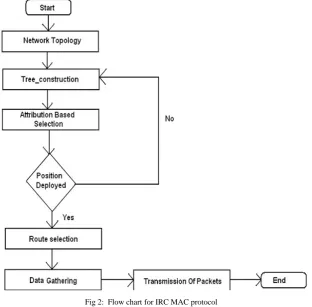
Figure 2 explains the flowchart for Improved Receiver Centric MAC protocol. In this algorithm first start with construction of Network topology and then tree construction and attribute based selection. Then goto position deployed stage, if yes it goes to route selection, data gathering and Transmission of packets. If No at position deployed it returns to tree construction. Then repeats the same process for completion of all nodes.
Fig 2: Flow chart for IRC MAC protocol
4. Experimental Results and Discussion
In simulation methodology, the work is done by using NS2 simulator. In this paper we are comparing the performance of RC-MAC and IRC-MAC protocol with various parametric measures like end to end delay and energy consumption. In experimental setup, Analysis of RC-MAC and IRC-MAC protocols for wireless sensor networks are performed using NS2 simulator. Table 1 shows the simulation setup parameters [08].
TABLE 1 Network Simulation Parameters
Simulation Parameter
Parameter Value
Simulator NS- 2.35
No of Nodes 100
Packet size 780 bytes
MAC Protocols RC-MAC and IRC-MAC
Area of Simulation 1000X 1000
Routing Protocol AODV
Traffic CBR
Channel Type Wireless Channel
4.1 Performance analysis of RC-MAC and IRC-MAC protocols
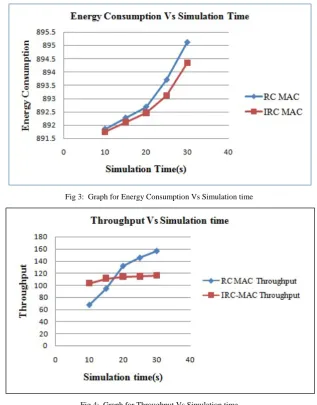
Fig 3: Graph for Energy Consumption Vs Simulation time
Fig 4: Graph for Throughput Vs Simulation time
Here we are comparing RC-MAC and MAC protocols. The average throughput of RC-MAC and IRC-MAC protocols are shown in figure 4. Average throughput is slightly more in IRC-IRC-MAC.
5. Conclusion
Many researchers propose different MAC protocols for wireless sensor networks. Here we implemented MAC protocols for various parameters like energy consumption, end to end delay and throughput. In this research we compare RC-MAC and IRC-MAC protocols for various parameters like energy consumption and end to end delay. Results show that IRC-MAC protocol is better than RC-MAC protocol. In IRC-MAC protocol in terms of energy consumption reduces by 0.05% and end to end delay reduce by 34.27% compared with RC-MAC protocol.
Acknowledgments
The author would like to express sincere thanks for encouragement and constant support provided by the Management RRGI, and CSE(R&D) RajaRajeswari College of Engineering, Bangalore-74, India during this research work.
References
[1] Khalil MI, Hossain MA, Haque MJ, Hasan MN(2017). EERC-MAC: Energy efficient Receiver Centric MAC protocol for Wireless
Sensor network. InImaging, Vision & Pattern Recognition (icIVPR), 2017 IEEE International Conference on Feb 13 (pp. 1-5). IEEE.
[2] Malik MA, Shin D (2007). Collision Free and Energy Efficient MAC protocol for Wireless Networks. IJCSNS. 2007 Sep;7(9):110.
[3] Kirubakaran MK. Regulated Rr-Mac Protocol For Wireless Sensor Networks. Indian Journal of Computer Science and
Engineering.;1(4):344-9.
[4] Cano C, Malone D, Bellalta B, Barceló J (2013). On the improvement of receiver-initiated mac protocols for wsns by applying
scheduling. In World of Wireless, Mobile and Multimedia Networks (WoWMoM), 2013 IEEE 14th International Symposium and Workshops on a Jun 4 (pp. 1-3). IEEE.
[5] Ramesh babu ,Nirupama, Vindhya (2014). RPMAC: A Novel Receiver Pivotal MAC protocol Event Driven Wireless Sensor Networks. International Journal of Advance Research in Computer Science and Management Studies,ISSN:2321-7782, Vol 2, Issue 11, Nov .
[6] Annes Philip, Hasna P (2015). A Fast and Efficient RBTRC – MAC Protocol for Event-Driven Wireless Sensor Networks, International Journal of Engineering and Computer Science, ISSN:2319-7242, Vol 4 Issue 7 July.
[7] Varghese, Jobin, and S. Viswanatha Rao (2014). "Performance analysis of synchronous and receiver initiated MAC protocols under
varying traffic density over Wireless Sensor Networks." In Control, Instrumentation, Communication and Computational Technologies (ICCICCT), 2014 International Conference on, pp. 1228-1232. IEEE.
![Fig 1: wireless sensor Networks [07]](https://thumb-us.123doks.com/thumbv2/123dok_us/9670586.1494978/1.595.171.442.599.721/fig-wireless-sensor-networks.webp)