understanding surface NO
x
emission changes
Ruixiong Zhang1, Yuhang Wang1, Charles Smeltzer1, Hang Qu1, William Koshak2, and K. Folkert Boersma3,4
1School of Earth and Atmospheric Sciences, Georgia Institute of Technology, Atlanta, Georgia, USA 2NASA-Marshall Space Flight Center, National Space Science & Technology Center,
320 Sparkman Drive, Huntsville, Alabama, USA
3Meteorology and Air Quality Group, Wageningen University, Wageningen, the Netherlands 4Royal Netherlands Meteorological Institute, De Bilt, the Netherlands
Correspondence:Yuhang Wang ([email protected])
Received: 13 November 2017 – Discussion started: 25 January 2018 Revised: 22 June 2018 – Accepted: 26 June 2018 – Published: 6 July 2018
Abstract.With the improved spatial resolution of the Ozone Monitoring Instrument (OMI) over earlier instruments and more than 10 years of service, tropospheric NO2 retrievals from OMI have led to many influential studies on the rela-tionships between socioeconomic activities and NOx
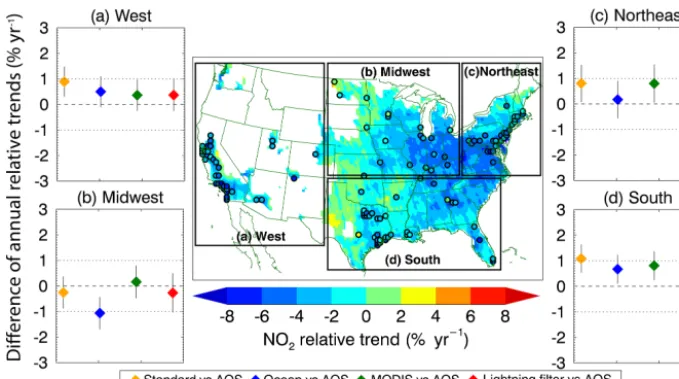
emis-sions. Previous studies have shown that the OMI NO2data show different relative trends compared to in situ measure-ments. However, the sources of the discrepancies need fur-ther investigations. This study focuses on how to appropri-ately compare relative trends derived from OMI and in situ measurements. We retrieve OMI tropospheric NO2vertical column densities (VCDs) and obtain the NO2seasonal trends over the United States, which are compared with coinci-dent in situ surface NO2measurements from the Air Qual-ity System (AQS) network. The Mann–Kendall method with Sen’s slope estimator is applied to derive the NO2seasonal and annual trends for four regions at coincident sites dur-ing 2005–2014. The OMI-based NO2 seasonal relative de-creasing trends are generally biased low compared to the in situ trends by up to 3.7 % yr−1, except for the underestima-tion in the US Midwest and Northeast during December, Jan-uary, and February (DJF). We improve the OMI retrievals for trend analysis by removing the ocean trend, using the Moder-ate Resolution Imaging Spectroradiometer (MODIS) albedo data in air mass factor (AMF) calculation. We apply a light-ning flash filter to exclude lightlight-ning-affected data to make proper comparisons. These data processing procedures re-sult in close agreement (within 0.3 % yr−1) between in situ and OMI-based NO2regional annual relative trends. The
re-maining discrepancies may result from inherent difference between trends of NO2tropospheric VCDs and surface con-centrations, different spatial sampling of the measurements, chemical nonlinearity, and tropospheric NO2profile changes. We recommend that future studies apply these procedures (ocean trend removal and MODIS albedo update) to ensure the quality of satellite-based NO2 trend analysis and apply the lightning filter in studying surface NOxemission changes
using satellite observations and in comparison with the trends derived from in situ NO2measurements. With these data pro-cessing procedures, we derive OMI-based NO2regional an-nual relative trends using all available data for the US West (−2.0 %±0.3 yr−1), Midwest (−1.8 %±0.4 yr−1), North-east (−3.1 %±0.5 yr−1), and South (−0.9 %±0.3 yr−1). The OMI-based annual mean trend over the contiguous United States is−1.5 %±0.2 yr−1. It is a factor of 2 lower than that of the AQS in situ data (−3.9 %±0.4 yr−1); the difference is mainly due to the fact that the locations of AQS sites are concentrated in urban and suburban regions.
1 Introduction
both anthropogenically and naturally (e.g., Gu et al., 2016). Anthropogenic fossil fuel combustions and biomass burning emit mostly nitrogen monoxide (NO) at high temperature, which is later oxidized by O3into NO2. Major natural NO2 sources include lightning and soils.
Surface NO2 concentrations are regulated by the US En-vironmental Protection Agency (EPA) through the National Ambient Air Quality Standards (NAAQS). NO2is measured routinely at the EPA Air Quality System (AQS) sites (Demer-jian, 2000). Although the AQS network continually provides valuable hourly NO2measurements, AQS sites are mostly lo-cated in urban and suburban regions, leaving large regions of rural areas unmonitored. Satellite data provide better spatial coverage than the in situ measurements.
Several satellites have been launched to monitor tropo-spheric NO2 vertical column densities (VCDs), such as the SCanning Imaging Absorption spectroMeter for Atmo-spheric CHartographY (SCIAMACHY), the Global Ozone Monitoring Experiment–2 (GOME-2), and the Ozone Moni-toring Instrument (OMI). For trend analysis, the tropospheric NO2 products from OMI surpass the others for a relatively high spatial resolution and over 1 decade of continuous op-eration (Boersma et al., 2004, 2011). Thus, OMI NO2 re-trievals are widely applied in NO2and NOxemission trend
studies (e.g., Lin et al., 2010, 2013; Lin and McElroy, 2011; Castellanos and Boersma, 2012; Russell et al., 2012; Gu et al., 2013; Lamsal et al., 2015; Lu et al., 2015; Tong et al., 2015; Cui et al., 2016; Duncan et al., 2016; de Foy et al., 2016a, b; Krotkov et al., 2016; Liu et al., 2017). Tong et al. (2015) reported that the reduction rates calculated from OMI NO2VCDs and AQS surface NO2data in eight cities were−35 and−38 % from 2005 to 2012, respectively. Lam-sal et al. (2015) also found the divergence between the an-nual trends inferred from the two datasets, i.e.,−4.8 % yr−1 vs. −3.7 % yr−1 during 2005–2008, and −1.2 % yr−1 vs. −2.1 % yr−1during 2010–2013. There are several potential factors that contribute to the discrepancies between trends from satellite and ground-based measurements: interferences by the oxidation products of NOx from the
chemilumines-cent instruments (Lamsal et al., 2008, 2014, 2015), the dif-ferences of sampling time between OMI (∼13:30 local time) and AQS (hourly) measurements (Tong et al., 2015), a high sensitivity of NO2VCDs to high-altitude NO2in contrast to the high sensitivity of surface NO2concentrations to surface NOx emissions (Duncan et al., 2013; Lamsal et al., 2015),
spatial representativeness of satellite pixels (Lamsal et al., 2015), and high uncertainties of satellite retrievals in clean regions (Lamsal et al., 2015).
To understand how various factors and the retrieval proce-dure affect the differences between the OMI-derived trends and those derived from the surface AQS measurements, we utilize a regional 3-D chemistry transport model (CTM), a radiative transfer model (RTM), and the Mann–Kendall method (Mann, 1945; Kendall, 1948) to calculate OMI-based NO2seasonal relative trends during December, January, and
February (DJF); March, April, and May (MAM); June, July, and August (JJA); and September, October, and November (SON) (Sect. 2). We find that two procedures are essential to ensure the quality of trend analysis using OMI tropospheric NO2 VCDs, including the ocean trend removal and the Moderate Resolution Imaging Spectroradiometer (MODIS) albedo update in calculating the air mass factors (AMFs). The lightning filter (Sect. 3.1) is necessary for comparing OMI-based and in situ AQS NO2trends. With these proce-dures implemented, the differences between OMI-based and AQS in situ annual relative trends are within 0.3 % yr−1 of coincident measurements for all the four regions. Finally, we estimate the OMI-based annual relative trends across the na-tion in Sect. 3.2. Conclusions are given in Sect. 4.
2 Methods
2.1 EPA AQS surface NO2measurements
The in situ surface NO2 measurements from the US EPA AQS network are used in this research. Sites with a continu-ous measurement gap of more than 50 days are removed, and the observations of 140 remaining cites are used (Fig. 1). The AQS chemiluminescent analyzers are equipped with molyb-denum converters to measure ambient NO2concentrations. These analyzers are known to have high biases, since the con-verters are not NO2specific and they measure some fractions of peroxyacetyl nitrate, nitric acid, and organic nitrates (De-merjian, 2000; Lamsal et al., 2008). In addition to chemi-luminescent analyzers, several NO2-specific photolytic in-struments have been deployed since 2013. By utilizing the data from both chemiluminescent and photolytic measure-ments at coincident sites during the overpassing time of OMI, we calculate the observed NO2concentration ratio between both measurements in Fig. S1 in the Supplement. The ratio peaks at 2.3 in June and decreases to 1.3 in November, indi-cating that the chemiluminescent analyzers overestimate by 27–132 % as compared to photolytic instruments. This find-ing is in agreement with Lamsal et al. (2008). We correct the chemiluminescent NO2 data by the observed ratio, assum-ing that the interannual change is small and the high bias of the chemiluminescent measurements is identical at all sites. This correction may contribute to the differences between in situ and OMI-based absolute NO2trends but does not signif-icantly affect the relative trends (since the correction is can-celed out in computing relative trends). In this study, we only examine the relative trends, and therefore the analysis results are not affected by the uncertainties in the in situ NO2 mea-surement corrections.
2.2 REAM model
ver-Figure 1.The solid black borders in the center map define the four regions used in this study. The colored background shows the OMI-based NO2annual relative trends of the “lightning filter” data. Grid cells with 2005–2014 mean NO2VCD values < 1×10¹⁵molecules cm−2are excluded in this study and are shown in white. The black-bordered circles represent the locations of AQS sites. Panel(a)through(d)show the regional difference (OMI-based relative trends minus AQS relative trends) of annual relative trends between coincident OMI-based and AQS in situ data. The colored diamonds are for “standard” (orange), “ocean” (blue), “MODIS” (green), and “lightning filter” (red) OMI data. The different OMI VCD data are described in Sect. 2.4.
tical transport (Choi et al., 2005; Zhao et al., 2009; Zhang et al., 2016), emission inversions (Zhao and Wang, 2009; Yang et al., 2011; Gu et al., 2013, 2014, 2016), and regional and seasonal variations (Choi et al., 2008a, b). The model has a horizontal resolution of 36 km with 30 vertical layers in the troposphere, 5 vertical layers in the stratosphere, and a model top of 10 hpa. In this study, the domain of REAM is about 400 km larger on each side than the contiguous United States (CONUS). Meteorology inputs driving the transport process are simulated by the Weather Research and Fore-casting model (WRF) assimilations constrained by National Centers for Environmental Prediction Climate Forecast Sys-tem Reanalysis (NCEP CFSR; Saha et al., 2010) 6-hourly products. The KF-Eta scheme is used for sub-grid convective transport in WRF (Kain and Fritsch, 1993). We run the WRF model with the same resolution as in REAM but with a do-main 10 grids larger on each side than that of REAM. REAM updates most of the meteorology inputs every 30 min, while those related to convective transport and lightning parameter-ization are updated every 5 min. The chemistry mechanism expands upon that of the global CTM GEOS-Chem (V9-02) with aromatic chemistry (Bey et al., 2001; Liu et al., 2010, 2012a, b; Zhang et al., 2017). For consistency, the GEOS-Chem (V9-02) simulation with 2◦×2.5◦ resolution is used to generate initial and boundary conditions for chemical trac-ers.
Anthropogenic emissions of NOx and other chemical
species are from the US National Emission Inventory 2008 prepared using the Sparse Matrix Operator Kernel Emission (SMOKE) model. Biogenic emissions are simulated online
using the Model of Emissions of Gases and Aerosols from Nature (MEGAN) algorithm (v2.1; Guenther et al., 2012). We parameterize lightning-emitted NOxas a function of
con-vective mass flux and concon-vective available potential energy (CAPE) (Choi et al., 2005). NOx production per flash is set
to 250 moles NO per flash, and the emissions are distributed vertically following the C-shaped profiles by Pickering et al. (1998). For recent model evaluations of REAM with ob-servations, we refer readers to Zhang et al. (2016), Zhang and Wang (2016), Cheng et al. (2017), and Zhang et al. (2017).
2.3 OMI-based NO2VCDs
tro-pospheric SCDs requires the calculation of AMFs. Since NO2 is an optically thin gas, tropospheric AMF for NO2 can be calculated from AMF for each vertical layer (AMFl) weighted by NO2 partial VCDs at the corresponding layer (xl) (Boersma et al., 2004), as shown in Eq. (1).
tropospheric AMF= tropospheric SCD tropospheric VCD=
R
AMFlxldl R
xldl (1) As the vertical distribution of NO2is usually unknown, we typically substitutexl by an a priori profile (xl,apriori) from a CTM. AMFl is the sensitivity of NO2SCD to VCD at a given altitude (Eskes and Boersma, 2003) and is computed using the Double-Adding KNMI (DAK) RTM (Boersma et al., 2011). As a result, the retrieved tropospheric NO2VCD computation depends on the a priori NO2 vertical profile, the surface reflectance, the surface pressure, the temperature profile, and the viewing geometry (Boersma et al., 2011). Previous studies have addressed the sources of uncertainties in NO2 retrievals, including surface reflectance resolutions (Russell et al., 2011; Lin et al., 2014), lightning NOx (Choi
et al., 2005; Martin et al., 2007; Bucsela et al., 2010), a pri-ori CTM uncertainties (Russell et al., 2011; Heckel et al., 2011; Lin et al., 2012; Laughner et al., 2016), surface pres-sure and reflectance anisotropy in rugged terrain (Zhou et al., 2009), cloud and aerosol radiance (Lin et al., 2014, 2015), and boundary layer dynamics (Zhang et al., 2016). In this study, we find that the first two factors are essential in NO2 VCD trend analysis, and we will discuss these in the follow-ing sections.
AMFs are derived using the pre-computed altitude-dependent AMF lookup table, which is generated by the DAK RTM. We use the NO2profiles from REAM, temper-ature and pressure from CSFR, and viewing geometry and cloud information from the DOMINO v2 product. We use the REAM results of 2010 to avoid the uncertainty introduced by yearly variation of NO2profiles. The yearly variations of meteorology and anthropogenic emission changes have little impact in polluted areas on trend analysis results using OMI data (Lamsal et al., 2015). We use the surface reflectance from the DOMINO v2 product as a default (Kleipool et al., 2008) and update it using a surface reflectance product with a higher temporal resolution (Sect. 2.3.2). The derived tro-pospheric NO2VCD relative trends with default surface re-flectance are referred to as “standard”.
2.3.1 Ocean trend removal
For trend and other analyses of OMI tropospheric VCDs, the data of anomalous pixels must be removed. The row anomaly initially occurred in June 2007 and subsequently in later years affected rows 26–40 (Schenkeveld et al., 2017). Addi-tional anomalies can be found in some years in rows 41–55. For trend analysis from 2005 to 2014, we exclude rows 26– 55, consistent with our understanding of the row anomaly (Schenkeveld et al., 2017). In addition, the data of coarse
spa-tial resolution from rows 1 to 5 and rows 56 to 60 are also ex-cluded, as suggested by Lamsal et al. (2015). The selection of rows 6–25 used in this research is stricter than the data flags in the DOMINO v2 product. Furthermore, we exclude OMI data with cloud fraction > 0.3 to minimize retrieval un-certainties due to clouds and aerosols (Boersma et al., 2011; Lin et al., 2014).
Figure 2a shows that there is an apparent increasing trend of the averaged tropospheric SCDs in the remote ocean region (Fig. 2b) with minimal marine traffic. This trend may reflect the inaccurately simulated stratospheric SCDs or the increase in the magnitude of the stripes (step-wise SCD variability from one row to another) in time, which originates from the use of a constant (2005-averaged) so-lar irradiance reference spectrum in the DOAS spectral fits throughout the mission and the weak increase of noise in the OMI radiance measurements (K. Folkert Boersma, personal communication, 2017; Zara et al., 2018). Fig-ure 2a shows that there is a positive annual trend of 1.75±0.45×10¹³molecules cm−2yr−1. The ocean trend is insensitive to the region selection in the remote North Pacific (varies within 10 %). We only analyze OMI tropospheric col-umn trends over the CONUS for grid cells with 2005–2014-averaged VCDs > 1×10¹⁵molecules cm−2, which tends to minimize the effect of the background noise. However, re-moving this background ocean (absolute) trend has a non-negligible effect in reducing the OMI relative trend (Fig. 1). We treat this trend as a systematic bias. We calculate the con-tribution from the ocean (absolute) annual trend to SCDs for each year and subtract it from OMI tropospheric NO2SCDs uniformly in the following analysis. Since the origin of this trend is not yet clear, the ocean trend removal method may need updates in future studies. We refer to such derived (rel-ative) trend data as “ocean”. An alternative method is to sub-tract monthly SCD trends of the remote ocean region (Fig. S2 in the Supplement) from the OMI tropospheric SCD data. Al-though the end results (Fig. S3 in the Supplement) are essen-tially the same as the annual trend removal method, noises are added to the SCD data, making it more difficult to un-derstand the effects of the MODIS albedo update and the lightning filter (next sections). We therefore choose to use the (absolute) annual trend removal method here.
2.3.2 MODIS albedo update
Figure 2.The black line in panel(a)shows the monthly averaged OMI tropospheric NO2VCD values in the North Pacific region (red box in panelb) from 2005 to 2014. The red line in panel(a)represents the ocean trend used in this research, with the 95th-percentile confidence intervals shaded in red.
10:30 LT, respectively. The band 3 (459–479 nm) is used to match the NO2fitting window (405–465 nm). The albedo is spatially integrated to the geometry of OMI pixels and is temporally interpolated to match OMI overpassing dates. In order to maintain the consistency of the DOMINO retrieval algorithm (Boersma et al., 2011), we only use the MODIS data to improve the temporal variations of albedo data used in the retrieval. We scale the MODIS albedo data such that the mean albedo during 2005–2009 is the same as the OMI climatology at 0.5◦×0.5◦. We recalculate OMI tropospheric VCDs using the MODIS albedo data as described. We re-calculate the relative OMI trend and remove the ocean (ab-solute) trend (Sect. 2.3.1). We refer to this version of OMI relative trend data as “MODIS”.
2.3.3 Lightning event filter
Over North America, lightning is a major source of NOxin
the free troposphere, and its simulations in CTMs are un-certain (e.g., Zhao et al., 2009; Luo et al., 2017). The large temporospatial variations of lightning NOxmake it difficult
to compute satellite-based NO2trends by changing the verti-cal distributions of NO2affecting the AMF calculation (e.g., Choi et al., 2008b; Lamsal et al., 2010) and the SCD values. Furthermore, accompanying lightning occurrences, the pres-ence of cloud significantly affects the lifetime of NOx and
the partitioning of NO2 to NO in daytime, and convective transport exports NOxfrom the surface and boundary layer to
the free troposphere, changing surface and column NO2 con-centrations. Given the difficulty to simulate lightning NOx
accurately across different years and meteorological effects (vertical mixing) of lightning, we use a lightning filter to remove potential effects of lightning NOx on the basis of
the flash rate observations of cloud-to-ground (CG) light-ning flash data detected by the National Lightlight-ning Detection Network™(NLDN) (Cummins and Murphy, 2009; Rudlosky and Fuelberg, 2010). NLDN only reports the ground point of a CG lightning flash, while the CG lightning flash can ex-tend horizontally to tens of kilometers. A CG lightning flash
can affect the NO2retrievals not only in the model grid cell where the CG lightning is located but also the nearby model grid cells. The atmospheric lifetime of NOxin the free
tropo-sphere can be up to 1 week. Therefore, we exclude the OMI NO2 data within a radius of 90 km of the NLDN-reported CG lightning location (about two model grid cells around the grid cell where the CG lightning is located) for a period of 72 h after the lightning occurrence. Since lightning usu-ally occurs along the track of a thunderstorm, the 90 km ra-dius is more of a constraint on lightning NOxeffects across
the track. The extended period of 72 h is to ensure that we exclude data affected by lightning NOx. Figure 4 shows the
distribution of the number of days of 2005–2014 with light-ning detection. The Southwest monsoon and the South re-gions have more lightning days than the other areas. While there are fewer lightning flashes in the Northeast than the South (Fig. 3), large amounts of lightning NOx can be
pro-duced by high flash ratios of severe thunderstorms, and they can be transported northward from the South to the Northeast (Choi et al., 2005). We therefore further filter OMI NO2data in the Northeast on the basis of CG lightning flash rates in the South. If the average CG flash rate in the South exceeds the 95th-percentile value of the NLDN observations, which is 0.035 flash km−2day−1(Fig. S4 in the Supplement), we ex-clude in the analysis the Northeast OMI data in the following 72 h. Excluding the OMI data based on CG lightning data im-plicitly removes the data affected by cloud-to-cloud lightning collocated with CG lightning. The lightning filter removes about 2, 27, 20, and 19 % of OMI data, which are coincident with AQS data for the West, the Midwest, the Northeast, and the South, respectively. We refer to this version of OMI rela-tive trend data as “lightning filter”.
3 Results and discussion
Figure 3. Number of days with NLDN-detected cloud-to-ground (CG) lightning per model grid cell per year during 2005–2014. The lightning occurrences are calculated using the REAM grid resolu-tion.
make a fair comparison between the in situ and OMI-based trends, we only use spatially and temporally coincident in situ and OMI NO2observations in Sect. 3.1. The AQS data are temporally interpolated based on the overpassing time of the available OMI pixels which cover the corresponding AQS sites. Similarly, only OMI pixels covering the corresponding available AQS sites are used. The data from each dataset are then aggregated and averaged on a regional basis into time series to calculate the regional trends.
We apply the Mann–Kendall method with Sen’s slope estimator to calculate the relative trend of NO2 for each season – i.e., DJF, MAM, JJA, and SON – during 2005– 2014. We compute the uncertainties of the trends with the 95th-percentile confidence intervals using the Mann–Kendall method. Note that, when we compare in situ and OMI-based trends, the lightning filter also removes in situ NO2 data, which are coincident with the OMI NO2 data affected by lightning. This leads to slightly different in situ NO2trends between Figs. 4 and 6 (Sect. 3.2.3). We first compute the trends using the standard OMI VCD data. The ocean trend removal, MODIS albedo update, and lightning filter are then added in sequence to compute three different OMI-based NO2trends (in addition to standard) to compare to the AQS in situ results. A subtlety in the comparison is that the coin-cident data change when the lightning filter is applied. As a result, the AQS in situ results in this set of comparisons differ from those in the other three sets.
3.1 In situ and standard OMI-based trends
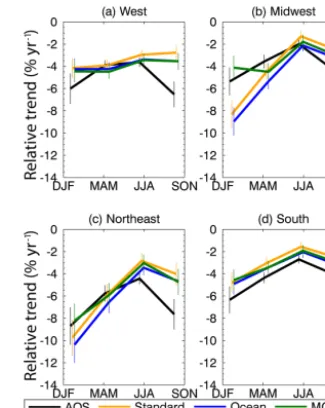
Figure 4 shows that both AQS in situ and standard OMI-based seasonal relative trends are negative for all seasons across the regions. OMI-based trends generally underesti-mate the decreasing trends by up to 3.7 % yr−1 (the abso-lute difference between relative trends) except for the large overestimation in the Midwest and the Northeast regions dur-ing DJF. The overestimates in these two regions are 3.0 and 1.1 % yr−1, respectively. On average, the differences between OMI-based and in situ seasonal relative trends are 1.6,−0.3,
Figure 4.Seasonal relative trends of NO2calculated from the AQS in situ measurements (“AQS”, black line) and those derived from different OMI VCD data (“standard”, orange line; “ocean”, blue line; “MODIS”, green line). The error bars represent 95th-percentile confidence intervals.
1.0, and 1.4 % yr−1 for the West, the Midwest, the North-east, and the South regions, respectively. Note that the rela-tive trends are calculated using coincident measurements for the comparisons. The focus of this work is to examine if the differences between AQS in situ and OMI-based trends can be reduced.
3.1.1 Improvement due to ocean trend correction
After removing the ocean trend as discussed in Sect. 2.3.1, the OMI-based NO2decreasing trends are more pronounced as shown in Fig. 4 (ocean version, blue line) by 0.1– 0.9 % yr−1. The regional relative trends have different sen-sitivities to the ocean trend removal due to different tropo-spheric VCD levels. In general, the discrepancies between OMI-based and in situ trends are reduced except for the Mid-west and the Northeast regions during DJF, which are al-ready biased low. The averaged differences between OMI-based and in situ seasonal relative trends for the West, the Midwest, the Northeast, and the South regions are 1.2,−1.1, 0.4, and 1.0 % yr−1, respectively. Only in the Midwest region does removing the ocean trend enlarge the difference due to the large winter bias.
3.1.2 Improvement due to MODIS albedo update
Figure 5.Seasonal relative albedo trends of OMI (black line) and MODIS (red line) surface reflectance products, coincident with AQS in situ data used in Fig. 6. The error bars represent 95th-percentile confidence intervals.
are no significant changes of the comparisons in other re-gions or other seasons. Figure 5 shows the albedo seasonal relative trends for the four regions coincident with AQS in situ NO2data. The OMI DOMINO v2 product incorporates a climatology albedo dataset (Kleipool et al., 2008) with snow/ice albedo adjustment, in which the albedo value is re-set to be 0.6 if snow/ice is reported in the NASA Near-real-time Ice and Snow Extent (NISE) dataset (Boersma et al., 2011). The climatology albedo data have no trends. Thus, the trends of albedo from the DOMINO v2 product mainly orig-inate from the yearly variation of NISE-detected snow/ice and to a lesser extent the OMI sampling variation. The no-ticeable seasonal trend of the OMI DOMINO v2 albedo dataset is the 3.9 % yr−1 increase in DJF of the Midwest and a smaller DJF increase (1.0 %) of the Northeast. In con-trast, the MODIS albedo dataset exhibits a smaller positive DJF trend (0.8 % yr−1), 3.1 % yr−1 less than the trend from DOMINO v2, in the Midwest and a small negative DJF trend (−0.8 %) in the Northeast. These differences suggest that using a fixed snow/ice albedo and climatology albedo data is inadequate. The comparison to the AQS data shows that the MODIS albedo update leads to better agreement between satellite and in suit trends in winter in these regions (Fig. 4).
3.1.3 Comparison after lightning event filter
As discussed in Sect. 2.3.3, lightning NOx affects the
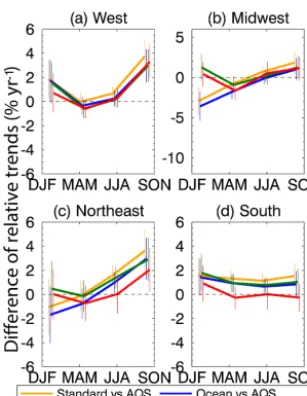
re-trievals of satellite tropospheric NO2VCDs and NO2vertical mixing. Figure 6 shows that the lightning filter significantly reduces the difference between the OMI-based relative trend and that of the AQS data by 0.5–1.4 % yr−1in the Northeast and 0.9–1.3 % yr−1 in the South. As a result, the seasonal
Figure 6.Seasonal relative trends of NO2calculated from the AQS in situ measurements (“AQS”, black line) and those derived from OMI data after applying the lightning filter (“OMI (lightning fil-ter)”, red line). The error bars represent 95th-percentile confidence intervals. The coincident data points are less than those used in Fig. 4, and therefore the AQS trends are not the same.
trend differences are within 0.9 % yr−1in these two regions except during SON. The Northeast is affected by the light-ning filter due to lightlight-ning in this region and transport of lightning NOx from the South (Sect. 2.3.3). The lightning
filter has little effect on the West and the Midwest. While lightning NOx can be significant during the monsoon
sea-son in some regions of the West (Fig. 3), the average tropo-spheric NO2VCDs are usually < 1×10¹⁵molecules cm−2, and lightning-affected regions are therefore excluded in trend analysis.
Table 1.Annual relative trends calculated with coincident data and all available data. The 95th-percentile confidence intervals from Mann– Kendall method are also listed.
Region Annual relative trends of coincident data (% yr−1) Annual relative trends using all data (% yr−1)
Standard Lightning filtera Standard Lightning filter
AQS OMI AQS OMI AQS OMIb AQS OMIb
West −4.1±0.5 −3.2±0.4 −4.2±0.5 −3.8±0.4 −4.1±0.5 −0.9±0.4 −4.2±0.5 −2.0±0.3 Midwest −3.4±0.5 −3.6±0.4 −2.8±0.6 −3.1±0.5 −2.5±0.5 −0.9±0.4 −2.2±0.5 −1.8±0.4 Northeast −5.8±0.5 −5.0±0.5 −5.2±0.6 −5.3±0.7 −4.7±0.5 −3.0±0.4 −4.1±0.5 −3.1±0.5 South −3.8±0.4 −2.7±0.3 −3.0±0.5 −3.0±0.5 −3.5±0.4 −0.2±0.4 −3.0±0.5 −0.9±0.3 Nationwide −4.3±0.4 −3.5±0.3 −4.1±0.4 −3.9±0.3 −4.0±0.4 −0.7±0.3 −3.9±0.4 −1.5±0.2
aThese data include the three data processing procedures of this study, namely, ocean trend correction, MODIS albedo update, and lightning filter screening.bThe
spatial coverage is shown in Fig. 1.
Figure 7.Seasonal differences of OMI-based relative trends from those computed from AQS in situ data. The error bars represent 95th-percentile confidence intervals. The relative trends are shown in Figs. 4 and 6. The figure legends are the same as in Figs. 4 and 6 but with the AQS trends subtracted from the OMI-based trends.
et al., 2015), different spatial coverages of the two measure-ments, and the inherent difference between trends of NO2 tropospheric VCDs and surface concentrations.
3.2 OMI-based NO2trends
Table 1 summarizes the regional annual trends of coincident AQS in situ and OMI data. The standard OMI data (following the DOMINO v2 algorithm) tend to show less NO2reduction than AQS data. After applying the three data processing pro-cedures discussed in the previous section to the OMI data, the agreement with the AQS trends is within the uncertain-ties of the trends. While lightning NOx is part of OMI NO2 observations, we treat the influence of lightning on the OMI tropospheric VCD trend as a bias for comparison purposes in
this study. Table 1 shows the effects of data sampling when both AQS and OMI data are analyzed and when the lightning filter is applied.
Without the lightning filter, AQS decreasing trends are stronger than the decreasing trends of OMI data (Fig. 7). The lightning trend in the NLDN data is unclear due in part to the changing instrument sensitivity (Koshak et al., 2015). If lightning NOx is not accounted for in OMI retrieval,
tropo-spheric NO2 VCDs are overestimated. On the other hand, lightning accompanies low-pressure systems which mix the atmosphere vertically and tend to reduce surface NO2 con-centrations when anthropogenic emissions are high, such as urban and suburban regions. Therefore, lightning has oppo-site effects on surface and satellite trends. The low-pressure dilution effect on surface NO2concentrations depends on an-thropogenic emissions (since the end point of dilution is the background NO2 value). Therefore, the weaker decreasing surface trends likely reflect a reduction of the low-pressure dilution effect. Similarly, as anthropogenic emissions de-crease, the positive bias of tropospheric VCDs due to light-ning NOxbecomes larger, likely resulting in weaker
decreas-ing trends. We consider the lightndecreas-ing effects on surface NO2 trends to be mostly meteorologically driven not by light-ning NOx directly (e.g., Ott et al., 2010; Luo et al., 2017),
and hence the filtered OMI NO2 data are likely closer to emission-related concentration changes.
reduc-Figure 8.Annual relative trends of OMI-based NO2for “standard”(a)and for “lightning filter”(b)as the colored background. Black-bordered circles indicate corresponding AQS NO2trends. Grid cells with 2005–2014 mean NO2VCDs < 1×10¹⁵molecules cm−2 are excluded in the analysis and are shown in white.
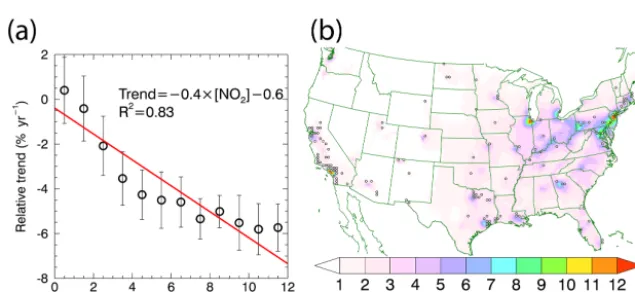
Figure 9. (a)The “lightning filter” OMI-based NO2relative trend as a function 2005–2014-averaged OMI tropospheric NO2VCD binned every 1×10¹⁵molec cm2. The error bars represent 95th-percentile confidence intervals. The red line shows a least-squares regression. (b)The distribution of 2005–2014-averaged OMI tropospheric NO2VCD. Black-bordered circles represent AQS sites. The OMI tropospheric NO2data (“lightning filter”) are used.
tion rates in the West (−3.8±0.4 % yr−1), the Midwest (−3.1±0.5 % yr−1), the Northeast (−5.3±0.7 % yr−1), and the South (−3.0±0.5 % yr−1) regions. The nationwide an-nual trend is−3.9±0.3 % yr−1.
One advantage of satellite observations over a surface monitoring network is spatial coverage. The processed OMI data (lightning filter) coincident with the AQS data show a national annual trend of −3.9±0.3 % yr−1, similar to the AQS in situ trend of−4.1±0.4 % yr−1. Using all data avail-able (Fig. 8, Tavail-able 1), the OMI data (lightning filter) show a much lower trend of−1.5±0.2 % yr−1, about half of the AQS trend (−3.9±0.4 % yr−1). Figure 9 shows that the AQS sites, which are mostly urban and suburban sites, tend to be located in regions with high tropospheric NO2 VCDs. The OMI decreasing trend is a function of tropospheric NO2 VCDs, increasing from 0 to−6 % yr−1(Fig. 9). The national annual trend is close to the value of clean regions, which contribute much more than polluted regions. The larger de-crease near the anthropogenic source regions reflects in part the nonlinear photochemistry (Gu et al., 2013) and in part a
stronger influence of NOx sources such as soils in rural
re-gions.
4 Conclusions
Using data from the DOMINO v2 algorithm, we find that the computed OMI-based seasonal NO2(relative) trends un-derestimate the decreasing trends of the EPA AQS data by up to 3.7 % yr−1. While lightning NOxis part of OMI NO2 observations, we treat the influence of lightning on the OMI tropospheric VCD trend as a bias for comparison purposes in this study. Furthermore, lightning NOx effects need to be
removed when using satellite observations to understand the effects of changing anthropogenic emissions.
0.3 % yr−1) with those of the AQS data. Among the correc-tions, the background ocean trend removal is not as signif-icant as the latter two. Since the origin of this trend is not yet clear, the ocean trend removal method may need up-dates in future studies. The remaining differences may result from the inherent differences between trends of NO2 tro-pospheric VCDs and surface concentrations, different spa-tial sampling of the measurements, chemical nonlinearity, and tropospheric NO2 profile changes. The largest effects of the MODIS albedo update are in winter in the Midwest and Northeast, and those of lightning filter are in the South and the Northeast. After these data processing procedures are applied, the derived OMI-based annual regional NO2trends change by a factor of > 2 for the South, the Midwest, and the West, and seasonal changes can be even larger. We de-rive OMI-based NO2regional annual relative trends using all available data for the West (−2.0 %±0.3 yr−1), the Midwest (−1.8 %±0.4 yr−1), the Northeast (−3.1 %±0.5 yr−1), and the South (−0.9 %±0.3 yr−1).
The national annual trend of the processed OMI data is −1.5±0.2 % yr−1, about half of the AQS trend (−3.9±0.4 % yr−1). It reflects that the AQS sites are mostly located in the urban and suburban regions, where OMI data show much larger decreasing trends (up to−6 % yr−1) than rural regions (down to 0 % yr−1). The reasons for the de-pendence of OMI-derived trends on tropospheric NO2VCDs and the seasonal/regional trend differences are still not com-pletely understood. Further studies are necessary to improve our understanding of these trends. The observation-based lightning filter implemented in this study is preliminary. In-corporating chemical transport modeling may improve this filter. Moreover, the results presented here represent an alter-native and indirect way to assess the importance of lightning NOx for National Climate Assessment (NCA) analyses
de-scribed in Koshak et al. (2015) and Koshak (2017). Inversion studies (e.g., Zhao and Wang, 2009; Gu et al., 2013, 2014, 2016) will be needed to quantify the emission and AMF changes corresponding to the OMI tropospheric NO2VCD trends.
Data availability. The datasets used in this research have been ob-tained online as follows:
– DOMINO v2 NO2retrievals: http://www.temis.nl/airpollution/ no2.html (last access: January 2016; Boersma et al., 2011).
– EPA AQS NO2 data: US Environmental Protection Agency. Air Quality System Data Mart (internet database) available at: http://www.epa.gov/ttn/airs/aqsdatamart (last access: January 2016).
– NLDN lightning data: https://lightning.nsstc.nasa.gov/data/ data_nldn.html (last access: January 2016; Cummins et al., 2016).
– MODIS MCD43B3 data: https://lpdaac.usgs.gov (LP DAAC, 2016).
Supplement. The supplement related to this article is available online at: https://doi.org/10.5194/amt-11-3955-2018-supplement.
Competing interests. The authors declare that they have no conflict of interest.
Acknowledgements. This work was supported by the NASA Atmo-spheric Composition Modeling and Analysis Program (ACMAP) and the NASA Climate Indicators and Data Products for Future National Climate Assessments (NNH14ZDA001N-INCA). We acknowledge data sources, including DOMINO v2 OMI data from KNMI, MODIS data from NASA, and EPA AQS NO2data from EPA. In addition, the authors gratefully acknowledge Vaisala Inc. for providing the NLDN data used in this study. K. Folkert Boersma acknowledges funding from the EU FP7 project QA4ECV (grant no. 607405).
Edited by: Andreas Richter
Reviewed by: two anonymous referees
References
Bey, I., Jacob, D. J., Yantosca, R. M., Logan, J. A., Field, B. D., Fiore, A. M., Li, Q. B., Liu, H. G. Y., Mickley, L. J., and Schultz, M. G.: Global modeling of tropospheric chemistry with assimilated meteorology: Model description and evaluation, J. Geophys. Res.-Atmos., 106, 23073–23095, https://doi.org/10.1029/2001jd000807, 2001.
Boersma, K. F., Eskes, H. J., and Brinksma, E. J.: Error analysis for tropospheric NO2retrieval from space, J. Geophys. Res.-Atmos., 109, D04311, https://doi.org/10.1029/2003JD003962, 2004. Boersma, K. F., Eskes, H. J., Dirksen, R. J., van der A, R. J.,
Veefkind, J. P., Stammes, P., Huijnen, V., Kleipool, Q. L., Sneep, M., Claas, J., Leitão, J., Richter, A., Zhou, Y., and Brunner, D.: An improved tropospheric NO2column retrieval algorithm for the Ozone Monitoring Instrument, Atmos. Meas. Tech., 4, 1905– 1928, https://doi.org/10.5194/amt-4-1905-2011, 2011.
Bucsela, E. J., Pickering, K. E., Huntemann, T. L., Cohen, R. C., Perring, A., Gleason, J. F., Blakeslee, R. J., Albrecht, R. I., Holzworth, R., Cipriani, J. P., Vargas-Navarro, D., Mora-Segura, I., Pacheco-Hernández, A., and Laporte-Molina, S.: Lightning-generated NOx seen by the Ozone Monitoring Instrument
dur-ing NASA’s Tropical Composition, Cloud and Climate Cou-pling Experiment (TC4), J. Geophys. Res.-Atmos., 115, D00J10, https://doi.org/10.1029/2009JD013118, 2010.
Castellanos, P. and Boersma, K. F.: Reductions in nitrogen oxides over Europe driven by environmental policy and economic reces-sion, Sci. Rep., 2, 265, https://doi.org/10.1038/srep00265, 2012. Cheng, Y., Wang, Y., Zhang, Y., Chen, G., Crawford, J. H., Kleb, M. M., Diskin, G. S., and Weinheimer, A. J.: Large biogenic contribution to boundary layer O3-CO regres-sion slope in summer, Geophys. Res. Lett., 44, 7061–7068, https://doi.org/10.1002/2017GL074405, 2017.
Choi, Y., Wang, Y., Zeng, T., Martin, R. V., Kurosu, T. P., and Chance, K.: Evidence of lightning NOx and
Cui, Y., Lin, J., Song, C., Liu, M., Yan, Y., Xu, Y., and Huang, B.: Rapid growth in nitrogen dioxide pollution over West-ern China, 2005–2013, Atmos. Chem. Phys., 16, 6207–6221, https://doi.org/10.5194/acp-16-6207-2016, 2016.
Cummins, K. L. and Murphy, M. J.: An Overview of Lightning Lo-cating Systems: History, Techniques, and Data Uses, With an In-Depth Look at the U.S. NLDN, IEEE T. Electromagn. C., 51, 499–518, https://doi.org/10.1109/TEMC.2009.2023450, 2009. Cummins, K. L., Burnett, R. O., Hiscox, W. L., and Pifer, A. E.:
Line reliability and fault analysis using the National lightning de-tection network, Preprints, Precise Measurements in Power Con-ference, 27–29 October 1993, Arlington, VA, USA, 1993. de Foy, B., Lu, Z., and Streets, D. G.: Satellite NO2
re-trievals suggest China has exceeded its NOx reduction
goals from the twelfth Five-Year Plan, Sci. Rep., 6, 35912, https://doi.org/10.1038/srep35912, 2016a.
de Foy, B., Lu, Z., and Streets, D. G.: Impacts of control strategies, the Great Recession and weekday variations on NO2columns above North American cities, Atmos. Environ., 138, 74–86, https://doi.org/10.1016/j.atmosenv.2016.04.038, 2016b. Demerjian, K. L.: A review of national monitoring
net-works in North America, Atmos. Environ., 34, 1861–1884, https://doi.org/10.1016/S1352-2310(99)00452-5, 2000. Dirksen, R. J., Boersma, K. F., Eskes, H. J., Ionov, D. V., Bucsela,
E. J., Levelt, P. F., and Kelder, H. M.: Evaluation of stratospheric NO2retrieved from the Ozone Monitoring Instrument: Intercom-parison, diurnal cycle, and trending, J. Geophys. Res.-Atmos., 116, D08305, https://doi.org/10.1029/2010JD014943, 2011. Duncan, B. N., Yoshida, Y., de Foy, B., Lamsal, L. N., Streets,
D. G., Lu, Z. F., Pickering, K. E., and Krotkov, N. A.: The observed response of Ozone Monitoring Instrument (OMI) NO2 columns to NOx emission controls on power plants in
the United States: 2005–2011, Atmos. Environ., 81, 102–111, https://doi.org/10.1016/j.atmosenv.2013.08.068, 2013.
Duncan, B. N., Lamsal, L. N., Thompson, A. M., Yoshida, Y., Lu, Z., Streets, D. G., Hurwitz, M. M., and Pickering, K. E.: A space-based, high-resolution view of notable changes in urban NOxpollution around the world (2005–2014), J. Geophys.
Res.-Atmos., 121, 976–996, https://doi.org/10.1002/2015JD024121, 2016.
Eskes, H. J. and Boersma, K. F.: Averaging kernels for DOAS total-column satellite retrievals, Atmos. Chem. Phys., 3, 1285–1291, https://doi.org/10.5194/acp-3-1285-2003, 2003.
Gu, D., Wang, Y., Smeltzer, C., and Liu, Z.: Reduction in NOx Emission Trends over China: Regional and
Sea-sonal Variations, Environ. Sci. Technol., 47, 12912–12919, https://doi.org/10.1021/es401727e, 2013.
(MEGAN2.1): an extended and updated framework for mod-eling biogenic emissions, Geosci. Model Dev., 5, 1471–1492, https://doi.org/10.5194/gmd-5-1471-2012, 2012.
Heckel, A., Kim, S.-W., Frost, G. J., Richter, A., Trainer, M., and Burrows, J. P.: Influence of low spatial resolution a priori data on tropospheric NO2satellite retrievals, Atmos. Meas. Tech., 4, 1805–1820, https://doi.org/10.5194/amt-4-1805-2011, 2011. Kain, J. S. and Fritsch, J. M.: Convective Parameterization for
Mesoscale Models: The Kain-Fritsch Scheme, in: The Repre-sentation of Cumulus Convection in Numerical Models, edited by: Emanuel, K. A., and Raymond, D. J., Am. Meteorol. Soc., Boston, MA, USA, 165–170, 1993.
Kendall, M. G.: Rank correlation methods, Rank correlation meth-ods, Griffin, Oxford, UK, 1948.
Kleipool, Q. L., Dobber, M. R., de Haan, J. F., and Lev-elt, P. F.: Earth surface reflectance climatology from 3 years of OMI data, J. Geophys. Res.-Atmos., 113, D18308, https://doi.org/10.1029/2008JD010290, 2008.
Koshak, W. J.: Lightning NOx estimates from space-based
light-ning imagers, 16th Annual Community Modeling and Analysis System (CMAS) Conference, 23–25 October 2017, Chapel Hill, NC, USA, 2017.
Koshak, W. J., Cummins, K. L., Buechler, D. E., Vant-Hull, B., Blakeslee, R. J., Williams, E. R., and Peterson, H. S.: Variabil-ity of CONUS Lightning in 2003–12 and Associated Impacts, J. Appl. Meteorol. Clim., 54, 15–41, https://doi.org/10.1175/jamc-d-14-0072.1, 2015.
Krotkov, N. A., McLinden, C. A., Li, C., Lamsal, L. N., Celarier, E. A., Marchenko, S. V., Swartz, W. H., Bucsela, E. J., Joiner, J., Duncan, B. N., Boersma, K. F., Veefkind, J. P., Levelt, P. F., Fioletov, V. E., Dickerson, R. R., He, H., Lu, Z., and Streets, D. G.: Aura OMI observations of regional SO2and NO2 pollu-tion changes from 2005 to 2015, Atmos. Chem. Phys., 16, 4605– 4629, https://doi.org/10.5194/acp-16-4605-2016, 2016. Lamsal, L. N., Martin, R. V., van Donkelaar, A., Steinbacher, M.,
Celarier, E. A., Bucsela, E., Dunlea, E. J., and Pinto, J. P.: Ground-level nitrogen dioxide concentrations inferred from the satellite-borne Ozone Monitoring Instrument, J. Geophys. Res.-Atmos., 113, D16308, https://doi.org/10.1029/2007JD009235, 2008.
Lamsal, L. N., Krotkov, N. A., Celarier, E. A., Swartz, W. H., Pickering, K. E., Bucsela, E. J., Gleason, J. F., Martin, R. V., Philip, S., Irie, H., Cede, A., Herman, J., Weinheimer, A., Szyk-man, J. J., and Knepp, T. N.: Evaluation of OMI operational standard NO2column retrievals using in situ and surface-based NO2 observations, Atmos. Chem. Phys., 14, 11587–11609, https://doi.org/10.5194/acp-14-11587-2014, 2014.
Lamsal, L. N., Duncan, B. N., Yoshida, Y., Krotkov, N. A., Pickering, K. E., Streets, D. G., and Lu, Z.: U.S. NO2 trends (2005–2013): EPA Air Quality System (AQS) data versus improved observations from the Ozone Mon-itoring Instrument (OMI), Atmos. Environ., 110, 130–143, https://doi.org/10.1016/j.atmosenv.2015.03.055, 2015.
Land Processes Distributed Active Archive Center (LP DAAC): MODIS/Terra+Aqua Albedo 16-Day L3 Global 1km SIN Grid V004, Sioux Falls, South Dakota, USA, U.S. Geological Survey, V003, available at: https://lpdaac.usgs.gov, last access: January 2016.
Laughner, J. L., Zare, A., and Cohen, R. C.: Effects of daily meteorology on the interpretation of space-based re-mote sensing of NO2, Atmos. Chem. Phys., 16, 15247–15264, https://doi.org/10.5194/acp-16-15247-2016, 2016.
Lin, J.-T. and McElroy, M. B.: Detection from space of a reduction in anthropogenic emissions of nitrogen oxides during the Chi-nese economic downturn, Atmos. Chem. Phys., 11, 8171–8188, https://doi.org/10.5194/acp-11-8171-2011, 2011.
Lin, J.-T., McElroy, M. B., and Boersma, K. F.: Constraint of anthropogenic NOx emissions in China from different
sec-tors: a new methodology using multiple satellite retrievals, At-mos. Chem. Phys., 10, 63–78, https://doi.org/10.5194/acp-10-63-2010, 2010.
Lin, J.-T., Liu, Z., Zhang, Q., Liu, H., Mao, J., and Zhuang, G.: Modeling uncertainties for tropospheric nitrogen dioxide columns affecting satellite-based inverse modeling of nitro-gen oxides emissions, Atmos. Chem. Phys., 12, 12255–12275, https://doi.org/10.5194/acp-12-12255-2012, 2012.
Lin, J.-T., Pan, D., and Zhang, R.: Trend and Interan-nual Variability of Chinese Air Pollution since 2000 in Association with Socioeconomic Development: A Brief Overview, Atmos. Ocean. Sci. Lett., 6, 84–89, https://doi.org/10.1080/16742834.2013.11447061, 2013. Lin, J.-T., Martin, R. V., Boersma, K. F., Sneep, M., Stammes,
P., Spurr, R., Wang, P., Van Roozendael, M., Clémer, K., and Irie, H.: Retrieving tropospheric nitrogen dioxide from the Ozone Monitoring Instrument: effects of aerosols, surface re-flectance anisotropy, and vertical profile of nitrogen dioxide, At-mos. Chem. Phys., 14, 1441–1461, https://doi.org/10.5194/acp-14-1441-2014, 2014.
Lin, J.-T., Liu, M.-Y., Xin, J.-Y., Boersma, K. F., Spurr, R., Martin, R., and Zhang, Q.: Influence of aerosols and surface reflectance on satellite NO2 retrieval: seasonal and spatial characteristics and implications for NOx emission constraints, Atmos. Chem.
Phys., 15, 11217–11241, https://doi.org/10.5194/acp-15-11217-2015, 2015.
Liu, F., Beirle, S., Zhang, Q., van der A, R. J., Zheng, B., Tong, D., and He, K.: NOx emission trends over Chinese cities
es-timated from OMI observations during 2005 to 2015, Atmos. Chem. Phys., 17, 9261–9275, https://doi.org/10.5194/acp-17-9261-2017, 2017.
Liu, Z., Wang, Y., Gu, D., Zhao, C., Huey, L. G., Stickel, R., Liao, J., Shao, M., Zhu, T., Zeng, L., Liu, S.-C., Chang, C.-C., Amoroso, A., and Costabile, F.: Evidence of Reactive Aromatics As a Ma-jor Source of Peroxy Acetyl Nitrate over China, Environ. Sci. Technol., 44, 7017–7022, https://doi.org/10.1021/es1007966, 2010.
Liu, Z., Wang, Y., Vrekoussis, M., Richter, A., Wittrock, F., Burrows, J. P., Shao, M., Chang, C.-C., Liu, S.-C., Wang, H., and Chen, C.: Exploring the missing source of glyoxal (CHOCHO) over China, Geophys. Res. Lett., 39, L10812, https://doi.org/10.1029/2012GL051645, 2012a.
Liu, Z., Wang, Y., Gu, D., Zhao, C., Huey, L. G., Stickel, R., Liao, J., Shao, M., Zhu, T., Zeng, L., Amoroso, A., Costabile, F., Chang, C.-C., and Liu, S.-C.: Summertime photochemistry during CAREBeijing-2007: ROxbudgets and O3formation, At-mos. Chem. Phys., 12, 7737–7752, https://doi.org/10.5194/acp-12-7737-2012, 2012b.
Lu, Z., Streets, D. G., de Foy, B., Lamsal, L. N., Duncan, B. N., and Xing, J.: Emissions of nitrogen oxides from US ur-ban areas: estimation from Ozone Monitoring Instrument re-trievals for 2005–2014, Atmos. Chem. Phys., 15, 10367–10383, https://doi.org/10.5194/acp-15-10367-2015, 2015.
Luo, C., Wang, Y., and Koshak, W. J.: Development of a self-consistent lightning NOx simulation in large-scale
3-D models, J. Geophys. Res.-Atmos., 122, 3141–3154, https://doi.org/10.1002/2016JD026225, 2017.
Mann, H. B.: Nonparametric Tests Against Trend, Econometrica, 13, 245–259, https://doi.org/10.2307/1907187, 1945.
Martin, R. V., Sauvage, B., Folkins, I., Sioris, C. E., Boone, C., Bernath, P., and Ziemke, J.: Space-based constraints on the pro-duction of nitric oxide by lightning, J. Geophys. Res.-Atmos., 112, D09309, https://doi.org/10.1029/2006JD007831, 2007. Ott, L. E., Pickering, K. E., Stenchikov, G. L., Allen, D. J.,
De-Caria, A. J., Ridley, B., Lin, R.-F., Lang, S., and Tao, W.-K.: Production of lightning NOx and its vertical distribution
calculated from three-dimensional cloud-scale chemical trans-port model simulations, J. Geophys. Res.-Atmos., 115, D04301, https://doi.org/10.1029/2009JD011880, 2010.
Pickering, K. E., Wang, Y., Tao, W.-K., Price, C., and Müller, J.-F.: Vertical distributions of lightning NOxfor use in regional and
global chemical transport models, J. Geophys. Res.-Atmos., 103, 31203–31216, https://doi.org/10.1029/98JD02651, 1998. Rudlosky, S. D. and Fuelberg, H. E.: Pre- and Postupgrade
Distribu-tions of NLDN Reported Cloud-to-Ground Lightning Character-istics in the Contiguous United States, Mon. Weather Rev., 138, 3623–3633, https://doi.org/10.1175/2010mwr3283.1, 2010. Russell, A. R., Perring, A. E., Valin, L. C., Bucsela, E. J., Browne,
E. C., Wooldridge, P. J., and Cohen, R. C.: A high spa-tial resolution retrieval of NO2 column densities from OMI: method and evaluation, Atmos. Chem. Phys., 11, 8543–8554, https://doi.org/10.5194/acp-11-8543-2011, 2011.
Russell, A. R., Valin, L. C., and Cohen, R. C.: Trends in OMI NO2 observations over the United States: effects of emission control technology and the economic recession, Atmos. Chem. Phys., 12, 12197–12209, https://doi.org/10.5194/acp-12-12197-2012, 2012.
H.-M., Doll, C., d’Entremont, R. P., Hu, B., Liang, S., Privette, J. L., and Roy, D.: First operational BRDF, albedo nadir reflectance products from MODIS, Remote Sens. Environ., 83, 135–148, https://doi.org/10.1016/S0034-4257(02)00091-3, 2002. Schenkeveld, V. M. E., Jaross, G., Marchenko, S., Haffner,
D., Kleipool, Q. L., Rozemeijer, N. C., Veefkind, J. P., and Levelt, P. F.: In-flight performance of the Ozone Mon-itoring Instrument, Atmos. Meas. Tech., 10, 1957–1986, https://doi.org/10.5194/amt-10-1957-2017, 2017.
Tang, J., Zhang, A., and He, Z.: The earth surface reflectance re-trieval by exploiting the synergy of TERRA and AQUA MODIS data, 2007 IEEE International Geoscience and Remote Sensing Symposium, 23–28 July 2007, Barcelona, Spain, 1697–1700, https://doi.org/10.1109/IGARSS.2007.4423144, 2007.
Tong, D. Q., Lamsal, L., Pan, L., Ding, C., Kim, H., Lee, P., Chai, T., Pickering, K. E., and Stajner, I.: Long-term NOx
trends over large cities in the United States during the great recession: Comparison of satellite retrievals, ground observa-tions, and emission inventories, Atmos. Environ., 107, 70–84, https://doi.org/10.1016/j.atmosenv.2015.01.035, 2015.
Yang, Q., Wang, Y., Zhao, C., Liu, Z., Gustafson, W. I., and Shao, M.: NOxEmission Reduction and its Effects on Ozone during
the 2008 Olympic Games, Environ. Sci. Technol., 45, 6404– 6410, https://doi.org/10.1021/es200675v, 2011.
17-3083-2017, 2017.
Zhang, Y. and Wang, Y.: Climate-driven ground-level ozone extreme in the fall over the Southeast United States, P. Natl. Acad. Sci., 113, 10025-10030, https://doi.org/10.1073/pnas.1602563113, 2016.
Zhang, Y., Wang, Y., Chen, G., Smeltzer, C., Crawford, J., Olson, J., Szykman, J., Weinheimer, A. J., Knapp, D. J., Montzka, D. D., Wisthaler, A., Mikoviny, T., Fried, A., and Diskin, G.: Large vertical gradient of reactive nitrogen oxides in the boundary layer: Modeling analysis of DISCOVER-AQ 2011 observations, J. Geophys. Res.-Atmos., 121, 1922–1934, https://doi.org/10.1002/2015JD024203, 2016.
Zhao, C. and Wang, Y.: Assimilated inversion of NOx emissions
over east Asia using OMI NO2column measurements, Geophys. Res. Lett., 36, L06805, https://doi.org/10.1029/2008GL037123, 2009.
Zhao, C., Wang, Y., Choi, Y., and Zeng, T.: Summertime impact of convective transport and lightning NOx production over North
America: modeling dependence on meteorological simulations, Atmos. Chem. Phys., 9, 4315–4327, https://doi.org/10.5194/acp-9-4315-2009, 2009.